Book Review: Runtime by S.B. Divya

I read all of Tor.com’s novellas, which is a good thing because I otherwise might have missed out on this gem by S.B. Divya. I would never have picked up a story about a cyborg endurance race on my own, but I’m glad I read this one. Runtime is a marvel of world building and character portraiture wrapped around a perfectly executed straightforward plot and just the right amount of smart-but-not-overbearing social commentary. It’s a near-perfect use of the novella length, and I cannot wait to see what S.B. Divya does next.

Marmeg Guinto is as prepared as she’ll ever be for the grueling Minerva Sierra Challenge, but she’s nonetheless not nearly as prepared as some of the other racers, with their support teams and wealthy sponsors. In a race where people compete and win on the strength of extreme body modifications, Marmeg has cobbled together her cyborg enhancements from cheap parts, black market materials, and sometimes literal garbage. Still, she’s determined to race well enough to win a better future for herself and her family. When she actually gets out on the trail, however, things don’t go entirely as planned, and Marmeg soon has to make some hard choices that put her future plans in jeopardy. The surface narrative here is simple enough and fits neatly into the popular genre of stories about young people who participate in extreme sports or contests in order to help their families in dystopia-ish futures. It could have been banal, but S.B. Divya does several things in Runtime that elevate it above the usual stories of its type.

Partly, this is accomplished by cleverly adding layers of meaning and nuance to a simple story. Within the simple framework of the race/survival story lies a cleverly integrated fable with something to say about cheating and good turns. Wrapped all around the story and built into the fabric of Divya’s excellent world building is some insightful social commentary about capitalism, gender, immigration, and community. It sounds like a lot, but it never feels like too much for the reader to take in. There’s never any obvious lecturing or moralizing, which is often a mistake made in these kind of stories, and the ending is satisfying and thematically appropriate without feeling pat.

The heroine, Marmeg, also accounts for a great part of Runtime’s appeal. She’s a nicely complex character but without falling into either any of the common Strong Female Character tropes or the common Morally Grey Character tropes. Instead, she’s highly distinctive, with a backstory and personality that are both well-considered and well-constructed. The key here is the specificity of this character and her background. Marmeg isn’t a Generic Dystopian Heroine, and the reader’s understanding of her situation, her family, and what she’s willing to sacrifice for them is absolutely necessary for the story to work. Fortunately, Divya communicates all of this information clearly and concisely with sparely elegant prose that is perfectly styled for the story she’s telling.

Where S.B. Divya excels most notably, however, is in simply balancing all the many moving parts of this novella. The race itself necessarily takes center stage, but Marmeg is a strong enough personality to really carry the story by getting the reader invested in it. There’s a nicely cinematic quality to the action, enough to earn this little book a place on my ever-growing list of things I’d like to see adapted for film or television. Marmeg’s peril feels like a very real threat, and there are a couple of small subplots that nicely augment the main story and could provide fodder for more stories or even a full-length novel in this same universe. Every piece of Runtime is meticulously crafted and fitted together with every other piece in order to make a whole that is even greater than the sum of its parts.

Weekend Links: August 28, 2016

I’m not even going to make excuses for this week’s lack of writing productivity. I did do some other stuff, though, like cooking some meals, getting my daughter all ready for 8th grade, baking some things, playing No Man’s Sky and finally watching Stranger Things. I’ve also been trying to get through a little more of my summer reading list while trying to figure out my fall plan, so I’ve been reading a good bit. I even recorded a little bit for a Cabbages and Kings podcast about this year’s Clarke Award shortlist, where I talk a little about why I loved The Long Way to a Small, Angry Planet so much. I feel as if I’ve been busy, just not writing. I didn’t even get started on this until late Sunday and only then because our planned evening excursion to see the Cincinnati Shakespeare Company perform A Midsummer Night’s Dream outdoors was aborted due to a storm.

Last weekend, of course, was this year’s Hugo Awards ceremony at MidAmeriCon, which I didn’t get to attend. I did watch the live stream of the actual event, however, and it was nice to see Vox Day and his Rabid Puppies lose again (in pretty much every conceivable way, to be honest). What I was struck by, personally, was how different the atmosphere seemed this time around. Last year, the Puppies and their slates managed to cast a pall around the whole proceeding, and numerous No Awards didn’t do much to alleviate things. This year, most people seemed to be having fun, and there were only two No Awards among a whole bunch of deserving winners.

Cora Buhlert’s Hugo posts are worth checking out if you want the full scoop, as she does a great job of collecting all the various posts on these things.

The longlists and votecounts for this year’s Hugos were released right after the ceremony.

Chaos Horizon did some immediate analysis that suggests that the Puppies may be losing interest in this game.

Almost Diamonds has a de-Puppied shortlist.

Due to the Puppies once again interfering with the real awards, George R.R. Martin once again handed out Alfies at the Hugo losers’ party.

N.K. Jemisin’s The Fifth Season took home the award for Best Novel, which it richly deserves. I was genuinely surprised to see it win against Uprooted, which has won pretty much every other award there is, and the popular Seveneves and well-liked Ancillary Mercy, but it was definitely my top vote.

Michi Trota of Uncanny Magazine became the first Filipina to win a Hugo, and her acceptance speech was wonderful.

At Book Riot, Troy L. Wiggins explains why N.K. Jemisin and Nnedi Okorafor’s Hugo wins are a victory for black readers.

Chuck Tingle dealt with his Hugo loss exactly how one could expect:

And Tor.com takes a look at what this year’s winners will be working on next.

There’s still nine more days on the Hath No Fury Kickstarter campaign, and they’re well into stretch goals at this point. This is shaping up to be an excellent anthology, and $10 gets you a digital copy of it.

The project was featured this week at Geeks of Doom, and editors Melanie Meadors and J.M. Martin also appeared on the A Kind Voice podcast to talk about it.

Adrian Tchaikovsky’s Children of Time won the Clarke Award.

Lady Business has introduced a new feature, Raiders of the Lost ARC, which kicks off with Courtney Schafer sharing some underappreciated novels of the 1980s.

Maria Dahvana Headley and Victor LaValle talked Mary Shelley’s Frankenstein for the book’s 200th anniversary.

Malka Older was on Midnight in Karachi, and I cannot wait til November’s elections to be over so I can maybe start reading Infomocracy.

Brain Pickings dug up a recording of Neil Gaiman reading “The Man Who Forgot Ray Bradbury.”

I loved Effie Seiberg’s short “Thundergod in Therapy” when I read it months ago, so I was pleased to see it on Podcastle this week.

Feminist Fiction and Tor.com both had posts on rape in fantasy this week. The general message, as always, is do better.

From LitHub, “There Is No Secret to Writing People Who Don’t Look Like You” has been going viral this week. It’s well worth a read for any writing types.

Bitch Media talked about the limits of celebrity feminism. Turns out celebrity feminists have been plain old fallible humans all along.

This Pornokitsch review of No Man’s Sky manages to touch on pretty much everything that I find so wonderfully enchanting about the game.

Even if you hated Ghostbusters, you have to admit that its VFX were excellent:

I will have more thoughts on Stranger Things coming out this week, but in the meantime I’m just glad I’m not the only one who really fell in love with Barb:

Weekend Links: August 21, 2016

While I’m still slightly concerned that I’m never going to be truly productive ever again, this week was definitely an improvement. Regardless, I didn’t accomplish half what I would have liked to finish. Instead, I finished school shopping for my daughter, read a couple of books, finally watched Suffragette (It was good. I cried.), cooked some meals, and even exercised some in an effort to try and get back into a more healthful routine. All of which is good, but obviously not what I had hoped to spend the week doing.

Still, it wasn’t a bad week, all things considered. The exercise, in particular, goes a long way towards improving my energy level–I’m also quitting Red Bull, which doesn’t help anything (except my chances of developing diabetes, probably)–but the truth is that there just are never enough hours in the day for me to do everything I want. One of these days I’m going to come to terms with this.

The Kickstarter for Ragnarok Publications’ Hath No Fury anthology hit its funding goal this week and has moved along to working towards stretch goals. Meanwhile, editor Melanie Meadors has started hoofing it around the SFF blogosphere to promote the project. You can read her guest post at Terrible Minds and her great interview at Fantasy Book Critic.

Yesterday was H.P. Lovecraft’s birthday, and earlier this week saw the publication of Kij Johnson’s Lovecraft-inspired Tor.com novella, The Dream-Quest of Velitt Boe, which has made this a bit of a Lovecraft[ian]-heavy week in terms of internet reading and listening.

Tangentially related (because there’s a cat in The Dream-Quest of Velitt Boe) is the Wertzone’s post on the cats of science fiction and fantasy.

Mothership Zeta published a look at some of the other companion animals in popular fantasy. I don’t know about you, but I still want a Pern dragon, even after 25 years since I first discovered Dragonflight.

At Ars Technica, Annalee Newitz writes about why Star Trek keeps going back to its roots.

The Establishment covers the evolution of LGBTQ+ YA literature.

Book Riot lists SF in translation for Women in Translation Month.

There were two movie trailers of note that dropped this week, for Hidden Figures–about black women working at NASA in the early 1960s–and for Arrival, based on the Ted Chiang short story “Story of Your Life.” Both of these look excellent.

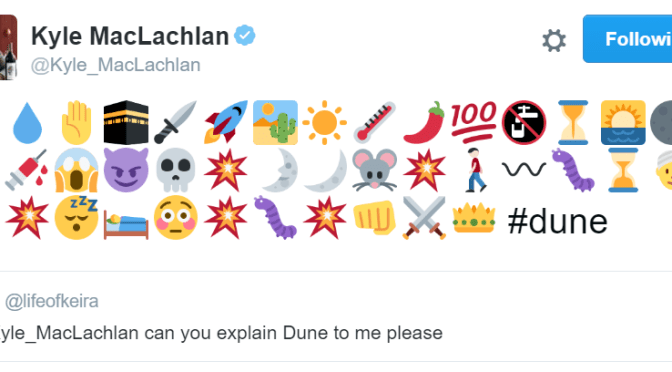
Finally, this happened:

Which is mostly a reminder to me that I should get back on track with my Dune readalong, but is also a reminder of how awesome Kyle MacLachlan is.

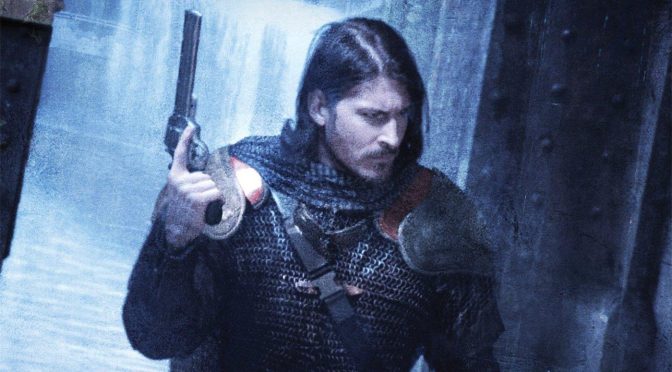
Book Review: The Ghoul King by Guy Haley

I didn’t hate Guy Haley’s first Dreaming Cities novella, The Emperor’s Railroad, though it wasn’t one of my favorite reads of the year so far. Nonetheless, I was intrigued enough to read this second installment of the series. The Ghoul King seemed to promise more action and a female character with something to do besides die for male character development, and I was hoping to see Haley dig a little deeper into some of the potentially very cool world building of his post-apocalyptic landscape. Sadly, I found myself disappointed on all counts with this book, and this is another series that I’m very unlikely to continue with.

Here’s the thing about these books: they’re fine. Haley has a handful of neat ideas, and a solid (if a bit hackneyed) premise. Quinn is a perfectly serviceable anti-ish-hero; the angels are theoretically compelling antagonists; and a post-apocalypse full of zombies and robot dragons marauding brigands and petty feudal-esque politics should offer plenty of minor conflicts and quests for an itinerant adventurer. Unfortunately, once you get past the initial observation of “huh, that’s cool,” there’s very little actually happening under the surface. Haley is great at window dressing, and the books’ appeal is helped along by sharp-looking covers, but when I finished both of these books I was just sort of like “is that it?”

Quinn is as inscrutable and laconic as ever in The Ghoul King, but he never manages to be in the least bit likeable or even interesting. Perhaps because of the choice to have the action narrated again from a point of view that isn’t Quinn’s, Quinn remains a bit of a cipher, as the first person narrator is never quite able to connect with him or get to know him on a personal level at all. Once again, Quinn is a sort of cowboy-ish character who rides into town, impresses the locals and rides away with his cloak of mystery intact. He’s a notably old-fashioned construct of stoic masculine heroism that just… isn’t fun to read about at all. Unless that’s your thing, in which case do you, but it’s not much fun for me.

There are a couple of female characters this time around, though only one, Rachel, plays a major role in the action. In fact, she’s the instigator of this novella’s adventure. Unfortunately, she’s also—through sheer ineptitude and ignorance—kind of the story’s main antagonist as well, and Rachel’s search for pre-apocalypse technology doesn’t end well for pretty much anyone. It’s an almost archetypal arc, with Rachel cast as a sort of Eve who lures men on a fruitless quest for knowledge that ends in tragedy and, ultimately, their expulsion from the seat of knowledge and into an uncertain future. On the one hand, there’s something almost mythologically epic going on. On the other hand, it doesn’t seem as if Haley has anything in particular to say with any of the mythology he’s crafting.

Certainly not every story has to be deep and insightful, and there’s something to be said for straightforward, uncomplicated adventure stories, but there still has to be something to engage the reader, make them care about the events they’re reading about, and keep them coming back for more. Without a likeable protagonist or any discernable message, and with the world building stalled out (there’s not much new information revealed in this volume at all, sadly) this series doesn’t do that for me.

This review is based on an advance copy of the book received through NetGalley.

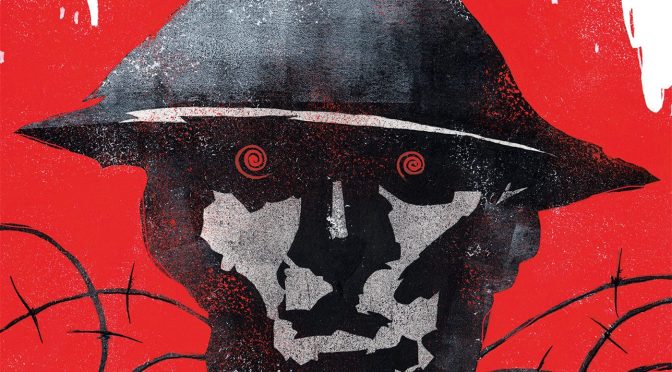
Book Review: Return of Souls by Andy Remic

I won’t be reading anything else by Andy Remic. I didn’t care for most of his first Tor.com novella, A Song for No Man’s Land, but it got interesting right at the end. Unfortunately, Return of Souls doesn’t deliver on what little promise its predecessor held. Instead, it doubles down on everything I didn’t like about the first book in this planned trilogy and adds a heaping dose of blatant misogyny that makes it a deeply unpleasant read.

Spoilers at the end, so beware.

Once again, we’re following Robert Jones through his time in World War I, only he’s come somewhat unhinged since the events of the first book and we’re now navigating his deteriorating mental state and his journeys through a sort of dark, war torn Wonderland, still pursued by the walriders that were introduced in A Song for No Man’s Land. Though all his friends died in the last book, this time around Robert is joined by a mysterious young woman named Orana who also seems to be running from the walriders. I’m sure that there are other things going on in this novella (I think I remember Bainbridge’s ghost showing up at least once), and I still get the feeling that Remic has some point that he’s trying to manfully make about war or something, but all of that is eclipsed by the sheer disgustingness of Robert’s relationship with Orana.

I mean, come on.

First off, Orana is barely even a character at all. Instead, she seems to be a sort of generalized embodiment of Remic’s ideals of womanhood, created to both tempt Robert and to motivate him to new acts of chivalrous heroism. Over and over again, Orana is described in infantilizing and fetishistic terms as childlike, naïve and in need of protection. When Robert and Orana finally have sex, even Robert feels as if he’s raping her, and indeed it’s difficult to understand exactly how this strange child-woman in need of rescue could be truly consenting. Either way, it’s gross to read.

But, wait! It gets worse. After about a hundred pages of detailing Robert’s creepily paternalistic relationship with Orana, the final revelation of the book is that Orana was a walrider all along and was, I guess, using Robert Jones to help her reach her home? Or maybe she was just tricking him deep into walrider territory? Or maybe Orana’s transformation really is just a misogynistic commentary on the inherent duplicitousness of women? I don’t even know, and it’s hard to care very much. Robert Jones is a highly unlikeable and, frankly, boring character, and honestly, by the time I got to the end of the book I was just ready for it to be over. Unfortunately, there’s no real ending here, just this major revelation and a sort of teaser for the trajectory of the final book in the trilogy, which I just don’t think I can bring myself to read.

I’d like to say that it’s not Return of Souls, it’s me, but I’m having a hard time even thinking of reasons why other people might enjoy this title. Its pace is slow, and its prose is only workmanlike. Its horror elements are sloppy, and its fantasy elements, drawn from real-world mythology, are poorly researched and badly implemented. Robert Jones is a character in turns profoundly dull and remarkably despicable, but he’s at no point enjoyable to read about. There’s no humor to speak of in the book, no spark of fun or joy to speak of; rather, it’s just unrelentingly dark and almost nihilistic in tone. But, hey, maybe that’s your thing. I won’t be back for more, though.

Weekend Links: August 14, 2016

RIP, Isabelle, you mean old broad.

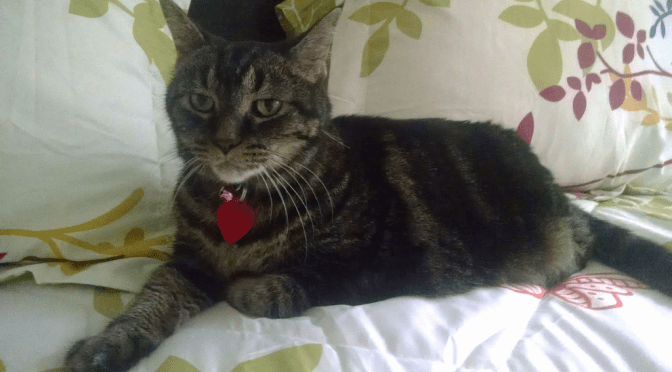
So, I am completely over 2016 already. In a year that has already been full of illness, stress, death, and grieving, this week added one more to the pile. Isabelle, the cat that we inherited from my partner’s late mother, passed away unexpectedly. In hindsight, I think she was probably sick–she’d been not eating very well for a couple of weeks, but I’d chalked it up to a change in her food and my daughter being out of town for a week–but two vets had looked at her and said she was healthy less than two months ago, so there’s really no telling what happened. She was mostly unfriendly and highly neurotic, she only really seemed to bond with my daughter, and we didn’t have her very long, but we loved her and we miss her.

I feel like most of this year (and part of last year, what with breaking my foot) has just been about me justifying why I haven’t accomplished things I intended to do or explaining away my lack of productivity, but come on. It really has been a fucking doozy. It’s like every time we return to some type of normalcy, another thing happens to derail things. So, it’s been a sad week, really. It started off okay, but quickly went straight to hell, and the last few days have been spent largely just feeling sad (and sore–turns out gravedigging is hard, even for a cat), reading (An Accident of Stars by Foz Meadows), and playing video games (No Man’s Sky).

Still, I did manage to find a few things of interest on the internet this week.

Uncanny Magazine‘s Year Three Kickstarter has just over two days left, and they’re well into stretch goal territory now. Sure, you can buy the issues later, but if you support it now, you’ll help ensure that each issue is extra-full of great fiction and essays.

Meanwhile, Ragnarok Publications’ just started a Kickstarter for Hath No Fury, a new anthology of stories with female protagonists:

https://www.kickstarter.com/projects/jmmartin/hath-no-fury-an-anthology-where-women-take-the-lea

Naomi Novik’s Uprooted is the winner of this year’s Mythopoeic Award.

William Gibson did a Q&A over at Gizmodo that is a reminder of why we all ought to read more William Gibson.

Sady Doyle’s piece on Suicide Squad encapsulates about 80% of why I’m in no hurry to go see it. (The other 20% is Jared Leto.)

Tor.com lists 10 SFF anthologies in translation from around the world.

Renay at Lady Business came up with this list of 60 essential sci-fi and fantasy reads, and it’s pretty much my favorite thing of the week.

Sarah Gailey’s essay “In Defense of Villainesses” is pretty great, too, though.

If you aren’t reading Marjorie Liu and Sana Takeda’s comic, Monstress, you ought to be. Then you should go read this profile of them over at the B&N Sci-fi and Fantasy Blog.

N.K. Jemisin’s The Obelisk Gate is probably my most-anticipated read of 2016, and it’s coming out in just a couple of days. Lit Hub takes a closer look at the radical sensibility that sets this series apart from so much other epic fantasy.

The Mary Sue asks if queer representation counts if it’s unconfirmed. Spoiler: Nope, not really.

Mythcreants has some tips for creating realistic cultures.

Finally, a new trailer for Rogue One dropped, and it looks amazing:

Book Review: The Jewel and Her Lapidary by Fran Wilde

I adored Fran Wilde’s debut novel, Updraft, so I was thrilled when I learned she had written one of Tor.com’s novellas. The Jewel and Her Lapidary was one of my most anticipated books for the first half of 2016, so imagine my surprise and dismay when I turned out to just not care for it very much.

Where Wilde excels, of course, is with world building, which was proven amply in Updraft and confirmed here. I loved the idea of the Jewels and Lapidaries in this novella, and I found the magic system Wilde describes interesting enough. And I liked the framing of the story as piece of folk history. Unfortunately, for all the fine world building on display, there’s just not a whole lot else going on here. I knew going in that this novella was somewhat on the shorter side, but there’s barely even a short story worth of actual story buried under all this world building, and it’s not that interesting of a story.

Instead of a proper novella, this feels like background work for a novel, which would be a much better use for such a complicated premise and would have given the characters, in particular, much more room to breathe. It’s hard to really get a sense of Lin and Sima and their relationship with such limited exposure to them, and most of what we learn about their friendship feels like an awful lot of telling rather than showing. For that matter, it’s unclear whether we should even consider their relationship a friendship or not, as the bond between Jewel and Lapidary is kind of weirdly symbiotic, not entirely consensual (they are assigned to each other in infancy), and has the Lapidary in a decidedly subordinate position. The thing is, none of the implications of this—which are all genuinely fascinating—are examined in the text, and instead Lin and Sima’s relationship is portrayed as somewhat simplistically sister-like.

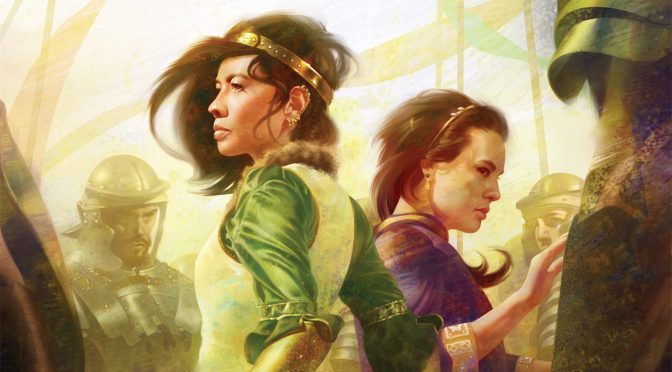
Worst of all, the story, such as it is, ends so abruptly that it feels unfinished and was certainly unsatisfying. While I don’t require a happy ending, the melancholy of this one was an unpleasant surprise; the vague cover art and the book description suggested something that was going to be much lighter in tone than what I got. Sure, one isn’t supposed to judge a book by its cover, but this one is misleading at first glance, and being an ebook reader I only really looked at the cover the one time. Things get fairly dark very quickly in this little book, and then they just end bittersweetly—with a distinct emphasis on the bitter part. Which would be fine if this story was part of some longer work to give it some context, but the framing device (much as I do like it) of it as folklore just isn’t quite enough to keep it from being rather unrelentingly and yet meaninglessly sad.

The Jewel and Her Lapidary isn’t the worst thing I’ve read this year, but it wasn’t great. There are the bones of a potentially great fantasy world here, but they’re wasted without a compelling story to bring them to life. I’m bummed by how little I liked this much-looked-forward-to book, but do I have to say that I’m definitely here for it if Wilde decides to revisit this universe in a longer format. In the meantime, I can always reread Updraft, and I’ve got Cloudbound to look forward to next month.

Weekend Links: August 7, 2016

This week has been more or less normal, which is nice. I haven’t been quite as productive as I’d like to have been, but I did manage to churn out reviews for a couple of movies I’ve seen recently, and I read all of the Saga trade paperbacks that I ordered a few weeks ago (how have I never checked out that comic before?). It’s also been nice enough to go outside a little, and I caught a few new Pokemon. Finally, I’m also working on quitting energy drinks and getting back in the habits of eating healthy and exercising that I was doing so well at before I broke my foot last year. This all kind of sucks because I love Red Bull and hate exercise and healthy eating, but the truth is that I do feel better and get more done when I take better care of myself.

It’s also been a somewhat slow week for me in internet-ing, mostly because of the reading and being out of doors, but I did find a few things of interest to share.

First of all, I know I shared it last week already, but if you haven’t read it yet Fireside Fiction’s Special Report on #BlackSpecFic is absolutely required reading.

As is Emma Newman’s guest post at The Mary Sue, where she talks about why feminism in fantasy is so important.

Also at the Mary Sue this week was a wonderful interview with author Becky Chambers, who is every bit as lovely as you would expect after reading her novel, The Long Way to a Small, Angry Planet.

N.K. Jemisin was interviewed for this month’s Clarkesworld, which has done nothing but whet my anticipation for The Obelisk Gate, the second book in her Broken Earth trilogy.

If you only listen to one thing from this week, be sure to check out Margaret Atwood on Midnight in Karachi.

Book Riot offered some much-deserved praise for antiheroines.

At Mythcreants, they picked apart six bad arguments against social justice in speculative fiction.

Fandom Following finally posted the third part of their breakdown of the rampant and virulent sexism in Game of Thrones’ sixth season.

There were two bits of GRRM news this week: first, the announcement of a special 20th anniversary edition of Game of Thrones, then the news that Wildcards has been optioned for television.


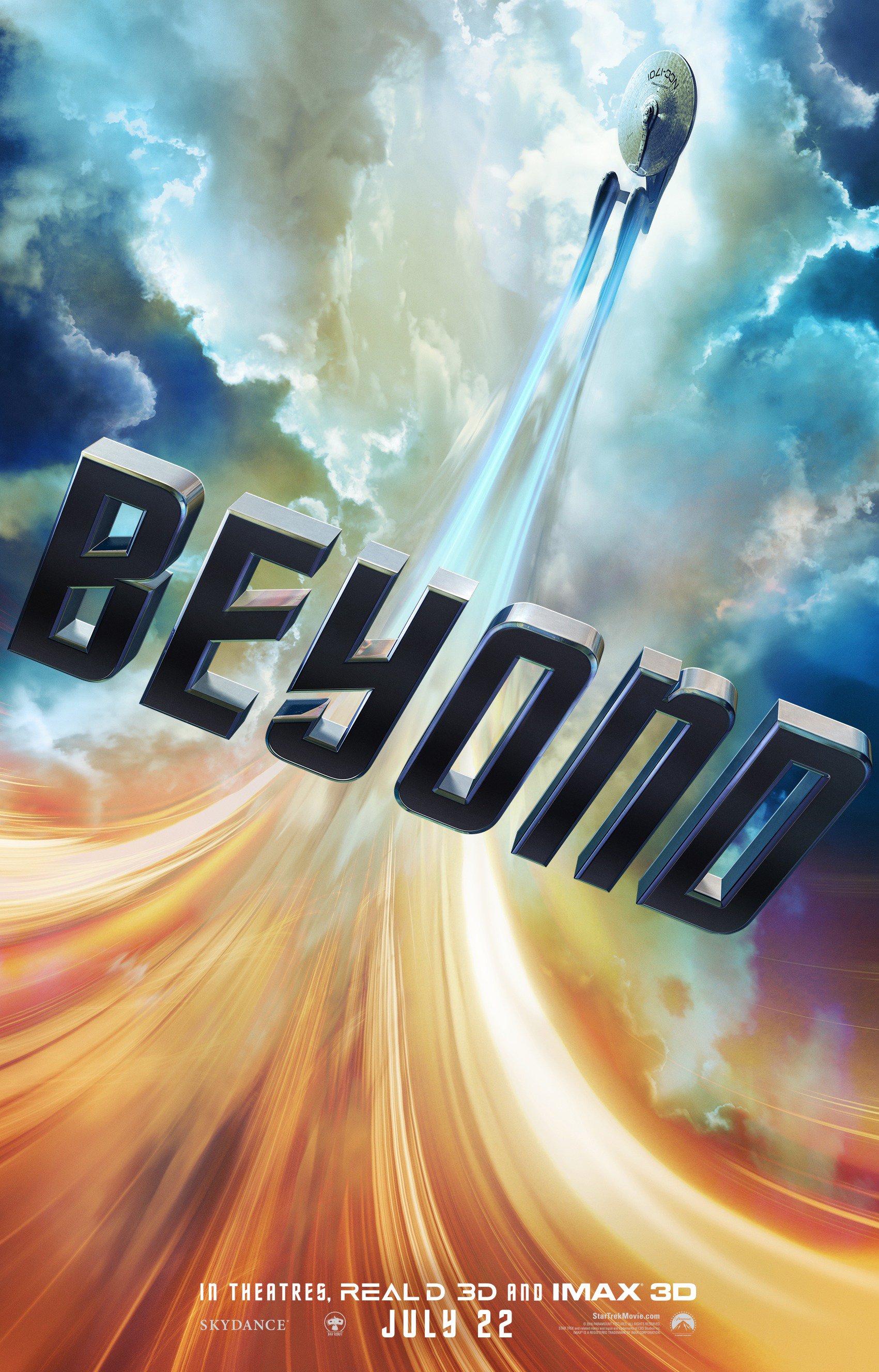
Movie Review – Star Trek: Beyond

Star Trek: Beyond is an interesting addition to the Star Trek universe. Of the new alternate timeline films, it’s certainly the most Trek-feeling of the bunch, and it’s the best at making use of its ensemble cast. Unfortunately, it’s still just not that great a movie, in spite of being great fun to watch.

Somewhat, but not totally, spoiler-y review ahead.

Beyond opens with the Enterprise already three and a half years into their famous five-year mission, which is somewhat disappointing to begin with. We get to see just the last bit of the crew’s most recent adventure before the movie dives right into James Kirk’s (Chris Pine) existential crisis. Apparently, after several years of being captain of a state-of-the-art spaceship where he’s responsible for a crew of hundreds, he’s now questioning whether he wants to be there at all, and the rest of the movie is basically about how Kirk gets his groove back. While the rest of the cast has a bit more to do in Beyond than in the last two Trek movies, Kirk’s dilemma—which isn’t whether or not to stay in Starfleet, but whether or not to take a promotion to admiral, which it’s frankly unclear how exactly he’s earned—makes up the central emotional arc of the film.

Sure, this is a thin and rather boring basis for getting the audience invested in the story, but it would have been fine if equal attention had been paid to some of the other characters who are also dealing with some life stuff. Spock (Zachary Quinto), in a touching tribute to the late Leonard Nimoy, is dealing with the in-universe death of his mentor, Ambassador Spock, and his relationship with Uhura (Zoe Saldana) is on the rocks, but most of this is explored through Spock’s conversations with McCoy (Karl Urban) and several short shots of Zachary Quinto looking sad. Yes, I cried more than once, because I’m not a monster, but those tears were only partly earned (I really loved Leonard Nimoy, okay?). Spock and Kirk barely interact at all in this film, and their lack of communication could indicate problems in their relationship as well, but their whole inability to be truly emotionally intimate with each other is hand-waved at the end of the film with what feels like a wink to the audience. Kirk and Spock might spend a whole movie with hardly a word to say to each other, and their lack of communication can be explicitly pointed out in conversations with other characters, but really we all know that there could never be any real trouble in that paradise. It’s a missed opportunity to add some depth and nuance to the Kirk/Spock friendship. Instead of examining these ideas further, they instead play the situation almost for laughs.

Much was made in the week or two before the film’s release of the revelation that Hikaru Sulu (John Cho) is gay in the reboot’s alternate universe, but it turns out to be much ado about, well, not nothing, but still not much. Ostensibly, the filmmakers were trying to raise the stakes by having Sulu’s husband and daughter on the Yorktown space station that the Enterprise crew spends most of the movie saving, but the revelation of Sulu’s partner and child happens quickly and without remark. There’s no scene to properly introduce us to Sulu’s family, and between our first sight of them and their reappearance at the end of the movie they are never once mentioned. I suppose the audience ought to be able to infer the personal significance the threat to Yorktown has for Sulu, but he gets a good amount to do in this movie. Would it have killed them to include some line, clichéd as it would be, to the effect of “My family is on that station!”? In a relatively high-paced action flick, it’s easy to lose these kind of subtler character beats in the shuffle of other things going on, and I’d rather have a slightly cliché line to highlight the point than see it get lost as I think Sulu’s story, tertiary as it is, does here.

One relationship that did work well in Beyond was the one between McCoy and Spock, but even that is somewhat overshadowed by the movie’s larger events. Still, there’s real humor and a friendly chemistry on display in the scenes shared by Urban and Quinto. Their adversarial affection is perfectly pitched and cleverly written, and both actors turn in nice performances. I wish the same could be said of Saldana and Cho as the similarly paired-off Uhura and Sulu. While that pair gets to participate in some theoretically important plot material, neither actor seems to really have their heart in it, and Cho’s performance in particular feels at times very wooden. The late Anton Yelchin’s performance as Chekov is little more than workmanlike, but it’s enough for the material he’s given. He’s paired off with Kirk for the parts of the movie that he’s actually visible in, and it’s not bad. It feels as if this movie was written very intentionally to shake up some of the character pairings in order to set it apart from the previous two movies and perhaps to give each character more time to shine, but I’d say this was done with mixed success at best.

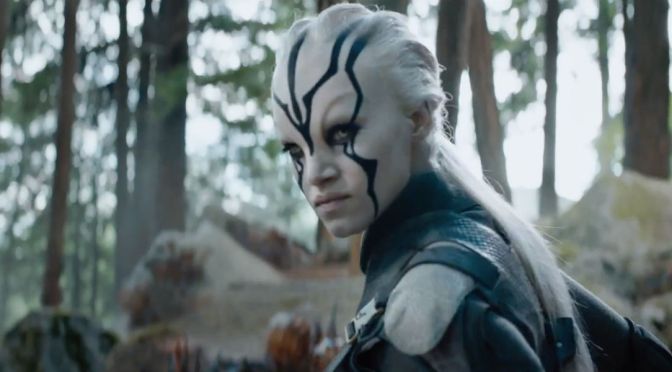
Co-writer Simon Pegg reprises his role as Scotty, and he finds himself paired with relative newcomer Sofia Boutella, who plays the cringeworthily named Jaylah, a young woman trying to escape from the planet the Enterprise crew finds themselves trapped on. I think the intent of all of Jaylah’s scenes with Scotty (and, later, Kirk) is to be sweet, but I found the overall effect to be creepily condescending, and Jaylah to be unusually and selectively naïve and childlike in a way that was consistently unpleasant. She does get a few badass moments, and the struggle to get Jaylah’s crashed ship “house” up and flying sets her up as a sort of engineering savant while also offering some moments of genuine comedy. On the bright side, Jaylah gets something like a character arc as the Enterprise crew hijacks her escape plan and forces her to help them get off the planet and stop the villain, and she even gets a truly happy ending, which was surprising. After the senseless killing of a couple of other new-to-this-installment female characters, I was fully expecting Jaylah to die tragically, so it was a pleasant surprise that by the end of the film her future is actually looking pretty bright.

Let’s talk about this villain, though. I love Idris Elba as much as the next red-blooded woman, but he’s a bit wasted in the role of Krall, who is one of the movie’s biggest problems. It’s not that Elba is a bad actor, and Krall definitely looks the part of a menacing Trek villain, but it’s never really clear exactly what Krall’s motivation is for wanting to commit such an enormous atrocity as killing a space station on the scale of Yorktown. Even when his supposed reasoning is revealed near the end of the movie, it’s not clear what his actual goal is. He’s an old soldier, and he misses war so he thinks a massive act of terrorism is going to turn back the clock on progress? Okay, but that doesn’t actually make much sense, and it doesn’t help that the revelation of Krall’s identity comes seemingly out of nowhere. In hindsight, I think I remember some hints at it throughout the movie, but the pacing is so frantic throughout that the eventual reveal feels blindsiding. It’s obvious that Krall is supposed to work as a sort of foil for Kirk, with both men experiencing doubt, unrest and disillusionment after years in Starfleet, but this isn’t explored enough to make one really care that much about it, and it’s resolved in the same pat fashion as every other conflict of the film.

On a more personal level, though, the biggest problem that I have with Beyond is that, though it does a much better job than the last couple of Trek efforts did at incorporating women characters into the story, women’s representation still kind of sucks. I already mentioned a couple of the issues I had with Jaylah, but to cap it all off she ends up damselled and has to be rescued by Kirk before they leave the planet, after which she is mostly absent until she shows up right at the end to be written out of the narrative. She does get a happy ending, as I stated earlier, but it feels much more like the tying up of a loose end than anything else—so they don’t have a repeat of uncomfortable questions like “Whatever happened to Carol Marcus?” Uhura doesn’t have to be rescued, but I loathe any time when a male character shows up unnecessarily to rescue a woman and it’s called out in the text. It’s not cute or funny, and it’s a simple aversion of the trope that is old and tired enough that it’s become its own trope. It’s 2016, and this is boring and lazy writing.

Also, and this is just sad, for all that Beyond has plenty of women, theoretically doing lots of stuff, it doesn’t pass the Bechdel test. And I get it; the Bechdel test isn’t the be all and end all of measuring the representation of women in film, but it’s honestly kind of impressive just how many women appear in Star Trek: Beyond without any of them actually interacting with each other. I’m not exaggerating when I say that I don’t recall any two female characters exchanging even one word together about anything. Even when Uhura is forced to watch another woman member of the crew get killed, I don’t think they talk to each other. Instead, Uhura only talks with Krall and watches helplessly as he murders the other woman.

This general lack of presence of women in the film is made worse by nearly all of the women characters being completely useless. They get a decent amount of screen time, and they’re all doing things, but none of the things they do seem to actually matter very much. Minor villainess Kalara manages to lure the Enterprise to Altamid, but she’s quickly disposed of. Uhura is desperately working with Sulu to escape their captivity or something, but I’m still not certain I really understand what she actually accomplishes. In the end, all of the captured crew members have to be rescued by Kirk and company. Jaylah has managed to survive alone on Altamid for years, and she’s gotten the radio working in her ship, but it takes Scotty to actually get the thing in the air and off the planet. And, ultimately, Krall is defeated by Kirk in true Trek tradition—in a bout of manly fisticuffs, just two men fighting a symbolic battle between good and evil, chaos and order, civilization and barbarism, progressive values and old hatreds—without a woman in sight.

Here’s the thing, though. I still kind of loved this movie. It was highly enjoyable and had some really excellent action sequences that made me happy to have shelled out for 3D. I was happy to see Shohreh Aghdashloo being typecast as a sci-fi woman of authority; she should be in everything ever, really. I adored the tribute paid to Leonard Nimoy, and I was never bored even when the film was at its most predictable. Of the new Trek films, this one certainly feels the most Trek-like, and that counts for a lot in my book as well. Realistically, I don’t think this (or any of the new Trek movies) will be something I want to watch again anytime soon, but I’m happy to have seen it once, and I recommend it equally for lovers of Star Trek and lovers of high-energy action adventure flicks. And do see it in 3D; Yorktown is worth it.
Movie Review: Ghostbusters (2016)

I loved Ghostbusters.

I rather expected to, to be honest, and I went prepared to enjoy it in spite of its flaws after the trailers for it were so widely criticized and there was so much negativity surrounding its mere existence. Still, when there is so much negativity and outright hatred surrounding a movie, it’s easy to lower one’s expectations.

Ghostbusters is really, really good.

That’s not to say that it’s a flawless film. Some of the humor misses its mark; Chris Hemsworth’s inept receptionist, Kevin, is very one-note; the villain (Neil Casey) is underdeveloped; and there are at least a couple of scenes that seem to have been included literally just because Kate McKinnon is hilarious. I mean, yeah, Kate McKinnon is a riot, but one oughtn’t to let her hijinks take over to the point where they cause pacing problems—and they do, a little. Still, Ghostbusters is exactly what it ought to be: a delightfully funny low-middle brow summer movie whose flaws are far outweighed by its positive aspects, which are practically legion.

By far my favorite thing about Ghostbusters is how it showcases the friendships between its four main characters. It’s refreshingly naturalistic the way these women come into each other’s lives, and it’s great to see a healthy, functional female friend group take center stage in a major summer movie. Kristen Wiig, Melissa McCarthy, Kate McKinnon and Leslie Jones have an easy chemistry together that really sells the evolution of the group as friends and colleagues and makes their interactions a pleasure to watch. Each woman has a distinct role to play, and all of them contribute significantly to the group. Best of all their group dynamic is totally free of anything resembling cattiness or jealousy. Sure, Abby (McCarthy) and Erin (Wiig) have a history that has to be resolved, but Erin and Jillian (McKinnon) are never competitive for Abby’s attention and when new friend Patty (Jones) joins the team she’s accepted quickly and immediately settles into the group as if she’s always been there.

Speaking of Patty, I was very concerned when the first trailer came out that she was going to be a sassy, street smart stereotype. Leslie Jones herself took to Twitter at the time to assure fans that this wasn’t the case, and she was right. Patty Tolan isn’t street smart; she’s book smart, a local historian whose vast knowledge of New York and excellent deductive skills are key to saving the city. That said, criticisms that a black woman is the only non-scientist in the group are reasonable, and while the racial makeup of the cast mirrors that of the original Ghostbusters I’d like to think we can do better than that over thirty years later. If anything, New York City has only gotten more diverse in that time, and with all the ongoing conversations about representation in media—Ghostbusters has itself been at the center of that because of the choice to reboot the franchise with an all-female cast—there are fewer excuses than ever to have a cast as white as this one. Do better, casting directors.

The actual story in Ghostbusters is pretty thin, which is firmly in the tradition of the franchise, but villain Rowan is an interesting choice. For most women and anyone tuned into feminist discourse, Rowan’s misogyny, pathological aggrievement, delusions of grandeur, and his simmering, rage-fueled sense of entitlement will all feel familiar. We have almost all met this man, and if we have we’ve definitely fantasized about how to vanquish him. Ghostbusters taps into that fantasy and provides a pleasant catharsis at the end, in spite of its very silly plot.

Fortunately, what the movie lacks in the storytelling department it more than makes up for in the sheer unadulterated fun department. All four leads fulfill their roles with joy and gusto. Kate McKinnon in particular brings a manic energy to the screen that is downright infectious. Cameos by most of the original cast are for the most part well-integrated, and there are some nicely done visual jokes and references to both the first and second Ghostbusters, though younger children and those unfamiliar with the older films may not catch all of them. While a couple of running gags in the film outstay their welcome, I (and everyone else in the theatre except for maybe one fedora-wearing dude) laughed constantly throughout the nearly two-hour runtime.

Ghostbusters isn’t a cinematic masterpiece by any means—though the special effects are top notch and masterfully walk the line between cartoonish and creepy; be sure to see it in 3D—but it’s a truly excellent summer movie that more than does justice to the original movie and smartly updates the material to entrance a new generation of children with its message that the power of friendship can conquer cynicism and hate. Also, ghosts.

Miscellaneous thoughts:

Charles Dance is an absolute treasure.

I wish they had made better use of the delightful Matt Walsh.

Gertrude the ghost is beautiful.

DO stay through the entire credits.

ghostbusters2016