All posts by SF Bluestocking

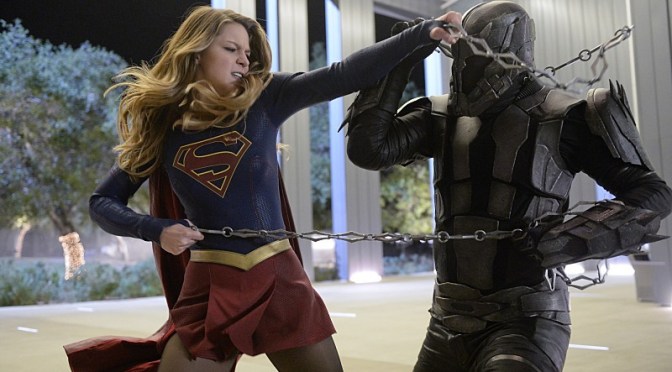
Supergirl: “Truth, Justice and the American Way” breaks into some bigger thematic ground

“Truth, Justice, and the American Way” isn’t a perfect episode, but it is on the excellent side for this series, mostly because it finally deals with some of the larger issues that are almost implicit in the premise of Supergirl. The ethical issues surrounding Supergirl’s work with the DEO and her own vigilante fighting for justice have been building all season, and things finally come to something of a head this week. Though the episode isn’t without some hiccups, it’s great to see it being more thematically ambitious.

First, though, the episode almost gets bogged down in HR issues. This week we find Kara back at the office, where she has to deal with some competition in the form of a second assistant that Cat has hired to take up some of the slack for Kara, who has been very flaky recently. I hate everything about this storyline so, so much. Yes, Kara has been flaky, and yes, she drove Cat’s son away, but it’s incredibly unprofessional for Cat to punish Kara like this, especially as publicly as she does here. I also despise that all of Kara’s relationships with women are so fraught, and it sucks that the show has introduced yet another woman for Kara to contend with.

Sure, Siobhan is aggressively unlikeable, but I even hate that framing of things. Siobhan is ambitious, and she is competitive with Kara, but this is a dynamic being fostered by Cat Grant, who is at her most petty and manipulative in her dealings with Kara this week—and all of these women are written that way. By the time you add in Lucy Lane, who is getting suspicious and jealous of her boyfriend’s relationship with Supergirl, CatCo has become a toxic mess for Kara to navigate in. Even outside of her day job, she’s dealing with her aunt Astra’s death, and she doesn’t even know yet that Alex is keeping a pretty big secret from her.

Admittedly, it’s not just Kara’s relationships with women that are on the rocks. She and Winn are still not talking much; she’s so angry with Hank over Astra that she is having trouble working with him; and James just gave her an ultimatum. However, in an ostensibly feminist show, it would be nice to see Kara able to have even one good, healthy relationship with another woman. Instead, the show’s writers seem determined to trot out every tired, catty, bitchy stereotype about women’s interpersonal relationships that they can fit into a single episode. This has been an ongoing problem for the show, but this week all of Kara’s relationships seem to be at nadirs, which makes the problem that much more pronounced and unpleasant to watch.

The real meat of “Truth, Justice, and the American Way” is, or ought to be if he didn’t have to share so much time with Kara’s office tribulations, the villain of the week. In an interesting change of pace, this week’s villain isn’t an inmate of Fort Rozz—he’s one of the guards, and he’s systematically hunting down and executing former inmates without regard to their present circumstances or even their original crimes and sentences. This is set up as a counterpoint to what Supergirl and the DEO are doing, and specifically to their indefinite detention of Maxwell Lord, who isn’t even an alien and probably ought to have some rights or something as an American citizen. Master Jailer is probably the best idea the show has had yet for a villain, but the execution of his story could definitely have been better.

As I already mentioned, this story—which deals with some of the show’s heavier ethical issues, namely the legality and, well, justice of extrajudicial justice—shares far too much time with material that doesn’t really fit together with it. The conclusions reached by the end of the hour feel almost glib, and Kara is portrayed as almost foolishly naïve rather than principled. The questions asked in the episode are worthwhile and certainly deeper than most of the other themes so far this season, but the answers just aren’t quite satisfactory. Still, it’s a step in a good direction for the show, and I would actually love to see this become a recurring theme to be examined in more depth in the future.

Miscellaneous thoughts:

  • Hated Kara’s astonishment that Cat could pronounce Siobhan. There’s not really any comparison between “Kara”—a name that can be mispronounced in many irritating and disrespectful ways—and “Siobhan”—which can only be mispronounced in ways that make the mispronouncer look ignorant.
  • This episode wasn’t terribly dark, really, but it was remarkably light on humor, which gave it a weird tone.
  • I was surprised that they went with a couple of straight up Gitmo references when talking about what Supergirl and the DEO do. It’s interesting to see what real-world things get worked into the show.
  • “It’s under the floor” was beyond words stupid. I mean, they didn’t even look for a cellar or anything first, and bad stuff is always underground. Get it together, Alex.


Lucifer: “Sweet Kicks” is a sour bore

Lucifer continues to disappoint, and “Sweet Kicks” is an almost entirely forgettable episode. I was moderately interested in this show before it first aired, even though I hadn’t read the comics, but after five episodes it’s only managed to be (mostly) inoffensively humdrum. There’s something to be said for a show playing its cards close to its chest, but there’s got to be something to keep people coming back week after week, and this show hasn’t really got it.

Tom Ellis’s charm has finally worn completely thin, and even his good humor wasn’t enough to elevate this episode to a bare minimum level of entertaining. Instead, Lucifer’s desire to “explore mortality” comes off as stupid, which is compounded when he proves himself essentially incapable of taking any responsibility for his own actions. Sure, I suppose the episode has something to say about his missing the forest of what it means to be mortal for the trees, but without any actual character growth, this isn’t particularly interesting.

Chloe is even more of a cold fish than usual this week, and spends nearly all her time on screen looking disapprovingly at Lucifer, accusing him of childishness (accurately), and devising petty and minor punishments for Lucifer’s irritating behaviors. It’s not cute or funny, though, and there’s no banter to their relationship. Lucifer is using her (although it was nice of him to not try and sleep with her this week), with no regard to how his presence might endanger her or jeopardize her career, and Chloe has a completely deadpan dislike for him that is the opposite of fun.

The character that I actually kind of liked best this week was Dan, who is somewhat useless in the narrative, but who is such a genuinely nice-seeming man that I can’t help but want good things to happen to him. While he doesn’t get a lot to do in terms of actually being part of the plot, he’s a piece of scenery in Chloe’s life that more or less works, and he’s one of the only characters who is consistently intelligent-seeming. I like that he seems to genuinely care about Chloe and isn’t afraid of Lucifer. That said, my bar for favorite character on this show is set pretty low at this point.

While Lucifer and Chloe are dealing with a deeply boring case of the week, Maze is meeting up with Amenadiel behind Lucifer’s back. Both of them want Lucifer to return to Hell, if for different reasons, so they’re going to plot together in order to get him to do what they want. These two are the only characters on the show who have any discernable sexual tension or chemistry, and they’re hands down more interesting to watch than anything Lucifer and Chloe get up to.

Honestly, I’m not sure how much longer I’m going to continue to cover this show. It’s not really good or bad enough for me to have any strong feelings about it one way or the other, and there’s plenty of other things I could be working on instead. Next week’s episode title suggests something more mythology-laden than what we’ve had so far, so I will decide then if I’m going to stick it out until the end of the season. With The X-Files finished with, I’m sure next week I’ll feel less overloaded, but I could always drop Lucifer and start writing about my deep and abiding hatred of Quentin Coldwater (The Magicians) instead.

Miscellaneous thoughts:

  • I don’t really “get” the sexy therapist character. Dr. Martin isn’t necessarily any specific misogynistic stereotype, but she seems more like a character from a crappy porno than a character who belongs in a prime time television show. Also, she doesn’t seem to exist for any particular purpose except to be funny, and she’s not.
  • Why did they have to kill the pig?
  • Maze is a legit badass, and I hate that she’s basically in an abusive relationship with Lucifer, who treats her like garbage. Tom Ellis isn’t nearly charming enough to make this okay.

The X-Files: “My Struggle II” is an epic disaster

I said right at the start of Season Ten that The X-Files is the same as it ever has been, and this continues to be basically true. “My Struggle II” is an hour-long roundup of all the show’s worst tendencies in one place, only without many of the show’s strengths to otherwise recommend it. The fact that it ends on a cliffhanger, with no assurance that it will ever be continued, is just the icing on the cake of overall mediocrity-to-badness that has been every episode of Season Ten except for “Mulder and Scully Meet the Were-Monster.”

Like “My Struggle,” “My Struggle II” is a mythology episode, wholly devoted to continuing the story that the earlier episode began. The thing is, these two episodes don’t tell a fully contained story at all. They don’t work as bookends for the season because there’s no actual ending here, but there’s also no real narrative symmetry, despite the use of a similar introduction to the episode, this time with a Scully voiceover. A better use of Scully’s voiceover would have been at the end of the episode to bring closure to the miniseries and the show in general, but of course this can’t have happened after a cliffhanger ending like what we got.

The worst part of “My Struggle II,” though, is that it just doesn’t make a lick of sense. The hour manages to feel at once overstuffed and devoid of story, a whole lot of sound and fury signifying nothing. Things happen, but they’re so absurd that it’s very difficult to suspend enough disbelief to even accept the basic premise. I could believe in the existence of a conspiracy, but the idea that a shadowy cabal of one percenters would somehow decide to just kill large swaths of humanity in the way that it’s show in The X-Files is just silly. Ultimately, it’s just fantastical, an episode of evil for evil’s sake, to be taken about as seriously as any cartoonish fantasy villain who wants to cover the whole world in darkness or some such nonsense.

Even the smaller events of the episode make little sense. Why are Miller and Einstein still hanging around? Why did the Cigarette Smoking Man save Reyes? Why use programmed diseases (that are usually vaccinated against) to kill people instead of programming in, say, cancer or some other illness that actually has a genetic component? What is the clear liquid Scully is administering to people? Why does Mulder need stem cells? And why does he need stem cells specifically from his and Scully’s son? Why is Tad O’Malley back after disappearing so completely back at the end of “My Struggle,” and why? There are so many questions, but almost no answers.

I was afraid that Season Ten would turn out this way—as a springboard for either more nostalgia-based programming or as a setup for a spin-off series, which seems highly possible at this point, with the return of Miller and Einstein in the finale. It was nice, in a way, to see something huge actually—finally—come of all the conspiracy theorizing the show has done over the last twenty-odd years, but now that the show has gone big, I wish it would go home.

Miscellaneous thoughts:

  • The reveal of the Cigarette Smoking Man’s face was pretty rad.

Book Review: Daughter of Destiny by Nicole Evelina

I’ve always found it a little sad that there isn’t more Arthurian literature written about Guinevere, so I was excited when I saw this self-pubbed title pop up on NetGalley and had high hopes that it would offer some new insight or a unique interpretation of the mythology. Unfortunately, Daughter of Destiny was mostly a let down on that score. It’s a fast, easy read, though entirely unexceptional, and while Nicole Evelina may have some historical background, her knowledge of, understanding of, and respect for Arthurian legend and literature is marginal at best. It’s not a bad novel, but it was definitely a disappointment as an Arthurian one.

The story starts off somewhat slowly, as 11-year-old Guinevere is sent to Avalon to train as a priestess, which feels like a page out of nearly every Arthurian retelling from Morgan’s point of view. Unlike most of those retellings, which often focus on Morgan’s relationships with the women she meets there, this first part of Guinevere’s story actually leaps over several years of her training in order to get straight into her senseless rivalry with Morgan and her relationship with, of all people, Aggrivane. I’m not sure which I find more upsetting: the conflation of Guinevere’s story with Morgan’s, the absurd twisting of the regular Arthurian timeline of events, or the general grossness of Guinevere’s relationship with Aggrivane (who is an adult man). It’s all completely unoriginal and establishes early on that the author doesn’t know or care much about the literary tradition she’s working within.

After graduating from priestess training, Guinevere doesn’t actually become a priestess. Instead, she’s sent back to her father, Leodgrance, who has become a Christian since the death of Guinevere’s mother. We’re told that Guinevere is extremely sad about her mother’s death, but the majority of Guinevere’s time in Northgallis deals with her relationship with her father. This does touch upon a common Arthurian theme—the conflict between the indigenous religions and traditions of Britain and the Christianity imported during the Roman occupation of the country—but in a very shallow manner. Rather than exploring these larger ideas, Evelina dwells on relationship drama, even contriving to have Aggrivane show up at Northgallis in order to create a situation that gets Guinevere sent away to the story’s next setting.

In Pellinor’s household, Guinevere meets Elaine (Pellinor’s daughter) and Isolde, both characters who usually have their own interesting roles to play in Arthurian legend. Here, though, Elaine is a quiet, strange girl in thrall to her domineering mother, Lyonesse, and obsessed with finding a man who she believes she is destined to marry. Isolde is the heir, in her own right apparently, to the throne of Ireland, but she’s kept practically as a servant in the household, where she spends her time sleeping around (as one does when one is a young princess in a time before birth control, I guess) and giving pages-long speeches of exposition to Guinevere. Guinevere and Isolde are supposed to be great friends, but the relationship isn’t very developed, and what passes for court intrigue is little more than mean girl antics.

The climax of the novel is a grand tournament held by Pellinor to entertain the new High King, Arthur, but there’s not much action to be had here. Guinevere again resumes her affair with Aggrivane, and they hope to marry, but instead Guinevere ends up promised to Arthur, who she has had almost no contact with whatsoever. She’s upset at first, but seems to be getting into the whole “being queen” thing by the end of the novel. Even Aggrivane doesn’t actually say anything in protest, even though he had been assured by his own father that marriage to Guinevere was a done deal. It ends up feeling like a betrayal of the whole book up to this point, with no foreshadowing or anything to prepare the reader for this. Obviously, as someone familiar with the story, I wasn’t surprised to have Guinevere paired off with Arthur—that’s a non-negotiable facet of the legend and was definitely going to happen by the end of the book—but it felt incredibly unearned here, as if the author expected it to be a shocking turn of events. Instead it just seemed silly and calls into question the purpose of the entire rest of the book.

There’s no particularly new ground covered in Daughter of Destiny. It borrows heavily from The Mists of Avalon and similar feminist interpretations of the Arthurian mythos, but without any real understanding of the things that make those stories compelling. Although she has some admirable (albeit generic) qualities, Guinevere is a passive character throughout her own story, with very little agency. Her singular rebellion (outside of her ill-advised relationship with Aggrivane) is to secretly continue her weapons training, which connects her to her dead mother and to her ancestral people, but this is never fully explored and is also never once relevant to the plot. Meanwhile, every major event in Guinevere’s life is determined by the men who control every aspect of her present and future.

[This review is based on a copy of the novel received through NetGalley.]

Book Review: ODY-C Volume 1 by Matt Fraction and Christian Ward

ODY-C is an ambitious, psychedelic epic fantasy that needs to be completely finished and printed into one enormous, beautiful book so I can just read it all in one sitting. It’s a futuristic, gender-bent retelling of The Odyssey, and it’s a great way of bringing an ancient story to life for a new generation of readers.

That said, ODY-C is not going to be for everyone. It definitely relies on the reader having some level of familiarity with the source material, for one thing. If you’ve never heard of Homer or The Odyssey, and don’t know at least some of the highlights of the story, you may feel somewhat at sea through much of this first volume. There’s no hand-holding here, and it’s very obvious that the reader is expected to either keep up or go spend some time on Wikipedia and then come back.

Even the language is a nod to the story’s origin. It’s written partly in a kind of sound-alike version of the dactylic hexameter that characterized much of the classical Greek epic poetry. I love this choice because it maintains some of the identity of the source material in the face of a lot of other more avant garde adaptational decisions, but it can sound clunky to modern readers. While I’m not an expert on the form to be either outraged or dismayed about the execution, I found the poetic language interesting, and it really helped to set the tone of the comic and give a fascinating classical flavor to the setting that makes it a little unique. Certainly, I’ve never seen anything quite like it.

Christian Ward’s art, of course, is stunning. It’s just page after page of gorgeous colors and textures, from brilliantly-rendered action scenes to grand space vistas. At the same time—and this is, I think, my favorite thing about ODY-C—while the overall look of the art shows a keen attention to detail (the yonic shapes of spacecraft are a nice touch in a universe that has been scrubbed almost entirely clean of men) and an eye for beauty, there seems to be remarkably little focus on making the book’s many, many women pretty. The women of ODY-C come in all shapes and sizes and colors, from the great warrior Odyssia to various goddesses and even a hideously rendered (in the best way) cyclops.

As with all comic books, my biggest complaint about ODY-C is that it’s not long enough, and I have to wait for more, which is even more frustrating since it seems to have a somewhat laissez-faire production schedule. I want more, and much sooner than I’m likely to get it.

Weekend Links: February 20, 2016

First things first. NASA’s new (FREE!) space travel posters are excellent, and I need them all, very large, to put on every wall of my apartment.

io9 covered the art of Santiago Perez earlier this week, and I wouldn’t mind having prints of that to cover the few square inches of wall space that I can’t cover with space travel posters.

This week’s Fanwankers podcast was all about Game of Thrones and is definitely worth a listen. There’s even a Book Snob Glossary to go along with it if you aren’t familiar with their terminology. I ugly-laughed more than once.

In other news, Ecto Cooler is coming back! Although I don’t think anyone under about thirty cares. My daughter looked at me as if I had two heads when I explained what it was.

Charlie Jane Anders is still promoting All the Birds in the Sky, and she did a Reddit AMA yesterday.

This week saw the release of probably my favorite Tor.com novella to date, Victor LaValle’s The Ballad of Black Tom, and LaValle has been making the rounds to promote the book:

POC Destroy Science Fiction managed to unlock all its stretch goals on Kickstarter, which is exciting. Editors Nalo Hopkinson and Kristine Ong Muslim were interviewed at SF Signal to talk about the project.

Nalo Hopkinson also joined Sunil Patel and Nisi Shawl to talk about POC Destroy SF at Geek’s Guide to the Galaxy this week.

Indrapramit Das has an excellent piece about writing global sci-fi over at Tor.com.

Black Girl Nerds is making the case for (and asking for help with) getting Amazon to give us a Black Sci-Fi, Fantasy, and Horror section.

At Tor.com, Foz Meadows explains that we can’t just adapt SFF books; we have to transform them.

The finalists for the 2015 Aurealis Awards have been decided.

SFWA announced that C.J. Cherryh is their 32nd Damon Knight Grand Master.

Finally, the 2015 Nebula Awards nominee list has been released.

SF Signal has the Nebula list with links to the fiction that can be read for free.

Book Review: Planetfall by Emma Newman

Planetfall is a brilliant portrait of a character and a community both in crises and a meditation on the ways in which the community and the individual are intertwined. It’s a gorgeously realized sci-fi mystery about a secret that festers in the heart of a seeming utopia and threatens to destroy it all.

Renata Ghali followed her dearest friend, Lee Suh-Mi, across the stars to a new planet in search of God, but what they found when they arrived on their new planet was, well, inconclusive. When Suh-Mi disappears, Renata and the rest of their colony have to figure out how to go on without her. Over twenty years later, Suh-Mi’s grandson shows up and starts uncovering the truth that Renata has helped to hide all this time.

Much of the praise I’ve seen for Planetfall has been for its narrator, and I can’t help but concur. Ren is a fascinating character with an unconventional point of view that makes hers a unique perspective to read a story from. She’s an older woman (a youthful seventy or so, in fact), a woman of color, queer, and significantly mentally ill, though the revelation of that last fact sort of creeps up on you as you read her story. The first person present tense narrative provides a nice sense of immediacy and immersion, which becomes increasingly important as the story moves along and Renata’s mental state deteriorates. Over the course of the novel, Ren becomes increasingly anxious and paranoid, then frantic as secrets start to be uncovered. It’s not always an easy thing to read, but it is absolutely riveting.

I only wish that there had been more actual science in Planetfall, although I think that’s more a sign that I’ve been in a mood for harder sci-fi recently than it is a sign that Emma Newman fails the reader in any particular way. Indeed, there are all kinds of interesting ideas on display here, from printing technology to sustainable living and social engineering. This book straddles the worlds of harder sci-fi and more human-focused sci-fi and does both justice, but I would have loved more explanation of how things worked, especially the space travel portion of the colony’s journey, which I felt was very glossed over. Realistically, it doesn’t matter and isn’t really pertinent to the story being told, which is likely why there’s not more detail about the ship and the journey, but I kind of love that stuff.

Finally, I would also have liked to see some of the themes surrounding religion and spirituality in an age of scientific and technological wonders be a little more fully developed. There are all kinds of ideas touched upon regarding the existence of God, the possible ultimate fruitlessness of humanity’s search for God, and even the ways in which faith makes people vulnerable—both to their own bad ideas and to exploitation in service of other people’s bad ideas. Ren is a great protagonist for asking questions and making observations about these things, as she’s a skeptic herself and her disconnectedness from her community makes her often a shrewd observer of people. However, her observations are thoroughly colored by her significant mental illness, making them increasingly unreliable over the course of the book even as more of Ren’s and the colony’s history is revealed, and the rather abrupt ending of the story is somewhat unsatisfying.

All in all, though, Planetfall is a great book. It’s got a lovely, almost meditative pace to it, and it’s an incredible character study of its narrator. As someone who also suffers from depression and anxiety, with a tendency towards reclusiveness, I found Ren incredibly relatable, and I can definitely see this being a book that I will return to in the future.

iZombie: “The Whopper” continues the show’s trend towards generalized excellence

Since returning from the winter break, iZombie has managed to really hit its stride. It’s always been a good show, but the last few weeks it seems to have settled into a comfortably consistent excellence that makes it a joy to watch, but not a whole lot of fun to write about since all I want to do is incoherently and excitedly flail about how much I’m loving the show right now. I haven’t liked iZombie this much since the second half of season one, and it seems to only be getting better.

There’s no Peyton this week, which is a bummer, but there’s really no space for her in this slightly convoluted episode and I’d rather do without her than have her shoehorned in when so much else is going on. Likewise absent are Vaughn and Gilda/Rita, but with so much Blaine and Boss drama happening I didn’t miss Max Rager drama.

Of course, it helps that all of the show’s villains are getting increasingly and more entertainingly intertwined every week. In “The Whopper,” Liv is investigating a murder that has occurred almost at the intersection of all the show’s various villainous schemes. Meanwhile, Blaine’s henchmen have captured Major, who let’s Blaine in on what the “Chaos Killer” is up to, though he doesn’t tell Blaine that he’s working for Vaughn Du Clark. While that’s going on, Stacey Boss is busy promoting Liv’s new boyfriend, Drake, from henchman to hitman.

It’s a solid episode, with a lot of laughs in spite of dealing with some fairly serious material and including a lot of setup for what is being built up to be a major three- or four-way conflict by the end of the season. All the show’s significant players—Liv and company, Blaine, Stacey Boss, Vaughn Du Clark, and the FBI—are getting steadily closer to figuring out how they’re all connected, and it’s obvious that shit is going to get real very soon. The only question is who is going to put all the pieces together first.

I can’t wait.

Miscellaneous thoughts:

  • I loved everything about the scene with the girl they brought in to identify that two-month-old corpse.
  • Blaine’s henchmen are the best. They have such a fun dynamic, and I could watch a whole show just about them.
  • I was glad to see Clive finally point out Liv’s dramatic personality shifts. It’s about time.
  • RIP New Hope.
  • This show has some of the greatest musical choices. That last number was perfect from start to finish.

The Shannara Chronicles: “Utopia” is WHAT THE FUCK DID I JUST WATCH?

The Shannara Chronicles is a wild fucking ride, folks. A couple of weeks ago I was ready to ragequit the show. Then last week the show seemed to be improving and getting back on track with the quest to get to Safehold and save the Ellcrys. I knew at least part of “Utopia” would be dedicated to rescuing Eretria, but I didn’t expect it to take the entire episode. And, you guys. I’m not sure I can even put into words what a complete disaster this episode was. There are all kinds of things I expected going into this series, and a few more things got added after I got a good look at the show, but “Utopia” is just mind-blowingly terrible on basically every level.

It starts off more or less how I expected it to, with Eretria being carted off by her evil ex-girlfriend and Wil and Amberle determined to find their friend, although I feel like “friend” is a very generous term for their relationship with the human girl. You know, what with all the subterfuge and thievery and betrayal and stuff. But, okay, they’re friends, and Wil and Amberle are going to find Eretria. But first, they’re going to almost bone, in a very boring and unsexy soft focus scene. Just in case anyone did manage to find Wil and Amberle’s tryst somewhat romantic, it’s interrupted, right when it’s heating up, by the worst possible development: the return of Cephalo.

Listen, I know that there was pretty much no way that Cephalo wasn’t coming back, and I even expected it to be something like this, but it would be nice to be pleasantly surprised once in a while. Sadly, nothing involving Cephalo in this episode is even remotely surprising. Amberle and Wil release him from the troll cage he’s caught in with minimal arguing about it, and Cephalo promptly tries to steal the elfstones again and bails on the party. He doesn’t try to rape anyone, which is good, I suppose, but he is given a completely unearned hero’s death and a touching parting scene where he tells Eretria that she’s “the best thing [he’s] ever done,” because apparently keeping a child as an actual slave and training her to be a thief/murderer and keeping her in line through abuse and by threatening to sell her to your terrifying friends is definitely something to be proud of. I mean, it’s not like Eretria was so desperate for anything resembling safety and love and basic kindness that she fell in with a weird cult this week or anything. Oh, wait. A+ parenting job, Cephalo.

Speaking of the weird cult! So, the elf hunters show up at a weird human settlement that looks less like a fantasy village and more like a hipster farming co-op, and it turns out that’s a pretty accurate description. Somehow, this little village, under the leadership of a guy named Tye, has managed to either save or rediscover quite a lot of pre-apocalypse human technology, everything from anesthetic to electric lights to Star Trek. This makes no sense at all and doesn’t seem to have any thematic purpose. It’s a tempting place for Eretria, but I think that any place where people are nice and she feels secure would be a temptation for her.

The way the citizens of Utopia almost worship the ancient technology is actually creepy, and though this weirdness foreshadows, I guess, the revelation that they sacrifice people to the nearby trolls, it also kind of breaks the fantasy setting. While the world of Shannara was always a post-apocalyptic fantasy world, it wasn’t revealed until much later in the books that it was actually our world, and the reason people didn’t know is because almost nothing survived of it after several thousand years. In the show, they seem to have shortened the timeline, and they’ve certainly been sure to use the detritus of our current world as a backdrop for the fantasy story they’re telling. This has mostly worked, and it’s been a good way for The Shannara Chronicles to set itself apart, visually, from other fantasy worlds. However, it’s definitely a situation where less is more—the dilapidated Space Needle is good for background and world building, but it’s nonsensical to spend most of an episode at a rave on a hipster commune.

It could have been worse, but not by much, and unfortunately this isn’t even so bad it’s good. While I did laugh, often and loudly, at “Utopia,” it was mocking, not mirthful. I will definitely be watching the final two episodes of the season, but I don’t think I’ll be coming back for season two if it happens. I really wanted to like this show, and I think I’ve been a good sport about it and very willing to overlook some of its flaws because it’s nice to look at and a nice break from the darker fantasy fare that is more common these days. “Utopia” is so awful that I want to take back everything nice I ever said about the show, and I’m frankly embarrassed to have defended and recommended it to people.

Whoops.

Miscellaneous thoughts:

  • Apparently Bandon is the next druid.
  • Ander decides that maybe he wants to be King after all.
  • This show should spend less money on cream colored dresses from Anthropologie and more money on making their trolls. Having them dressed in rags and gas masks is lazy and cheap.
  • Why is Eretria’s ex-girlfriend killed? Yeah, she wasn’t a nice person, but that seemed kind of random and unnecessary since she’d already been safely written out of things after she sold Eretria to the hipster cult. She wasn’t even a loose end at that point, so there was no reason to revisit her at all, which makes her death truly gratuitous.

The X-Files: “Babylon” is a confused mess only salvaged by some great Scully/Mulder stuff

“Babylon” almost works, but gets bogged down in its own self-importance. It’s got a message of some kind, about terrorism and faith and the cyclical nature of the universe or something, but it’s senselessly garbled by mixed messaging.

The episode opens with a too-long sequence of a young Muslim man praying, being harassed by rednecks, meeting a friend, and then walking into an art gallery right before the place explodes. We later learn that the two men were suicide bombers who decided to attack the gallery because it was displaying art that they considered sacrilegious. Here’s the thing, though. That revelation feels almost like a betrayal by the time it comes. The first young man, Shiraz, is definitely humanized in the episode’s prologue, and that introduction that heavily suggests to the viewer that we’re about to get a very different story than what is delivered. Furthermore, there’s such a slyness to the way these scenes are filmed that there’s no way this misdirection is unintentional.

Unfortunately, this humanization of Shiraz doesn’t actually work the way I think it’s intended to, even taking into account his mother, Noora’s, insistence that Shiraz never detonated his bomb. Instead, it serves to make the act of terrorism feel even more cold and calculated than if Shiraz had been shown more stereotypically, and it’s not entirely redeemed by the fact that Shiraz is able to mystically—by way of Mulder’s symbolism-laden trip—give the FBI intelligence that helps them root out the rest of the terror cell. In the greater context of the episode, the introductory scenes meant to show us Shiraz as a person turn out to not actually give us very much information about him at all, and in light of his participation in a suicide attack, the veneer of normalcy we’re shown turns out to be very thin.

Even the nods to the hatred and discrimination faced by American Muslims don’t really land properly. The truck full of rednecks mocking Shiraz in the episode opening isn’t specific or unpleasant enough to act as a motive for Shiraz to decide to participate in a suicide bombing. Although many American Muslims deal with that kind of casual hatred and racism daily, it’s shown here as a singular occurrence and not as a very serious event. The idea of anti-Muslim bigotry is supported later in the episode by the ravings of the racist nurse who literally tries to murder Shiraz by turning off his life support, but even this is portrayed more as the aberrant, irrational behavior of an individual rather than a systematic problem that has serious negative impact on the day to day lives of millions of people. Every other character in the episode is shown as at least somewhat sympathetic towards Shiraz—at least recognizing what happened to him as a tragedy—and just genuinely concerned about stopping terrorism, which of course is a laudable goal, but it sets up a self-serving dichotomy where any white viewer who manages to go through life without actively trying to murder or harass Muslims can identify with the “good guys” and feel a little self-righteous about not being one of those bigots who are shown as a minority.

And, frankly, none of this even matters that much, since Shiraz and his terrorist friends aren’t motivated by some high-minded anti-racist ideals. It’s explicitly stated in the episode that this terrorist attack was directly in response to the art gallery displaying sacrilegious art. By removing any guesswork or speculation regarding the terrorists’ motive, the show actually cuts itself off from the avenue it seems to be trying to take by highlighting the unreasonably bigotry of some white Americans as a counterpoint to the unreasonable actions of Shiraz’s terror cell. I get where they were going with these ideas, but the execution is just off, especially when these themes have to share space and time with Mulder and Scully and their respective journeys.

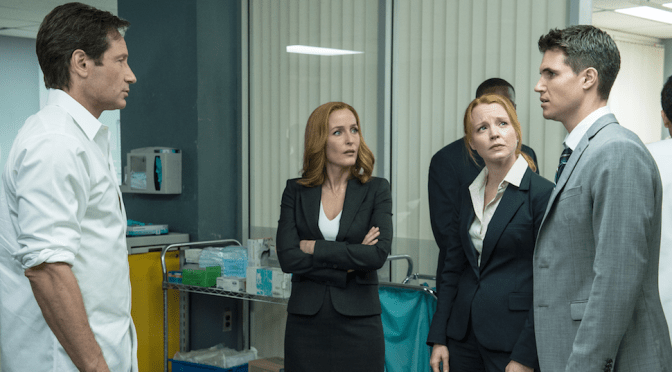
This week, Mulder and Scully are joined by a pair of doppelgangers, Agents Miller and Einstein, who were moderately amusing in scene released in a preview clip last week but who otherwise drag the episode down. Miller is young, handsome, and enthusiastic, but he seems slightly stupid and doesn’t actually have much to do in the episode. Einstein makes more of an impression, but this is mostly because she’s so entirely humorless that it’s actually kind of impressive. While this pair is supposed to be younger versions of Mulder and Scully, I don’t remember Mulder ever being so credulous or Scully ever being so dour. I guess there’s some kind of joke here, but it stopped being funny, or even very entertaining, very early on.

The saving grace of the episode is Mulder and Scully themselves. Looking back on my decades-long love for this show, I have to admit that it’s mostly because of these characters, who are far more memorable than any of the various cases or plots they’ve been involved in. Like the previous nine seasons of The X-Files, Season Ten functions best as a character study, and as with the first four episodes, the best moments of “Babylon” are when Mulder and Scully are together, from Scully’s cheerful “Only the FBI’s most unwanted!” to their final scene of the episode as the hold hands and talk outside the house they once shared. All the years of will-they-or-won’t-they waffling in their relationship has finally matured into a deep, if somewhat ambiguous, intimacy, and their comfort with and love for each other is really beautiful to see. The show might struggle in every other area, but not in this most important one.