All posts by SF Bluestocking

Lucifer: “Manly Whatnots” is a string of missed opportunities

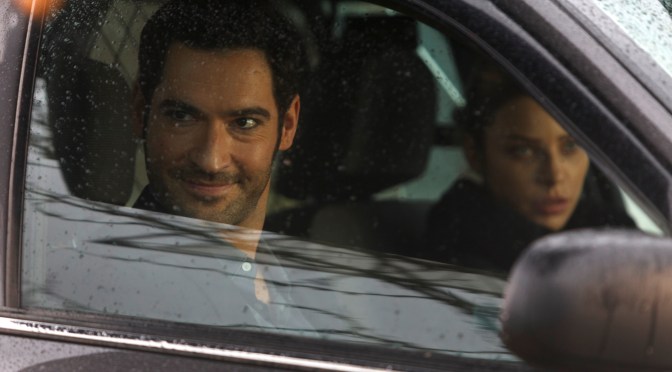
We’re now four episodes into Lucifer, and this show just can’t seem to manage anything better than mediocrity. Sure, it’s entertaining, but I can’t help but feel as if every episode so far has missed opportunities for adding some real depth and nuance to the characters and substance to the show. The ridiculously titled “Manly Whatnots” is the most frustrating episode yet on this score.

The case of the week involves the disappearance and supposed murder of a young woman who has gotten involved with a pickup artist guru, which is a great way to get Lucifer involved with a pickup artist guru, which ought to have made for an amazing and thematically resonant episode. Unfortunately, rather than exploring the issues of consent, coercion, abuse, rape and/or stalking this setup perfectly lends itself to, the show decides to play pretty much the whole thing for laughs and only examine a couple of these themes in the shallowest possible fashion. It’s honestly kind of unbelievable just how much the show missed the boat with this one when it should have been an easy slam dunk to tie things together and provide Lucifer with some interesting things to think about regarding his behavior towards Chloe (which is atrocious this week, by the way).

Lucifer’s denseness (the character’s and the show’s, frankly) is incredibly disappointing, and both character and show seem incapable of taking themselves very seriously. Here, the show even goes out of its way to identify the parallels between what Lucifer does and pickup guru Carver’s cult of toxic masculinity and misogynistic exploitation, only to pull all punches at the end of the episode and entirely sidestep any critical examination of Lucifer’s behavior. This might have worked better if the case itself were compelling enough to carry the episode, but there’s really not much going on here and the mystery, well, isn’t much of one.

Furthermore, the reveal of what really happened to Lindsay goes from groan-worthy to cringe-inducing as Lucifer turns on her when he learns about her revenge scheme against Carver, who it turns out was sexually predatory towards Lindsay several years before, wrote about it in his book, and didn’t even remember her name or face, which is why she was able to successfully trick him now. On the one hand, this could be intended to show that Lucifer has a very real character flaw—he believes himself to be the ultimate arbiter of justice and meting out appropriate punishments, but he’s not infallible. Here, even though I tend to agree with him that Carver probably doesn’t deserve to be actually murdered, his fury at Lindsay—who Carver violated and left deeply hurt and damaged by the experience—seems disproportionate. However, this show isn’t that subtle and doesn’t seem capable of handling that sort of nuance. Rather, Lucifer’s anger at Lindsay is portrayed as righteous and works to further elevate him in the narrative as a voice of reason and as the arbiter of justice he seems to see himself as.

It’s a missed opportunity at best and a piece of gross sexism at worst, since Lucifer’s character is established at Lindsay’s expense and to Carver’s benefit—even though Lindsay was treated poorly by the misogynistic Carver and Carver’s reformation is recent, conditional, and selective. He says that he’s fallen in love with Lindsay, but he literally can’t remember her name or face in spite of having taken her virginity. And he continues to profit off of selling his particular brand of aggressive rape culture to other men. So, yeah, sure, he doesn’t deserve to die, but Lindsay and her brother don’t seem to have intended to kill him. They just wanted to extort a ransom from him and break his heart, probably. In any case, the whole saga could have been a much more interesting critique of toxic masculinity and a compelling examination of this facet of Lucifer’s human-ish persona. Instead, it turns into a sort of mealy mouthed morality play that doesn’t have much to say about anything at all.

There are some strides made this week with Chloe’s continued disbelief of Lucifer’s claims about being the Lord of Hell. She’s not quite bought his story yet, but the best scenes of the night were regarding this story, and we learn that perhaps part of the reason Chloe isn’t susceptible to Lucifer’s “charms” is because she doesn’t actually believe in Hell at all, even if she’s not a complete atheist. In another scene, Chloe gets to see the terrible scars on Lucifer’s back where his wings were cut off, and it’s clear that this challenges her understanding, but it’s still not enough to convince her. Unfortunately, Lucifer’s final plan to prove his imperviousness by having her shoot him doesn’t turn out the way he hopes, but we’ll have to wait til next week to find out what happens next.

It’s nice to see the show relying somewhat less on Tom Ellis’s pretty face to carry the whole thing, but even as his charm begins to feel strained and the good humor seems increasingly forced, the writers haven’t managed to inject the show with anything more substantial. This episode totally squanders a promising concept without even scratching the surface of its potential, and with nearly a third of the season gone this doesn’t give me much hope for improvement in the coming weeks.

Miscellaneous thoughts:

  • Who else is totally shipping Maze and Amenadiel after this episode?
  • I’m not sure if Lucifer presenting himself nude to Chloe is just a completely gross act of sexual harassment or if it’s redeemed by the fact that Lucifer is never actually sexually menacing. Also, this is the first time in the show that they’ve managed to have anything even resembling sexual tension between these two characters.
  • Lucifer is a total dick to Dr. Martin this week, and it’s not funny or endearing in any way.
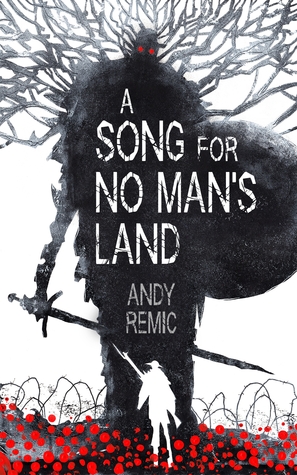
Book Review: A Song for No Man’s Land by Andy Remic

A Song for No Man’s Land is a dull, depressing slog of a novella that never seems to figure out what it wants to say. For all of its short length, it seems to drag on interminably before finally sputtering to a stop right when things seemed to almost start to get interesting. It is the first book in a series of at least three, so perhaps that can be forgiven, but I’m not sure I care enough about Robert Jones to want to come back for more.
The story alternates fairly rhythmically between Robert’s time as a soldier during World War I and his childhood in rural Wales, but neither setting is particularly compelling. Robert’s time in the war is characterized by pretty run-of-the-mill WWI imagery and tropes while the flashbacks to his youth are mostly concerned with introducing the story’s mystical elements. However, the use of Scandinavian mythology (the hulder) seems out of place in a story about a Welshman as well as in a story about WWI. I’m not averse to the idea of forest spirits being upset or angry at the destruction of war (that would be very Princess Mononoke), but it seems an odd choice to co-opt the forest spirits of a neutral country where there was no actual fighting during the war. Alternatively, the forest spirits could be a reference to some similar German creatures, but that still doesn’t explain what they would be doing hanging around in Wales while Robert Jones was a kid.

The other characters introduced never manage to come truly alive, though Bainbridge comes closest. Instead, they’re all simply passing through, and they don’t even seem to have much impact on Robert, much less on the reader. Even Robert’s supposed friend, George, appears abruptly in the final quarter of the book only to come to a senselessly tragic end that left me wondering why he was introduced at all. The only women mentioned are either decidedly subservient figures (mothers, a sister, a nurse) who exist only to coo over or fuck the men in the story—well, mostly just Robert—or they are the demonically horrific Skogsrå that has apparently been menacing Robert Jones since he was a little boy.

The horror elements of A Song for No Man’s Land are sadly underdeveloped. The abovementioned appropriated mythology is made regrettably generic, and the monsters themselves are left largely to the reader’s imagination. I believe that Andy Remic was trying to rely on building a horrific atmosphere and crafting a feeling of terror through language, but his workmanlike prose is just not up to the task. Furthermore, the decision to replace vulgarities with “______” is described in an introductory note as a hat tip to the time of the book’s setting, but it comes off as coy, distracting, and frankly confusing as it’s often not clear what the censored term ought to be. This choice might have made sense if the overall tone of the writing was made to feel antiquated, but in a book that is otherwise modern in its style it just feels like an on the nose anachronism.

One of the reasons I read all of Tor.com’s novellas is because doing so encourages me to read outside my comfort zone and try new things that I wouldn’t normally pick up. Often, this has paid off big time; it’s been nice to discover several new authors to follow, and it’s interesting to read stuff that isn’t my usual cup of tea. Unfortunately, this time it just didn’t work out that way. A Song for No Man’s Land might be a great story for the right reader, but I just couldn’t like it.

Weekend Links: February 13, 2016

This week’s link post is late because I spent a good deal of the day going to a play, Lauren Gunderson‘s The Revolutionists at Cincinnati’s Playhouse in the Park. It’s incredible, and it’s here until March 6, so if you are in or near Cincinnati in the next three weeks, I highly recommend trying to get tickets.

Tomorrow is Valentine’s Day, if that’s a thing you’re into. The Barnes & Noble Sci-Fi and Fantasy Blog has a decent list of 11 Stories of Truly Science Fictional Romance that has more than just the usual suspects on it.

I just discovered Miike Snow’s music video for “Ghengis Khan,” which is a delightful little romance in just four minutes:

If you’re a Parks and Recreation fan, you probably know that February 13th is Galentine’s Day, which makes it a great day to read this Bitch Media post on Rat Queens and the Power of Female Friendship and then check out their whole Alphabet of Graphic Novels by Women.

It’s been a big week over at Women in Science Fiction. They’ve got a new Women in Fantasy Story Bundle available, and a new anthology, Women of Futures Past, that just became available for preorder.

Also available for preorder is Kameron Hurley’s The Stars Are Legion, which just had a cover reveal over at io9.

Tor.com has collected the cover art for all of their spring and summer titles for 2016.

Lightspeed’s POC Destroy SF! Kickstarter has just 6 days left, and they’re still just a little shy of unlocking POC Destroy Fantasy. The Destroy SF project has been excellent from its inception a couple of years ago, and I have every reason to expect this year’s issues will continue that tradition.

Awards season continues to chug along, with shortlists and recommended reading popping up all over.

The British Science Fiction Association posted their shortlist last weekend.

Apex Magazine has a list, with links, of all their award-eligible fiction from 2015.

The Philip K. Dick Awards nominees have been revealed, and you can sign up at their website for a chance to win copies of all of them.

Rocket Stack Rank is a nice resource if you’re looking for short fiction to nominate for this year’s Hugo Awards.

The finalists for the 30th Annual Asimov’s Readers’ Awards can be found listed–with links!–over at SF Signal.

In other free fiction news, there’s a brand spanking new (and quite sharp-looking) site for perusing the works of H.P. Lovecraft.

I’ve been meaning to read some Lois McMaster Bujold for a couple of years now, so I may be putting this “Where to Start with Lois McMaster Bujold’s Vorkosigan Saga” post to good use sometime soonish.

At Ars Technica, Nick Farmer talks about the Belter language he created for SyFy’s The Expanse.

The Book Smugglers have a great guest post from Foz Meadows about her new novella, Coral Bones, and being genderqueer.

It looks like Bryan Fuller is going to be show running CBS’s new Star Trek project.

The Wertzone has a pretty comprehensive list of all the genre adaptations currently in development for film and television.

There are a bunch of new Game of Thrones Pop! Vinyls coming soon, but I only care about Melisandre and Margaery.


Movie Review: Pride and Prejudice and Zombies

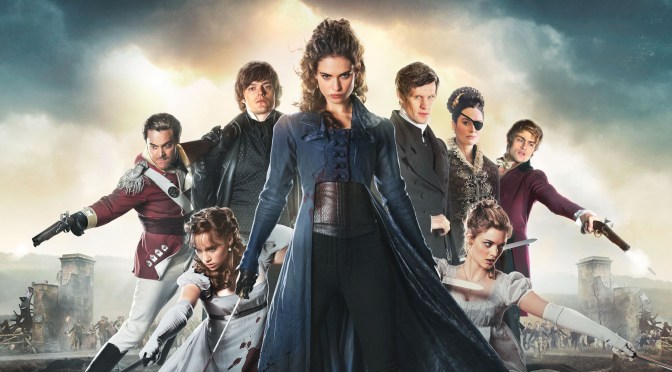
I kind of loved this stupid movie, though I think it’s more for what it could have been than for any of the things it actually was. And unfortunately, one thing Pride and Prejudice and Zombies isn’t is good. It’s not terrible, however, and it is fun, more or less. Mostly, though, P&P&Z is an overstuffed mess of mismatched tropes, frantic pacing, and bizarre tonal shifts as it tries to be far too many things at once.

As a zombie flick, well, this one is sadly hindered by a PG-13 rating. However, P&P&Z still manages to show a surprising amount of halfway decently produced gore. The prologue scene shows us some zombies right away, and I appreciate not having to wait for any big reveal on that score. There are even some interesting ideas here regarding the zombies, and the existence of sentient zombies who don’t eat humans is a potentially compelling concept that is largely squandered by having characters essentially laugh the idea off. The moral dilemma that the sentient zombies should create is pretty much ignored, although there is some kind of hand-waving excuse-making done by vaguely tying the sentient zombies to the four horsemen of the apocalypse, who exist in the narrative for just this singular purpose.

The four horseman are only one of many potentially fascinating mythological ideas that are wasted in this movie. The opening credits detail a lengthy, detailed, and highly entertaining alternate history of an England that colonized the New World and brought back a plague that eventually caused King George to go mad and build a hundred foot wall around the whole city of London. The idea of the zombie disease as a sort of cosmic punishment for the sins of imperialism is reasonably original, and tying that to religion and framing it as the end times with the four horsemen and everything would be plenty good enough to carry a Regency-era zombie film on its own. The zombie cult with their pig brain communion and the conflict between zombie fighters and zombie sympathizers adds an element of moral complexity to the story that deserved to be more fully explored. Unfortunately, there’s just no time here, with such an enormous amount of story to get through.

The reason there’s so much story to get through, of course, is because this zombie movie is also trying to be an adaptation of Pride and Prejudice. The thing is, there’s a reason why the gold standard adaptation of this material is a six-hour mini-series. There’s an enormous amount of story happening in Jane Austen’s novel, and even the 2005 film—which, while a solid adaptation, was widely criticized for omitting parts of the source material—clocks in at twenty-two minutes longer than P&P&Z. With all the zombie material thrown in, P&P&Z moves at a simply blazing pace, and it becomes increasingly convoluted and disjointed as it goes along.

Eventually, it just feels as if the P&P elements are simply strewn throughout the film randomly. Things keep happening that are kind of like the book, but they never seem to mean anything, and even major plot points and emotional beats feel slightly nonsensical. For example, when Lady Catherine (Lena Headey, just making Cersei Lannister faces) comes to confront Elizabeth about her relationship with Darcy, it’s just a thing that occurs that has no real effect even on Elizabeth. Later on, Darcy says something like the “it taught me to hope” line that usually refers to his having learned from Lady Catherine of Elizabeth’s refusal to promise not to marry him, but when he says it here, he’s referring to something completely different.

Similarly, early in the movie, Elizabeth’s Aunt Phillips mentions that they have to plan their trip to the north or whatever, but then the trip—which in the book is a significant event—never happens. Also, Aunt Phillips isn’t even the right aunt—Elizabeth travels to Derbyshire with the Gardiners in the novel. The whole movie just betrays a disrespect for the source material and its fans that is, frankly, infuriating. P&P&Z feels as if it was conceived and written by someone who read the Cliff’s Notes for Pride and Prejudice once, begrudgingly, in ninth grade, and didn’t understand (or care to even try to understand) any of the things that made it a great novel and have turned it into a perennially popular and beloved pop cultural artifact.

I didn’t expect P&P&Z to be a good movie, so I can’t claim to be disappointed upon learning that it isn’t, but I did expect it to deliver a bit more in the fun department than it did. Certainly there’s the enjoyment of watching something with good production values, a great cast, and pretty costumes, but the whole thing was just too gloomy and over-serious to be truly fun. Most of the humor was unintentional, and there was overall too much grit and grime and not enough gore to generate the kind of visceral pleasure a good zombie-killing flick can. P&P&Z contains a lot of the pieces to a marginally acceptable adaptation of Pride and Prejudice, an okay action flick, and dark and morally complex zombie film, but not enough to do any of those things justice.

Miscellaneous thoughts:

  • Darcy’s grave flies were neat, but in a movie that is so overfull of things happening, there’s not really time to appreciate that kind of detail. While they appear more than once, the flies end up being just one of many superfluous flourishes that uses up screen time that could have been better spent on something else.
  • P&P&Z’s action scenes are nicely done, if a bit rushed. I was pleasantly surprised by how well Lily James did as an action heroine, having previously seen her playing waifish princess-y types on Downton Abbey and in Cinderella.
  • On one level, I like the repeated allusions made to a previous Mr. Darcy by having Sam Riley wearing billowy white shirts. Tragically, though, he never does go full Firth for us.
  • They did do a nice job of showing the sisterly relationship between Elizabeth and Jane, and I kind of loved when they got to rescue their men as a sort of bonus on their way to a totally different objective. Too bad about Charlotte, though. Lydia suffers similarly from lack of characterization, and it’s even worse in her case because there’s not much reason to be invested in Jane and Elizabeth’s rescue mission at the end since we haven’t actually gotten to know Lydia well enough to care.
  • I would love to see Matt Smith play Mr. Collins again in a more serious adaptation. I’ve always imagined Collins as a small, slightly weaselly fellow, but Matt Smith’s tall scarecrow of a Collins was a bit of a revelation. It’s only too bad that he was reduced to comic relief in a movie that otherwise took itself far too seriously.
  • I know this all reads like a laundry list of complaints, but I’d be lying if I said I wasn’t going to watch this like twenty-five times when it hits Netflix.

Book Review: Bitch Planet, Volume 1, Extraordinary Machine

I can’t believe I waited so long to read this comic. Like, I’m truly appalled at myself, and now that I’ve read the first five issues, I can’t even remember why I hadn’t been that interested. Bitch Planet is a gorgeously drawn, tightly plotted feminist masterpiece that should be required reading for women everywhere. It’s also brutal and heartwrenching and more than a little uncomfortably close to the truth of many women’s experiences.
The first issue is a shocking bait and switch that sets up the rest of the story, which deals with a group of women judged “non-compliant” and sent to an off-world “Auxiliary Compliance Outpost” colloquially referred to as Bitch Planet. It’s exactly as terrible as it sounds like, and women are imprisoned there for any number of offenses from “wanton obesity” to being a bad mother to murder. It’s as if The Handmaid’s Tale had a comic book baby with a prison exploitation film; as in Margaret Atwood’s classic, the most terrifying part of Bitch Planet is how familiar it feels.

The standout issue of the first arc is definitely #3, which is the first of several issues planned to deal with the story of a single character. This one is about Penny Rolle, and it’s equal parts chilling—with lines like “…see yourself through the fathers’ eyes” and “How long since you prioritized how others see you?”—and empowering. It’s an incredible story of oppression, abuse, and dehumanization—and how a woman can survive those things with her identity and spirit intact. It also does more than any other issue so far to frame non-compliance as active resistance—to be non-compliant is to be victimized by a system that despises women, but it is also a sign of resilience and can be a source of pride.

The only problem that I have with this collection of the first five issues is that it doesn’t include the original comics’ wonderful supplementary materials. Each issue contains essays that complement and expand upon the issue’s themes, and those are further supplemented by letters and, increasingly, photos of folks’ rad NC tattoos. While the comics certainly speak for themselves and can be read and enjoyed just fine without the extra materials, the essays in particular add valuable context and depth to each issue that isn’t made up for by just tacking on a short study guide at the end of the collection. It might be hard to get your hands on the print issues, but digital issues are cheap.

iZombie: “Physician, Heal Thy Selfie” is the best episode of the season so far

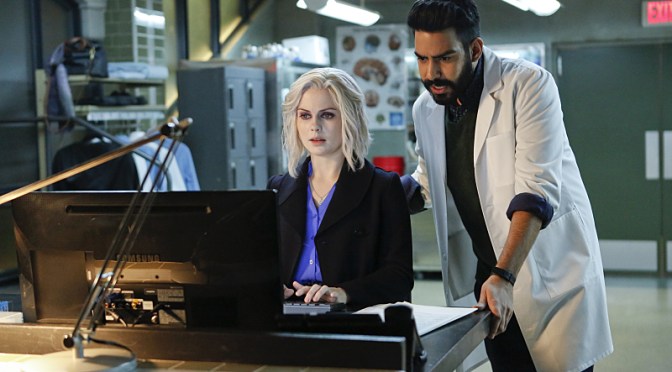
“Physician, Heal Thy Selfie” is by far my favorite episode of season two, and maybe of the show so far. There’s just so much great stuff going on here, with Peyton playing a big role, Blaine in the same room as Stacey Boss, more Vaughn Du Clark, and basically all the story lines being tied together in a big way. While I generally enjoy iZombie, it’s been a while since the show has had an episode that is this close to perfect.

This episode gives Peyton so much screen time, you guys. It’s the first time that she’s felt this much like an integral part of the show, and I wish we could get this much of her more often. One of the episode’s best scenes is when Peyton and Liv confront Blaine together, and it’s a display of solidarity between the two women that does more make their friendship feel real than a season and a half of verbally being told that they are best friends. Peyton’s scenes with Ravi are also wonderful, and should give Peyton/Ravi shippers plenty to fantasize about this week.

It’s a great week for villains, and all of the show’s baddies get things to do. Major is dealing with Vaughn, who uses his time this week to reassert his dominance over Major when he finds out that Major hasn’t been as diligent in his zombie-killing as Vaughn wants. This is the one story line this week that still seems somewhat disconnected from the rest of the show’s events, but the scenes work well enough on their own that they don’t need to be particularly tied to everything else just yet.

Meanwhile, Blaine has bigger problems than Peyton not wanting to bang him again. When Blaine’s funeral home is handling the funeral for Stacey Boss’s nephew, Boss realizes that Blaine is still alive and takes some time to calculate the interest on Blaine’s debts. Fortunately for Blaine, Boss hasn’t realized yet that Blaine is the new major drug dealer in town—although Liv does by the end of the episode. In any case, Stacey Boss and Blaine in the same room together is one of the best things that could have happened on this show, and it’s everything I imagined it would be.

The case of the week in this episode is used really cleverly, and it’s good to see the show mixing things up a little in the way it handles Liv’s brain-eating. Three headless bodies means that the brain Liv eats this week has nothing to do with the case, but she still has to deal with having some of the personality traits of a social media-crazed Millenial. I only wish that the few jokes that this generates were as clever as the general idea of showing that Liv has skills that can help her solve cases even without the unfair advantage she gets by eating the brains of murder victims. I might have chuckled a little when Liv Instagrammed her sushi (#BrainFood!), but the concept quickly wore thin.

After a lot of episodes this season that seemed dedicated to pushing all of the characters and stories farther apart from each other, I’m happy to see things coming back together. I won’t say that a resolution to anything is in sight, but after this week I do feel like everyone is in the same story instead of in two or three different ones.

Great lines in this episode:

  • “Looks like a no brainer to me.”
  • “The violent soundscape of nature is making my ears bleed.”
  • “Like Starbucks. Or the eye of Sauron.”

Miscellaneous thoughts:

  • Not really related to this episode, but I love that viewers were so concerned about Minor.
  • Speaking of Starbucks, it was pointed out in The Mary Sue’s episode recap that Liv is somehow getting pumpkin spice lattes in February, and now it’s really bothering me.
  • I hope that Peyton moving into her own place again doesn’t mean she’s going to disappear for another extended period of time.
  • I had almost forgotten that Gilda/Rita was still Liv’s roommate. I would have been fine, though, if the show had just quietly retconned this so that Peyton could move in with Liv.

The Shannara Chronicles: “Breakline” is a solid episode, but in a world that feels very small

After two weeks of Game of Thrones-ing things up, The Shannara Chronicles finally delivers another solid episode with a better balance between the monster of the week and a B-plot back at Arborlon. I’m also happy to report that nothing rape-y happens this week, which is also a nice change of pace.

The opening glosses over exactly how Wil, Amberle, and Eretria survived their fall at the end of “Pykon” as well as what exactly happened to the Reaper that had followed them. We also don’t learn this week what happened to Cephalo after he cut the zipline on the young people, but I feel it’s safe to say we probably haven’t seen the last of him. Normally this kind of narrative shortcutting would irritate me, but I can’t say I was disappointed to have an episode free of sexual predators, especially when it turns out to be a well-conceived, nicely paced, action-packed hour that is probably the best episode of the season so far. In any case, we start the episode with our protagonists separated and trying to find their way back to each other, and this occupies the majority of the episode.

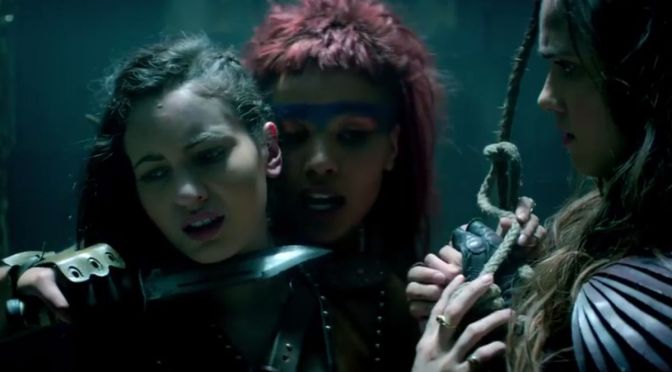
Wil almost immediately has an encounter with a young elf, Perk, who has been attacked by a group of human elf hunters who cut off one of his ears. Because apparently gnomes think that elf ears have “medicinal” properties. This is profoundly silly, but okay. Wil treats Perk’s wound with some kind of herb (marijuana, obv), and they head off to find the elf hunters, who have captured Perk’s partner and who Wil worries may have captured Amberle and Eretria. Meanwhile, Eretria and Amberle do have a run-in with the elf-hunters, but they manage escape. However, Amberle irresponsibly drops her sword, which tips the elf hunters off to who she is and ensures that they will keep hunting the girls, who manage to fall through an ancient rooftop into a remarkably well-preserved, albeit filthy, high school gymnasium still decorated for prom. I absolutely adored these parallel adventures, though for very different reasons.

Wil is kind of a fascinating character to me because he’s not a fighter at all, and this week we get to see more of his real strength, which is healing. One thing that is great about this show as an adaptation of The Elfstones of Shannara is that it mostly leaves Wil alone when it comes to this. It would have been easy to turn him into a more traditionally swashbuckling sort of fantasy hero, but instead the show has pretty consistently portrayed Wil as a character who prefers to solve problems creatively rather than violently and who genuinely wants to help people. So his interactions with Perk this week are excellent and do a nice job of challenging Wil’s ideals of how the world ought to be. It forces some character growth, by making Wil think about things from a different perspective, but I really appreciate that it doesn’t change who Wil is at heart. He might be able to help Perk and accept help from Perk, but Wil isn’t ready to abandon his own personal ethos.

For me, Eretria and Amberle’s journey through the Pompeii-esque ruins of a 21st century high school really stole the show this week. I thought the bath scene in “Pykon” was just a case of boring old queerbaiting, but “Breakline” takes the time to develop the relationship between the two women a little more. I’m not sure if I’m ready to say that Ambertria is real, but it’s close. I only wish the elf hunters had caught up to them about thirty seconds sooner. I loved the scene, but the dialogue turned very clunky and felt as if the writers don’t trust the audience to understand Amberle and Eretria’s relationship without having it spelled out for us. It’s a classic case of telling instead of showing, and nothing spoils an intimate moment like having the intimacy explained to us like we’re two.

The only major criticism I have of the Wil-Amberle-Eretria stuff this week, however, is that the show continues to suffer from a sort of small world syndrome. We’re getting to see some new settings and stuff, which is nice, and I loved the world building power of Amberle and Eretria’s trip through the old school, but what are the odds that the elf hunters are being led by Eretria’s jilted ex-girlfriend? I mean, good job on further confirming that Eretria is canonically bisexual, I guess, but come on. It’s just not reasonable that basically every new character we meet in this fantasy world knows each other, and it really diminishes the feeling that our heroes are on an epic quest. Eretria being captured by her evil ex at the end of the episode means that we’ll still be dealing with this newest diversion for at least part of next week’s episode as well. I’m concerned that this means that all the epic parts of Elfstones are going to be crammed into episodes nine and ten, which could make the ending feel very rushed and even anticlimactic. We’ll see.

The B-plot of “Breakline” deals with Arion and Ander being sent by fake Eventine to try and use the warlock sword against the Dagda Mor. I’m not sure why the princes go along with this obviously terrible idea, but it ends up getting Arion killed and Ander has to be rescued by Allanon. Arion’s death feels really unceremonious and abrupt, in spite of being fairly heavily telegraphed, probably because Ander just leaves him lying there on the ground. While I’m not a stickler for adaptations hewing too closely to their source material, it’s too bad that Arion’s death is treated as such a small, personal event, with no witnesses besides Ander and Allanon. Similarly, the defeat of fake Eventine happens in a room with just a couple of people. Surely crowd scenes can be expensive, but these types of events demand a larger audience if they’re going to feel as epic as they ought.

Miscellaneous thoughts:

  • I wish we got a better look at Perk’s bird thingy. I remember the Wing Riders being pretty cool in the books, and I’d love to see more of them in the show.
  • Bremen looks a lot like Rutger Hauer, and I actually got a little excited for a second thinking it might be him, but it wasn’t. I feel cheated by this.
  • I’ve seen a lot of people making fun of Allanon’s transformer sword, but I actually kind of love that cheesy effect.
  • I loved Amberle’s dice.

Lucifer: “The Would-Be Prince of Darkness” shows marked improvement over the last couple weeks

“The Would-Be Prince of Darkness” opens with a profoundly stupid bait and switch, which is so obvious and heavy-handed that I was a little second-hand embarrassed for everyone involved in writing, performing and filming the scene. Even at this early stage of the show, we know that Lucifer isn’t actually encouraging a young woman to commit suicide. It’s not funny, there’s no real suspense, and it’s drawn out for several seconds longer than it ought to have been, even if I could agree that this little prologue should exist at all. Frankly, the whole thing is a little creepy, as Lucifer sounds very serious about getting this girl to jump into a pool at a party.

Which is, I think the biggest problem this show has in general—a tendency to take itself entirely too seriously without actually having anything substantive to say for itself. At some point Lucifer has to start just owning its absurd premise and either really having fun with it or using it to explore some deeper and more compelling ideas. The good news, however, is that although this newest episode starts off on a sour note, it does show some signs of moving in the right direction.

A largely forgettable case of the week is mostly made up for by Lucifer’s own investigation of a man who has been using Lucifer’s name to get laid. Lucifer’s decision to not actually punish the guy is telling, and it’s interesting to see him talk about it with his therapist after the fact. Lucifer’s sessions with Dr. Martin are a bit better integrated this week than they have been, although I’d like to see these scenes be a little less full of explanation. They would work better as a complement to well-developed ideas throughout the episode instead of sounding like an 8th grade report on the episode’s themes put into dialogue.

Much more than the previous episodes, this one felt like it was really about Lucifer, with all the rest of the show’s characters properly put into their places as characters in Lucifer’s story. Chloe seems to be coming closer to an epiphany about Lucifer’s true identity, and her ex seems to be finding his place in the show. Maze seemed to be making up for Amenadiel’s absence this week by being more unpleasant than usual, but it worked for the episode, even if she doesn’t seem to have much of an effect on Lucifer. Tom Ellis is still carrying the show, but that’s starting to feel less strained, and hopefully things will continue to get better.

It’s nice to see that Lucifer is improving, even if it’s not exactly doing so in leaps and bounds. “The Would-Be Prince of Darkness” definitely works marginally better than either of the show’s first two episodes, though, even if it doesn’t manage to elevate itself to anything truly deserving the descriptor “good.”


Supergirl: In “For the Girl Who Has Everything” nothing much actually happens

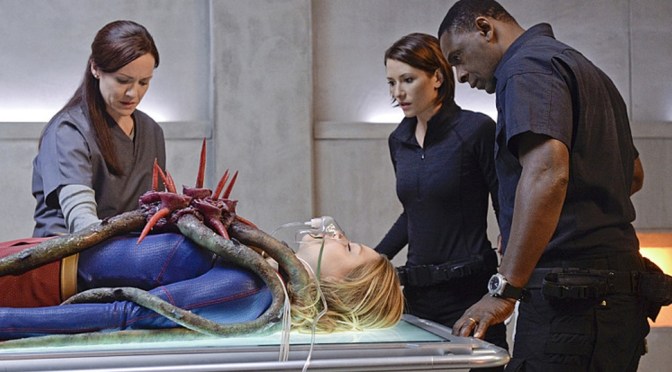
“For the Girl Who Has Everything” could have, and should have, been a much better episode than it is. Sadly, the episode starts off with somewhat of a disappointment. The thing that attacked Kara at the end of last week’s episode turns out to be a weird plant thing that just puts Kara into a sort of coma, and while unconscious she gets a taste of her ideal life. The rest of the episode mostly deals with Kara’s friends trying to figure out what has happened to her and how to rescue her. The thing is, most of this stuff is very, very boring, and even a major character death at the end of the episode doesn’t really do much to liven things up. This week, the show chooses to focus on basically every character except Kara, but mostly to the extent that it’s a way of returning to a comfortable status quo.

The last few weeks have looked at Winn and James’s relationships with Kara and seemed to be moving both of those relationships towards some kind of change, but this episode reconfirms that they are all just friends. Alex was keeping a secret from her sister at the beginning of the season, but since they’ve both been working at the DEO they’ve had very little conflict. This week, however, Alex gets a new secret, which also happens to be a new reason for Kara to distrust Hank Henshaw. Cat Grant doesn’t appear much in this episode, but Kara’s relationship with her boss is also back to a downright unpleasant square one as well. After weeks and weeks of Kara’s relationships progressing and developing, this episode undoes basically all of it in less than an hour.

The saga of Kara’s plant-induced coma shows us nothing new about the character, which is a huge missed opportunity. Kara’s speech at the end of the episode spells out to us why her ideal world is back on Krypton with her parents, but it doesn’t really ring true. Sure, things haven’t been great lately for Kara on Earth, but they haven’t really been so bad that she should want to regress to her childhood. Even if things have been that bad, the sort of regression portrayed here would be an unhealthy way of dealing with problems. Unfortunately, the episode never really delves into this, and instead sort of glosses everything over with pot stickers and ice cream. It works to establish a new normal, but it doesn’t actual deal in any meaningful way with any of the trauma or sadness Kara has suffered this week.

The thing that seemed most promising this week was Kara’s rage at Non, but it seemed to dissipate as quickly as it arose. Their fight seemed superfluous to Kara’s outburst of emotion, and it doesn’t seem to have actually had any reason for existing other than to add a little more excitement to a dull episode. Similarly pointless was Astra’s sort-of redemption, which would have been much more effective if we’d actually seen Astra more than a handful of times since the show started. It also doesn’t help that she’s really not redeemed here at all and her death has almost no impact on anyone.

It’s a disappointing episode that rolls back a lot of progress the show had made in earlier episodes, leaving us with essentially a blank slate for the rest of the season. With Maxwell Lord imprisoned at the DEO (which apparently has no consequences at all), that leaves Non (now likely motivated by a desire to avenge his wife’s death) as the major villain for the remaining episodes. Without the personal connection that existed between Astra and Kara, however, this leaves Non a fairly one-dimensional character, and with the show paying scarce attention to its overarching storyline I can’t see this improving without a real commitment to changing the format of the series.

Miscellaneous thoughts:

  • Kara can’t get drunk, apparently.
  • Hank-as-Kara dealing with Cat Grant should have been comedy gold, but it was a tragically squandered opportunity.
  • The thing that seemed most promising this week was Kara’s rage at Non, but it seemed to dissipate as quickly as it arose. Their fight seemed superfluous to Kara’s outburst of emotion, and it doesn’t seem to have actually had any reason for existing other than to add a little more excitement to a dull episode.
  • Similarly pointless was Astra’s sort-of redemption, which would have been much more effective if we’d actually seen Astra more than a handful of times since the show started. It also doesn’t help that she’s really not redeemed here at all and her death has almost no impact on anyone.

The X-Files: “Home Again” kind of wastes a great premise

I wish I could say that I loved “Home Again.” It’s got a great, creepy monster. It deals with an important and timely issue, addressing gentrification and the displacement of homeless people in cities. Thematically, it’s both rich and consistent, and the episode moves along at a brisk pace while still spending an appropriate amount of time on its more emotional scenes. Unfortunately, it only partly works, and the episode just leaves too many questions unanswered for it to feel very satisfying. This could be intentional, but it would have been better if something had been resolved by the end of the hour.

The episode opens with Alessandro Juliani (from Battlestar Galactica!) appearing as an evil public official overseeing the forced removal of what amounts to a small village of homeless people who are in the way of a new housing development that would gentrify the Philadelphia neighborhood they live in. The casually brutal inhumanity with which the homeless people are treated may be slightly exaggerated, but only slightly, and it’s a great way to set up the catharsis we’re supposed feel as a mysterious man starts ripping those responsible for the abuse of the homeless apart limb from limb. It promises to be a compelling story, but “Home Again” unfortunately doesn’t quite deliver on its interesting premise.

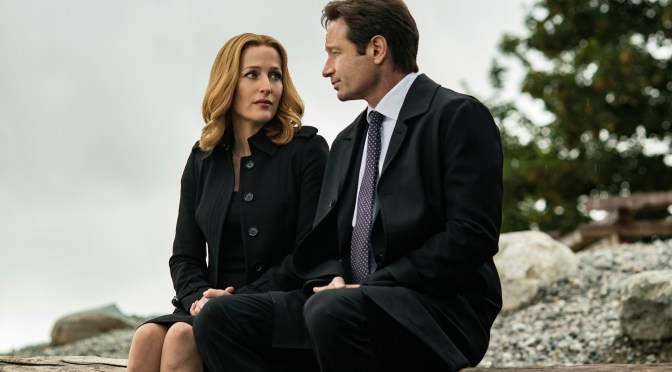
This is primarily because the episode gets bogged down in melodrama when Scully’s mother has a heart attack right in the middle of Mulder and Scully examining the first crime scene. While there are several more murders over the course of the episode, there’s very little actual investigation of the crimes, and the mystery remains unsolved at the end of the episode although there is a somewhat gratifying conclusion to the murder spree, as all of the bad guys who are being mean to homeless people end up dead. Instead of exploring a potentially fascinating X-File, Scully goes to be with her mom in the hospital and spends most of her screen time this week dealing with the news that her mother has changed her advanced directive without Dana’s knowledge. Like the monster of the week, this storyline has a lot of potential, but it too feels just half-baked.

The monster of the week plot ends up being a straightforward revenge story, but it seems to assume that the audience already has a high level of familiarity with issues surrounding gentrification and its effect on homeless populations. Further, it seems to take it as given that just knowing that homeless people exist and are being harmed will be enough to provoke a sense of outrage in the viewer. At no point, for example, do Scully and Mulder actually talk to any of the homeless people who are being displaced. They are always spoken about and for, but the episode would have been much improved by giving these people a voice of their own instead of simply having a story happen around them. Even at the end of the episode, the plight of the homeless is not revisited after the last grisly murder, so the audience is left wondering what happened to them and what good is done by having a secret monstrous avenger on your side if it doesn’t actual change anything. In short, it’s a worthy theme that just isn’t done justice in the episode.

Similarly, Scully’s mother’s death feels less impactful than it ought. There’s a certain sort of naturalism to this story that I normally like, but I’m not sure The X-Files is the place for naturalistic storytelling. Certainly, the death of a parent is never convenient, and it contributes to the sort of slice-of-life feeling this whole season of the show has had so far, but I have to admit that I mostly just found it terribly disappointing that Scully was once again sort of sidelined from the story—and in a weird way. The episode in many ways could be considered a very Scully-centric one, but the truth is that very little actually happened in “Home Again.” I would have much preferred to just have the whole episode dedicated to Mulder and Scully actually working on the case of the bandaid-nosed man, and have the sweet character moments between the pair left to fanfic writers if the show’s writers aren’t going to do it properly.

It’s hard to put my finger on exactly what didn’t work this week, but I’m pretty sure the problem is just that both plotlines needed several more minutes of material to round them out and ensure that they hit their emotional marks. “Home Again” isn’t a bad episode, but I just want more of all of it. It feels as though the show’s writers are working really hard to squeeze, well, everything into these six episodes. I can understand treating these episodes as a final farewell, but that’s no excuse to waste a great monster of the week idea like this.