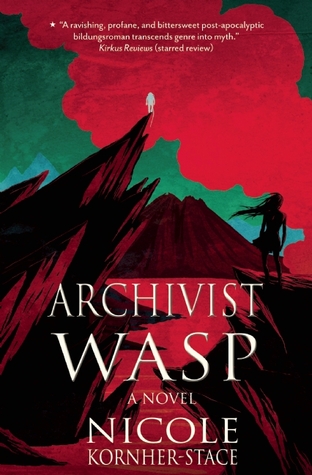
 Archivist Wasp is a strange and beautiful story that still managed to be somewhat disappointing to me. I liked it quite a bit, but I didn’t love it the way I thought I would and I’m not sure exactly why except that I feel somewhat misled by an enormous amount of good reviews that were terribly vague about what this book is. At the same time, I do like that Archivist Wasp defies any neat genre categorization. It’s a book that is many things, but mostly it’s hard to describe without giving away the whole story. In any case, I’m not sure exactly what I expected from this book, but what I got wasn’t it, and I can’t say that my expectations were challenged or unsettled in any positive way. I just feel weirdly neutral about the whole thing.
After about a week of trying to figure out why this book just didn’t sit right with me, I think it’s largely because, while it’s a thematically strong work—dealing with issues of identity and choice and the ways in which people can be susceptible to bad ideas—there’s just not a whole lot of actual story. The whisper thin plot might have worked if Nicole Kornher-Stace made up for it with particularly beautiful prose or great characters or a good sense of the setting, but that’s not the case. Kornher-Stace’s prose is just workmanlike; Wasp is kind of a wonderful character, but she’s not enough to carry a whole novel; and the setting seems to be shooting for almost mythic—a journey through an underworld—but fails, and at the same time is a post-apocalyptic dystopia of sorts—but without any details to give it any specificity or to ground it in a plausible future.
It seems to be somewhat in vogue these days for authors to skirt the line between science fiction and fantasy, and genre-bending is a common buzzword of recent years that I’d heard used to describe Archivist Wasp. That may be the case, but to me it felt more noncommittal than purposeful in its failure to decide what it wanted to be. Wasp’s abilities seem to be mystical in nature, and this isn’t entirely at odds with a world that appears to have been shattered by a human-caused apocalypse, but there’s really no explanations for either of these things. Certainly, there isn’t nearly enough explanation given to even begin to explain how the world shifted from the one that produced the super soldiers whose ghosts Wasp interacts with to the world in which Wasp has been raised.
It’s not always necessary to explain this stuff, and sometimes it’s actually better if authors don’t bother—too many potentially good books have been ruined by over-explaining—but the society that Wasp is part of is so alien that it’s difficult to imagine how it happened at all. If I’m being very generous, I could say that this makes the book original, and it is, as far as that goes, but in the absence of any common genre tropes, it becomes the responsibility of the author to make sure that the reader has all the information they need to grok the book.
I suppose that in the end, though, it’s not so much that Archivist Wasp is hard to understand; it’s just deeply unsatisfying. While I can appreciate what I suspect is the author’s aversion to holding the reader’s hand, just a little more explanation would have gone a long way towards making this a much more enjoyable read.
 Lawrence M. Schoen’s Barsk: The Elephants’ Graveyard is a wonderfully original masterpiece of a novel, and I am so glad that I got to it in time for Hugo Award nominations. Somehow, I’d thought it was a 2016 book because it came out so late in the year (December 29). Fortunately, it showed up on the Nebula shortlist before I missed out on it entirely. You guys, this book is so good. If you are a Hugo voter, I highly recommend reading this book before you finalize your nominations. 2015 was an amazing year for genre fiction in general, but this novel is definitely at the top of the heap of amazingness.
 When I read the first of Michael R. Underwood’s new Genrenauts series, I compared it to the pilot of a television show—it was a solid introduction to the series, but it had a lot of pilot episode problems. The Absconded Ambassador is a rather shaky second outing for the series, and it just didn’t work for me. This time the genrenauts travel to science fiction world, which was exciting, but Underwood didn’t really do anything particularly new or interesting with the setting. The Shootout Solution had a sort of twist that, while obvious, was an interesting exploration of western adventure tropes. There’s nothing like that here, which was a little bit of a letdown.
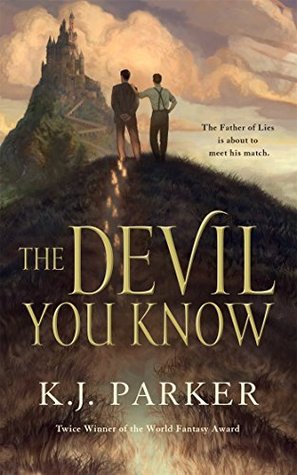 Alright, so I loved this book, but I kind of hate that I did because it’s actually, objectively, a lot of things that I hate. Mostly, The Devil You Know is just not nearly as clever an idea as the author seems to think it is. Still, I just ate it up, and I tore through this little book in the space of an afternoon, it was so much fun. K.J. Parker has taken an idea that has been done before and freshens it up just the right amount, but without making it overly precious or smugly faux-intellectual.
 The Ballad of Black Tom opens with a dedication, “For H.P. Lovecraft, with all my conflicted feelings,” which is a handy summary of how many, if not most, modern readers feel about Lovecraft. Victor LaValle has written at some length elsewhere about his history with Lovecraft’s work and how he was inspired to write this novella in response to the Lovecraft story “The Horror at Red Hook,” so I won’t rehash that all here. Suffice it to say that The Ballad of Black Tom functions as both an indictment of and a love letter to Lovecraft, but it’s also a great story in its own right and is sure to be one of the best novella-length works of 2016.
 I’ve always found it a little sad that there isn’t more Arthurian literature written about Guinevere, so I was excited when I saw this self-pubbed title pop up on NetGalley and had high hopes that it would offer some new insight or a unique interpretation of the mythology. Unfortunately, Daughter of Destiny was mostly a let down on that score. It’s a fast, easy read, though entirely unexceptional, and while Nicole Evelina may have some historical background, her knowledge of, understanding of, and respect for Arthurian legend and literature is marginal at best. It’s not a bad novel, but it was definitely a disappointment as an Arthurian one.
 ODY-C is an ambitious, psychedelic epic fantasy that needs to be completely finished and printed into one enormous, beautiful book so I can just read it all in one sitting. It’s a futuristic, gender-bent retelling of The Odyssey, and it’s a great way of bringing an ancient story to life for a new generation of readers.
 Planetfall is a brilliant portrait of a character and a community both in crises and a meditation on the ways in which the community and the individual are intertwined. It’s a gorgeously realized sci-fi mystery about a secret that festers in the heart of a seeming utopia and threatens to destroy it all.
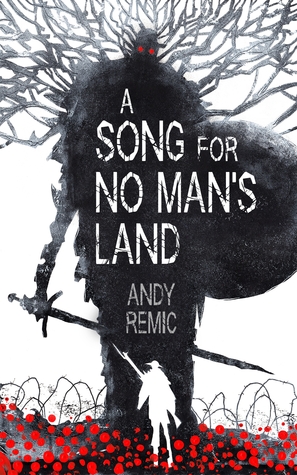 A Song for No Man’s Land is a dull, depressing slog of a novella that never seems to figure out what it wants to say. For all of its short length, it seems to drag on interminably before finally sputtering to a stop right when things seemed to almost start to get interesting. It is the first book in a series of at least three, so perhaps that can be forgiven, but I’m not sure I care enough about Robert Jones to want to come back for more.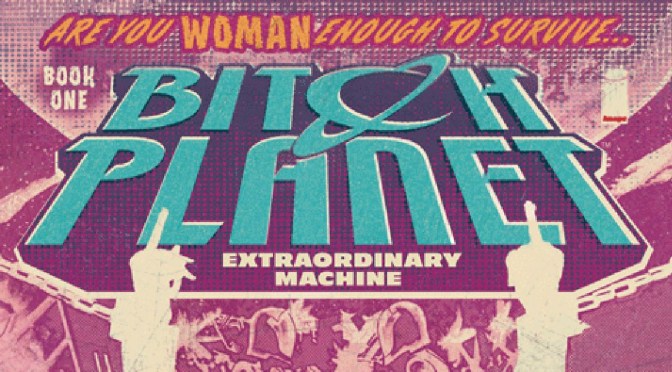
 I can’t believe I waited so long to read this comic. Like, I’m truly appalled at myself, and now that I’ve read the first five issues, I can’t even remember why I hadn’t been that interested. Bitch Planet is a gorgeously drawn, tightly plotted feminist masterpiece that should be required reading for women everywhere. It’s also brutal and heartwrenching and more than a little uncomfortably close to the truth of many women’s experiences.
 SF Bluestocking