All posts by SF Bluestocking

Game of Thrones Recap/Review: Season 7, Episode 1 “Dragonstone”

After the total shitshow that was season six (and seasons four and five) of Game of Thrones, my expectations heading into last night’s premiere were low. I ended up being pleasantly (-ish) surprised. There are some Game of Thrones storylines that are well beyond salvaging at this point, and I’ll get to those soon enough, but there’s also some decent writing in “Dragonstone.” If some of the episode’s more emotional moments only work in isolation, divorced from the context of the previous several seasons, I’m feeling magnanimous enough halfway through this garbage year to be forgiving of some of the show’s sins in the interest of being able to enjoy it with a bottle of wine each week.

**Spoilers ahead, natch.**

Arya Stark

It seems like it’s been a while since Game of Thrones used a cold open, but they did for this season. We begin the episode with what appears to be Walder Frey addressing a room full of his nearest and dearest male relatives and quickly turns into, well, whatever a bloodbath is when it’s done with poison. Because—surprise!—that’s not Walder Frey! It’s Arya in disguise, which anyone who watched even just the last episode of season six will guess by the time Walder’s face appears on screen, so I’m not entirely certain who is supposed to be surprised by any of what happens in this scene.

David Bradley, in one last turn as the Frey patriarch, looks like he’s having the time of his life playing Arya-as-Walder, and his dialogue is clever enough, but it relies too heavily on uninspired wordplay (“Leave one wolf alive…”) and overused catchphrases (“The North remembers,” “Winter came…”). Visually, the whole thing recalls the Red Wedding, but this was already true of Arya’s original murder of Lord Walder last year. It’s a scene that feels mostly redundant, covering thematic and visual ground that the show tread in literally the last episode, but it’s nevertheless an entertaining scene to watch, with an overall feel to it that suggests something designed by committee to be crowd-pleasing for exactly the crowd of people who are still watching this terrible show.

Similarly, Arya’s second scene, later in the hour, feels calculated to achieve broad appeal, down to its Ed Sheeran cameo as a singing Lannister soldier, one of a group of men that Arya meets in order to learn a lesson about remembering the humanity of her enemies or something. On the one hand, such a lesson would be consistent with the themes of the episode’s Jon and Sansa material. On the other hand, it’s so totally at odds with the celebratory tone of the Frey massacre scene that it’s hard to imagine that any such lesson is what is intended. That said, it’s pretty par for the course on this show to frame a hate- and vengeance-fueled mass murder as a girl power moment and then undercut it within half an hour.

Bran Stark

Directly after the opening credits, we get an update on the Night King and the army of the dead that’s marching south to the Wall and the Seven Kingdoms. After lasting a good twenty seconds too long (not helped by the trouble my television had processing all the mist and snow effects), this turns out to be another vision of Bran’s. He and Meera (who is much the worse for wear) have finally made it to the Wall, where they’re met by a suspicious Dolorous Edd who questions whether they’re Wildlings—I’m not sure why this matters since the Wildlings are allies of the Night’s Watch now—and then is bizarrely easily convinced of Bran’s identity after Bran tells Edd’s fortune—even though Bran Stark has been presumed dead for all this while and there’s no reason for Edd to know that Bran now has psychic powers. It’s a strange, short scene that seems intended to be tense but lacks any legitimate source of the intended tension, so it feels more like a perfunctorily executed update scene about characters who almost certainly will have little of import to do until later in the season.

At Winterfell

Jon is settling into his new role as King in the North, and he’s full of ideas and commands and sweeping social reforms. First on his checklist is to find a way to get more dragonglass for making weapons to fight the White Walkers that he sees as the most immediate concern faced by the people of the North. He asks Tormund and the Wildlings to garrison the castles along the Wall, starting with Eastwatch-by-the-Sea. Because Jon is Super Feminist™, he also wants to ensure that all the Northfolk are being trained to fight and defend themselves, and he’s backed up by Lyanna Mormont, whose only discernable personality traits are supporting Jon Snow and sternly talking down to men old enough to be her grandfather.

Last, Jon must figure out what to do about the castles and lands left leaderless after the deaths of the lords who sided with the Boltons last season, and he apparently forgot to prepare that part of his presentation. When he hesitates over how to handle the situation, Sansa suggests that the Umber and Karstark holdings be given as rewards to some of the lords who remained true to the Starks, which elicits cheers from the room. Jon’s not Super Feminist™ enough to defer to his sister, however, and he doesn’t believe in punishing children for the sins of their fathers, so he makes actual children Alys Karstark and Ned Umber publicly declare their allegiance to House Stark. This would be fine if Jon had just decisively done this to begin with, but his uncertainty left room for suggestions, which Sansa gave.

It also makes no sense that the Northern and Vale lords would so quickly shift from supporting Sansa’s idea to unquestioningly supporting Jon’s decision, and this, combined with Jon’s dressing down of his sister afterwards, ends up feeling like a contrived public humiliation for Sansa. She spoke up—and perhaps it was the wrong timing on her part, but Jon hadn’t consulted her prior to his meeting and didn’t seem to know what he was doing during the meeting—only to be immediately shut down by Jon and then inexplicably ignored by a roomful of people who agreed with her moments before. To add insult to injury, the writers have put an additional obsequious speech in her mouth where—after just having publicly disagreed with Jon about a major policy matter, largely in an attempt to cover for Jon’s own ineptitude—Sansa praises Jon’s leadership abilities.

It’s weird, and it’s an obvious ploy to humiliate Sansa to the show’s audience as well, only topped by Jon going on to accuse Sansa of admiring Cersei about a minute later. The seeds of a real conflict between Jon and Sansa are already growing, which is about what I expected coming into the season, but I’m somewhat surprised at how decisively the audience is being led to take Jon’s side, especially when he’s so clearly in the wrong. Jon isn’t a confident leader, and he seems out of his depth already, but he’s also baldly sexist in his refusal to even consider taking advice from Sansa, scoffing at the idea straight to her face. So Super Feminist™ of him.

Fortunately, this is all the Jon we see this week, though we return to Winterfell later in the episode for brief updates with Brienne, Tormund, Podrick, Sansa and Littlefinger. Brienne is “training” Podrick, mostly, it seems, by brutally hitting him, but she’s distracted by Tormund leering at her. Sansa is watching this when Littlefinger comes over to try and conspire with her, but Sansa shuts him down relatively quickly. Still, Sansa defends Littlefinger’s presence to Brienne a moment later, citing the man’s usefulness and their indebtedness to him after his support helped win back Winterfell. Okay.

At King’s Landing

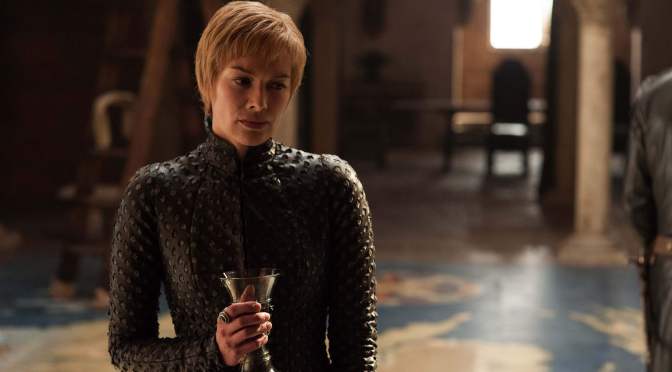
Cersei and Jaime have a boring talk while walking all over an unfinished painting of Westeros. It’s a rather on the nose bit of symbolism, and the conversation isn’t particularly illuminating. They are sort of talking strategy, but things are looking pretty bleak for the Lannisters. They have enemies on all sides (described by Cersei in colorfully misogynistic terms), and the arrival of winter doesn’t improve things for their military forces, who depend on other parts of the Seven Kingdoms for supplies, which will presumably not be forthcoming now that Cersei has destabilized the whole country by killing most of its leaders and pissing off the rest. The biggest piece of information to come out of this whole talk is that Cersei has no idea what a “dynasty” is.

What Cersei does have, however, is a new ally: Euron Greyjoy, who slouches into the throne room looking like a refugee from circa 2000 Hot Topic. He’s brought a thousand ships—which is a lot (the Spanish Armada, for example, was only 130 ships in 1588)—and a proposal for Cersei. Even though the Lannisters surely need Euron and his impossibly enormous fleet of ships far more than he needs them, Cersei refuses the proposal until Euron has proven his loyalty. He promises to leave and return to her with a gift; I’m guessing the gift will be people, likely Tyrion or the Sand Snakes if Euron can catch them.

In Oldtown

Though Sam was sent to Oldtown to train to replace Maester Aemon at Castle Black, it’s not clear what his training consists of other than a sort of humiliating and profoundly dull general-purpose drudgery. There’s a whole sequence of what is obviously some time passing with Sam spending his days cleaning chamber pots, serving food and shelving books. Some time is spent with the Archmaester, played by Jim Broadbent, who gives Sam a fatalistic speech about how they at the Citadel are the world’s memory and that the world isn’t going to end because of the White Walkers. In the end, Sam decides to steal a key to the restricted area of the library so he can study up on the White Walkers and dragonglass. He stays up late one night to go through the books he’s stolen, and he helpfully finds a very simple map that indicates a whole mountain of dragonglass underneath Dragonstone. Thank goodness. We wouldn’t want finding this information to be genuinely challenging or suspenseful or anything.

In the Riverlands

In the best-written segment of the episode (and it’s genuinely excellent), Sandor Clegane and the Brotherhood Without Banners are traveling north through the Riverlands when they stop at the night at the home of the man and child Clegane robbed a couple seasons ago. Sandor tries to urge them on, to go past the house, which is obviously now abandoned—no livestock, no smoke from the chimney—but it’s getting dark and the other men want shelter. While I don’t think we’ll be seeing a true redemption arc for Sandor Clegane, we are seeing him having real, compelling and sustainable character growth. His attempts to externalize his guilt and shame by insulting and arguing with Beric and Thoros are unsuccessful, and instead Clegane ends up having a bona fide religious experience when he finally agrees to look into the flames in the hearth and sees a vision of the army of the dead heading towards Eastwatch. This makes me doubly certain that we won’t be seeing any Cleganebowl this season, and it certainly raises the odds of this group dying tragically in the upcoming war against ice zombies.

Sandor burying the man and child whose deaths he’s somewhat responsible for was nicely done. While I’m still by no means a great fan of the Hound, I like that he did this small act of kindness. It also feels notable that the moment wasn’t ruined by the writers’ cynical streak. Sandor’s eulogy for the man and girl—“I’m sorry you’re dead; you deserved better”—is simple and heartfelt, and Thoros’s helping Sandor finish isn’t played for laughs or marred by any argument between the two men. It’s a sad, quiet moment that’s allowed to just exist in the show as a short bit of earnest and powerful thematic commentary in a show that is otherwise devoid of any sincere meaning.

Daenerys

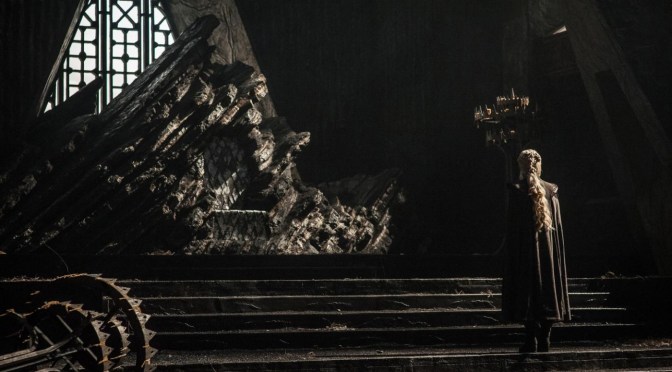
Daenerys and company have arrived at Dragonstone, where we get a lengthy sequence of Daenerys discovering and exploring her birthplace in silence as her entourage hangs back respectfully. It’s almost too much, to be honest, and the whole thing goes on just shy of too long before Daenerys arrives in the map room, lovingly caresses the length of the table best known as the place where Stannis banged Melisandre that one time, and then turns to her advisors to say, “Shall we begin?” as if they haven’t started their invasion already. I liked this sequence in spite of myself. It’s almost silly in its self-importance, but Dragonstone is stunning and we get to see Daenerys’s dragons wheeling overhead looking as beautiful and impressive as they ever have. As ridiculous a line as “Shall we begin?” is, it’s also full of promise, and I enjoyed this episode enough that I’m looking forward to seeing what happens next. After a somewhat slow start to the season, hopefully the pace will pick up next week.

Miscellany:

  • Why is Arbor Gold a red wine?
  • Why is Alys Karstark a redhead? I’m sure it’s because they’re supposed to be Stark cousins, but Sansa got her hair from her Southron mother; it’s not just a trait that all Stark relations have.
  • Arya is going to try and kill Cersei, exactly as I predicted.
  • Jorah is in a cell at the Citadel, and his greyscale has progressed. He’s still obsessed with Daenerys, though.
  • How is Dragonstone so completely empty, though? Stannis didn’t literally take every man, woman and child with him when he went, right? The big, empty space makes for a neat image, sure, but there’s no way everyone would be gone like this.
  • I am actually slightly alarmed by how many of my predictions for the season are already coming true.
State of the Blog and Weekend Links: July 16, 2017

I don’t know what I will ever do if I ever have a week that goes unequivocally well for me, with nothing bad happening in the world and no personal or financial crises in my own life. Obviously, of course, this week was not that week.

Things started off well, with a good writing day and a 2k word Gormenghast post on Monday, but by Tuesday my car was acting up again. I dropped it off at the auto shop Wednesday afternoon, and it is still there as of this writing. It’s either something probably moderately expensive to have fixed or it needs a whole new engine; hopefully I’ll get the final word on it tomorrow. Either way, I’m torn between being glad to be on the verge of finally getting to the bottom of months of car trouble and being furious that whatever this problem is wasn’t diagnosed at the beginning of this whole saga before we’d spent thousands of dollars on other car repairs.

As you might imagine, this made for a stressful week. My partner was working from home, which is a distraction. Fortunately, we live within walking distance of most necessities, but having to walk everywhere means simple things like grocery shopping take extra time. Being without a car also derailed later-in-the-week plans. I’d hoped to see a couple of movies this week (The Big SickValerian and the City of a Thousand Planets, maybe Wonder Woman) and I wanted to see a free outdoor performance of The Merry Wives of Windsor this weekend, but none of that was possible.  It’s been just a big, boring, financially stressful mess of a week, and that’s never a good way for me to stay on task and productive.

In the coming week, my number one goal is to find some better ways to not allow depression and anxiety to cause me to shut down quite so completely. Game of Thrones is back tonight, and I’ll be writing about that tomorrow. I’ve already read my next section of Titus Groan (Chapters 32-35), so that should be in the works for late tomorrow or sometime Tuesday. I’ve got outlines for a couple of essays I’d like to work on this week, and I’m thinking of trying a different, shorter sort of round-up style for book reviews for when I don’t have at least 500 or so words to write about things. I’ve been reading a lot lately, and I’d like to share more about what I’m reading and enjoying without the pressure of trying to write a full, lengthy, spoiler-free review.

Just when I needed it this week, Chuck Wendig shared this essay: “So, You’re Having a Bad Writing Day.” It helped.

I finished reading Issue 17 of Uncanny this week, and the first have of the issue’s content is already available online. My recommendations:

I love this Meghan Ball essay at Fireside: “The Importance of Being Monstrous”

Coming soon at Fireside: new serialized fiction by Sarah Gailey.

A series based on Nnedi Okorafor’s Who Fears Death is in early stages of production at HBO with George R.R. Martin executive producing:

There’s another new story at the Book Smugglers this week. Their Gods & Monsters series continues with Tonya Liburd’s “A Question of Faith.” You can also read about Liburd’s inspirations and influences.

There’s a new Darcie Little Badger story at Strange Horizons: “Owl VS. the Neighborhood Watch”

JY Yang’s Tensorate series is high on my to-read list for later this summer, and their new story, “Waiting on a Bright Moon,” only helped to whet my appetite.

Be sure to check out Michelle Ann King’s “15 Things You Should Know Before You Say Yes” at Daily Science Fiction.

I read all of Margaret Killjoy’s Tor.com novella, The Lamb Will Slaughter the Lion, this week, and I am telling you right now that you want to pre-order this title. If you aren’t convinced, you can read the first chapter (and part of the second) right now.

Andrew Neil Gray and J.S. Herbison wrote about their favorite part of their novella, The Ghost Line.

Sarah Kuhn wrote about the Big Idea in her new novel, Heroine Worship.

Emma Newman has another novel coming out in 2018 that takes place in the same universe as Planetfall. Watch for Before Mars in April of next year.

The first trailer for Ava DuVernay’s A Wrinkle in Time came out, and it’s wonderful. I wasn’t in love with the stills shared in the last week or two, but everything looks great in the trailer, and I’m glad to see that this production is embracing some of the weirdness of the book:

Christopher Brown wrote about “The Persistance of American Folklore in Fantastic Literature” at Tor.com.

Yoon Ha Lee talked about 6 Books at Nerds of a Feather.

This behind the scenes footage from the production of Star Wars Episode 8 has enough Carrie Fisher in it to break my heart. I am still not okay about her death.

George Romero passed away. And so did Martin Landau.

Finally, it doesn’t completely redeem this garbage week, but the BBC revealed the Thirteenth Doctor today, and it’s Jodie Whitaker.  Reader, I wept.

Game of Thrones: Season 7 Predictions

It’s that time of year again, where I try to guess, in broad strokes at least, what might happen on the new season of Game of Thrones. In the past, I have only had very mixed success at this, and last season was a shitshow that defied all expectations, but I’m back. Again. Still. Always. Because I have a weird, fierce love for this stupid, bad show. Also, two bottles of cheap Moscato for tonight.

This season, I haven’t been following Game of Thrones news the way I have in the past, though I have watched the trailers and looked at some of the promo posters and so on. However, I haven’t bothered with the endless parade of cast interviews and spoiler-free speculation and so on as it’s just gotten boring at this point. HBO likes to keep the show heavily under wraps in order to maximize our “surprise” at the show’s senseless violence and nonsensical storytelling, and that’s fine. It just means I’m pretty much basing my predictions on what I remember from season six, what little footage I’ve seen in the trailers for season seven, and six years’ worth of knowledge of the respect with which David Benioff and D.B. Weiss treat their source material and the audience.

Here’s what I think we might see this season:

Sansa Stark
We left Sansa at the end of season six watching her illegitimate half-brother/cousin Jon Snow accede to the titles and honors that she is both more legally entitled to and better qualified for, but there were some ominously foreshadowing shots of her seeming discontent with this situation. I fully expect this season to find Sansa segueing into the role of antagonist to Jon. With trailers and promo images indicating that Jon Snow will be heading past the Wall again, I think we’ll see Sansa left in charge of Winterfell in his absence. My concern is that this will end up with her having nothing of particular interest to do for the majority of the season, with her own antagonist dead and the Lannisters in King’s Landing likely to be busy with more immediate existential threats.

Jon Snow
It’s already been mentioned somewhere or other that Jon Snow will be heading to Dragonstone to meet Daenerys, and there are images of Jon beyond the Wall as well, so I predict that Jon is going to be doing some teleporting. There’s no way that, with just seven episodes in the season, the show is going to even try to convey the months-long journeys all this stuff will necessitate, and they’ve shown in the past that they care very little about maintaining anything like a coherent timeline.

Bran Stark
In trailers, it looks like Bran and Meera make it to the Wall and the Night’s Watch. I suspect that Bran’s new magic powers are going to be of use in defeating the zombie hordes of the North, but I don’t think we’ll see that actually accomplished this year. Instead, I think we’ll see a late-season reunion between Bran and Jon as Jon heads North to fight the zombies and finds his brother already there.

Arya Stark
Arya was last seen at the Twins, checking Walder Frey’s name off her infamous list, and I think this season will see her trying to make some more progress on those goals. It’s likely that she doesn’t know yet that any of her other siblings are alive in the North, so it seems logical that she would head south to King’s Landing. With the recent news that Gendry is back this season, and knowing how small the show likes to keep its world, I could see her reuniting with him somehow when she gets there.

Littlefinger
He could stay at Winterfell with Sansa as either a new antagonist for her or as Sansa’s co-conspirator against Jon Snow, either of which would be consistent with where the show left things last season. Alternatively, he could return to King’s Landing to hedge his bets with Cersei. He could even teleport to Dorne and/or Dragonstone, you know, as one does, and get up to some plotting there as well.

Brienne and Podrick
Something tells me that Brienne is going to head south again this season, perhaps for a reunion of some kind with Jaime Lannister. They’re also on my shortlist of characters I don’t expect to live out the season.

Davos Seaworth
Davos is still going to be on Team Jon, but he’s going to die beyond the Wall.

Melisandre
Banished from the North, Melisandre will either teleport to Dragonstone immediately or be completely absent until a late episode, when she’ll show up just in time to provide a magical solution to a problem.

The Hound
Promo material places the Hound in the North with Beric Dondarrion and the Brotherhood Without Banners. We won’t be getting Cleganebowl this year, if ever. Most of the Brotherhood will die, and this might include the Hound.

Cersei Lannister
True to her straw feminist form, Cersei will be day drinking and making terrible decisions. With almost every other character in King’s Landing dead, she’ll finally think about what’s going on in the rest of the kingdom, and it’s going to shock her. She is going to lose her shit when she finds out about Daenerys, but she’ll be even more concerned when she learns that Tyrion is still alive.

Jaime Lannister
Jaime is going to feel conflicted about Cersei, but not so conflicted he won’t still bang her. I predict/hope that this is the season we get to see Nikolaj Coster-Waldau go full frontal nude.

Bronn
Bronn will “hilariously” say some gross shit about women. I could see him getting to kill a Sand Snake or two this year.

The Greyjoys
Last time we saw them, Yara and Theon had joined up with Daenerys, but I don’t think this is going to turn out well for them. I think we’ll find out early in the season that Euron Greyjoy is throwing his support behind Cersei, and I think by midseason he’ll have caught up with his errant niece and nephew for a final showdown. If I was a betting woman, I’d put money on them all killing each other in a strategically silly naval battle of some kind because it would look cool. Yara’s queerness is going to be played for laughs at least once.

Sam and Gilly and Baby Sam
Gilly will still be waiting in that vestibule where Sam left her. Baby Sam is going to be like five years old. Sam is going to hang around the Citadel for the whole season, presumably learning something that we won’t actually find out about until season eight.

Olenna, Ellaria and the Sand Snakes
They’re going to join Daenerys, obviously. I don’t think we’ll see much, if anything, of Dorne this season, however. Instead, the Dorne crew will meet Daenerys at Dragonstone, and I think they’ll be significant in whatever battles with the Lannisters we get to see this season. However, I also think they’re likely to die in those battles as the show is surely looking to further cull its cast and storylines by the end of the season in preparation for the final few episodes next year.

Varys
Varys had teleported from Dorne straight onto Daenerys’s ship at the end of season six, so he should be with her when she makes it to Dragonstone. There’s no obvious role for him in any storyline at this point, so I think he’ll be more of a background advisor for Dany for most of the season. He could potentially come into conflict with Tyrion if they disagree over how Daenerys’s invasion of the Seven Kingdoms should be carried out, which would inject some drama into the situation, but I think it’s more likely that he’ll be around just enough for the show to include a joke or two about him being a eunuch.

Missandei and Grey Worm
There’s about a second of footage in one of the trailers for the season that looks like Missandei and Grey Worm getting ready to do it. So I guess that’s happening. I hope they run away together and live happily ever after, but I think it’s more likely that one or both of them will die tragically in service to someone else’s (either Daenerys’ or Tyrion’s) storyline.

Jorah Mormont
Jorah will die this season, almost certainly in battle, fighting for Daenerys.

Tyrion Lannister
Tyrion will mansplain everything to everyone. And he’s still going to be a fan favorite and critical darling, completely unearned.

Daenerys
We know for sure that Daenerys will make it to Dragonstone, and that will probably take up most of the first episode. I think the majority of whatever fighting she’s going to do in season seven will be in the last couple episodes and that most of her time will be spent holding court at Dragonstone and looking pensively off the battlements. I don’t think she’ll get a romance plot this year, but there’s going to be a bananas amount of new Daenerys/Jon fanfic after they meet.

Tits
We will see some.

Dragons
We won’t see as many as we’d like, but they’re going to be gorgeous.

Let’s Read! Gormenghast: Titus Groan, Chapters 27-31

In a book full of strangeness, perhaps the weirdest part of today’s reading is how disparate its chapters are. Previous sections have had unifying themes or dealt with the same characters throughout or with a short period of time, but these chapters each stand apart from the others. They also each advance the story in the most linear fashion that has occurred so far in Titus Groan. There’s still a lot of worldbuilding exposition, but in this section that is accompanied by copious character work and not just one but several actual events. It’s the most normative section of the book so far, in terms of construction, but it’s a weird turn that I’m curious to see is sustained. After waiting all this time for a proper plot to develop and finally giving up on that ever happening, I’m obviously leery of getting my hopes up.

The section begins with a chapter that feels somewhat out of place and is something of a speedbump. Chapter 27, “While the Old Nurse Dozes,” is primarily devoted to Keda’s story, and we learn something about her life before coming to Gormenghast. A forced marriage according to the customs of the people of the Mud Dwellings, a dead husband and child, and two men in love with her at the same time are the stuff of high drama, but the tale is told quietly and calmly by Keda herself to Nannie Slagg, who falls asleep during the story. It’s an interesting background for Keda and some fascinating exposition on the lives of those who live in the Mud Dwellings and the culture built around the veneration of the Bright Carvers, though it’s also a very generously favorable portrayal of forced marriage and rape. Keda seems more affected by the anxiety of being involved in a love triangle than by being treated like chattel and married off to a much older man.

To be honest, there’s very little about Keda’s characterization in this chapter that feels true. Though Keda makes a somewhat impassioned speech to Nannie Slagg—“I feared my future, and my past was sorrow, and in my present you had need of me and I had need of refuge so I came”—even that is delivered “quietly,” a word used both at the beginning and end of the paragraph that contains this speech. In fact, words like “still” and “quiet” are used many times in Chapter 27 to describe Keda, and she even describes herself in such terms, which is at odds with her more general passion and the impulsiveness of her decision to come to the castle as Titus’s nurse. It’s possible that in the seventy years since its original publication, the book has become dated; perhaps women like Keda were more numerous in the 1940s. However, I’m more inclined to think that an eccentric and often isolated male author just didn’t have enough interactions with real women to convincingly write an adult woman’s pathos.

Keda’s stoicism rings false, and her final, definitive (albeit whispered) statement, “I must have love,” feels hollow in a book that consistently depicts love as anything but desirable. Love in Gormenghast, to the degree that it exists at all, can be fierce and obsessive and often violent, but the only particularly positive example of love that we’ve seen so far is Keda’s own tenderness for the infant Titus. Nannie Slagg’s love for Fuchsia and Titus may be seen as positive, but it’s also self-serving; she loves their nobility and the position that grants her (such as it is) in Gormenghast, which she uses her inflated sense of self-importance to lord over Keda and to imagine herself as superior to the other servants, with whom she rarely interacts. Fuchsia has been shown to love things fiercely, but inconstantly; she’s young and strange and self-absorbed enough that she doesn’t know what love even is, as evidenced by her own fantasies in the previous chapters. This is certainly explicable in light of Fuchsia’s parents’ cold marriage, which is no kind of example for a young girl, but there’s an altogether cynical and unromantic tone that suffuses the whole book and all Mervyn Peake’s depictions of its characters. Keda isn’t treated with quite the same satirical eye as the rest of Peake’s cast, but the earnestness of her portrayal only serves to highlight the ways in which Peake doesn’t really understand her.

Chapter 28, “Flay Brings a Message,” begins with the advent of autumn in Gormenghast. Autumn—or just the change of seasons more generally—is often symbolically significant, and that is the case here as well. Fuchsia is, at least ostensibly, on the verge of running away. Keda has gone. Nannie Slagg is worried. Flay is anxious. Sepulchrave, at long last, wants to see his son. The real star of this chapter, though, is Gormenghast itself and Peake’s superbly beautiful prose as he describes it:

“Autumn returned to Gormenghast like a dark spirit reentering its stronghold. Its breath could be felt in forgotten corridors—Gormenghast had itself become autumn. Even the denizens of this fastness were its shadows.”

And:

“The crumbling castle, looming among the mists, exhaled the season, and every cold stone breathed it out. The tortured trees by the dark lake burned and dripped, and their leaves snatched by the wind were whirled in wild circles through the towers. The clouds moldered as they lay coiled, or shifted themselves uneasily upon the stone sky-field, sending up wreaths that drifted through the turrets and swarmed up the hidden walls.”

And:

“From high in the Tower of Flints the owls inviolate in their stone galleries cried inhumanly, or falling into the windy darkness set sail on muffled courses for their hunting grounds.”

I am a total sucker for alliteration, and I’m further enamored of anthropomorphic metaphors, so I adore these descriptive passages. But in addition to being lovely in isolation, these passages also reiterate some of the earliest motifs I identified when I first embarked on my reading and further develop some more recently introduced ideas about Gormenghast the place. The emptiness and the sense of haunting and unholiness are palpable, and early motifs are evident in Peake’s word choices. The profane is succinctly contained in terms like “dark spirit” and images like those of the “tortured trees” that “[burn] and [drip]” and in the inhuman voices of Gormenghast’s owls. The whole place comes alive with words like “become” and “exhaled” and “breathed,” while the pathological weirdness of the castle is shown in word choices like “moldered” and “swarmed” that suggest illness and infestation.

In Chapter 29, “The Library,” we get even more description of Gormenghast—further expanding upon the off-kilter feel of the place and with sumptuous paragraphs about the castle’s Gothic architecture. The main focus of the chapter, however, is Sepulchrave. In a slightly surprisingly modern turn, it’s made clear that Sepulchrave’s malaise is in fact a “native depression” with a history that stretches back to his youth. We learn something about Sepulchrave’s unhappy (albeit fruitful) marriage to Gertrude, which certainly doesn’t improve the earl’s state of mind, but ultimately Peake writes that “…compared with the dull forest of his inherent melancholy it was but a tree from a foreign region that had been transplanted and absorbed.” In today’s terms, of course, it seems obvious that what Peake is describing about Sepulchrave is a clinical depression, with no cause and no easy cure, but what feels most surprising about the portrayal of Sepulchrave’s depression is how sensitively-crafted it is. Sepulchrave’s depression is certainly extreme, and it’s his defining trait, but it’s treated seriously and humanely, without the satirical gaze Peake turns on so many of the book’s other characters. That said, Sepulchrave’s depression is still pathologized in the text: “His dejection infected the air about him and diffused its illness upon every side.” Throughout the book there has been a sense of sickness about Gormenghast, and it would be easy to interpret Sepulchrave—Lord of Gormenghast and the theoretical head of the Groan family and their household—as the source of that sickness based upon passages like this if there weren’t so many other competing potential sources of rot in the place. The next couple chapters explore several of these possibilities.

At the end of Chapter 29, Flay takes a short detour on his journey to request Titus’s presence in the library, and he’s appalled to observe Swelter doing, well, something. Chapter 30, “In a Lime-Green Light,” elaborates a bit upon what Mr. Flay finds so horrifying about the cook. There’s something almost Lovecraftian about the nameless, inarticulable fear and antipathy Flay has for Swelter, the scenes of Flay spying on Swelter as Swelter seemingly plots Flay’s murder see Gormenghast at its worst and most hellish. The green light of Swelter’s underground room and the descriptions of his honing the cleaver and practicing stealth are positively demonic in tone, and Flays utter terror by the end of the chapter feels entirely earned.

Finally, Chapter 30, “Reintroducing the Twins,” returns to Steerpike and the Prunesquallors, who have sat down to a dinner of—perhaps significantly, given the ongoing bird motifs in the novel—chicken. Steerpike’s social climbing has been as successful so far as he could have hoped, and he seems to have made himself quite indispensable to the Prunesquallor siblings, especially Irma, whose vanity has only increased in light of Steerpike’s solicitousness of her. After this dinner, the Prunesquallors are visited by Cora and Clarice Groan, who take an immediate interest in Steerpike, who, for his part, jumps at the opportunity to advance himself still more. He listens to the twins’ grievances (mainly that “[Gertrude] steals our birds”), strokes their egos, and escorts them home with the suggestion that he may be able to serve them and return them to their former glory. The chapter ends with a monologue-ish account of Steerpike’s scheming and a hopeful and powerfully symbolic image of the sky clearing: “…the sky had emptied itself of cloud and was glittering fiercely with a hundred thousand stars.”

Miscellany:

  • Fuchsia’s eccentricity has taken an interestingly almost-scientific turn. I love the idea of her as a collector and cataloguer of the natural world, though I also think this may be verging on an almost Hardy-esque ideal of the girl as a sort of pure nature or earth spirit, untouched by the corruption of the world around her, especially in the way Fuchsia’s innocence and wildness is set in opposition to the strictures of life within the castle. She seems ripe for corruption or tragedy, and I don’t know if I can bear it if anything terrible happens to her. Still, she remains a fascinatingly trope-defying character. There could be something manic pixie-ish about her in other circumstances, but Fuchsia’s narrative so far is in service to nothing and no one but herself.
  • I’m going to riot if I don’t get to read at least one chapter about Gertrude that’s as informative about her as Chapter 29 is about Sepulchrave.
  • So far, though at least some of Peake’s influences are obvious (Shakespeare, Gothic romances, Dickens, Carroll, Poe), he’s steered clear of any direct literary allusions, but he alludes to Washington Irving in Chapter 29 when he writes of the east wing past the Tower of Flints as “an Ichabod of masonry that filed silently along an avenue of dreary pine whose needles hid the sky.” I was so surprised I had to Google it just to make certain it wasn’t a more obscure Biblical allusion instead. The Irving allusion makes me wonder how much American literature Peake was familiar with. There are definite shades of Poe, but perhaps Peake also read Hawthorne. And Peake’s fixation on the pathology of place and the quiet horror of ancient spaces suggests he might even have read some Lovecraft, but the book is so far free of any of Lovecraft’s virulent prejudices. Indeed, Peake’s interest seems to be particularly in the foibles and failings of the antiquated system of English nobility, a peculiarly English sort of introspection that doesn’t have much in common with the oeuvres of popular early American writers.
  • I guess Steerpike is going to wear black after all.

State of the Blog and Weekend Links: July 9, 2017

This week, the holiday took a lot more out of me than I expected it to, so I didn’t get as much writing done as I’d hoped to. However, I did read a great novel (An Oath of Dogs by Wendy N. Wagner), and after a few days of relative restfulness I’m feeling recharged and ready to make some real progress on some things in the coming week.

I finally got another Gormenghast post out the other night, covering Titus Groan Chapters 22-26, which was less than I’d hoped to get to this week. I’ve already finished reading for the next post in the series, though, which should be out tomorrow, and I’ve begun reading past that with the goal of getting back on track with two or three Gormenghast posts a week. I’ve got two more Gormenghast novels and a biography of Mervyn Peake to get through before I can move on to what is likely to be my next Let’s Read project: Gene Wolfe’s The Book of the New Sun. Realistically, I expect Gormenghast to take most of the rest of 2017 to finish, but I’m already slightly excited about what’s next.

ICYMI, I’m giving away a copy of The Guns Above by Robyn Bennis.

Next up on my reading list is Issue 17 of Uncanny Magazine. The first half of the issue content is free online already, but it’s never a bad time to just subscribe to the publication.

After that, I’ll be reading the new issue of FIYAH, built around the theme of “Sundown Towns.” Look at that gorgeous cover by the wonderful Geneva Benton, listen to the awesome Issue Three playlist, and don’t forget to buy the issue (and maybe a poster or mug or beach towel).

There’s change afoot at Fireside Magazine, where Brian J. White is stepping down. It’s still going to be awesome though, and for just $2/month, you can get a convenient monthly ebook of Fireside content.

The 2017 Chesley Award winners were announced.

Tor.com’s fall lineup is going to be amazing.

Also at Tor.com, all the book releases you should be looking for in July:

The B&N Sci-Fi and Fantasy blog has their own list of the best new releases coming out this month.

Also, also at Tor.com, a nostalgia rewatch of The Craft.

Junot Diaz interviewed Margaret Atwood about The Handmaid’s Tale.

Ava DuVernay is bringing the story of the Central Park Five to Netflix.

I laughed far too hard at “Indiana Jones and the Lobby of Hobby,” but we all, frankly, need every laugh we can get these days.

Wendy N. Wagner wrote about her Favorite Bit of An Oath of Dogs.

And Sarah Kuhn talked about her Favorite Bit of her second book, Heroine Worship.

At the Book Smugglers, Kuhn wrote some more about writing a sequel (with a giveaway).

The Book Smugglers also revealed the cover for the next installment in their Gods & Monsters line of short fiction: “A Question of Faith” by Tonya Liburd.

Sarah Gailey wrote about bread and circuses for B&N.

Fantasy Faction interviewed Auntie Fox (aka Adele Wearing) from Fox Spirit Books.

Of all the weird places to find compelling sci-fi, check out “17776” by Jon Bois at SBNation.

Let’s Read Gormenghast! Titus Groan, Chapters 22-26

These chapters begin with yet another flashback in the story, this time to focus on Fuchsia Groan’s reaction to her brother’s birth before setting her on a trajectory that has her meet Steerpike, who talks her into introducing him to Doctor Prunesquallor, who eventually takes Steerpike into his service. To the degree that Titus Groan has any plot at all, this constitutes a significant development, and these chapters seem to mark the end of the introductory saga of Titus Groan’s birth and christening, the immediate reactions to those events, and Steerpike’s rebirth as something other than a kitchen boy. The overall impression of the first two hundred pages of Titus Groan is of a season of change within Gormenghast, but within these few chapters, the story is focused on the contrasts between Fuchsia, the scion of a strange and ancient nobility, and Steerpike, the ambitious interloper who might as well have sprung fully formed from the bowels of Gormenghast itself for all we know of his history.

Chapter 22, “The Body by the Window,” finds Fuchsia absolutely distraught over her brother’s birth, and this offers us some insight into her psychology. Fuchsia is passionate in her hatred, which extends to everything: “I hate things! I hate all things! I hate and hate every single tiniest thing. I hate the world!” In her next breath, Fuchsia expresses a desire to live alone: “Always alone. In a house or in a tree.” And she fantasizes about a man who will come and rescue her from her exile. She sees herself as separate and different from the rest of those around her, and she hopes for “someone from another kind of world—a new world” who will fall in love with her because she lives alone, because of her differentness and, she says, because of her pride. Further requirements for this imaginary lover include great height—“taller than Mr. Flay”—strength and yellow hair “like a lion” and big feet—to make Fuchsia’s own big feet seem smaller. Fuchsia’s fantasy man is also clever, and he must wear dark clothes to enhance the brightness of her own.

On the one hand, Fuchsia’s outburst and her fantasies may be typical of a spoiled and sheltered fifteen-year-old. On the other hand, they are the beginning of a great deal of work in these chapters to show us who Fuchsia is and explain her place in Gormenghast and its narrative. Fuchsia’s place in the story of Gormenghast—both in her understanding and the reader’s—is deeply tied to her sense of self, which is in turn deeply tied to her connection to the place of Gormenghast. For all that Fuchsia verbally expresses feelings of alienation and a desire to be left alone, she doesn’t fantasize about leaving Gormenghast. Indeed, just a page after she dreams of a lover who will come fall in love with her where she lives alone, she writes herself onto the very walls of the castle: “I am Fuchsia. I must always be.” We’ve already had an inkling of Fuchsia’s feelings about her hidden attic rooms, and in Chapter 23, “Ullage of Sunflower,” there is even more evidence of the way that Fuchsia’s identity and sense of self are intimately connected with the places she considers her own. Her feelings of violation when she finds Steerpike in her rooms are palpable and vividly conveyed; Fuchsia has a visceral reaction to Steerpike and his transgression on her space, which is only a couple uses of the word “penetrate” away from being an obvious rape metaphor.

Instead, the interactions between Fuchsia and Steerpike in Chapters 23 and 24 (“Soap for Greasepaint”) could perhaps generously be interpreted as a seduction of sorts, as the cold, calculating Steerpike tries to charm Fuchsia into helping him rise above his present station. At the same time, there’s something decidedly unsexual—certainly unsexy—about all of this. While Fuchsia is a girl who has entertained romantic ideals, there’s no evidence that Steerpike ever has, and it’s quickly revealed that Steerpike’s grasp on the workings of Fuchsia’s mind is shaky at best. They are set up as opposites—Fuchsia’s imagination and passion versus Steerpike’s base cunning—but not in the way of opposites that attract. Fuchsia in fact finds Steerpike repellant; though she’s charmed by his clowning, she never trusts him and has an almost instinctual suspicion of the boy, who she pegged immediately as cleverer than herself. Steerpike’s instincts serve him well enough, however, as he does manage to achieve his objective of an introduction to someone who might give him different employment. In a different novel, I might suggest that Steerpike’s failure to fully understand Fuchsia—and his subsequent failure to even suspect that he might have failed—might be the seeds of his undoing. In this novel, peculiarly non-linear and plotless as it is, it’s hard to say.

What seems most important about these chapters is the illustration of contrasts between Steerpike and Fuchsia and the way these contrasts serve as an illustration of the class and station dynamics within Gormenghast. In the absence of a strong plot, it’s easier and more rewarding to interpret Titus Groan as a book about Gormenghast the place rather than as a story about Gormenghast’s people. Rather, the characters are all simply ancillaries to the setting, which actually has very few characters when you think about it. The Groans and their servants inhabit vast empty spaces within the walls of Gormenghast, even going years without seeing each other at times. The Mud Dwellings outside the castle are inhabited by unnamed crowds, and Swelter’s kitchen, while a veritable hive of activity, is a hellish place and once again mostly filled with nameless masses.

It’s an emptiness that is both literal—there just aren’t very many people in Gormenghast—and metaphorical—the lives of the family of Groan and their closest retainers are variously empty of employment or meaning, filled with nonsense and absurdity and hollow traditions. It’s this world that alienates Fuchsia, who escapes into a fantasy world in which she imagines being rescued through marriage, perhaps the only ambition a sheltered and neglected girl of her station can imagine or, perhaps, the only ambition the author could imagine for her. It’s also this world that the outsider, Steerpike, wants to infiltrate, but one can’t help but feel that he is going to be sorely disappointed by what he finds. In the end of this section, it’s this empty, lonely world of Gormenghast that leads the Doctor and Irma Prunesquallor to employ Steerpike at all; they’re educated, relatively lively people who are hungry for intelligent and stimulating society of a kind that doesn’t exist within Gormenghast, and they hope that Steerpike will fill that void in their lives.

Miscellany:

  • There are some lovely turns of phrase in these chapters. Personal favorites include Steerpike’s “clever imitation of a smile” and the description of the Doctor’s gift to Fuchsia as “a ruby like a lump of anger.”
  • I would be fine, just fine, if I never had to read another description, ever, of the awakening of an adult man’s sexual interest in a barely-pubescent girl. Just saying.
  • These chapters were almost entirely devoid of most of the descriptive and thematic motifs I’d identified so far, but the bird motif comes back at the end of Chapter 26 when Irma Prunesquallor is describing her plans to dress Steerpike in grey: “the hue of doves.” With Steerpike having been both specifically described as predatory and then shown to have a rapacious ambition, the connotations of this description are clear. Within the broader bird motif, if Steerpike is a predator, then to dress him in “the hue of doves” paints him as the avian equivalent of a wolf in sheep’s clothing.

Review + Giveaway: The Guns Above by Robyn Bennis

The Guns Above is a whip-smart, fast-paced, and surprisingly funny military fantasy. I didn’t think that I was interested in reading stories about a woman having to overcome systematic sexism anymore, and I was double not interested in reading anything like a redemption arc for that woman’s sexist antagonist, but Bennis manages to breathe some new life into both of those stories. I’m very glad that I was interested enough in airships to read this book despite my misgivings, as it turned out to be a wonderfully readable, remarkably fun and ultimately optimistic (but not cloyingly so) take on its subject matter.
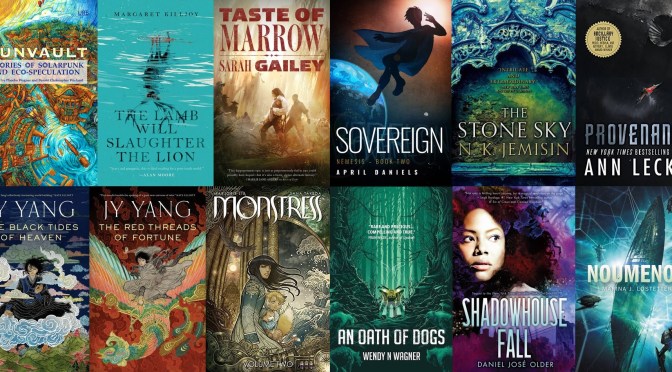
After an act of combat heroism, Josette Dupris gets a promotion that makes her the first woman to captain an airship in a military with strict limits on women’s service. This would be a tough enough challenge on its own, but Josette is also saddled with a spy, Bernat, a spoiled nobleman with no military or airship experience to speak of, but whose job is nonetheless to report back to his powerful uncle on any of Josette’s failings, real or imagined. It’s definitely the sort of thing that one needs to be in the mood to read, especially since there aren’t easy answers to Josette’s problems, but it’s also definitely worth reading. This isn’t a book about one woman smashing the patriarchy single-handedly, and in fact Josette is largely unconcerned with doing so; she just wants to do her job like she knows she’s capable of. The Guns Above is about the way in which an ambitious woman can exist and find ways to thrive in a sexist society, and it’s about the incremental changes and personal fights that slowly push the needle of progress forward. It’s also about gritty, action packed airship battles and snarky humor, which makes it a perfect light-ish summer read.

You need this book for the beach or next to the pool or out on the porch or inside an air-conditioned building or wherever else you’re reading this summer.

Luckily, courtesy of the publisher, I have a hardcover copy of The Guns Above that I’m giving away.

CLICK HERE ENTER THE GIVEAWAY – Ends July 16

State of the Blog and Weekend Links: July 2, 2017

The farther we get into 2017, the more I long for a–just one–completely uneventful week. I continue to struggle with productivity, although this week was better than most weeks in the last couple of months. I wrapped up my Spring Reading and posted my Summer Reading List, which will get us through the end of September, and that means a fresh start for me, writing-wise, as I do myself a kindness and set aside anything I had left unfinished from the spring so I can enjoy a brief respite from feelings of inadequacy before I get behind on summer stuff as well.

One thing I’m not behind on, at least not technically, is Let’s Read! Gormenghast, though I did take a break from it this week in order to finish some other things. I’m not making any promises about this coming week, as the holiday will take up at least some of the time I’d, frankly, much rather spend reading and writing about Titus Groan, but here’s what I’m (tentatively) planning the next few posts to cover:

  • Titus Groan Chapters 22-26
  • Titus Groan Chapters 27-31
  • Titus Groan Chapters 32-36
  • Titus Groan Chapters 37-39

I’ve already skimmed Chapters 22-26, and I’m fairly certain that will work as a section for a post, but I’ve continued to find it necessary to adjust my plans as I go because I find that the book comes with its own pretty obvious stopping points. Just based on previous experience, I fully expect to adjust one or more of these sections, give or take a chapter, as I get to them.

io9 lists all the must-read sci-fi and fantasy books coming out in July.

I finished reading Yoon Ha Lee’s Raven Stratagem and Theodora Goss’s The Strange Case of the Alchemist’s Daughter this week. Both were excellent, and I’m hoping to write some reviews in the next couple of days. In the meantime, Lee was interviewed at Lightspeed and Goss was interviewed for the B&N Sci-fi and Fantasy Blog.

Invisible 3, edited by Jim C. Hines and Mary Anne Mohanraj, is now available.

Kelly Robson beautifully makes the case for writing futures that include disability.

Joe Sherry is still reading his way through this year’s Hugo finalists. This week: novels.

Check out the cover and table of contents for Uncanny Magazine Issue 17.

In this month’s Clarkesworld, Fran Wilde writes about Invisible and Visible Engineering in Science Fiction.

At NPR, K. Tempest Bradford reminds us that, no really, cultural appropriation is, in fact, indefensible.

Kotaku has an interesting piece up on the women who helped create Dungeons & Dragons.

Nimona is going to be an animated movie.

At Fireside Fiction, Malka Older writes about The Narrative Spectrum.

The next installment of the Book Smugglers Gods & Monsters series of short fiction is out. Check out “The Waters and Wild of Winter Street” by Jessi Cole Jackson. Then be sure to read about the author’s inspirations and influences.

I have a feeling that Chuck Wendig’s advice on “ways to stay motivated in this shit-shellacked era of epic stupid” is going to be evergreen.

The SF Bluestocking 2017 Summer Reading List

It’s that time again, where I list all the things I wish I could be more certain I would have time and energy to read over the coming months. July, August and September are full of exciting new releases, a little light on sci-fi and heavier on fantasy than my recent tastes have been, but exciting nonetheless. Here’s what’s on my radar for the rest of the summer.

Tor.com Publishing

As always, I plan to read most of what Tor.com will be publishing. I always enjoy their novellas, though I will be skipping a couple of novels that are sequels in series I haven’t read yet (unless I somehow manage to read the rest of their respective series). Probably the titles I’m most looking forward to from Tor.com right now are that pair of JY Yang novellas at the end of September, but I’m also really hoping to finally get around to reading Infomocracy so I can read Null States when it comes out. I am bummed that there’s not another Sin du Jour book until November, though.

  • The Ghost Line by Andrew Neil Gray and J.S. Herbison – 7/11
    The concept on this one is a little ho hum, but I’m always down for another short space opera.
  • The Delirium Brief by Charles Stross – 7/11
    I won’t be reading this one because it’s about eight books deep into a series I haven’t read and am not interested in reading back that many books to get into.
  • The Five Daughters of the Moon by Leena Likitalo – 7/25
  • The Lamb Will Slaughter the Lion by Margaret Killjoy – 8/15
    “…pits utopian anarchists against rogue demon deer” is relevant to all of my interests.
  • Starfire: A Red Peace by Spencer Ellsworth – 8/22
  • A Song for Quiet by Cassandra Khaw – 8/29
  • The Ruin of Angels by Max Gladstone – 9/5 
    I keep trying, anytime I have downtime, to get into the Craft Sequence, but I’ve been unsuccessful so far. I’m not sure if I want to just skip this one or give up on reading the earlier ones and just start here since my understanding is that The Ruin of Angels stands alone just fine.
  • Acadie by Dave Hutchinson – 9/5
  • Taste of Marrow by Sarah Gailey – 9/12
    We seem to be living in an age of sequels surpassing their predecessors, so I have high hopes for this title.
  • The Twilight Pariah by Jeffrey Ford – 9/12
  • Null States by Malka Older – 9/19
    will finish Infomocracy in time to read this before release.
  • The Red Threads of Fortune by JY Yang – 9/26
  • The Black Tides of Heaven by JY Yang – 9/26

Magazines

  • FIYAH Literary Magazine, Issue 3, SUNDOWN TOWNS – 7/1
    Every issue of FIYAH is more beautiful than the one before. Just look at this gorgeous cover. I’m not familiar with any of the names on the table of contents for this one, but that only makes it more exciting.
  • Uncanny Magazine #17, July/August 2017
    I’ve already got my hands on Uncanny #17 because I’m a Kickstarter backer, and even though I haven’t dug into it yet, I can already tell it’s going to be a-MAZING. You can see the cover and table of contents at the Uncanny blog.
  • Uncanny Magazine #18, September/October 2017
  • POC Take Over Fantastic Stories
    This is, as far as I know, the final issue ever of Fantastic Stories of the Imagination, guest edited by Nisi Shawl and overflowing with stuff I am looking forward to reading.

Anthologies

2017 has been a year of trying to read more short fiction, and with that in mind I backed several anthologies on Kickstarter in the last year or so that should be coming out in the next couple of months.

  • Evil is a Matter of Perspective: An Anthology of Antagonists edited by Adrian Collins – Currently available.
    I backed this on Kickstarter because it sounded fun. The final product is a little white-dude-heavy, but I’m thinking it will work well for some light-ish reading at some point
  • Hath No Fury edited by Melanie R. Meadors and J.M. Martin – August?
    There’s not a firm release date for this Kickstarted anthology but I’m thinking mid-to-late summer.
  • Strange California edited by Jaym Gates and J. Daniel Blatt – August?
    Another kickstarted anthology with an interesting theme. I’m not from California, but my partner lived in the Bay Area for years and he was pretty interested in this book for that reason. I was excited because I’ve enjoyed stuff Jaym Gates has edited before and Strange California has a promising table of contents.
  • 2084: A Science Fiction Anthology from Unsung Stories – July?
    Another Kickstarted title with a great table of contents, although reading about dystopias gets less appealing all the time these days.
  • Sunvault: Stories of Solarpunk and Eco-Speculation edited by Phoebe Wagner and Brontë Christopher Wieland – 8/29
    I cannot wait to find out what solarpunk and eco-speculation are all about. And look at that gorgeous cover art by Likhain!

Comics and Graphic Novels

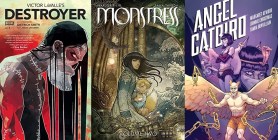
  • Victor LaValle’s Destroyer
    I’ll be buying and reading issues more or less as they are released.
  • Monstress, Volume 2: The Blood by Marjorie Liu and Sana Takeda – 7/11
    Hands down the trade I’m most excited for this year.
  • Angel Catbird, Volume 3: The Catbird Roars by Margaret Atwood, Johnny Christmas and Tamra Bonvillain – 7/4
    I believe this will wrap up the series.

Books

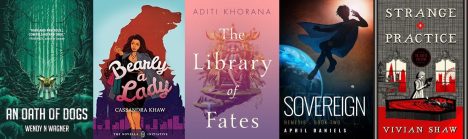
  • An Oath of Dogs by Wendy Wagner – 7/4
  • At the Table of Wolves by Kay Kenyon – 7/11
  • Bearly a Lady by Cassandra Khaw – 7/18
    I will likely be reading all the novellas and short fiction the Book Smugglers publish this year.
  • The Library of Fates by Aditi Khorana – 7/18
    I’m not reading much YA these days, but this one sounds good.
  • Sovereign by April Daniels – 7/25
    I really enjoyed Dreadnought earlier this year, but I may have to be in the right mood for this one. I’ve gone off super heroes a bit lately.
  • Strange Practice by Vivian Shaw – 7/25
  • Noumenon by Marina J. Lostetter – 8/1
  • The Stone Sky by N.K. Jemisin – 8/15
    The final book in Jemisin’s Broken Earth trilogy. Much anticipated.
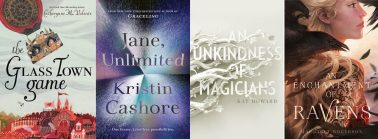
  • The Glass Town Game by Catherynne M. Valente – 9/5
    This is a middle grade novel, which chills my interest in it a tiny bit, but I think I will always read literally everything Catherynne Valente publishes.
  • Girls Made of Snow and Glass by Melissa Bashardoust – 9/5
    I’m always down for retold fairy tales, and this one is getting some excellent early reviews from people I trust.
  • An Excess Male by Maggie Shen King – 9/12
  • Shadowhouse Fall by Daniel José Older 9/12
  • Autonomous by Annalee Newitz – 9/19
  • Jane, Unlimited by Kristin Cashore – 9/19
    I’ve loved Kristin Cashore since I first read Graceling years ago, and it’s been far too long since I’ve gotten to read anything new by her. I’m still holding out hope for more Graceling Realm books, but this will definitely do in the meantime.
  • Provenance by Ann Leckie – 9/26
    New Ann Leckie. In the same universe as her Imperial Radch trilogy. I am stoked.
  • An Unkindness of Magicians by Kat Howard – 9/26
    This might be my favorite book cover of the season.
  • An Enchantment of Ravens by Margaret Rogerson – 9/26

The SF Bluestocking Spring 2017 Reading List Wrap-Up

Between personal life stuff (my car will not stop breaking down about once a week) and generalized depression and anxiety about the state of the country and the world, I didn’t get around to writing nearly as much as I’d have liked to about what I’ve read in the last three months, so I’ve been looking forward to writing this list and wrapping up this season of stress and frustration so I can move onto other things.

That said, there was so much great stuffed published over the last three months, and I ended up reading most (though by no means all) of my Spring Reading List. It’s been very sad to not have the energy to write about it all, so I’m glad to have begun doing these wrap-up posts so I can squee a bit about everything I’ve missed writing longer posts about.

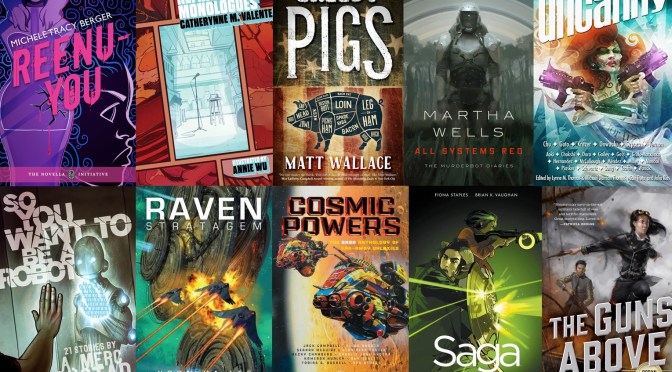
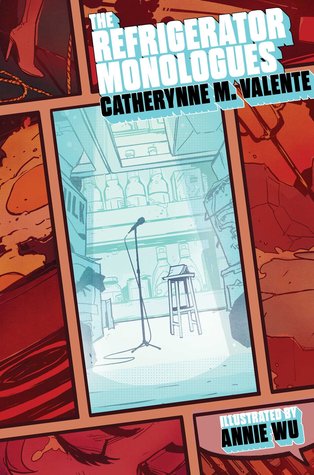
Best Fantasy Novel – The Refrigerator Monologues by Catherynne M. Valente

I have unequivocally loved everything I’ve ever read by Catherynne Valente, and The Refrigerator Monologues was always one of my most-anticipated releases of 2017, so it’s no surprise that I adored it. Valente has always had a way with language, and like all of her other work, The Refrigerator Monologues deserves to be read aloud, even if just to yourself. It’s smart and funny and furious and sad, and Valente has crafted a wonderfully original world of superheroes and a marvelous group of heroines with strong voices that are distinctive and familiar in turns.

Best Science Fiction Novel – Raven Stratagem by Yoon Ha Lee
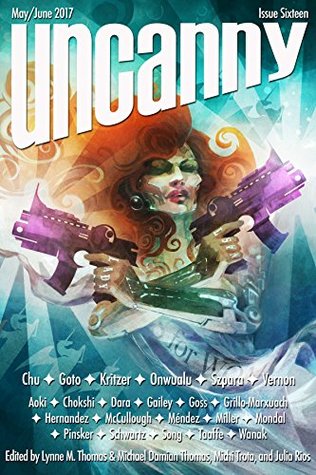
I’ve been following Yoon Ha Lee’s career with interest since picking up Conservation of Shadows a few years ago because I liked the cover and realizing that it was one of the finest SFF short fiction collections I’d ever read. Lee’s first novel, last year’s Ninefox Gambit, was among my favorite books of 2016, but he’s really outdone himself with Raven Stratagem, which is one of those rare second books in trilogies that is better than the first. Even having read some of Lee’s short fiction set in his Hexarchate universe, I sometimes struggled to follow parts of Ninefox Gambit, but that’s not the case with Raven Stratagem, which is all around a stronger book, more character-focused, with a more easily comprehensible plot and a great cathartic payoff at the end that sets things up for a very exciting third installment in the series.

Best Magazine – Uncanny #16, May/June 2017
Uncanny‘s Year Three has been outstanding in general, but this was an especially excellent issue. Sarah Gailey’s essay, “City of Villains: Why I Don’t Trust Batman,” went almost viral (and deservedly so) as soon as it was posted online, but it’s only one great piece in an issue heavy on wonderful nonfiction. My personal favorite essays were “Missive from a Woman in a Room in a City in a Country in a World Not Her Own” by Mimi Mondal and “How I Learned to Stop Worrying and Eat the Eyeball” by Dongwon Song. This issue is no slouch in the fiction and poetry department, either, with new short stories by Ursula Vernon (“Sun, Moon, Dust”) and Chinelo Onwualu (“Read Before Use”), among others, and a pair of lovely poems by Roshani Chokshi (“Dancing Princesses”) and Theodora Goss (“Seven Shoes”). Honestly, just buy the whole thing, and then think about backing Year Four (which will include a People with Disabilities Destroy Sci-Fi special issue) when the Kickstarter goes live in July.

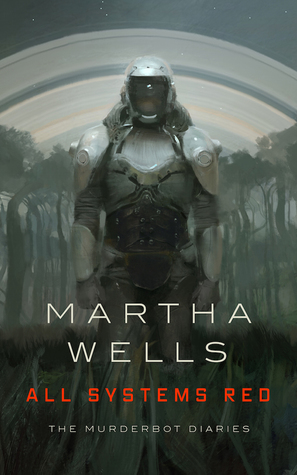
32758901Best Novella – All Systems Red by Martha Wells
I read an above average number of very good novellas in the last three months, but All Systems Red is a true standout even with stiff competition. A sci-fi adventure written from the point of view of a sentient cyborg/robot who calls itself “Murderbot,” All Systems Red has humor, excitement, a dash of horror, and criticism of capitalism–all things relevant to my interests–combined with a strong and unique narrative voice. The best part is that there are at least three more Murderbot stories forthcoming from Tor.com over the next year or so. I cannot wait.

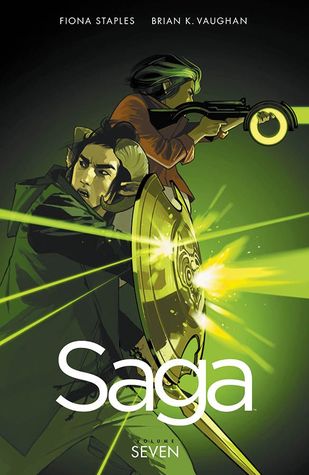
Best Comic Book – Saga, Volume 7 by Fiona Staples and Brian K. Vaughan

This seems an obvious choice, especially since I’m not a great reader of comics in general, but Saga is really, really good. This volume is full of all the weirdness one can always expect from this series, but it also comes with almost as much heartbreak (including at least one straight up gut punch) as the six previous volumes combined, so be sure to enjoy it with a box of tissues close at hand, possibly after several glasses of wine to preemptively dull the pain this book is pretty much guaranteed to make you feel.

Best Anthology – Cosmic Powers: The Saga Anthology of Far-Away Galaxies edited by John Joseph Adams

Listen. You’re almost never going to find any collection of short fiction that you like every bit of, but this anthology comes close for me. From the very funny “A Temporary Embarassment in Spacetime” by Charlie Jane Anders to the sharp and wryly witty “Zen and the Art of Starship Maintenance” by Tobias Buckell to Linda Nagata’s mother/daughter caper, “Diamond and the World Breaker, to a new Yoon Ha Lee Hexarchate story, “The Chameleon’s Gloves,” there’s something here for almost everyone. It’s an anthology with (cosmically) big ideas, a great deal of fun, and an entertainingly retro sensibility without sacrificing forward-thinking messages.

Best Collection – So You Want to Be a Robot and Other Stories by A. Merc Rustad
I only discovered A. Merc Rustad in January when I read their lovely story, “This is Not a Wardrobe Door,” at Fireside, but I loved that story so much that this collection was at the top of my to-read list as soon as I found out about it. So You Want to be a Robot and Other Stories collects that story and twenty more in a showcase of Rustad’s consistently good ideas and solid execution. Personal favorite stories in the collection include: “The Android’s Prehistoric Menagerie,” “Where Monsters Dance,” “Finding Home,” and “BATTERIES FOR YOUR DOOMBOT5000 ARE NOT INCLUDED.”

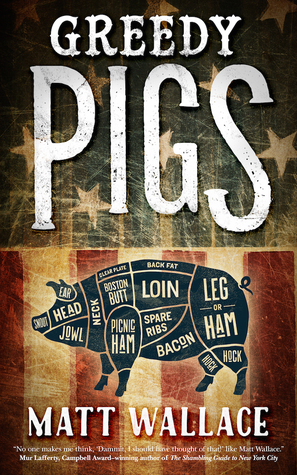
Best Sin du Jour Novella – Greedy Pigs by Matt Wallace
We’re up to book number five in this seven part series, and I am already getting sad about it ending. I’ve enjoyed this series since day one, and each installment continues to be better than the one before. In Greedy Pigs, the Sin du Jour team finds themselves accidentally catering an event for the President of the United States. Things get weird, obviously.

Best Non-SFF Thing – Natasha, Pierre & the Great Comet of 1812 Original Broadway Cast Recording

Not a book, I know, but I’m slightly obsessed with this musical right now. It’s based on about seventy pages from War and Peace by Leo Tolstoy, and it scratches basically all my itches. It’s ambitious. It’s funny. It’s literary. It’s gorgeously written and produced. It’s got accordions. It’s got Helene Kuragina, who is played by Amber Gray, who is a treasure and gives us this earworm:

Honorable Mentions:

  • Reenu-You by Michele Tracy Berger – Not the best written novella I read this spring, and it could have used another pass with a copy editor, but it’s a story that has stuck with me. Even weeks later, I still find myself thinking every couple of days about these characters and the way they bond through a shared trauma.
  • Victor LaValle’s Destroyer #1 – A promising first issue with a fresh take on classic source material.
  • “Beauty, Glory, Thrift” by Alison Tam – A delightful sci-fi adventure novelette.
  • Down Among the Sticks and Bones by Seanan McGuire – I only liked Every Heart a Doorway, but I loved Down Among the Sticks and Bones. I think if I’d read this one first, I’d have liked the other better as well.
  • The Guns Above by Robyn Bennis – I didn’t think I was in the mood for a book about a woman having to deal with sexist garbage, but this one is a good, fast read.

Biggest Disappointments: 

  • Ladycastle #4 – After this limited series started off strong, it ends with some baffling plot developments and a too-easy resolution.
  • River of Teeth by Sarah Gailey – This novella was fine. I like the hippos. But I think it’s a case of it being extremely over-hyped. I’m not sure what I expected, but it doesn’t seem near exciting enough on its own merits to earn all the superlative praise I’ve seen for it.
  • The Space Between the Stars by Anne Corlett – By about five chapters in, I’d predicted the book’s big “twist” and couldn’t even be bothered to finish it.