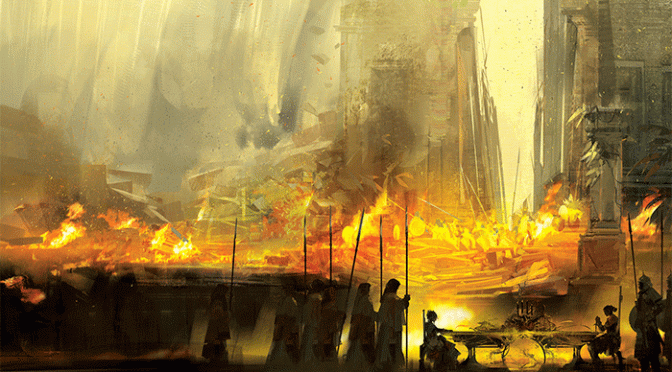
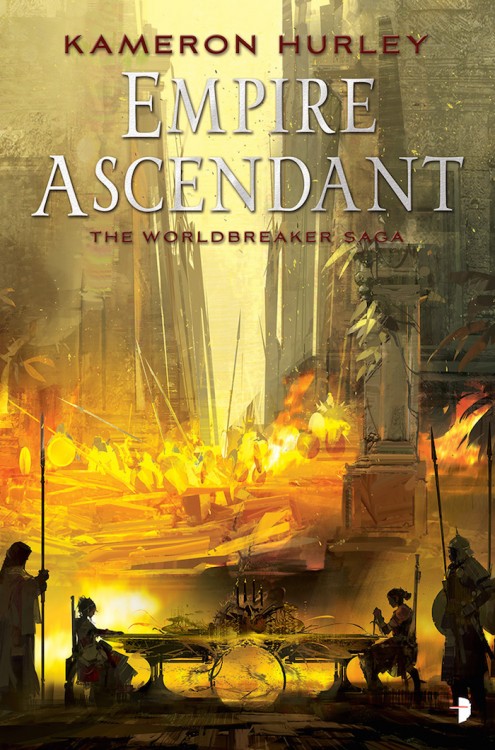
Empire Ascendant is definitely one of my top ten most anticipated books this year, so I’ve been waiting pretty anxiously to see what it will look like.
I’m not disappointed. This cover is gorgeous, and I can’t wait to have it on the shelf next to The Mirror Empire.
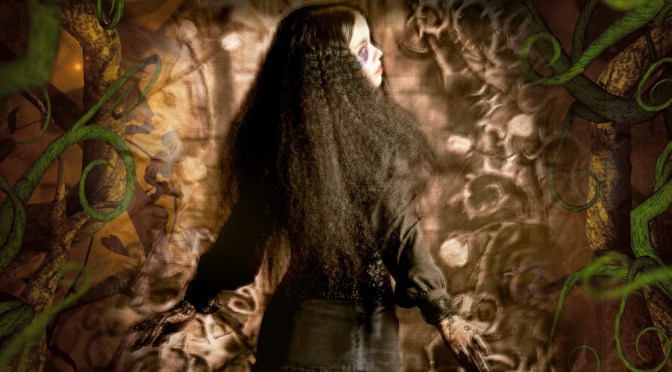
Spindle is a charming little self-published title by Tasmanian author W.R. Gingell. I received a copy of it through NetGalley, where I was drawn in by the book description and a surprisingly nice-looking (for self-publishing) cover image. It turns out that Spindle is a fast, fun read, well worth $2.99 for the Kindle version.
It’s a Sleeping Beauty story that begins with our heroine, Poly (short for Polyhymnia), being kissed awake by an enchanter named Luck, who managed to find a loophole in the curse. The rest of the book details their adventures as they work together to find a way to break the curse once and for all and defeat the evil wizard who created it.
Spindle definitely has some problems, most of which I think would have been solved by being put through a professional editorial process. There are a lot of adverbs as dialogue tags, which I find to be generally either distracting or redundant. There are a handful (but literally only a handful) of typos that might have been caught with just another once-over by someone detail-oriented. There is a lot of reusing of phrases and words that I can tell the author really likes, and I have some issues with a lot of word choices. The language often verges on pretentious and the book overall ends up being almost (but not quite) too preciously quirky.
All that said, I enjoyed Spindle a great deal, mostly because Gingell has come up with a great cast of characters, whose interactions with each other are interesting and compelling. I appreciated that Poly’s ending up with Luck wasn’t entirely a foregone conclusion from the first page, and I liked that she got to explore a couple of other romantic attractions with men who respected her. Poly’s adoption of Onepiece and her growth in her role as a parent to him is nice and gives Poly something to do and focus on besides dealing with her curse and sorting out her feelings about Luck. There are a good number of other female characters that Poly befriends, and I’m always happy to read about women having relationships that aren’t toxic. I particularly liked Poly’s friendship with Margaret.
Of course, probably the most important relationship Poly has is with Luck, the enchanter who woke her up. I’m not sure how I feel about this one, to be honest, because Luck is often a terribly annoying character. I didn’t care at all for the repeated descriptions of Luck as vague. It made him seem both boring–with just the one character trait–and it created a consistently comical image in my head of a dude just staring off into space all the time. It’s a poor word choice, in my opinion, and not one to inspire romantic feelings. As far as what we’re shown about Luck (as opposed to told), he’s often self-centered, distractable, uncommunicative, needlessly obscure, and awfully inconsiderate of nearly everyone around him. It seems like the relationship between Poly and Luck is supposed to be evolving over time, but mostly I felt like Poly just learned better coping mechanisms and became more self-sufficient. This is nice, but I found myself wondering why they needed to end up together at all.
In the end, the mad-cap high energy of Spindle manages to be more fun than annoying, and I’d recommend it as a piece of light reading that is a little reminiscent of Howl’s Moving Castle (the Studio Ghibli movie, not the book). I’m not dying to read any of W.R. Gingell’s older work, but I might keep an eye out for things she publishes in the future, especially if she gets picked up by a proper publisher who could help iron out some of the wrinkles in Gingell’s style.
Shadowshaper seems to be most often compared to Cassandra Clare’s Mortal Instruments, but it’s a terrible comparison. In fact, there is no comparison to be made that isn’t entirely superficial. Shadowshaper isn’t a flawless piece of work, but it’s not a mess of derivative, hackneyed tropes like the Mortal Instruments series was, either.
Yes, Shadowshaper also takes place in New York, but where Clare’s series was generic and poorly researched, Older’s book is set in the Bedford-Stuyvesant neighborhood that he resides in himself and has a strong sense of place that helps to draw the reader into the world he’s created.
Yes, Shadowshaper also has a teenage girl protagonist whose story starts when she begins seeing weird stuff and finds out she has magical powers, but where Clare’s Clary Fray is a bland cipher upon which the reader can self-project fairly freely, Older’s Sierra Santiago has a vibrant personality and a specific identity that invites the reader to share and understand her but not to become her. While Sierra has plenty of likable traits–she’s clever and brave and kind, for example–there are many things about her that I don’t expect will be universally relatable. As a white reader, I appreciate the gift that Older offers me–a tiny window into an experience of the world very different from my own–and I can only imagine how gratifying it must be for young people who share more of Sierra’s experiences to discover this book in libraries and bookstores that are far too full of characters like Clary Fray.
Yes, like Clary Fray, Sierra has a group of friends who help her fight the forces of darkness, but where Cassandra Clare’s Shadowhunters are a group thrown together by the most boring sort of destiny ever (and often don’t even seem to like each other), Sierra’s friend group in Shadowshaper is made up of people who are part of a community, and that community is really the whole point of the book. It feels real and organic, and the emotional payoffs, for the most part, feel earned.
Shadowshaper even has romance, but it doesn’t take over the novel, and it develops sensibly; at the end of the book, I felt like Sierra and Robbie were embarking on an exciting new part of their lives, but not as if everything was settled before the characters even graduated high school. I always appreciate when authors do YA romance without turning it into some sort of star-crossed, destined, One True Love situation. Young love deserves to be treated seriously, and teenagers’ emotions are deep and strong, but we seldom meet The One at that age. I tend to enjoy YA romance much more when authors keep it in perspective, and Older has done a nice job with it here, creating a heroine who likes a boy but doesn’t waste too much time overthinking the situation. Sierra has more important things to deal with, after all.
I would have liked this book to spend more time with Sierra’s mother, who I think is interesting enough to carry a book of her own. I felt like Maria’s change of heart about shadowshaping at the end of the book felt abrupt and more driven by what the author wanted to happen and how he wanted to end things than it was by anything that would normally have naturally happened with these characters. I understand wanting to write the happiest possible ending, but the way that this happens felt pretty inexplicable to me.
The shadowshaping magic itself was on the one hand really interesting, but on the other hand slightly nonsensical. It’s not exactly clear what this magic is capable of, and some of the descriptions of the magic Sierra works are confusing. One of the reasons I read this book in the first place was that it promised Caribbean magic. While I think it does a good job of capturing the sense that shadowshaping is specific to the culture depicted in the book, it’s on a bit more shaky ground when compared to other fantasy magic systems (but still worlds better than anything Cassandra Clare has written).
Shadowshaper is an excellent read overall, though. It’s fast-paced, and I had a hard time putting it down because I always wanted to know what happened next. While its flaws aren’t inconsiderable, I think they are more than made up for by its strengths–namely, it’s beautifully crafted setting and a delightfully plucky heroine. Also, it’s got an absolutely gorgeous cover.
“The Black Tower” might be the single best episode of television I’ve watched so far in 2015. It’s superbly written on its own, and it shines as an adaptation of a much-beloved novel. What (remarkably little, actually) is lost in the translation from page to screen is more than made up for by the incredible performances of Bertie Carvel (Jonathan Strange), Marc Warren (The Gentleman), and Ariyon Bakare (Stephen Black). This is definitely the best episode yet for all of these characters.
There’s no such thing as bad publicity?
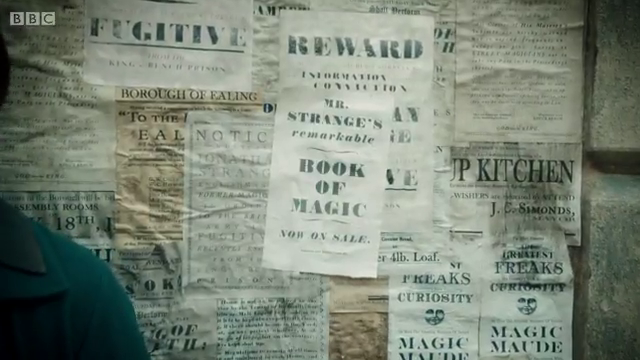
We begin the episode with breaking of two bits of Jonathan Strange news: his escape from jail and the publication of his book, The History and Practice of English Magic. The publisher is delighted, although he does point out that the one problem with having a fugitive author is that he doesn’t know where to send all the money they are raking in from the book sales.
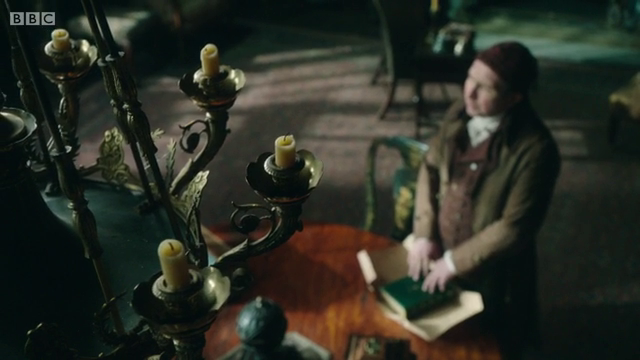
At his house in Hanover Square, Mr. Norrell opens his copy of Strange’s book, which is beautiful (a nice detail kept from the novel, where Strange insisted that part of his goal with the book was for it to be a work of art). The shot of Norrell weeping as he reads it is, I think, the most human and sympathetic we’ve seen him since his final tea with Strange, and it’s definitely the best we see of him in this episode.
Mr. Norrell casting his spell to destroy Jonathan Strange’s book.
It’s clear that Norrell has mixed feelings about the book, but he truly believes it to be dangerous enough that he puts down his copy at least long enough to magick all the other copies of it out of existence. The way they show this spell is kind of uncharacteristically (for this show, anyway) silly, as the books just start disappearing–each with an audible pop–but it’s a welcome bit of levity in an otherwise very dark episode. And, honestly, I suppose that for many bibliophiles, this tiny bit of comedy isn’t going to distract from what an enormous crime it is for anyone to censor any book as completely as Norrell does Strange’s.
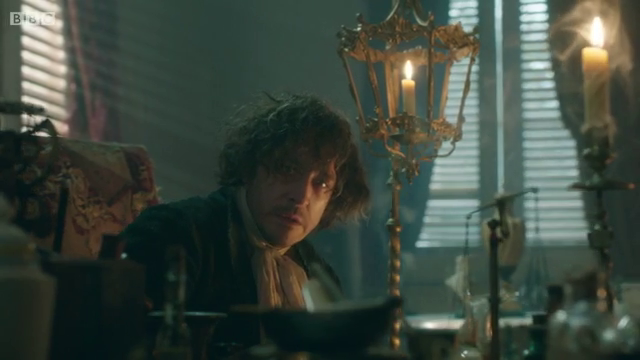
Jonathan Strange in Venice.
In Venice, and completely unaware of Norrell’s destruction of the book, Jonathan Strange is hard at work trying to summon a fairy, and he’s looking much the worse for wear. He’s also, frustratingly, consistently successful at summoning the Gentleman. He just can’t see him. My favorite thing about these first scenes of Strange is how perfectly realized his Venice workshop is. It looks like exactly the sort of place that a wealthy and slightly mad and extremely single-minded fugitive magician on a mission might be hanging out. My only criticism is that it looks like he’s been there for years rather than for only a couple of months, and so it becomes another sort of example of the show’s struggles with conveying the passage of time.
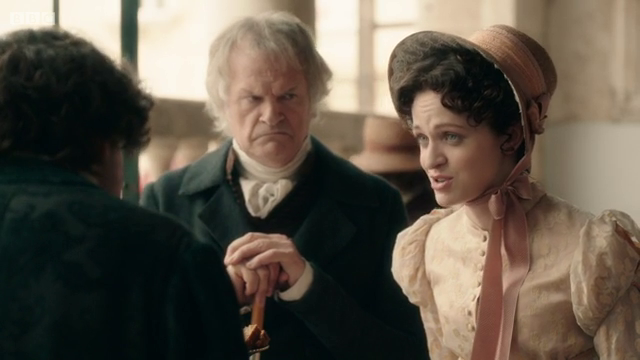
Jonathan Strange has lunch with the Greysteels.
I was super excited to see that they managed to squeeze in the Greysteels, and it turns out that Flora is at least as delightful in the show as she ever was in the book. Jonathan Strange’s first meeting with Flora and her father is excellently done, if a little rushed. They managed to get Clive Mantle to play Dr. Greysteel, and literally every look on his face is my favorite. He is so fed up with Flora’s shenanigans, but she’s clearly a force of nature he can’t control even a little bit. The Greysteels have been visiting with Mrs. Delgado, the crazy cat lady from the book, and have I mentioned how happy I am that they didn’t cut Venice and the Greysteels from the show?
“All you men leave me in peace.”
At Starecross, Vinculus is trying to convince Stephen Black to let him out of his cell, and Lady Pole is just fucking done. She’s exhausted with trying to communicate with people about her situation, and she’s disheartened (though not particularly surprised) to learn that Jonathan Strange has fled the country. It seems that she has finally given up on their ability to be of any help to her at all, and she intends to sleep so that she may keep watch over Arabella at Lost-Hope.
Well, this is embarrassing.
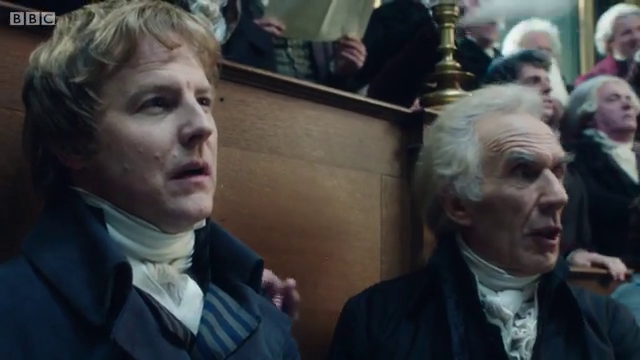
In Parliament, we get to see a great shouting match, as Sir Walter Pole and Lord Liverpool have become pretty unpopular these days. Basically everyone is pissed off about the magicians, and they blame Sir Walter particularly for promoting them.
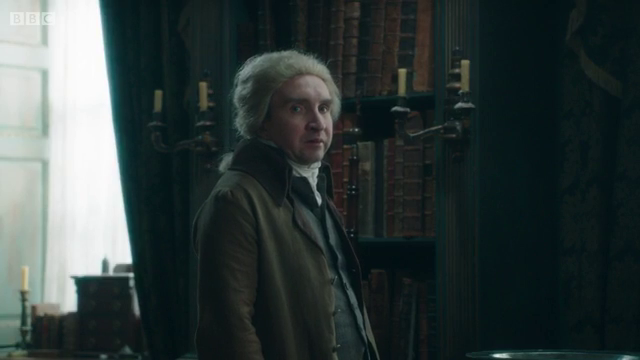
At Hanover Square, Mr. Norrell is desperate to learn what Jonathan Strange is doing, and this precipitates a trip to the prison to ask Drawlight about it. Poor Drawlight is looking even more poorly than Jonathan Strange these days, but he’s still managed to glean some gossip about the magician and his doings in Venice. To learn more, Norrell sends Drawlight to Venice to spy on Strange in person. While this is basically what happened in the book, I felt like it was out of character for Norrell to threaten Drawlight in person the way he did here. In the book, it’s Lascelles who retrieves Drawlight and sends him on his way alone, because Norrell doesn’t get his hands dirty with that sort of thing. I suppose I understand why it might be easier to film it the way they did in the show, especially in an episode where Norrell has relatively little screentime when compared to Jonathan Strange, but still. It’s a small departure that actually makes a fairly big difference in the way we understand Norrell’s character during this part of the story, and I don’t care for it.
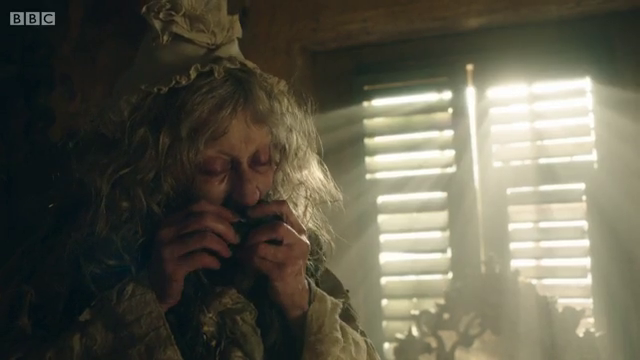
Mrs. Delgado.
Returning to Venice, Jonathan Strange has decided to pay his own visit to Mrs. Delgado. He offers to give her her heart’s desire if she will teach him to be mad. The deal is quickly struck; Mrs. Delgado is turned into a cat, and Jonathan Strange has concentrated all of the old widow’s madness into one dead mouse. He tries to eat the mouse whole, but finds that Mrs. Delgado’s madness was even stronger than he expected it to be, so he returns to his laboratory to try using it a different way.
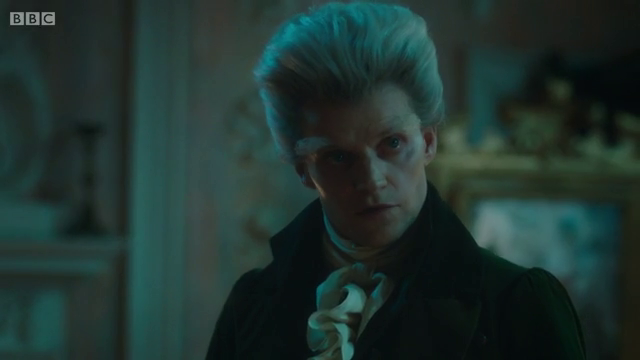
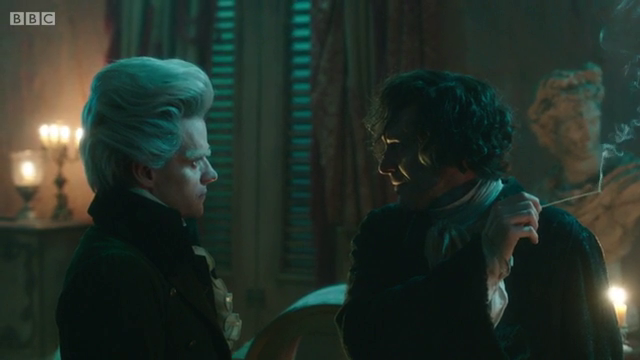
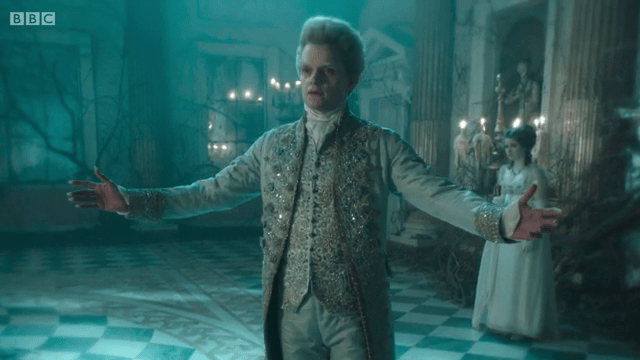
Marc Warren gives great face as the Gentleman in this episode.
After steeping the dead mouse in some water (and I’m not sure if this is more or less disgusting than the way he ground up the dried mouse and mixed it with water in the book), Jonathan Strange drinks a few drops of the mouse liquid and continues on with trying to summon a fairy. Sure enough, Jonathan finds himself able to see the Gentleman on his very next summoning attempt, for all that he is nearly too mad to realize at first what he’s done.
For his part, the Gentleman is just absolutely furious, although quietly so, and as soon as Strange releases him from the summoning he goes to complain to Stephen Black about it. Still at Starecross, Stephen Black decides after this visit from the Gentleman to listen to Vinculus, who promises that he knows how to free Stephen from the fairy. When Stephen leaves Starecross, he has Vinculus hidden in the back of his cart.
Back in Venice again, Drawlight has arrived and is rather conspicuously lurking about in the background as Flora Greysteel helps Jonathan Strange shop for a dress for his wife. Clearly in high spirits following his first successful contact with a fairy, Jonathan is practically effervescent as he fills Flora in on his plans to revive Arabella and restore magic to England. Flora asks if he will teach her, and Strange affirms that he will teach “all the women and the poor men,” and this affirmation is an important piece of the characterization of Jonathan Strange as having a much more egalitarian philosophy than the very class-conscious and chauvinistic Mr. Norrell.
The second meeting.
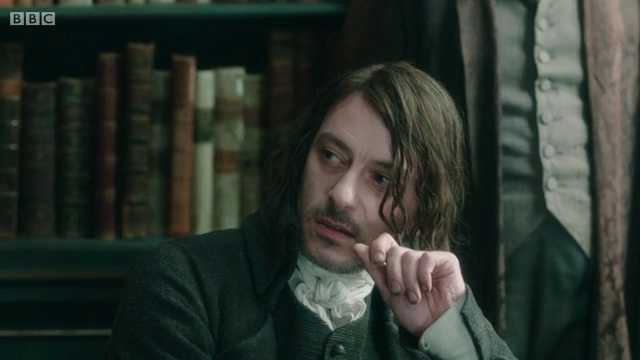
Jonathan Strange’s second meeting with the Gentleman doesn’t go nearly so well as he’d hoped. Strange is prepared to negotiate for Arabella’s resurrection, but the Gentleman’s reply is a flat no. He cannot resurrect Arabella because of “certain circumstances”–obviously, to the viewer, the fact that Arabella is not, in fact, dead at all. Unfortunately, Jonathan Strange knows nothing of this, and his pain is palpable. However, this leads Strange to question the Gentleman about his previous interactions with English magicians, and this is how Jonathan Strange discovers the secret of how Mr. Norrell resurrected Lady Pole.
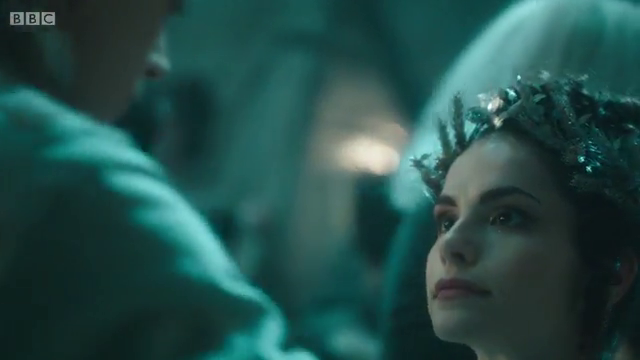
Lady Pole at Lost-Hope, disappointed again.
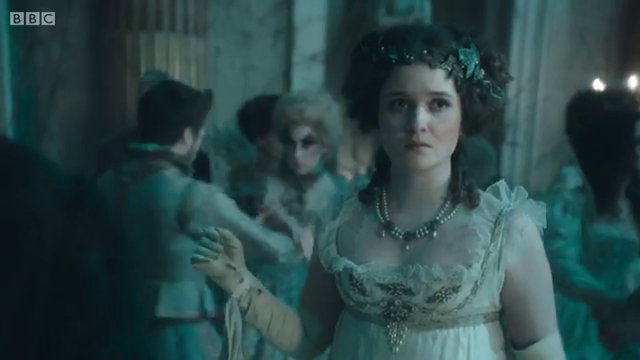
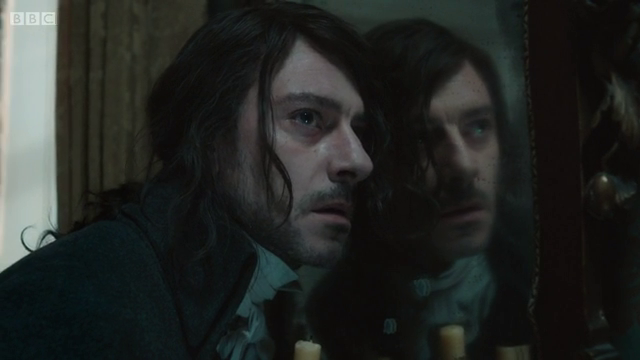
Denied his wife, Strange demands that the fairy bring him a token from his last dealing with an English magician, and he receives Lady Pole’s finger in a box. Using the finger, Strange is able to travel through a mirror to reach Lost-Hope, where he finds himself at one of the Gentleman’s balls. Strange is greeted first by Stephen Black, who is aghast at the magician’s appearance there. Then he is met by Lady Pole who at first, hopefully, asks if Strange has come to rescue them, but quickly becomes deflated when she realizes that he had no idea that she or Stephen or Arabella were even there.
Jonathan Strange faces the Gentleman alone.
When Jonathan sees Arabella, he becomes distraught and yells for the Gentleman to release her, but the fairy instead dispels all of the revelers except Stephen Black. All of the fairy Gentleman’s anger at the magicians is released in one terrific spell. Though it drains much of his strength to do it, the Gentleman curses Jonathan Strange with eternal darkness and deports the magician from Lost-Hope.
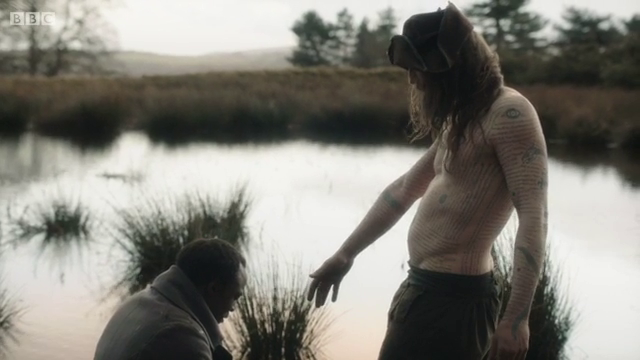
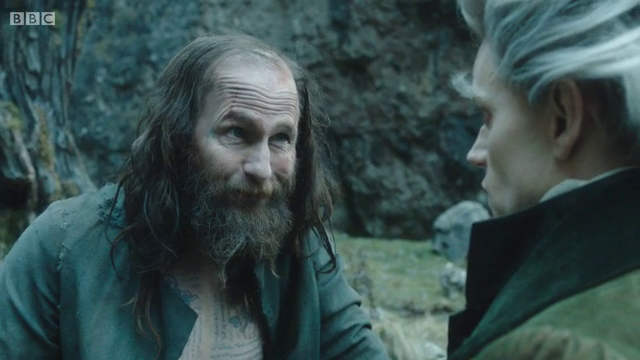
Before we see what happens to Jonathan Strange, Stephen Black wakes up back in the English countryside, where he is still traveling with Vinculus. As they prepare to continue on their journey, Stephen confronts Vinculus about the prophecy and demands to see the book that Vinculus claims to have, at which point Vinculus strips off his shirt to show that he is the Book of the Raven King.
Stephen Black and Vinculus.
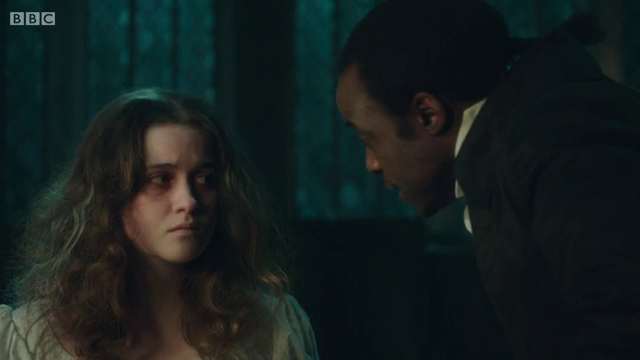
“Our meaning is written in our skin,” Vinculus intones, to which Stephen Black says that his skin means that he will always face racism and oppression. Vinculus replies that his skin says the opposite, and that Stephen Black “will be raised on high” and become a king. It’s a powerful scene, and Ariyon Bakare’s performance is note perfect. The show has often struggled with doing justice to the character of Stephen Black, but I think they really nailed it here. It also helps that in this episode they finally shot some Stephen Black scenes outside of poorly lit English houses so we can see a bit more of Ariyon Bakare’s face, which is highly expressive when not in shadows.
Flora Greysteel enters the darkness.
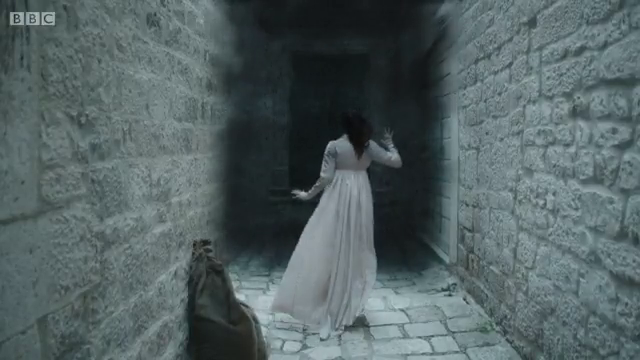
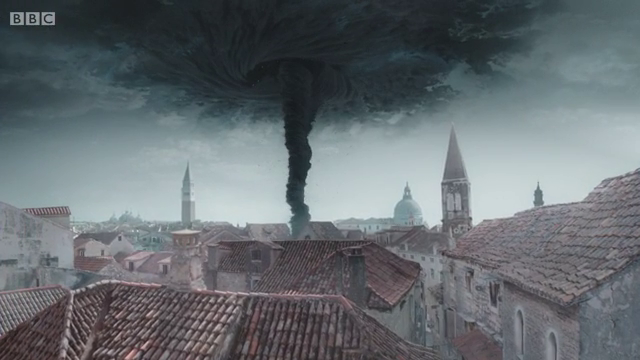
In Venice, an enormous, swirling tower of darkness has appeared over the city. While most of the city’s denizens are fleeing, Flora Greysteel runs towards it–because of course she’s the sort of woman who runs to the danger instead of away from it. She finds Jonathan, who tries to send her away, but Flora is desperate to help her friend. Strange tells her that she will know what to do when the time comes for her to help him, but she is only persuaded to go when her father comes to escort her to safety. They pass Drawlight on their way out, and when they get back to their own apartments, there is a mirror waiting there under a blanket.
The Black Tower.
Unable to learn anything from the Greysteels, Drawlight tries to leave town, but finds himself being chased by the tower of darkness, which is calling his name. The poor man finds himself pulled to the center of the darkness, where he comes upon Jonathan Strange, who promises not to harm him if Drawlight will take three messages to England. First, the box with Lady Pole’s finger and the explanation for it must be given to Childermass. Second, there is a letter for Lady Pole herself. And the third message, as it was in the book, is for Mr. Norrell and is simply, “I am coming.”
Once more at Hanover Square, Mr. Norrell is preparing to leave for his home and library at Hurtfew Abbey when Sir Walter and the Lord Liverpool arrive with a final commission from the government: stop Jonathan Strange. Mr. Norrell upbraids the Ministers for encouraging Strange in the first place, and then says that he doesn’t even know if he can stop Jonathan Strange or even what Strange is capable of doing.
Childermass notices the mirrors first.
While Mr. Norrell’s household is finishing packing up his belongings, Childermass notices strange sounds coming from the mirrors in the house–like faint scratching or the pecking of birds. After the Ministers have left, Norrell is examining a large mirror more closely, when it smashes open and a flood of ravens bursts out of it, which is terribly dramatic and a striking visual effect.
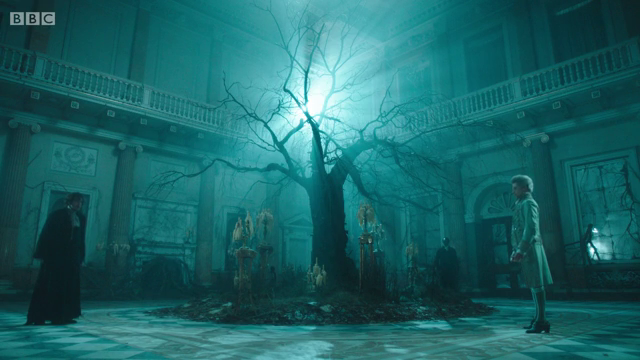
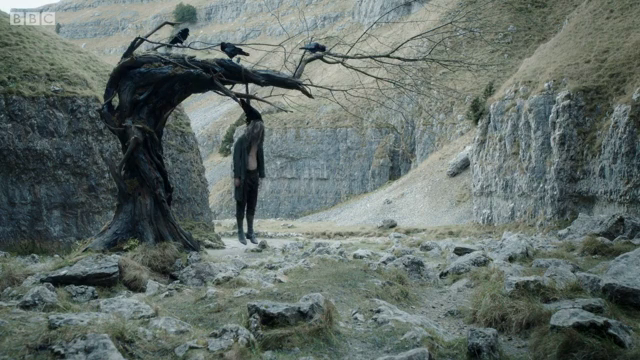
The episode ends with Vinculus’s meeting with the tree. As soon as they arrive at the out of the way place–a sort of canyon, with just one tree in the center of it–Stephen Black points out that this is not a friendly looking place, but the camp out to wait anyway.
Vinculus and the Gentleman.
Soon enough, the Gentleman arrives, visiting Stephen for the first time since he cursed Jonathan Strange and still in a peculiar mood. When he realizes that Vinculus can see him, the Gentleman seems to turn his residual malice on this new target, suggesting that they kill Vinculus and then go do something else. Vinculus informs the fairy that he will find that Vinculus is “a hard man to kill,” but, while Stephen Black weeps helplessly, the Gentleman hangs Vinculus anyway. Keeping with the tarot card symbolism that was so common in the book, “The Black Tower” has as its final image a hanged man in a tree rather ominously covered with ravens.
The Mary Sue recommends Star vs. the Forces of Evil, which looks pretty freakin’ adorable. If I don’t watch it, I’ll definitely suggest it to my daughter if I can tear her away from her current FairyTail obsession.
In spite of its awful title–I actually find it, like, deeply and viscerally disgusting–“Vessel” was an episode good enough to keep me watching this show for at least one more week.
There are some tropes on display in this episode that are usually pretty annoying, but that I think are mostly well-executed here. I do tend to have a soft spot for badass pregnant women in fiction, though, and so I’m willing to forgive quite a lot just because I love the characters of Constance and Jenny.
I actually like Constance and Jenny so much that I’m not even going to write much about the rest of the episode. Dutch is still mysterious, and she’s mysteriously in possession of some fancy musical instrument that usually only belongs to royalty. The newly introduced Delle Seyah Kendry is fascinating, and I kind of liked the dynamic between her and Dutch, although I thought things were wrapped up a little too neatly at the end. I kind of liked that D’avin was so good with the girls, although I also sort of hated that his basic human decency (learning their names! gasp!) is played for laughs.
The surrogates.
Back to Jenny and Constance, though.
If the show really feels like they must write an episode dealing with young women who are in a sort of fertility cult where they are surrogates for wealthy people, I generally approve of the way it was done in this episode. These aren’t poor, sad, ignorant girls. They are interesting young women who are trying to make the best of what life has handed them.
Jenny saving the day.
Jenny, it turns out, is something of an engineer, but when her family couldn’t afford to keep her she got sent to be a surrogate. However, this doesn’t stop her from continuing to develop and use her skills. Unfortunately, Jenny dies in the episode when she kind of inexplicably decides to suicide bomb the men who are trying to capture Constance. It’s an effective tactic, though, and Jenny’s sacrifice clears the way for the remaining girls to escape.
Sadly, I don’t think Jenny’s death is treated with a truly appropriate amount of gravity–the team just keeps on with barely a pause to think about what just happened. Obviously this sort of “job of the week” show is going to have some kind of disposable single-episode characters, but I’d prefer if Jenny wasn’t so disposable, especially when I’m still not sure why she didn’t just throw the grenade instead of walking it to the bad guys herself. This makes her character seem not just disposable, but senselessly disposable in an effort to elicit a cheap emotional response from the audience that isn’t backed up by the other characters in the show.
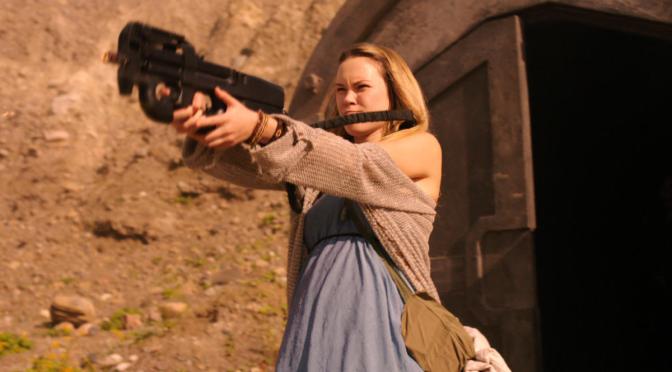
Constance, however, is a consistently great character, in my opinion, and I think this is shown best in her interactions with Dutch, who seems at first to think that all the surrogates are sad, brainwashed waifs who need a Strong Female Character to rescue them. Dutch is quickly disabused of this notion, however. Constance actually has a pretty realistic view of her situation, she’s not afraid to advocate and make choices for herself, and she clearly knows her way around a gun.
Constance and Dutch.
I loved the conversation when Constance is going into labor and Dutch stops to ask what Constance wants. Dutch has so far bit a bit of a cipher, and she’s only being very slowly rounded out as a character, so it was nice to see her have a sort of human moment here. It also makes me happy to see women supporting women–especially women like Dutch, who is (so far, anyway) so much a totally stock version of the badass fighter type of Strong Female Character.
Constance is a character with a different sort of strength, and I enjoyed seeing Dutch increasingly come to accept that over the course of the episode. By the end, when Constance refuses the opportunity to help raise the child she bore in favor of dedicating her life to helping other young women like herself, Dutch seems to have come to truly respect her and again supports Constance’s choice.
Dutch and Delle Seyah. Dutch Seyah? I could go down with this ship.
This unconditional support for and respect of women’s choices was a strong theme in this episode, although it felt a bit buried by the end underneath the sheer amount of exposition “Vessel” contained about the Killjoys universe and its politics. I definitely feel like I have a better grasp on the politics of the Quad after this, and I’m looking forward to more intrigue with Delle Seyah, but I would have liked to see a bit more character development at this point. “D’avin and John are nice to women” isn’t character development, and was, frankly, a bit undermined anyway when they were discussing Dutch’s bangability at the end of the episode.
I’m glad to see things moving along in the show, even slowly, and I’m not ready to quit watching yet, but I still think it’s uneven and inconsistent.
I’m not sure that most people would agree with me that The Philosopher Kings is a fun read, but I enjoyed it at least as well as I did its predecessor, The Just City. After the rather abrupt and somewhat shocking ending of the previous book, I couldn’t wait to see what happened next.
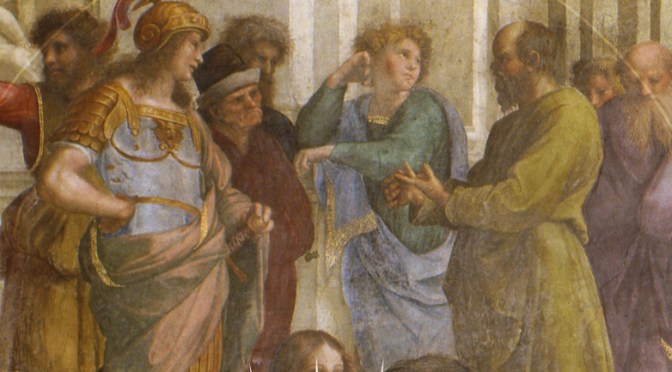
This book returns to the Just City, but after a gap of about twenty years. Since the Last Debate (between Socrates and Athena) things have changed considerably. After transforming Socrates into a gadfly, Athena departed in a huff, taking all but two of the robot Workers with her. Kebes and about a hundred and fifty other people (including several Masters) disappeared with one of the settlement’s two ships. After all this, the remaining people in the city split into more cities, each dedicated to realizing Plato’s Republic in slightly different ways. This went well enough at first, but in later years the cities have begun to fight over the art that was originally brought to the Just City, and there are now frequent battles between cities and works of art are stolen back and forth between them.
The Philosopher Kings begins with one of these art raids in progress, and Simmea (one of the points of view in The Just City) is killed in the fighting. Pytheas could have killed his human body, regained his powers as Apollo, and healed Simmea before she died, but she stopped him. The rest of the book is, ostensibly, about Pytheas’s quest to figure out why Simmea did this. Really, though, The Philosopher Kings picks up where The Just City left off with exploring the answers to the question: What would happen if people actually tried to put Plato’s ideas into practice?
It turns out that all sorts of things could happen, and we get to see several of them in this book. It’s fascinating to see how the different cities that split off from the original one have turned out, and it’s interesting to see what Kebes and his people have done after leaving the island. I like that even though the original city has fractured into smaller groups, even those smaller groups aren’t entirely like-minded.
The new narrator for this book is Simmea’s daughter with Pytheas, Arete (“excellence”), who is fifteen. She’s smart and kind and likable, but she still manages to seem like a fifteen-year-old. It’s nice to read a teen protagonist who isn’t overly precocious and who doesn’t have everything all figured out. Besides Arete, Pytheas returns as an occasional narrator, and it’s clear how much he’s grown up in twenty years. However, Simmea’s death affects him deeply and forces him to go through yet another sort of coming of age in this book. We really get to see how much he depended upon Simmea and how pretty much his entire life was his relationship with her, especially as the children they’ve raised are all adults now except for Arete. For Pytheas, this book is about finding his place in the community outside his own family. Also returning with point of view chapters in The Philosopher Kings is Maia, who is now in her fifties. While few in number, her chapters are by far my favorite parts of the novel.
The only problem that I had with The Philosopher Kings is the way it dealt with rape. While I appreciate that this book didn’t forget Maia’s or Simmea’s rapes in The Just City, Simmea’s rape is used too much as a motivating force for Pytheas and Maia’s rapist, Ikaros, is largely redeemed by the end of the book, in the narrative if not in the eyes of the reader. While I think the intent is not to treat rape lightly–rather, the impression I got was that it’s just one more messy aspect of human interactions that would be better in a more just society–I also think it kind of does treat rape lightly. Ikaros, in particular, is given too much credit, in my opinion, for being a fundamentally decent person, and there are some things he says to Maia in this book that had me absolutely seeing red on her behalf.
Some readers have complained that the book is overly philosophical with too much debating going on, but I, personally, adore the debates between characters. This was a common complaint about The Just City as well, so if you didn’t like that book you probably won’t enjoy this one any more. Another complaint that I’ve seen about this book in particular is that it abruptly and unexpectedly turned into science fiction at the end, but this is also something that appealed to me. Of course, that’s partly because, to my mind, this series has always been science fiction (I mean, robots.), but it’s also because I enjoy heavy handed genre bending of this kind.
With that in mind, I was super thrilled to learn that this isn’t a duology as I originally thought, but a trilogy. The bad news, of course, is that it’s not a six month wait like between the first two books. Per Jo Walton herself, it looks like we can’t expect to see Necessity before mid 2016.
Compared the the first four episodes of Jonathan Strange & Mr. Norrell, not a lot happens in this episode. Instead, “Arabella” is a slower-paced hour focused on character development and feelings. Overall, I think it’s a strong episode, but there were a couple of odd adaptational decisions that I’m not thrilled with.
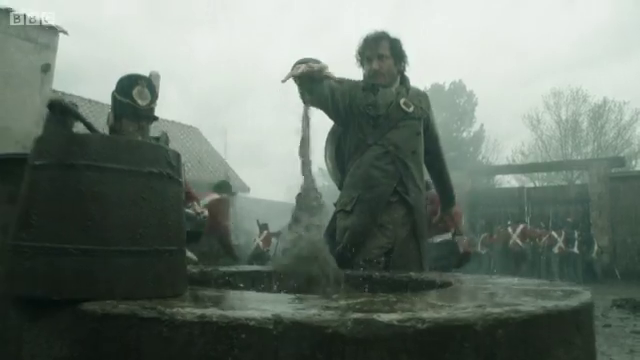
Jonathan Strange pulling water from the well. I DO love the look of the magic in this show.
The episode begins with Jonathan Strange at the Battle of Waterloo, which doesn’t feel anywhere near as epic as it did in the book. We see nothing of Brussels. Instead the action takes place in an almost comically tiny fort surrounded by a veritable sea of CGI army guys, although most of the actual action in the wide shots is obscured by an enormous cloud of smoke and the whole battle is over in just a couple of minutes.
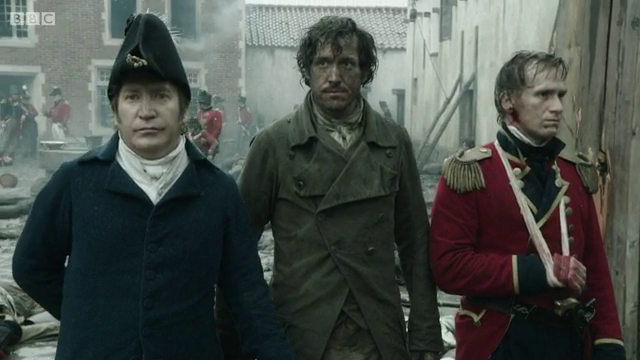
Wellington, Strange, and Grant at the end of the battle.
During the battle, Jonathan Strange magicks some water out of a well to put out a fire, whips up some vines to keep some guys from climbing the walls of the fort, and almost gets blown up. In a moment of desperation, Strange uses his magic to make a huge mud hand and squishes a guy that was about to kill him–very clearly violating his own earlier statement that a gentleman would never kill anyone with magic. It ought to be a huge deal, but everything happens so quickly that I didn’t really feel the weight of this moment. Even the wide shot of the devastated battleground and a long look at the melancholy faces of Wellington, Strange, and Grant as they observe it just feels off–probably because Wellington ruins the gravitas of the moment by wondering aloud what will be done with them now. I suppose this could be read as ironic, but I just didn’t like it. It would have been better to just stick with the three men silently looking at the horrors of war.
When Jonathan Strange returns to England, he goes back to residing at his country house, Ashfair in Shropshire. He’s obviously quite changed by his experiences in the war–his hands shake, and he’s got a touch of gray in his hair–but he seems focused on rebuilding his life with Arabella and writing his book. I like these quiet domestic scenes, and I love that Arabella is the illustrator of her husband’s book, but I feel like everything goes a little too quickly back to something a little too close to normal after Jonathan’s trauma at Waterloo. Mostly, while I think the gray in his hair and the tremble in his hands are nice, subtle ways of showing the change in him, Jonathan’s final decision to use magic to kill is not really commented on in any specific way, but ends up sort of smushed together with the whole war experience.
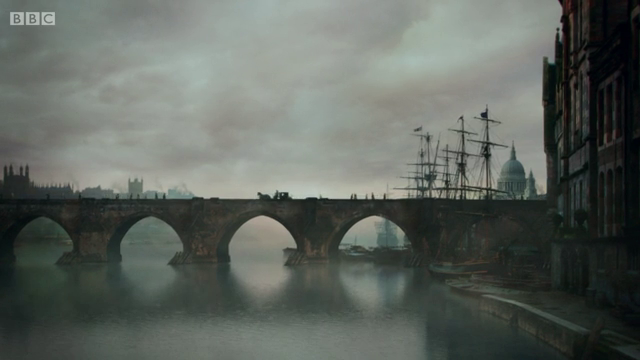
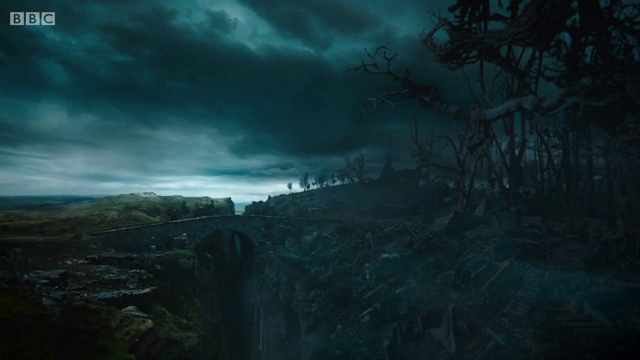
One thing this show does nicely is create gorgeous, atmospheric scenery, even if it does feel a little out of place. I loved this shot, but it doesn’t really fit the tone of what follows.
Back in London (introduced in this episode with the above shot), Mr. Norrell is denouncing Jonathan Strange to anyone who will listen and frantically trying to find a way to prevent the publication of Strange’s book. I was happy to see the show include the publisher, Murray, who practically laughs Norrell out of the room when Norrell and Lascelles try to bully him.
Moss oak Arabella.
While the moss oak Arabella we saw at the end of the last episode wanders the countryside freaking out honest folk, Lady Pole dreams that Arabella will be taken by the Gentleman and tries rather unsuccessfully to communicate her fears to Segundus and Honeyfoot. Lady Pole beseeches them to send a message to Jonathan Strange, but it is too late. Stephen Black comes in the night and spirits Arabella away to Lost-Hope.
The border between England and Faerie is another beautiful piece of scenery.
This decision to have Stephen be the one who actually, physically kidnaps Arabella is one that I just can’t get on board with because it seems so out of character. We’ve seen Stephen hanging around with the Gentleman quite a bit, but he always seems reluctant at best and more often revolted by the fairy. We’ve even gotten to see Stephen Black’s subtle resistance of the Gentleman, even though Stephen becomes increasingly hopeless and despondent as things continue on. Even in this episode, there are times when Stephen refuses to do the Gentleman’s bidding while they are in the same room together, so it doesn’t make sense that Stephen would kidnap Arabella on his own, without any evidence of his being compelled to do so and with such evident guilt and shame about doing it.
In the novel, it’s actually left somewhat mysterious exactly how the Gentleman manages to steal Arabella away in the night, and I think that something similar could have been done on the show. Or they could have had some random fairies do it. Or they could have had the Gentleman in the carriage as well. Or literally almost anything except having Stephen Black be the sole kidnapper.
Enchanted Arabella is almost creepier than moss oak Arabella.
One thing I like about the way that Arabella’s enchantment is handled is that it’s made very clear exactly how Jonathan Strange is tricked into renouncing his wife. I’ve never felt that this was particularly well done in the book, but in the show it’s pretty unambiguous. However, then the show turns right around and does another thing I don’t like: has Arabella enchanted in such a way that she doesn’t remember her life before Lost-Hope at all.
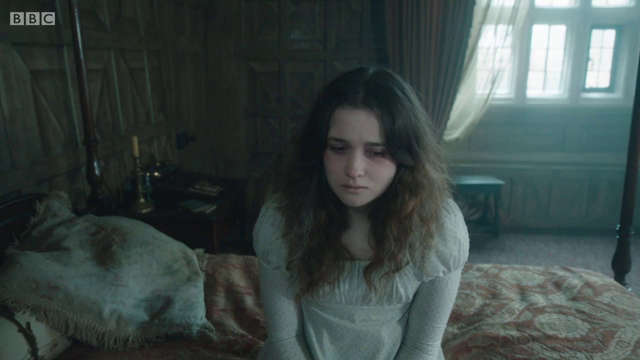
Poor Lady Pole.
In the book, Arabella and Lady Pole are both very aware of what has happened to them, and while this doesn’t exactly give them any agency or control over their stories, it does give them distinct personalities. Lady Pole simmers with fury and frustration. She resents Mr. Norrell for his abuse of her and she has no good opinion of Jonathan Strange for what she sees as his neglect of his wife. Arabella, on the other hand, is trapped entirely in faerie instead of dealing with the stress of living in two worlds like her friend. Where Lady Pole has no faith in the magicians’ ability (or desire) to rescue either of them, Arabella holds onto hope that her husband will come for her.
I actually really hate that we are losing this dynamic in the show. After all the show has done to treat these two women fairly in the narrative, even expanding upon Lady Pole’s role quite a bit, it’s deeply disappointing that they’ve sort of senselessly cut out this part of their relationship. If nothing else, it kind of cruelly deprives Lady Pole of the comfort of her friend, and for no real reason.
At Ashfair, Jonathan Strange doesn’t notice that Arabella is gone until a neighbor arrives to tell him that she’s been seen wandering the countryside again. When it’s discovered that she’s not in the house, Strange first attempts to use magic to locate her but is confused when his scrying says that she’s not in England, Scotland, or Wales. Strange and a search party go out to look for her, and they soon find moss oak Arabella and return her to the house. After extracting Jonathan’s assurances that she is his only wife, moss oak Arabella dies in the night.
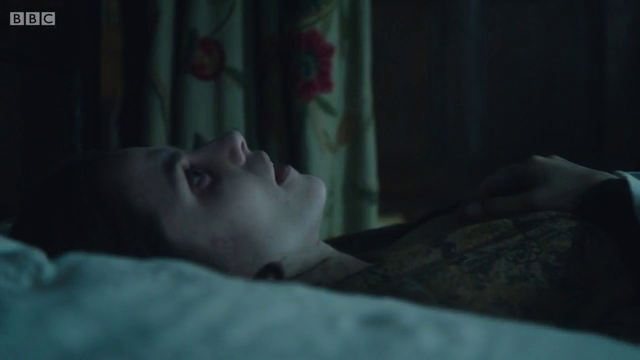
Dead “Arabella.”
When Jonathan Strange wakes up to find what he thinks is his wife’s (rather gruesome-looking) corpse, I think it’s fair to say that he loses it. By the time his brother-in-law, Henry Woodhope, arrives, Strange is well into searching through what books he has looking for a clue for how to return Arabella to life. In desperation, Strange even writes to his old tutor begging for help, offering to give up magic entirely if only Mr. Norrell will tell him how he brought back Lady Pole.
Childermass is starting to lose patience with Mr. Norrell’s shit.
In London, Mr. Norrell has still been trying to figure out how to prevent the publication of Jonathan Strange’s book, but for some reason he barely entertains the idea of helping Strange–even with Strange offering not to publish. We see in these London scenes just how much Norrell is under Lascelles’ thumb, and we also see some of the stress that this puts on Norrell’s relationship with Childermass. In the end, Norrell never even replies to Strange’s letters.
Arabella’s funeral.
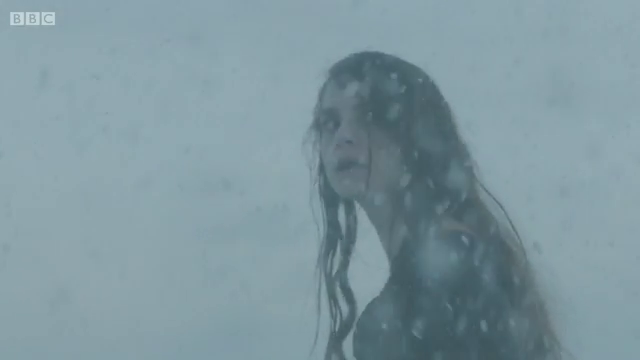
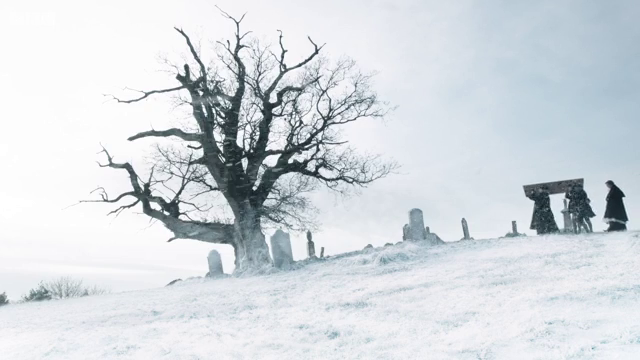
A full week after Arabella’s death, Jonathan Strange is finally forced to admit defeat. Even the spell he used to reanimate the Neapolitans has no effect, and Norrell’s silence leaves him with no hope of help from that quarter. In perhaps the most moving scene of the show so far, Henry Woodhope finally convinces Jonathan that they must let Arabella go, and she is finally buried in a familiar, snow-covered graveyard.
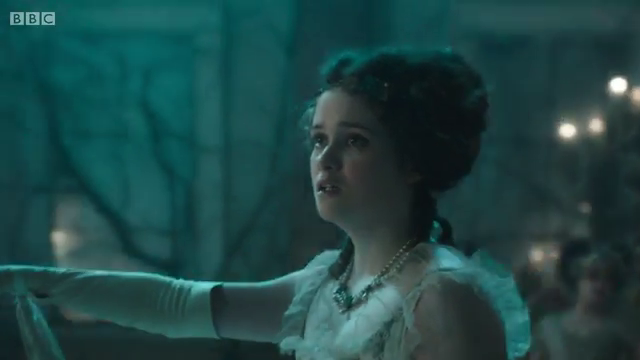
Have I mentioned lately how much I love Alice Englert as Lady Pole? She just nails her performances over and over again.
Meanwhile, at Starecross, Honeyfoot and Segundus are perhaps making a breakthrough with Lady Pole’s treatment. Honeyfoot recognizes some of the stories Lady Pole tells because they are similar to fairy tales that his mother collected when he was a child, only Lady Pole’s stories are from the fairies’ point of view. While Stephen Black is skeptical of the magicians’ methods, Lady Pole is insistent that they do what they can to make it possible for her to communicate what she’s been trying to for years. Unfortunately, just as they seem to be making some headway in understanding her, they are distracted by someone dropping Vinculus off at the madhouse.
Mr. Norrell is still determined to stop Strange’s book.
After Arabella’s funeral, Jonathan Strange returns to London to finish his book. He meets with Sir Walter, who warns Strange of the danger of writing too favorably about the Raven King. After telling Strange that “we do not require English magic to be restored any more than it already has been,” Sir Walter promptly reports to Norrell on his conversation with Strange.
Next, Childermass is sent to speak with Strange. Spotting Childermass hiding in some shadows, Jonathan Strange greets the other man warmly and invites Childermass back to his house to discuss the book and to see the illustrations Arabella produced. When Childermass expresses some dissatisfaction with Norrell, Strange asks if it’s not time that he left Norrell and joined him, but Childermass refuses. He’s not done with Norrell yet, but he is willing to promise Strange that there will always be two magicians and two opinions on magic in England. Things take a quick turn, though, when Childermass tells Strange how desperate Norrell is to prevent the publication of Strange’s book. On hearing that Norrell would do “anything” to keep him from publishing, Strange flies into a rage and steps through a mirror before Childermass can stop him.
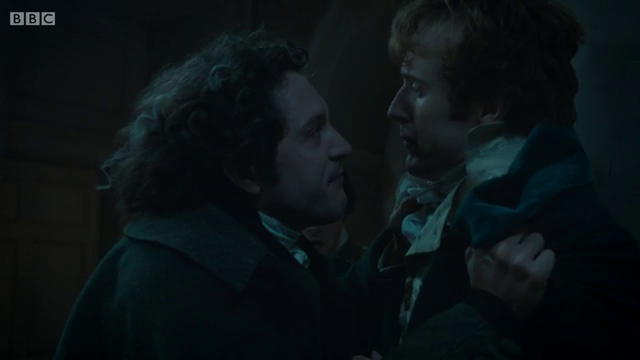
Jonathan Strange assaults Lascelles.
Jonathan Strange tumbles out of a mirror at Mr. Norrell’s house only to be met by Lascelles, who insists that Norrell is not home. Norrell does come downstairs, but he refuses to speak and Jonathan really only gets a glimpse of the other magician before Lascelles and the footmen wrestle him out of the house. Out in the street, Strange continues to rant until he’s arrested for breaking and entering and tossed into jail. His friend Grant comes to have him released, but before Grant gets the door unlocked, Strange has disappeared into a reflective puddle on the floor.
It’s a great ending to a well-constructed episode. While I have some complaints about it, I think the show has so far been very true to the source material, in spirit if not in every particular detail.
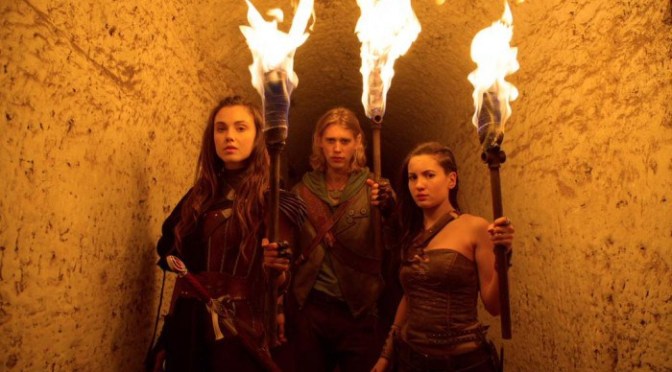
I didn’t expect this show to be good at all, but it looks like it might be. Everything in this reel shown at SDCC looks incredible, and I’m looking forward to a light, fun alternative to Game of Thrones.
I’m really encouraged by the fact that it looks like they’re preserving the post-apocalyptic world of the Shannara books instead of turning it into a generic fantasy setting. Judging from what we see here, it looks like MTV has really captured the sense of a magical world built upon the ruins of something much more familiar to us.
 Spindle is a charming little self-published title by Tasmanian author
 Shadowshaper seems to be most often compared to Cassandra Clare’s Mortal Instruments, but it’s a terrible comparison. In fact, there is no comparison to be made that isn’t entirely superficial. Shadowshaper isn’t a flawless piece of work, but it’s not a mess of derivative, hackneyed tropes like the Mortal Instruments series was, either.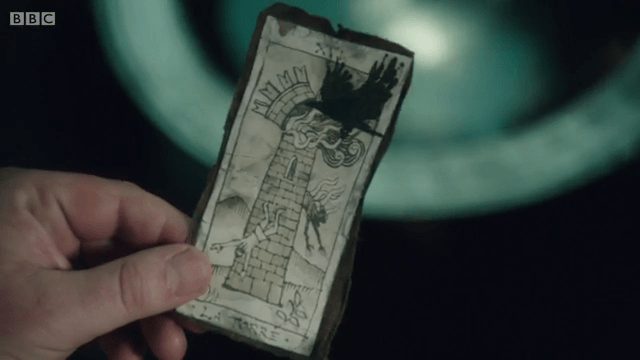




 I’m not sure that most people would agree with me that The Philosopher Kings is a fun read, but I enjoyed it at least as well as I did its predecessor, The Just City. After the rather abrupt and somewhat shocking ending of the previous book, I couldn’t wait to see what happened next.
 SF Bluestocking