All posts by SF Bluestocking

Book Review: All the Birds in the Sky by Charlie Jane Anders

All the Birds in the Sky, on its surface, is a story about two weirdos who come of age and fall in love during an apocalypse. It’s a story infused with magic, from the first time we see Patricia talk to a bird, and it’s a story about bad timing, from the moment Laurence makes his first two-second time machine. It’s a comedy of errors about the end of the world, and it’s one of the most wonderful things I’ve ever read. I’m only a little disappointed to have read it so early in the year. I feel about All the Birds in the Sky the way I felt about N.K. Jemisin’s The Fifth Season (which this novel is absolutely nothing like) last year; I just know, deep down, that nothing else I read in 2016 is going to top it.

In Patricia and Laurence, Charlie Jane Anders has created a pair of compelling and dynamic protagonists who are in perfect balance with each other. Patricia learns at an early age that she’s a witch, and Laurence is doing advanced tinkering in first grade. By the time they are in middle school, they’re both decidedly outcast by their peers and bond over that shared status even though they are otherwise nearly polar opposites. However, Anders avoids stereotypes and simplistic characterization in her depiction of her leads. Laurence and Patricia are both grandly archetypal and intensely real, and their story is at once epic and deeply personal.

Anders also peoples the world that Patricia and Laurence live in with a diverse cast of characters, from their two very different but equally dysfunctional families to their mentors to their adult friend groups who turn out to have more in common than not. There are talking birds, an AI, a tree spirit, and even a time traveling assassin/guidance counselor who ends up being one of the funniest characters in the book. While, on one level, all of these secondary and tertiary characters are arrayed like chess pieces, again Anders avoids drawing the battle lines too clearly, creating an interesting, nuanced dramatis personae.

The story meanders between fantasy and science fiction towards a climax that combines the best of both to excellent effect. The plotting and pacing are consistently good, and the tropes Anders utilizes are well chosen and smartly combined. When she chooses to subvert the reader’s expectations, it’s done in a way that is obviously very clever but never veering into twee territory. All the Birds invites the reader to play along when other less deft works might simply toy with the reader’s emotions. There’s plenty in this book that is unexpected, but there’s enough of the familiar to make it feel like an old friend that you’ll want to visit again and again.

It’s a strange book to review because I don’t want to give too much away, but also because I’ve never read anything quite like it. All the Birds reminds me most of Neil Gaiman and Terry Pratchett’s Good Omens, albeit vaguely, and it objectively has very little in common with that book outside of the fact that it also deals with an apocalyptic event and was quite funny. The truth is that All the Birds in the Sky is a wonderfully unique and fabulously original novel that isn’t really quite like anything except itself.

Weekend Links: February 6, 2016

We’re properly into literary awards season now, which is exciting. 2015 was really an excellent year to be a reader of speculative fiction of all kinds, and with any luck we’ve left some of last year’s awards season ugliness behind. If you’re nominating and voting on any awards this year, or just want to catch up with some of the best of 2015, the Locus Recommended Reading List is up.

Some of the Best of Tor.com 2015 is available for free download if you want to brush up on some of last year’s best short fiction.

Fran Wilde wrote one of my favorite novels of 2015, Updraft, but she’s also got her own excellent longlist of works to check out in time for Hugo nominating.

Aliette de Bodard’s The House of Shattered Wings was another one of last year’s most interesting new novels, and her recommended reading list is also worth checking out.

While the nomination process for the Hugos is just beginning, some other awards are already being given. This week, it was announced that two fantasy novels–Sabaa Tahir’s An Ember in the Ashes and Victoria Aveyard’s Red Queen–won People’s Choice Awards. And Kai Ashante Wilson’s superb novella, The Sorcerer of the Wildeeps, won the William L. Crawford Fantasy Award.

In other recommended reading list news, the Young Adult Library Services Association has released their 2016 list of Great Graphic Novels for Teens.

Meanwhile, David Benioff’s list of ten favorite books couldn’t be any more exactly what I would have expected. He’s a sadly laughable stereotype, but this explains a lot about why Game of Thrones is such a mess.

Speaking of Game of Thrones, Mythcreants lists 5 Signs Your Story is Sexist.

February is Black History Month, and Black Girl Nerds is celebrating black excellence with #29DaysofBlackCosplay.

N.K. Jemisin’s 2013 essay “How Long ’til Black Future Month?”  is still very relevant.

Lightspeed’s POC Destroy Science Fiction is still short on a couple of its stretch goals, but there’s 13 days left to back the project.

The UB Reporter has a great profile of Nnedi Okorafor.

Earlier this week, SF Signal published a wildly offensive post by Amy Sterling Casil: “We Are All Disabled”. It provoked an immediate outraged and disappointed response, and was quickly removed and apologized for by both SF Signal (good) and Sterling Casil (notably less good). Foz Meadows in “Empathy is Not a Disability” and Jim C. Hines in “No We’re Not All Disabled” took on the most problematic elements of the original post, which was just a total disaster.

There’s an interesting piece over at Lit Hub about “The Rise of the Literary Binge Read.”

Melissa Benoist wrote some this week about what her role as Supergirl means to her.

China Mieville has (arguably) written a bad book.

In this month’s Uncanny Magazine, L.M. Myles writes about the “Quest for an SF/F Grandmother.”

V.E. Schwab’s A Darker Shade of Magic could be coming to television.

A documentary about the life and influence of Ursula K. Le Guin has blown past its initial Kickstarter goal.

Arthur Rackham’s Alice in Wonderland illustrations of are gorgeous.

Atlas Obscura shares Andrew DeGraaf’s incredible painted map of Madeleine L’Engle’s A Wrinkle in Time.

Lego revealed their new Ghostbusters sets. I know what I’ll be doing on July 1. Although it sadly won’t be this amazingly rad, but very expensive 4634-piece Ghostbusters firehouse.

Finally, the new trailer for Kubo and the Two Strings finally shows a little more about the actual story:


Book Review: The Seventh Bride by T. Kingfisher

The Seventh Bride is, loosely, a retelling of “Bluebeard,” which is a nice change from the more common fairy tale retellings that populate most shelves. I don’t see “Bluebeard” pop up that often in the vast sea of princess stories that seem to get almost obligatorily reimagined on a perennial basis, so right out of the gate I was predisposed to love this story because it was so obviously a fresh perspective. It turns out to be much more than just a simple retelling of an old tale, however. The Seventh Bride is a beautiful, clever, funny story about power, abuse, revenge, and—above all—the ties of shared experiences that bind women together and the vital importance of women loving and supporting each other.

Rhea is the fifteen-year-old daughter of a miller in a small town, and while she always did expect to be married someday, she didn’t expect to find herself engaged so young and rather against her will to the wealthy (and sinister) Lord Crevan. Although Rhea’s parents are good, loving people who want their daughter to be happy, there’s very little they can do to prevent the marriage. The marriage to the much older, more powerful, and creepy man isn’t ideal, but peasants don’t say no to lords. When Rhea goes to live at Crevan’s house before the actual wedding takes place, however, she finds out that things are much worse than she thought they were. Not only has Crevan been married before, but his previous wives aren’t dead. Well, mostly.

Perhaps what I love best about Rhea is that she’s such a refreshingly ordinary girl. This is characteristic of much of T. Kingfisher’s (Ursula Vernon in disguise) work, and so far I have never not been delighted by the total lack of exceptionalism among her heroines. It’s not that her girls and women don’t have any exceptional qualities; Rhea, for example, is exceptionally tenacious, brave, kind, and principled. It’s just that there’s nothing about a T. Kingfisher heroine that is ever framed as “not like other girls.” I feel like this shouldn’t be noteworthy, but “not like other girls” is sadly too often the shorthand authors use in order to create “strong female characters” so I’m always happy—especially in work about and for teenage girls—to see girl characters who are allowed to exist without being shown as constantly in competition with other girls and women.

Instead of just one exceptional girl, Ursula Vernon creates a whole cast of diverse and compelling women who, ultimately, have to work together in order to defeat the man who has harmed them all and fight back against a system that gives them little recourse to address the injustices they’ve been subjected to. It’s a powerfully feminist message that resonates with a deep and abiding truth that many women will relate to and all girls need to hear. At the same time, it’s a story that isn’t preachy and never gets bogged down in messaging. Rather, it’s a fast-paced tale that utilizes some familiar fairytale tropes and subverts others, all while taking place in a well-drawn and richly detailed fantasy world that is steeped in whimsy but never overly precious.

With The Seventh Bride, Vernon continues to prove herself as a consistent producer of marvelously enchanting fairy tale stories. She knows her genre and audience well enough to perfectly walk the line between comfortingly familiar and delightfully fresh and subversive.

iZombie: “Fifty Shades of Grey Matter” could have been great, but wasn’t

iZombie is an almost frustratingly consistent show, and this second season has been one long line of good-but-not-great episodes. With the magnificently titled “Fifty Shades of Grey Matter,” we can add another one to that pile.

This week’s murder victim is an actual sexy librarian, murdered practically on the eve of the publication of her first novel—a delightful piece of erotica about a sexually adventurous flight attendant titled Upright Position. As much as I love everything about this premise, I was terribly disappointed to find that the show had wasted Kristen Bell’s “cameo” on having her read the Upright Position audiobook. This is somewhat redeemed by having Kristen Bell read the phrase, “I’m going to show you why it’s called the cock pit,” but still. Considering how much the show was using this as a promotional tactic, it was kind of a letdown.

As with most of season two’s murder mysteries, this one takes a decided back seat to the show’s overarching storyline, and the murdered woman, whose name actually completely escapes me, she was so irrelevant, is much less interesting than literally everything else that happens this week. This isn’t helped in the end by the revelation that the husband did it. Because of course he did. Frankly, there’s so much else going on that I barely even noticed.

The biggest news of the week is that Peyton was back, still working on building her case against Stacey Boss, still depending on Blaine as her primary source of information. This gets complicated when she decides, for some reason, to sleep with him, and then it’s even more complicated as Clive and Dale make a move to arrest Blaine as a suspect in the recent spate of high profile murders in town. Peyton manages to get Blaine off the hook for that stuff only to find out via Liv that Blaine really is a pretty villainous character. This is surprisingly devastating stuff to watch, considering how little of Peyton we’ve seen this season. I never know how much to care about her, since she floats in and out of the narrative pretty randomly and never stays for long.

Elsewhere, Major has to dump Minor to avoid being caught because of the dog’s gps tracking implant—which isn’t an implant at all, so he gives the dog up for no reason. My only hope is that at some point Ravi is going to realize how increasingly bizarre Major’s behavior has gotten and figure things out.

Now that I’m actually breaking things down, I’m forced to admit that not a whole lot actually happened this week. The sexy librarian brain led to a couple of funny interactions, and it was nice to see Peyton back. Liv and Peyton both get laid, but then they’re both sad about it, and Liv doesn’t even know yet that her new boy toy is working for Stacey Boss. There’s no progress on the zombie cure front, and we don’t get to see Gilda/Rita or Vaughn du Clark.

Still, it’s a solidly entertaining hour that does a lot of what iZombie does best. Namely, coming up with truly clever puns and keeping all its characters mostly miserable. We’re now halfway through the season, though. It would be nice to see a little more forward movement in all of the show’s plots.

Miscellaneous thoughts:

  • Dale and Clive are very cute together. I’m glad they’re happy.
  • Whatever happened to Liv’s mother and brother? Are they just gone forever now?
  • Liv’s sex life, or lack thereof, has been a recurring theme this season, but it never does manage to be really fully examined. In that way, this episode felt like a huge missed opportunity with it’s very shallow messaging.

The Expanse: “Critical Mass/Leviathan Wakes” deliver exactly the payoff we deserve

Well, that was a wild ride. Which I’m sure I’ve said more than once already this season, but I really, really mean it this time. The Expanse has been a captivating show from day one, but “Critical Mass/Leviathan Wakes” was an exhilarating experience. While I have at times felt that the show spent too much time on set-up and world building, it definitely paid off this week with several big reveals and a major ratcheting up of the stakes in preparation for the show’s second season—in 2017, a long wait which was probably the most devastating revelation of the day. Considering all that happened in the finale, that’s saying a lot.

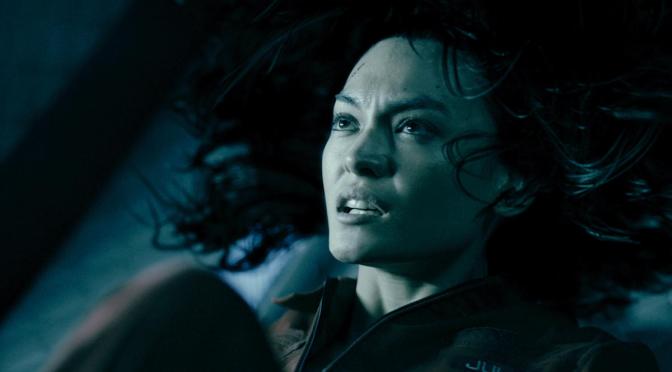
“Critical Mass” opens with an extended flashback that tells Julie Mao’s story from Julie’s point of view. It’s a great way to elevate her from being essentially an object in a narrative that revolves around the stories of men—Holden and Miller in particular, but to a lesser extent Dawes and Johnson—to being a real character who we can empathize with and care about. By dedicating nearly a full half episode to showing us who Julie was, the show forces us to think of her as an active agent in her own right, driving her own narrative, which only intersects with Holden’s and Miller’s. What I most appreciated about the time we spend with Julie this week is how much of that is dedicated to showing us who she was as a person, not just what she did. At the same time, this material gives us a much better understanding of what Miller and Holden have gotten themselves into—even as it highlights that there is still a ton of stuff that they (and we) don’t know.

And can we all stop to appreciate that Julie Mao’s death isn’t sexualized? Her body isn’t posed in any kind of titillating fashion, and her illness is filmed in a way that invites the viewer to identify with her rather than simply observing her. It’s done in a way that is almost viscerally affecting, as we’re able to almost experience her increasing sickness, her rising desperation as her attempts to contact Anderson Dawes go unanswered, her panic as she realizes what is happening to her, and her final despair as she succumbs to whatever the blue space goo is. Still, she’s given a sort of sad dignity through all of it, and I was happy to see that her death is framed as tragic for her sake more than for Miller’s like it was in the book.

The second half of “Critical Mass” and all of “Leviathan Wakes” are dedicated to the present day, where things are getting very scary extremely quickly. Miller and the Rocinante crew manage to escape from the motel, only to find the whole station on lockdown due to a supposed emergency. As Eros residents are herded into radiation shelters, Miller, Holden, and the rest try to get their bearings. Eventually, they split up—Miller and Holden to find out what’s going on and Naomi leading the rest back to the Rocinante. What follows is a fast-moving series of tense, high stakes sequences as the two groups try to find their way off the doomed space station. It’s definitely the best work of this type that the show has delivered so far, and the danger they’re in, especially Holden and Miller, feels very real.

All of the events on Eros this week made me a little regretful that I read Leviathan Wakes before the show aired. The show is a pretty faithful adaptation of the book, and I think it would have been cool to see it with fresh eyes. Even knowing how things would turn out, I felt real worry for Holden and Miller, so I can only imagine how harrowing their scenes must have been for non-readers.

One thing that wasn’t in the books, though? Naomi’s journey back to the Rocinante, which I loved. It’s nice to see her get a chance to really be in a leadership position, even if she does decide before the end of the episode that she doesn’t really want that responsibility after all. I haven’t always been completely happy with the way the show dealt with the situation between Naomi and Holden as they jockeyed for primacy on the Roci, but I liked the way it ended here. Her struggle to lead felt real and human; her decision to defer to Holden felt honest; and the final tender moment they share together hints at a possible romance that feels genuine and earned. It’s a brief moment of sweetness in an overall extremely dark episode.

Meanwhile, back on Earth, Chrisjen is going to pay her respects to her old friend, Franklin DeGraaf. She finds his husband very angry with her, but he lets her in regardless. It’s impressive how much convincing feeling Shohreh Aghdashloo can produce in this role, and this is a standout episode for her character. She’s definitely grieving for her friend, but she’s also trying to piece together more pieces of a mystery—in this case, a proper conspiracy. When Fred Johnson makes an announcement regarding the destruction of the Donnager and broadcasts some of the same information that Chrisjen found in her dead friend’s desk, things start to become clearer. When she reconnects with Errinwright, Chrisjen immediately sees that he’s in on it, whatever it is, and she smiles and plays her part. Then she goes home and takes steps to keep her family safe from whatever storm is about to hit.

Avasarala’s story line this season has been perhaps the show’s most consistently weak link, but it finally starts to pay off in “Leviathan Wakes.” As an enormous Chrisjen fan, I can’t wait to see how this develops next season. Most of the season, her role seemed largely to function as a way to further understand the events in the Belt, but her uncovering of a conspiracy, combined with her introduction to Jules-Pierre Mao, finally gives her a proper story of her own. She’s still stuck on Earth, where most of the action isn’t, but now she’s in some real peril that she’ll have to face next year.

The Expanse is hands-down SyFy’s best production since Battlestar Galactica, and this finale only continues to prove the series’ strengths. It’s a perfect mix of personal stories and epic scale plots, and it ends with an iconic and ominous shot that promises that shit is going to get very real in season two.

Miscellaneous thoughts:

  • “Everyone’s a winner on Eros!” Indeed.
  • I feel like people would have been rioting in the streets if we’d had to wait a week between the end of “Critical Mass” and the beginning of “Leviathan Wakes.”
  • Those pencil-shaped data sticks are awesome.
  • “Half the system thinks you’re some kind of outlaw hero, but you’re really kind of clueless, aren’t you?”
  • I’m not entirely sure why Sematimba had to die. I suppose he’s just a loose end or perhaps this is going to lead to conflict between Miller and the Roci crew next season, but I didn’t love the way this went down. I’d have preferred it if he just disappeared in the chaos on Eros.
  • “You guys look like shit.”
  • One could almost feel bad for Kenzo. Only almost, though.


The Shannara Chronicles: “Pykon” is an unnecessary, derivative slog of a detour

In “Pykon,” our heroes are diverted through some mountains in search of a kind of shortcut through an old Elven fortress. Meanwhile, Arion is entirely taken in by the Changeling, who is posing as the presumably dead Eventine, and Ander is gallivanting rather uselessly around the countryside with his ex-girlfriend and a gnome. One major issue with the episode is that these storylines barely seem to have anything to do with each other, and there’s a total lack of thematic cohesion between them. Unfortunately, that glaring issue of craft is basically the least of the hour’s problems.

“Pykon” starts off with a train wreck, giving the viewer a creepily voyeuristic view of Amberle’s sex dream about Wil. It’s a lens flare monstrosity from which she is abruptly woken from by her attempted rapist, who is apparently just a regular member of the group now. No big deal. I’m not sure what the most infuriating thing about this is because it’s so much grossness crammed into such a short amount of time. In any case, the idea that actual rapist Cephalo is just roaming around free like a normal person who didn’t just try to rape Amberle last week had me spitting mad before the episode even properly started. I could see bringing him along as a potentially useful prisoner or as a way to keep him from following behind and causing trouble, but he shouldn’t get to have banter within two days of being shown to be an actual rapist who actually attempted to rape a main character who we’re supposed to identify with.

Not only is Cephalo a free man, but he’s practically the leader of the group this week. His opinions dictate pretty much every decision made by the party, starting with the decision to go to Pykon. It doesn’t make any sense whatsoever, though. He kidnapped and tried to rape Amberle. He’s stolen Wil’s elfstones multiple times. And he owned Eretria, with the heavy implication that he was physically and likely sexually abusive towards her, and he has threatened her life on numerous occasions. Crispin the elf guard quite sensibly doesn’t trust him, at least, but literally no one gives a shit about what Crispin thinks about anything at all. In the end it gets Crispin killed and the rest of the party betrayed by Cephalo, who proves—to no one’s surprise—that he only cares about himself.

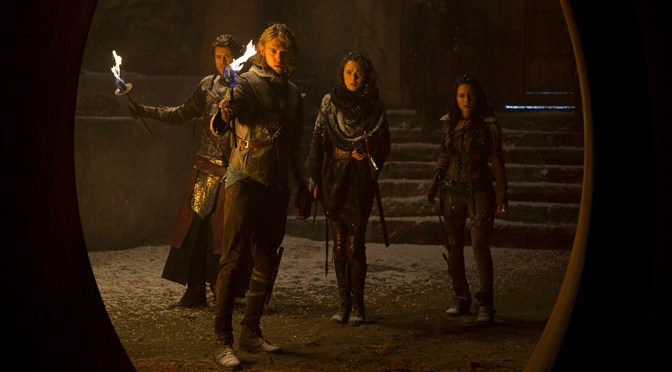
The thing is, I get the feeling that this is supposed to parallel the much better written stuff that happens this week with Ander, Commander Tilton, and Slanter, who are on their way to the Breakline to find out if there really is a demon army amassing there. En route, they come across a small group of gnomes who have been slaughtered by demons, underscoring the fact that the Dagda Mor and his forces aren’t just a problem for the elves; they threaten everyone. Slanter requests that he be allowed to say last rites for his people, and the soft-hearted Ander removes his chains only to have Slanter promptly turn on him and abscond with the horses, leaving the two elves alone so they can talk about their feelings. Unlike Cephalo, however, Slanter isn’t a complete monster of a person, so when he sees that there actually is a huge army, he comes running back and there’s something of an alliance forged between the elven prince and the gnome.

This whole sequence is surprisingly smart and well-executed, with some good character growth for Ander and a nice amount of backstory that helps to explain his relationship with Commander Tilton, but it’s not enough to redeem the rest of the episode. Mostly, though, it just doesn’t really work as a counterpoint to the Cephalo stuff because Cephalo is so irredeemable. Slanter isn’t exactly a great dude, but it could be argued (pretty successfully) that his killing of Aine Elessidel was a more or less fair act of war. Cephalo is just a really shady guy (and a rapist and slaver). The idea that two once-warring factions could bury the hatchet after many years makes a lot more sense than the idea that a young woman is going to follow her attempted rapist into low-budget Caradhras for a shortcut that may not even exist.

Which brings me to that little adventure. Listen, we all know that the Shannara stories have been, from the very beginning, a shameless rip-off of Lord of the Rings. The Sword of Shannara is practically a scene for scene rewrite of The Fellowship of the Ring, and all the subsequent books have been similarly, if not quite so absurdly, derivative. So far, the show had managed to avoid inviting too many direct comparisons between itself and LOTR, but in “Pykon” they seem to have just said, “Fuck it! Let’s go full Tolkien!” There’s the trip through the mountains in a blizzard, the seemingly abandoned edifice, the escape over a chasm, from a monster made of fire and smoke, who kills a party member, before falling down the crevasse, pulling people with it. The only new flourishes are the obvious queerbaiting and gratuitous torture scenes.

Let’s talk about Eretria and Amberle in the bath. First, I have to say that I am totally here for bisexual Eretria. I actually kind of love that idea, and it would be interesting to see the relationship between these two women develop in that direction if there was time to do it. However, that’s not what this is. This is just titillating filler that wastes time that could have been spent on, oh, something like an actual conversation between Amberle and Eretria to cement their newfound and rather fragile alliance. Worse, this scene isn’t even particularly sexy. It’s not that the two women don’t have any chemistry, but it’s a decidedly PG-13 show that isn’t actually interested in really exploring sexual tension between women; the scene is shot even more voyeuristically than the episode’s opening dream sequence, and it’s interrupted by a weird noise (perhaps from the creepy voyeur whose point of view we’re observing from) that is never actually explained. It really is just a “sexy” interlude thrown in for, well, who knows why this show does the things it does?

It turns out that, of course, the creepy guy that they find at Pykon is a torturer with a serious grudge against Amberle’s grandfather. Or something. It doesn’t really matter because he’s just a roadblock to give the characters something to do while the Reaper from last week recharges—because, goodness knows, we wouldn’t want to feel like there was too much forward movement. This tendency to reuse monsters and recycle situations is further confirmed by what happens to Amberle inside Pykon. When the whole group is drugged and imprisoned, Amberle tries to pull rank, using her status as a princess to try and convince Remo to release them, but it backfires. In a near-repeat of last week’s events, Amberle finds herself separated from the group, this time to be both sexually menaced and tortured—again needing to be rescued, this time by Wil, who is rewarded with a kiss. Because nothing gets Amberle’s motor running like the threat of being lobotomized and forcibly impregnated, I guess.

I never did expect The Shannara Chronicles to be particularly good, but I did think the show would be an entertaining and lighter alternative to heavier fantasy fare like Game of Thrones. However, week after week this show is squandering good will and frittering away its potential by doing its best to imitate the worst qualities of its grittier counterpart. At over halfway through the season, I figure I might as well watch the rest of it, but I have a feeling I won’t be happy about it. I guess I should just be happy that The Shannara Chronicles showed its true colors before I got five seasons invested into it. At this point, Shannara is going to have to do something really good to get me to subject myself to a season two.

Miscellaneous thoughts:

  • I can’t reiterate enough that Cephalo is an actual rapist, not a lovable rogue.
  • If Pykon was used within the last twenty years as an active military installation, why are the elves skeptical that it exists?
  • Why did Mag have to die? Sure, a child is inconvenient on a quest, but it wouldn’t be the worst idea this show ever had, and I rather liked her interactions with Wil.
  • Arion’s daddy issues and conflict with Allanon are potentially interesting, but get bogged down this week by having to share time with Catania and Bandon, who are the most superfluous of all superfluous characters.
Supergirl: “Bizarro” has Kara at war with herself

I’m not sure if “Bizarro” is objectively the best episode yet of Supergirl, but it definitely ranks among my personal favorites so far. This show has a strong tendency to rush through material and miss opportunities for emotional shading and depth, but it hit all the right notes this week as Supergirl faced off against her doppelganger while also trying to have a life as Kara Danvers. Supergirl had already delivered one incoherent mess of an episode while trying to communicate a very garbled something about Kara’s struggles to balance the different aspects of her identity, and that made it particularly pleasing to see the show get it right (or nearly so) this time around.

The main plot of the episode deals with the conflict between Kara and Bizarro, but it can really be better understood as a more internal conflict as Kara struggles to maintain her own identity in the face of her responsibilities and the weight of dealing with her specialness. She accepts Bizarro more and more fully over the course of the episode, until by the end she actually identifies with the other woman. It doesn’t show the viewer anything particularly new about Kara, but it does allow Kara to reaffirm her identity to herself. She’s been trying all season so far to separate Kara and Supergirl and compartmentalize her life in a way that allows her to “have it all,” but here she’s forced to integrate her dual identities and come to terms with the fact that she is different and she really might not be able to have a normal life.

The secondary plots this week are both intertwined with and perfectly complementary to the Kara/Bizarro stuff.

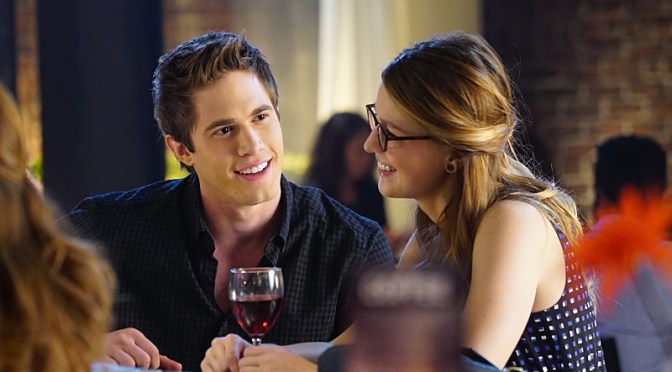
The first and more significant one is Kara’s attempt to date Cat Grant’s son, Adam. Unsurprisingly, it doesn’t work out, though not for the reason I expected. Rather, the relationship ends before it even really begins because Kara just can’t see a way to fit him into her already very hectic—and dangerous—schedule. As sad as this is, especially considering how adorable this pair was together, the real gut punch comes when we learn how this affects Kara’s relationship with Cat. Cat’s remarks to Kara might not seem entirely fair to the viewer who knows the whole story, but from Cat’s point of view Kara has kind of betrayed her. Kara brought Adam to town and was an integral part of Cat’s reunion with her son, but now Kara has failed to deliver on the promise that implied—namely, that she would be Cat’s ally in reforging that mother-son relationship. Instead, Kara has somewhat quixotically started something that she isn’t capable of seeing all the way through, and she’s put her own sanity ahead of her desire to be all things to all people. It might not be fair of Cat to punish Kara by cutting her off emotionally, but it’s definitely understandable and sad for everyone involved.

Finally, there are the other men in Kara’s life, Winn and James, who managed to also be moderately interesting and less tiresome than usual this week. Winn seems to have mostly gotten over Kara’s rejection of him. I cringed when he used the term “friendzone,” but I can mostly forgive it as it’s said without rancor. What I can’t forgive is the gross way Winn suggests to James that James could “have” Kara any time he wants. Yuck. I’m also having an increasingly difficult time forgiving James for continuing his relationship with Lucy when he’s obviously got feelings for Kara. I don’t care if he never manages to ask Supergirl out—especially since that feels like a kind of weird transference of affections situation anyway—but I hate that he’s stringing Lucy along in the meantime. We haven’t gotten to see much of Lucy yet, but she seems like a nice woman who is genuinely in love with James and willing to relocate to pursue him. It’s kind of a dick move to let her do that when he’s obsessed with Supergirl.

The best parts of “Bizarro,” however, are the parts involving its titular character. There are several decently produced fight scenes, and Bizarro is infused with enough real pathos to make her the most compelling single-episode antagonist the show has given us so far. Overall, it’s a solid episode that manages to hit all its plot beats on time and effectively develop its themes without dipping into the after school special territory the show is sometimes prone to. Most gratifyingly, it manages to say something about a moderately complex feminist issue without putting it in Cat Grant’s mouth in the form of a clunky speech.

Miscellaneous thoughts:

  • Loved the Dr. Frankenstein vibe at the beginning. It’s a little heavy-handed, but it’s an appropriate allusion that works to make Maxwell Lord a more well-rounded villain. It’s very unsettling how deeply he seems to believe in what he’s doing.
  • It strains credibility a little that Kara is so quick to blame everything on Maxwell Lord. Sure, he’s a pain in the ass, but she just seems awful certain, awfully fast and in a way that feels more for narrative convenience than for any logical reason.
  • That brown sweater Kara wore to the office was wonderful.
  • I need Alex to get more and better character development.
  • Lucy was visiting her dad this week, apparently. I have a feeling that this is a hint that we’ll be seeing him again soon.

Lucifer: Still with the good looks and charm, but this show desperately needs substance

I really, really want to like this show. It’s got quite a few things going for it that I actually do like, if I look at them in isolation. Unfortunately, none of those things are working that well together yet.

Tom Ellis continues to shine in the titular role. He’s absurdly good-looking and quite funny, with an excellent sense of both comedic and dramatic timing. It’s an interesting balancing act he’s got to maintain, trying to create Lucifer as both the jaded, misanthropic ex-Lord of Hell and a compellingly human character that the audience can care about. This second episode finds him managing this with mixed success. There’s an excellent opening scene where Lucifer takes down an unscrupulous street preacher, and there’s a scene where he’s learning more about Chloe’s history that is nice. But then there’s also stuff like his interaction with Trixie Decker, which only retreads ground that was already covered in the pilot and which wasn’t very funny then, either.

Lauren German does the best she can with the shoddy-to-fair material she’s granted as Detective Chloe Decker. If her interest in Lucifer was prurient, that might make more sense than what’s going on here. I could understand why a beautiful, hot-blooded woman would want to bang this guy, but Chloe’s desire to explain the inexplicable things she’s seen would be much more believable if Lucifer wasn’t literally telling her exactly what’s going on all the time. Frankly, it makes her seem a little slow, especially when combined with her apparent complete lack of professionalism or adherence to police procedures. Her best scene this episode actually comes at the end and has nothing to do with Lucifer or the case of the week. Instead, it’s when she decides that she’s going to tell her daughter about her teen movie past—only to find out that Trixie already knows. It’s a sweet moment, and a cute reminder that kids are often smarter and better than people give them credit for.

The dynamic I was most interested to see this week was also the biggest letdown. I love the idea of Lucifer having a therapist, but the episode didn’t spend much time on his sessions. Both of the scenes with Dr. Martin felt rushed and inconsequential, and neither of them added much to the story or Lucifer’s character arc (such as it is). Similarly dull are Lucifer’s relationships with Amenadiel, who is little more than a laconic wet blanket so far, and Mazikeen, who is still sadly under-baked while also being kind of weirdly invested in Lucifer’s being evil. It could be that the show is simply ramping up its more supernatural plots instead of just throwing us into them, but so far none of this stuff has really grabbed me.

The biggest problem I have with the show so far is that it’s wildly entertaining, but not much else. It’s got slick production values, decent actors, a devilishly handsome lead, and good pacing, but there’s not a whole lot going on under the surface so far. It’s a concept that could lend itself well for exploring all kinds of interesting themes and ideas, but instead it wastes time joking about how big Lucifer’s dick is and leering about Chloe’s nude scene in a movie from fifteen years before the show even starts. The ending of this episode does hint at some deeper things going on, and it could be that we’re going to really get more substance going forward, but something needs to happen quick. As I said about the pilot, good looks and charm will only take this show so far. At some point it needs to have something to actually say.

Miscellaneous thoughts:

  • “King of Pain” is a little on the nose.
  • Lucifer, to an apple: “Hello, old friend.”
  • Lucifer, when he sees Chloe’s home: “Do you take bribes?”
  • Chloe’s ex, Dan, was surprisingly decent this week. I like when exes are friendly with each other like this. It’s much more interesting to me than when they just hate each other.
  • Trixie, about the dvd: “This isn’t even in HD.”

The X-Files: “Mulder and Scully Meet the Were-Monster” is a near-perfect deconstruction of the show

“Mulder and Scully Meet the Were-Monster” is by far the best episode of season ten so far, but it also ranks among the show’s best episodes ever. Certainly it’s one of the funniest episodes of The X-Files, but it’s also surprisingly affecting as an exploration of how Mulder and Scully have changed with age and wonderfully effective as an examination of some of the show’s bigger ideas. I love a good genre deconstruction, and this episode is a near-perfectly executed one.

It’s interesting to see the show tackling head-on some of the issues presented by the just the existence of these new episodes. Namely, what are we even doing here? Why bother after all these years? It’s definitely true that even just these last few years have made many of the original series’ mysteries much less mystifying, and government conspiracies have become somewhat less entertaining in the post-9/11 world. And the truth is, the more we know about the world the more it’s confirmed that there is no magic and that the seemingly inexplicable seldom actually is. This was always the case with The X-Files, as well, although it often tried to have it both ways, leaving many of its “mysteries” ultimately unresolved—which has always made the show something short of truly fulfilling. This week, we take a good, hard look at what that means for Mulder and Scully.

Much as in the last couple of episodes, the show continues to be primarily concerned with Mulder and his journey. We find him having a sort of midlife existential crisis as he’s digging back into the X-Files. He’s questioning not just whether his time in the department was worth anything, but whether or not this is what he wants to be doing at his age. After all, Mulder reasons, they never did find any real evidence of anything supernatural, and many of his theories have actually been made ridiculous in light of new science. It’s a fascinatingly meta argument and a bold way of addressing the show’s critics and engaging longtime fans by referencing particular past episodes.

Scully, on the other hand, seems revitalized by their return to the X-Files (it’s her “I want to believe” poster that Mulder is destroying), and she’s excited about a new case—one with a monster. Mulder’s newfound maturity has made him insecure and questioning, while Scully has grown into her skepticism and her faith so that she’s returning to work with a new confidence and fresh enthusiasm. I kind of love this sort of role reversal, and Gillian Anderson sparkles with wit throughout the hour. While the episode is largely dominated by Mulder’s problems, his crisis, and his emotional growth, Scully gets some of the best lines and she definitely gets to make the best wryly amused and affectionately indulgent faces of the night.

The actual story this week is profoundly silly, but in a good way. It injects the new season with a much-needed dose of fun and lightens up some otherwise overly serious and self-indulgent character work. Mulder has never been my favorite half of The X-Files, and it would have been far too easy for an episode focused almost entirely on examining some of his most irritating character traits to be a masturbatory disaster. Instead, this one turns out to be a charming delight that proves that the writers and actors have a good sense of humor about what they’re doing here.

Miscellaneous thoughts:

  • What a waste of Kumail Nanjiani. He’s so funny, but he’s tragically underused here.
  • Mulder and Scully aren’t that old. Jokes about how confused they are by smartphones are lazy.
  • The creepy motel and its weirdo owner would have been enough to carry their own episode.
  • The lizardman feels urges to get a job, worry about retirement, and lie about his sex life. I love it.
  • Awww. Queequeg.
  • Scully straight up stole a dog. That is probably the best thing that could possibly happen in this show.

Book Review: Bryony and Roses by T. Kingfisher

As is often the case with  popular fairy tales, there’s very little new story to be wrung out of “Beauty and the Beast” these days, so I was a little skeptical of Bryony and Roses. Even after reading T. Kingfisher’s (a pen name of Ursula Vernon) Toad Words and Other Stories, which is full of superb fairy tale reimaginings, I was unsure if there was anything she could do to freshen up such an old and well-worn story path. An opening note that admitted an enormous debt to Robin McKinley, whose Rose Daughter is perhaps the definitive feminist “Beauty and the Beast,” was frankly more concerning than reassuring. I ought not have worried so much. Just like in her earlier fairy tale work, Vernon-as-Kingfisher does an incredible job of exploring and revitalizing ancient material, infusing it with a bright, modern, thoroughly feminist (and unequivocally delightful) sensibility.

Bryony and Roses is clearly heavily influenced by Rose Daughter. Let’s get that out of the way, first. However, it’s been nearly twenty years since the release of that book, almost forty years since McKinley’s first “Beauty and the Beast” retelling, Beauty, and close to twenty-five years since the release of Disney’s animated version. There’s also been any number of other retellings of the story, with perhaps a handful of significant new versions in any given year. While Bryony and Roses shares some ideas and motifs with Rose Daughter, it also owes a considerable amount to other versions of the story, if in no other way than that it’s very obvious that Ursula Vernon went into writing this tale with a long list of things not to do and a few tropes that she specifically seems to have set out to upend.

**Spoilers Ahead** Continue reading Book Review: Bryony and Roses by T. Kingfisher