Tag Archives: 2016 Books

Book Review: Pieces of Hate by Tim Lebbon

Pieces of Hate is, technically, an okay book. However, it’s exactly the sort of thing that I normally try to avoid like the plague because I kind of hate it. It’s one of the better examples of its kind of story, but it’s still not my cup of tea. There’s very little that I find more boring than a fridged wife—nameless, even, to add insult to injury—and a manly revenge quest in which the only other women encountered are prostitutes who are (of course) repulsive to the protagonist. It’s a level of casual misogyny (either the author’s or the characters’—it doesn’t matter) that I found alienating from page one.

The mythology of surrounding the characters of Gabriel and Temple is moderately interesting, but nothing particularly special. The introductory novelette, “Dead Man’s Hand” didn’t help much in this regard, either. If anything, it was especially dull, being told from the point of view of a minor character who doesn’t actually know or understand the events happening around him. It’s also a pretty terrible introduction to Gabriel as a character. Without any of the insight into Gabriel’s inner thoughts like we get in Pieces of Hate, the Gabriel of “Dead Man’s Hand” isn’t at all likeable or sympathetic.

While I like the flexibility the premise of the two warriors, locked in an ongoing battle or hunt across time and space, offers, the downside of it here is that the two stories in this volume are so different that they are very disconnected. It lets Lebbon experiment with different genres, which could be potentially very interesting, but the juxtaposition here of the western with a sort of pirate story just doesn’t work. Partly this is because it’s cliché, but the disconnectedness of the narratives is exacerbated by the abovementioned change in point of view between the two parts of the book.

The biggest issue I had with Pieces of Hate, however, is just that it’s not my kind of story. While I enjoy reading outside my usual genre comfort zones from time to time, it’s very difficult for me to get into any of these sort of testosterone-fueled revenge narratives unless there is something really special or unique about them. Unfortunately, Pieces of Hate isn’t anything I haven’t read many times before, and Tim Lebbon fails to bring anything fresh or compelling to a set of very old tropes.

This review is based upon a copy of the book received from the publisher through NetGalley.

Book Review: Archivist Wasp by Nicole Kornher-Stace

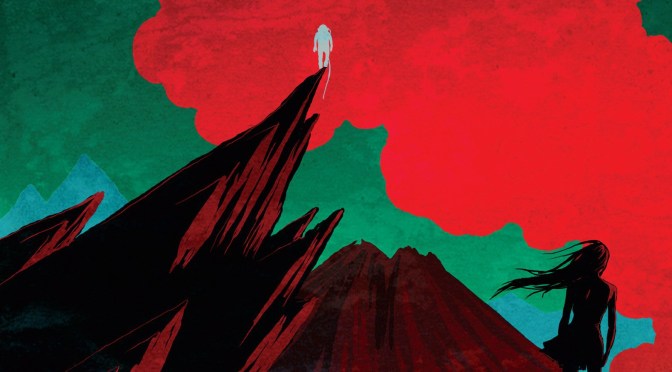
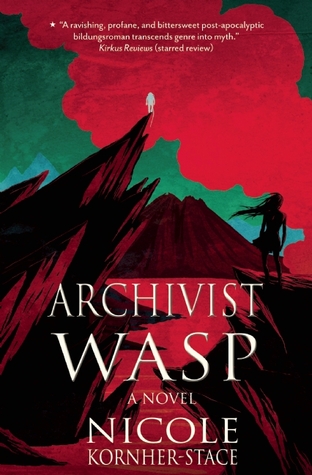
Archivist Wasp is a strange and beautiful story that still managed to be somewhat disappointing to me. I liked it quite a bit, but I didn’t love it the way I thought I would and I’m not sure exactly why except that I feel somewhat misled by an enormous amount of good reviews that were terribly vague about what this book is. At the same time, I do like that Archivist Wasp defies any neat genre categorization. It’s a book that is many things, but mostly it’s hard to describe without giving away the whole story. In any case, I’m not sure exactly what I expected from this book, but what I got wasn’t it, and I can’t say that my expectations were challenged or unsettled in any positive way. I just feel weirdly neutral about the whole thing.

After about a week of trying to figure out why this book just didn’t sit right with me, I think it’s largely because, while it’s a thematically strong work—dealing with issues of identity and choice and the ways in which people can be susceptible to bad ideas—there’s just not a whole lot of actual story. The whisper thin plot might have worked if Nicole Kornher-Stace made up for it with particularly beautiful prose or great characters or a good sense of the setting, but that’s not the case. Kornher-Stace’s prose is just workmanlike; Wasp is kind of a wonderful character, but she’s not enough to carry a whole novel; and the setting seems to be shooting for almost mythic—a journey through an underworld—but fails, and at the same time is a post-apocalyptic dystopia of sorts—but without any details to give it any specificity or to ground it in a plausible future.

It seems to be somewhat in vogue these days for authors to skirt the line between science fiction and fantasy, and genre-bending is a common buzzword of recent years that I’d heard used to describe Archivist Wasp. That may be the case, but to me it felt more noncommittal than purposeful in its failure to decide what it wanted to be. Wasp’s abilities seem to be mystical in nature, and this isn’t entirely at odds with a world that appears to have been shattered by a human-caused apocalypse, but there’s really no explanations for either of these things. Certainly, there isn’t nearly enough explanation given to even begin to explain how the world shifted from the one that produced the super soldiers whose ghosts Wasp interacts with to the world in which Wasp has been raised.

It’s not always necessary to explain this stuff, and sometimes it’s actually better if authors don’t bother—too many potentially good books have been ruined by over-explaining—but the society that Wasp is part of is so alien that it’s difficult to imagine how it happened at all. If I’m being very generous, I could say that this makes the book original, and it is, as far as that goes, but in the absence of any common genre tropes, it becomes the responsibility of the author to make sure that the reader has all the information they need to grok the book.

I suppose that in the end, though, it’s not so much that Archivist Wasp is hard to understand; it’s just deeply unsatisfying. While I can appreciate what I suspect is the author’s aversion to holding the reader’s hand, just a little more explanation would have gone a long way towards making this a much more enjoyable read.

Book Review – Barsk: The Elephants’ Graveyard by Lawrence M. Schoen

Lawrence M. Schoen’s Barsk: The Elephants’ Graveyard is a wonderfully original masterpiece of a novel, and I am so glad that I got to it in time for Hugo Award nominations. Somehow, I’d thought it was a 2016 book because it came out so late in the year (December 29). Fortunately, it showed up on the Nebula shortlist before I missed out on it entirely. You guys, this book is so good. If you are a Hugo voter, I highly recommend reading this book before you finalize your nominations. 2015 was an amazing year for genre fiction in general, but this novel is definitely at the top of the heap of amazingness.

The concept of Barsk is fascinating. Thousands of years in the future, spacefaring anthropomorphic animals of numerous species have colonized the galaxy. A pair of species collectively known as the Fant (descended from Asian and African elephants) inhabit the titular planet, Barsk, where they have been left more or less undisturbed for hundreds of years due to the other (all furred) species’ dislike of them. They might be left alone entirely if the Fant weren’t the only manufacturers of a drug called koph that, in some people, awakens a rare and highly desirable ability to Speak to the dead. Needless to say, after eight centuries of depending solely on the Fant for the drug, not everyone is happy with the current state of affairs.

What makes Barsk such a joy to read is that, while it may technically be a flaw, it has a tendency to meander, and there are all kinds of small flourishes that have little to do with the actual plot but that are nice to see as they really work to make the world of Barsk come alive. Sometimes, as well, Schoen includes material that isn’t strictly necessary in order to lighten up some of the story’s darker moments or simply to add some depth to a minor character. In every case, these detours and seemingly extraneous details are naturally integrated with the main story, whether it’s a solitary chapter from Tolta’s point of view or the brief story of the unexpected reunion of two Fant men who were able to have a few days of joy together at the end of their lives.

The portrayal of the animal cultures is fascinating. Schoen has clearly done a lot of research, and he does an excellent job of balancing an imagination of what the racial cultures and traits of his anthropomorphized animals might be with a wonderful instinct for character that prevents the animal characters from being too stereotypical. Certainly some of the background groups—especially the Badgers and Pandas—are a little too homogenous-seeming, but even that can be more safely attributed to the fact that the Pandas we see are soldiers and the Badgers are torturers, which accounts for their seemingly monolithic natures. The named characters, however, are, by and large, all unique and compelling individuals. Their species certainly informs who they are, but they aren’t defined by it.

The exploration of racism, genocide, and marginalization may seem a little on the nose, and I’m generally not a fan of exploring these themes through fantasy races and cultures, but it works here. The political situation between Barsk and the rest of the colonized worlds is fraught in realistic ways that recall some real-world scenarios but never copy any exactly. This allows Schoen to take a look at some common structures of oppression and exploitation without stepping on the toes of any real people. It’s not the most thorough look at these themes, but it’s well done without being heavy-handed or preachy and the ending of the story is messy and ambiguous enough to keep Barsk from every being called simplistic.

If I have any criticism of Barsk, it’s that there’s just not enough of it. I’m thrilled that it’s a standalone title, but I would love to read more stories set in this world. I want to know how Lirlowil turns out or what Pizlo grows up to be like or whether Jorl ever notices the girl in the bookstore or if Tolta ever finds love again. I’d even take a book about what Bish gets up to now that he’s got a fresh start. Barsk is a story that I never wanted to end, and I can’t wait to see what Lawrence M. Schoen writes next.

Book Review: Genrenauts #2, The Absconded Ambassador by Michael R. Underwood

When I read the first of Michael R. Underwood’s new Genrenauts series, I compared it to the pilot of a television show—it was a solid introduction to the series, but it had a lot of pilot episode problems. The Absconded Ambassador is a rather shaky second outing for the series, and it just didn’t work for me. This time the genrenauts travel to science fiction world, which was exciting, but Underwood didn’t really do anything particularly new or interesting with the setting. The Shootout Solution had a sort of twist that, while obvious, was an interesting exploration of western adventure tropes. There’s nothing like that here, which was a little bit of a letdown.

On the bright side, there was more character development for the main characters this time around, and Leah and the rest of the genrenauts are starting to feel a little more like real people. That said, Leah isn’t a particularly likeable character, but she’s also not unlikeable in any particularly interesting ways. She also shares a lot of screen time on this outing with other characters, but none of them are very memorable, either.

If you don’t have compelling characters, a great plot is a must, but the actual plot here is whisper thin. Very few things actually happen, and those that do aren’t very interesting. The peril caused by the kidnapping of the ambassador never feels very high stakes, and the more general danger of what could happen in the real world if a genre world breaks never manages to feel, well, real.

These issues may simply be due to the limitations of the short length of these novellas and the serial nature of the story, but it’s already hard to muster up any excitement for the next installment at this point. I’ve so far compared this series to a television show, but the problem with serial novella-length installments is that they don’t come out a week apart. The next one won’t be out until months from now, and that’s a long time to wait for mediocrity.

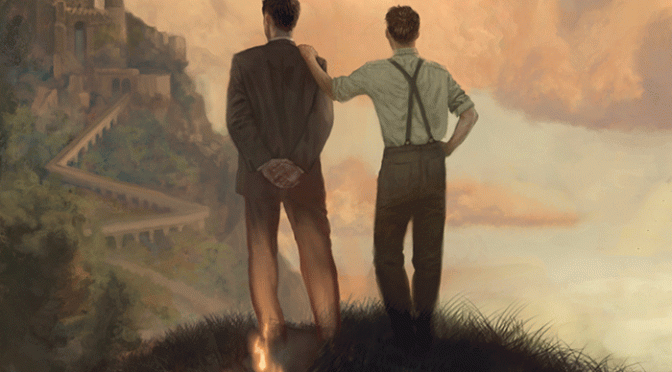
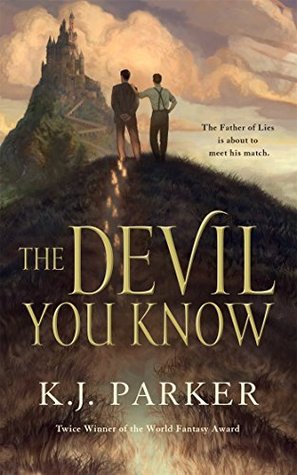
Book Review: The Devil You Know by K.J. Parker

Alright, so I loved this book, but I kind of hate that I did because it’s actually, objectively, a lot of things that I hate. Mostly, The Devil You Know is just not nearly as clever an idea as the author seems to think it is. Still, I just ate it up, and I tore through this little book in the space of an afternoon, it was so much fun. K.J. Parker has taken an idea that has been done before and freshens it up just the right amount, but without making it overly precious or smugly faux-intellectual.

The Devil You Know takes the unreliable narrator trope and multiplies it by two, telling its story from the twin perspectives of an actual (if unnamed) devil and the great philosopher, Saloninus. While there are a couple of point of view shifts that were easily missed—to the point I had to go back and reread once or twice—this mostly works. Saloninus in particular is a wildly clever and funny character, and the contrast between his confidence and the increasingly worried tones of his devil servant is consistently hilarious enough to make up for some of the story’s shortcomings.

The biggest problem that I had with The Devil You Know was the way that women were treated in the narrative. For one thing, there are no actual female characters in this book. There are hordes of nameless prostitutes, shipped in to entertain the menfolk, and there is the woman presumed to be Saloninus’s ex-wife. The sheer lack of agency and importance of these women isn’t particularly surprising, but the way in which both Saloninus and his devil callously use women makes it difficult to truly root for either of them. It’s one thing to have a story with few or no women, but it’s something else entirely to have two essentially misogynistic point of view characters and expect them to be universally appealing.

Regardless, I rather found myself liking both Saloninus and his devil in spite of myself. Saloninus is a wonderfully wicked and manipulative character, but he is only human. The devil has the air of a sort of harried bureaucrat. His anxiety about the contract with Saloninus is palpable, and it’s highly entertaining to experience the devil’s warring feelings about the philosopher. Neither character is particularly compelling, and they definitely aren’t breaking any new ground, but they are both better-than-middling examples of their types.

While the story’s ending is somewhat telegraphed and certainly not very original, Parker manages to mostly make it work. It wraps up a little too quickly and neatly, if anything, and it would have been nice to see things go down in a way that was a little less expected. However, it’s a solidly entertaining story that one doesn’t have to think too hard about. Sometimes, that’s good enough, and this is one of those times.

This review is based upon a free advance copy of the book received through NetGalley.

Book Review: The Ballad of Black Tom by Victor LaValle

The Ballad of Black Tom opens with a dedication, “For H.P. Lovecraft, with all my conflicted feelings,” which is a handy summary of how many, if not most, modern readers feel about Lovecraft. Victor LaValle has written at some length elsewhere about his history with Lovecraft’s work and how he was inspired to write this novella in response to the Lovecraft story “The Horror at Red Hook,” so I won’t rehash that all here. Suffice it to say that The Ballad of Black Tom functions as both an indictment of and a love letter to Lovecraft, but it’s also a great story in its own right and is sure to be one of the best novella-length works of 2016.

It also doesn’t actually require a familiarity with the material that inspired it, although it does help. Even just a basic knowledge of Lovecraft’s work and his major themes will enrich your reading of LaValle’s novella and place The Ballad of Black Tom in proper context. While there’s definitely a vast difference in the length of Black Tom and the short story that inspired it, the biggest difference here is one of narrative scope. LaValle brings Tommy Tester and his contemporaries to life in a way that is directly contrary to Lovecraft’s fantasy of immigrant communities as unwashed, faceless hordes to be controlled and exploited by one malevolently erudite old white dude. Victor LaValle has done his research and combined it with his own lived reality in order to resurrect for the reader a specific time and place and people, and “The Horror at Red Hook”, in comparison, ends up looking like exactly what it is—the paranoid imaginings of a very sheltered, racist white man.

Whereas Lovecraft viewed immigrants and brown people with the same degree of horror with which we might think of tentacle monster gods in the depths of the ocean, LaValle is consistently clear on what the horrors are in Black Tom. At the same time, though, LaValle eschews any simple dichotomy of good and evil, instead preferring to explore ideas about how and why evil is made and used—and what it means when different people use it. When the climax of The Ballad of Black Tom comes, it’s a scene of catharsis that is both exhilarating to read and uncomfortable to feel so exhilarated about.

It’s a powerful reclamation of the racist narrative that Lovecraft created nearly a century ago, and it’s more wonderful and more unsettling than anything Lovecraft could have thought up. It’s a viscerally effecting and definitive illustration of the ways in which Lovecraft’s own biases and neuroses hindered him from telling this story in the way it deserves to be told. Victor LaValle has rehabilitated it and made it perfectly his own.

Book Review: Daughter of Destiny by Nicole Evelina

I’ve always found it a little sad that there isn’t more Arthurian literature written about Guinevere, so I was excited when I saw this self-pubbed title pop up on NetGalley and had high hopes that it would offer some new insight or a unique interpretation of the mythology. Unfortunately, Daughter of Destiny was mostly a let down on that score. It’s a fast, easy read, though entirely unexceptional, and while Nicole Evelina may have some historical background, her knowledge of, understanding of, and respect for Arthurian legend and literature is marginal at best. It’s not a bad novel, but it was definitely a disappointment as an Arthurian one.

The story starts off somewhat slowly, as 11-year-old Guinevere is sent to Avalon to train as a priestess, which feels like a page out of nearly every Arthurian retelling from Morgan’s point of view. Unlike most of those retellings, which often focus on Morgan’s relationships with the women she meets there, this first part of Guinevere’s story actually leaps over several years of her training in order to get straight into her senseless rivalry with Morgan and her relationship with, of all people, Aggrivane. I’m not sure which I find more upsetting: the conflation of Guinevere’s story with Morgan’s, the absurd twisting of the regular Arthurian timeline of events, or the general grossness of Guinevere’s relationship with Aggrivane (who is an adult man). It’s all completely unoriginal and establishes early on that the author doesn’t know or care much about the literary tradition she’s working within.

After graduating from priestess training, Guinevere doesn’t actually become a priestess. Instead, she’s sent back to her father, Leodgrance, who has become a Christian since the death of Guinevere’s mother. We’re told that Guinevere is extremely sad about her mother’s death, but the majority of Guinevere’s time in Northgallis deals with her relationship with her father. This does touch upon a common Arthurian theme—the conflict between the indigenous religions and traditions of Britain and the Christianity imported during the Roman occupation of the country—but in a very shallow manner. Rather than exploring these larger ideas, Evelina dwells on relationship drama, even contriving to have Aggrivane show up at Northgallis in order to create a situation that gets Guinevere sent away to the story’s next setting.

In Pellinor’s household, Guinevere meets Elaine (Pellinor’s daughter) and Isolde, both characters who usually have their own interesting roles to play in Arthurian legend. Here, though, Elaine is a quiet, strange girl in thrall to her domineering mother, Lyonesse, and obsessed with finding a man who she believes she is destined to marry. Isolde is the heir, in her own right apparently, to the throne of Ireland, but she’s kept practically as a servant in the household, where she spends her time sleeping around (as one does when one is a young princess in a time before birth control, I guess) and giving pages-long speeches of exposition to Guinevere. Guinevere and Isolde are supposed to be great friends, but the relationship isn’t very developed, and what passes for court intrigue is little more than mean girl antics.

The climax of the novel is a grand tournament held by Pellinor to entertain the new High King, Arthur, but there’s not much action to be had here. Guinevere again resumes her affair with Aggrivane, and they hope to marry, but instead Guinevere ends up promised to Arthur, who she has had almost no contact with whatsoever. She’s upset at first, but seems to be getting into the whole “being queen” thing by the end of the novel. Even Aggrivane doesn’t actually say anything in protest, even though he had been assured by his own father that marriage to Guinevere was a done deal. It ends up feeling like a betrayal of the whole book up to this point, with no foreshadowing or anything to prepare the reader for this. Obviously, as someone familiar with the story, I wasn’t surprised to have Guinevere paired off with Arthur—that’s a non-negotiable facet of the legend and was definitely going to happen by the end of the book—but it felt incredibly unearned here, as if the author expected it to be a shocking turn of events. Instead it just seemed silly and calls into question the purpose of the entire rest of the book.

There’s no particularly new ground covered in Daughter of Destiny. It borrows heavily from The Mists of Avalon and similar feminist interpretations of the Arthurian mythos, but without any real understanding of the things that make those stories compelling. Although she has some admirable (albeit generic) qualities, Guinevere is a passive character throughout her own story, with very little agency. Her singular rebellion (outside of her ill-advised relationship with Aggrivane) is to secretly continue her weapons training, which connects her to her dead mother and to her ancestral people, but this is never fully explored and is also never once relevant to the plot. Meanwhile, every major event in Guinevere’s life is determined by the men who control every aspect of her present and future.

[This review is based on a copy of the novel received through NetGalley.]
Book Review: ODY-C Volume 1 by Matt Fraction and Christian Ward

ODY-C is an ambitious, psychedelic epic fantasy that needs to be completely finished and printed into one enormous, beautiful book so I can just read it all in one sitting. It’s a futuristic, gender-bent retelling of The Odyssey, and it’s a great way of bringing an ancient story to life for a new generation of readers.

That said, ODY-C is not going to be for everyone. It definitely relies on the reader having some level of familiarity with the source material, for one thing. If you’ve never heard of Homer or The Odyssey, and don’t know at least some of the highlights of the story, you may feel somewhat at sea through much of this first volume. There’s no hand-holding here, and it’s very obvious that the reader is expected to either keep up or go spend some time on Wikipedia and then come back.

Even the language is a nod to the story’s origin. It’s written partly in a kind of sound-alike version of the dactylic hexameter that characterized much of the classical Greek epic poetry. I love this choice because it maintains some of the identity of the source material in the face of a lot of other more avant garde adaptational decisions, but it can sound clunky to modern readers. While I’m not an expert on the form to be either outraged or dismayed about the execution, I found the poetic language interesting, and it really helped to set the tone of the comic and give a fascinating classical flavor to the setting that makes it a little unique. Certainly, I’ve never seen anything quite like it.

Christian Ward’s art, of course, is stunning. It’s just page after page of gorgeous colors and textures, from brilliantly-rendered action scenes to grand space vistas. At the same time—and this is, I think, my favorite thing about ODY-C—while the overall look of the art shows a keen attention to detail (the yonic shapes of spacecraft are a nice touch in a universe that has been scrubbed almost entirely clean of men) and an eye for beauty, there seems to be remarkably little focus on making the book’s many, many women pretty. The women of ODY-C come in all shapes and sizes and colors, from the great warrior Odyssia to various goddesses and even a hideously rendered (in the best way) cyclops.

As with all comic books, my biggest complaint about ODY-C is that it’s not long enough, and I have to wait for more, which is even more frustrating since it seems to have a somewhat laissez-faire production schedule. I want more, and much sooner than I’m likely to get it.

Book Review: Planetfall by Emma Newman

Planetfall is a brilliant portrait of a character and a community both in crises and a meditation on the ways in which the community and the individual are intertwined. It’s a gorgeously realized sci-fi mystery about a secret that festers in the heart of a seeming utopia and threatens to destroy it all.
Renata Ghali followed her dearest friend, Lee Suh-Mi, across the stars to a new planet in search of God, but what they found when they arrived on their new planet was, well, inconclusive. When Suh-Mi disappears, Renata and the rest of their colony have to figure out how to go on without her. Over twenty years later, Suh-Mi’s grandson shows up and starts uncovering the truth that Renata has helped to hide all this time.

Much of the praise I’ve seen for Planetfall has been for its narrator, and I can’t help but concur. Ren is a fascinating character with an unconventional point of view that makes hers a unique perspective to read a story from. She’s an older woman (a youthful seventy or so, in fact), a woman of color, queer, and significantly mentally ill, though the revelation of that last fact sort of creeps up on you as you read her story. The first person present tense narrative provides a nice sense of immediacy and immersion, which becomes increasingly important as the story moves along and Renata’s mental state deteriorates. Over the course of the novel, Ren becomes increasingly anxious and paranoid, then frantic as secrets start to be uncovered. It’s not always an easy thing to read, but it is absolutely riveting.

I only wish that there had been more actual science in Planetfall, although I think that’s more a sign that I’ve been in a mood for harder sci-fi recently than it is a sign that Emma Newman fails the reader in any particular way. Indeed, there are all kinds of interesting ideas on display here, from printing technology to sustainable living and social engineering. This book straddles the worlds of harder sci-fi and more human-focused sci-fi and does both justice, but I would have loved more explanation of how things worked, especially the space travel portion of the colony’s journey, which I felt was very glossed over. Realistically, it doesn’t matter and isn’t really pertinent to the story being told, which is likely why there’s not more detail about the ship and the journey, but I kind of love that stuff.

Finally, I would also have liked to see some of the themes surrounding religion and spirituality in an age of scientific and technological wonders be a little more fully developed. There are all kinds of ideas touched upon regarding the existence of God, the possible ultimate fruitlessness of humanity’s search for God, and even the ways in which faith makes people vulnerable—both to their own bad ideas and to exploitation in service of other people’s bad ideas. Ren is a great protagonist for asking questions and making observations about these things, as she’s a skeptic herself and her disconnectedness from her community makes her often a shrewd observer of people. However, her observations are thoroughly colored by her significant mental illness, making them increasingly unreliable over the course of the book even as more of Ren’s and the colony’s history is revealed, and the rather abrupt ending of the story is somewhat unsatisfying.

All in all, though, Planetfall is a great book. It’s got a lovely, almost meditative pace to it, and it’s an incredible character study of its narrator. As someone who also suffers from depression and anxiety, with a tendency towards reclusiveness, I found Ren incredibly relatable, and I can definitely see this being a book that I will return to in the future.

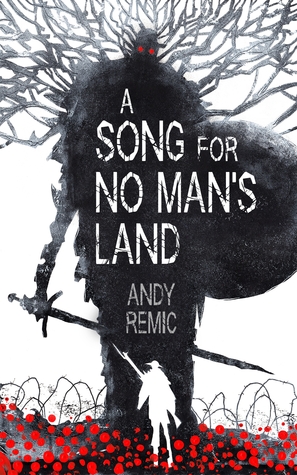
Book Review: A Song for No Man’s Land by Andy Remic

A Song for No Man’s Land is a dull, depressing slog of a novella that never seems to figure out what it wants to say. For all of its short length, it seems to drag on interminably before finally sputtering to a stop right when things seemed to almost start to get interesting. It is the first book in a series of at least three, so perhaps that can be forgiven, but I’m not sure I care enough about Robert Jones to want to come back for more.

The story alternates fairly rhythmically between Robert’s time as a soldier during World War I and his childhood in rural Wales, but neither setting is particularly compelling. Robert’s time in the war is characterized by pretty run-of-the-mill WWI imagery and tropes while the flashbacks to his youth are mostly concerned with introducing the story’s mystical elements. However, the use of Scandinavian mythology (the hulder) seems out of place in a story about a Welshman as well as in a story about WWI. I’m not averse to the idea of forest spirits being upset or angry at the destruction of war (that would be very Princess Mononoke), but it seems an odd choice to co-opt the forest spirits of a neutral country where there was no actual fighting during the war. Alternatively, the forest spirits could be a reference to some similar German creatures, but that still doesn’t explain what they would be doing hanging around in Wales while Robert Jones was a kid.

The other characters introduced never manage to come truly alive, though Bainbridge comes closest. Instead, they’re all simply passing through, and they don’t even seem to have much impact on Robert, much less on the reader. Even Robert’s supposed friend, George, appears abruptly in the final quarter of the book only to come to a senselessly tragic end that left me wondering why he was introduced at all. The only women mentioned are either decidedly subservient figures (mothers, a sister, a nurse) who exist only to coo over or fuck the men in the story—well, mostly just Robert—or they are the demonically horrific Skogsrå that has apparently been menacing Robert Jones since he was a little boy.

The horror elements of A Song for No Man’s Land are sadly underdeveloped. The abovementioned appropriated mythology is made regrettably generic, and the monsters themselves are left largely to the reader’s imagination. I believe that Andy Remic was trying to rely on building a horrific atmosphere and crafting a feeling of terror through language, but his workmanlike prose is just not up to the task. Furthermore, the decision to replace vulgarities with “______” is described in an introductory note as a hat tip to the time of the book’s setting, but it comes off as coy, distracting, and frankly confusing as it’s often not clear what the censored term ought to be. This choice might have made sense if the overall tone of the writing was made to feel antiquated, but in a book that is otherwise modern in its style it just feels like an on the nose anachronism.

One of the reasons I read all of Tor.com’s novellas is because doing so encourages me to read outside my comfort zone and try new things that I wouldn’t normally pick up. Often, this has paid off big time; it’s been nice to discover several new authors to follow, and it’s interesting to read stuff that isn’t my usual cup of tea. Unfortunately, this time it just didn’t work out that way. A Song for No Man’s Land might be a great story for the right reader, but I just couldn’t like it.