
Alan Tudyk’s upcoming webseries, Con Man, looks as excellent as I expected, and there are a ton of familiar faces in it.
It can be pre-ordered now on Vimeo for $14.99 if you want to be super prepared for its arrival on September 30.
Alan Tudyk’s upcoming webseries, Con Man, looks as excellent as I expected, and there are a ton of familiar faces in it.
It can be pre-ordered now on Vimeo for $14.99 if you want to be super prepared for its arrival on September 30.
And it’s got Lucy Lawless in it!
This looks fun. No news on an air date yet, but it’s going to be shown in cinemas worldwide as well.
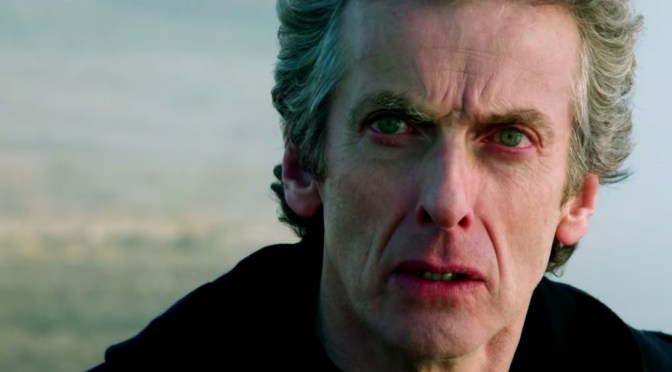
I think the most important thing here is that Missy is coming back.
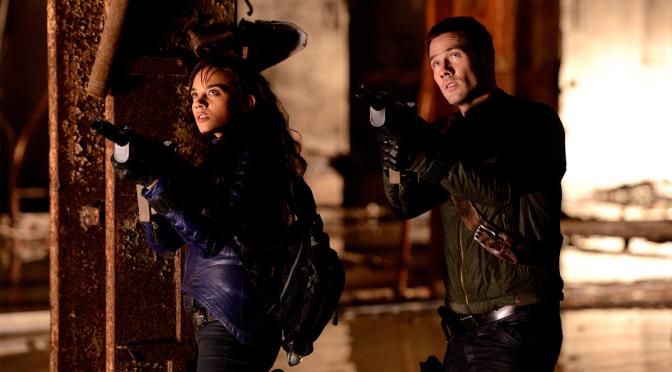
With “The Harvest,” Killjoys is finally starting to get out of pilot territory, but I’m still not sure exactly what the point of the show is. I would have liked, three hours into a ten hour season, to have a better sense of what exactly is going on, but I’m just not quite there yet. It’s unfortunate, because there’s a lot that I like about this series, and I think it has some real potential.
The episode starts with D’avin passing his tests to become a Killjoy. He’ll actually start at level four, outranking his brother, as soon as he can pass a psychological evaluation. Of course, John is insecure about it, but we don’t actually get to see the brothers interact that much, and John’s feelings end up being worked out with Dutch instead in the final minutes of the episode. Instead, after the introductory scenes, D’avin spends most of his time trading barbs with a new character, Pawter, the shady doctor he’s trying to get to sign off on his psych eval.
The job of the week (retrieving a runaway migrant worker) seems like it should be an easy one, and it’s a favor for a friend of John’s, but for some reason Dutch is reluctant to do it. I know she’s wrapped up right now in trying to figure out why she’s supposed to be killing the guy she grabbed at the end of episode two, but this seems like the sort of job that should be right up her bounty-hunter-with-a-heart-of-gold alley.
Which brings me to my major complaint about the series so far, which is that it’s just damned inconsistent. While there are a lot of interesting things going on and a lot of neat ideas on display, everything seems to become more and more garbled with every episode. While this episode finally moves beyond (mostly, anyway) what I would consider first episode material, there still seems to be a lot of exposition and a lot of set up going on without any payoff. The one piece of drama that was resolved in this episode–John’s jealousy of D’avin–is actually something that would have been better either as a long term part of the dynamic between the trio of main characters or just left out entirely because it’s predictable and trite.
D’avin’s PTSD-like condition is ongoing and unresolved, although it so far doesn’t seem to have any serious impact on his ability to function. While I think it’s being treated in a serious manner by the writers, it seems like they don’t want it to be too big a part of the show. And aside from Pawter, who deliberately triggers D’avin in a public place in order to try and force him to seek treatment, neither John nor Dutch seem to be particularly concerned about it–even though D’avin literally almost killed a random dude at a bar for no reason early in the episode.
Dutch’s mysterious past (and present) becomes no clearer in this episode. While we do get to see her torturing the dude that she is apparently too ethical to want to assassinate, we don’t even know who the guy is or what his job is or anything about him at all that might give us a clue about what Dutch is involved in. It’s incredibly disappointing, because I was very hopeful last week that this episode would shed some light on things. Instead, I know less than the character does about what’s going on, and all I learned about Dutch this week is that, while she doesn’t want to kill people for money, she’s totally cool with putting the screws to some dude who doesn’t even know why someone wants him dead.
“The Harvest” continues exploring the idea of inequality, but I still don’t get how the Quad is organized. So there are people who are really rich and people who are de facto slaves, and this is bad. But our Killjoy protagonists also gleefully send some dude off to be a slave in a mine because he’s an asshole. I suppose it’s not so much that I’m not beginning to see what is going on in the Quad; I’m ust not understanding how our supposed protagonists fit into it.
Honestly? They don’t seem like sensible people. They seem very young, rather irresponsible, and totally directionless. Every damn one of them has some kind of dark past, but they seem to be only sporadically affected by their histories. They inhabit a world of drinking and banging married women and dealing with black markets. They kill people in the course of their work, and there doesn’t seem to be any real rhyme or reason to whatever half-baked honor code they live by.
Now, it could be that what is unfolding in this show is a coming of age and the political awakening of the characters, but that brings me back to the fact that we’re already three episodes into a ten episode season and I’m just not feeling very invested in the journey yet. I expect a coming of age or political awakening story to be messy, but as much as there is to like about Killjoys and as much as I’ve enjoyed parts of the show so far, I just don’t feel like the story has started yet, whatever it is.
Killjoys is a fun show with a theoretically likable concept, but if something doesn’t happen soon I’m not sure how much longer I’ll be able to stick it out hoping.
“All the Mirrors of the World” marks the halfway point of the miniseries, and, fittingly, it’s an episode that is heavily concerned with balance. More accurately, it’s an episode that deals largely with the ways in which things are out of balance and are not right with our characters.
The episode begins right where last week’s ended: with the chaos following Lady Pole’s attempt on Mr. Norrell’s life. We quickly learn that Lady Pole succeeded only in wounding Childermass and earning herself a trip to an asylum.
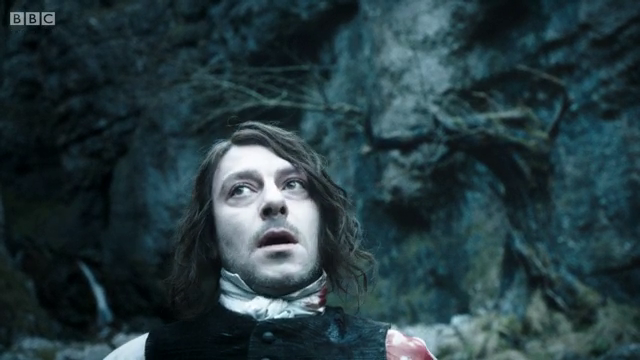
The standout part of this whole sort of opening sequence is the interaction between Childermass and Norrell. It’s probably the longest we’ve gotten to see these two characters alone together so far in the show, and I think it’s been worth the wait. This scene finally manages to really establish the sort of relationship that exists between Mr. Norrell and his servant. Mostly, it’s a weird relationship, characterized by Childermass’s self-assurance and Norrell’s awkward reliance on Childermass. Indeed, while Childermass is incapacitated, Norrell is seemingly barely able to function. At the same time, though, Norrell is suspicious of Childermass’s use of magic, and Childermass has begun to mistrust Norrell as well.
Meanwhile, the Stranges seem to be in somewhat better accord now that Jonathan Strange has returned from the Peninsula. As Jonathan prepares to return to his apprenticeship with Mr. Norrell, he and Arabella are extremely cute together.
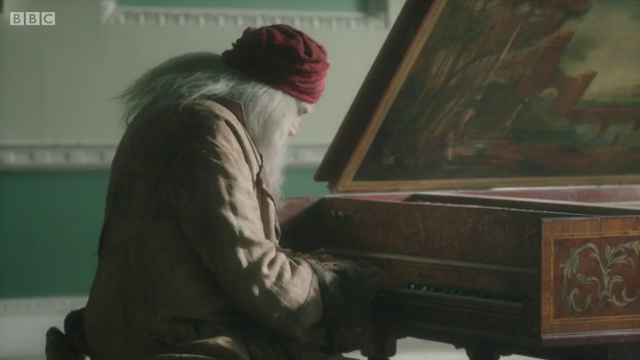
The first thing that Norrell and Strange do now that they’re back together is visit King George III, who is in the midst of his final bout of madness. They’ve been called to see the king by his children, who hope that they might be able to use magic in some way to help him. Norrell, of course, has already said that magic cannot cure madness, but Strange is more hopeful and even returns on his own after Norrell has already moved along from the matter. While Strange is unsuccessful in penetrating the king’s madness, he does get to see the king disappear into a mirror after having an odd conversation with someone Jonathan can’t see.
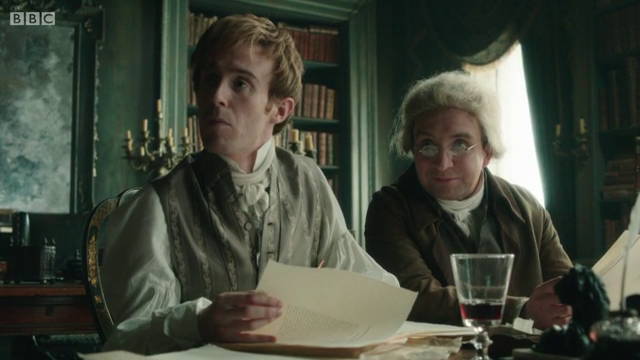
When Jonathan goes to Mr. Norrell to talk about what happened, Norrell is dismissive. Norrell is much more interested in promoting his own ideas, primarily through Lascelles’ book, which is nearly ready for publication. Strange is basically shut down entirely, and it’s becoming clear to everyone that Norrell intends to be the only magician in England whose opinions matter. Frustrated with Norrell, Strange takes his leave, returning to his home, where Arabella reminds him of the first spell he ever did–which warned him that Norrell was his enemy.
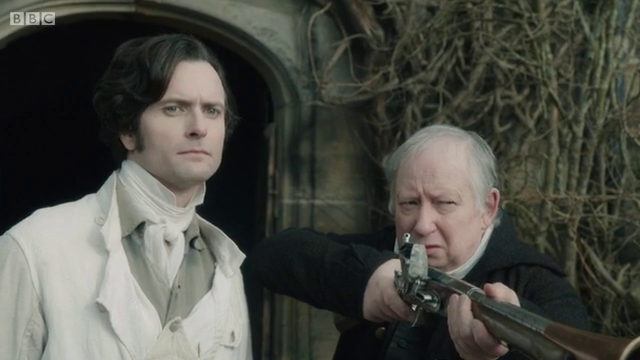
Lady Pole has been taken to Starecross, which Segundus and Honeyfoot have turned into an asylum since Childermass told them they couldn’t have a magicians’ school. Lady Pole will be their first patient, but she’s terribly unhappy about it. When she recognizes them as magicians, she’s convinced that they are Norrell’s men, only calming down when she observes them refusing Childermass entry to see her. It seems that Starecross may be a comfortable place for Lady Pole after all, and Segundus is even able to see the enchantment that has been placed upon her and Stephen Black, although he doesn’t know what it is.
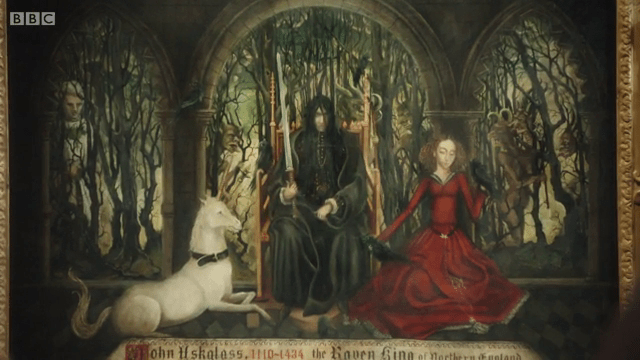
Earlier in the episode, Arabella questioned her husband about a Miss Grey, who claimed to be learning magic from him, and Jonathan disclaimed any knowledge of the girl. While Jonathan is at a club with a couple of friends, however, he comes face to face with a pair of men who also claim to be his pupils. Clearly, someone is running a scam. When called upon to demonstrate his magic and prove his identity, Strange steps into a mirror, where he finds himself on the [Raven] King’s Roads.
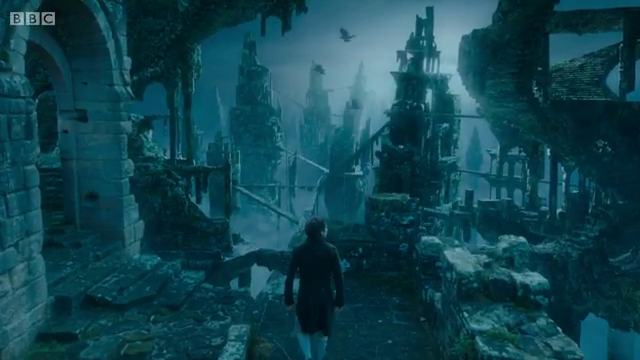
Jonathan Strange uses the roads to travel to where Drawlight is; unsurprisingly, Drawlight is in the middle of duping yet another person out of exorbitant amounts of money, and Strange speedily puts a stop to the scheme. When Strange finally returns to his own house, Arabella has been worried, and she turns furious when Jonathan is dismissive of her concerns. I am pleased that the show follows the book in presenting Jonathan Strange’s inconsiderate behavior toward his wife as a fault, and they do a wonderful job here of showing this conflict between the Stranges in a way that is fair to both characters. Bertie Carvel is affable enough as Jonathan Strange that he’s lovable in spite of his sometimes glaring faults, and Charlotte Riley as Arabella captures such a perfect mix of loving concern and absolutely justified anger that there’s no reasonable way anyone could think her shrewish or nagging. Indeed, I think the viewer is supposed to be almost entirely on her side in this argument, and her feelings are treated entirely seriously.
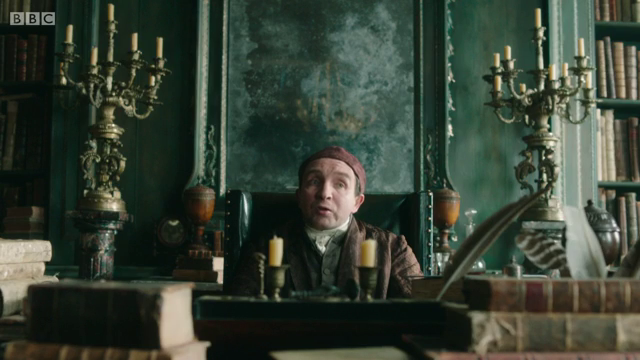
Drawlight finds himself permanently exiled from Norrell’s presence and in a great deal of debt that is about to get him tossed into prison. However, this might be considered lucky, as Norrell is pushing to have some ancient magical court revived in order that Drawlight could actually be hanged–with the added benefit that such a court could be used to squash any opinions on magic that differ from Norrell’s. Fortunately, Sir Walter is there to, quite sensibly, put a stop to that idea, and he gets one of my favorite speeches so far in the show. This is also, I think, a really clever way of including material from the book without really including it. In the novel, there’s a whole thing where Norrell pesters Parliament for a while about reviving the Cinque Dragownes, and it would have been terribly boring to put that in the miniseries even though it’s a pretty important bit of Norrell’s characterization. This conversation, though, allows us to get that characterization in one short scene, communicating the concept from the book in a smart way. Also, it’s very funny.
Angry about Drawlight and upset that he won’t have his own personal court of law, Norrell turns to picking on Jonathan Strange, next, berating him for his injudicious use of magic. Strange argues, trying to get Norrell excited about the King’s Roads, but Norrell only insists that modern magic must be kept “respectable.” As Strange leaves in frustration again, he grabs a copy of Lascelles’ finished book, which he sets out to review when he gets home.
I am a little bummed that we don’t get the whole text of Strange’s scathing review, but I suppose that gives people a good reason to read the book after watching the miniseries. I did like seeing Lascelles rant about the review to Norrell, though.
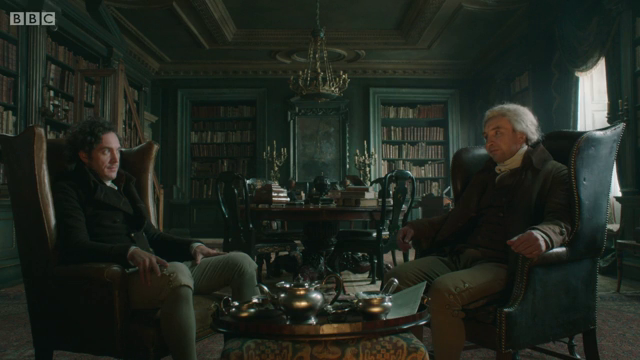
Probably the most important thing that happens in this episode is the inevitable breakup between Jonathan Strange and Mr. Norrell. Following the publication of the infamous book review, Strange goes to visit his mentor and inform him of the end of their association. This scene is shot so perfectly and acted so sensitively that it actually made me a little teary. Norrell practically begs Strange not to leave him, and it broke my heart a little.
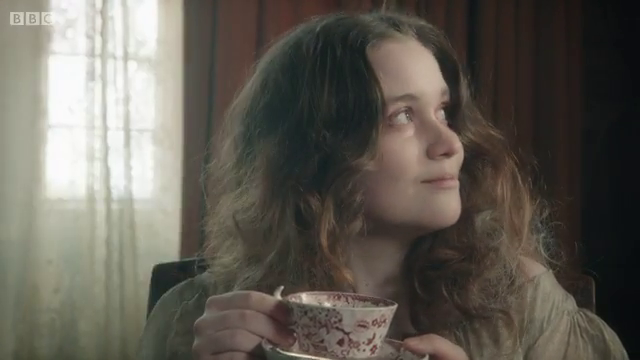
I would have been happy if the episode had ended here, but there are still a couple of things to be wrapped up. In the last few minutes, we get to see Lady Pole finally settled at Starecross, which is nice, although I think I would rather have seen this finished earlier in the episode. Mostly, I feel this way because Lady Pole’s fleeting contentment is immediately overshadowed by a sort of triple cliffhanger ending.
First, Jonathan Strange is called back to war when Napoleon escapes and starts causing trouble on the continent again. This throws a wrench in the Stranges’ plans to return to their country home, where Jonathan intended to retire and become a theoretical magician.
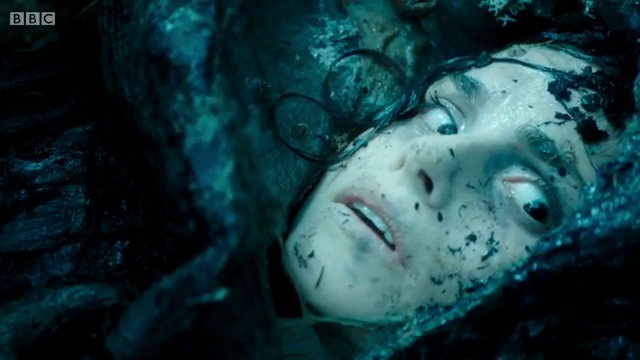
Second, Stephen Black and the Gentleman unearth a “moss oak” from a sort of bog. The Gentleman said that he needed the moss oak for his plan to take Arabella away from Jonathan Strange, and it turns out that the moss oak is a piece of enchanted wood, or perhaps a piece of wood that can be enchanted. In any case, and much to Stephen Black’s horror, the Gentleman peels back part of the wood, revealing Arabella’s face.
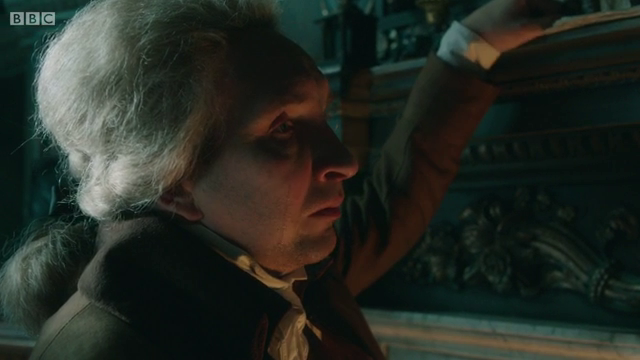
Finally, the episode ends with Lascelles confronting Norrell about the breakup with Jonathan Strange. Apparently, they had a whole plan of how Norrell was going to browbeat Strange into retracting his book review and stuff, but Norrell didn’t do any of that stuff. However, Norrell is receptive as Lascelles encourages him to work against Jonathan Strange, and by the last ominous shot of the episode, Norrell is vowing to destroy his erstwhile pupil.
“All the Mirrors of the World” is the best episode of the show so far. It’s thematically consistent with its examination of how different pairs of characters balance each other, and it does a masterful job of breaking up the central pair of Strange and Norrell, who don’t know yet just how much they need each other.
As an adaptation, this episode probably hews closer to the source material than any episode yet. Though notable cuts have been made and we miss out on some of the book’s insights into the interior lives of the characters, this episode covers an enormous amount of story in a way that feels naturalistic and almost effortless. The shifts between story lines are smartly done and keep things interesting the whole time without being disorienting or confusing.
Overall, this was just a superb piece of television, and it’s exactly the sort of thing I hoped to see when I first heard this miniseries was in the works. I’m not sure how the whole series will stand up to the source material, but this episode at least definitely does it justice.
“The Sugar Point Run” still feels a lot like Firefly, but I do think we’re already starting to see Killjoys distinguishing itself a bit from its predecessor.
Unfortunately, to me, this episode feels almost more like a pilot episode than the first one did. There’s still a lot of verbal exposition going on, some of which is repeated from last week, and I would have liked the situation with Dutch, Johnny, and Dav to have ended up last week where it is at the end of this episode. Because of course that’s what has to happen in order for there to be a story here.

There’s a lot of good stuff going on in “The Sugar Point Run,” though. It takes us deeper into the Company-run dystopia the characters are inhabiting, and there are some neat things happening there. I definitely came away from this episode with a better understanding of the politics of the Quad and what the killjoys’ role in things is supposed to be. I’m not completely sold on it all yet, but it’s still interesting enough to keep me watching. I’m hoping, though, that we’re coming to the end of this heavy handed info dumping so we can get on with learning more about the characters and seeing a real story play out.
Because the characters have a ton of potential. “The Sugar Point Run” shows us more of Dutch’s training as a child assassin, which is actually pretty harrowing, and we also see that D’avin is still having PTSD dreams, which isn’t explored at all. A big part of this episode was Dutch and D’Avin doing stuff together, which I liked, although I don’t like that it looks as if they’re headed for will-they-or-won’t-they sexual tension town. They have nice chemistry, as beautiful people often do, but that’s just such a tired trope that I could really do without it, maybe, just this once.

The other half the episode is Johnny hanging out with the ship, Lucy. We get to see Johnny being competent, which is good to establish, although he still feels a little too much like a comic relief character to me. While he’s repairing the ship, he does make a discovery that starts him to questioning Dutch, though, which introduces some more tension into their relationship.
I’m actually more interested in Lucy, though. We’ve seen a good amount of the human characters’ interactions with the ship, and it looks like they are definitely going to be developing the ship herself as a character. I’m not generally a fan of sentient ships, although I do think they can be done well. So far, Lucy has gotten some of the show’s best lines, but I think that’s a testament more to the overall weakness of the scripts than it is of how well the ship is being utilized as a character. Like the other main characters, though, Lucy definitely shows some potential.
All things considered, I am still enjoying Killjoys quite a bit, and I’ll almost certainly be sticking out the rest of this season. If the writers can move away from info dumping, get the series arc moving, and give the characters a bit more depth, I think it could be be a great show. And it could be that my impression of this episode as a second half of our introduction to the world and characters is exactly what the writers intended. If so, it’s not how I would have done it, personally, but it would mean that things will start getting really good this week with episode three. Here’s hoping.
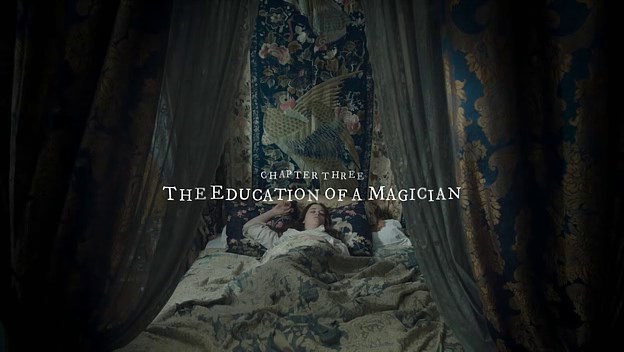 I always watch an episode at least twice before writing about it, and I’m very glad I did in this case. “The Education of a Magician” is definitely a piece of work that improves upon better acquaintance. On first viewing, I was disappointed at some of the liberties taken from the source material, but the second time around I was impressed with how well the adaptation is bringing to life the spirit of the novel, if not every single detail that I want to see on screen.
This episode contains, essentially, three stories: Jonathan Strange’s experiences in the Peninsular War, Mr. Norrell and how he deals with his pupil’s absence, and the advancement of Arabella Strange and Lady Pole’s friendship. We also start to see the increasing entwinement of the fates of Stephen, Arabella, and Lady Pole as well as the beginning of a huge gulf forming between Strange and Norrell as both of them cross some lines that they probably ought not (even though, at the end of this episode they seem as close as ever).
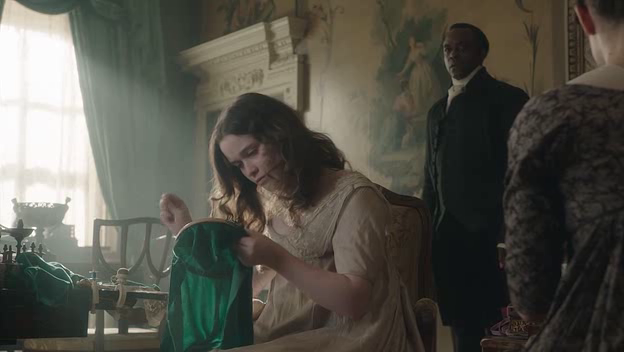
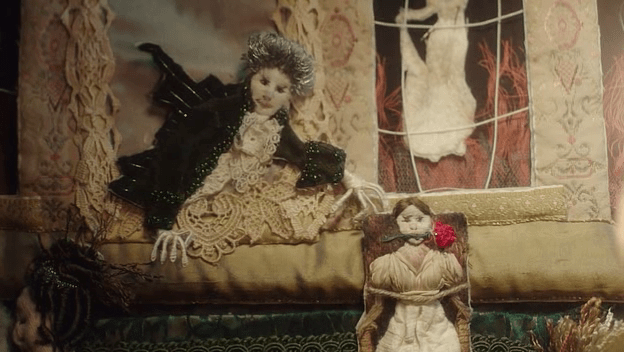
Interestingly, “The Education of a Magician” doesn’t open with Jonathan Strange, even though that might seem like the most exciting place to begin. Instead, the episode starts with Lady Pole waking up and having a new idea for how to tell Arabella about her predicament. She gets out of bed quickly and starts ripping up her dress to make a tapestry. Lady Pole’s tapestry is a somewhat interesting departure from the book, as it continues the show’s trend of expanding Lady Pole’s role and granting her somewhat more agency than she had in the novel. It’s nice to see, because I think Lady Pole is a tricky character who could easily have been flattened into a handful of unpleasant tropes or made into a simple damsel in distress. Instead, this adaptation actually improves upon the source material, giving us a Lady Pole who is clever and resourceful and never gives up trying to take back control of her life.
As Lady Pole is working out new ways of communicating, Childermass is, at Norrell’s instruction, intercepting letters to prevent Arabella from telling her husband anything that Norrell might disapprove of. Also sandwiched in here is a pretty much straight-from-the-book conversation between Arabella and Drawlight that I was happy to see included.
In Portugal, Jonathan Strange gets off to a rocky start with his military career, and Lord Wellington is downright dismissive of him. It seems to the two magicians have so far done more harm than good for the war effort, and Strange can’t provide what Wellington wants–men and arms–and is therefore useless. Strange is left quite at loose ends, with no magic to do and struggling to find a way to make himself useful in the war effort.
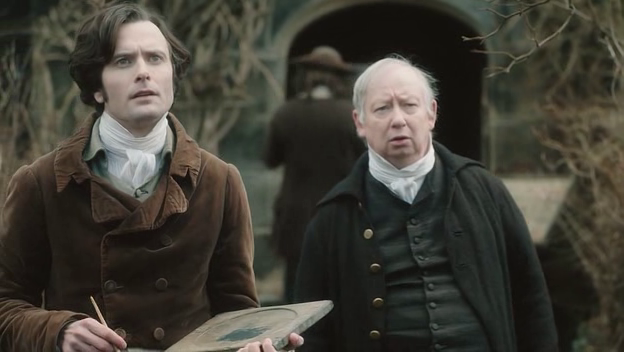
Meanwhile, back in England, Childermass is also busy making sure that no one in England besides Norrell does anything resembling magic. He rides out to Starecross, which Segundus and Honeyfoot are turning into a school for magicians and advises them to stop this plan before Norrell finds out. In exchange for their going into another sort of business, Childermass offers to send clients their way when he gets the chance.
In London, Arabella continues her visits with Lady Pole, who is continuing to work on a tapestry illustrating Lost Hope. She shows the tapestry to Arabella, who doesn’t understand at all, which I found a little frustrating to watch, if I’m honest. For one thing, it’s not entirely clear quite how Lady Pole is not only able to make this tapestry but also to talk rather at length about it to Arabella. And in light of how much Lady Pole is able to say in this manner about her and Stephen’s enchantment, I’m honestly just not sure how Arabella manages to not see what her friend is getting at. I’m also not sure why Arabella doesn’t recognize the Gentleman in the tapestry, since he’s been creeping on her for a good while now.
For all that I’m not entirely happy with the way this is playing out, this visit with Lady Pole has one of my favorite speeches in the show so far. Arabella tries to cheer up her friend by basically advising Lady Pole to count her blessings, among them Sir Walter’s love, Lady Pole will have none of it and even turns it around on Arabella, asking what good Mr. Strange’s love ever did her.
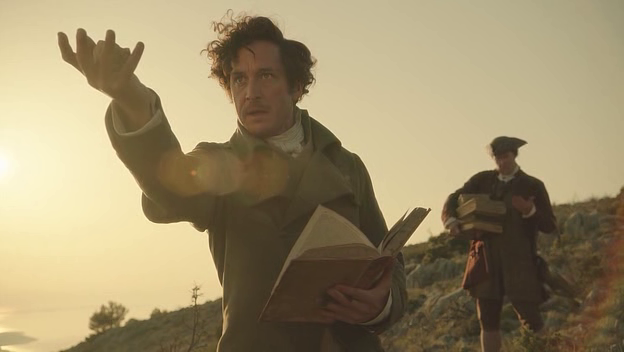
On the continent, Jonathan Strange finally figures out a way to contribute when a soldier complains to him about the poor roads destroying boots. Strange presents a plan to Lord Wellington whereby he will use magic to make roads the troops can march down more easily. This is quickly done and earns Strange Wellington’s gratitude and, against his protestations that it’s not respectable, the nickname “Merlin.”
For a nice bit of foreshadowing, Strange’s dinner with Wellington and the officers includes Jonathan Strange’s rather famous line from the book. When Wellington asks if a magician can kill a man by magic, Strange replies:
“A magician might, sir, but a gentleman never would.”
At which point every even mildly astute viewer groaned a little inside. Because, obviously, we’ll see about that. I think my issue here is that sometimes a great line in a book only ends up being really obvious when it’s delivered with such deliberate nonchalance in a screen adaptation. I suppose it beats having to see the line delivered with melodramatic significance, but I think perhaps they went a little too far in the opposite direction from that here.
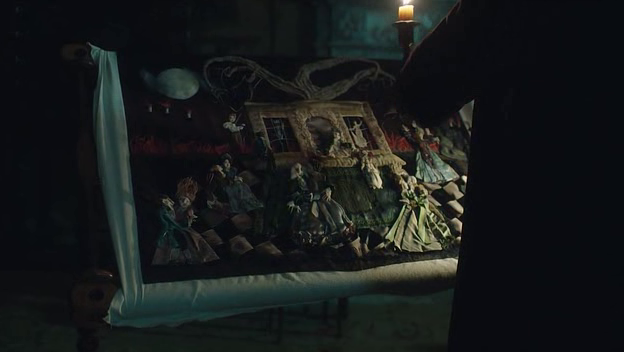
In England again, Childermass is having some misgivings about stealing all the Stranges’ mail and says so to Norrell. Norrell is characteristically evasive, but manages to assure Childermass that it’s for the best. Norrell then sends Childermass on an errand, which turns out to be breaking into the Poles’ house and stealing Lady Pole’s tapestry, which he does.
Robbed of her tapestry–effectively having her voice stolen–a distraught Lady Pole attempts to kill herself, only to learn from Mr. Norrell that she cannot die. Not for another seventy-odd years, anyway. This scene is, frankly, absolutely chilling: Lady Pole in her nightdress, strapped to a small bed in an empty room, with Norrell standing over her. Norrell giving her the bad news and then physically trying to silence her anger, frustration and despair. And, finally, Norrell going to Sir Walter, lying about Lady Pole’s condition and then advising Sir Walter to separate Lady Pole from Arabella.
And this is all edited together with more of Strange’s escapades in the war, which on the one hand is perhaps a good thing–to break up these scenes so it’s not just one long sequence of Norrell’s terrible treatment of Lady Pole–but is made into something much less than comfortable when we see what Strange is up to, which isn’t much good. Indeed, Strange is being shaped into someone rather frightening himself.
First, Wellington wants Strange to move an entire forest, which brings up an interesting conversation about how that might be done. Unfortunately, Wellington isn’t interested in Strange’s musings about talking to trees, because I would have loved to hear more about it. When Strange goes to move the forest, he and the men he’s with find themselves under attack. Strange can’t get the forest to move, and while Strange does manage to save the lives of most of the men, Strange’s servant, Jeremy, is hit by cannon fire and dies. Also lost are all of the books that Strange has brought with him to work from.
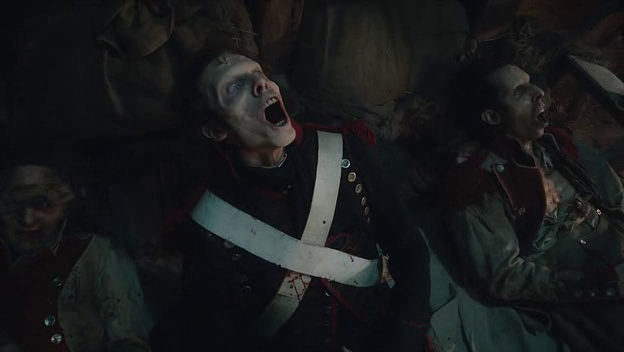
This is a significant problem when it comes to Strange’s next task, which is to find out where some Neapolitan soldiers have taken a bunch of cannons they stole. Strange is without any books, the army has no live Neapolitans to question, and scrying in water just shows trees and grass that could be anywhere in the countryside. However, it turns out that they do have some Neapolitan corpses, which Strange brings to life and grants speech to, in an interesting counterpoint to Norrell’s silencing of Lady Pole.
Unfortunately, Strange is no more successful than Norrell with this sort of magic. While Norrell only managed to give Lady Pole half a life, leaving her quite absent from the real world, Strange’s Neapolitans are all to real and persistently alive-ish. And rotting. And begging to be allowed to return to their families.
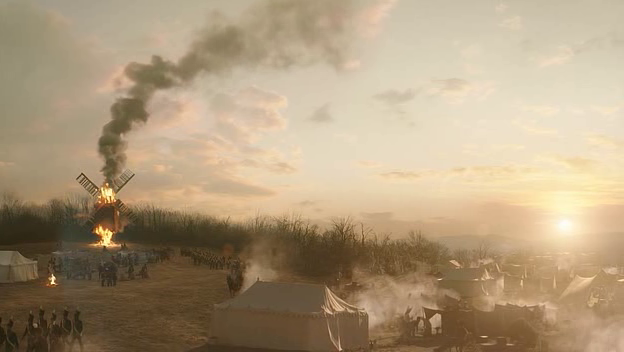
It’s very shortly obvious that Jonathan Strange has done something pretty messed up here and doesn’t have any idea how to undo it. In another parallel to Mr. Norrell, Strange is also lauded as a sort of hero for what is pretty much exactly the sort of magic that he doesn’t want to do at all. This is not modern magic. However, Strange seems consoled as he rides away into a beautiful new dawn while the unlucky undead Neapolitans are burned behind him.
It feels very telling to me how much alike Strange and Norrell seem when Strange finally returns to England. For all their differences in temperament, age, appearance, and experience, they seem very nearly equals now.
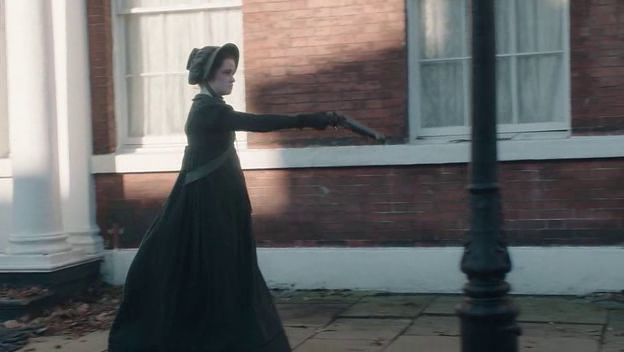
The episode ends, of course, with Lady Pole’s attempt on Mr. Norrell’s life, in which she misses her mark but succeeds only in shooting Childermass instead.
It’s a great ending to a very busy episode that covered a lot of ground. I still think the show struggles with conveying the passage of time–it’s not at all clear that Jonathan Strange has been gone for some three years, for example–but the pacing of this episode felt just right and the interweaving of the various story lines was masterfully done. So far, the mini-series is faithful to the book without being a slave to it, and the changes that have been made are mostly smart ones that I think enhance the material rather than otherwise.
I am unabashedly excited about this show no matter what anybody says against it. I don’t think it’s going to be extremely good, and the entire Supergirl/Superman mythology is absurd, but it looks like exactly the sort of light, slightly silly entertainment I’ve been wanting recently. I wasn’t interested in Arrow or The Flash, and I couldn’t get into Agents of Shield (and therefore skipped Agent Carter), but Supergirl looks like it’s right up my alley.
Premiere is October 26.
First, we got this “Where are the heroes?” teaser, in which apparently the whole world wants to know:
It manages to be both boring and confusing, for a couple of reasons. First, if you haven’t already watched Heroes (and stopped watching after the first season) you probably won’t really be on board with the whole “Where are the heroes?” thing. Second, they’ve got what sounds like a children’s choir covering Metallica’s “Nothing Else Matters” in the background, and I don’t think anyone has unironically liked Metallica since the mid-90s. Is NBC really serious with this?
It appears so, because just a couple days later we got a proper trailer, sort of:
Still with the Metallica (I mean, really? REALLY?), but this time with a bunch of quick shots of people doing stuff, a teenage boy saying something extremely cliché, and a look at Hiro Nakamura’s face that is just long and lingering enough that it makes me think that they’re using Masi Oka’s involvement to sell the show but that we might not actually see much of him when it airs.
Honestly, I’m just not sure exactly who they’re trying to sell this show to. I know the first season of Heroes was excellent, but I honestly don’t think I’ve ever heard anyone say that it needed a reboot. Or a sequel. Or whatever this is, since the trailers are pretty light on story details. I suppose it feels like they’re trying really hard to bring in older fans of the original show, but a long look at Hiro’s face and a cover of a twenty-five-year-old Metallica song just aren’t working for me.
Probably, I’ll watch this regardless, but so far I’m unimpressed.
Premiere date is September 24.



 SF Bluestocking