
 Planetfall is a brilliant portrait of a character and a community both in crises and a meditation on the ways in which the community and the individual are intertwined. It’s a gorgeously realized sci-fi mystery about a secret that festers in the heart of a seeming utopia and threatens to destroy it all.
Renata Ghali followed her dearest friend, Lee Suh-Mi, across the stars to a new planet in search of God, but what they found when they arrived on their new planet was, well, inconclusive. When Suh-Mi disappears, Renata and the rest of their colony have to figure out how to go on without her. Over twenty years later, Suh-Mi’s grandson shows up and starts uncovering the truth that Renata has helped to hide all this time.
Much of the praise I’ve seen for Planetfall has been for its narrator, and I can’t help but concur. Ren is a fascinating character with an unconventional point of view that makes hers a unique perspective to read a story from. She’s an older woman (a youthful seventy or so, in fact), a woman of color, queer, and significantly mentally ill, though the revelation of that last fact sort of creeps up on you as you read her story. The first person present tense narrative provides a nice sense of immediacy and immersion, which becomes increasingly important as the story moves along and Renata’s mental state deteriorates. Over the course of the novel, Ren becomes increasingly anxious and paranoid, then frantic as secrets start to be uncovered. It’s not always an easy thing to read, but it is absolutely riveting.
I only wish that there had been more actual science in Planetfall, although I think that’s more a sign that I’ve been in a mood for harder sci-fi recently than it is a sign that Emma Newman fails the reader in any particular way. Indeed, there are all kinds of interesting ideas on display here, from printing technology to sustainable living and social engineering. This book straddles the worlds of harder sci-fi and more human-focused sci-fi and does both justice, but I would have loved more explanation of how things worked, especially the space travel portion of the colony’s journey, which I felt was very glossed over. Realistically, it doesn’t matter and isn’t really pertinent to the story being told, which is likely why there’s not more detail about the ship and the journey, but I kind of love that stuff.
Finally, I would also have liked to see some of the themes surrounding religion and spirituality in an age of scientific and technological wonders be a little more fully developed. There are all kinds of ideas touched upon regarding the existence of God, the possible ultimate fruitlessness of humanity’s search for God, and even the ways in which faith makes people vulnerable—both to their own bad ideas and to exploitation in service of other people’s bad ideas. Ren is a great protagonist for asking questions and making observations about these things, as she’s a skeptic herself and her disconnectedness from her community makes her often a shrewd observer of people. However, her observations are thoroughly colored by her significant mental illness, making them increasingly unreliable over the course of the book even as more of Ren’s and the colony’s history is revealed, and the rather abrupt ending of the story is somewhat unsatisfying.
All in all, though, Planetfall is a great book. It’s got a lovely, almost meditative pace to it, and it’s an incredible character study of its narrator. As someone who also suffers from depression and anxiety, with a tendency towards reclusiveness, I found Ren incredibly relatable, and I can definitely see this being a book that I will return to in the future.
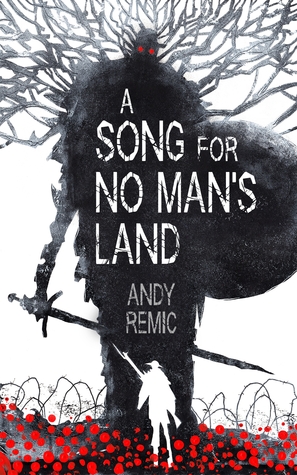 A Song for No Man’s Land is a dull, depressing slog of a novella that never seems to figure out what it wants to say. For all of its short length, it seems to drag on interminably before finally sputtering to a stop right when things seemed to almost start to get interesting. It is the first book in a series of at least three, so perhaps that can be forgiven, but I’m not sure I care enough about Robert Jones to want to come back for more.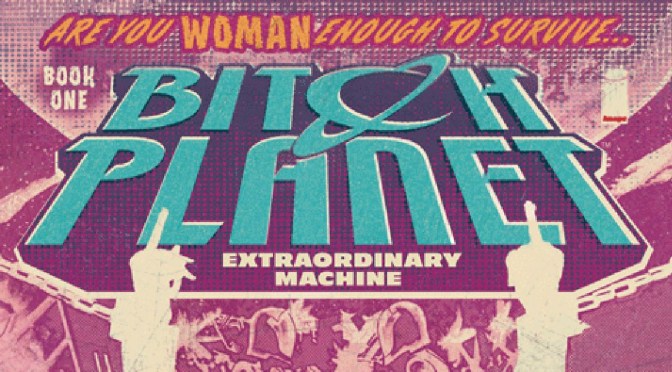
 I can’t believe I waited so long to read this comic. Like, I’m truly appalled at myself, and now that I’ve read the first five issues, I can’t even remember why I hadn’t been that interested. Bitch Planet is a gorgeously drawn, tightly plotted feminist masterpiece that should be required reading for women everywhere. It’s also brutal and heartwrenching and more than a little uncomfortably close to the truth of many women’s experiences.
 All the Birds in the Sky, on its surface, is a story about two weirdos who come of age and fall in love during an apocalypse. It’s a story infused with magic, from the first time we see Patricia talk to a bird, and it’s a story about bad timing, from the moment Laurence makes his first two-second time machine. It’s a comedy of errors about the end of the world, and it’s one of the most wonderful things I’ve ever read. I’m only a little disappointed to have read it so early in the year. I feel about All the Birds in the Sky the way I felt about N.K. Jemisin’s The Fifth Season (which this novel is absolutely nothing like) last year; I just know, deep down, that nothing else I read in 2016 is going to top it.
 As is often the case with popular fairy tales, there’s very little new story to be wrung out of “Beauty and the Beast” these days, so I was a little skeptical of Bryony and Roses. Even after reading T. Kingfisher’s (a pen name of Ursula Vernon) Toad Words and Other Stories, which is full of superb fairy tale reimaginings, I was unsure if there was anything she could do to freshen up such an old and well-worn story path. An opening note that admitted an enormous debt to Robin McKinley, whose Rose Daughter is perhaps the definitive feminist “Beauty and the Beast,” was frankly more concerning than reassuring. I ought not have worried so much. Just like in her earlier fairy tale work, Vernon-as-Kingfisher does an incredible job of exploring and revitalizing ancient material, infusing it with a bright, modern, thoroughly feminist (and unequivocally delightful) sensibility.
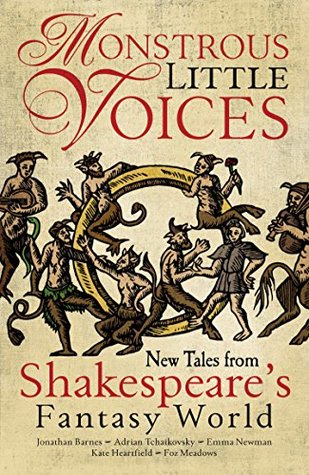 Monstrous Little Voices is a collection of five short novellas that take place within a fantasy world based upon the works of William Shakespeare, and it’s about 80% brilliant, which is pretty good for an anthology. There’s something of an overarching storyline connecting the stories, in addition to common themes and motifs, and this is nicely executed without making the stories feel totally linear or requiring them to be read in order. At the same time, each one also stands alone quite well.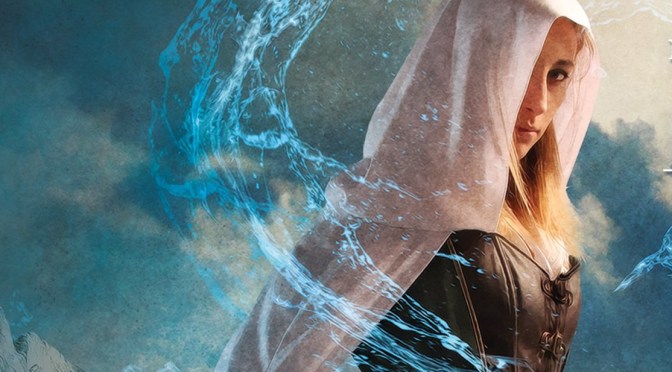
 Whew! Truthwitch is an absolutely exhausting, if exhilarating, read. There’s an enormous amount of stuff going on in this book, and I kind of loved it, but the problem with doing lots of things in a novel is that it’s only seldom that they’re all done well. Like many other ambitious and complex works, especially those intended for a YA audience, Truthwitch is a bit of a mixed bag.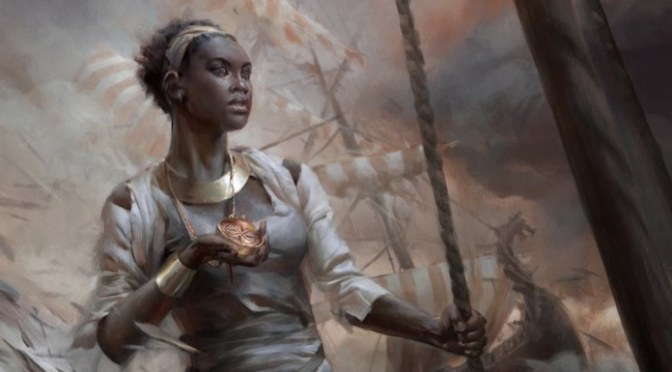
 I expected to love The Drowning Eyes, but I’m sad to say I only liked it. The gorgeous cover art and the book’s description had me very excited about it, but it just wasn’t quite what I expected.
 I received a free advance copy of this title from the publisher via NetGalley.
 SF Bluestocking