Category Archives: Book Reviews

Book Review: Of Sorrow and Such by Angela Slatter

Of Sorrow and Such is a thoughtful piece of work whose contemplative tone would be restful if its subject matter wasn’t so infuriating. I love a good witch story. The thing is, stories about women being mistreated make me actually angry. This one does so in a great way.

I adore witches of all sorts, and I have had a special place in my heart for these sort of vaguely historical witch stories since the first time I read The Witch of Blackbird Pond over twenty years ago. Edda’s Meadow is much less historical and much vaguer as a setting, but it definitely scratches that same itch. Also like The Witch of Blackbird Pond, Of Sorrow and Such is a book that is fundamentally (even more so, really) concerned with the relationships between women and how we help each other survive (or not) in hostile, sometimes murderously, misogynistic societies.

I think what I love best about witch stories is the way that they work on multiple levels to examine ideas about how women exist in the world. To be a witch is both a metaphor and a depiction of a kind of reality, and not just a historical one. Angela Slatter’s practiced deployment of these ideas tells me that she knew exactly what kind of story she was writing, and she skillfully manipulates her characters and setting for maximum emotional effect.

Mistress Gideon is a great character. In many ways she’s exactly the sort of woman that can be a role model for readers, but Slatter never places that burden upon her protagonist. She’s therefore allowed to be much more than that, and Slatter gives us a main character who is kind and wise and motherly and loving and fiercely protective of her daughter and friends, but who is also not all-knowing, who can be cruel when she thinks she needs to be, and who is quite capable of murder.

The other women that surround Mistress Gideon are just as well-drawn. Her daughter, Gilly, is both lovable and infuriating. The other women we meet also have their own assortments of good and bad qualities. From the passionate young shapeshifter who desperately wants to be herself to her repressed spinster sister-in-law to the pastor’s wife who won’t leave her husband but also won’t submit to his literally poisoning her, these might not be women I want to be, but they are certainly lifelike enough that I can imagine meeting them.

This, really, is Angela Slatter’s gift. She brings these characters to life and I love them and want to read more about them. Though this is the only thing I’ve read by this author, it’s most assuredly only the first thing. I am very much looking forward to reading more of her work in the future.

Book Review: Speak Easy by Catherynne M. Valente

Speak Easy is every bit as weird and wonderful as I could hope for or expect of a new novella by Catherynne M. Valente. As is characteristic of the author’s work, Speak Easy is a lush tapestry of beautiful prose, full of cunning wordplay, richly detailed descriptions, and a cast of eccentric characters.

My favorite thing about any Cat Valente book is the sense of space she achieves in every world she creates. The hotel Artemisia is no different. Reading Speak Easy is like walking into the hotel and taking a guided tour with someone who has lived there their entire life. They know all its nooks and crannies, but there’s really no end to the secrets of the place. Every page of this book is full of life and color and drama, and Valente seems to almost effortlessly weave a picture of a vibrantly wonderful world.

Speak Easy is being sold as a retelling of The Twelve Dancing Princesses, but you may not see it unless you know the original fairy tale very well. Valente is a shrewd scholar of fairytales and mythology of all kinds, and she has a keen talent for adding her own embellishments and twists. Her deep love, appreciation, and understanding of the form shines from every single page.

At the same time, though, there’s an awful lot packed into this slim little story. It’s not just an old fairytale; it’s also A Midsummer Night’s Dream and a particular moment in America’s literary history. It’s tragedy and comedy and heaven and hell and the exploration of these dualities. It’s a story about creativity and what it takes to be an artist. It’s a story about stories and where they come from and who they belong to.

It will break your heart in the best way. Not gently, though.

My first exposure to Valente’s work was her Fairyland books for young readers, which I read aloud to my daughter until she finally decided she was too old for bedtime stories any longer. I’ve since decided that every single thing Cat Valente writes deserves to be read aloud, just for the sheer joy of feeling her words roll off one’s tongue. Read it to a baby (goodness knows they don’t know any better) or to your pet or just to yourself in the privacy of your own home. Just do it, because it’s beautiful. Then go do the same with all of Valente’s other work.

The only negative of this book is that the hardcover is extremely expensive. Unless you are a collector of books, I’d suggest opting for the ebook, which is the best $5 you could spend this year.

Magazine Review: Nightmare Magazine, October 2015, Queers Destroy Horror! Special Issue

While I’m not a regular reader of magazines, I have become absolutely hooked on the various Destroy SF projects of the last couple of years. October’s Nightmare Magazine special issue, Queers Destroy Horror was another great entry into the series.

The surprise for me in reading this issue, though, was that I found myself less enchanted with the fiction this time around and much more interested in non-fiction pieces, most of which were excellent.  Sigrid Ellis’s powerful piece about her complicated relationship with the works of Stephen King, “The Language of Hate” is worth the $2.99 I paid for the issue all by itself. The same could be said for Lucy A. Snyder’s “The H Word: A Good Story” and Michael Matheson’s “Effecting Change and Subversion Through Slush Pile Politics.”

The roundtable discussion and the author spotlights as well were particularly excellent in this issue, although I do find it a little disingenuous how often some version of the phrase ‘I don’t think of myself as a [identity] author” appeared. I know that identity issues are complicated (I’ve got my own, thanks), but still. I just find it a little cliché, this coyness about how one’s identity informs one’s work, and I sometimes think that it gets in the way of more useful insights. That said, there are still plenty of interesting things being said here.

While the non-fiction sections of this issue were superb, that’s not to say there was no good fiction, either. Matthew Bright’s Dorian Gray tale, “Golden Hair, Red Lips,” was a great way to kick off the issue, and I loved Alyssa Wong’s story, “Hungry Daughters of Starving Mothers.” My favorite of the short stories, though, was “Dispatches from a Hole in the World” by Sunny Moraine. It’s a wonderfully dark and atmospheric story, as well as a delightfully inventive and timely piece whose specific subject matter works perfectly to place it in a particular time and space and address a particular community. I loved it, although I expect that those less interested in or connected to the goings on of the internet may not quite “get it.”

While most other entries in the Destroy SF catalog include flash fiction, Queers Destroy Horror opted for poetry instead. Unfortunately, I’m not terribly into poetry as a general rule, but I did enjoy Lisa M. Bradley’s “The Skin Walker’s Wife” and Amal El-Mohtar’s Snow White-inspired poem, “No Poisoned Comb.” When I do like poetry, I usually prefer these sort of narrative pieces, and these two really hit the spot.

As always, I highly recommend checking out all of the Destroy SF material. I don’t know that I’d say there’s something for everyone, but it’s a great project that consistently turns out high quality collections of work that puts a spotlight on ordinarily marginalized voices in genre literature. It’s great stuff, and it’s not too late to buy this issue.

Book Review: The Last Witness by K.J. Parker

The Last Witness is decidedly not my kind of book. If I wasn’t making a point of reading all of the Tor.com novellas in publication order, I would never have picked this one out based just upon its back cover copy. Needless to say, I’m glad that I’m working on this reading project, because I would be sad to have missed this little gem of a story.

The Last Witness deals with some rather heavy ideas about memory and storytelling—specifically the stories that we tell others and ourselves. It’s a fascinatingly speculative story with an intriguing perspective and a main character with a powerful magic that is the very definition of a double-edged sword. He can steal memories, but he remembers them all perfectly, himself. The story answers some of the questions that must be asked as a matter of course once you think up that kind of magic power.

As the story unfolds, we learn more and more about Parker’s wonderfully unreliable narrator, where he came from, and what having this power has made of him. There’s not a lot in this premise that is terribly surprising, but the story is well-constructed, and when the twist comes near the end it’s, well, not unexpected exactly, but so perfectly placed and executed that it provokes a deep emotional response as one is forced to change the way one thinks of the narrator and the story he’s told up to that point.

My biggest criticism of the book is that there are parts that are just plain confusing. Because of the mechanics of the narrator’s magical ability, he sometimes has a difficult time differentiating between his own natural memories and those that he’s gleaned through his work. While everything becomes clear by the end of the story, there were several times in the first third or so where I found myself struggling to make sense of it. This isn’t aided, either, by the fact that there are no chapters or other markers to clarify shifts between the narrator’s memories and other people’s memories that are being remembered by the narrator or between flashbacks and the present day events of the story. It’s not bad enough to make the story unreadable, but I could definitely see this being off-putting for people who (unlike myself) have no problem abandoning a book partway through.

I don’t expect that The Last Witness will be among my favorites of the Tor.com novellas, but I’m happy to have read it. It’s a solidly written story with an interesting protagonist, a clever twist, and a satisfying conclusion.

Book Review: Updraft by Fran Wilde

Updraft is an exciting, inventive debut novel with a delightful protagonist and a unique and totally unexpected setting. I often think that authors have to pick and choose where they want to do things that are new and fresh and different, and Fran Wilde has chosen really well here by writing a relatively pedestrian story in a fascinating new fantasy world.

Kirit has never wanted to do anything other than become her mother’s apprentice and learn to be a trader between the tower communities that make up the world of Updraft, but her plans are derailed just days before she’s supposed to take her flight test so she can travel freely around the cities. The plot of Updraft is a simple one, really, a fairly classic coming-of-age-with-complications story as Kirit finds herself forced into a role she never wanted and starts uncovering secrets that make her question everything she thinks she knows.

­You can tell when reading Updraft that Wilde has really thought about every aspect of this world, and probably her greatest achievement is in the society she’s invented for the people who inhabit her bone tower cities. The largely oral traditions are well-thought-out in a world where lack of trees and paper would make for minimal written communication, and this is also, to a large degree, where the major ideas and themes of the novel come from. In a world without written records, who controls information, who has the power, and how does that affect a civilization?

Also, there are huge monsters called skymouths that sound something like enormous aerial squids and something like flying gulper eels. And it’s never exactly spelled out, but the bones these people are living on might be growing out of the back of something even bigger.

While I’ve read reviews that class Kirit as an “unlikable” heroine, I adored her. It’s refreshing to read about a girl character who isn’t anxious from the beginning to sacrifice herself for some greater cause, and I love that Kirit has a bit of a stubborn, selfish streak. Kirit doesn’t want any part of being some kind of chosen one, and she only participates in “destiny” under duress and with no romantic notions about it. Kirit is a tough girl from the start, and Updraft is the story of how she grows into a strong woman with a well-developed sense of civic responsibility.

Also a nice change from many other books about young heroines, Kirit isn’t neatly paired off with a man at the end of the novel. Instead, she’s made over her society and stands ready to be a significant part of a future that is very different from their history up to this point.

So far, it looks as if Updraft is planned as a standalone novel, but I rather hope that Fran Wilde returns to this world and these characters. For all that this is a book that deals mostly with the uncovering of secrets, I still feel as if there’s a lot more to be explored. I, for one, would still like to know what exactly the bone towers are the bones of.


Book Review: The Traitor Baru Cormorant by Seth Dickinson

The Traitor Baru Cormorant is a technically superb and compulsively readable novel that might also be the most frustrating thing I’ve read this year. It’s a book that comes very close to greatness only to fail so slightly, yet so completely, that it’s actually pretty impressive.

The story opens with the invasion of the child Baru Cormorant’s small island nation by the militarily, culturally, and economically hegemonic Empire of Masks. Baru’s entire life is disrupted by this momentous event, and she sets out on a lifelong quest to infiltrate the Empire itself, understand its workings, and find a way to avenge the wrongs that were done to her family and her people.

It’s a fascinating story from the very beginning, and Baru is an incredible character. I have a penchant for unlikable women in fiction, and Baru is, frankly, pretty despicable by the end of this book. She’s inscrutable and calculating. She’s cold and selfish and manipulative and arrogant. She gives words like duplicitous and treacherous new meaning. Baru Cormorant will do anything, say anything, sacrifice anything–or anyone–in pursuit of her long term goals. I love her, of course.

The enormous cast of supporting characters is equally well-drawn and works to bring the world to life. Every character works, from Baru’s three parents to the mysterious “benefactor” who sponsors Baru’s education and career to the woman Baru loves. Like every other detail of The Traitor, each and every character seems meticulously planned, and they all move around and through Baru Cormorant’s life like clockwork.

The Empire of Masks (or Masquerade) looms large over all of the characters we meet, as they are all either colonizers or colonized (and sometimes both). The Traitor is a pretty amazing portrait of the dynamics and complexities of colonization, and the Masquerade touches every aspect of people’s lives. In addition to language and currency, the Empire of Masks imposes law and order, educational standards, religion, strict “hygienic” practices (namely, no homosexual or polyamorous relationships), and eugenic breeding schemes. Like all empires, the Masquerade is a mix of good and bad; it’s not devoid of benefits for some of the people it colonizes, but it definitely brings its changes whether the colonized like it or not. It’s interesting to see an author making such an honest attempt at really deeply examining how that colonization works and what it does to people.

Which brings me to one of the two subtle-but-significant failures of The Traitor Baru Cormorant. While the novel tries to handle its themes with delicacy and nuance, and is helped along in this by staying strictly in Baru’s point of view, I can’t help but feel that in the end it’s all treated a bit glibly. The evil empire itself is almost too evil to be really believable, and the book makes far too much of a point to highlight the benefits of colonization. Even the choice to center the narrative so firmly on Baru’s POV weakens the message, as Baru’s identity becomes increasingly confused over the course of the novel as she slips further and further inside the mask she’s chosen to inhabit. Her real opinions become more and more opaque as the story goes on, and her perspective becomes unreliable and even slightly unhinged.

Rather than an account of a morally grey character navigating a complex political situation, the book becomes a simple story of power and corruption. Because of the heavy focus on the worst atrocities of the Masquerade, it’s easy to root for Baru against it, but Baru’s own lack of deep feeling undermines the very idea that she is sincerely opposed to the Empire. This lack of sincerity becomes absolutely palpable in the last third of the book, and it leads to the second major issue I had with the novel:

While the specifics of the ending are well-thought-out and make complete sense, the broad strokes of the ending are so heavily telegraphed in the last 30-40% of the book that the “shocking twist” is more likely to elicit groans than gasps. It’s really obvious, honestly, that this was always the story that was being told and things were always going to play out this way. Unfortunately, it’s just not that satisfying.

Perhaps I’m just old-fashioned, but I’m just not sure I “get” this book. I kind of love that Seth Dickinson has done something ostensibly new and different, but how different can it really be if I saw the ending coming so many miles away? Baru Cormorant is an amazing character, but it’s hard to really make a story work when its subject doesn’t, ultimately, get to be even an antihero. By the end of the book, Baru has lost sight of any noble goals she may have had and abandoned every principle she may have started with, so the final impression I was left with was one of existential bleakness and hopelessness so complete that it was actually a little depressing.

The Traitor Baru Cormorant is the most fun I’ve ever had reading a book this hyper-tragic, which is something special in itself, but it’s definitely not the sort of thing I want to reread over and over again. It’s funny and smart and cleverly plotted and often insightful, but it also might crush you under an enormous weight of despair. It’s a book that I want to love wholeheartedly, but that ended up leaving me cold.

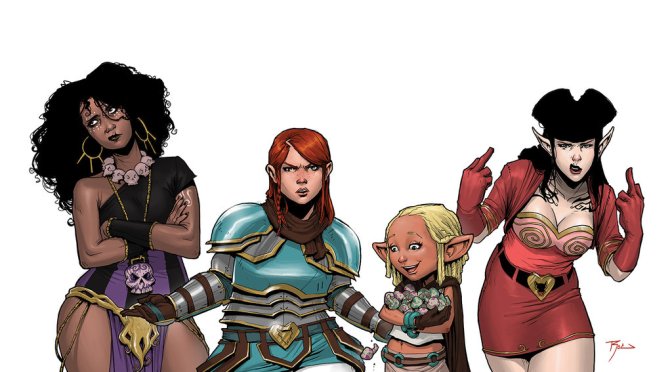
Book Review: Rat Queens, Volume 2: The Far-Reaching Tentacles of N’Rygoth + Braga #1

If possible, I think I love Rat Queens even more now than I did after finishing Volume 1. Volume 2 addressed the few quibbles I had with the first collection, and the Braga special issue tells the story of one of my favorite secondary characters from the comic.
When I read the first volume, I lamented a little that there wasn’t a whole lot of backstory for most of the characters. A friend assured me that this was something I could look forward to in the second volume, and he was absolutely right. I won’t say that there was as much backstory as I could ever want, but it’s definitely enough to both partially satisfy my desire for more information about the characters and whet my appetite for the series.

The character who was least developed in Sass and Sorcery was Dee, and we learn a lot more about her here. What I love, however, is the way Dee’s background is revealed here, in slow stages, while continuing to maintain a sense of mystery about her. I’ve got a much better sense of who Dee is, but I don’t think we’ve got the full measure of her yet.

The stand-out characters here, though, are Violet and Hannah. Violet’s backstory is great, with just the right amount of humor, properly deployed to lighten it up. It introduces a couple of really excellent minor female characters as well. For Hannah, we get some of her personal history as well as some new information that helps explain her difficult relationships with secondary characters Sawyer and Tizzie. I love that we get to see a little bit of softness and depth for both Hannah and Violet, which prevents them from slipping too comfortably into any Strong Female Character tropes. Instead, and this is particularly true for Hannah, they are pleasantly complex, with sometimes surprising depths.

Unfortunately, this isn’t true for Betty, who remains woefully unexplored in comparison. Her relationship with Faeyri is touched upon, but overall Betty has rather little to do. I hope that means the next arc will include more of Betty’s background, as she’s a potentially interesting character who so far is still a little one-note which becomes glaringly obvious as other characters gain more and more dimension.

The Braga special issue is excellently done, and it’s refreshing to find a story about a transgender character whose transness is almost incidental to her story. I have a particular love for stories about orcs in general, and this one is wonderfully different while still being very classically orc-story-like. It’s numbered, so I’m looking forward to more Braga stories in the future.

I only wish I’d read this all in the same afternoon as I read the first book, which I highly recommend doing for those who’ve just started the series. Do it. Just read it all in one go. You know you want to.

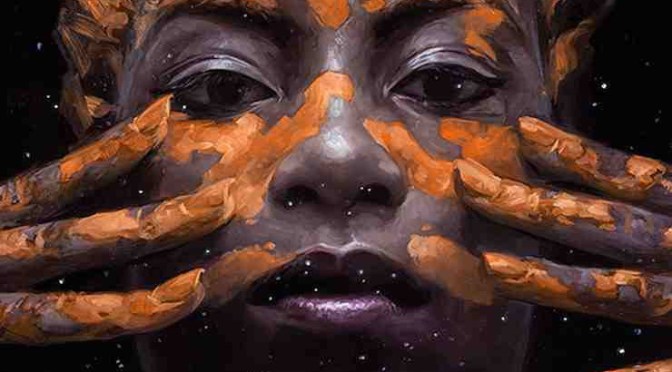
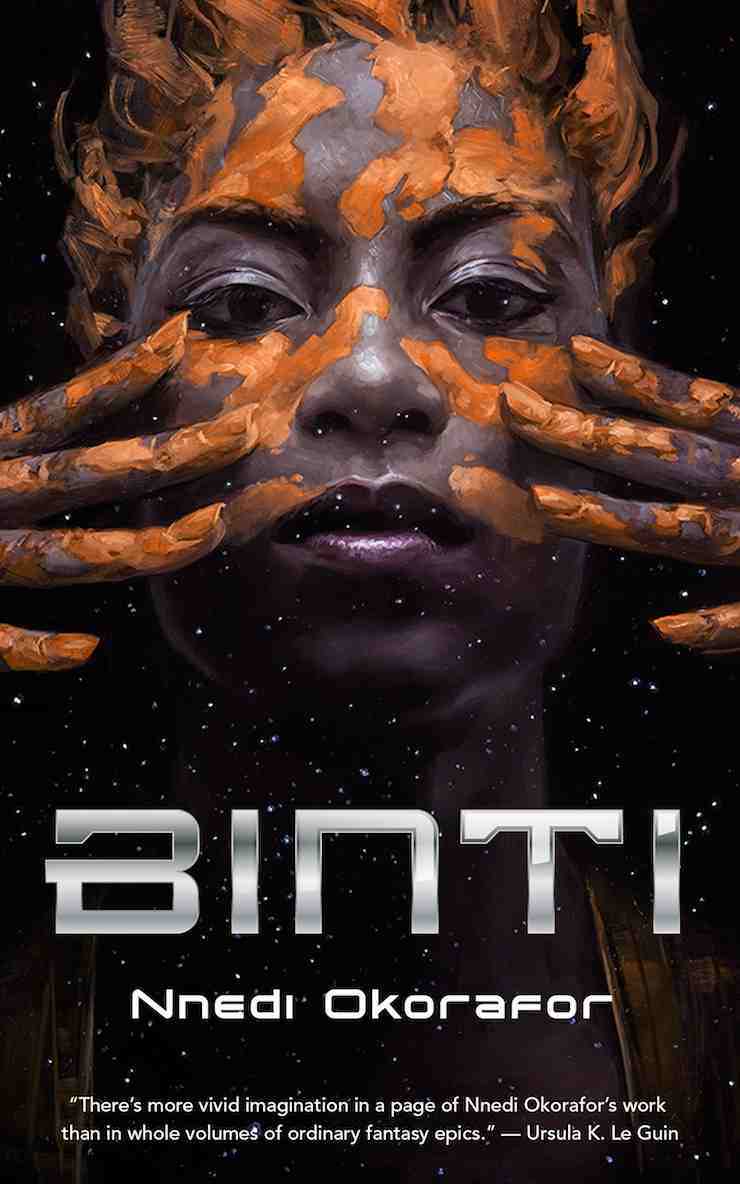
Book Review: Binti by Nnedi Okorafor

binti-book-coverBinti is the first of the Tor.com novellas that has turned out to be slightly disappointing to me, but I think that’s because my expectations were so very high after reading Nnedi Okorafor’s previous work over the last few years. It was always going to be hard for this story to live up to the power and beauty of Lagoon or Who Fears Death or The Book of Phoenix.

This isn’t to say that I didn’t like Binti. Indeed, there’s a lot to love about this little book, although probably my first complaint about it would be that it is so very little. Of the Tor.com novellas I’ve read so far, Binti has by far the lowest page count, which is a shame if for no other reason than I never want any book by Nnedi Okorafor to end.

My second complaint, and a more substantive one, is that Binti relies a little too much on magic in order to move the story along. Okorafor has always created worlds with a synthesis of magic and science, but here the magic becomes too much of a deus ex machina. Considering the book’s hefty messages about colonization, racism, and the nature of humanity, this excessive mysticism may be intentional, but I found it a bit much at times.

Binti‘s greatest strengths, on the other hand, lie in Okorafor’s gift for crafting characters and cultures. Binti herself is a wonderful heroine, if perhaps a little unrealistic in her lack of any real flaws, and her Meduse counterpart Okwu is excellently conceived and nicely-written. The Meduse people in general are fascinating, although their grievance was resolved a little too neatly in the end.

The very best part of the book, though, is the way Okorafor weaves in Binti’s personal history and shows the complicated feelings Binti has about her people, her culture, and her sense of self. There’s something rather melancholy about the ways in which Binti’s journey changes her, but I quite like the idea that every journey–no matter how much we start on our own terms–is a journey into an unknown and uncontrollable future. What I like even more, however, is the idea that we can always save something and take it with us. I love the idea of something as culturally and regionally specific as the Himba people’s otjize lasting long enough in time and space for someone to wear it to college on another planet, and in Binti otjize becomes a perfect symbol of resistance, endurance, and connection to the past.

I just wish there was a little more plot happening. There’s just not much going on, and the novella ends up feeling both uneventful and overstuffed with meaning. Without a strong story to support all of the big ideas Okorafor is weaving together, Binti starts collapse under its own weight. It’s a shame, because Binti herself is a great character that I’d love to see more of.

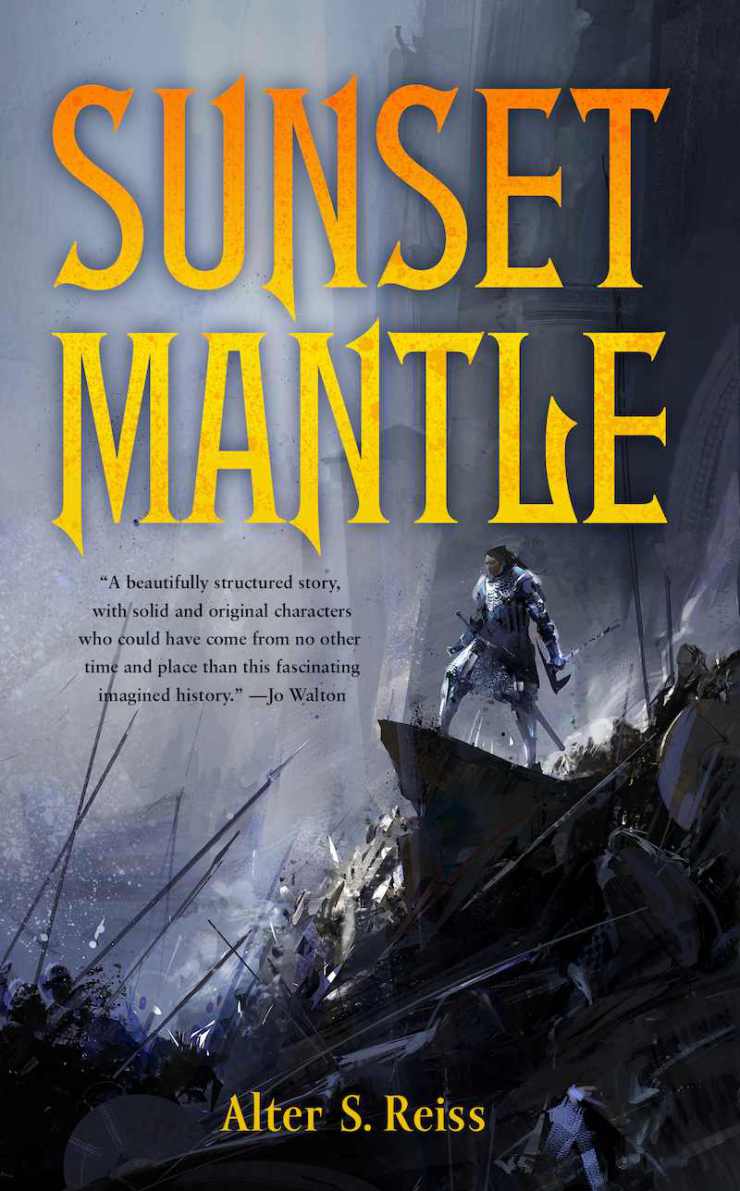
Book Review: Sunset Mantle by Alter S. Reiss

sunset-mantle-coverSunset Mantle is a sort of strange little book. It’s an interesting mix of things that I love (epic fantasy, low key romance, a huge battle scene) and things that I usually hate (military stories, few women characters, overly stoic and maladaptively principled hero), and I’ve kind of fallen in love with it.

Cete is exactly the sort of outcast slightly grizzled warrior character that would normally bore me to tears, but the first thing we learn about him is that he appreciates and longs for beautiful things. This is a simple, honest desire, and it’s a small aspect of the character of a man whose only business and skill is death, but who loves art. It’s this desire that is always at the core of the story in Sunset Mantle, and its frankly miraculous that Alter S. Reiss manages to make this novella work without it becoming mawkish and trite, but he does.

Marelle, the artisan who created the titular sunset mantle, is kind of a fascinating character to me. I really appreciate the first physical descriptions we get of her which are pleasantly unsexual and focus on qualities that are representative of her experiences and the unique ways she exists in the world. Her age is unstated, though it’s clear that she’s a young-but-mature woman, and her beauty or lack thereof is never remarked upon, though it’s shown amply later in the story that Cete at least finds her desirable. In the beginning, though, we learn about the way she carries herself, the ways that hard work has marked her, and the way she smiles directly at Cete–“the smile of one man to another, rather than that of a woman to a man.”

This particular passage is one that Reiss handles with delicate precision, establishing Marelle as a character who is both comforting and challenging to Cete and establishing Cete as a man who (sadly unusually in the epic fantasy genre) respects Marelle in a way that is refreshingly unpatronizing. The first two pages of this novella might be my favorite thing I’ve read in the fantasy genre in years, and they are the key to understanding and appreciating the rest of the book. It’s a great cold open that, while light on action, deftly and economically introduces the two most important characters in the story and makes them interesting and likable without resorting to any hackneyed or offensive tropes.

The world-building in Sunset Mantle is similarly superb, although there was a stretch between the opening scene and the end of the first third of the book where I wasn’t entirely sure I understood what was going on. This might have been intentional, to build suspense or something, but I found it just confusing, and I would have preferred a more straightforward explanation for how some of the political structures of this world are organized. All the same, when I finally got my bearings, I was impressed by the depth of detail Reiss has packed into such a short book. I’ve read 800-page novels with less world-building than Reiss packs into just over one hundred pages, and this world could easily support a much bigger story than the one told here.

Perhaps the greatest strength of Sunset Mantle is that it’s just plain well-written (aside from the above-mentioned early confusion about the political situation). It’s tightly plotted, generally easy to follow, contains an excellent battle at its climax, and has a satisfying ending that feels natural and earned. It’s a small and personal story that still manages to feel epic, and it has enough darkness and high stakes to be compelling but stops well enough short of being grimdark that the word “fun” can still be reasonably used to describe one’s Sunset Mantle reading experience.

Book Review: Witches of Lychford by Paul Cornell

Witches of Lychford is every bit as beautiful as its truly lovely cover (somewhat reminiscent of the posters for my favorite ’90s teen witch flick, The Craft) suggests. Like its cover, Witches is a story painted in subtle tones to develop its themes with both a clear sensibility for small town life and a gentle humor that makes it a joy to read.

The story deals largely with themes related to the disruption and destruction of small towns by corporate interests. The villain here seems to me a pretty thinly veiled reference to Walmart (or Asda, I suppose, in the UK), and we learn that what’s at risk is not just destruction of the expected small town community virtues but also the destruction of the border between two worlds.

The really standout aspect of this novella, though, is its characters. The three women around whom the story revolves all have their own separate and unique personalities and character arcs, which unfold at a pace that is both tightly managed to fit inside just 144 pages but also leisurely enough to be enjoyable reading. Judith, Lizzie, and Autumn are exactly the sorts of women that I love to read about: smart, funny, brave, resourceful, flawed enough to feel real and with just the right amount of magic. They’re also supported by a cast of small-town characters that feel familiar without the use of any tired tropes and have enough depth to make me care about them and become even more invested in what happens to their town by making Lychford feel like a real place.

The plot is simple and straightforward, which is ideal for novella length works. It’s never too complicated and Paul Cornell has a real gift for knowing just how best to develop his story and characters. While the urgency of the story builds throughout the book, events never feel rushed, and emotional moments happen exactly when they need to. The ending is satisfying, but it isn’t too tidy or trite, and it’s open-ended enough that I could easily see this story being continued in another novella or novel.

Recommended reading for a lazy Sunday afternoon in fall. I’d suggest making a day of just reading and watching stuff with witches in it. Combine with Practical MagicHocus Pocus, and something pumpkin spice flavored.