Category Archives: Fantasy

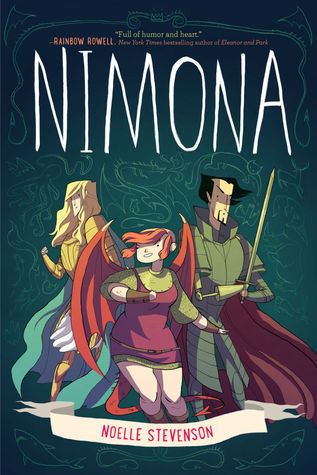
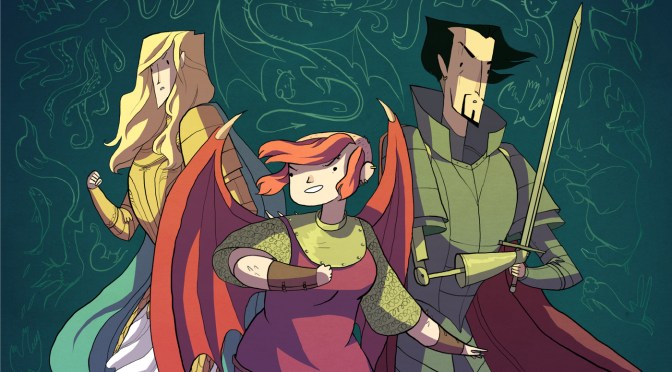
Book Review: Nimona by Noelle Stevenson

Nimona is actually my twelve-year-old daughter’s book. I knew it was good when she didn’t even want to put it down long enough for us to check out at the book store. When she finished it the next day, I knew I had to read it myself. I’m so, so glad I did.

So, apparently Nimona started life as a web comic,  but to read the whole thing now you have to buy the book.

It’s totally worth it. You should go buy it right now. Maybe even buy two copies, because this is a book that I could easily see reading over and over again. Also the sort of book that your friends aren’t going to return after you force them to borrow it, so it won’t hurt to have an extra copy laying around.

The art is simple, especially at the beginning, which again betrays  Nimona‘s internet origins, but I found it enjoyable to see the work evolve over the course of the story. Noelle Stevenson’s style is fluid and impressionistic. Every panel looks as if it’s in motion, which adds a sense of realism that is reflective of the naturalistic portrayal of the characters and their relationships. At the same time, Stevenson avoids realistic or consistent color schemes in favor of constantly changing palettes that tell a story of their own and convey moods extremely effectively. I especially liked the oranges in the middle of the book and the acid greens near the end.

Nimona herself is a great character. Though at times she skirts a little too close to Manic Pixie levels of quirkiness, she doesn’t exist in service to anyone’s story but her own. I love the growth of her friendship with Lord Blackheart, and it’s nice to see a bit of gender role reversal here, with Nimona as the rash, bloodthirsty one and Blackheart as a temporizing force and voice of reason. Blackheart and Sir Goldenloin are both nicely written, with a good backstory, and the ending of their story feels organic and earned. I also really appreciate that the only other two significant characters, The Director and Dr. Blitzmeyer, are women, another smart authorial choice that avoids the fantasy convention of marooning female characters in a sea of testosterone. While Nimona doesn’t get much interaction with these women, just their existence avoids one of the biggest problems I tend to have with fantasy stories in general.

The thing about Nimona is that it’s utterly charming. It’s funny and smart and sweet and deploys its pathos in exactly the right ways at exactly the right times to tug at the reader’s heartstrings. Like many web comics, it does tend to meander now and then, but the story is overall well-conceived and deftly executed with a minimum of sidetracking so that it’s cohesive when published in a single volume.

Nimona is a great book and a fast read, and it might (probably) will make you cry. Highly recommend.


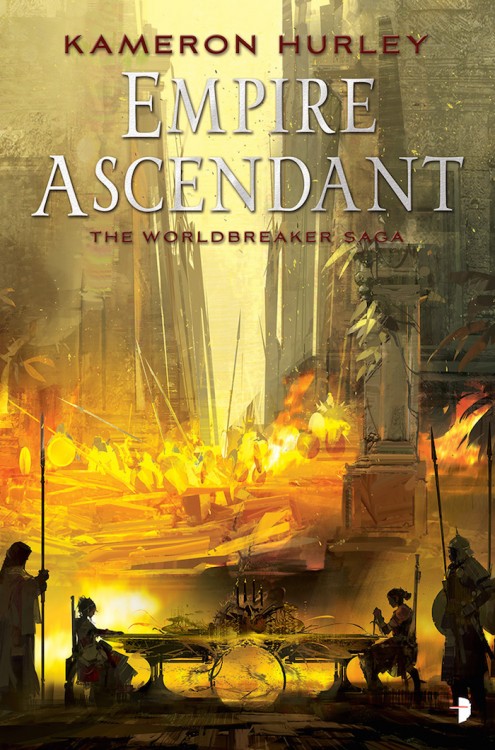
Book Review: Empire Ascendant by Kameron Hurley

empire-ascendant-by-kameron-hurley-495x750[This review is based on an advance copy of the book received through NetGalley.]

Empire Ascendant is a brutal read, which is somewhat to be expected from Kameron Hurley in general, and certainly to be expected in the follow-up to The Mirror Empire. The world of The Worldbreaker Saga is a harsh one, and this second book in the series turns the grimdark up to eleven.

Unfortunately, I’m just not loving this series the way I did Hurley’s God’s War trilogy. I liked The Mirror Empire well enough, but it took me about a third of Empire Ascendant to get my bearings and figure out what was going on. In addition to the increased blood and higher body count, there are several new POV characters who I had a hard time placing in the narrative, which was confusing. Additionally, though it’s been less than a year since I read the first book, it turns out that it wasn’t actually all that memorable.

Except for Zezili, a character I adored in the first book but whose page time in Empire Ascendant is greatly reduced, I found myself barely recognizing most of the characters until partway through the novel. I did enjoy Anavha’s parts, but his story line seemed to move at a painfully slow pace. Ahkio spends most of the book being ineffectual, as does Lilia. The invading empress from the other world is somewhat humanized, but we don’t see much of her except near the beginning and end of the book. For basically all of the characters, everything just goes from bad to worse to worst for some five hundred pages, and by the end of the book I found myself just unable to engage with that level of darkness any longer.

The thing is, this isn’t a technically bad book. Quite the opposite, actually. It’s a technically brilliant book that I just don’t know if I’m capable of appreciating right now, which is sad because it’s a book that I’ve been eagerly anticipating for months. There’s still a lot going on in this series that I think is fascinating, and I have no doubt that I’ll go on to read the third book in the series when it comes out as well.

I think, though, that the reality is that this is not a series for the faint of heart. The role reversal and the interrogation of gender and the implicit (so implicit they actually become explicit) criticisms of genre mainstays are well worth checking out, but I think that it’s the very subversiveness of this series that makes it such difficult reading. Empire Ascendant isn’t a book that can be read lightly. It demands (and deserves) all of the reader’s attention, but it’s, frankly, so  concerned (and rather self-consciously so) with subverting tropes and challenging expectations that it becomes weighed down with it’s own seriousness and self-importance.

In the end, I want to love everything about this series as much as I loved Zezili in the first book or as much as I loved all of the God’s War books, but I think I’m going to have to settle for only being able to objectively know the value of them and recognize the excellence of Kameron Hurley’s craft–which has certainly improved since her God’s War days. Empire Ascendant shows Hurley’s growth as a writer, but I feel like it also shows a notable lack of joy or humor when compared to her earlier work–which translates directly to me finding this new series increasingly unenjoyable.

Book Review: Sorcerer to the Crown by Zen Cho

[This review is based on an advance copy of the book obtained through NetGalley.]

If you loved Jonathan Strange & Mr. Norrell, you owe it to yourself to read Zen Cho’s Sorcerer to the Crown. At the same time, though, I’m not sure I’d compare it to Jonathan Strange & Mr. Norrell if I hadn’t just recently read the older novel.

Sorcerer to the Crown really has much more in common with the works of Jane Austen in both style and tone. While Jonathan Strange & Mr. Norrell is a broad-ranging pastiche that pays tribute to many genres while being very much its own thing, Sorcerer to the Crown is something simpler and purer–more earnest in its adherence to old-fashioned language and storytelling conventions. That said, Sorcerer to the Crown is a wildly original and deeply unconventional twenty-first century novel and a great deal of fun.

The book opens with a very young black boy named Zacharias being shown off to a bunch of white men to prove his (and his race’s) magical capabilities. While the ominous tone of the prologue is somewhat at odds with much of what follows in the novel, I think it’s a pretty excellent way of infusing the rest of the book–which would not be inaccurately described as a “romp”–with an undercurrent of darkness that keeps things grounded and provides a sort of baseline for the exploration of POC experiences in the rest of the story. It’s a prologue that shows the reader immediately what kind of book this is, which is the perfect sort of prologue if an author really must include one.

The rest of the story takes place after Zacharias has managed to find himself in the position of being the most eminent sorcerer in England. We quickly learn that his high office has earned Zacharias no shortage of enemies and is more a nuisance than anything else. He’s not even certain he wants the office at all, but there’s no way for him to give it up. Instead, he determines to make the best of it and try and enact what change and bring what progress he can while he still has time. To that end, Zacharias has to deal with magical school girls, Malaysian vampires. scheming racists, and angry dragons.

It’s a wild ride.

The characters in Sorcerer to the Crown can all be a little one-dimensional at times, and I didn’t always find Zacharias to be particularly likable, although I absolutely loved Prunella. Some things seemed a little too tidy at the end, and I’m not sure I entirely buy the romance, which was so restrained as to be almost nonexistent. Although it is kind of refreshing that the book isn’t overly focused on the romance, I would have preferred a more gradual growth of affection over time. As it was, the resolution of the romance felt somewhat tacked on and less earned than it could have been.

Still, Sorcerer to the Crown is a thoroughly enjoyable read. From beginning to end, it hits all the right notes that I look for in a book. It’s a very different perspective than we’re usually offered in Regency-set fantasies. It’s fast-paced and interesting enough that even though a great deal happens it never feels overstuffed or overlong. It’s whimsical without being precious and clever without being pretentious. Best of all, it’s a downright funny book, and I found myself chuckling aloud more than once. Definitely in my top ten books of the year so far.

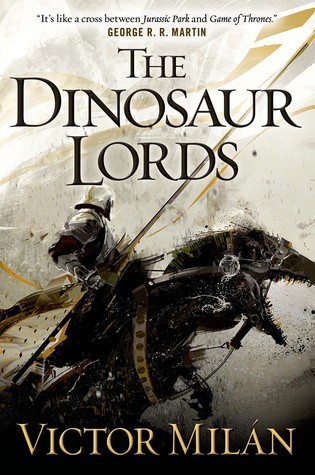
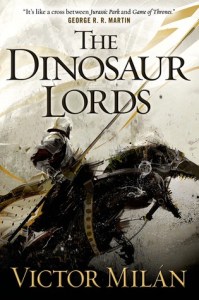
Book Review: The Dinosaur Lords by Victor Milán

DinosaurLordsCover**Trigger Warning: Discussion of Rape**

The Dinosaur Lords is being sold as “a cross between Jurassic Park and Game of Thrones,” which sounds pretty rad. I like dinosaurs, and I like medieval fantasy so, even though Victor Milán’s previous work was (apparently) libertarian sci-fi (which would normally be a dealbreaker for me), I decided to give this book a try. It helped that it’s got an absolutely gorgeous (if absurd) cover and that the black and white interior illustrations are similarly lovely. This is also a novel that has been getting an enormous amount of buzz. Its got a quote on the cover from George R.R. Martin, the concept for the book is fun, and the author has done a ton of guest blogging and self-promotion in addition to heavy promotion for it at Tor.

Unfortunately, the concept, packaging and advertising for the book are the best things about it. The Dinosaur Lords is by far the biggest reading disappointment I’ve had this year. To be fair, I probably should have known better than to give this book and its author the benefit of the doubt, but I really, really wanted to read about knights riding dinosaurs. And there was supposed to be an allosaurus as a point of view character!

So (spoiler alert!) the “allosaurus as a POV character” thing was vastly exaggerated in the promotion of the book. In reality, Shiraa’s point of view amounts to just a handful of paragraphs near the beginning and end of the novel. Also, it turns out that dinosaur POVs are boring as shit and even these few paragraphs are more than the book needed of that experiment. This is basically the least of The Dinosaur Lords‘ sins, though.

To be honest, I’m not sure what makes me most angry about this book: its rank misogyny or that the misogyny doesn’t even make much sense. Like, Milán really has to bend over backwards with his storytelling and world building to shoehorn his particular brand of woman-hating into the book. It would end up being laughably bad if it wasn’t too busy alternating between offensively nonsensical and viscerally unpleasant.

The book opens with an author’s note clarifying that Paradise isn’t/wasn’t/will never be earth, which is weird; Milán wanted to make it really clear that this wasn’t a book supporting young Earth creationism. It comes off as really oddly defensive about something that I kind of feel like no one actually cares about, and it’s a, frankly, bizarre way to start a novel. Milán actually touches on this in a guest post over at the B&N Sci-Fi & Fantasy Blog, where he brags at some length about his lazy world building. Apparently, he just sort of chose ideas that he thought sounded “cool” and tossed them all together along with some ideas calculated to increase book sales.

I won’t say that the world building in The Dinosaur Lords is completely atrocious because it’s not. Sure, Milán has shamelessly cribbed from Anne McCaffrey’s Pern, but he actually has some good ideas of his own. Unfortunately, it all just becomes completely bogged down in absurd contradictions that just get worse and worse as the book goes on.

So, Paradise is, from what I can gather, a cultivated world akin to Pern where humans presumably traveled some several hundred years in the past, seeded the planet with plants and animal life to make it suitable for human habitation, set up a kind of inexplicably feudal society, and decided (also inexplicably, because it’s a terrible idea) to keep the whole thing in place by passing down their plans and rules in the form of kind of sacred texts that explain the world and tell people how things are supposed to be run. All of this I could forgive, even though there’s no reason I can think of that any spacefaring species would be attempting a form of government/economy as inefficient and iniquitous as feudalism.

The thing is, The Dinosaur Lords isn’t a story about a scrappy group of underdogs fighting to overthrow an oppressive regime. It’s not even like Game of Thrones, where there are a wide variety of point of view characters who largely exists in the margins of their society and whose stories are interesting studies of complex individuals. Nope. The Dinosaur Lords instead expects us to spend four hundred-odd pages inside the heads of the oppressive regime, with POV characters (besides the allosaurus) including a self-absorbed yes man of a knight, a naive and sheltered imperial princess, a sort of mercenary lord who has lost his lands and army, and a supposed everyman character who spends much of his time thinking about how admirable the right kind of nobility are. Of these characters, the princess is the most interesting, but most of the problems I have with this book come from it’s depictions of female characters.

Paradise is a world that truly is wonderful for its inhabitants. People live for hundreds of years, there’s almost no disease, and any injury that doesn’t outright kill someone will heal in a matter of days. However, women still die in childbirth, I guess because the author doesn’t actually know much about childbirth. Also because it was convenient for him to have Princess Melodia’s mother dead so he wouldn’t have to write about her. So, that’s a thing in this book. Admittedly, I have a special hatred for the Missing Mom trope, but it’s used in an especially lazy manner here, where by the rules of the fantasy world death in childbirth ought to be vanishingly rare.

The way that gender and sexuality is portrayed in the book is just bizarre, in general. Paradise is a world where nudity is no big deal, but women can apparently still feel naked and vulnerable because of their gender. It’s a world where women are sexually “liberated” enough that they can freely have sex with men and each other, but where rape culture continues to thrive and rape is relatively common and no woman is safe from it. Women in Paradise can choose their sexual partners (unless they’re raped), but they still have to get their father’s permission to marry who they want. It’s a world where homosexuality is normalized to the point that one of the most elite military groups in the world is primarily made up of gay and bisexual men but where “boy-fucker” is still an insult. It’s a world where we’re told that women can be fighters as well as men, but with the condescending caveats that to actually participate in warfare is “beneath a noblewoman’s station” and that they have to learn fighting styles that accommodate “woman’s relative lack of muscle.” Also, I think that there is precisely one named female fighter in the book, even though it’s implied that there are many.

Over and over again, the book tells us that women are equal to men but shows that this isn’t really the case. In Paradise, women are decidedly subordinate to men in a disappointingly familiar patriarchal landscape, and they are similarly marginalized in the fabric of the novel. The first female character we see in the book is a random old lady who gets killed while looting bodies after a battle, and Melodia is the only female point of view character besides the allosaurus. It seems promising early on that Melodia is surrounded by so many other female characters, but her ladies are largely a pack of unpleasant catty stereotypes. Even to the degree that they are likable, Melodia and her ladies read like a male fantasy of the way groups of women interact together, and there is nothing particularly real or relatable about them whatsoever.

Perhaps the most disappointing thing about the treatment of women in The Dinosaur Lords is the prevalence of rape. I find it disgusting how ubiquitous rape still is as a cheap plot device and an easy way for authors to add some grimdark seasoning to their settings, and rape is used in exceptionally sickening ways in this book. The worst, though, is Melodia’s fairly graphic rape at the hands of a scheming courtier, and what makes this the worst is that the way it’s written is more like a sex scene in a romance novel than a rape.

The set up for the rape starts about two thirds through the book when Melodia spends an evening dancing with the guy who will eventually rape her. She seems somewhat attracted to him, but then the magic of the evening wears off and she realizes that she’s still devoted to her absent fiance, but not before having to be rescued from this dude because he almost rapes her right then. We’re then treated to an absolutely vile discussion between the rapist and another dude, where they talk about what a cock-teasing bitch Melodia is in one of the grossest scenes I’ve read in any book in a long time–made even more sickening because on some level the reader is supposed to identify and sympathize with the rapist guy.

I about quit reading right then because I was so certain that Melodia was going to be raped by the end of the book, but I kept reading against my better judgment. And there was no rape for a while. Just when I’d been thinking that maybe it wasn’t going to happen after all, though, it did. Melodia is imprisoned and raped by the guy that it was heavily telegraphed she was going to be raped by. The thing is, Milán is so coy about it. The way he writes the actual rape manages to be graphic enough to be so unsettling that I almost vomited, but it also reads like the penultimate sex scene of a romance novel, complete with the fade to black that is normally intended to allow the reader to use their imagination.

After the rape, the word rape is studiously avoided, Melodia seems curiously immune to the normal trauma of being raped, and by the end of the book she seems to have forgotten all about it. All in all, is a singularly awful representation of rape on every level. It doesn’t make much sense that rape is so rampant in the fantasy world as its described; the use of rape culture rhetoric to justify the rape is presented in a way that seems intended to make the reader sympathize with that misogynistic reasoning; the rape itself is sexualized and written in a way that feels like it’s supposed to be titillating; and the experience and aftermath of the rape and its effects on Melodia’s character are minimized and ignored.

I have some other issues with this book, too, like the sheer stupidity of feudal systems, the cliché religion of the Eight Creators (which is also poorly described throughout the book), the regressive sort of “divine right of kings” politics of characters like Melodia and Jaume, the way that Karyl loses his hand but then grows it back immediately because magic, the inconsistency of Rob’s feelings about the aristocracy, the way that much of the exposition feels like it would be more at home in a D&D campaign setting (Paradise would actually make a pretty cool D&D setting), and so on. But the rape of Melodia is the thing that is a dealbreaker for me. Everything else could have been chalked up to the book being somewhat silly, but it still might have been a fun read. But the level of simmering hatred towards women that pervades this novel isn’t fun for me at all.

As far as I can tell, The Dinosaur Lords is little more than a cynical cash grabbing mash-up specifically and explicitly designed to extract money from the pockets of readers who enjoy a good summer blockbuster. In that sense, I suppose, the book is a success. Much like most summer blockbusters, however, The Dinosaur Lords is terribly light on actual substance and heavy on bullshit. Ultimately, I found it to be deeply unpleasant and alienating. I won’t be reading any more of the series.
Book Review: Spindle by W.R. Gingell

Spindle is a charming little self-published title by Tasmanian author W.R. Gingell. I received a copy of it through NetGalley, where I was drawn in by the book description and a surprisingly nice-looking (for self-publishing) cover image. It turns out that Spindle is a fast, fun read, well worth $2.99 for the Kindle version.

It’s a Sleeping Beauty story that begins with our heroine, Poly (short for Polyhymnia), being kissed awake by an enchanter named Luck, who managed to find a loophole in the curse. The rest of the book details their adventures as they work together to find a way to break the curse once and for all and defeat the evil wizard who created it.

Spindle definitely has some problems, most of which I think would have been solved by being put through a professional editorial process. There are a lot of adverbs as dialogue tags, which I find to be generally either distracting or redundant. There are a handful (but literally only a handful) of typos that might have been caught with just another once-over by someone detail-oriented. There is a lot of reusing of phrases and words that I can tell the author really likes, and I have some issues with a lot of word choices. The language often verges on pretentious and the book overall ends up being almost (but not quite) too preciously quirky.

All that said, I enjoyed Spindle a great deal, mostly because Gingell has come up with a great cast of characters, whose interactions with each other are interesting and compelling. I appreciated that Poly’s ending up with Luck wasn’t entirely a foregone conclusion from the first page, and I liked that she got to explore a couple of other romantic attractions with men who respected her. Poly’s adoption of Onepiece and her growth in her role as a parent to him is nice and gives Poly something to do and focus on besides dealing with her curse and sorting out her feelings about Luck. There are a good number of other female characters that Poly befriends, and I’m always happy to read about women having relationships that aren’t toxic. I particularly liked Poly’s friendship with Margaret.

Of course, probably the most important relationship Poly has is with Luck, the enchanter who woke her up. I’m not sure how I feel about this one, to be honest, because Luck is often a terribly annoying character. I didn’t care at all for the repeated descriptions of Luck as vague. It made him seem both boring–with just the one character trait–and it created a consistently comical image in my head of a dude just staring off into space all the time. It’s a poor word choice, in my opinion, and not one to inspire romantic feelings. As far as what we’re shown about Luck (as opposed to told), he’s often self-centered, distractable, uncommunicative, needlessly obscure, and awfully inconsiderate of nearly everyone around him. It seems like the relationship between Poly and Luck is supposed to be evolving over time, but mostly I felt like Poly just learned better coping mechanisms and became more self-sufficient. This is nice, but I found myself wondering why they needed to end up together at all.

In the end, the mad-cap high energy of Spindle manages to be more fun than annoying, and I’d recommend it as a piece of light reading that is a little reminiscent of Howl’s Moving Castle (the Studio Ghibli movie, not the book). I’m not dying to read any of W.R. Gingell’s older work, but I might keep an eye out for things she publishes in the future, especially if she gets picked up by a proper publisher who could help iron out some of the wrinkles in Gingell’s style.

Book Review: Shadowshaper by Daniel José Older

Shadowshaper seems to be most often compared to Cassandra Clare’s Mortal Instruments, but it’s a terrible comparison. In fact, there is no comparison to be made that isn’t entirely superficial. Shadowshaper isn’t a flawless piece of work, but it’s not a mess of derivative, hackneyed tropes like the Mortal Instruments series was, either.
Yes, Shadowshaper also takes place in New York, but where Clare’s series was generic and poorly researched, Older’s book is set in the Bedford-Stuyvesant neighborhood that he resides in himself and has a strong sense of place that helps to draw the reader into the world he’s created.

Yes, Shadowshaper also has a teenage girl protagonist whose story starts when she begins seeing weird stuff and finds out she has magical powers, but where Clare’s Clary Fray is a bland cipher upon which the reader can self-project fairly freely, Older’s Sierra Santiago has a vibrant personality and a specific identity that invites the reader to share and understand her but not to become her. While Sierra has plenty of likable traits–she’s clever and brave and kind, for example–there are many things about her that I don’t expect will be universally relatable. As a white reader, I appreciate the gift that Older offers me–a tiny window into an experience of the world very different from my own–and I can only imagine how gratifying it must be for young people who share more of Sierra’s experiences to discover this book in libraries and bookstores that are far too full of characters like Clary Fray.

Yes, like Clary Fray, Sierra has a group of friends who help her fight the forces of darkness, but where Cassandra Clare’s Shadowhunters are a group thrown together by the most boring sort of destiny ever (and often don’t even seem to like each other), Sierra’s friend group in Shadowshaper is made up of people who are part of a community, and that community is really the whole point of the book. It feels real and organic, and the emotional payoffs, for the most part, feel earned.

Shadowshaper even has romance, but it doesn’t take over the novel, and it develops sensibly; at the end of the book, I felt like Sierra and Robbie were embarking on an exciting new part of their lives, but not as if everything was settled before the characters even graduated high school.  I always appreciate when authors do YA romance without turning it into some sort of star-crossed, destined, One True Love situation. Young love deserves to be treated seriously, and teenagers’ emotions are deep and strong, but we seldom meet The One at that age. I tend to enjoy YA romance much more when authors keep it in perspective, and Older has done a nice job with it here, creating a heroine who likes a boy but doesn’t waste too much time overthinking the situation. Sierra has more important things to deal with, after all.

I would have liked this book to spend more time with Sierra’s mother, who I think is interesting enough to carry a book of her own. I felt like Maria’s change of heart about shadowshaping at the end of the book felt abrupt and more driven by what the author wanted to happen and how he wanted to end things than it was by anything that would normally have naturally happened with these characters. I understand wanting to write the happiest possible ending, but the way that this happens felt pretty inexplicable to me.

The shadowshaping magic itself was on the one hand really interesting, but on the other hand slightly nonsensical. It’s not exactly clear what this magic is capable of, and some of the descriptions of the magic Sierra works are confusing. One of the reasons I read this book in the first place was that it promised Caribbean magic. While I think it does a good job of capturing the sense that shadowshaping is specific to the culture depicted in the book, it’s on a bit more shaky ground when compared to other fantasy magic systems (but still worlds better than anything Cassandra Clare has written).

Shadowshaper is an excellent read overall, though. It’s fast-paced, and I had a hard time putting it down because I always wanted to know what happened next. While its flaws aren’t inconsiderable, I think they are more than made up for by its strengths–namely, it’s beautifully crafted setting and a delightfully plucky heroine. Also, it’s got an absolutely gorgeous cover.

Book Review: The Philosopher Kings by Jo Walton

I’m not sure that most people would agree with me that The Philosopher Kings is a fun read, but I enjoyed it at least as well as I did its predecessor, The Just City.  After the rather abrupt and somewhat shocking ending of the previous book, I couldn’t wait to see what happened next.
This book returns to the Just City, but after a gap of about twenty years. Since the Last Debate (between Socrates and Athena) things have changed considerably. After transforming Socrates into a gadfly, Athena departed in a huff, taking all but two of the robot Workers with her. Kebes and about a hundred and fifty other people (including several Masters) disappeared with one of the settlement’s two ships. After all this, the remaining people in the city split into more cities, each dedicated to realizing Plato’s Republic in slightly different ways. This went well enough at first, but in later years the cities have begun to fight over the art that was originally brought to the Just City, and there are now frequent battles between cities and works of art are stolen back and forth between them.

The Philosopher Kings begins with one of these art raids in progress, and Simmea (one of the points of view in The Just City) is killed in the fighting. Pytheas could have killed his human body, regained his powers as Apollo, and healed Simmea before she died, but she stopped him. The rest of the book is, ostensibly, about Pytheas’s quest to figure out why Simmea did this. Really, though, The Philosopher Kings picks up where The Just City left off with exploring the answers to the question: What would happen if people actually tried to put Plato’s ideas into practice?

It turns out that all sorts of things could happen, and we get to see several of them in this book. It’s fascinating to see how the different cities that split off from the original one have turned out, and it’s interesting to see what Kebes and his people have done after leaving the island. I like that even though the original city has fractured into smaller groups, even those smaller groups aren’t entirely like-minded.

The new narrator for this book is Simmea’s daughter with Pytheas, Arete (“excellence”), who is fifteen. She’s smart and kind and likable, but she still manages to seem like a fifteen-year-old. It’s nice to read a teen protagonist who isn’t overly precocious and who doesn’t have everything all figured out. Besides Arete, Pytheas returns as an occasional narrator, and it’s clear how much he’s grown up in twenty years. However, Simmea’s death affects him deeply and forces him to go through yet another sort of coming of age in this book. We really get to see how much he depended upon Simmea and how pretty much his entire life was his relationship with her, especially as the children they’ve raised are all adults now except for Arete. For Pytheas, this book is about finding his place in the community outside his own family. Also returning with point of view chapters in The Philosopher Kings is Maia, who is now in her fifties. While few in number, her chapters are by far my favorite parts of the novel.

The only problem that I had with The Philosopher Kings is the way it dealt with rape. While I appreciate that this book didn’t forget Maia’s or Simmea’s rapes in The Just City, Simmea’s rape is used too much as a motivating force for Pytheas and Maia’s rapist, Ikaros, is largely redeemed by the end of the book, in the narrative if not in the eyes of the reader. While I think the intent is not to treat rape lightly–rather, the impression I got was that it’s just one more messy aspect of human interactions that would be better in a more just society–I also think it kind of does treat rape lightly. Ikaros, in particular, is given too much credit, in my opinion, for being a fundamentally decent person, and there are some things he says to Maia in this book that had me absolutely seeing red on her behalf.

Some readers have complained that the book is overly philosophical with too much debating going on, but I, personally, adore the debates between characters. This was a common complaint about The Just City as well, so if you didn’t like that book you probably won’t enjoy this one any more. Another complaint that I’ve seen about this book in particular is that it abruptly and unexpectedly turned into science fiction at the end, but this is also something that appealed to me. Of course, that’s partly because, to my mind, this series has always been science fiction (I mean, robots.), but it’s also because I enjoy heavy handed genre bending of this kind.

With that in mind, I was super thrilled to learn that this isn’t a duology as I originally thought, but a trilogy. The bad news, of course, is that it’s not a six month wait like between the first two books. Per Jo Walton herself, it looks like we can’t expect to see Necessity before mid 2016.

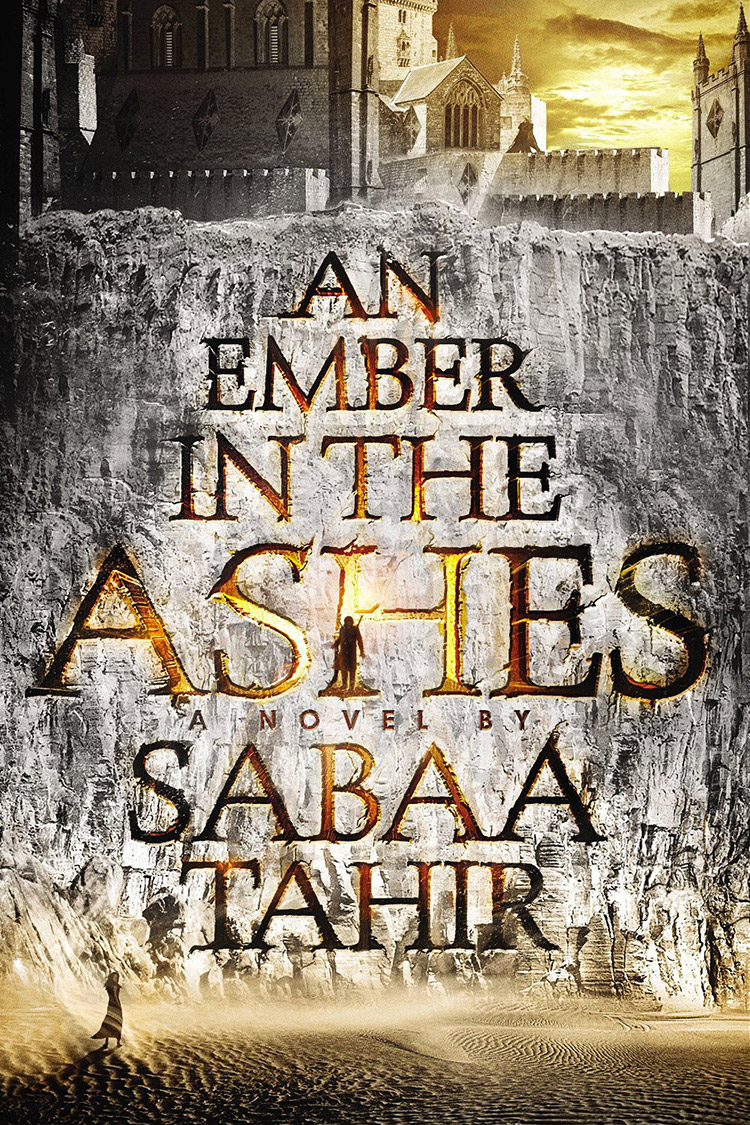
Book Review: An Ember in the Ashes by Sabaa Tahir

an-ember-in-the-ashes-by-sabaa-tahirAn Ember in the Ashes was a surprise. I was looking for (and expected) a fast, easy read that would help get me out of the reading slump I’d been in since breaking my foot in May. I don’t read much YA these days, but this book has gotten a lot of positive attention and I could have sworn that I heard somewhere that it was basically a standalone, which would have been nice since I’m not looking to get into any more uncompleted series. I figured this would be a quick, shallow, fun read that I’d never have to think about again.

It turns out I was super wrong about everything except it being a fast read. I did manage to race through it in about a day, but that was because it was really, really good, not because it was light reading.

This book is not light reading.

An Ember in the Ashes opens with a gut punch and then kicks the reader while they’re down, for over four hundred glorious pages. It’s a wild ride from the very beginning, and it’s definitely the best YA novel I’ve read in a couple of years.

At the same time, Ember is a sort of strange book for me to review. It has several glaring flaws that would ordinarily be dealbreakers for for me, but that Sabaa Tahir manages to make work.

First, I don’t love the names of the main characters, Laia and Elias. They’re just too close to each other, too many L’s and A’s, and though I never found them confusing, these names are just a little too match-y for my taste. They’re also part of a general lack of consistent naming conventions throughout the novel. The fantasy world of the book is ostensibly based upon ancient Rome, but the character names are a mix of Greek, English, Gaelic, and other origins. This could work as a way to differentiate between different cultures in the book, but that’s not how it’s done here. Instead, it’s just a mishmash of names, some of which make sense, some which don’t.

This sort of naming convention mess is increasingly characteristic of YA fiction in general, and it always turns me off a bit. It’s only tolerable here because the story Tahir tells is so well-crafted and because, while the names are sloppy, they don’t inhabit the realm of just plain silly and absurd that some YA character names do.

My second major criticism is also sort of about names, but in the general worldbuilding sense. Frankly, if it didn’t all manage to somehow work, I’d think that Tahir had used this humorous article at The Toast as a serious writing advice. Everything is just awfully generic.

There are the Scholar people, who are peaceful artisans and intellectuals who were easily overpowered and enslaved by the warlike Martial people. Aside from these two major groups, there are also Tribesmen, Barbarians, Lake People and Wildmen, The live in places like “The Empire,” “The Southern Lands,” and “The Tribal Deserts.” The one major holiday we see in the book is just called the “Moon Festival,” another extremely vague and generic piece of the world Tahir has created.

Even the prophesying Augurs seem generic when surrounded by so many other generic groups of people, and this isn’t helped much by the use of the name “Cain” for the main Augur. It’s a name that is so loaded with hackneyed connotations of antiquity, mystery and villainy (or occasional anti-heroism) that it should basically never be used unless an author is literally referring to the biblical Cain. I have a special loathing for the use of mythologically significant names in lieu of actual characterization.

All that said, there’s a lot to like about this fantasy world. There are definitely some bits of ancient Rome in here, but this isn’t Rome the great empire and foundation of western society. The Martials are Rome the violent colonizing juggernaut, and the Scholars and Tribespeople are clearly representative of the great civilizations of the Middle East and North Africa. While I think that the conflict between the Scholars and Martials is a little simplistic, it also offers a refreshingly different and much-needed perspective than the pro-imperialist ones that are more common in high fantasy.

Though there is much about this fantasy world that is bland and generic, there is still enough detail to make it stand out from more standard fare. The incorporation of creatures from Arab mythology is nice and helps to solidify the reader’s sense of the story world as vaguely Middle Eastern as opposed to the usual vaguely Medieval European fantasy.

The one really original fantastical element Tahir introduces is the masks worn by the uncreatively named Masks, and I would have liked to see this explained and explored a little more. Because Elias’s mask hasn’t bonded to him, we don’t get any firsthand details on what it’s like for any of the characters to have a mask permanently affixed to their faces. The masks are also mentioned inconsistently throughout the book, and it’s never quite clear exactly what the masks look like. It’s too bad that we don’t learn more about the masks because they’re probably the most unique worldbuilding aspect we’re shown.

The things that make all of the above-listed mediocrity okay and turn An Ember in the Ashes into a highly readable piece of work are the well-drawn main characters and a meticulously planned and beautifully realized plot. It also helps that Tahir avoids some of the more obnoxious YA tropes and what tropes she does utilize are smartly chosen. Finally, I really appreciate that Tahir isn’t afraid to hurt her characters. The stakes feel high and the danger feels real throughout the book, but at the same time I never felt like the suffering was gratuitous or overdone. 

This book feels like it shouldn’t work as well as it does, and there are any number of things I can pick out of it that I ordinarily don’t care for. However, I really enjoyed it, and I’m definitely looking forward to reading its sequel. An Ember in the Ashes is a sprawling, challenging young adult fantasy that is much greater than the sum of its parts.

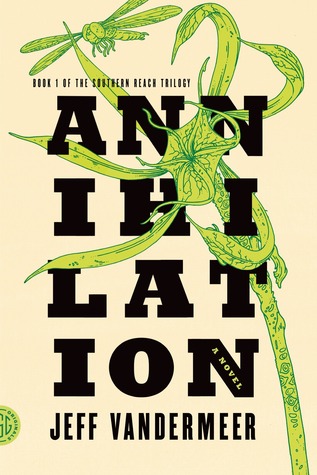
Book Review: Annihilation by Jeff VanderMeer

Annihilation_by_jeff_vandermeerAnnihilation is something else.

That said, I wouldn’t say that it was weird, exactly, as it has so much in common with traditional genre work.

It’s science fiction in the sense that it’s about science; in fact, it’s told from the first person point of view of a biologist, ostensibly on a scientific expedition. There’s a lot of scientific-sounding observations and a lot of scientific terminology tossed around. However, most of what the biologist encounters is decidedly not scientific, is indeed almost certainly supernatural or alien in nature, moving Annihilation firmly into the realm of the fantastical.

The biologist might have the mind of a scientist, but she has the soul of a poet. The descriptions of Area X’s environs are full of lush imagery and gorgeous turns of phrase that grant the whole book a sort of dreamlike quality. At times it even slips into what feels like nothing more than stream of consciousness narration, liberal interspersed with the biologists memories from before the expedition and an entire secondary story nestled in there about the biologist’s marriage, a tragic romance if there ever was one.

It’s a mystery in the sense that the reader doesn’t quite know what’s going on, but there’s no explanation in the end, and the biologist (and therefore the reader) finds far more new questions than answers over the course of the book. While reading, I generally felt like I was getting more and more information, but I was left somewhat frustrated at the end even though I felt like the biologist’s story ended in a way that felt just right for her.

Probably the thing Annihilation is most like is the works of Lovecraft and his copycats, but it’s not really horror, either. While there are some horror elements, especially of the psychological kind, I found the book to be more melancholy than anything else, and the biologist’s very detached, clinical style of narration rather dissected her feelings of horror more than it projected them to the reader. I felt like I was reading about horror, not experiencing it.

I suppose I would call Annihilation a work of literary surrealism, which definitely earns it a place under the SF umbrella, but aside from the common comparisons of it to Lovecraft (and those comparisons aren’t truly apt), I’d say it defies ordinary genre classification.

I can’t say that I particularly liked Annihilation, but there are things I loved about it. Its lovely prose and well-though-out structure show the meticulous craft that went into its creation. I don’t think I will be reading the rest of the trilogy, though. Annihilation left me wanting to know more about Area X, but it just wasn’t a very enjoyable read for me. Not enough to make me want to read another two books like it.

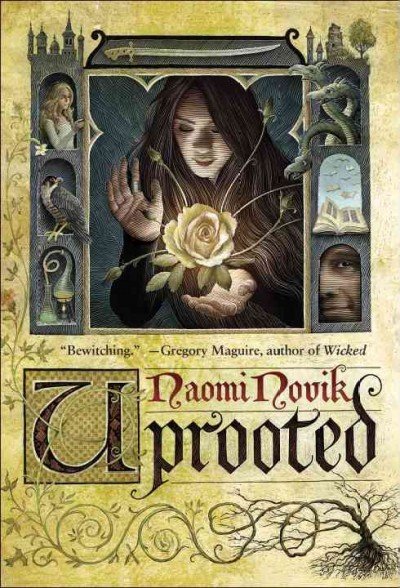
Book Review: Uprooted by Naomi Novik

Uprooted coverUprooted is probably my favorite book that I’ve read so far this year, and it’s definitely the best thing I’ve ever read by Naomi Novik. I did rather like His Majesty’s Dragon, but I never kept up on the series. This book is nothing like the Temeraire books, though.

Reading Uprooted is a truly magical experience, and I tore through it in less than a day. Although I generally am not a huge fan of first person narration, I fell in love with Agnieszka immediately. She’s a character with a very strong personality that shines out from every page, and her voice only gets stronger and more certain as she grows throughout the novel.

Her love interest, the Dragon, is a little less three-dimensional, but I think he works. While I don’t usually like large age gaps in my romance and teacher-student romances are even worse, Novik neatly side-steps about 95% of any weirdness by making Agnieszka extremely self-sufficient. The Dragon doesn’t really have that much to teach her; the things Agnieszka needs to learn can’t be taught much at all. Instead, she and the Dragon become friends and partners, and I felt like their relationship grew so organically that by the time the actually consummate it (in a scene that manages to be sexy and fun without being a distraction from the plot) it feels perfectly timed.

The supporting characters are mostly good as well. Perhaps the most important relationship in the book is the one between Agnieszka and her best friend, Kasia, and I love that it’s not always easy. Novik isn’t afraid to look at the darker side of their long friendship and explore negative emotions like jealousy and resentment in an honest and positive way. I liked the Falcon, who is one of the best sort of mostly-static characters–he is who he is, and there’s not much that is going to change him drastically. The book could stand to be more diverse, but the one notable character of color is a black woman who is a badass wizard and gets her own sort of happy ending.

The plot is something else. I read quite a lot of retold fairy tales, and I rather expected Uprooted to be in that vein. Instead, it’s something very different and fresh, and there were several times when I thought I was reading one kind of book only to turn the page and find out that it was something different. While Uprooted is inspired by Polish folk stories, which gives it a certain feeling of familiarity, it’s a wholly original work that pays homage to fairy tales but avoids all the worst fairy tale tropes. In fact, Uprooted plays with fairy tale conventions in some really interesting ways that I definitely see putting it at the top of my year’s best list.