Book Review: The Ballad of Black Tom by Victor LaValle

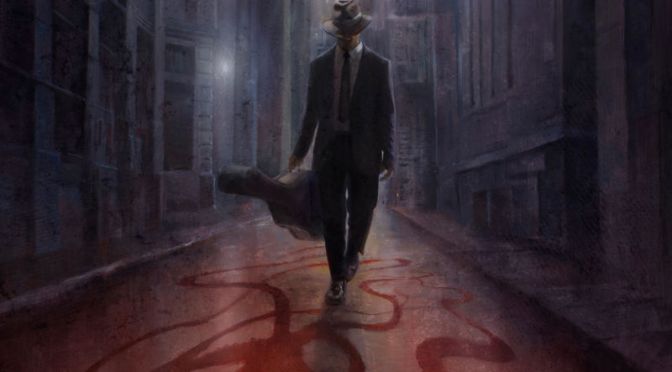
The Ballad of Black Tom opens with a dedication, “For H.P. Lovecraft, with all my conflicted feelings,” which is a handy summary of how many, if not most, modern readers feel about Lovecraft. Victor LaValle has written at some length elsewhere about his history with Lovecraft’s work and how he was inspired to write this novella in response to the Lovecraft story “The Horror at Red Hook,” so I won’t rehash that all here. Suffice it to say that The Ballad of Black Tom functions as both an indictment of and a love letter to Lovecraft, but it’s also a great story in its own right and is sure to be one of the best novella-length works of 2016.

It also doesn’t actually require a familiarity with the material that inspired it, although it does help. Even just a basic knowledge of Lovecraft’s work and his major themes will enrich your reading of LaValle’s novella and place The Ballad of Black Tom in proper context. While there’s definitely a vast difference in the length of Black Tom and the short story that inspired it, the biggest difference here is one of narrative scope. LaValle brings Tommy Tester and his contemporaries to life in a way that is directly contrary to Lovecraft’s fantasy of immigrant communities as unwashed, faceless hordes to be controlled and exploited by one malevolently erudite old white dude. Victor LaValle has done his research and combined it with his own lived reality in order to resurrect for the reader a specific time and place and people, and “The Horror at Red Hook”, in comparison, ends up looking like exactly what it is—the paranoid imaginings of a very sheltered, racist white man.

Whereas Lovecraft viewed immigrants and brown people with the same degree of horror with which we might think of tentacle monster gods in the depths of the ocean, LaValle is consistently clear on what the horrors are in Black Tom. At the same time, though, LaValle eschews any simple dichotomy of good and evil, instead preferring to explore ideas about how and why evil is made and used—and what it means when different people use it. When the climax of The Ballad of Black Tom comes, it’s a scene of catharsis that is both exhilarating to read and uncomfortable to feel so exhilarated about.

It’s a powerful reclamation of the racist narrative that Lovecraft created nearly a century ago, and it’s more wonderful and more unsettling than anything Lovecraft could have thought up. It’s a viscerally effecting and definitive illustration of the ways in which Lovecraft’s own biases and neuroses hindered him from telling this story in the way it deserves to be told. Victor LaValle has rehabilitated it and made it perfectly his own.

iZombie: “Eternal Sunshine of the Caffeinated Mind” takes some very dark turns

“Eternal Sunshine of the Caffeinated Mind” has the best case of the week so far this season, which is good because it’s able to carry an otherwise overstuffed and scattered-feeling episode. It’s not a bad episode. In fact, it’s quite good. It’s just that there’s an enormous amount of story here and several big developments, not all of which are satisfactorily resolved by the end of the hour. What’s most interesting about this episode, though, is how overall dark it is. It’s not uncommon for a comedic case of the week to lighten up the show, but this week’s case is as grim as anything else in the episode.

This was a week for adventurous camera work, which is neat. iZombie has always been a show with a distinctive visual style, and it’s good to see it trying some new things. The murder that kicks off the case of the week happens outside a coffee shop, and it’s filmed from inside where we can just see the air conditioner drop like an anvil on top of Leslie when she walks outside to see some chalk art. Later, while Clive and Liv are investigating the murder, the discovery of a clue is filmed from inside a toilet, which is another very cool shot, subtly funny (because toilet) but not too clever and not silly, either.

For most of this season, the cases of the week have seemed to fade into the background while Liv dealt with other things going on in her rather hectic life, but this episode finds Liv pretty much fully engaged in an actual investigation, and most of her time (until about the last five minutes of the episode) is spent actually working on solving the mystery. It’s the most she’s interacted one on one with Clive in ages, and I’d forgotten how much I love them together. They’re complemented in “Eternal Sunshine” by a great guest cast that includes Kacey Rohl (Hannibal and The Magicians) as the daughter of the murdered woman and Oscar Nunez (The Office) as Leslie’s ex and the owner of a much grumpier coffee shop across the street from Positivity. The only black mark on this little saga is that one of the first persons of interest in the case is Pam, Liv’s cellmate from her brief stint in jail earlier this season. Sadly, Pam is still basically a borderline racist caricature who is used primarily for comic relief in a way that is just uncomfortable to watch now as it was a few months ago.

The actual murder mystery, as it unravels, isn’t particularly complex, but that’s a good thing. What’s really important about it is the way it supports the thematic tone of the rest of the episode and seems to foreshadow darker times ahead for Liv and company. Liv and Clive are a great team, but sometimes the bad guy gets away—or, in this case, gets her boyfriend to take the fall for her. This case of the week isn’t breaking any new ground or upending any expectations, but it’s a good piece of solid storytelling, and it’s one of the most compelling cases Liv has worked on in a while and it just manages to hold together the rest of this episode which works at varying degrees of less well than the murder mystery.

Blaine is making good on his agreement to pay back Stacey Boss the eighty grand Boss said he owes, but things change when Boss’s henchman remembers Blaine’s old nickname, “Chinatown”—and more importantly, how Blaine earned that moniker. Boss is understandably furious and decides to take Blaine out once and for all, which ends with Blaine’s throat slit and his lifeless body buried in a shallow grave. Of course, this isn’t the end of Blaine, who has been exhibiting zombie symptoms for a little while now, and we don’t even have to wait until next week to see Blaine burst from the ground and terrify a group of birdwatching girl scouts. I can’t wait to see Boss’s face when he finds out Blaine is still alive.

Meanwhile, Drake turns out to be an undercover cop, which is something I did not see coming. On the one hand, I’m happy to know that Liv’s new love interest isn’t really one of the bad guys. On the other hand, I’m now concerned that he’s going to end up going the way of Lowell—especially in light of Major’s continued presence (and newfound commitment to honesty) in Liv’s life. I also hate that so much of the episode was spent dealing with Drake stuff. This could have been about a two-minute-long reveal, but instead it was dragged out over much longer than that, and several scenes. It’s not the worst use of time this show has ever exhibited, and I’ve seen a lot of folks excited because Drake’s handler is played by the guy who I guess played the dad on Veronica Mars. Having never gotten into that show, though, I didn’t even make that connection until I read it elsewhere, and I still can’t bring myself to care enough about it to make it worth all the screen time this stuff was given.

The penultimate scene of the episode starts with Major showing up at Liv’s place with the intention of telling her all about the Max Rager and Chaos Killer stuff, but he bails when Gilda/Rita shows up—but not before calling her Rita, which tips Liv off to her roommate’s identity. Although Liv doesn’t know about Rita’s relationship to Vaughn Du Clark, yet, it’s still a small catharsis to see Liv punch Rita in the face and kick her out of the house. I’m not thrilled that this essentially amounts to them fighting over a boy, especially when that boy is Major, and especially when it had started to look like Liv might be moving on, but (and maybe, probably, I’m being overly optimistic) maybe this means that Peyton will move back in with Liv and we’ll get to see more of her in the future.

Miscellaneous thoughts:

  • “…the crown jewel of our empire…” Oh, Ravi, you beautiful man.
  • There was a piece of sidewalk in Leslie’s brain.
  • Gary Derryberry.
  • I love Don E.’s reaction when he sees Candy eating brains, but Candy’s reaction to his reaction is equally hilarious.
  • David Anders needs to sing more often on this show. Total sploosh.
  • Stacey Boss is a genuinely scary villain, and his D&D speech to Blaine was amazing.
The Shannara Chronicles: “Safehold” is this show’s most unintentionally hilarious episode yet

This week, as indicated by the episode title, we finally see our heroes make it to Safehold, which is a relief after several weeks of almost no forward progress. Unfortunately, the lack of silly side quests, ridiculous obstructions and unnecessary meandering on the part of Amberle and company doesn’t mean we get an episode free of boring and unimportant nonsense. Indeed, Amberle, Wil and Eretria feel shoved almost to a back burner this week as the show focuses on goings on at Arborlon, where new King Ander is struggling to hold onto his crown and Bandon is being possessed by the Dagda Mor.

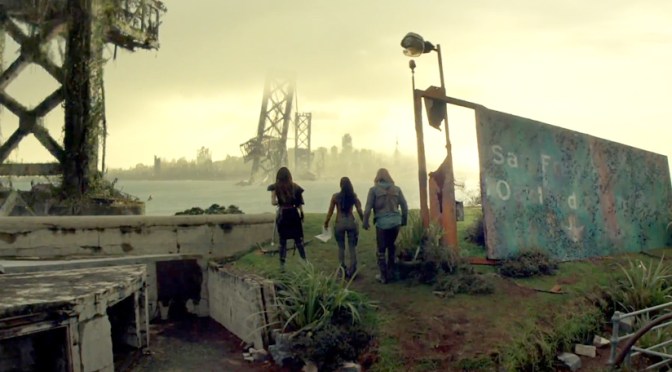
Safehold, it turns out, is named for the letters that are left on an ostensibly ancient sign next to the ruins of the Bay Bridge that connects San Francisco and Oakland. I have very mixed feelings about this, to be honest. Remains of something as large as the Bay Bridge might last hundreds of years, but most of the other detritus of human society would not, and the sheer amount of stuff that seems to have survived in the onscreen Shannara world is simply unbelievable. The show should definitely have stuck with a less-is-more approach to this sort of thing, but instead they’ve opted for an unfortunate mash-up of fantasy and post-apocalyptic aesthetics that works less and less well the deeper they delve into the world. This week continued to have some nice porn-y wide shots of scenery, especially of Arborlon (although it does seem like they’ve started to recycle the aerial views of the city), but in close things are a mess.

The biggest problem for Amberle, Wil, and Eretria this week is that for once they don’t really have any problems. After weeks of contrived random encounter bullshit, they’re basically able to just walk right into San Francisco. Eretria’s tattoo is a deus ex machina and a half, and they don’t even disturb the trolls. When they get to the actual Bloodfire, the two banshees or whatever that are guarding it are laughably weak. All they can do is say some mean things to the heroes, and they’re quickly dispatched with Wil’s elfstones. The “cliffhanger” ending, with Amberle disappeared into the Bloodfire and Eretria seemingly dead (but obvs just passed out from blood loss), isn’t actually very cliffhanger-y at all since the show has done a piss poor job of creating a sense of actual danger for the characters.

Even the emotional stakes are remarkably low. Amberle and Eretria are besties now, which leaves Wil feeling henpecked, and there’s no hint of romance for any of them this week which makes one wonder why the show even bothered with the love triangle business in previous weeks. All of their interactions and epiphanies feel hollow and soulless. The only one of the trio who seems to have any real, authentic feelings this week is Eretria, who is exhilarated by the rush of magic when her tattoo turns out to be a map to exactly where they need to go, because fate or something. There are some other things hinted at, such as Eretria’s abandonment issues, and she and Wil almost have a moment of bonding over their desire to find someplace to belong. However, it’s spoiled by the fact that Wil’s claim of outsider status is a glaring case of telling-not-showing and feels insincere.

At Arborlon, Ander’s decision to claim his father’s throne has had some consequences as the head Councilor, Kail, has decided to lead a coup. This storyline actually has a lot of potential, but there’s not enough context for it to work as a single-episode arc. For one thing, Kail hasn’t even had any lines before this week, so it’s uncertain who she is and why we’re supposed to care about her opinion so much. Apparently Ander had promised her that he wasn’t going to take the throne, but that must have happened offscreen, which makes the implied betrayal of trust much less impactful. Without any foreshadowing or setup or seeding of the plot points here—the show didn’t even introduce the major characters involved in this plot before this week—it just feels like a distraction, and the eventual acceptance of Ander as King is aggressively uninteresting.

The other major happening at Arborlon this week is Bandon’s continued druid training under Allanon’s tutelage. Mostly, this amounts to Allanon trying to force Bandon into revealing that he’s possessed by the Dagda Mor, and Manu Bennett gets some of his worst lines yet in a season that is just full of poorly written dialogue. When Allanon is unsuccessful at (I guess?) exorcising the Dagda Mor from Bandon’s mind, Bandon goes to hang out with Catania, who definitely wants to bang him. Unfortunately for her—and for the viewer, because this scene is legitimately unsettling to watch—boners are apparently the thing that really wakes up the Dagda Mor in Bandon, who sexually assaults Catania. She’s able to escape/get rescued by Allanon, but not before being pretty brutally attacked. It’s a super gross scene, and I don’t think there are words to describe how disgusted it makes me that sexual violence is such a cheap way for shows to try and be “dark” and “gritty.”

The episode finally (mercifully) ends with the last leaf falling from the Ellcrys and unleashing the Dagda Mor and his demon army. Earlier in the season, I had rather thought that there would be some kind of epic battle in episode nine, but we’re going to have to wait until the season finale. This episode does seem to promise such a battle, but considering this show’s track record so far I wouldn’t be surprised if Amberle gets back with the Ellcrys seed just in time to stop anything actually interesting from happening. We’ll see.

Miscellaneous thoughts:

  • Holy lens flare, Batman! Enough is enough, show.
  • At one point Eretria exclaims in exasperation, while talking about Cephalo saving her, that “It doesn’t make any sense!” and this made me laugh so hard I almost choked, which was very distracting, but also the funniest thing that has happened on this show to date.
  • “You’re no King; you’re just what was left” is a genuinely excellent line.

Supergirl: “Truth, Justice and the American Way” breaks into some bigger thematic ground

“Truth, Justice, and the American Way” isn’t a perfect episode, but it is on the excellent side for this series, mostly because it finally deals with some of the larger issues that are almost implicit in the premise of Supergirl. The ethical issues surrounding Supergirl’s work with the DEO and her own vigilante fighting for justice have been building all season, and things finally come to something of a head this week. Though the episode isn’t without some hiccups, it’s great to see it being more thematically ambitious.

First, though, the episode almost gets bogged down in HR issues. This week we find Kara back at the office, where she has to deal with some competition in the form of a second assistant that Cat has hired to take up some of the slack for Kara, who has been very flaky recently. I hate everything about this storyline so, so much. Yes, Kara has been flaky, and yes, she drove Cat’s son away, but it’s incredibly unprofessional for Cat to punish Kara like this, especially as publicly as she does here. I also despise that all of Kara’s relationships with women are so fraught, and it sucks that the show has introduced yet another woman for Kara to contend with.

Sure, Siobhan is aggressively unlikeable, but I even hate that framing of things. Siobhan is ambitious, and she is competitive with Kara, but this is a dynamic being fostered by Cat Grant, who is at her most petty and manipulative in her dealings with Kara this week—and all of these women are written that way. By the time you add in Lucy Lane, who is getting suspicious and jealous of her boyfriend’s relationship with Supergirl, CatCo has become a toxic mess for Kara to navigate in. Even outside of her day job, she’s dealing with her aunt Astra’s death, and she doesn’t even know yet that Alex is keeping a pretty big secret from her.

Admittedly, it’s not just Kara’s relationships with women that are on the rocks. She and Winn are still not talking much; she’s so angry with Hank over Astra that she is having trouble working with him; and James just gave her an ultimatum. However, in an ostensibly feminist show, it would be nice to see Kara able to have even one good, healthy relationship with another woman. Instead, the show’s writers seem determined to trot out every tired, catty, bitchy stereotype about women’s interpersonal relationships that they can fit into a single episode. This has been an ongoing problem for the show, but this week all of Kara’s relationships seem to be at nadirs, which makes the problem that much more pronounced and unpleasant to watch.

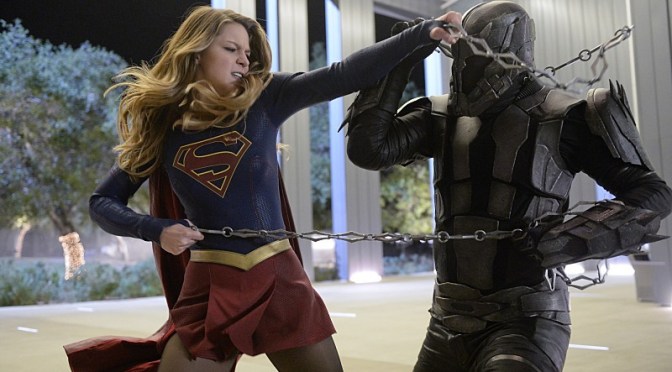
The real meat of “Truth, Justice, and the American Way” is, or ought to be if he didn’t have to share so much time with Kara’s office tribulations, the villain of the week. In an interesting change of pace, this week’s villain isn’t an inmate of Fort Rozz—he’s one of the guards, and he’s systematically hunting down and executing former inmates without regard to their present circumstances or even their original crimes and sentences. This is set up as a counterpoint to what Supergirl and the DEO are doing, and specifically to their indefinite detention of Maxwell Lord, who isn’t even an alien and probably ought to have some rights or something as an American citizen. Master Jailer is probably the best idea the show has had yet for a villain, but the execution of his story could definitely have been better.

As I already mentioned, this story—which deals with some of the show’s heavier ethical issues, namely the legality and, well, justice of extrajudicial justice—shares far too much time with material that doesn’t really fit together with it. The conclusions reached by the end of the hour feel almost glib, and Kara is portrayed as almost foolishly naïve rather than principled. The questions asked in the episode are worthwhile and certainly deeper than most of the other themes so far this season, but the answers just aren’t quite satisfactory. Still, it’s a step in a good direction for the show, and I would actually love to see this become a recurring theme to be examined in more depth in the future.

Miscellaneous thoughts:

  • Hated Kara’s astonishment that Cat could pronounce Siobhan. There’s not really any comparison between “Kara”—a name that can be mispronounced in many irritating and disrespectful ways—and “Siobhan”—which can only be mispronounced in ways that make the mispronouncer look ignorant.
  • This episode wasn’t terribly dark, really, but it was remarkably light on humor, which gave it a weird tone.
  • I was surprised that they went with a couple of straight up Gitmo references when talking about what Supergirl and the DEO do. It’s interesting to see what real-world things get worked into the show.
  • “It’s under the floor” was beyond words stupid. I mean, they didn’t even look for a cellar or anything first, and bad stuff is always underground. Get it together, Alex.


Lucifer: “Sweet Kicks” is a sour bore

Lucifer continues to disappoint, and “Sweet Kicks” is an almost entirely forgettable episode. I was moderately interested in this show before it first aired, even though I hadn’t read the comics, but after five episodes it’s only managed to be (mostly) inoffensively humdrum. There’s something to be said for a show playing its cards close to its chest, but there’s got to be something to keep people coming back week after week, and this show hasn’t really got it.

Tom Ellis’s charm has finally worn completely thin, and even his good humor wasn’t enough to elevate this episode to a bare minimum level of entertaining. Instead, Lucifer’s desire to “explore mortality” comes off as stupid, which is compounded when he proves himself essentially incapable of taking any responsibility for his own actions. Sure, I suppose the episode has something to say about his missing the forest of what it means to be mortal for the trees, but without any actual character growth, this isn’t particularly interesting.

Chloe is even more of a cold fish than usual this week, and spends nearly all her time on screen looking disapprovingly at Lucifer, accusing him of childishness (accurately), and devising petty and minor punishments for Lucifer’s irritating behaviors. It’s not cute or funny, though, and there’s no banter to their relationship. Lucifer is using her (although it was nice of him to not try and sleep with her this week), with no regard to how his presence might endanger her or jeopardize her career, and Chloe has a completely deadpan dislike for him that is the opposite of fun.

The character that I actually kind of liked best this week was Dan, who is somewhat useless in the narrative, but who is such a genuinely nice-seeming man that I can’t help but want good things to happen to him. While he doesn’t get a lot to do in terms of actually being part of the plot, he’s a piece of scenery in Chloe’s life that more or less works, and he’s one of the only characters who is consistently intelligent-seeming. I like that he seems to genuinely care about Chloe and isn’t afraid of Lucifer. That said, my bar for favorite character on this show is set pretty low at this point.

While Lucifer and Chloe are dealing with a deeply boring case of the week, Maze is meeting up with Amenadiel behind Lucifer’s back. Both of them want Lucifer to return to Hell, if for different reasons, so they’re going to plot together in order to get him to do what they want. These two are the only characters on the show who have any discernable sexual tension or chemistry, and they’re hands down more interesting to watch than anything Lucifer and Chloe get up to.

Honestly, I’m not sure how much longer I’m going to continue to cover this show. It’s not really good or bad enough for me to have any strong feelings about it one way or the other, and there’s plenty of other things I could be working on instead. Next week’s episode title suggests something more mythology-laden than what we’ve had so far, so I will decide then if I’m going to stick it out until the end of the season. With The X-Files finished with, I’m sure next week I’ll feel less overloaded, but I could always drop Lucifer and start writing about my deep and abiding hatred of Quentin Coldwater (The Magicians) instead.

Miscellaneous thoughts:

  • I don’t really “get” the sexy therapist character. Dr. Martin isn’t necessarily any specific misogynistic stereotype, but she seems more like a character from a crappy porno than a character who belongs in a prime time television show. Also, she doesn’t seem to exist for any particular purpose except to be funny, and she’s not.
  • Why did they have to kill the pig?
  • Maze is a legit badass, and I hate that she’s basically in an abusive relationship with Lucifer, who treats her like garbage. Tom Ellis isn’t nearly charming enough to make this okay.

The X-Files: “My Struggle II” is an epic disaster

I said right at the start of Season Ten that The X-Files is the same as it ever has been, and this continues to be basically true. “My Struggle II” is an hour-long roundup of all the show’s worst tendencies in one place, only without many of the show’s strengths to otherwise recommend it. The fact that it ends on a cliffhanger, with no assurance that it will ever be continued, is just the icing on the cake of overall mediocrity-to-badness that has been every episode of Season Ten except for “Mulder and Scully Meet the Were-Monster.”

Like “My Struggle,” “My Struggle II” is a mythology episode, wholly devoted to continuing the story that the earlier episode began. The thing is, these two episodes don’t tell a fully contained story at all. They don’t work as bookends for the season because there’s no actual ending here, but there’s also no real narrative symmetry, despite the use of a similar introduction to the episode, this time with a Scully voiceover. A better use of Scully’s voiceover would have been at the end of the episode to bring closure to the miniseries and the show in general, but of course this can’t have happened after a cliffhanger ending like what we got.

The worst part of “My Struggle II,” though, is that it just doesn’t make a lick of sense. The hour manages to feel at once overstuffed and devoid of story, a whole lot of sound and fury signifying nothing. Things happen, but they’re so absurd that it’s very difficult to suspend enough disbelief to even accept the basic premise. I could believe in the existence of a conspiracy, but the idea that a shadowy cabal of one percenters would somehow decide to just kill large swaths of humanity in the way that it’s show in The X-Files is just silly. Ultimately, it’s just fantastical, an episode of evil for evil’s sake, to be taken about as seriously as any cartoonish fantasy villain who wants to cover the whole world in darkness or some such nonsense.

Even the smaller events of the episode make little sense. Why are Miller and Einstein still hanging around? Why did the Cigarette Smoking Man save Reyes? Why use programmed diseases (that are usually vaccinated against) to kill people instead of programming in, say, cancer or some other illness that actually has a genetic component? What is the clear liquid Scully is administering to people? Why does Mulder need stem cells? And why does he need stem cells specifically from his and Scully’s son? Why is Tad O’Malley back after disappearing so completely back at the end of “My Struggle,” and why? There are so many questions, but almost no answers.

I was afraid that Season Ten would turn out this way—as a springboard for either more nostalgia-based programming or as a setup for a spin-off series, which seems highly possible at this point, with the return of Miller and Einstein in the finale. It was nice, in a way, to see something huge actually—finally—come of all the conspiracy theorizing the show has done over the last twenty-odd years, but now that the show has gone big, I wish it would go home.

Miscellaneous thoughts:

  • The reveal of the Cigarette Smoking Man’s face was pretty rad.

Book Review: Daughter of Destiny by Nicole Evelina

I’ve always found it a little sad that there isn’t more Arthurian literature written about Guinevere, so I was excited when I saw this self-pubbed title pop up on NetGalley and had high hopes that it would offer some new insight or a unique interpretation of the mythology. Unfortunately, Daughter of Destiny was mostly a let down on that score. It’s a fast, easy read, though entirely unexceptional, and while Nicole Evelina may have some historical background, her knowledge of, understanding of, and respect for Arthurian legend and literature is marginal at best. It’s not a bad novel, but it was definitely a disappointment as an Arthurian one.

The story starts off somewhat slowly, as 11-year-old Guinevere is sent to Avalon to train as a priestess, which feels like a page out of nearly every Arthurian retelling from Morgan’s point of view. Unlike most of those retellings, which often focus on Morgan’s relationships with the women she meets there, this first part of Guinevere’s story actually leaps over several years of her training in order to get straight into her senseless rivalry with Morgan and her relationship with, of all people, Aggrivane. I’m not sure which I find more upsetting: the conflation of Guinevere’s story with Morgan’s, the absurd twisting of the regular Arthurian timeline of events, or the general grossness of Guinevere’s relationship with Aggrivane (who is an adult man). It’s all completely unoriginal and establishes early on that the author doesn’t know or care much about the literary tradition she’s working within.

After graduating from priestess training, Guinevere doesn’t actually become a priestess. Instead, she’s sent back to her father, Leodgrance, who has become a Christian since the death of Guinevere’s mother. We’re told that Guinevere is extremely sad about her mother’s death, but the majority of Guinevere’s time in Northgallis deals with her relationship with her father. This does touch upon a common Arthurian theme—the conflict between the indigenous religions and traditions of Britain and the Christianity imported during the Roman occupation of the country—but in a very shallow manner. Rather than exploring these larger ideas, Evelina dwells on relationship drama, even contriving to have Aggrivane show up at Northgallis in order to create a situation that gets Guinevere sent away to the story’s next setting.

In Pellinor’s household, Guinevere meets Elaine (Pellinor’s daughter) and Isolde, both characters who usually have their own interesting roles to play in Arthurian legend. Here, though, Elaine is a quiet, strange girl in thrall to her domineering mother, Lyonesse, and obsessed with finding a man who she believes she is destined to marry. Isolde is the heir, in her own right apparently, to the throne of Ireland, but she’s kept practically as a servant in the household, where she spends her time sleeping around (as one does when one is a young princess in a time before birth control, I guess) and giving pages-long speeches of exposition to Guinevere. Guinevere and Isolde are supposed to be great friends, but the relationship isn’t very developed, and what passes for court intrigue is little more than mean girl antics.

The climax of the novel is a grand tournament held by Pellinor to entertain the new High King, Arthur, but there’s not much action to be had here. Guinevere again resumes her affair with Aggrivane, and they hope to marry, but instead Guinevere ends up promised to Arthur, who she has had almost no contact with whatsoever. She’s upset at first, but seems to be getting into the whole “being queen” thing by the end of the novel. Even Aggrivane doesn’t actually say anything in protest, even though he had been assured by his own father that marriage to Guinevere was a done deal. It ends up feeling like a betrayal of the whole book up to this point, with no foreshadowing or anything to prepare the reader for this. Obviously, as someone familiar with the story, I wasn’t surprised to have Guinevere paired off with Arthur—that’s a non-negotiable facet of the legend and was definitely going to happen by the end of the book—but it felt incredibly unearned here, as if the author expected it to be a shocking turn of events. Instead it just seemed silly and calls into question the purpose of the entire rest of the book.

There’s no particularly new ground covered in Daughter of Destiny. It borrows heavily from The Mists of Avalon and similar feminist interpretations of the Arthurian mythos, but without any real understanding of the things that make those stories compelling. Although she has some admirable (albeit generic) qualities, Guinevere is a passive character throughout her own story, with very little agency. Her singular rebellion (outside of her ill-advised relationship with Aggrivane) is to secretly continue her weapons training, which connects her to her dead mother and to her ancestral people, but this is never fully explored and is also never once relevant to the plot. Meanwhile, every major event in Guinevere’s life is determined by the men who control every aspect of her present and future.

[This review is based on a copy of the novel received through NetGalley.]

Book Review: ODY-C Volume 1 by Matt Fraction and Christian Ward

ODY-C is an ambitious, psychedelic epic fantasy that needs to be completely finished and printed into one enormous, beautiful book so I can just read it all in one sitting. It’s a futuristic, gender-bent retelling of The Odyssey, and it’s a great way of bringing an ancient story to life for a new generation of readers.

That said, ODY-C is not going to be for everyone. It definitely relies on the reader having some level of familiarity with the source material, for one thing. If you’ve never heard of Homer or The Odyssey, and don’t know at least some of the highlights of the story, you may feel somewhat at sea through much of this first volume. There’s no hand-holding here, and it’s very obvious that the reader is expected to either keep up or go spend some time on Wikipedia and then come back.

Even the language is a nod to the story’s origin. It’s written partly in a kind of sound-alike version of the dactylic hexameter that characterized much of the classical Greek epic poetry. I love this choice because it maintains some of the identity of the source material in the face of a lot of other more avant garde adaptational decisions, but it can sound clunky to modern readers. While I’m not an expert on the form to be either outraged or dismayed about the execution, I found the poetic language interesting, and it really helped to set the tone of the comic and give a fascinating classical flavor to the setting that makes it a little unique. Certainly, I’ve never seen anything quite like it.

Christian Ward’s art, of course, is stunning. It’s just page after page of gorgeous colors and textures, from brilliantly-rendered action scenes to grand space vistas. At the same time—and this is, I think, my favorite thing about ODY-C—while the overall look of the art shows a keen attention to detail (the yonic shapes of spacecraft are a nice touch in a universe that has been scrubbed almost entirely clean of men) and an eye for beauty, there seems to be remarkably little focus on making the book’s many, many women pretty. The women of ODY-C come in all shapes and sizes and colors, from the great warrior Odyssia to various goddesses and even a hideously rendered (in the best way) cyclops.

As with all comic books, my biggest complaint about ODY-C is that it’s not long enough, and I have to wait for more, which is even more frustrating since it seems to have a somewhat laissez-faire production schedule. I want more, and much sooner than I’m likely to get it.

Weekend Links: February 20, 2016

First things first. NASA’s new (FREE!) space travel posters are excellent, and I need them all, very large, to put on every wall of my apartment.

io9 covered the art of Santiago Perez earlier this week, and I wouldn’t mind having prints of that to cover the few square inches of wall space that I can’t cover with space travel posters.

This week’s Fanwankers podcast was all about Game of Thrones and is definitely worth a listen. There’s even a Book Snob Glossary to go along with it if you aren’t familiar with their terminology. I ugly-laughed more than once.

In other news, Ecto Cooler is coming back! Although I don’t think anyone under about thirty cares. My daughter looked at me as if I had two heads when I explained what it was.

Charlie Jane Anders is still promoting All the Birds in the Sky, and she did a Reddit AMA yesterday.

This week saw the release of probably my favorite Tor.com novella to date, Victor LaValle’s The Ballad of Black Tom, and LaValle has been making the rounds to promote the book:

POC Destroy Science Fiction managed to unlock all its stretch goals on Kickstarter, which is exciting. Editors Nalo Hopkinson and Kristine Ong Muslim were interviewed at SF Signal to talk about the project.

Nalo Hopkinson also joined Sunil Patel and Nisi Shawl to talk about POC Destroy SF at Geek’s Guide to the Galaxy this week.

Indrapramit Das has an excellent piece about writing global sci-fi over at Tor.com.

Black Girl Nerds is making the case for (and asking for help with) getting Amazon to give us a Black Sci-Fi, Fantasy, and Horror section.

At Tor.com, Foz Meadows explains that we can’t just adapt SFF books; we have to transform them.

The finalists for the 2015 Aurealis Awards have been decided.

SFWA announced that C.J. Cherryh is their 32nd Damon Knight Grand Master.

Finally, the 2015 Nebula Awards nominee list has been released.

SF Signal has the Nebula list with links to the fiction that can be read for free.

Book Review: Planetfall by Emma Newman

Planetfall is a brilliant portrait of a character and a community both in crises and a meditation on the ways in which the community and the individual are intertwined. It’s a gorgeously realized sci-fi mystery about a secret that festers in the heart of a seeming utopia and threatens to destroy it all.

Renata Ghali followed her dearest friend, Lee Suh-Mi, across the stars to a new planet in search of God, but what they found when they arrived on their new planet was, well, inconclusive. When Suh-Mi disappears, Renata and the rest of their colony have to figure out how to go on without her. Over twenty years later, Suh-Mi’s grandson shows up and starts uncovering the truth that Renata has helped to hide all this time.

Much of the praise I’ve seen for Planetfall has been for its narrator, and I can’t help but concur. Ren is a fascinating character with an unconventional point of view that makes hers a unique perspective to read a story from. She’s an older woman (a youthful seventy or so, in fact), a woman of color, queer, and significantly mentally ill, though the revelation of that last fact sort of creeps up on you as you read her story. The first person present tense narrative provides a nice sense of immediacy and immersion, which becomes increasingly important as the story moves along and Renata’s mental state deteriorates. Over the course of the novel, Ren becomes increasingly anxious and paranoid, then frantic as secrets start to be uncovered. It’s not always an easy thing to read, but it is absolutely riveting.

I only wish that there had been more actual science in Planetfall, although I think that’s more a sign that I’ve been in a mood for harder sci-fi recently than it is a sign that Emma Newman fails the reader in any particular way. Indeed, there are all kinds of interesting ideas on display here, from printing technology to sustainable living and social engineering. This book straddles the worlds of harder sci-fi and more human-focused sci-fi and does both justice, but I would have loved more explanation of how things worked, especially the space travel portion of the colony’s journey, which I felt was very glossed over. Realistically, it doesn’t matter and isn’t really pertinent to the story being told, which is likely why there’s not more detail about the ship and the journey, but I kind of love that stuff.

Finally, I would also have liked to see some of the themes surrounding religion and spirituality in an age of scientific and technological wonders be a little more fully developed. There are all kinds of ideas touched upon regarding the existence of God, the possible ultimate fruitlessness of humanity’s search for God, and even the ways in which faith makes people vulnerable—both to their own bad ideas and to exploitation in service of other people’s bad ideas. Ren is a great protagonist for asking questions and making observations about these things, as she’s a skeptic herself and her disconnectedness from her community makes her often a shrewd observer of people. However, her observations are thoroughly colored by her significant mental illness, making them increasingly unreliable over the course of the book even as more of Ren’s and the colony’s history is revealed, and the rather abrupt ending of the story is somewhat unsatisfying.

All in all, though, Planetfall is a great book. It’s got a lovely, almost meditative pace to it, and it’s an incredible character study of its narrator. As someone who also suffers from depression and anxiety, with a tendency towards reclusiveness, I found Ren incredibly relatable, and I can definitely see this being a book that I will return to in the future.