Tag Archives: NetGalley

Book Review: Every Heart a Doorway by Seanan McGuire

Every Heart a Doorway is a sort of interesting twin to The Girl Who Raced Fairyland All the Way Home, which I reviewed yesterday. In many ways, they are very similar books, both being fairly sophisticated examinations of the children’s portal fantasy genre, but Seanan McGuire’s novella of course has sharper edges and a more nuanced message than Catherynne M. Valente’s middle grade masterpiece. Like Valente’s series, however, Every Heart a Doorway is a book that is absolutely necessary for its audience, which I would say is primarily teens and young adults, but ought to include basically everyone. It’s a book that many people will identify with, and those who don’t see themselves in its pages could probably stand to learn a few things from it.

While Valente offers her heroine the opportunity to stay in the world she has found a home in, McGuire turns her eye to the young people who don’t get to stay. Eleanor West is one such child, and she runs a boarding school for as many others like herself that she can collect. It’s here that main protagonist Nancy finds herself when she’s sent home from an underworld that she loved because the Lord of Death wanted her to be sure before she committed to staying forever. At Eleanor’s school, Nancy meets other young people like herself and learns more about the different possible worlds while she waits and hopes for her door to reappear. Most of all, Nancy learns that most people never do find their door again, and much of the book is dedicated to exploring the different ways in which Nancy and the other characters are dealing with this reality.

Whereas Valente’s Fairyland ultimately delivers a fantasy in which one can find harmony and unity by integrating different aspects of oneself and changing one’s world to suit, McGuire offers a very different solution to problems of belonging, predicated on the sad truth that sometimes, if we can’t change the world we live in, we have to leave it behind. It’s a bittersweet lesson, and it comes at a steep price, but it also comes with the assurance that it’s okay to leave. In some ways, it’s the ultimate “it gets better” message, but what McGuire gives us in Every Heart a Doorway is something much deeper and more nuanced than that platitude. For Nancy and her friends, things don’t always get better or easier, but they nonetheless have the strength to find joy and meaning in their lives regardless.

Every Heart a Doorway is a book about making the best of things, but it’s also a book about not being afraid to take chances and not feeling guilty about doing what is best for yourself. It encourages a sort of healthy selfishness that more people—specifically marginalized people, who are often expected to be absurdly self-sacrificing—ought to cultivate. There are no martyrs here. There are tragedies, but not inevitable ones, and the overall message is one of hope, though a much more complicated and ambiguous sort of hope than in Valente’s series. This is an altogether more grown-up book, and in all the best possible ways.

This review was based upon a copy of the book received from the publisher for review through NetGalley.
Book Review: Pieces of Hate by Tim Lebbon

Pieces of Hate is, technically, an okay book. However, it’s exactly the sort of thing that I normally try to avoid like the plague because I kind of hate it. It’s one of the better examples of its kind of story, but it’s still not my cup of tea. There’s very little that I find more boring than a fridged wife—nameless, even, to add insult to injury—and a manly revenge quest in which the only other women encountered are prostitutes who are (of course) repulsive to the protagonist. It’s a level of casual misogyny (either the author’s or the characters’—it doesn’t matter) that I found alienating from page one.
The mythology of surrounding the characters of Gabriel and Temple is moderately interesting, but nothing particularly special. The introductory novelette, “Dead Man’s Hand” didn’t help much in this regard, either. If anything, it was especially dull, being told from the point of view of a minor character who doesn’t actually know or understand the events happening around him. It’s also a pretty terrible introduction to Gabriel as a character. Without any of the insight into Gabriel’s inner thoughts like we get in Pieces of Hate, the Gabriel of “Dead Man’s Hand” isn’t at all likeable or sympathetic.

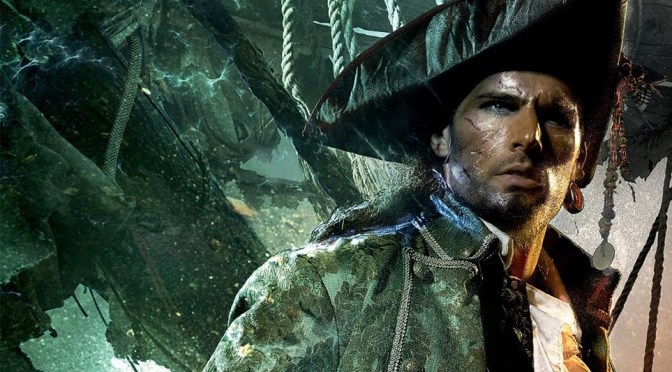
While I like the flexibility the premise of the two warriors, locked in an ongoing battle or hunt across time and space, offers, the downside of it here is that the two stories in this volume are so different that they are very disconnected. It lets Lebbon experiment with different genres, which could be potentially very interesting, but the juxtaposition here of the western with a sort of pirate story just doesn’t work. Partly this is because it’s cliché, but the disconnectedness of the narratives is exacerbated by the abovementioned change in point of view between the two parts of the book.

The biggest issue I had with Pieces of Hate, however, is just that it’s not my kind of story. While I enjoy reading outside my usual genre comfort zones from time to time, it’s very difficult for me to get into any of these sort of testosterone-fueled revenge narratives unless there is something really special or unique about them. Unfortunately, Pieces of Hate isn’t anything I haven’t read many times before, and Tim Lebbon fails to bring anything fresh or compelling to a set of very old tropes.

This review is based upon a copy of the book received from the publisher through NetGalley.

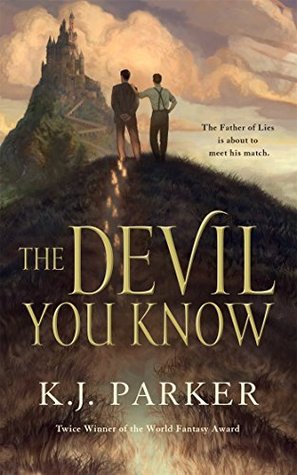
Book Review: The Devil You Know by K.J. Parker

Alright, so I loved this book, but I kind of hate that I did because it’s actually, objectively, a lot of things that I hate. Mostly, The Devil You Know is just not nearly as clever an idea as the author seems to think it is. Still, I just ate it up, and I tore through this little book in the space of an afternoon, it was so much fun. K.J. Parker has taken an idea that has been done before and freshens it up just the right amount, but without making it overly precious or smugly faux-intellectual.

The Devil You Know takes the unreliable narrator trope and multiplies it by two, telling its story from the twin perspectives of an actual (if unnamed) devil and the great philosopher, Saloninus. While there are a couple of point of view shifts that were easily missed—to the point I had to go back and reread once or twice—this mostly works. Saloninus in particular is a wildly clever and funny character, and the contrast between his confidence and the increasingly worried tones of his devil servant is consistently hilarious enough to make up for some of the story’s shortcomings.

The biggest problem that I had with The Devil You Know was the way that women were treated in the narrative. For one thing, there are no actual female characters in this book. There are hordes of nameless prostitutes, shipped in to entertain the menfolk, and there is the woman presumed to be Saloninus’s ex-wife. The sheer lack of agency and importance of these women isn’t particularly surprising, but the way in which both Saloninus and his devil callously use women makes it difficult to truly root for either of them. It’s one thing to have a story with few or no women, but it’s something else entirely to have two essentially misogynistic point of view characters and expect them to be universally appealing.

Regardless, I rather found myself liking both Saloninus and his devil in spite of myself. Saloninus is a wonderfully wicked and manipulative character, but he is only human. The devil has the air of a sort of harried bureaucrat. His anxiety about the contract with Saloninus is palpable, and it’s highly entertaining to experience the devil’s warring feelings about the philosopher. Neither character is particularly compelling, and they definitely aren’t breaking any new ground, but they are both better-than-middling examples of their types.

While the story’s ending is somewhat telegraphed and certainly not very original, Parker manages to mostly make it work. It wraps up a little too quickly and neatly, if anything, and it would have been nice to see things go down in a way that was a little less expected. However, it’s a solidly entertaining story that one doesn’t have to think too hard about. Sometimes, that’s good enough, and this is one of those times.

This review is based upon a free advance copy of the book received through NetGalley.

Book Review: Daughter of Destiny by Nicole Evelina

I’ve always found it a little sad that there isn’t more Arthurian literature written about Guinevere, so I was excited when I saw this self-pubbed title pop up on NetGalley and had high hopes that it would offer some new insight or a unique interpretation of the mythology. Unfortunately, Daughter of Destiny was mostly a let down on that score. It’s a fast, easy read, though entirely unexceptional, and while Nicole Evelina may have some historical background, her knowledge of, understanding of, and respect for Arthurian legend and literature is marginal at best. It’s not a bad novel, but it was definitely a disappointment as an Arthurian one.
The story starts off somewhat slowly, as 11-year-old Guinevere is sent to Avalon to train as a priestess, which feels like a page out of nearly every Arthurian retelling from Morgan’s point of view. Unlike most of those retellings, which often focus on Morgan’s relationships with the women she meets there, this first part of Guinevere’s story actually leaps over several years of her training in order to get straight into her senseless rivalry with Morgan and her relationship with, of all people, Aggrivane. I’m not sure which I find more upsetting: the conflation of Guinevere’s story with Morgan’s, the absurd twisting of the regular Arthurian timeline of events, or the general grossness of Guinevere’s relationship with Aggrivane (who is an adult man). It’s all completely unoriginal and establishes early on that the author doesn’t know or care much about the literary tradition she’s working within.

After graduating from priestess training, Guinevere doesn’t actually become a priestess. Instead, she’s sent back to her father, Leodgrance, who has become a Christian since the death of Guinevere’s mother. We’re told that Guinevere is extremely sad about her mother’s death, but the majority of Guinevere’s time in Northgallis deals with her relationship with her father. This does touch upon a common Arthurian theme—the conflict between the indigenous religions and traditions of Britain and the Christianity imported during the Roman occupation of the country—but in a very shallow manner. Rather than exploring these larger ideas, Evelina dwells on relationship drama, even contriving to have Aggrivane show up at Northgallis in order to create a situation that gets Guinevere sent away to the story’s next setting.

In Pellinor’s household, Guinevere meets Elaine (Pellinor’s daughter) and Isolde, both characters who usually have their own interesting roles to play in Arthurian legend. Here, though, Elaine is a quiet, strange girl in thrall to her domineering mother, Lyonesse, and obsessed with finding a man who she believes she is destined to marry. Isolde is the heir, in her own right apparently, to the throne of Ireland, but she’s kept practically as a servant in the household, where she spends her time sleeping around (as one does when one is a young princess in a time before birth control, I guess) and giving pages-long speeches of exposition to Guinevere. Guinevere and Isolde are supposed to be great friends, but the relationship isn’t very developed, and what passes for court intrigue is little more than mean girl antics.

The climax of the novel is a grand tournament held by Pellinor to entertain the new High King, Arthur, but there’s not much action to be had here. Guinevere again resumes her affair with Aggrivane, and they hope to marry, but instead Guinevere ends up promised to Arthur, who she has had almost no contact with whatsoever. She’s upset at first, but seems to be getting into the whole “being queen” thing by the end of the novel. Even Aggrivane doesn’t actually say anything in protest, even though he had been assured by his own father that marriage to Guinevere was a done deal. It ends up feeling like a betrayal of the whole book up to this point, with no foreshadowing or anything to prepare the reader for this. Obviously, as someone familiar with the story, I wasn’t surprised to have Guinevere paired off with Arthur—that’s a non-negotiable facet of the legend and was definitely going to happen by the end of the book—but it felt incredibly unearned here, as if the author expected it to be a shocking turn of events. Instead it just seemed silly and calls into question the purpose of the entire rest of the book.

There’s no particularly new ground covered in Daughter of Destiny. It borrows heavily from The Mists of Avalon and similar feminist interpretations of the Arthurian mythos, but without any real understanding of the things that make those stories compelling. Although she has some admirable (albeit generic) qualities, Guinevere is a passive character throughout her own story, with very little agency. Her singular rebellion (outside of her ill-advised relationship with Aggrivane) is to secretly continue her weapons training, which connects her to her dead mother and to her ancestral people, but this is never fully explored and is also never once relevant to the plot. Meanwhile, every major event in Guinevere’s life is determined by the men who control every aspect of her present and future.

[This review is based on a copy of the novel received through NetGalley.]

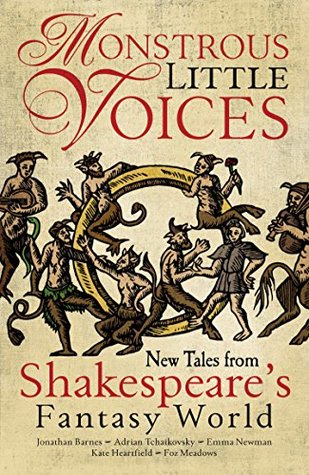
Book Review – Monstrous Little Voices: New Tales from Shakespeare’s Fantasy World

Monstrous Little Voices is a collection of five short novellas that take place within a fantasy world based upon the works of William Shakespeare, and it’s about 80% brilliant, which is pretty good for an anthology. There’s something of an overarching storyline connecting the stories, in addition to common themes and motifs, and this is nicely executed without making the stories feel totally linear or requiring them to be read in order. At the same time, each one also stands alone quite well.

Foz Meadows kicks things off with “Coral Bones,” a deliberate and thoughtful meditation on the ways in which we learn and perform gender roles. Through the examination of the character of Miranda and Miranda’s life after her marriage and “rescue,” Meadows explores questions about where gender comes from, how it’s imposed upon people, and what are some of the consequences—both personal and social—for failing to adequately conform to strict gender roles. She imagines essentially three worlds: the island where Miranda grew up unconstrained by social expectations, though being also groomed by her father, Prospero, to perform femininity; the world of the court of Naples, where Miranda lives after her marriage to Ferdinand, in which her performance of femininity is no longer optional and the qualities that made her different and attractive to Ferdinand on the island are now unnecessary and unwanted; and the fairy world, into which Miranda flees to escape her unhappy marriage after suffering a miscarriage, and in which gender is fluid and sexuality is flexible. It’s a clever story, and Meadows makes superb use of the Shakespearean elements in order to both pay tribute to and interrogate the Bard’s work.

“The Course of True Love” by Katherine Heartfield takes place, in the world of the book, some twenty years after “Coral Bones,” and it’s an altogether different sort of story—a fairly straightforward romance—that also plays with its source material in interesting ways. Heartfield tells the story of the witch Pomona, who is a friend of Sycorax and devotee of Hecate, and her encounter with an imprisoned fairy ambassador. Of all the stories in Monstrous Little Voices, this one may be the most in the spirit of Shakespeare, filled as it is with fairies, witches, mistaken identities, gender swaps, and humorous banter. What I liked best about it, however, is that it’s a romance where an old woman gets to be the main heroine. Like the previous tale, it’s overtly feminist, but with a significantly lighter and less complicated feminist message than “Coral Bones.”

Emma Newman’s “The Unkindest Cut” may be my favorite story in the collection, and it’s definitely the one about which I most wonder what happens next. Lucia de Medici is a girl with a destiny—to enter into a marriage that will end a war before it even begins—and she’ll do anything to ensure that it comes to pass. It’s an enormous amount of character development and growth squeezed into a relatively short number of pages, and it’s fascinating to watch Lucia change over the course of the story’s events. This girl who begins as somewhat shallow and seemingly marriage-obsessed turns out to be clever, resourceful, and downright ruthless in pursuit of her goals. The ending of the story is somewhat heavily telegraphed, and the ultimate solution to Lucia’s central problem is obvious before it’s even revealed, but it’s so great and the punchline of the story is delivered with such panache that I can barely even think of this as a drawback.

Adrian Tchaikovsky contributes “Even in the Cannon’s Mouth,” which is the story in the collection that is most like an actual play, with at rise descriptions and stage directions being used to provide a theatrical tone and break up the story into distinct scenes. It’s a tactic that I think is used to mixed success here, and I honestly found myself just being overwhelmed by the number of characters and disoriented by the swift and often sudden changes in the narrative. It’s a wild ride, for sure, and there are some interesting interpretations of Shakespeare’s characters—especially Helena—but the actual events of the story are sometimes difficult to follow. I was very glad to be taking notes, but not everyone likes to treat their leisure-reading like homework. Fortunately, everything comes more or less into focus by the end of the story so that there is a mostly satisfying ending, but “Even in the Cannon’s Mouth” is noticeably less substantive than all three of the previous stories. It’s not a bad tale, but it has far less to say than any of the others.

The final story in Monstrous Little Voices is “On the Twelfth Night” by Jonathan Barnes, and it comes somewhat out of left field. It starts off promisingly, albeit very differently than any of the rest of the stories in the collection, being told in second person from the point of view of Shakespeare’s wife, Anne. Then, though, things get weird, and the story barrels towards an ending that I found profoundly disappointing, mostly because it was so completely disconnected from the rest of the collection in tone and subject matter. I might have liked “On the Twelfth Night” in a different context, but here it just feels out of place and so completely unpredicated by the rest of the stories that it’s both baffling and irritating. It’s the highest concept of the book’s tales, but in this case that only means that it has the biggest opportunity to fail with its audience.

All in all, though, Monstrous Little Voices is something special, and this is a great year for reading Shakespeare, being the four hundredth anniversary of his death. With the introduction and afterword, I’d say that it’s definitely worth it to buy the full book, but each story is also being sold separately as an ebook if you prefer to read them that way. At the very least, the first three stories are essential reading, but the whole thing together is worth checking out.

(I received a copy of this title from the publisher via Netgalley.)

Book Review: Lustlocked by Matt Wallace

I received a free advance copy of this title from the publisher via NetGalley.
Lustlocked is the second in Matt Wallace’s Sin du Jour series, which began with the riotously funny Envy of Angels late last year. When I read the earlier volume, it was as part of my ongoing project of reading all of Tor.com’s new novellas, but I didn’t expect to like it much. Instead I found it quite enjoyable—smart and fast and a thoroughly fun read. I couldn’t wait for Lustlocked, and I was not disappointed.

It picks up more or less right where Envy of Angels ended, with Lena and Darren still kind of reeling from their experiences during their first days on the job at Sin du Jour and now faced with the decision of whether or not to sign on to the company on a more permanent basis. Of course they do, or there’d be very little story left to tell, and they (and we) quickly learn that there’s never a boring day at this catering outfit. The first job after Lena and Darren sign their contracts is a huge formal wedding for goblin royalty, which quickly gets out of hand when the bride complains that her in-laws aren’t always as nice to her as they could be and resident witch Boosha decides to do something about it.

Where Envy felt a little disjointed and too busy, with the fish-out-of-water story of Lena and Darren seeming almost incidental to the various other, more interesting storylines happening around it, Lustlocked finds a much better balance. There’s still an awful lot going on, including a sort of prologue that still seems somewhat out of place and disconnected from the main plot, which concerns a goblin wedding, but Lustlocked never feels overstuffed the way its predecessor sometimes did. Aside from the prologue, things flow along at a respectable and pleasantly methodical pace.

Where this second installment of the (hopefully open-ended and long-running) series really shines, though, is in continuing to bring to life its world and characters. Every new revelation about the mythology Matt Wallace is creating for this series is a new delight, and between Lustlocked itself and the bonus short story at the end (which was an excellent surprise) there was a ton of character background and development. I loved the sequence where Lena and Darren are being given a tour of the building, where I was glad to meet a couple of new characters. Wallace’s descriptions of food are delectably creative and full of vivid sensory descriptions, while his knowledge of the restaurant/catering/food business is definitely up to the task of making Sin du Jour feel like a real and lived-in place.

My only real criticism of the series so far is that I’m not quite sure what exactly Darren is there for. He didn’t make much of an impression on me in Envy, and he wasn’t much more present in Lustlocked. While Lena is really coming into her own as a character, Darren just kind of… exists. In a series as jam-packed with characters as this one, especially when being told in novella-length pieces, I kind of feel like every character really needs to exist for a specific reason. Lena is his roommate, and even she doesn’t seem to like or think about Darren very much at all, so he sadly ends up feeling superfluous.

In a bittersweet-in-hindsight turn of events, I read Lustlocked the day that David Bowie died, which feels a little like destiny, as it’s heavily implied in the book that David Bowie is/was an actual goblin king. I think this book might always be a little special to me because of that, as it’s a lovely tribute to the man, and one that I especially like because it is such pure, unadulterated fun. Of course David Bowie could be actual goblin royalty—IRL headcanon accepted.

Book Review: Patchwerk by David Tallerman

I received a free advance copy of this title from the publisher via NetGalley.

I had no idea what to expect when I opened Patchwerk, aside from what the cover blurb says about it, so it was a complete and mostly pleasant surprise. I’d never heard of David Tallerman before, and this is the only thing I’ve ever read by him. Patchwerk is a type of sci-fi story that I don’t usually seek out—the “man invents something ill-advised and hijinks ensue” sort—so it was an interesting change of pace, although it was a great follow-up to Microsoft’s Future Visions anthology of “harder” sci-fi, which I just recently finished.

In some ways, Patchwerk is an interestingly experimental work, told in a series of alternate universe vignettes, each beginning where the previous one left off so that the reader learns what is going on at about the same rate as the characters do. At the same time, I figured it out before I think I was supposed to when I read it, so that the revelation when it came felt a little redundant and slightly condescending. It felt as if Tallerman thought he was being a good deal cleverer than he actually was when he came up with the concept for the book. Still, it wasn’t a particularly egregious example of this flaw, and the concept works well in other ways even if it fails somewhat as a tool for creating suspense.

What Patchwerk lacks in suspense—the stakes are said to be high (or at least implied to be), but things never do feel all that dire, and the ending was a little too pat—it makes up for in sheer action packed-ness. At no point was I ever bored reading this little book, and I finished it almost entirely in one sitting, on the edge of my seat the whole time. Though I complain that I figured some things out before the book confirmed them, I was so delighted with what was going on that it didn’t bother me at all while reading.

Perhaps my only significant complaint about this novella is a technical one. While I’d have to reread it to find specific examples, it seemed as if Tallerman shifted pretty freely between a close third person point of view focused on Dran and an omniscient narrator with some insights to Karen that Dran wouldn’t have been privy to on his own, and this was sometimes distracting. It might have benefited from another close read during the editing process to clarify some random-seeming point of view shifts that were a little distracting.

This definitely isn’t my favorite of Tor.com’s novellas, but it’s another solid entry into the catalog, and I’m glad to have read it. While it didn’t tickle my fancy as much as Of Sorrow and Such or Binti or Sorcerer of the Wildeeps, it was a nice journey outside my usual sub-genre choices, and it gave me something to think about for the afternoon that I read it.

Book Review: The Heart Goes Last by Margaret Atwood

The Heart Goes Last isn’t as great a read as Oryx and Crake or The Robber Bride, and it’s not going to be a formative reading experience for me the way The Handmaid’s Tale or The Edible Woman were. And it’s not as meticulously excellent and perfectly curated as Atwood’s most recent story collection, Stone Mattress. Even still, The Heart Goes Last is something special, because I honestly believe that’s the only kind of work Margaret Atwood is capable of producing.

The story follows Stan and Charmaine, a down-on-their-luck couple who are just one couple of millions that are trying to scrape by in the wake of an economic disaster. Charmaine waits tables at a sort of frightening bar, and they’re living together in their car when they hear about a new opportunity that sounds, frankly, too good to be true, but still a damn sight better than having to guard their car and move around daily in order to avoid marauding looters and rapists.

The basic gist of the Positron project is this: they will join a new sort of large scale intentional community where they will spend half their time living in a [pretty comfortable] prison (Positron) and the other half living in an idyllic town (Consilience) where they will have their own home, jobs, food, and security. In either place, they will be provided for and protected from the ongoing economic crisis in the outside world. Obviously, things are not as they seem, and the majority of the book deals with how Stan and Charmaine learn exactly how much they’ve screwed up and then how they try with mixed success to extricate themselves from a pretty messed up predicament.

It’s tempting to compare The Heart Goes Last to Atwood’s earlier dystopian work, and there are some similarities. With The Handmaid’s Tale, it shares its examination of gender and sexuality in a strictly planned and regimented society. With the MaddAddam books, it shares concerns about corporatism and other evils of late stage capitalism. However, Positron/Consilience is a sort of kitschy post-postmodern paradise that lacks the darkness and grit of either the Republic of Gilead or the MaddAddam trilogy.

And where neither The Handmaid’s Tale nor MaddAddam were devoid of Atwood’s signature wry humor, in The Heart Goes Last we’re treated to a sort of ever-present tongue in cheek sarcasm with high camp stylings. I feel like The Heart Goes Last needs to be adapted to film by John Waters. Or perhaps Richard O’Brien. Or both. I think it could work.

In any case, it’s a funny, funny book that is also weird as hell, and it has a core of tragedy that, as someone who has struggled economically in recent years (although I never did have to live in my car), I found sometimes a little too relatable. There was no point in the book where I just though “this is too absurd; I don’t believe this.” I mean, sure, some weird things happen, but the sort of absurd situational humor that Atwood employs retains just enough realism that I always felt like Stan and Charmaine could be real people. Their extreme ordinariness is a big part of the humor, but they’re never boring or banal. Instead I find the characters’ normalcy comforting, and it helps to ground a story that has enough bizarre details that it could easily be driven off the rails by its own silliness.

The Heart Goes Last isn’t a great Margaret Atwood novel, possibly due in part to its odd genesis (it began as a serial work on now-defunct Byliner). There are definitely places, mostly in the beginning, where it reads more like a set of loosely related vignettes about the same characters. It doesn’t start to feel like a proper novel in its own right until somewhere after the first third.

The thing is, “not a great Atwood novel” is still a distinct cut above most everything else being published. I wouldn’t recommend The Heart Goes Last to someone just discovering the author, but if you already love Margaret Atwood, you’ll want to read it.

[This review is based on a free ARC received through NetGalley.]

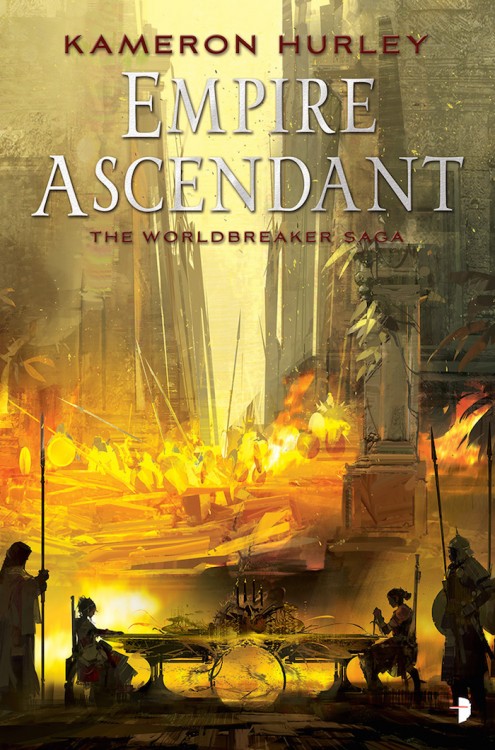
Book Review: Empire Ascendant by Kameron Hurley

empire-ascendant-by-kameron-hurley-495x750[This review is based on an advance copy of the book received through NetGalley.]

Empire Ascendant is a brutal read, which is somewhat to be expected from Kameron Hurley in general, and certainly to be expected in the follow-up to The Mirror Empire. The world of The Worldbreaker Saga is a harsh one, and this second book in the series turns the grimdark up to eleven.

Unfortunately, I’m just not loving this series the way I did Hurley’s God’s War trilogy. I liked The Mirror Empire well enough, but it took me about a third of Empire Ascendant to get my bearings and figure out what was going on. In addition to the increased blood and higher body count, there are several new POV characters who I had a hard time placing in the narrative, which was confusing. Additionally, though it’s been less than a year since I read the first book, it turns out that it wasn’t actually all that memorable.

Except for Zezili, a character I adored in the first book but whose page time in Empire Ascendant is greatly reduced, I found myself barely recognizing most of the characters until partway through the novel. I did enjoy Anavha’s parts, but his story line seemed to move at a painfully slow pace. Ahkio spends most of the book being ineffectual, as does Lilia. The invading empress from the other world is somewhat humanized, but we don’t see much of her except near the beginning and end of the book. For basically all of the characters, everything just goes from bad to worse to worst for some five hundred pages, and by the end of the book I found myself just unable to engage with that level of darkness any longer.

The thing is, this isn’t a technically bad book. Quite the opposite, actually. It’s a technically brilliant book that I just don’t know if I’m capable of appreciating right now, which is sad because it’s a book that I’ve been eagerly anticipating for months. There’s still a lot going on in this series that I think is fascinating, and I have no doubt that I’ll go on to read the third book in the series when it comes out as well.

I think, though, that the reality is that this is not a series for the faint of heart. The role reversal and the interrogation of gender and the implicit (so implicit they actually become explicit) criticisms of genre mainstays are well worth checking out, but I think that it’s the very subversiveness of this series that makes it such difficult reading. Empire Ascendant isn’t a book that can be read lightly. It demands (and deserves) all of the reader’s attention, but it’s, frankly, so  concerned (and rather self-consciously so) with subverting tropes and challenging expectations that it becomes weighed down with it’s own seriousness and self-importance.

In the end, I want to love everything about this series as much as I loved Zezili in the first book or as much as I loved all of the God’s War books, but I think I’m going to have to settle for only being able to objectively know the value of them and recognize the excellence of Kameron Hurley’s craft–which has certainly improved since her God’s War days. Empire Ascendant shows Hurley’s growth as a writer, but I feel like it also shows a notable lack of joy or humor when compared to her earlier work–which translates directly to me finding this new series increasingly unenjoyable.

Book Review: Sorcerer to the Crown by Zen Cho

[This review is based on an advance copy of the book obtained through NetGalley.]

If you loved Jonathan Strange & Mr. Norrell, you owe it to yourself to read Zen Cho’s Sorcerer to the Crown. At the same time, though, I’m not sure I’d compare it to Jonathan Strange & Mr. Norrell if I hadn’t just recently read the older novel.

Sorcerer to the Crown really has much more in common with the works of Jane Austen in both style and tone. While Jonathan Strange & Mr. Norrell is a broad-ranging pastiche that pays tribute to many genres while being very much its own thing, Sorcerer to the Crown is something simpler and purer–more earnest in its adherence to old-fashioned language and storytelling conventions. That said, Sorcerer to the Crown is a wildly original and deeply unconventional twenty-first century novel and a great deal of fun.

The book opens with a very young black boy named Zacharias being shown off to a bunch of white men to prove his (and his race’s) magical capabilities. While the ominous tone of the prologue is somewhat at odds with much of what follows in the novel, I think it’s a pretty excellent way of infusing the rest of the book–which would not be inaccurately described as a “romp”–with an undercurrent of darkness that keeps things grounded and provides a sort of baseline for the exploration of POC experiences in the rest of the story. It’s a prologue that shows the reader immediately what kind of book this is, which is the perfect sort of prologue if an author really must include one.

The rest of the story takes place after Zacharias has managed to find himself in the position of being the most eminent sorcerer in England. We quickly learn that his high office has earned Zacharias no shortage of enemies and is more a nuisance than anything else. He’s not even certain he wants the office at all, but there’s no way for him to give it up. Instead, he determines to make the best of it and try and enact what change and bring what progress he can while he still has time. To that end, Zacharias has to deal with magical school girls, Malaysian vampires. scheming racists, and angry dragons.

It’s a wild ride.

The characters in Sorcerer to the Crown can all be a little one-dimensional at times, and I didn’t always find Zacharias to be particularly likable, although I absolutely loved Prunella. Some things seemed a little too tidy at the end, and I’m not sure I entirely buy the romance, which was so restrained as to be almost nonexistent. Although it is kind of refreshing that the book isn’t overly focused on the romance, I would have preferred a more gradual growth of affection over time. As it was, the resolution of the romance felt somewhat tacked on and less earned than it could have been.

Still, Sorcerer to the Crown is a thoroughly enjoyable read. From beginning to end, it hits all the right notes that I look for in a book. It’s a very different perspective than we’re usually offered in Regency-set fantasies. It’s fast-paced and interesting enough that even though a great deal happens it never feels overstuffed or overlong. It’s whimsical without being precious and clever without being pretentious. Best of all, it’s a downright funny book, and I found myself chuckling aloud more than once. Definitely in my top ten books of the year so far.