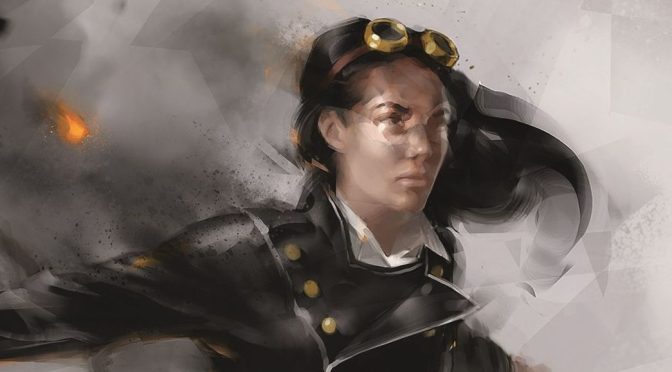
The Guns Above is a whip-smart, fast-paced, and surprisingly funny military fantasy. I didn’t think that I was interested in reading stories about a woman having to overcome systematic sexism anymore, and I was double not interested in reading anything like a redemption arc for that woman’s sexist antagonist, but Bennis manages to breathe some new life into both of those stories. I’m very glad that I was interested enough in airships to read this book despite my misgivings, as it turned out to be a wonderfully readable, remarkably fun and ultimately optimistic (but not cloyingly so) take on its subject matter.
After an act of combat heroism, Josette Dupris gets a promotion that makes her the first woman to captain an airship in a military with strict limits on women’s service. This would be a tough enough challenge on its own, but Josette is also saddled with a spy, Bernat, a spoiled nobleman with no military or airship experience to speak of, but whose job is nonetheless to report back to his powerful uncle on any of Josette’s failings, real or imagined. It’s definitely the sort of thing that one needs to be in the mood to read, especially since there aren’t easy answers to Josette’s problems, but it’s also definitely worth reading. This isn’t a book about one woman smashing the patriarchy single-handedly, and in fact Josette is largely unconcerned with doing so; she just wants to do her job like she knows she’s capable of. The Guns Above is about the way in which an ambitious woman can exist and find ways to thrive in a sexist society, and it’s about the incremental changes and personal fights that slowly push the needle of progress forward. It’s also about gritty, action packed airship battles and snarky humor, which makes it a perfect light-ish summer read.
You need this book for the beach or next to the pool or out on the porch or inside an air-conditioned building or wherever else you’re reading this summer.
Luckily, courtesy of the publisher, I have a hardcover copy of The Guns Above that I’m giving away.
The farther we get into 2017, the more I long for a–just one–completely uneventful week. I continue to struggle with productivity, although this week was better than most weeks in the last couple of months. I wrapped up my Spring Reading and posted my Summer Reading List, which will get us through the end of September, and that means a fresh start for me, writing-wise, as I do myself a kindness and set aside anything I had left unfinished from the spring so I can enjoy a brief respite from feelings of inadequacy before I get behind on summer stuff as well.
One thing I’m not behind on, at least not technically, is Let’s Read! Gormenghast, though I did take a break from it this week in order to finish some other things. I’m not making any promises about this coming week, as the holiday will take up at least some of the time I’d, frankly, much rather spend reading and writing about Titus Groan, but here’s what I’m (tentatively) planning the next few posts to cover:
Titus Groan Chapters 22-26
Titus Groan Chapters 27-31
Titus Groan Chapters 32-36
Titus Groan Chapters 37-39
I’ve already skimmed Chapters 22-26, and I’m fairly certain that will work as a section for a post, but I’ve continued to find it necessary to adjust my plans as I go because I find that the book comes with its own pretty obvious stopping points. Just based on previous experience, I fully expect to adjust one or more of these sections, give or take a chapter, as I get to them.
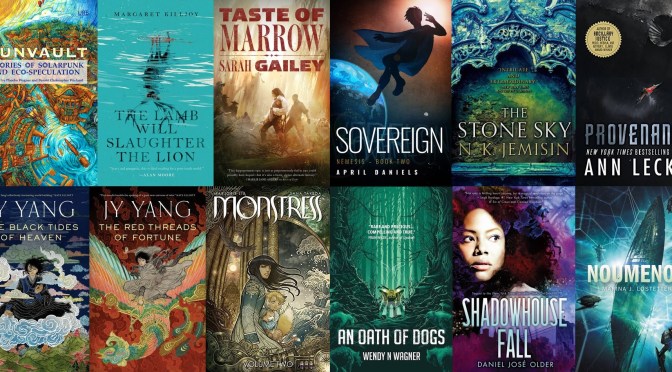
It’s that time again, where I list all the things I wish I could be more certain I would have time and energy to read over the coming months. July, August and September are full of exciting new releases, a little light on sci-fi and heavier on fantasy than my recent tastes have been, but exciting nonetheless. Here’s what’s on my radar for the rest of the summer.
Tor.com Publishing
As always, I plan to read most of what Tor.com will be publishing. I always enjoy their novellas, though I will be skipping a couple of novels that are sequels in series I haven’t read yet (unless I somehow manage to read the rest of their respective series). Probably the titles I’m most looking forward to from Tor.com right now are that pair of JY Yang novellas at the end of September, but I’m also really hoping to finally get around to reading Infomocracy so I can read Null States when it comes out. I am bummed that there’s not another Sin du Jour book until November, though.
The Ghost Line by Andrew Neil Gray and J.S. Herbison – 7/11
The concept on this one is a little ho hum, but I’m always down for another short space opera.
The Delirium Brief by Charles Stross – 7/11
I won’t be reading this one because it’s about eight books deep into a series I haven’t read and am not interested in reading back that many books to get into.
The Five Daughters of the Moon by Leena Likitalo – 7/25
The Lamb Will Slaughter the Lion by Margaret Killjoy – 8/15
“…pits utopian anarchists against rogue demon deer” is relevant to all of my interests.
Starfire: A Red Peace by Spencer Ellsworth – 8/22
A Song for Quiet by Cassandra Khaw – 8/29
The Ruin of Angels by Max Gladstone – 9/5
I keep trying, anytime I have downtime, to get into the Craft Sequence, but I’ve been unsuccessful so far. I’m not sure if I want to just skip this one or give up on reading the earlier ones and just start here since my understanding is that The Ruin of Angels stands alone just fine.
Acadie by Dave Hutchinson – 9/5
Taste of Marrow by Sarah Gailey – 9/12
We seem to be living in an age of sequels surpassing their predecessors, so I have high hopes for this title.
The Twilight Pariah by Jeffrey Ford – 9/12
Null States by Malka Older – 9/19
I will finish Infomocracy in time to read this before release.
The Red Threads of Fortune by JY Yang – 9/26
The Black Tides of Heaven by JY Yang – 9/26
Magazines
FIYAH Literary Magazine, Issue 3, SUNDOWN TOWNS – 7/1 Every issue of FIYAH is more beautiful than the one before. Just look at this gorgeous cover. I’m not familiar with any of the names on the table of contents for this one, but that only makes it more exciting.
Uncanny Magazine #17, July/August 2017
I’ve already got my hands on Uncanny #17 because I’m a Kickstarter backer, and even though I haven’t dug into it yet, I can already tell it’s going to be a-MAZING. You can see the cover and table of contents at the Uncanny blog.
Uncanny Magazine #18, September/October 2017
POC Take Over Fantastic Stories
This is, as far as I know, the final issue ever of Fantastic Stories of the Imagination, guest edited by Nisi Shawl and overflowing with stuff I am looking forward to reading.
Anthologies
2017 has been a year of trying to read more short fiction, and with that in mind I backed several anthologies on Kickstarter in the last year or so that should be coming out in the next couple of months.
Evil is a Matter of Perspective: An Anthology of Antagonists edited by Adrian Collins – Currently available.
I backed this on Kickstarter because it sounded fun. The final product is a little white-dude-heavy, but I’m thinking it will work well for some light-ish reading at some point
Hath No Fury edited by Melanie R. Meadors and J.M. Martin – August? There’s not a firm release date for this Kickstarted anthology but I’m thinking mid-to-late summer.
Strange California edited by Jaym Gates and J. Daniel Blatt – August?
Another kickstarted anthology with an interesting theme. I’m not from California, but my partner lived in the Bay Area for years and he was pretty interested in this book for that reason. I was excited because I’ve enjoyed stuff Jaym Gates has edited before and Strange California has a promising table of contents.
2084: A Science Fiction Anthology from Unsung Stories – July?
Another Kickstarted title with a great table of contents, although reading about dystopias gets less appealing all the time these days.
Sunvault: Stories of Solarpunk and Eco-Speculation edited by Phoebe Wagner and Brontë Christopher Wieland – 8/29
I cannot wait to find out what solarpunk and eco-speculation are all about. And look at that gorgeous cover art by Likhain!
Comics and Graphic Novels
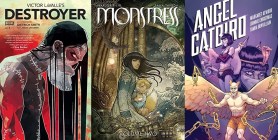
Victor LaValle’s Destroyer
I’ll be buying and reading issues more or less as they are released.
Monstress, Volume 2: The Blood by Marjorie Liu and Sana Takeda – 7/11
Hands down the trade I’m most excited for this year.
Angel Catbird, Volume 3: The Catbird Roars by Margaret Atwood, Johnny Christmas and Tamra Bonvillain – 7/4
I believe this will wrap up the series.
Books
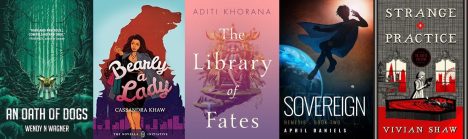
An Oath of Dogs by Wendy Wagner – 7/4
At the Table of Wolves by Kay Kenyon – 7/11
Bearly a Lady by Cassandra Khaw – 7/18
I will likely be reading all the novellas and short fiction the Book Smugglers publish this year.
The Library of Fates by Aditi Khorana – 7/18
I’m not reading much YA these days, but this one sounds good.
Sovereign by April Daniels – 7/25
I really enjoyed Dreadnought earlier this year, but I may have to be in the right mood for this one. I’ve gone off super heroes a bit lately.
Strange Practice by Vivian Shaw – 7/25
Noumenon by Marina J. Lostetter – 8/1
The Stone Sky by N.K. Jemisin – 8/15
The final book in Jemisin’s Broken Earth trilogy. Much anticipated.
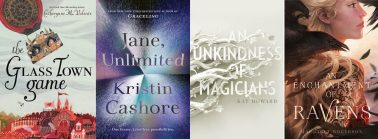
The Glass Town Game by Catherynne M. Valente – 9/5
This is a middle grade novel, which chills my interest in it a tiny bit, but I think I will always read literally everything Catherynne Valente publishes.
Girls Made of Snow and Glass by Melissa Bashardoust – 9/5
I’m always down for retold fairy tales, and this one is getting some excellent early reviews from people I trust.
An Excess Male by Maggie Shen King – 9/12
Shadowhouse Fall by Daniel José Older 9/12
Autonomous by Annalee Newitz – 9/19
Jane, Unlimited by Kristin Cashore – 9/19
I’ve loved Kristin Cashore since I first read Graceling years ago, and it’s been far too long since I’ve gotten to read anything new by her. I’m still holding out hope for more Graceling Realm books, but this will definitely do in the meantime.
Provenance by Ann Leckie – 9/26
New Ann Leckie. In the same universe as her Imperial Radch trilogy. I am stoked.
An Unkindness of Magicians by Kat Howard – 9/26
This might be my favorite book cover of the season.
An Enchantment of Ravens by Margaret Rogerson – 9/26
Between personal life stuff (my car will not stop breaking down about once a week) and generalized depression and anxiety about the state of the country and the world, I didn’t get around to writing nearly as much as I’d have liked to about what I’ve read in the last three months, so I’ve been looking forward to writing this list and wrapping up this season of stress and frustration so I can move onto other things.
That said, there was so much great stuffed published over the last three months, and I ended up reading most (though by no means all) of my Spring Reading List. It’s been very sad to not have the energy to write about it all, so I’m glad to have begun doing these wrap-up posts so I can squee a bit about everything I’ve missed writing longer posts about.
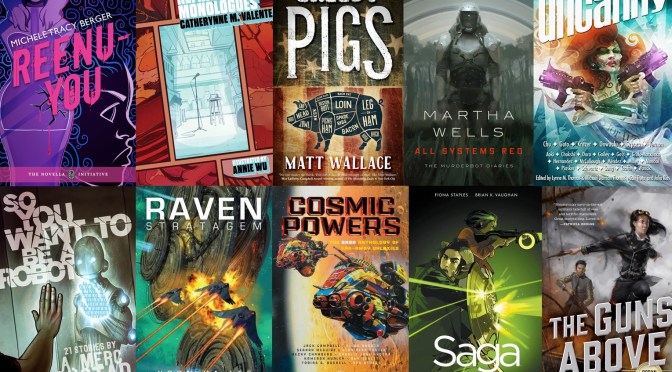
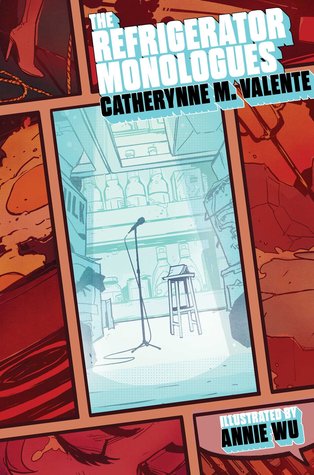
Best Fantasy Novel – The Refrigerator Monologues by Catherynne M. Valente
I have unequivocally loved everything I’ve ever read by Catherynne Valente, and The Refrigerator Monologues was always one of my most-anticipated releases of 2017, so it’s no surprise that I adored it. Valente has always had a way with language, and like all of her other work, The Refrigerator Monologues deserves to be read aloud, even if just to yourself. It’s smart and funny and furious and sad, and Valente has crafted a wonderfully original world of superheroes and a marvelous group of heroines with strong voices that are distinctive and familiar in turns.
Best Science Fiction Novel – Raven Stratagem by Yoon Ha Lee
I’ve been following Yoon Ha Lee’s career with interest since picking up Conservation of Shadows a few years ago because I liked the cover and realizing that it was one of the finest SFF short fiction collections I’d ever read. Lee’s first novel, last year’s Ninefox Gambit, was among my favorite books of 2016, but he’s really outdone himself with Raven Stratagem, which is one of those rare second books in trilogies that is better than the first. Even having read some of Lee’s short fiction set in his Hexarchate universe, I sometimes struggled to follow parts of Ninefox Gambit, but that’s not the case with Raven Stratagem, which is all around a stronger book, more character-focused, with a more easily comprehensible plot and a great cathartic payoff at the end that sets things up for a very exciting third installment in the series.
I read an above average number of very good novellas in the last three months, but All Systems Red is a true standout even with stiff competition. A sci-fi adventure written from the point of view of a sentient cyborg/robot who calls itself “Murderbot,” All Systems Red has humor, excitement, a dash of horror, and criticism of capitalism–all things relevant to my interests–combined with a strong and unique narrative voice. The best part is that there are at least three more Murderbot stories forthcoming from Tor.com over the next year or so. I cannot wait.
Best Comic Book – Saga, Volume 7 by Fiona Staples and Brian K. Vaughan
This seems an obvious choice, especially since I’m not a great reader of comics in general, but Saga is really, really good. This volume is full of all the weirdness one can always expect from this series, but it also comes with almost as much heartbreak (including at least one straight up gut punch) as the six previous volumes combined, so be sure to enjoy it with a box of tissues close at hand, possibly after several glasses of wine to preemptively dull the pain this book is pretty much guaranteed to make you feel.
Best Anthology – Cosmic Powers: The Saga Anthology of Far-Away Galaxies edited by John Joseph Adams
Listen. You’re almost never going to find any collection of short fiction that you like every bit of, but this anthology comes close for me. From the very funny “A Temporary Embarassment in Spacetime” by Charlie Jane Anders to the sharp and wryly witty “Zen and the Art of Starship Maintenance” by Tobias Buckell to Linda Nagata’s mother/daughter caper, “Diamond and the World Breaker, to a new Yoon Ha Lee Hexarchate story, “The Chameleon’s Gloves,” there’s something here for almost everyone. It’s an anthology with (cosmically) big ideas, a great deal of fun, and an entertainingly retro sensibility without sacrificing forward-thinking messages.
Best Collection – So You Want to Be a Robot and Other Stories by A. Merc Rustad
I only discovered A. Merc Rustad in January when I read their lovely story, “This is Not a Wardrobe Door,” at Fireside, but I loved that story so much that this collection was at the top of my to-read list as soon as I found out about it. So You Want to be a Robot and Other Stories collects that story and twenty more in a showcase of Rustad’s consistently good ideas and solid execution. Personal favorite stories in the collection include: “The Android’s Prehistoric Menagerie,” “Where Monsters Dance,” “Finding Home,” and “BATTERIES FOR YOUR DOOMBOT5000 ARE NOT INCLUDED.”
Best Sin du Jour Novella – Greedy Pigs by Matt Wallace
We’re up to book number five in this seven part series, and I am already getting sad about it ending. I’ve enjoyed this series since day one, and each installment continues to be better than the one before. In Greedy Pigs, the Sin du Jour team finds themselves accidentally catering an event for the President of the United States. Things get weird, obviously.
Best Non-SFF Thing – Natasha, Pierre & the Great Comet of 1812 Original Broadway Cast Recording
Not a book, I know, but I’m slightly obsessed with this musical right now. It’s based on about seventy pages from War and Peace by Leo Tolstoy, and it scratches basically all my itches. It’s ambitious. It’s funny. It’s literary. It’s gorgeously written and produced. It’s got accordions. It’s got Helene Kuragina, who is played by Amber Gray, who is a treasure and gives us this earworm:
Honorable Mentions:
Reenu-You by Michele Tracy Berger – Not the best written novella I read this spring, and it could have used another pass with a copy editor, but it’s a story that has stuck with me. Even weeks later, I still find myself thinking every couple of days about these characters and the way they bond through a shared trauma.
Victor LaValle’s Destroyer#1 – A promising first issue with a fresh take on classic source material.
“Beauty, Glory, Thrift” by Alison Tam – A delightful sci-fi adventure novelette.
Down Among the Sticks and Bones by Seanan McGuire – I only liked Every Heart a Doorway, but I loved Down Among the Sticks and Bones. I think if I’d read this one first, I’d have liked the other better as well.
The Guns Above by Robyn Bennis– I didn’t think I was in the mood for a book about a woman having to deal with sexist garbage, but this one is a good, fast read.
Biggest Disappointments:
Ladycastle #4 – After this limited series started off strong, it ends with some baffling plot developments and a too-easy resolution.
River of Teeth by Sarah Gailey – This novella was fine. I like the hippos. But I think it’s a case of it being extremely over-hyped. I’m not sure what I expected, but it doesn’t seem near exciting enough on its own merits to earn all the superlative praise I’ve seen for it.
The Space Between the Stars by Anne Corlett – By about five chapters in, I’d predicted the book’s big “twist” and couldn’t even be bothered to finish it.
I am bogged down (in a good way, though) this week with other projects and some housekeeping stuff here at SF Bluestocking, so I’m taking a break from Titus Groan while I wrap up my Spring Reading List and get out my Summer Reading List. I’ve also got a couple book reviews and at least one giveaway in the works in the next week or so, so be on the lookout for those.
New Titus Groan posts will appear after the 4th of July.
Things have gotten weird on iZombie over the course of this season, and this season finale ratchets the weirdness up to eleven by going full-on zombie apocalypse. It’s an ambitious decision; the show has had some success this season with changing up its style, moving away from the episodic case of the week format in favor of developing a season-long story, but this is a huge change, and the way they get there is, frankly, bizarre.
After spending the previous dozen episodes teasing a conspiracy, it’s revealed over the course of about ten minutes in this episode that every potential lead we had before now was a red herring and that all the unusually connected events of the season were a plot by background character Carey Gold (a criminally underutilized Anjali Jay). Pretty much everything about this revelation is terrible. It’s surprising, sure, but not in a good way. Carey Gold hasn’t gotten enough screen time or characterization to make her betrayal feel consequential or to make her motives feel real or compelling. She doesn’t have any strong personal connections to any of the main characters to make her actions feel personal, and she just literally never got enough screen time to feel like, well, anything more than exactly what she appeared to be: an important administrator at Fillmore Graves with ill-defined job responsibilities and no particular connection to the show’s main story.
There’s not even much that in hindsight justifies the decision to have Carey be behind the conspiracy. Yes, Weckler’s daughter was staying at the Gold house, and it was Carey’s daughter who was on the plane, but it’s only in this final episode that we really understand what the conspiracy even is, what is actually going on and what Carey’s goals are. When we do find out, it’s in a lengthy (for iZombie) monologue from Chase Graves, who has put the pieces together (at around the same time Liv has a vision of Carey murdering Katty Kupps) and explains Carey’s own plan to her before rather unceremoniously shooting her. To be fair, Carey was about to have Chase killed, so at least it was self-defense, but her very brief remarks about how cowardly Chase and the zombie island idea are don’t really work as an effective conclusion to her plot to, apparently, usher in the zombie apocalypse instead of trying to coexist peacefully with humans like some kind of sissy. Or something. It’s hard to say, since—though Carey Gold gets more to say in this episode than in the whole rest of the season—we don’t actually get any cogent explanations out of her.
After a whole season of buildup to this baffling denouement, it’s finished with quickly—by about the halfway point of the episode—and the back half of the hour deals with much of the fallout from Carey’s plan. As the episode opens, the Aleutian flu has started infecting more in the Seattle area, and a vaccine is being recommended for as much of the populace as possible. We later learn that this was all part of Carey Gold’s plot and that the vaccine is how she and her faction of zombies have decided to transmit the zombie virus, which sends Liv on a frantic quest to stop the infections and hopefully prevent the chaos that must surely come from the sudden infection of thousands of people with a zombie disease. It’s a situation where the best-case scenario is still only damage control, and Liv and her friends have mixed success.
Major has Chase Graves re-infect him with the zombie virus so he can rejoin the mercenary force; Johnny Snow is a zombie now; Peyton’s first tasks as Mayor Baracus’s chief of staff are crisis management; Dale Bozzio shows up again just in time to get turned into a zombie right after finding out zombies are even a thing; and Ravi ends the episode asking Liv to scratch him as a test of his newly developed zombie vaccine, because vaccines have worked out so well for people already in the iZombie universe. iZombie has always been a plot-heavy show, this has been a jam-packed busy season, and they’ve never shied away from making sweeping changes from season to season, but this is a lot of changes, many of which undermine the formula of the show the audience fell in love with. The worst part of it, however, is that what felt like a solid ten minutes of this stuff is delivered under yet another lengthy Chase Graves monologue, which lays out how things are going to work now that the zombie cat is out of the bag—and it looks and sounds like next season we’re in for a positively dystopian ride that no one has ever asked for, filled with zombie martial law, brain-hungry hordes dependent on Fillmore Graves for sustenance, murderous anti-zombie mobs, underground speak easy shenanigans, and I guess some kind of resistance(?).
The biggest thing left unclear by the end of this season is what the shape of Liv’s role is going to be from now on. In the final montage of the episode, one gets the sense that basic infrastructure has not held up well in the post-zombie world, no matter how much zombies insist that they’re still everyone’s friends and neighbors, and the Fillmore Graves mercenaries (Major and Justin included) are shooting humans in the streets, so it seems safe to say that normal police work is not going to be happening. By the end of the hour, Liv has reverted to her pale-faced and bleached-hair look, which reads as both a direct rejection of Chase’s compliment of her tanned and dyed disguise and an explicit embracing of her identity as a zombie, but this could mean anything in a show that has never quite totally decided if Liv is owning this zombie thing or if she desperately wants a cure. Without a case of the week and with it left so ambiguous about who the antagonists are now that Carey Gold is gone (not that she was much of an antagonist), it’s hard to say what further seasons of the show hold, and I’m not sold yet on this darker zombie apocalypse dystopia. Much of iZombie’s charm has always been in its fundamental lightheartedness and optimism; it’s been a fun show before this season, and it’s hard to see the potential for fun in the landscape we’re left with at the end of this episode.
Miscellany:
Liv blaming Katty’s brains for her infidelity with Chase is not her finest moment, but I guess props to her for confessing immediately?
I want a full-length music video of choreographer brain at The Scratching Post, with extra shots of Don E.’s delight.
Every face Clive and Ravi make while Liv is talking around having slept with Chase Graves. That is all.
Zach crawling around as a torso after the house party explosion was uncharacteristically gruesome for the show, though it was a nicely executed special effect.
Chase seems to genuinely like Liv, and they probably have more chemistry than any other Liv/X pairing on the show, but I’m ready for a season without a romantic subplot for Liv.
Zombie Johnny Snow is a spinoff-worthy idea.
Liv and Ravi saying “I love you” before she scratches him was perfect, and ending the season with that scene in the morgue—quiet as chaos reigns outside, and with just the two of them—was a smart and moving callback to the dynamic that has been at the absolute core of this series since the very beginning.
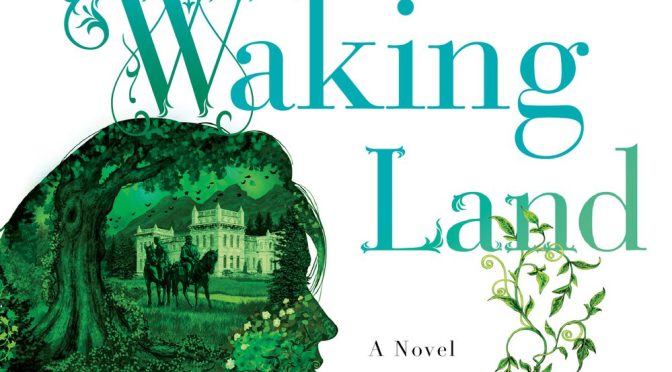
This book was slow enough in its first third or so that I nearly put it down in frustration, but when it gets good it gets very good. It’s got some issues with exposition and pacing that are likely just due to its being a first novel, but there’s quite a lot to enjoy about it nonetheless. For one thing, it’s got a drop dead gorgeous cover (designed by Kathleen Lynch and illustrated by Ben Perini), and inside you’ll find an intriguing magic system, a resourceful (if flawed) heroine, and an interesting take on fantasy politicking, and if The Waking Land isn’t a great read, it’s still a more or less promising debut that sets up Callie Bates as an author to watch.
Elanna Valtai has been raised like a daughter by the king who exiled her parents after a failed rebellion, but when the king is poisoned she finds herself on the run, forced to confront some unpleasant realities that she’s been kept ignorant of, and discovering parts of herself she didn’t know existed. It’s a solidly conventional fantasy set-up, part coming of age and part political intrigue, but Bates tweaks the narrative just enough to keep things somewhat fresh. Elanna’s attachment to her foster father and the way she identifies with her adopted country turn out to be an interesting exploration of something very like Stockholm syndrome, and there’s a lot of page time dedicated to Elanna’s feelings about her confused identity. It’s easy to follow Elanna’s growth from the sheltered girl who thought she’d come to terms with her childhood trauma to a girl learning that she didn’t even understand what had been done to her to a self-actualized woman who has resolved her inner conflicts and is ready to both forge her own path and work together with others to build a better future for their people.
One thing I love about Elanna is that, though she’s not, in general, unlikeable, she’s written with very little seeming concern about likeability. Instead, while not written in a naturalistic fashion—it’s hard to have true naturalism in this kind of fantasy—she is allowed to just exist and have feelings without any attempts within the text to justify or make excuses for her worst tendencies. When Elanna is selfish or cowardly or uncertain, the text is nonjudgmental and, for a book with first person narration, nicely free of self-loathing. Elanna’s internal conflicts are rarely about whether she feels capable of achieving what she wants; instead, she struggles both with knowing what she wants for herself and with trying to figure out the best way to live up to her inherited responsibilities. That said, in early chapters, Elanna’s self-absorption and ignorance can be tiresome. It makes for a compelling and coherent character arc when she finally starts to grow up a little, and Elanna proves herself time and again as a staunch friend, loving daughter and loyal ally, but there are a solid hundred pages where she borders on being insufferable.
On a more positive note, the setting and supporting characters are mostly strong. Bates has crafted a smartly imagined fantasy world with a sort of 17th century aesthetic and elements of French and what seems like Welsh (or some mix of Welsh, Scottish and Irish) culture. There’s gunpowder-based technology, extravagant palaces, salons with shade of the Enlightenment, and a democratic-revolution-minded rebellion in the works. The magic system is left somewhat ill-defined, but it’s also not overpowered, and none of the book’s major conflicts are resolved through solely mystical means. For a YA fantasy, naming conventions are reasonably good; “Elanna Valtai” is the fussiest name in the book, and the rest of the characters and places are named pronounceably and with consistency and good sense. There’s even some effort made at diversity, though it’s done in that weirdly subtle, vague way that seems calculated to be inoffensive to a presumed white audience.
The biggest problem weighing down the story, however, is a lot of very clunky exposition (including a wholly unnecessary prologue) all of which is only made more unwieldy by the choice to tell the story in first person present tense. While this seems to be the reigning popular point of view for YA fantasy, Bates struggles to make it work here, especially in lengthy expository sections about Elanna’s background, the backgrounds of other characters, the history of the land and the political situation. Sadly, the earliest parts of this novel really are enough of a slog to deter many discerning readers; at 400 pages, The Waking Land feels much longer than it is, and there are faster and more evenly paced options for those without the patience to stick this one out until it gets better.
This review is based on a copy of the title received from the publisher through NetGalley.
Welp. It’s been a long week, with a lot to worry about, both personally and generally, and that’s had an impact on my productivity. I only got out one Gormenghast post, but it’s a good one, and I’ve been working on some housekeeping stuff to prepare for my next seasonal reading list, though I haven’t posted it yet. Expect it this coming week, though, as well as a wrap-up post about my Spring Reading List. There’s so much great stuff coming out over the next few months, and I’m super excited to get into it.
That said, some great stuff came out this week as well. Beth Ditto has a solo album, and it’s good. The Strange Case of the Alchemist’s Daughter by Theodora Goss was released on Tuesday, and I’m trying very hard to rush through the next several books on my TBR so I can get to it. GLOW hit Netflix on Friday, and I tried to watch the first episode today–which quickly turned into watching the first FOUR episodes before I could tear myself away to finish writing this post. Everything in the world might feel like it’s being destroyed these days, but at least there are plenty of incredible things to read and watch and listen to while civilization burns.
The Book Smugglers kicked off a new feature, Cooking the Books, in partnership with Aliette de Bodard and Fran Wilde’s podcast of the same name. This month they talk with Malka Older.
Sarah Gailey’s “On Feasting” at the B&N Sci-Fi and Fantasy Blog is a must-read, especially if you like food and fantasy.
Nagata also popped in to Terrible Minds to write about five things she learned writing The Last Good Man. I hadn’t planned on reading this book, not being much into military sci-fi, but it’s quickly crawled up my TBR this week, and it’s on my list of titles I’d like to finish by the end of June.
Finally, there’s a new trailer for season 7 of Game of Thrones, and I hate myself for getting so excited for this trash. HBO’s posters and other promo material for this show are lazy and boring, but they do know how to put together an exciting trailer.
[Once again, I find myself having to revise my planned reading because I came to the end of a chapter that felt like such a natural finishing point for the section that I didn’t want to move on without writing about it. This section, instead of covering Chapters 17 through 23 as I originally intended to, will only cover material through Chapter 21.]
“It seemed to him that all his life he’d been climbing.”
I think I mentioned it already, but I’m giving up on this book ever developing any particular plot. After finally having some forward progress, at least temporally, Chapter 17, “Means of Escape,” resets the clock again, taking us fourteen days back to find out how Steerpike escaped from the room in which Mr. Flay had imprisoned him. Steerpike and his whereabouts are, along with Flay’s rivalry with Swelter, Mr. Flay’s primary anxieties, though both of these can be summed up together as an overall anxiety regarding anything Flay considers to be a rebellion against the established order of things in Gormenghast. Flay fears Swelter’s desire for personal revenge, but he seems to worry more over the missing Steerpike, who is, to Flay’s mind, a force of chaos, a dangerous entropy that must be found and controlled before something bad happens. At the same time, Flay’s fears about Steerpike are so amorphous as to be absurd; Flay isn’t an imaginative man, and he struggles to articulate (or perhaps Mervyn Peake struggled to articulate from Flay’s point of view) exactly what he finds so unsettling about the stray kitchen boy.
Most of this section, however, is about Steerpike himself, starting with some deft characterization immediately after Flay has left the prison room: “Most people would have tried the handle of the door. The instinct, however irrational, would have been too strong—the first impulse of one who wishes to escape. Steerpike looked at the knob of the door for a moment. He had heard the key turn. He did not disobey the simple logic of his mind. He turned from the only door in the room and, leaning out of the window, glanced at the drop below.” It’s the most complete idea of Steerpike so far, and it’s a smart illustration of the type of boy he is: logical, creative and quick-thinking, but also circumspect enough to be thinking about the costs of failure. What follows, over the next several chapters, is a symbolic, obviously foreshadowing journey in turns dreamlike and nightmarish as Steerpike ascends the rooftops of Gormenghast and must find a way back into the castle.
Chapter 18, “A Field of Flagstones,” begins with Steerpike consciously choosing to not think about the risks that gave him pause as he first looked out the window and contemplated the drop, and we quickly find that he’s a character skilled at purposeful, next steps thinking. We’re also reminded of Steerpike’s youth; Peake writes about Steerpike’s “young smile” in a way that can’t help but feel pointed in contrast to how Peake has described everything and everyone else we’ve met so far in terms to exaggerate great age, especially the way that characters, in particular, are described as having aged prematurely. It’s possible that Steerpike is still just young enough to have not been subject to the early aging that affects, but it seems more likely that this is an intentional choice to highlight Steerpike’s outsider status within the world of Gormenghast, which is a running theme in these chapters.
Once atop the roof of the castle, Steerpike finds that everything is bigger than he expected, and things quickly take a frightening turn for him as it gets dark and he must find his way around through intuition and touch. The skies clear shortly before dawn, offering some greater visibility, which lets him pick a window to start working towards. It’s a somewhat arbitrary goal, but as we’re reminded in Chapter 21, “he had been searching for one thing and one thing only—a means of entering the castle.” This singlemindedness in pursuit of a modest goal works for Steerpike in these chapters, but we’re reminded over and over again about the precariousness of his position, the danger posed by the risks he takes, and of his own ignorance—he’s only a kitchen boy, after all, and Gormenghast is extremely large and very mysterious. Chapter 20, “Near and Far,” may liken Steerpike to a predator (picking up the bird motif again) and meditate on the question of whether a predator thinks in terms of a big picture or only focuses on its prey, but Steerpike is just orienting himself so far as he wanders around taking in the sights and sounds of Gormenghast over a full day, which must teach him something about the place.
Taken together, Chapters 17 through 21 encapsulate an ambitious trajectory writ small as Steerpike scrambles across the rooftops, and they end with him finally penetrating the castle, almost by accident, when he falls into Fuchsia’s secret attic. It remains to be seen if the map of Steerpike’s non-metaphorical trajectory will match this one.
Miscellany:
I think the unnamed poet in Chapter 20 is Sepulchrave. Certainly, the melancholy poem he recites sounds like him.
Cora and Clarice creeping around is oddness of exactly the sort that I’ve now come to expect from this book. It’s also interesting to note that they’re wearing their purple dresses already, even though the events in these chapters are nearly two weeks before the christening. That said, this is the sort of thing that could mean nothing except that Peake intended for the reader to understand the two distantly seen ladies as the twins, without intending any other, deeper importance.
There’s a pool with a white horse and foal swimming in it, and I’m not sure if these are literally white horses—as no one in Gormenghast has been described as a rider, and all the characters so far are various types of shut-ins—or if they only look like horses from Steerpike’s high vantage point. If it is a white horse, is it a symbol (white horses figure largely in various mythologies and horses are common symbols) or is it just a horse?
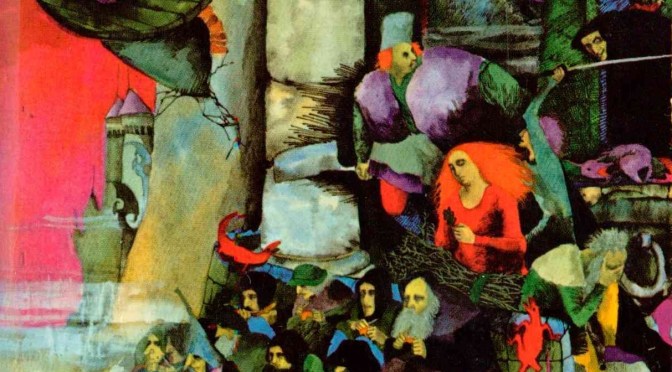
I’m now over 150 pages into Titus Groan, and it’s still difficult-to-impossible to identify which characters are protagonists and which are antagonists. Peake seems to be taking the humanist route of examining his characters as people rather than roles, and the shifting perspectives prevent any character from emerging as definitively pro- or antagonistic. Some of this is because there’s still not much of an actual plot going on, but some of this feeling is because of the deliberately humanist care with which Peake writes about his characters. They may be absurd, bizarrely so at times, but they’re never less than fully formed.
Peake uses specific numerical descriptions often in this section, and I’ll definitely be watching to see if this precision of language and thought is characteristic of just Steerpike’s point of view of if it’s more broadly characteristic of the author. I seem to remember it being a thing in earlier chapters as well, but nowhere near as prominently notable as it was in these chapters.
I have read a little bit about Gormenghast and the idea of place as a character, and these chapters do as much to bring Gormenghast to life as any of the ones before. Mr. Flay may act in an antagonistic way towards Steerpike, but it’s Gormenghast that presents the real challenge to the ambitious outsider. There are a couple of instances of straight up anthropomorphic language being used to describe the castle—most memorably the description of Gormenghast’s towers and buildings as “a stationary gathering of stone personalities”—and I’m looking forward to paying close attention to this sort of thing going forward.
It’s not a great time to be a tertiary/guest character on iZombie in the first half of the season three finale. The title reference for “Looking for Mr. Goodbrain, Part 1” is to a 1977 film about a young woman’s self-destruction via sex and drugs, and this episode sadly has some of that movie’s worst tendencies, specifically a penchant for inflicting unreasonable punishments upon its female characters. It’s not that this is a bad episode of iZombie: it’s a good set up for next week’s finale, they made a smart choice by skipping any Blaine/Don E. stuff this week, and it ends with a genuinely surprising and upsetting turn of events. It’s just that it’s also an episode with some unfortunate implications that suck a good deal of the fun out of the room if you think much about them.
**Spoilers ahead.**
Once again, the show eschews the case of the week format in favor of having Liv eat a brain that is more intimately involved with the overarching storyline of the season. This time, the brain du jour belongs to Ravi’s old boss from the CDC, Katty Kupps, and there’s much to be infuriated about regarding this development. It’s irritating that Katty is a character who seems to have been introduced for just this purpose; she doesn’t get much backstory of her own, she hasn’t been treated with much respect in her interactions with the show’s main cast, and she’s disposed of here so brutally and with so little ceremony it feels positively indecent. When we find out, two thirds of the way through the episode, that Katty had been picking up men nightly in the hotel bar and going to bed with them, it’s hard not to put that together with the title allusion and conclude that Katty’s murder was a culmination of her own self-destructive tendencies as much as anything else. In a show that is otherwise largely sex-positive and mostly non-judgmental, this might be easy to overlook if Katty was the only woman who seemed to be being narratively punished for her sex life this week, but she’s not.
Liv, under the influence of Katty’s brain (but also having her own ambivalent feelings about her fledgling relationship with Justin) spends much of the episode following Katty’s patterns, though she does stop short of having sex with any the human men she picks up. It’s only late in the episode that Liv is tempted enough to go through with the infidelity she’s been flirting with this whole time. After finally clarifying her relationship status with Justin (they’re officially exclusive), Liv still finds herself drawn to the hotel bar, and this time she runs into Chase Graves. This hook-up has been teased most of the season, and as handsome and sweet as Justin is, Liv has definitely had a bit more straight-up chemistry with Chase (who… oh, my god, is that body for real?). Considering Liv’s poor track record with men so far, it was even easy to root for Liv and Chase, if only to protect Justin from her, but not like this. While picking up men in a hotel bar isn’t exactly Liv at her best, she and Chase have a seemingly genuine connection before going up to his room to bang on his desk, and it’s kind of heartbreaking for Liv to end the episode with a strong and well-founded suspicion that Chase might be involved in Katty’s murder, especially when it’s framed in a way that almost suggests that Liv is stupid and should have known better.
The woman who comes out the worst this week, however, and by a long shot, is Major’s friend Natalie, who took the cure he gave her and has since moved to Italy. She’s back in Seattle for a few days, however, to wrap up her affairs there and move her stuff into storage before returning to her new home, and she takes the time to visit Major and thank him for everything he’s done for her. Major is recently unemployed, having been fired from Fillmore Graves when Chase found out he was human, and he offers to help Natalie move things. After a long day of lugging boxes around, they get back to Major’s place, things get romantic, and next thing you know Natalie’s asking him to come to Italy with her and Major is saying yes. He just has to go to his Fillmore Graves going away party first, and he takes Natalie with him—and she’s promptly killed in the blast when Harley Johns shows up and suicide bombs the place. Natalie has always been something of a plot device for Major’s storyline rather than a character in her own right, but this is a pretty obvious case of fridging that is both wholly unnecessary and wildly frustrating, as it’s not at all clear based on the show’s previous treatment of Natalie whether or not Major will be deeply affected by her death. Either way, it was always bad enough that the show played the Hooker with a Heart of Gold trope so blandly straight with Natalie, and is disappointing that they so casually have killed her off right as she was about to get a happy ending. That it directly followed her having sex, in an episode where she isn’t the only woman to have bad things happen to her after having some sex, only solidifies the connection: sex leads to bad things happening to you.
While Major is caught up with his romance with Natalie and Liv is in the midst of some kind of existential crisis, it’s Clive and Peyton who make the most of somewhat minimal screen time. New Mayor Baracus asks Peyton to be his chief of staff, which would be a significant promotion and great opportunity for an ambitious woman under thirty, but she’s still suspicious that he’s involved in the Weckler murder. Though Peyton can’t completely clear Baracus of the crime, she does test him by bringing up the case, only to find that he doesn’t show any obvious signs of guilt. Liv advises Peyton to take the job, and it seems likely that she will. Meanwhile, Clive is doing most of the heavy lifting in the actual investigation of Katty Kupps’ murder, and it leads him right back to the house where Weckler’s daughter is staying, which we find out is also the home of Carey Gold from Fillmore Graves. Between this connection and Liv finding the napkin in Chase’s room with Katty’s name and room number on it, it’s starting to look like Fillmore Graves may be up to their collective ears in whatever is going on this season.
Miscellany:
Ravi breaks the news to Liv about the front-page zombie story that he’s the source of, but Liv doesn’t seem to actually care that much about the source of the story and it’s somewhat glossed over in general.
I don’t really understand the bioterrorism red herring. I mean, it’s a red herring, obviously, and by the end of the episode it seems much more likely that Katty was investigating the zombie outbreak after all, but the bioterrorism angle never gets explored enough for it to properly do its job as a red herring.
I hated the trailer scenes of Liv having visions of Katty having sex with Ravi, but they weren’t terrible in context.
“Wake up sheeple!” surprised a cackle out of me.
Ravi and Liv interrogating the racist lady and then segueing to the adorable Sikh dad was perfectly done and extremely funny.
Harley Johns’ suicide bombing was genuinely unexpected, but it also makes so much sense for a character who has lost everyone he loved and has been turned against his will into something he hates.
I always miss Blaine when he’s gone, but it was a smart choice to skip him this week.
 The Guns Above is a whip-smart, fast-paced, and surprisingly funny military fantasy. I didn’t think that I was interested in reading stories about a woman having to overcome systematic sexism anymore, and I was double not interested in reading anything like a redemption arc for that woman’s sexist antagonist, but Bennis manages to breathe some new life into both of those stories. I’m very glad that I was interested enough in airships to read this book despite my misgivings, as it turned out to be a wonderfully readable, remarkably fun and ultimately optimistic (but not cloyingly so) take on its subject matter.

 Magazines
 Best Fantasy Novel – The Refrigerator Monologues by Catherynne M. Valente
 Best Science Fiction Novel – Raven Stratagem by Yoon Ha Lee
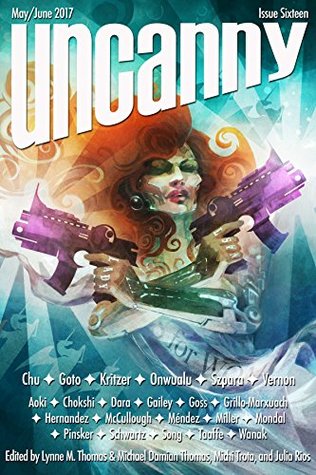 Best Magazine – Uncanny #16, May/June 2017
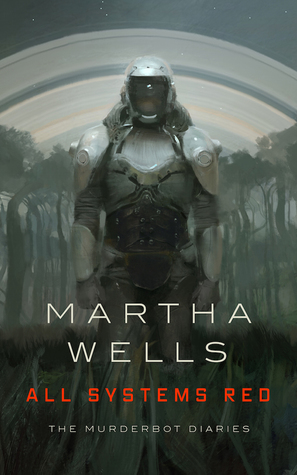 Best Novella – All Systems Red by Martha Wells
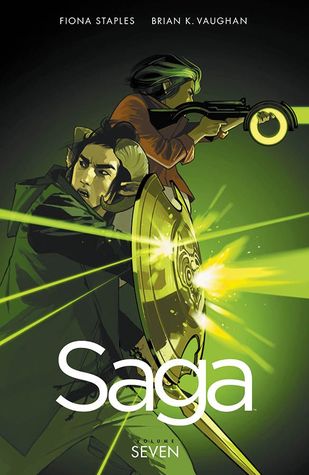 Best Comic Book – Saga, Volume 7 by Fiona Staples and Brian K. Vaughan
 Best Anthology – Cosmic Powers: The Saga Anthology of Far-Away Galaxies edited by John Joseph Adams
 Best Collection – So You Want to Be a Robot and Other Stories by A. Merc Rustad
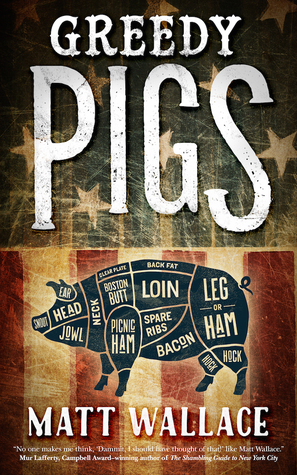 Best Sin du Jour Novella – Greedy Pigs by Matt Wallace
 Best Non-SFF Thing – Natasha, Pierre & the Great Comet of 1812 Original Broadway Cast Recording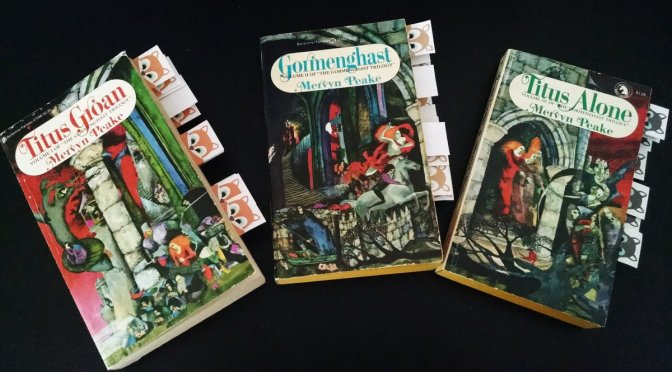

 This book was slow enough in its first third or so that I nearly put it down in frustration, but when it gets good it gets very good. It’s got some issues with exposition and pacing that are likely just due to its being a first novel, but there’s quite a lot to enjoy about it nonetheless. For one thing, it’s got a drop dead gorgeous cover (designed by Kathleen Lynch and illustrated by Ben Perini), and inside you’ll find an intriguing magic system, a resourceful (if flawed) heroine, and an interesting take on fantasy politicking, and if The Waking Land isn’t a great read, it’s still a more or less promising debut that sets up Callie Bates as an author to watch.

 SF Bluestocking