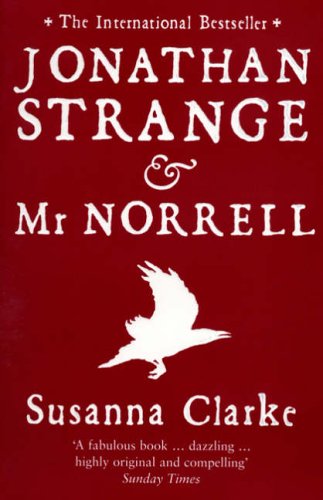
In Chapter 22, we finally meet Jonathan Strange for real. It’s a great ending to Volume One of the book, and by the end of the chapter we’ve met all of the most important characters and all the pieces are moved into place for the rest of the story. 260 pages is a very long first part, and I have a feeling that some readers may dislike the lack of action so far, but this is definitely where it starts to get really, really good.
Jonathan Strange
Jonathan Strange
After his father’s death, Jonathan Strange proves himself to be quite a different sort of man than Laurence Strange. However, while free of his father’s vices, Jonathan isn’t particularly virtuous, either. Rather, he’s only a decent sort of man, well-liked by fashionable people, but without any strikingly good traits. Red-haired and long-nosed, Jonathan isn’t even particularly handsome, although he is tall and fit. The author describes him as having a face with “an ironic expression,” which I love, as it’s a description that is very indicative of Jonathan Strange’s personality.
Arabella Woodhope
Arabella is the woman that Jonathan wants to marry, having only been prevented from doing so thus far by his father’s disapproval of Arabella’s relative poverty. With his father out of the way, Jonathan hopes to soon wed. The problem now, of course, is that Arabella disapproves of Jonathan’s idle lifestyle, and although he has spent the last year fully intending to pick up one profession or another, he hasn’t quite gotten to the point just yet. Even so, with his father’s death, Jonathan intends to propose immediately (reasoning that Arabella “would never be more full of anxious tenderness than she was at this moment and he would never be richer”) so he rides to meet Arabella at the home of some of her friends in Gloucestershire.
The Man Under the Hedge
On his way to propose, Jonathan comes to an empty town. When he finds the townspeople, they are all in a furor over a passing vagabond who has been bothering the village for several days and whom they plan to send on his way. When the man extracts himself from the thorn bushes he’s been sleeping under, he introduces himself as Vinculus.
Vinculus immediately recognizes Jonathan Strange as the second magician of his prophecy, which he recites again now. Jonathan is unimpressed by such dreary pronouncements, and is ready to ride off when Vinculus stops him. Vinculus pulls out the spells that Norrell had written down for Childermass to use against the street magician, and offers to sell them to Jonathan, who pays for them, if only to stop Vinculus from talking to him any longer.
Jonathan Strange, Arabella Woodhope, and Mrs. Redmond
The Spirit of a Banker
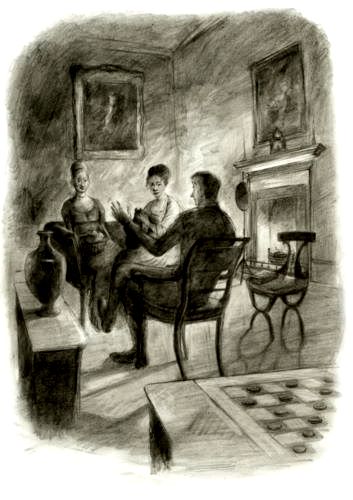
When Jonathan Strange finally arrives at the home of Arabella’s friends, the Redmonds, he isn’t prepared to answer Mrs. Redmond’s questions about what he intends to do now that his father is gone. Finally, he declares his intention to study magic and produces the spells that he bought from Vinculus. Only one of the spells seems practical to do, “A Spell to Discover What My Enemy is Doing Presently,” but Jonathan manages easily to perform it. They are all disappointed, however, to see only a man fitting Mr. Norrell’s description and just sitting in his library working at a desk.
“If I am a magician, I am a very indifferent one. Other adepts summon up fairy-spirits and long-dead kings. I appear to have conjured the spirit of a banker!” says Jonathan Strange, laughing, at the close of the chapter.
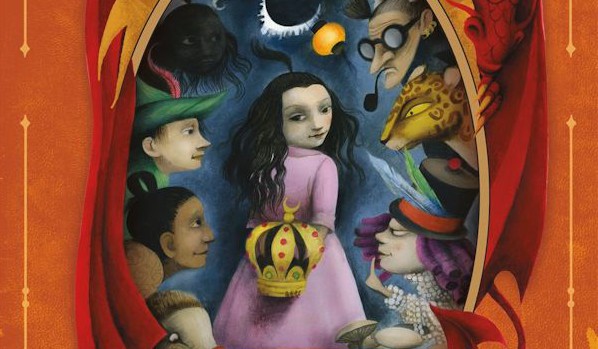
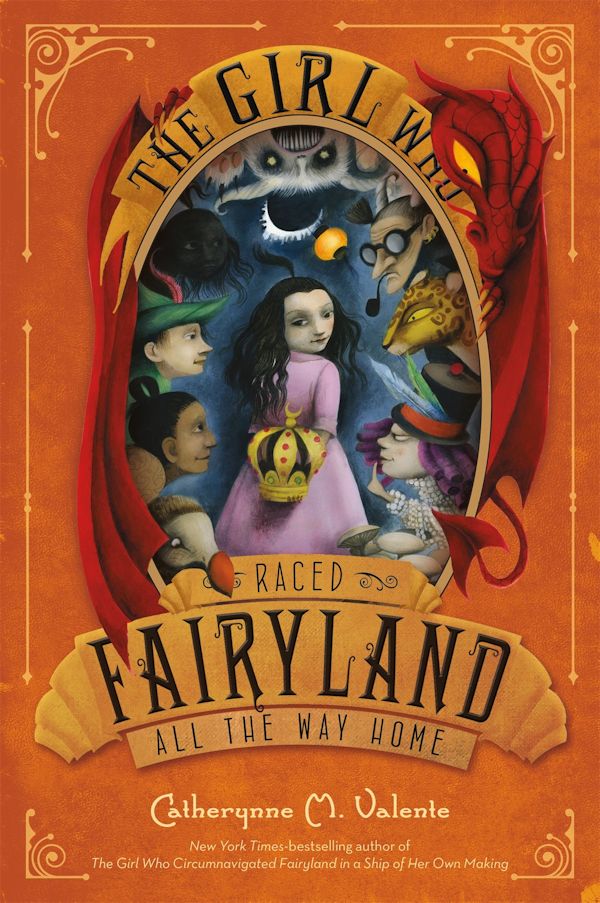
It’s no secret that I adore Catherynne M. Valente’s Fairyland series, and I am beyond thrilled (and also a little devastated) about the release of this final volume in March 2016. I love the color of this one, and I can’t wait to have the whole series lined up on a shelf looking gorgeous.
Quite by accident, September has been crowned as Queen of Fairyland – but she inherits a Kingdom in chaos. The magic of a Dodo’s egg has brought every King, Queen, or Marquess of Fairyland back to life, each with a fair and good claim on the throne, each with their own schemes and plots and horrible, hilarious, hungry histories. In order to make sense of it all, and to save their friend from a job she doesn’t want, A-Through-L and Saturday devise a Royal Race, a Monarckical Marathon, in which every outlandish would-be ruler of Fairyland will chase the Stoat of Arms across the whole of the nation – and the first to seize the poor beast will seize the crown. Caught up in the madness are the changelings Hawthorn and Tamburlaine, the combat wombat Blunderbuss, the gramophone Scratch, the Green Wind, and September’s parents, who have crossed the universe to find their daughter…
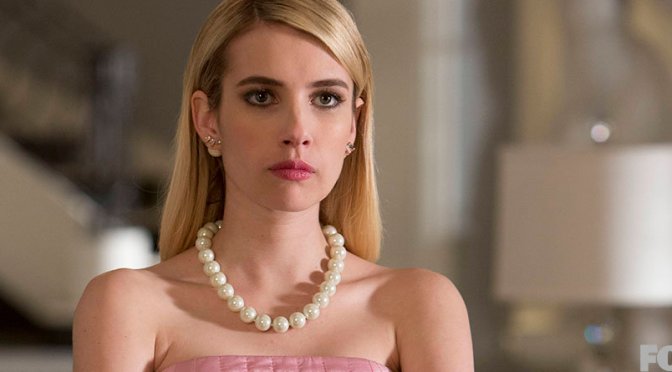
The scariest thing in the first full-length trailer for FOX’s Scream Queens is Emma Roberts, who looks delightfully monstrous as the leader of a sorority.
This section of the book contains perhaps my favorite encounter in the novel, one between Childermass and Vinculus. These are two of the most interesting characters in the book so far, and their meeting is everything I could ever want to read when two characters I love cross paths for the first time.
Setbacks and Disappointments
Chapters 20 and 21 see the end of Mr. Norrell’s honeymoon period as the only magician in England, and he quickly starts trying to secure his position in other ways. While the cabinet ministers are bemoaning the lack of other magicians, convinced as they are that if only they had more magic at their disposal they could win the war, Norrell is more concerned with eliminating all other magicians to preserve his own primacy.
The Street Magicians
Street magicians have already been mentioned many times in the book, and seldom in flattering terms. By and large, they are charlatans, essentially performance artists looking to make a quick penny off of whatever credulous marks they can find. Norrell, as one might expect, has a special loathing for these frauds, and he manages to mobilize the government to ban and expel them.
Vinculus’s Booth
Eventually, only one street magician is left in London, the famous Vinculus who we’ve already met. Although threatened with arrest and fines and time in the stocks, Vinculus refuses to go, and his popularity with the people of London is such as to make physically removing him a dodgy prospect. The authorities are concerned it could set off a riot.
Finally, when it seems clear that Vinculus will not be rousted by other means, Norrell sends his own man, Childermass to deal with him. Childermass goes to Vinculus in the guise of a milliner, but Vinculus quickly sees through the ruse and the two repair to an ale-house to discuss things.
Vinculus and Childermass at the Pineapple
At the Pineapple
At a corner table, Childermass gets right into it, pointing out that with a real magician in London, there will be no more demand for Vinculus’s tricks, so why should Vinculus insist on sticking around? Vinculus in turn mocks Norrell as being no better, really, than himself:
“The magician of Hanover Square! All the great men in London sit telling one another that they never saw a man so honest. But I know magicians and I know magic, and I say this: all magicians lie and this one more than most.”
Childermass can’t or won’t deny this charge, and Vinculus goes on to start reciting again the prophecy that he pronounced to Mr. Norrell. When Childermass asks, Vinculus says the prophecy is from a book–one which Vinculus has possession of and that Norrell can never have. If you’re reading along, pay close attention to the words Vinculus uses when he talks about the book.
The Cards of Marseilles
After drinking in silence for some time after Vinculus’s statement about the book, Childermass offers to read Vinculus’s fortune. He lays out the cards with Vinculus’s consent, and begins flipping them over. Interestingly, it turns out that Vinculus is already planning to go wandering, and Childermass laughs when he realizes that his efforts to convince the other man to leave were unnecessary. Vinculus then runs the cards for Childermass’s own fortune, and Childermass confirms its’ accuracy, although Vinculus doesn’t have the education to actually read them himself. As Childermass says:
“You are a strange creature–the very reverse of all the magicians of the last centuries. The were full of learning but had no talent. You have talent but no knowledge.”
The Emperors
Vinculus then states his intention to tell Norrell’s fortune as well. While Childermass doesn’t see the point, he doesn’t stop Vinculus from laying out the cards. As the begin to turn the cards over, however, every single one of them is L’Emperor, only this emperor looks much more like the Raven King–Norrell’s past, present, and future. Even without knowing much about Tarot, this should stand out to the reader, but a quick glance through the list of meanings this card can hold will give one a much greater appreciation for the author’s sense of drama in this scene.
Five Wives
A disturbed Childermass returns home and tells Norrell about his meeting with Vinculus. After upbraiding Childermass for his use of cards, Norrell quickly fixates on the book Vinculus claimed to own–namely, on obtaining it for himself as there is very little that upsets Norrell more than knowing a book exists and not being able to read it. To that end, Childermass investigates Vinculus, hoping to find where the book is hidden. He only manages to find that Vinculus has five wives, none of whom know anything about any book. Even Mr. Norrell’s magic cannot uncover the thing, and Chapter 21 ends with Childermass reading his cards again, hoping to find the book himself, but finally concluding that it must be in some unknown language.
After the lovely introduction to fairy land we got in the last couple of chapters, with all of Susanna Clarke’s gorgeous descriptive language, this pair of chapters follow with a gut punch. Apparently, dancing all night with fairies is not very conducive to one’s health and happiness.
Lady Pole’s Illness
Just a few weeks after Lady Pole’s scintillating societal debut, we find her sunk into a exhausted, depressed, and irritable, unable to endure music, positively abhorrent of dancing, and not desirous of any company whatsoever. Poor Sir Walter is highly alarmed by the change in his bright young wife, and he quickly calls a doctor to see to her. Of course, there is nothing physically wrong with the lady, and the doctor suggests that perhaps there is some marital disagreement that needs to be resolved. There is no disagreement that Sir Walter knows of, so he turns to his fellow cabinet Ministers for help. At their suggestion, Sir Walter calls Mr. Norrell to find out what is the matter with Lady Pole.
Norrell’s Diagnosis
When Mr. Norrell is told of Lady Pole’s symptoms and the strange happenings at the house, he knows exactly what is going on. However, he doesn’t tell Sir Walter this. Instead, Norrell simply tells Sir Walter that he cannot help and returns to his own home where he confronts the gentleman with the thistle-down hair. The gentleman, for his part, denies that he broke any faith with Norrell, which is technically true. Norrell is left wringing his hands, and Lady Pole is left to sink further into darkness and cold, to be quickly forgotten by society.
Stephen Black’s Symptoms
Meanwhile, Stephen Black is suffering from the same symptoms as Lady Pole, although Stephen’s malady goes unnoticed. The butler, you see, doesn’t have the luxury of sitting around doing nothing all day, but must continue with his work. Like Mr. Norrell, Stephen is also visited by the fairy gentleman, who ignores Stephen’s concerns and pleas and instead explains that he intends to make Stephen a king. The chapter ends with the fairy speculating on which fairy kingdom might be best suited to his new friend.
Parallels
These two chapters are, I think, a masterful example of Susanna Clarke’s running fascination with the exploration of various dualities throughout Jonathan Strange & Mr. Norrell. I love the symmetry here, and while some of Clarke’s parallels may seem obvious or heavy-handed I think this style works remarkably well in this book. The juxtaposition of Lady Pole’s and Stephen’s illnesses and the contrast between Stephen’s and Mr. Norrell’s encounters with the fairy would, in my opinion, be much less fun to read if they were written in a more obfuscatory way. I love symbols and allusions and foreshadowing as much as the next person, but I don’t want to think too hard about it, and Clarke does a wonderful job of gradually revealing her intentions without beating the reader over the head with them.
via io9, a first look at the Warcraft movie’s Orgrim Doomhammer. I’m more interested in seeing which female characters are going to be included in the film, but Orgrim looks pretty rad.
Well, I can’t say I’m surprised about last night’s episode of Game of Thrones, but I’m actually a lot more disappointed about the whole thing than I thought I would be. Generally, this show has, even in its worst episodes, a few great moments peppered through it. “Unbowed, Unbent, Unbroken” is, as far as I can recollect, the first episode of the show that I’ve come away from thinking that it’s just a big old mess. Basically nothing about this episode worked, and even the return of Lady Olenna wasn’t enough to save the episode for me.
As always, spoilers under this line.
Arya’s still working at the House of Black and White.
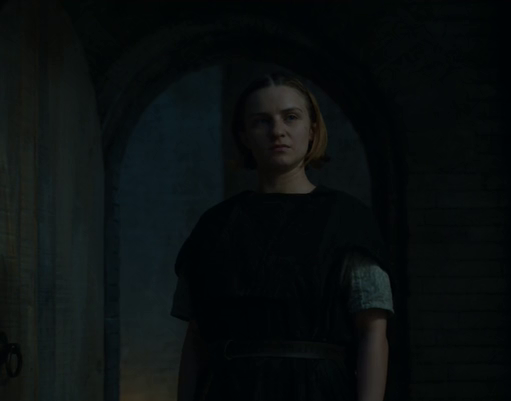
The episode opens in maybe the most boring place possible, the House of Black and White in Braavos, where Arya is busy washing dead bodies. She’s been here for weeks now, apparently, and she still doesn’t know what they do with the bodies when she’s done with them. She talks with the Waif (who, on the show is not even remotely waifish–more sturdy, really) and then with Jaqen, who beats Arya with a switch when she lies, and she’s no closer to learning more about the House of Black and White than she was a couple of weeks ago.
Does anyone working for this show even know what a “waif” is?
I rather liked Arya’s chapters in the books, but the show has turned this stuff into a real snooze fest. Arya’s time in Braavos so far hasn’t been a time of healing for her; she hasn’t learned anything (really, she’s only exchanged one menial task for another so far); and whatever character growth she’s having seems to be coming at an absolutely glacial pace. This is the weakest opening to any episode this season, for sure.
Next up, we head farther east to visit with Jorah and Tyrion. It turns out that there are no villages near Valyria, so they’re just hoofing it to Meereen at this point. During a break in their travels, Tyrion explains why he’s in Essos to begin with and then ends up being the one to break the news to Jorah that his father, Lord Commander Mormont of the Night’s Watch, is dead. It was nice to see Jorah get a moment to be likeable. I think that this is another slow-moving part of the show right now, but I almost always think the show shines brightest in these quieter moments.
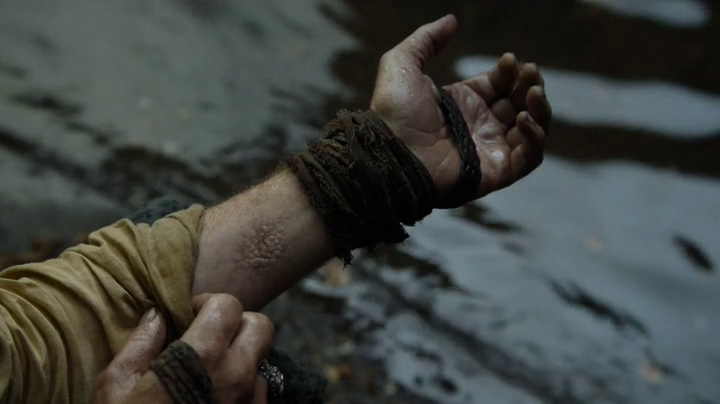
Jorah should probably get that looked at and stop picking at it.
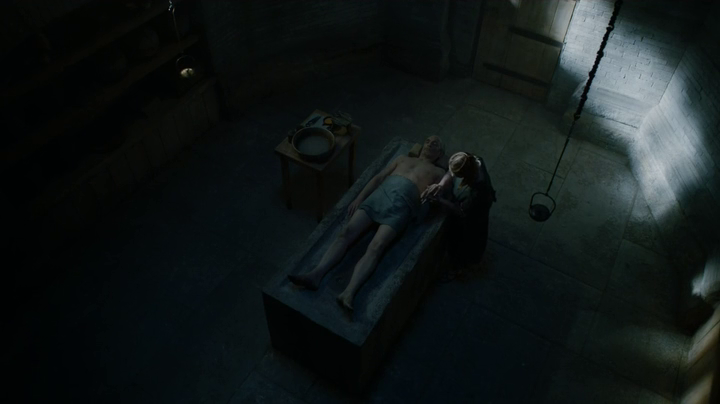
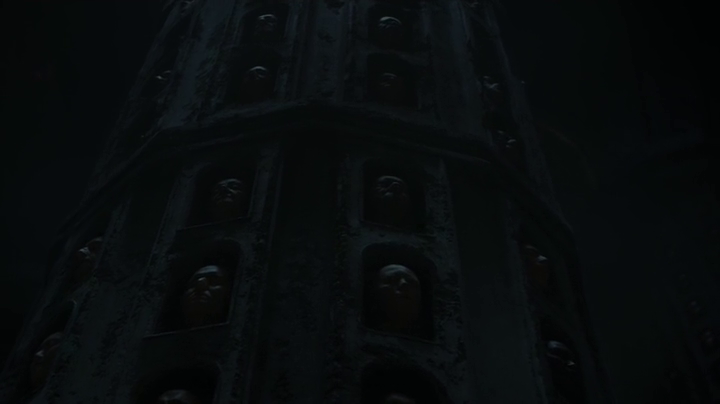
Back at the House of Black and White, Arya is scrubbing the floor when a man arrives with his sick daughter. He wants for his daughter to be put out of her misery, and Arya is the only person around. Arya comforts the girl by lying to her and gets her to drink some of the poison water in the temple. This time, after Arya finishes washing the girl’s body, Jaqen H’ghar invites her to see where the bodies go. Which is apparently a giant room full of pillars that are filled, floor to ceiling with the faces of the dead.
I actually hate this. I’m sure that someone thought this would be a cool reveal and that (obviously) bigger is better, but it doesn’t even make sense. I kind of hate the whole House of Black and White setup they have on the show as it is; it’s to monochromatic, too gloomy, too boring. And this enormous basement full of faces is probably the worst part of it that I’ve seen yet. The place looks like it’s about on the same scale as Moria in the Lord of the Rings movies, which is to say absurdly large. And there’s not a ladder in sight.
I suppose this sounds cooler on paper than it actually is.
It’s honestly nonsensical, but not as nonsensical as Jaqen’s reasoning that Arya was “ready” for something–”to become someone else” apparently, as well as ready to see the face library. I don’t understand how Arya’s sullen pouting, moping, and raging around the House of Black and White prepare her for anything. There was a moment of gentleness when she was dealing with the dying girl, and again when she was washing the girl’s body, but if that was meant to represent some kind of momentous shift in Arya’s outlook, I think the show failed to effectively communicate it. Also, Arya seems really creepily fascinated by the faces. All together, Arya’s behavior in this episode makes her seem unbalanced, as if (contrary to the episode’s title) something in Arya has been a little broken by her experiences.
Shifting to Jorah and Tyrion again, we get a nice little conversation about Daenerys. Jorah describes seeing the birth of the dragons as a sort of religious experience, but Tyrion isn’t convinced that Daenerys really is the rightful ruler of Westeros. I like this, but then they get captured by slavers, and everything is terrible.
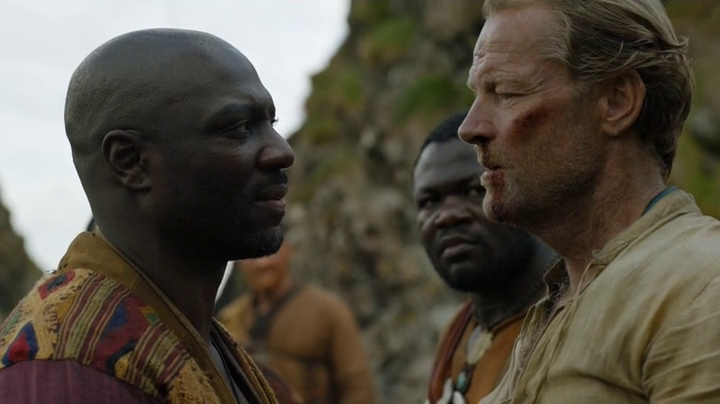
In all of Essos, I don’t think we’ve seen even one white slaver yet.
First, I’d like to point out that this show has a real problem with diversity. There are very few characters of color, but of course they make the evil slave traders a group of black dudes. Second, the dialogue in this scene is just fucking embarrassing. The dwarf-sized cock joke was the worst and “cock merchant”? Really? I cringed at the awfulness of it all. Of course, this is Game of Thrones, where plot convenience seems to trump all other concerns these days. At least this (hopefully) means that Tyrion and Jorah will be getting to Meereen soon instead of wandering around the countryside sniping at each other for a couple more episodes.
In King’s Landing, Petyr Baelish has returned to find the city much changed since his departure. When he meets with Cersei, he immediately questions the wisdom of having Loras Tyrell arrested, to which Cersei replies that it wasn’t she who arrested Loras. They go on to speak of the state of the North. Littlefinger assures Cersei that the armies of the Vale will be at her disposal, but then he informs her that Sansa Stark is alive and at Winterfell. Cersei is furious, and she gives Baelish leave to mobilize the Vale against Roose Bolton. It seems likely that this is exactly what Littlefinger wants. He’s already said that he intends to back Stannis in the upcoming conflict, and this will allow him to get his own forces to Winterfell without Cersei thinking anything is amiss. In an episode so filled with people making poor decisions and falling victim to terrible storytelling, this stands out as one scene that actually makes some kind of sense.
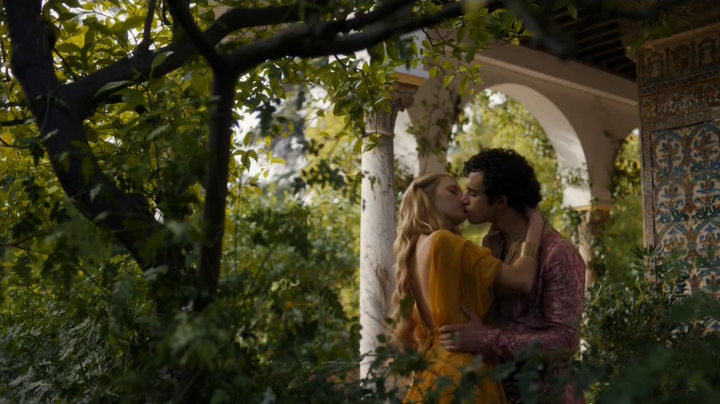
This is the steamiest these two get, but they just look like a couple of fumbling 8th graders.
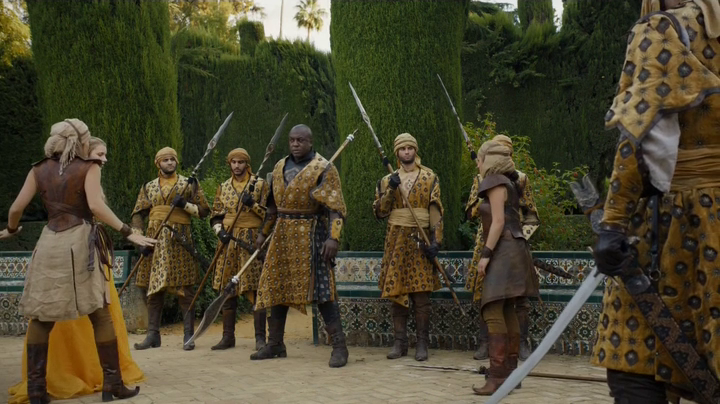
In Dorne, we finally get to see Myrcella, who is wandering the Water Gardens with her betrothed, Trystane Martell. They are anxious to be married, it seems, so they can start banging as soon as possible. Personally, though, I’m not buying it. I’ve hardly seen a couple with so little chemistry, and between Myrcella’s childishness and Trystane’s bizarre accent, it’s difficult to take them at all seriously.
Elsewhere, Jaime and Bronn are nearing their destination. I was disappointed by how unimpressive the Water Gardens look from afar, but what I was most upset about here was that we didn’t get to hear the end of “The Dornishman’s Wife.” Also, of course Jaime doesn’t have a real plan. Also also, this isn’t funny. It’s just infuriatingly stupid. Already in the palace, Ellaria and the Sand Snakes are ready to make their move as well, so these characters are on a collision course for one of the major conflicts of the episode.
This is the worst sort of plot convenience coincidence, and I hate it so much. I know that coincidence is an important part of any kind of storytelling, but this is just absurd. It’s especially intolerable in a show that is ostensibly an adaptation of a book series that has been heavily praised for its realism and its subversion of common tropes. While coincidences are often necessary to make stories happen at all, this one just feels cheap.
At least Areo Hotah looks like a badass.
Worse, it ends up being anti-climactic as the plans of both groups of conspirators are foiled and everyone is captured after a “fight” scene so heavily choreographed to have no one actually get injured that it feels more like a particularly silly kind of interpretive dance. This is also all spliced with split-second shots of Myrcella cowering and screaming helplessly, which doesn’t do anything to make the scene feel any more interesting. Also, a whip is a terrible weapon if you are fighting against people with swords, no matter how many times you can get it to make that whip cracking sound. AND, for all the Obara seems to be supposed to be “the tough one” of the Sand Snakes, she sure spends a lot of time whirling her spear around not actually hitting anyone. This whole showdown over Myrcella thing is a case of style over substance, and the style isn’t even good.
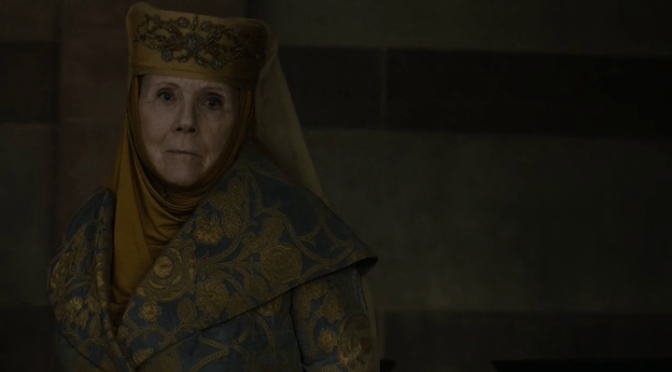
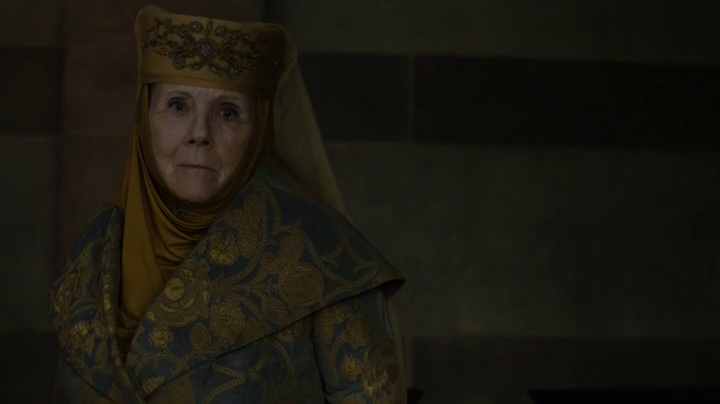
Back in King’s Landing, Lady Olenna is arrived. In another bit of straight up silliness, her carriage stops before they get to the city just so Olenna can complain that she “can smell the shit from five miles away.” At least this silliness is actually (and intentionally) funny, though. Olenna reassures Margaery that there really is nothing that can be done to Loras, and then she goes to see Cersei, who is entirely unhelpful. Cersei is determined to call what she seems to think is Olenna’s bluff, and Olenna is sent away unsatisfied.
I’m disappointed, too, Olenna.
At Loras’s inquest, he denies all the charges, which Margaery backs up. Then, surprise, Olyvar is brought in to testify, with some made up story that he was Loras’s squire and that was how he came to have “relations” with Loras. And, because this is Game of Thrones and the writers have no respect for the source material or the viewers, Loras doesn’t do the smart thing and deny all knowledge of Olyvar. Instead, Loras tries to attack Olyvar and ends up getting himself and his sister in trouble with the Faith. The scene ends with Loras and Margaery both arrested, Tommen looking around uselessly, Olenna looking shocked and disappointed, and Cersei looking smug. This whole “Loras on trial for being gay” thing might actually be the thing I hate most about this season of the show so far, but I am glad Olenna is back. Hopefully, she will be able to make some sense out of things over the next couple of weeks.
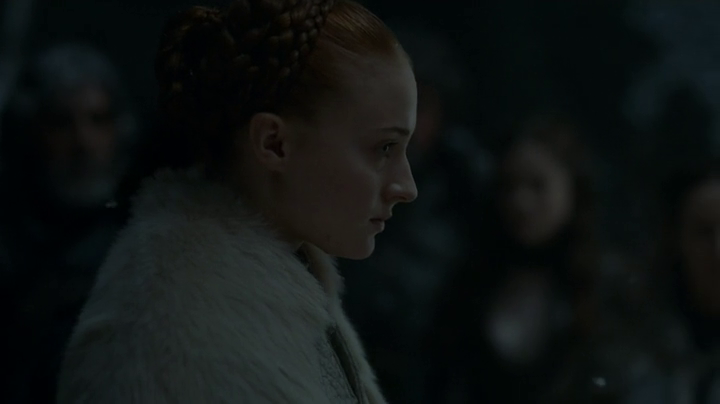
Finally, we shift to Winterfell, where Sansa is preparing for her wedding to Ramsay. Myranda pops in to help Sansa bathe, but really she’s there to spitefully tell Sansa about Ramsay’s penchant for hunting women like animals. The more I see of Myranda this season, the more furious I am that the writers felt the need to create an original character just to play out some bullshit female jealousy plot. There’s literally no reason for Myranda to be jealous of Sansa. She knows Ramsay, and she knows what is likely to happen to Sansa at Ramsay’s hands. It just doesn’t make sense that Myranda would care one way or the other about Sansa at this point, and it’s honestly really gross that she seems to take so much pleasure in Ramsay’s treatment of other women. I also hate that this bath scene is set up as a sort of “empowering” scene for Sansa. How empowering is it, really, for Sansa to profess her lack of fear in Winterfell when we, the viewers, know as well as Myranda does what is about to happen to Sansa in just a few minutes? If anything, this just makes Sansa seem naive in the face of such imminent danger.
The child bride.
Even the washing out of Sansa’s dark dyed hair seems to symbolize a regression in her character, an undoing of all the supposed growth we’ve seen in her over the last season or so of the show, and by the time she is dressed for the wedding, Sansa looks nearly as young and girlish as we’ve ever seen her. When Theon arrives to escort her to the godswood, Sansa makes one last show of spirit by refusing to even touch this man that she believes murdered her little brothers, but by the time of the actual wedding, she seems perpetually teary-eyed.
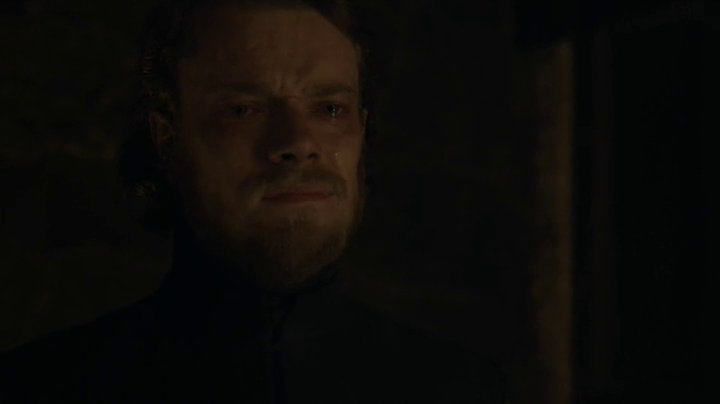
The final scene of the episode is, as I expected it would be, Sansa’s rape on her wedding night. After verbally humiliating Sansa, Ramsay orders her to take her clothes off while he tells Theon to stay in the room to watch. Fortunately, I suppose, we don’t have to watch–we just have to listen to Sansa crying out in pain as Ramsay brutalizes her while the camera slowly zooms in on Theon’s agonized face. Because, goodness knows, it’s important to remember who the real victim is here.
I thought I would feel this way about it, too, but all I can feel is rage, to be honest.
In some ways, this scene wasn’t as bad as I thought it would be. I rather expected that the show would choose this scene to really be faithful to the books, and I’m glad to have been wrong about that. However, they still managed to turn this wedding to Ramsay into a complete degradation of Sansa, with the rape coming right on the heels of an exhibition of her supposed “empowerment” so as to make if feel even more as if Sansa is being put in her place. Even worse, they framed this violation of Sansa in a way that makes it less about her experience and more about Theon’s pain at being forced to watch–even though this would have been a great opportunity for Theon to get his spine back and do something, anything, to try and protect Sansa. Instead, Theon just watches and weeps.
In light of everything that happens in this episode, I suppose the episode’s title might be meant as aspirational, but mostly it just feels sarcastic and mocking by the end of it.
In these chapters, we get an update on Lady Pole’s condition following her resurrection; we meet a new character, Stephen Black; and we get our first idea of the price that is to be paid for Mr. Norrell’s spell. These chapters stand out as a delightful fusion of comedy of manners, upstairs/downstairs drama, and a Gothic ghost story–only minus the ghosts and with fairies added.
How is Lady Pole?
It turns out that Lady Pole is remarkably well. In fact, she’s the talk of the town, and everyone is excited for her debut as one of fashionable society’s most prominent hostesses. This young person is as full of opinions as she is of vivacious energy, and her husband, Sir Walter, is thrilled to have secured such a wife. Chapter 15 opens with the planning of Lady Pole’s first dinner as the wife of a politician.
The Servants’ War
While Sir and Lady Pole are brushing shoulders with other people of high station in London and enjoying being newly wed, their connubial bliss doesn’t extend to the people employed in their household. Half their servants have been transplanted from Lady Pole’s country estate, the other half have been newly hired in town, and these two factions, divided by accent and education, necessarily come into conflict with each other. When the country servants come to Lady Pole to complain about the merciless pranks played upon them by the London servants, she is unsure how to address the situation and goes to her husband for help. Sir Walter advises her to leave matters in the hands of his butler, Stephen Black.
Stephen Black
Stephen Black has run Sir Walter’s house for some years, and is unusual for being a black man in such a position. His name, fittingly, means “crown,” and the other servants like to speculate that Stephen Black is no ordinary man at all, but a prince of Africa who is only moonlighting as a butler until he comes into his inheritance. The symbol of a crown is associated with Stephen Black throughout the book, and it begins with our first introduction to him. We learn that Stephen is handsome, capable, and evenhanded in his style of household management, but even he struggles to reconcile the downstairs factions of the Pole house.
The Important Evening
When Lady Pole’s dinner finally occurs, she shows herself to great advantage as both a charming hostess and a woman who is unafraid to speak her mind, especially on the topic of magic. Mr. Norrell is in attendance, and when Norrell is questioned about whether he plans to find and train more magicians, Lady Pole professes to be a strong proponent of the idea–to Mr. Norrell’s vexation.
The Haunted House
And so, Lady Pole’s first major event as a hostess is a great success, but no thanks to the footmen, who we find Stephen Black excoriating as Chapter 15 draws to a close. All three of the men report seeing or hearing strange things throughout the evening. The first saw a mysterious (albeit not to the reader) green coated and white-haired figure standing behind Lady Pole’s seat; the second reports hearing strange, sad music; and the third claims to have heard the branches of a forest rasping at the windows, even though there are no trees nearby.
In the next chapter, the seeming hauntings continue, and these unusual occurrences finally succeed where Stephen’s efforts have so far failed. The servants of the Pole house are united, or at least all so unsettled by the recent strangeness that they are too distracted to torment each other, although their fearful speculations about what horrid spirits might be haunting the place are tiresome to the butler.
Stephen Black meets the gentleman with the thistle-down hair.
Lost-Hope
A couple of weeks after Lady Pole’s dinner, Stephen is summoned to a room in the house that shouldn’t exist where he waits upon a man with voluminous silver-white hair that the reader should recognize right away. This gentleman flatters Stephen, insisting that Stephen must be destined to be a king, and then whisks him away to a ball where Stephen dances the night away with beautiful people wearing clothing of the most wonderful colors. Susanna Clarke’s descriptions continue to be fascinatingly evocative–I want a dress the color of storms, shadows and rain (and a wig of beetles–which I devoutly hope we get to see in the BBC adaptation, because it sounds marvelous).
Mrs. Brandy
In Chapter 17, we meet Mrs. Brandy, a friend of Stephen Black’s who owns the grocery that supplies Sir Walter’s house. She has recently come into the inexplicable possession of a large sum of money and has no idea from whence it may have come, so she sends for Stephen Black to advise her on what to do with it. He finds the money situation as strange as she does and advises her to hire a lawyer to try and find the money’s owner then goes on his way. Stephen Black, of course, is dealing with his own inexplicable problem–he’s exhausted and sore as if he’d danced all night, but he doesn’t remember attending any ball.
An Oak Tree in Piccadilly
As Stephen starts making his way home, he bumps into a stranger and has a moment of panic as the other man looks ready to accuse Stephen of stealing. Then, though, the man is replaced with a tree right before Stephen’s eyes. “Unusual,” Stephen thinks, but only momentarily as the rest of the town begins to transform as well until Stephen is walking not along a street but along a wooded path. At the end of the path, he finds himself at a glamorous party with new acquaintances welcoming him as he arrives.
Paramount is developing a new show based on Caitlin Doughty’s amazing memoir, Smoke Gets in Your Eyes: And Other Lessons from the Crematory. This isn’t particularly SF-related, but it’s an excellent book and would probably make my top ten list of favorite things I’ve read in the last couple of years.
Finally someone explains Adventure Time over at Kotaku. In all seriousness, though, if you aren’t watching this show, you should be. All of it is currently available on Hulu Plus, and each episode is only twelve minutes long.
Even if it wasn’t being on purpose feminist, one should never neglect an opportunity to stick it to misogynists–and apparently they are losing their collective minds over this film. If misogynists hate it, it can’t be all bad.
If none of this is convincing enough, Fury Road is currently sitting at 98% on Rotten Tomatoes.
 In Chapter 22, we finally meet Jonathan Strange for real. It’s a great ending to Volume One of the book, and by the end of the chapter we’ve met all of the most important characters and all the pieces are moved into place for the rest of the story. 260 pages is a very long first part, and I have a feeling that some readers may dislike the lack of action so far, but this is definitely where it starts to get really, really good.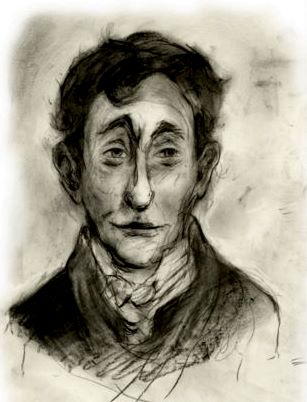





 SF Bluestocking