Jonathan Strange & Mr. Norrell Recap: “The Education of a Magician”

vlcsnap-2015-06-28-11h33m17s49I always watch an episode at least twice before writing about it, and I’m very glad I did in this case. “The Education of a Magician” is definitely a piece of work that improves upon better acquaintance. On first viewing, I was disappointed at some of the liberties taken from the source material, but the second time around I was impressed with how well the adaptation is bringing to life the spirit of the novel, if not every single detail that I want to see on screen.

This episode contains, essentially, three stories: Jonathan Strange’s experiences in the Peninsular War, Mr. Norrell and how he deals with his pupil’s absence, and the advancement of Arabella Strange and Lady Pole’s friendship. We also start to see the increasing entwinement of the fates of Stephen, Arabella, and Lady Pole as well as the beginning of a huge gulf forming between Strange and Norrell as both of them cross some lines that they probably ought not (even though, at the end of this episode they seem as close as ever).
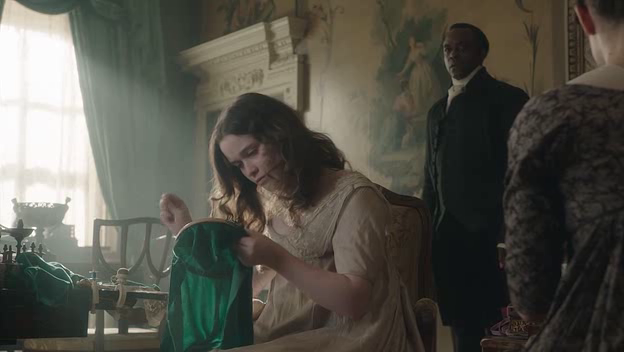
vlcsnap-2015-06-28-11h39m36s3
Lady Pole at work.

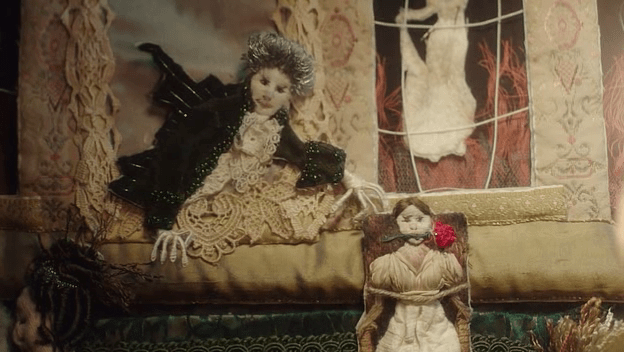
Interestingly, “The Education of a Magician” doesn’t open with Jonathan Strange, even though that might seem like the most exciting place to begin. Instead, the episode starts with Lady Pole waking up and having a new idea for how to tell Arabella about her predicament. She gets out of bed quickly and starts ripping up her dress to make a tapestry. Lady Pole’s tapestry is a somewhat interesting departure from the book, as it continues the show’s trend of expanding Lady Pole’s role and granting her somewhat more agency than she had in the novel. It’s nice to see, because I think Lady Pole is a tricky character who could easily have been flattened into a handful of unpleasant tropes or made into a simple damsel in distress. Instead, this adaptation actually improves upon the source material, giving us a Lady Pole who is clever and resourceful and never gives up trying to take back control of her life.

As Lady Pole is working out new ways of communicating, Childermass is, at Norrell’s instruction, intercepting letters to prevent Arabella from telling her husband anything that Norrell might disapprove of. Also sandwiched in here is a pretty much straight-from-the-book conversation between Arabella and Drawlight that I was happy to see included.

In Portugal, Jonathan Strange gets off to a rocky start with his military career, and Lord Wellington is downright dismissive of him. It seems to the two magicians have so far done more harm than good for the war effort, and Strange can’t provide what Wellington wants–men and arms–and is therefore useless. Strange is left quite at loose ends, with no magic to do and struggling to find a way to make himself useful in the war effort.
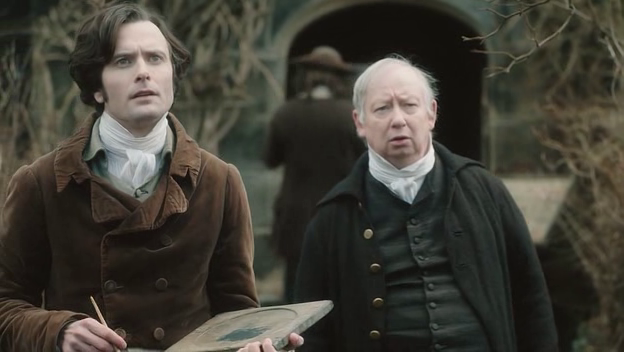
Honeyfoot and Segundus at Starecross.

Meanwhile, back in England, Childermass is also busy making sure that no one in England besides Norrell does anything resembling magic. He rides out to Starecross, which Segundus and Honeyfoot are turning into a school for magicians and advises them to stop this plan before Norrell finds out. In exchange for their going into another sort of business, Childermass offers to send clients their way when he gets the chance.

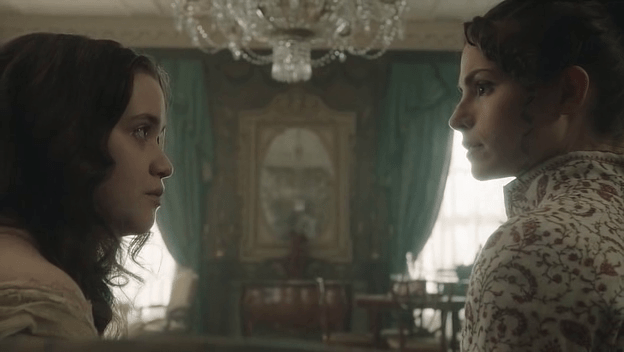
In London, Arabella continues her visits with Lady Pole, who is continuing to work on a tapestry illustrating Lost Hope. She shows the tapestry to Arabella, who doesn’t understand at all, which I found a little frustrating to watch, if I’m honest. For one thing, it’s not entirely clear quite how Lady Pole is not only able to make this tapestry but also to talk rather at length about it to Arabella. And in light of how much Lady Pole is able to say in this manner about her and Stephen’s enchantment, I’m honestly just not sure how Arabella manages to not see what her friend is getting at. I’m also not sure why Arabella doesn’t recognize the Gentleman in the tapestry, since he’s been creeping on her for a good while now.

For all that I’m not entirely happy with the way this is playing out, this visit with Lady Pole has one of my favorite speeches in the show so far. Arabella tries to cheer up her friend by basically advising Lady Pole to count her blessings, among them Sir Walter’s love, Lady Pole will have none of it and even turns it around on Arabella, asking what good Mr. Strange’s love ever did her.
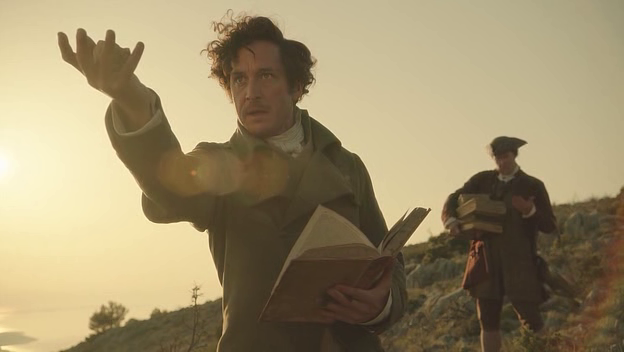
Jonathan Strange creates a road.

On the continent, Jonathan Strange finally figures out a way to contribute when a soldier complains to him about the poor roads destroying boots. Strange presents a plan to Lord Wellington whereby he will use magic to make roads the troops can march down more easily. This is quickly done and earns Strange Wellington’s gratitude and, against his protestations that it’s not respectable, the nickname “Merlin.”

For a nice bit of foreshadowing, Strange’s dinner with Wellington and the officers includes Jonathan Strange’s rather famous line from the book. When Wellington asks if a magician can kill a man by magic, Strange replies:

“A magician might, sir, but a gentleman never would.”

At which point every even mildly astute viewer groaned a little inside. Because, obviously, we’ll see about that. I think my issue here is that sometimes a great line in a book only ends up being really obvious when it’s delivered with such deliberate nonchalance in a screen adaptation. I suppose it beats having to see the line delivered with melodramatic significance, but I think perhaps they went a little too far in the opposite direction from that here.
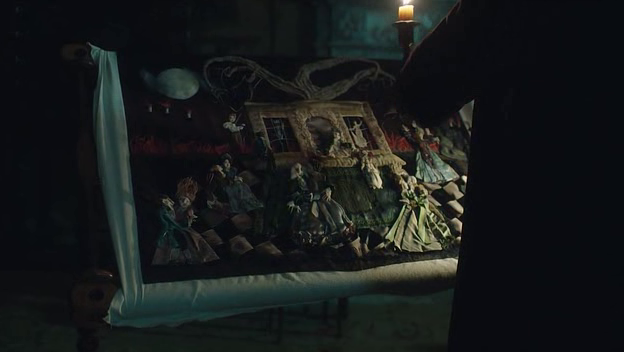
Lady Pole's tapestry.
Lady Pole’s tapestry.

In England again, Childermass is having some misgivings about stealing all the Stranges’ mail and says so to Norrell. Norrell is characteristically evasive, but manages to assure Childermass that it’s for the best. Norrell then sends Childermass on an errand, which turns out to be breaking into the Poles’ house and stealing Lady Pole’s tapestry, which he does.

Robbed of her tapestry–effectively having her voice stolen–a distraught Lady Pole attempts to kill herself, only to learn from Mr. Norrell that she cannot die. Not for another seventy-odd years, anyway. This scene is, frankly, absolutely chilling: Lady Pole in her nightdress, strapped to a small bed in an empty room, with Norrell standing over her. Norrell giving her the bad news and then physically trying to silence her anger, frustration and despair. And, finally, Norrell going to Sir Walter, lying about Lady Pole’s condition and then advising Sir Walter to separate Lady Pole from Arabella.

And this is all edited together with more of Strange’s escapades in the war, which on the one hand is perhaps a good thing–to break up these scenes so it’s not just one long sequence of Norrell’s terrible treatment of Lady Pole–but is made into something much less than comfortable when we see what Strange is up to, which isn’t much good. Indeed, Strange is being shaped into someone rather frightening himself.

First, Wellington wants Strange to move an entire forest, which brings up an interesting conversation about how that might be done. Unfortunately, Wellington isn’t interested in Strange’s musings about talking to trees, because I would have loved to hear more about it. When Strange goes to move the forest, he and the men he’s with find themselves under attack. Strange can’t get the forest to move, and while Strange does manage to save the lives of most of the men, Strange’s servant, Jeremy, is hit by cannon fire and dies. Also lost are all of the books that Strange has brought with him to work from.
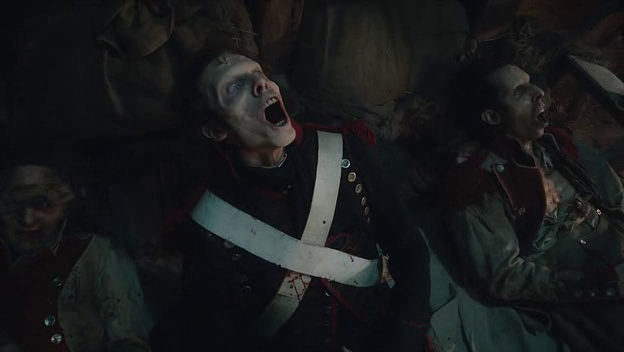
The dead Neapolitans.

This is a significant problem when it comes to Strange’s next task, which is to find out where some Neapolitan soldiers have taken a bunch of cannons they stole. Strange is without any books, the army has no live Neapolitans to question, and scrying in water just shows trees and grass that could be anywhere in the countryside. However, it turns out that they do have some Neapolitan corpses, which Strange brings to life and grants speech to, in an interesting counterpoint to Norrell’s silencing of Lady Pole.

Unfortunately, Strange is no more successful than Norrell with this sort of magic. While Norrell only managed to give Lady Pole half a life, leaving her quite absent from the real world, Strange’s Neapolitans are all to real and persistently alive-ish. And rotting. And begging to be allowed to return to their families.
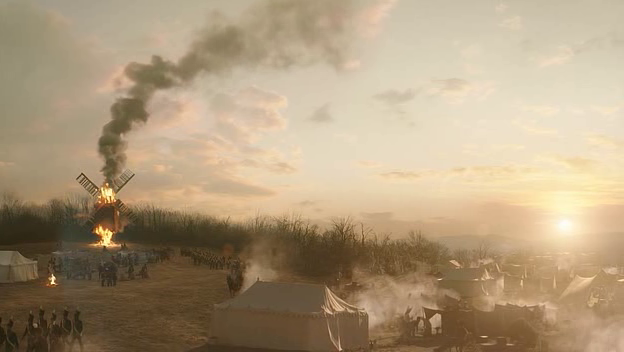
The burning mill.
The Neapolitans’ fate.

It’s very shortly obvious that Jonathan Strange has done something pretty messed up here and doesn’t have any idea how to undo it. In another parallel to Mr. Norrell, Strange is also lauded as a sort of hero for what is pretty much exactly the sort of magic that he doesn’t want to do at all. This is not modern magic. However, Strange seems consoled as he rides away into a beautiful new dawn while the unlucky undead Neapolitans are burned behind him.

It feels very telling to me how much alike Strange and Norrell seem when Strange finally returns to England. For all their differences in temperament, age, appearance, and experience, they seem very nearly equals now.
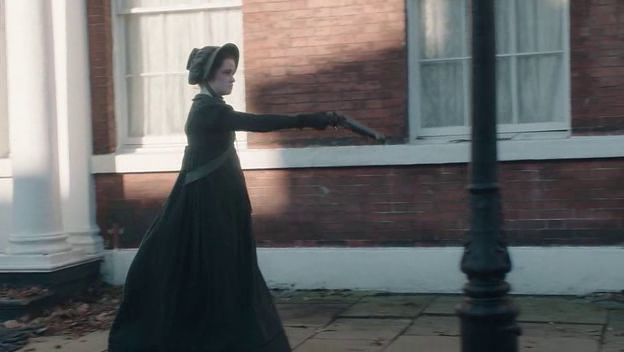
Lady Pole comes for Mr. Norrell.

The episode ends, of course, with Lady Pole’s attempt on Mr. Norrell’s life, in which she misses her mark but succeeds only in shooting Childermass instead.

It’s a great ending to a very busy episode that covered a lot of ground. I still think the show struggles with conveying the passage of time–it’s not at all clear that Jonathan Strange has been gone for some three years, for example–but the pacing of this episode felt just right and the interweaving of the various story lines  was masterfully done. So far, the mini-series is faithful to the book without being a slave to it, and the changes that have been made are mostly smart ones that I think enhance the material rather than otherwise.

The new trailer for Supergirl looks super fun

I am unabashedly excited about this show no matter what anybody says against it. I don’t think it’s going to be extremely good, and the entire Supergirl/Superman mythology is absurd, but it looks like exactly the sort of light, slightly silly entertainment I’ve been wanting recently. I wasn’t interested in Arrow or The Flash, and I couldn’t get into Agents of Shield (and therefore skipped Agent Carter), but Supergirl looks like it’s right up my alley.

Premiere is October 26.

Heroes Reborn promises a “new phenomenon” but with terrible music?

First, we got this “Where are the heroes?” teaser, in which apparently the whole world wants to know:

It manages to be both boring and confusing, for a couple of reasons. First, if you haven’t already watched Heroes (and stopped watching after the first season) you probably won’t really be on board with the whole “Where are the heroes?” thing. Second, they’ve got what sounds like a children’s choir covering Metallica’s “Nothing Else Matters” in the background, and I don’t think anyone has unironically liked Metallica since the mid-90s. Is NBC really serious with this?

It appears so, because just a couple days later we got a proper trailer, sort of:

Still with the Metallica (I mean, really? REALLY?), but this time with a bunch of quick shots of people doing stuff, a teenage boy saying something extremely cliché, and a look at Hiro Nakamura’s face that is just long and lingering enough that it makes me think that they’re using Masi Oka’s involvement to sell the show but that we might not actually see much of him when it airs.

Honestly, I’m just not sure exactly who they’re trying to sell this show to. I know the first season of Heroes was excellent, but I honestly don’t think I’ve ever heard anyone say that it needed a reboot. Or a sequel. Or whatever this is, since the trailers are pretty light on story details. I suppose it feels like they’re trying really hard to bring in older fans of the original show, but a long look at Hiro’s face and a cover of a twenty-five-year-old Metallica song just aren’t working for me.

Probably, I’ll watch this regardless, but so far I’m unimpressed.

Premiere date is September 24.

Weekend Links: June 27, 2015

Weekend links are a little late this week  because Patch 6.2 happened this week in World of Warcraft. After a bit of a slump in my interest in the game, I’m excited to report that Tanaan Jungle is fun, shipyards are pretty cool, and I have learned that druids in deer form ride on top of Goblin Gliders like badasses. Other things happened this week, too, though.

Amy Schumer dismantled the ideal of being a princess on Inside Amy Schumer:

Margaret Atwood is making comic strips for the geek girl anthology, The Secret Loves of Geek Girls. For a $25 contribution to the Kickstarter, you can get digital and physical copies of the book.

The New York Times has the scoop on Cuban Science Fiction, and Tor.com has a Cuban Sci-Fi giveaway.

The Mary Sue interviews Jane Espenson

Over at Kirkus Reviews, there’s a great interview with Ellen Datlow, Paula Guran, Rich Horton, and Jonathan Strahan for anyone who has ever wondered about the process of creating all the “Year’s Best” anthologies that we love.

Gail Z. Martin guest posts at SciFiChick.com about Mary Sues and how the concept has been used to deride female characters in general

Finally, composer James Horner, who was responsible for the music in basically every film you loved as a child, has died in a tragic plane crash.

RIP, James Horner.


Reading Queers Destroy Science Fiction is a great way to celebrate the SCOTUS marriage equality ruling

Last year, Lightspeed invited women to destroy SF; this year the LGBTQ+ community gets their turn. It’s glorious, and it kicked off this month with a massive special issue of Lightspeed.

lightspeed_61_june_2015At over 500 pages (according to my epub of it), Queers Destroy Science Fiction! is a weighty piece of work, and it’s clear that it’s been conceived and crafted with deep caring and exquisite attention to its purpose. Most importantly, a real (and successful!) effort was made to be inclusive of the entire QUILTBAG acronym, and the more than two dozen personal essays included in the issue are must-read content for this reason. If you’re not queer, they offer a great variety of different perspectives to learn from; if you are queer, there’s a multitude of stories to identify with. Either way, if you have a soul something here will speak to you.

The fiction included is well chosen, which is characteristic of the publication in general, and there is a good mix of work included. My favorites, in no particular order except the one I read them in:

  • “Trickier With Each Translation” by Bonnie Jo Stufflebeam – a bit of a time traveling super hero love story
  • “The Tip of the Tongue” by Felicia Davin – a story about reading and government control that has given me a new nightmare
  • “Plant Children” by Jessica Yang – a sensitively written romance about plants and family
  • “Nothing is Pixels Here” by K.M. Szpara – a story about hard choices
  • “Two by Two” by Tim Susman – a story about the end of the world and how we might face it and who we will face it with
  • “Melioration” by E. Saxey – about the power of words
  • “Helping Hand” by Claudine Griggs – an astronaut survival story
  • “Bucket LIst Found in the Locker of Maddie Price, Age 14, Written Two Weeks  Before the Great Uplifting of All Mankind” by Erica L. Satifka – exactly what the title says, but sad and beautiful (I love the conceit of telling a story through a found piece of ephemera.)
  • “A Brief History of Whaling with Remarks Upon Ancient Practices” by Gabby Reed – exactly what the title says, but also sad and beautiful
  • “In the Dawns Between Hours” by Sarah Pinsker – about why or why not and when to use a time machine if you can
  • “Letter From an Artist to a Thousand Future Versions of Her Wife” by JY Yang – another story that is exactly what the title says, but also sad and beautiful (If you can’t tell, sad and beautiful are two of my favorite attributes in short fiction, and I’m also a sucker for clinically descriptive titles.)
  • “CyberFruit Swamp” by Raven Kaldera – definitely the most graphically sexual story in the collection (and be sure to read the author spotlight on Raven Kaldera)
  • “The Sound of His Wings” by Rand B. Lee
  • and “O Happy Day!” by Geoff Ryman – Both of these stories deal with obvious Nazi metaphors and totalitarian futures, but with vastly different approaches and two very different ways of integrating queerness into the narrative.

In nonfiction, aside from the truly wonderful personal essays, there’s also a nice piece on Robert A. Heinlein’s influence and an excellent interview with David Gerrold. This, however, leads to my only real complaint about the issue, which is that the David Gerrold interview is extremely poorly formatted. I thought it might just be the epub version of the magazine,  but it appears that the online version of the interview is similarly difficult to read because with no quotation marks, italics, or block quoting it’s hard to tell what parts of it are David Gerrold’s statements and what parts are Mark Oshiro’s commentary.

At just $3.99, Queers Destroy Science Fiction! is a great value, and I highly recommend purchasing it. Queers Destroy Horror!, a special issue of Nightmare will be out in October, followed by a Queers Destroy Fantasy! issue of Fantasy Magazine in December. And in 2016, Lightspeed will be doing POC Destroy Science Fiction! with guest editor Nalo Hopkinson.

Killjoys seems like a worthy successor to Firefly in the fun space opera genre

I’m nuts for original space operas these days, with recent movies like Jupiter Ascending and recent books like The Long Way to a Small, Angry Planet to whet my appetite, so giving this show a chance was a no brainer for me. The deal was sealed when I saw it compared favorably to Firefly over at io9. Fortunately, I wasn’t disappointed when I sat down to watch the premiere episode, “Bangarang.”

The Quad is a dwarf planet and three moons.

I can see right off why this show will be heavily compared to Firefly. The Quad is a multiplanet system controlled by an oppressive centralized government (the Company). Nevertheless, there seems to be a little bit of wild west atmosphere going on, where outside of the Company’s direct oversight there are black markets and other illicit goings on. Probably the most notable similarity to Firefly however is the vision of a future cultural fusion between East and West.

The bad news about this is that it feels a little derivative, although for Firefly fans (myself included) it might also be pleasantly familiar. The good news, however, is that whoever is making the decisions on Killjoys has taken notes on the criticisms of Firefly over the years, and the world of Killjoys looks, so far at least, a lot more diverse than Firefly ever managed to be. To be fair, that isn’t saying much, and a glance through the entry for the show at IMDb still shows a pretty white cast, but it’s definitely a step up and in the right direction.

“Bangarang” is a fast-paced episode that didn’t feel very long considering the amount of worldbuilding going on. While there were a couple very obvious straight out infodumps to the audience, I think they handled them as well as is possible to do, and I’m happy to have that out of the way. The story of the episode is fairly simple; it gets our main trio of characters (Dutch, John, and D’Avin) together, and it sets up basically three mysteries that I expect to define the rest of the season:

  • Who is Dutch?
  • Why does someone want D’Avin dead?
  • What’s the deal with the Company?

Honestly, though, this is pretty standard stuff, and there’s not really anything groundbreaking here.

Such a pretty dress, though. And the necklace does something awesome, too.

It’s nice to see a woman of color (Hannah John-Kamen) taking the lead in a sci-fi show, and I think I am going to really like her character, but I found it off-putting to see a rape threat in the first two minutes of the show and she’s of course sharing the spotlight with a pair of square-jawed white dudes. Also, I kind of hate the “She Can Still Kick Ass in a Dress” trope, which was on full display in this episode, complete with an absolutely absurd camera focus on her sashaying into battle in a ridiculously sexy manner.

Just in general, I felt like the cast just didn’t quite gel properly in this episode, but I think this is largely because the episode was so heavily focused on worldbuilding and setting up the story. All in all, I enjoyed the premiere, and I’m looking forward to see how things go once they get a bit more into the meat of things.

Jonathan Strange & Mr. Norrell Recap: “How is Lady Pole?”

For all that the novel, Jonathan Strange & Mr. Norrell is often said to be a slow starter, I feel like the adaptation so far has remained pretty remarkably true to the source material while also moving through it at a pretty good clip. “How is Lady Pole?” covers an enormous amount of story, even more than last week’s episode, and things are getting exciting.

vlcsnap-2015-06-21-14h19m27s3
The rain ships.

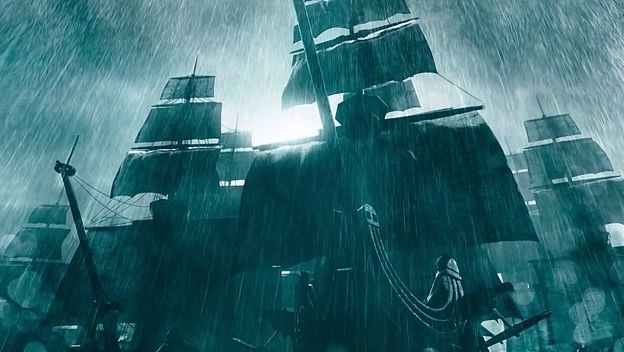
The episode opens with one of my favorite bits of magic from the book: Mr. Norrell’s ships made of rain. They’re gorgeous, but this scene, to me, isn’t quite right. The problem isn’t the ships, which are great. It’s that I don’t feel any passage of time. In the book, Norrell’s illusory ships are a blockade that keep the French fooled for eleven days. The way it’s presented here, it looks like just the work of an afternoon; the French see the ships, break out their spyglasses, then immediately row out to them and learn that they are just made of rain. I suppose this is still a waste of French time, but it’s not as impressive as the eleven days of the book, and it doesn’t seem to warrant the degree of congratulations Norrell receives from the ministers in London. It just all seems a bit much, and I think it wouldn’t have been that difficult to at least hint at some greater passage of time here.

vlcsnap-2015-06-21-14h38m27s135
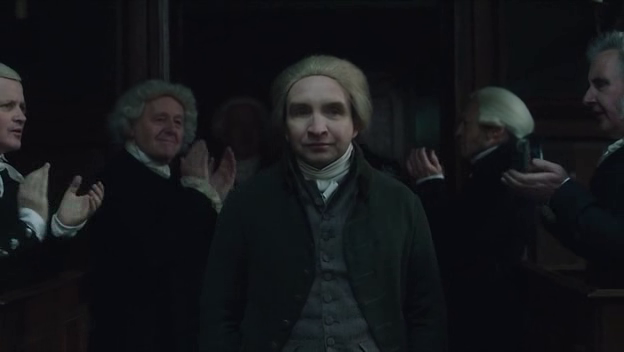
This is a Norrell’s wigs appreciation blog.

That said, I love the way the show has done Mr. Norrell’s scrying. It looks awesome. It’s nice to see this attention to detail when they could just as easily have sort of ignored the less flashy magic in favor of just focusing on bringing to life big stuff like the rain ships. Speaking of details, I also really appreciated Norrell’s wigs in this episode. He’s got a variety of them, and every one is either ratty-looking, ill-fitting, or both. Because, obviously he can’t be bothered. It’s a lovely little bit of visual characterization that makes me think that the people involved in the production are really committed to making something special.

Honeyfoot and Segundus at Starecross/the Shadow House.

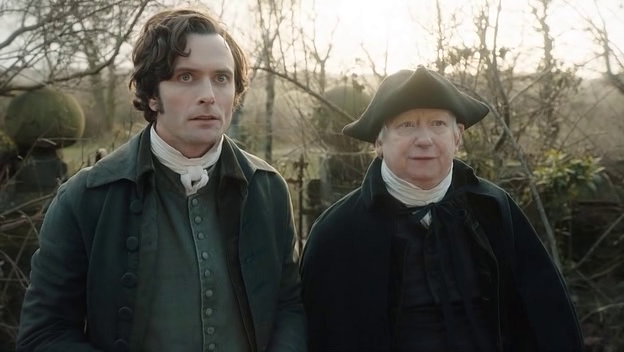
The show has combined the Shadow House and Starecross into one place, and they’ve moved up Segundus and Honeyfoot looking to open a magician’s school on the property. I’m not thrilled with this change, because I want to see as many great magicians’ houses as possible, but it makes a lot of sense with the way the show is generally just shuffling things around and streamlining events. And, really, it doesn’t matter which house it is; what matters is that Segundus and Honeyfoot are in the right place at the right time to meet Jonathan Strange so they can refer him to Mr. Norrell.

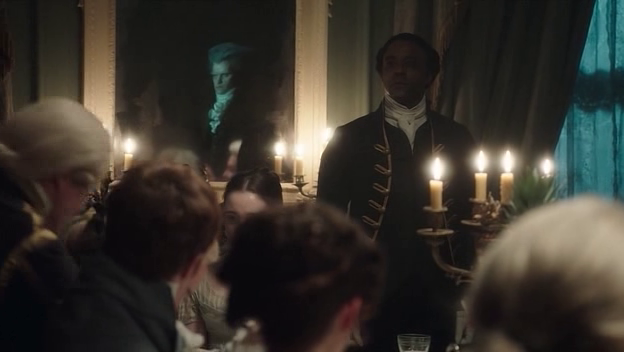
Stephen Black at Lady Pole's dinner party.
Stephen Black at Lady Pole’s dinner party.

In London, Lady Pole is a wonderful dinner hostess. I love how loud and opinionated she is, which make the rest of what happens to her in this episode extra horrifying. I’m kind of surprised by just how much I love the show’s Lady Pole, to be honest. I adored the character in the book, but seeing her brought to life is even better. She definitely improves in adaptation, and I’m especially pleased that the show seems to be making just as certain as the book ever did that we know that Lady Pole is not actually crazy. Rather, she’s enchanted and spitting angry about it.

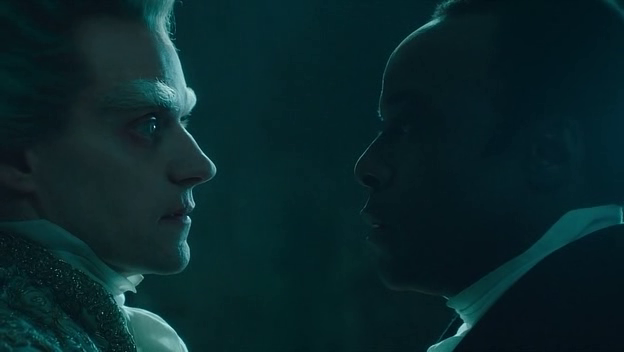
Stephen Black and the Gentleman.

This episode introduces Sir Walter’s butler, Stephen Black, who is exactly how I imagined him, if a bit more taciturn than I would have liked. Some of that is because basically all the characters that Stephen interacts with in the book have been cut from the adaptation, so he speaks very little except with the Gentleman, and then it’s mostly utterances of confusion and helpless dismay. In the book, Stephen is a complicated character who doesn’t say much but who does think a lot, only here we don’t have the insight into his private thoughts that the book offers. Additionally, I don’t think it helps that they seem to light most of Stephen’s scenes to flatter the white fairy, which makes Ariyon Bakare’s very dark face hard to read at times simply because he nearly fades into the background.

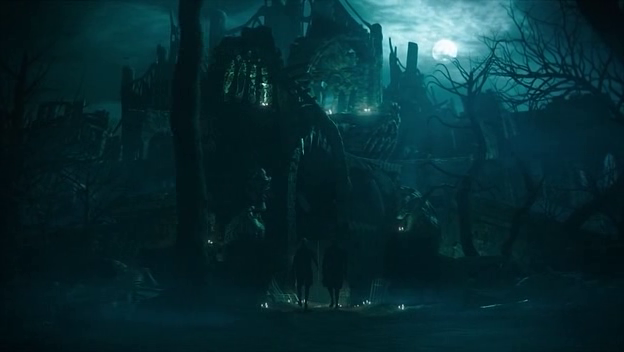
Lost-hope.
Lost-hope.

We do get our first proper look at Faerie in this episode, in flashes in Lady Pole’s dreams and then more thoroughly when the Gentleman takes Stephen there. I absolutely loved the dark forest, the path Stephen follows the Gentleman down, and the outside view of Lost-hope. Once they get inside, though, I was disappointed. Everything is so positively gray, and I would have much preferred to see some color. I’ve always felt like part of the horror of Lost-hope is the dissonance of the place–bright colors and whimsy and dancing, but surrounded by an ancient battlefield and a dark forest and with gloomy tolling bells. There’s too much of a sameness to everything here, and while there is some sparkle, it’s not enough to keep the place from just feeling terribly bleak when I feel like it ought to have instead been disturbing and strange and awful in that way instead.

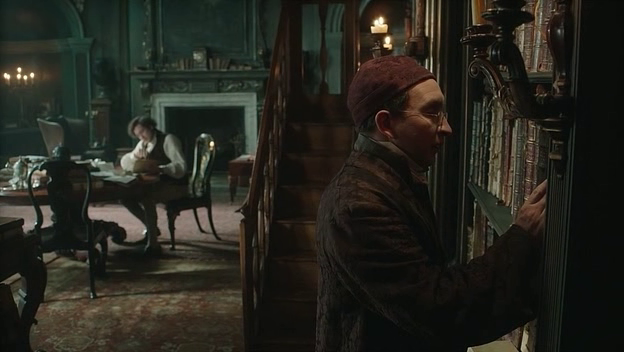
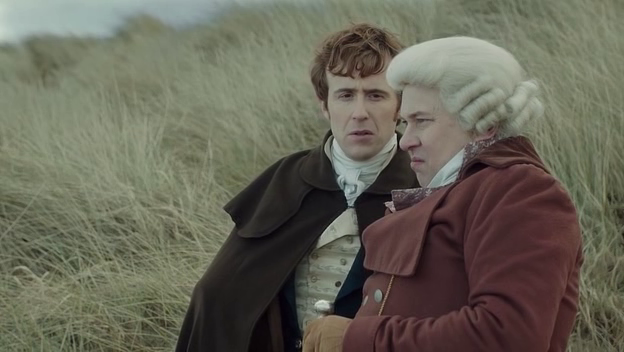
Strange and Norrell at work.

Probably the most important thing that happens in this episode is the meeting of Jonathan Strange and Mr. Norrell, and it’s so very like it was described in the book that I felt a little teary. Again, though, the show seems to struggle a little with portraying the passage of time. I love how they show the early days of Strange and Norrell’s partnership (and I laughed out loud at Norrell’s ten year plan written out), but it felt like just a single afternoon and didn’t convey months or even weeks passing before things quickly moved along to other meetings and scenes between character pairs.

Drawlight and Lascelles

This focus on pairs of characters is something else about the book that I’m very glad to see preserved in the adaptation. Indeed, most scenes in the show are between pairs of characters, and this episode in particular either works to pair characters off in significant ways (Strange and Norrell, Stephen Black and the Gentleman, Lady Pole and Arabella) or expands upon our understanding of the relationships between already existing character pairs (Childermass and Norrell, Drawlight and Lascelles, Strange and Arabella, Honeyfoot and Segundus). Like the book, the show is constantly pairing off characters and then switching them around and seeing how they interact in various combinations so that we can see a variety of fascinating contrasts and parallels between them.

Norrell finishes creating his sea beacons.

In a sequence that is perhaps a little heavyhanded, we get to see two feats of magic at Portsmouth. First, Mr. Norrell finally completes the series of sea beacons that he promised the government. While a good number of people have gathered on the beach to watch him finish the spell, it turns out that there isn’t anything to see. As one might expect, everyone is terribly disappointed.

Horse Sand.
Horse Sand.

The next morning, however, they are in for a treat. Probably because of the sea beacons, a ship has run aground on a shoal. Norrell claims to have a headache that prevents him from doing anything about it, but Jonathan Strange comes back out to the beach to see if he can help. After a couple of bad ideas, Strange thinks to use the sand itself to upright the ship, and because the shoal is called Horse Sand, he forms the sand into horses that go out to the ship and set it back up in the water. It’s extremely impressive, perhaps even excessively so, and it’s definitely the coolest piece of magic we’ve seen performed so far. Mostly, though, it establishes Jonathan Strange’s reputation as a powerful magician in his own right, and it plants the idea in the ministers’ heads that maybe they could send a magician to the war after all.

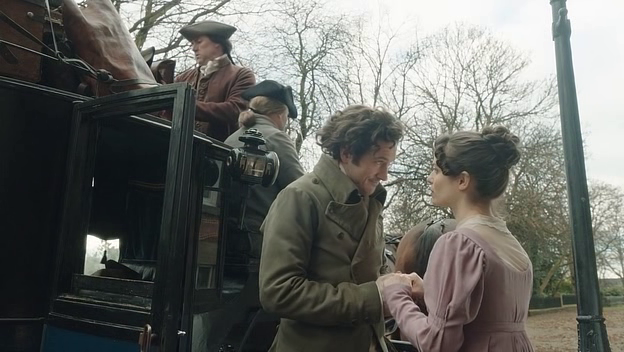
Jonathan and Arabella say farewell for now,

By the end of the episode, this is what indeed happens. Although Norrell was at first very opposed to the idea, knowledge of an imminent book sale (provided by Lascelles and Drawlight) convinces him that perhaps Strange would be better off out of the country for a while after all. I hope that Norrell is getting a lot of new books, since Strange is taking forty or so of Norrell’s books with him to the Peninsula.

Sci-fi and Fantasy books, tv, films, and feminism