State of the Blog and Weekend Links: June 18, 2017

As always, this week I didn’t manage to be nearly as productive as I’d like, though I’m proud of what I did accomplish: two Gormenghast posts and a review of the most recent episode of iZombie.

This week, the big hold-up on productivity was just getting totally bogged down in Gormenghast. I’m loving Titus Groan, but it’s a rich text with many layers to analyze, and trying to stick to a strict three-to-four-posts-per-week schedule with it is, frankly, leaving me completely overwhelmed and unable to concentrate on much else (or, unfortunately and paradoxically, on Gormenghast, because that’s just the sort of garbage anxiety issues I have). I have other book reviews I’d like to write, and we’re coming up on Game of Thrones season seven, so I can’t be spending all my productive time on the Gormenghast project. From here on out, I’ll be continuing to post a tentative plan for Gormenghast posts each Sunday in the State of the Blog post, but (just for my own sanity, really) posts will be up when they’re up. Two 1000+ word Gormenghast posts a week seems to be doable so far, so I’m thinking that will be the baseline, with extra posts as time/energy/interest permits.  This coming week, I’ll be covering two to four of the following:

  • Titus Groan, Chapters 17-23
  • Titus Groan, Chapters 24-26
  • Titus Groan, Chapters 27-31
  • Titus Groan, Chapters 32-36

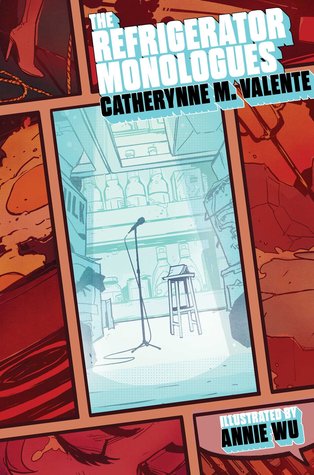
Aside from my continued disappointment with my own lack of productivity, it’s been a pretty good week. The last round of repairs to my car seem to have held; I’m half-obsessed with Natasha, Pierre & the Great Comet of 1812; and Tuesday was perhaps the single best day for new book releases so far this year, so I’ve had plenty to read this week. I’m still savoring Nicky Drayden’s incredible debut novel, The Prey of Gods, which is probably the book I was most excited about this week, but other notable releases included Raven Strategem by Yoon Ha LeeMars Girls by Mary TurzilloThe Changeling by Victor LaValleDown Among the Sticks and Bones by Seanan McGuire, and The Refrigerator Monologues by Catherynne M. Valente (which was actually out last Tuesday, but was shipped this week with my pre-orders of The Prey of Gods and Raven Strategem). I also got my bookmarks from the Kickstarter for Moonshot: The Indigenous Comics Collection Vol. 2, which are lovely.

You can read Nicky Drayden’s Big Idea at John Scalzi’s blog.

Apex Publications has still been aggressively promoting Mars Girls:

It was a good week for short fiction as well.

Last week, the second half of Uncanny Magazine #16 was posted and is now free to read online.

Sunny Moraine’s “eyes I dare not meet in dreams” was posted at Tor.com.

And you have got to check out “Beauty, Glory, Thrift” by Alison Tam at the Book Smugglers. Then don’t forget to read more about her inspirations and influences.

The fourth and (apparently) last Book Smugglers Quarterly Almanac is now available.

Tor.com scored the cover reveal for Cassandra Khaw’s novella, Bearly a Lady, which will be available July 18 and sounds like everything I want in a novella.

Invisible 3, edited by Jim C. Hines and Mary Anne Mohanraj, is out on June 27, with any profits from sales of the collection going to Con or Bust. For a sneak peek, check out Fran Wilde’s essay: “Notes from the Meat Cage.”

File 770 posted a nice Hugo Finalist Review Roundup if you’re still undecided on how to vote.

Joe Sherry at nerds of a feather covered Novelettes and Fancasts this week.

At Black Gate, John O’Neill makes a great case for buying bulk back issues of Asimov’s and Analog. I was convinced enough to order $30 worth, myself, and I’ll report back when they arrive and let you know if it’s worth it (I’m thinking yes).

Aidan Moher’s series on the art of SFF continues with a look at the work of Galen Dara.

Mari Ness writes about Twelve Dancing Princesses.

Let’s Read! Gormenghast: Titus Groan, Chapters 14-16

[Note: I had originally planned for this section to include through Chapter 17, but there’s a natural stopping point at the end of Chapter 16, “Titus is Christened,” and it turns out that Chapter 17 fits in better with the chapters following it than those that precede it. Apologies for any confusion this might cause to anyone who is reading along and making plans based on the schedule I shared in the most recent State of the Blog post. I will continue to alert readers to similar changes in the future with a note at the top of any impacted posts.]

Today’s chapters concern events that occur on the day of Titus Groan’s christening, which is fascinating, as worldbuilding and as character study, but doesn’t mark the kind of plot development that I was hoping to see after the end of Chapter 13 had such a feeling of significance. In fact, these chapters introduce even more characters—the gardener Pentecost as well as Sepulchrave’s twin sisters, Cora and Clarice—and continue to expand upon the setting. They also elaborate on thematic threads from earlier chapters and expound upon the connections and conflicts between various characters.

The first part of Chapter 14, “First Blood,” introduces the head gardener, Pentecost, and describes the room in which the christening will take place. While descriptions of Gormenghast and its environs have, until this point, held that the whole place is hot, humid and stinking to various degrees, the Christening Room is also called the Cool Room. Unlike the rest of the castle, this one room is a place of peace and quiet, frequented only by the gardener, who refreshes the flowers every day. No one else in the castle goes there, though Fuchsia sometimes observes Pentecost from her hideaways under the roofs and Lord Sepulchrave (very) occasionally stops in for a quiet moment. For Titus’s christening, the room is decorated mostly with lavender, which is purple (a color symbolizing nobility as well as matching Titus’s purple eyes) and has a scent associated with peace and calmness, and with golden orchids (exotic flowers that could represent a new beginning).

Perhaps what’s most notable about this room, however, is that it’s not a church or chapel of any kind, despite the peacefulness of it in comparison to the rest of Gormenghast. It’s a space not cared for by a priest or chaplain, but by a gardener, and even on the day of the christening, the preparations are overseen by Mr. Flay, a manservant. The actual christening ceremony is performed by the Librarian, Sourdust, and while there is a baptism with water, no Christian words are said throughout the event. While the term “christening” is used for this ceremony, it’s a profoundly atheist event, lacking even any identifiably pagan overtones. Titus isn’t being dedicated to God, and though water is used, it lacks the usual symbolism of rebirth or cleansing associated with either religious baptism or pagan rites. Instead, Titus is dedicated to Gormenghast itself in a ritual that foreshadows madness (the “ancient word of the Twelfth Lord” in particular speaks of the lord of the castle hearing voices “when his ear is tuned to Gormenghast”) and suicide (“until he dies across the Groan’s death turret”) while exhorting the infant to hold nothing sacred except Gormenghast and its traditions.

Early on while reading Titus Groan, I pointed out that there’s a sense of the profane about Gormenghast, and these chapters feel like a culmination of that. The Cool Room is the only place of peace and quiet and beauty in Gormenghast, a refuge from the heat and dankness and chaos to be found elsewhere in the castle. Pentecost, whose name is the only explicit nod to Christianity in these chapters, is the closest thing Gormenghast has to a holy man (of the hermit type), and he notably comes from the mud huts outside the castle. Pentecost’s artistic soul and his deep connection to the earth are a stark contrast with the Groans’ worship of their own nobility and the rituals that uphold their position as Lords of Gormenghast. Pentecost has the heart of a Bright Carver, and his connection to the earth is deep and spiritual, a reverence for where he came from; the Groans’ connection to their land is facile and centered in connecting with things, like the stones of the castle or the very book in which their endless schedule of rituals is recorded.

A major theme throughout these chapters is power: who in Gormenghast has it, who doesn’t, how it’s structured, and, perhaps, how to get it. The introduction of Cora and Clarice brings this theme to the forefront. Sepulchrave’s sisters, these two older women (their ages aren’t given, but they do have grey hair) have been nursing a grievance for some years against their sister-in-law, Gertrude. “Gertrude has all the power,” the twins intone, a sentiment repeated several times. They want it, and they insist that Gertrude has it, even though it’s Sephulchrave who inherited it, just as Titus will inherit over his sister Fuchsia. It’s hard to say just yet why Peake chose to pit female characters against each other like this. English inheritance law and its effects on women has been a fraught issue in the British fictional landscape for centuries, so it can’t be that there isn’t a wealth of material to draw from in crafting the twins’ discontent with their lot. The words with which their grievance is introduced—“Gertrude has what we ought to have”—could be read as a suggestion of incestuous interest in their brother, but they never interact directly with him. Instead, all of their disappointment and resentment is projected onto Gertrude and, to a lesser extent, Fuchsia (presumably for being Gertrude’s daughter).

The thing is, it’s not entirely clearly what power Gertrude actually has. She lives as something of a recluse, lavishing any tender feelings she possesses on her birds and cats. While Gertrude must have had sex with Sepulchrave at least twice in the last couple of decades, they haven’t directly interacted in 130 pages of novel. The order in which guests for the christening enter the Cool Room is said to signify their importance in the castle (with the least important entering first), and Gertrude is the last to enter, just after her husband, but it’s a decidedly odd way for the power system in the castle to be organized. Any power Gertrude has comes from her husband, and we’ve already seen that it’s Sepulchrave whose responsibility it is to maintain the traditions and rituals of Gormenghast. If Gertrude was an active manager of the household, it would make more sense for her to be considered the “real” power in Gormenghast, but she isn’t; indeed, she seems totally indifferent to everything but her birds and cats, is an indifferent mother (at best), and the only household servant she’s interacted directly with is Nannie Slagg, who (not incidentally, I suspect) enters even later than Gertrude, suggesting (by the explicitly stated rules of this fantasy world) that Nannie Slagg’s position as the primary caregiver of the future Lord may in fact be the greatest position of power in the castle.

Gormenghast is a place, I would argue, where even the concept of what power means is nebulously defined. Sepulchrave, as Lord of Gormenghast, has the title of Earl, which is only a mid-ranking noble title in the real world and, so far, is rendered meaningless in the novel by the extreme isolation of the castle and its people. There’s no mention whatsoever of the outside world, and while Gertrude is perceived as an interloper by her sisters-in-law, there’s no information given about where she came from, and Gertrude feels so much a part of Gormenghast and fits in so well to its eccentric culture that she seems quite native to the place. As Sepulchrave’s wife and a countess, Gertrude ought to have some power, but there’s no textual evidence so far that she does so except to arrange for her own comfort—namely, to be left alone with her animals. Cora and Clarice define power as being able to “tell people what to do,” and both Sepulchrave and Gertrude can do that, but, again, neither Lord nor Lady Groan seem to have much interest in active ruling.

As in previous chapters, this all feels like setting up the kind of conflict that generates a plot, but I’m, frankly, done guessing when that might develop. It also continues to be unclear what message, if any, Mervyn Peake wants to communicate about his subject matter. Titus Groan might be a biting satire of the antiquated rituals of an inbred upper class, but Peake turns an equally critical eye upon those of the servant class in Gormenghast, who are, on the whole, just as disagreeable as their masters. At the same time, all of Gormenghast’s characters are crafted with a sort of gleeful affection that inspires the reader to love even the most despicable of them, or at the very least care what happens to them and avoid harshly judging their actions. The overall effect is one of what I’m currently thinking of as gloomily cheerful nihilism. It’s weird, but I like it.

Miscellany:

  • Flay and Swelter’s enmity for each other comes to a head before the christening, with Swelter’s subversive insolence provoking Flay to strike Swelter across the face with a chain—the “First Blood” of Chapter 14. I was somewhat disappointed that that chapter title didn’t have a more multilayered meaning.
  • I keep thinking that I’m going to have to write about the way Peake uses disability and disfigurement as a tool for characterization, but I’m still forming an opinion on the way he does it.
  • Word and phrase repetition are extremely important in Titus Groan. I’m making lists of key words and phrases that I expect to write more about at a later date. Similarly, words and phrases with double (or even triple) meanings are important to note; some of those are also repeated throughout the text.
  • Titus tearing a page as he falls out of the book is only “his first recorded act of blasphemy.”
  • Fuchsia’s fierce love and protectiveness of Nannie Slagg at the end of Chapter 16 is my favorite scene so far in the book. “You’ve made her cry, you beasts!” is a powerful ending note to the christening drama.

iZombie: In “Conspiracy Weary” about half the season’s chickens come home to roost

After expanding the story and cast by quite a bit in the last few weeks, “Conspiracy Weary” sees that trend reversing in preparation for the season’s two-part finale. Not all of it works, at least not entirely and not all in this episode, but it seems almost certain that some of the show’s more questionable storytelling decisions—like everything to do with Shawna—are going to turn out to be important in the next couple of weeks. Personally, I’m still not entirely sold on the necessity of these story threads, but we’ll see, starting next week, if the payoff is going to be worth the sometimes tiresome buildup.

**Spoilers ahead.**

We start at the shooting range, where shit gets very real very fast once Liv and Blaine show up. Ravi is hurt (only a little, fortunately) and Rachel flees into the night about the time that a group of Fillmore Graves soldiers shows up. Liv and Blaine take down one Bo Johns while two of the other zombie truthers are shot by the Fillmore Graves crew when they try to engage in a shootout instead of surrendering. Meanwhile, Harley Johns manages to give everyone the slip. It’s a taut, exciting action sequence, overall, and a great way to open the episode, fully delivering on the promise of last week’s cliffhanger. The zombie truther body count is even slightly surprising, since the show tends to avoid having its protagonists straight up murder people, even when they are kind of asking for it. The highlight of these early scenes, however, isn’t the action. Instead, it’s Blaine, Liv and Don. E. companionably sharing the brain of Bo Johns.

Once again, the show eschews the case of the week format in favor of advancing its bigger storylines, and Liv on conspiracy theorist brain is smartly done, with some of the funniest brain-eating-antics-related moments of the season. Liv and Peyton working to unravel the actual conspiracy surrounding Weckler’s murder and the connection to zombies is a great opportunity for their friendship to get some much-appreciated screen time, and some real strides are made in that investigation as Peyton gets the memory card Weckler was killed over and deduces that Weckler’s daughter, Tatum, is a zombie. Unfortunately, none of this is discovered before Baracus wins the mayoral election.

Liv also works with Blaine and Don E. to try and figure out where the Johns brothers’ secret property is. The guns recovered from Harley’s truck at the start of the episode turn out to be the same weapons that were used to kill Wally and Anna, which has Clive very invested in finding Harley Johns. When they finally track Harley down, however, Liv has a last-minute vision (right as Clive shoots Harey) that proves that Harley didn’t kill Wally and Anna. Fortunately/unfortunately, Harley isn’t dead; he’s a zombie, a revelation that will likely be dealt with early in next week’s episode. It seems obvious, especially in hindsight, that the Johns brothers weren’t going to turn out to be Wally’s killers, and by the end of “Conspiracy Weary” it seems likely that their deaths are tied in some unknown (and not obvious) fashion to the broader zombies vs. humans plot, the Weckler case, Baracus, and Fillmore Graves.

Bafflingly, we get some more of the Major and Shawna thing that started last week. She seems nice, and she encourages Major to start going out again, even convincing him to go dancing with her, but a short bit of sleuthing on Liv’s part (possibly influenced by the paranoia caused by Liv eating conspiracy theorist brains, but possibly just jealousy, though Liv denies this) turns up that Shawna has been sharing photos and videos of herself with Major since the beginning of their relationship. Here’s the thing, though. Why is Major so shocked and upset by this? He knew that she was taking pictures. He posed for them. He knew that she was active on social media, and he was aware of her Tumblr. It’s normal for people to post photos of themselves on social media, and none of what Shawna shared was particularly embarrassing. Sure, she should have been clearer in explicitly asking Major’s permission to share his image, especially considering his history as the Chaos Killer, and it makes sense that he would be upset about that, but at the same time, what did he think she was doing with all these pictures?

The show frames Shawna’s social media use as weird and suggests that she’s somehow trying to exploit Major, even though it’s not clear what she could gain here other than some notoriety (and then only if she was publicizing Major’s history). Really, though, the stuff Shawna posted is pretty run-of-the-mill honeymoon phase relationship pictures, and while she wasn’t explicit with Major about what she was doing, she also wasn’t hiding it; Liv was able to literally just google Shawna to find her totally public Tumblr. The episode takes pains to portray Shawna as “crazy,” but nothing she does actually is crazy. Even when Major unceremoniously dumps her—she very reasonably apologized and offered to take down the photos immediately when he confronted her about it—Shawna is upset but not unhinged in anyway. We’re meant to think that the shirts being sold at the end of the episode with Major’s photos on them are Shawna’s doing, but it, frankly, seems out of character for her, and it seems at least somewhat likely that this is a coincidence and that Shawna is going to turn out to have some other importance to the story. We must hope so, anyway. Otherwise, this whole Shawna subplot—introducing her just for the sex fort gag and to give Major a “crazy ex-girlfriend”—feels like a huge waste of time.

Finally, it’s not just Major who’s having girl trouble this week. Ravi’s friend and seemingly potential new love interest, Rachel, turns out to be a journalist, and she manages to get Ravi to tell her everything about zombies, which she promptly turns into a fear-mongering frontpage piece in a local newspaper. The episode ends with this, which, after the revelations of Baracus’s election win and Harley Johns being a zombie, leaves things very well set up for an exciting two-parter starting next week.

Miscellany:

  • It’s not just me, right? Chase Graves is obviously super into Liv.
  • Peyton and Clive both have the best reaction to Liv’s brain-influenced behaviors, but nothing beats the faces Clive makes when he’s just silently judging.
  • I could listen to Liv, Don E. and Blaine talk about conspiracy theories forever.
  • It seems very unethical for Peyton to pressure a child to comply with her off-the-books investigation like that. Isn’t this girl just fifteen or so?
  • How did Liv know to text Major about Harley? I mean, thank goodness she did, because I was about 95% certain poor Justin was about to die tragically like all the rest of Liv’s boyfriends, but this scenario was extremely contrived.
  • How is it possible that there aren’t officially licensed “Killer Abs” shirts already available to buy?

Let’s Read! Gormenghast: Titus Groan, Chapters 10-13

I’m always happy when I somehow, fortuitously, manage to arrange my section breaks in these projects in just the right way to have interesting things to talk about. These four chapters do something neat; Chapter 10, “Prunesquallor’s Kneecap,” essential presses a restart button on the day through which we’ve already followed several characters and, together with Chapters 11 through 13, tells the story of Titus Groan’s day of birth from a new set of character perspectives, particularly Fuschia’s and Mrs. Slagg’s, but also introducing something of the points of view of Doctor Prunesquallor and Keda, a woman from the Outer Walls who is to become Titus Groan’s wet nurse.

The book’s 1946 publication date puts it far too early to have been influenced by Upstairs, Downstairs (1971) and its novel blending of the stories of the upper class and their servants, but there’s definitely something akin to that beginning to emerge in this novel. The sharp divisions between characters and groups of different social status within and without Gormenghast continue to figure largely in the narrative, and by the end of these chapters it feels as if we’re intended to have a distinct idea of the organization of Gormenghast as well as of the relationships and dynamics between the various characters. At the same time, it’s not at all clear what, if anything, Titus Groan has to say about the class distinctions it’s highlighted so far. The palpable distinction between the nobility and servants within the castle and between the castle servants and the people of the Outer Walls, along with their respective disconnection from each other, feels significant, but nearly a hundred pages into the book we’re still quite without a definitive plot. Things happen, but these chapters continue to feel introductory to the actual story. That said, by the end of Chapter 13, “Keda,” it finally feels as if all the pieces are in place, motivations are established, and a plot is about to emerge.

After her introduction, I rather expected Mrs. Slagg to be more of a cardboard character, but starting in “Prunesquallor’s Kneecap,” she emerges as perhaps the closest thing to a clear protagonist to appear so far in the book. While Mrs. Slagg is introduced as a somewhat doddering and much put-upon elderly caregiver, which is a fairly standard stock character, when the story shifts to her point of view, we find a character with a rich and complex, if deeply eccentric, inner life. Her love for Fuchsia, her distrust of Doctor Prunesquallor, and her reinvigoration at the prospect of a new baby to care for suggest a depth of feeling that wasn’t obvious at our first sight of her from a more removed point of view. When, in Chapter 12, “Mrs. Slagg by Moonlight,” we learn even more about her—her vanity, her slyness, her disdain for those she considers below herself—she becomes (by rather a lot) the most developed character in the book so far. Indeed, it’s Mrs. Slagg’s moment of awareness—rather, alarm—when she realizes that she didn’t choose Keda as Titus’s wet nurse that suggests perhaps the most interesting potential conflict of the book so far, and it’s the comparison and contrast between Mrs. Slagg and Keda in Chapter 13 that seems to confirm the conflict between these two women who will be raising Titus Groan together for his first few years of life.

We also get more insight into Fuchsia in these chapters, which detail a general routine of hers as she awakes, is an affection tyrant to Mrs. Slagg, and then goes about her business only to slowly work out that something is different in the castle today than on previous days. The creepily sexual language used to describe Fuchsia continues to be off-putting, especially as so much of her material in this section highlights just how much of a child she is. We begin with a description of her bedroom and attic (which we later learn is a series of multiple attics that Fuchsia has turned into playrooms and hideaways for herself) before segueing into her brief interaction with Mrs. Slagg. Fuchsia is artistic and sensitive and has been left, apparently, to run quite wild for much of her childhood, with only Mrs. Slagg as company. The fierceness of Fuchsia’s affection for Mrs. Slagg is matched only by Fuchsia’s love for Gormenghast itself; she is intimately familiar with the castle, its inhabitants and its routines, and she’s built a richly imaginative play world of her own in spaces that leave her above and separate from the rest of Gormenghast’s inhabitants, where she watches and loves them from afar. It’s tempting to try and read Fuchsia’s rage at the news of her brother’s birth as the frustration and protest of a girl just realizing that the home she loves will never truly belong to her because of antiquated inheritance laws, but the text seems determined to miss that opportunity in favor of Fuchsia’s upset being more a case of childish jealousy—informed by an eccentricity that borders on madness—than anything else.

In the final two chapters of today’s selection, we get a decent picture of the wet nurse, Keda, who by the end of Chapter 13 seems poised to become an influential character in the life of Titus Groan. However, much of what we learn of Keda is about her people, with much time spent on describing the inhabitants of the Outer Walls as prematurely aged. Peake positively dwells upon these descriptions; everyone is old-looking and ugly except the children, who possess “an unnatural brightness” as if being burned up from the inside out. This brightness only remains deep inside the adults of the Outer Dwellings, and perhaps not in all of them, as “the hotness of creative restlessness” that is expressed through the Bright Carvings from Chapter 1. Among these people, Keda isn’t extraordinary. She’s young, about twenty, her beauty already fading, and she’s recently lost her own child. What is notable about Keda, at least so far, is the way in which she takes immediately takes charge of Mrs. Slagg, steering the older woman back to the castle before Mrs. Slagg can object to Keda’s self-appointment as Titus’s wet nurse. This multi-layered conflict between Mrs. Slagg and Keda is a conflict of personalities, but it’s also a conflict between old and young, castle and town, hidebound tradition and new ideas.

Mrs. Slagg is unsettled by Keda’s assertiveness and agency in a way that makes Keda’s simple actions feel subversive, a threat to the way of life within Gormenghast in much the same way that Steerpike’s ambition is portrayed as threatening. So far, the narrative hasn’t taken any particular position on the rightness or wrongness of the established order of things in Gormenghast, however, which makes it impossible to guess what, ultimately, the message of the book is going to be. Instead, these first ninety-nine pages are a fantasized portrait of English gentry and their servants and tenants that casts a satirical eye on nearly all its subjects. It will be interesting to see how things play out now that a game finally seems to be afoot.

Miscellany:

  • There’s a nonsense poem, “The Frivolous Cake,” in Chapter 11 that is nicely reminiscent of Lewis Carroll and similar, but I’m so far resisting the urge to try and analyze it. I may return to it later if something occurs to suggest that it’s more important than it appears at this time.

State of the Blog and Weekend Links: June 11, 2017

Sometimes I feel like I’m never going to catch a break. After being moderately productive last week, I was all prepared to churn out some work this week, especially since I started a new blogging project (Let’s Read! Gormenghast) that I’ve been excited to dig into for months.

Reader, I’m already a post behind where I’d planned to be. And the thing is, it’s not even depression or poor time management, which would be disappointing, but also classic me. Nope. This time it’s just plain old seasonal allergies, which got randomly worse for me last weekend and have only let up in the last 36 or so hours. I’ve always had a little bit of sniffling, like in April when every flower in my town blooms at once and I have the windows open for fresh air, but usually it clears up by now. Not this year, though. This year, I just got a full week of sinus pain, stuffiness, runny eyes and constant headaches that were literally only helped by laying completely horizontal and essentially doing nothing. Which amounted to quite a lot of sleeping, as the headaches made it hard to even read a book, much less anything else even remotely productive.

Today is the first day in over a week that I’ve felt anything close to normal, and most of my waking hours have been spent at my nephew’s birthday party, which was nice, but the noise has undone most of the good that a couple days of pretty solid resting and quiet/early (for me) evenings have done. The good news is that I think the allergy situation is clearing up now that it’s hitting 90 degrees and I turned on the A/C. I have high hopes that this coming week will be a bit more normal.

All that said, this past week wasn’t the total worst, all things considered. I reviewed iZombie as normal, and I did get out two of the three posts I’d planned to do about Titus GroanPart 1 | Part 2–with another one likely to be ready tomorrow. If my energy level stays high and the rest of my body cooperates, I’m hoping to catch up this week by just making up this week’s missed post by Friday. Here’s what I’ve got planned next if you’re following along:

  • Monday: Titus Groan, Chapters 10-13
  • TBD: Titus Groan, Chapters 14-17
  • TBD: Titus Groan, Chapters 18-23
  • TBD: Titus Groan, Chapters 24-26

Energy level and health again permitting, I’ve got several book reviews in the works, and I’d love to get out sometime soon to catch Guardians of the Galaxy 2 and Wonder Woman, which I expect to have thoughts on–unless I decide to just hold off on movie-going until The Little Hours and/or Atomic Blonde comes out. Because, really, raunchy nuns and Charlize Theron killing dudes and romancing Sofia Boutella will almost certainly be better than anything Marvel or DC is going to put out this year.

In sad news this week, original Batman star Adam West passed away at age 88.

If you’re planning your summer reading already and can’t wait around for my Summer Reading List near the end of June, the Barnes & Noble Sci-Fi and Fantasy Blog has a book for you each week in both science fiction and fantasy.

If you’re reading for the Hugo Awards, you should definitely be following along with Joe Sherry at Nerds of a Feather. He just did short stories.

Finalist lists were announced this week for this year’s Mythopoeic Award and John W. Campbell Memorial Award.

The Wertzone’s Cities of Fantasy series continues with Waterdeep.

In her continuing fairy tale series at Tor.com, Mari Ness talks Hansel and Gretel.

As I gear up and prepare my liver for season seven of Game of Thrones, that show’s numerous failings have been much on my mind. Fortuitously, the good folks over at the Fandomentals have organized most of the reasons why Game of Thrones is bad in a handy 101 post.

Pornokitsch offers up a taxonomy of villains.

One of the books I’m hoping to finish a review of this week is Catherynne M. Valente’s The Refrigerator Monologues, which is every bit as superbly excellent as you might expect anything by Valente to be. She was interviewed over at Vox this week; you can read her Big Idea post about the new book; and if you still aren’t convinced, you can read an excerpt at Paste.

Yoon Ha Lee’s Raven Stratagem, out Tuesday (6/13), is the next major release I’m hotly anticipating, and he’s been making the rounds to promote it this week.

The other release I’m looking forward to this week is Mary Turzillo’s YA novella, Mars Girls, from Apex Publications, which I’ve had on pre-order for what feels like forever. There’s been a big blog tour going on this week ahead of publication (and stretching into next week), and all it’s done is whet my appetite for this book. I mean, look at that stunning cover and that book description. Can not wait.

While we’re still waiting on the next Book Smugglers novella, they did just reveal the cover and synopsis for the first book in their 2017 short story season, Beauty, Glory, Thrift by Alison Tam. Reader, I instantly pre-ordered it. All the cool kids are doing it.

Finally, Book Smugglers is also where I found out about the Kickstarter for the Tansy Rayner Roberts-edited anthology, Mother of Invention. I’m starting to be slightly concerned about how much the Book Smugglers are influencing my spending decisions, but AUS $10 will net you a digital edition of the book when it comes out. It had me at “diverse, challenging stories about gender as it relates to the creation of artificial intelligence and robotics.”

Also, I know I negged superhero movies a bit earlier, but the first teaser for Black Panther looks promising:

Let’s Read! Gormenghast: Titus Groan, Chapters 4-9

These next few chapters of Titus Groan vary in length, further adding to the sense of unease and strangeness that permeates the book, while at the same time slowly metering out more information about Gormenghast and the Groan family. There’s even the glimmering of the beginning of a proper plot, though, like the first three chapters, these contain only a couple of actual events that don’t represent any particular forward motion in the story.

Chapter 4, “The Stone Lanes,” begins with Mr. Flay becoming overwhelmed with disgust at Swelter and the kitchen. He leaves through a door that Steerpike has never used before, and Steerpike follows him into the Stone Lanes, a mazelike set of tunnels within the castle. When Flay discovers Steerpike following him, he takes the boy to see the “cat room,” which is just what it sounds like, and to spy on the Earl and Doctor Prunesquallor as they talk about the baby, who is apparently very ugly, with unusual violet-colored eyes. When Flay tries to send Steerpike back to the kitchen, Steerpike refuses, threatening to spread the gossip about the new baby throughout the rest of the staff, which prompts Flay to lock him up to be dealt with later.

Meanwhile, the Lady Gertrude, 76th Countess of Groan, is chafing at her enforced bedrest after childbirth. She proves herself an indifferent mother at best when her new son is brought to her and she simply names him—Titus—and sends him away, to be brought back to her when he’s six years old. Finally, we get something of a glimpse into the life of Lord Sepulchrave as he meets with the “Lord of the Library,” Sourdust, and plans his day using a set of enormous books that detail routines stretching back generations. Nearly seventy pages into the book, I would expect for more stuff to actually be happening, but there’s still so much that’s delightful about the Mervyn Peake’s lush and atmospheric prose and sharp, often funny worldbuilding that I’m not even a tiny bit bored yet.

The central motifs continue to develop, with strong references to birds and disease, though descriptions of humidity have petered out in favor of just a general pall of ill health. In these chapters, we finally get some appreciable dialogue from characters who aren’t (as Swelter was) drunk, and it gets weird. Time and again, characters talk right past each other in conversations that never quite connect, where the results of a discussion don’t quite logically follow from its content. Words and phrases are repeated for emphasis or as mantras, not quite on the level of catchphrases for each character yet, but the reader is almost certainly intended to associate certain lines and manners of address with particular characters.

  • Mr. Flay’s conversation with Steerpike, such as it is, reveals something of Steerpike’s ambition—to be out of the kitchen and away from Swelter—and much about Flay’s obsession with Gormenghast and its history and the preservation of whatever twisted sort of order exists in this place. Flay repeats the question and accusation, “Rebellion,” several times, suggesting that he maintains a level of paranoia about it without having a firm idea of what rebellion might look like.
  • Doctor Prunesquallor is a fool and a drunk, prone to sycophantic fawning on the Earl and his family.
  • Fuchsia’s theatricality and self-absorption is felt in every line of her brief speech.
  • Lady Gertrude’s irascible temper and wry good humor is swiftly established in the way she talks with her birds. Her treatment of Nanny Slag is less unkind than impatient, and again it’s characterization that is managed economically.
  • Lord Sepulchrave may be the sanest of the characters we’ve met so far by this point in the novel, though even he is plagued by a pervasive melancholia, burdened by the weight of history and tradition as we find out he is in his short conversation with Sourdust.

Finally, it’s encouraging that there are already multiple female characters introduced, although it’s less encouraging (albeit interesting) the ways in which these women conform to and sometimes defy stereotypes.

It’s Fuchsia who we meet properly first, and she’s little more than a child, petty and spiteful and jealous in the way of some young teenagers, angry at the prospect of having a brother and casually cruel about him when she first sees him. Fuchsia is said to be almost beautiful, though, and Peake goes on to describe her in somewhat creepily sexual terms (“Her sullen mouth was full and rich; her eyes smoldered.”) before then switching tacks and calling her manner “utterly unfeminine—no man could have invented it,” in a direct contradiction to the earlier, sexually-charged description. At the same time, Fuchsia wears a red dress—a color long associated with passion and sexuality—and has long dark hair “like a pirate’s flag,” a descriptor which casts Fuchsia, though only fifteen, as both sexually aggressive and somewhat disreputable. It’s a weird mix of traits for the character, and while Fuchsia may yet grow into such a fearsome description of her person and mannerisms, I can’t help being mildly to moderately squicked out when I remember that she’s only fifteen.

Fuchsia’s mother, Lady Gertrude, may be my favorite character in the book so far. It seems to me that Peake intends for us to understand Gertrude as being at least slightly mad, with her indifference to motherhood just one facet of her madness, but one can also read her as simply repressed, trapped in her role as the 76th Countess of Groan and resentful of it. Peake’s physical descriptions of Gertrude are fascinating. She’s a large woman, and some other writers may have portrayed her as grossly fat, but even in a book where words that connote illness and disease are common, Peake avoids this. Instead, Gertrude is shown as large and rather impressively imposing: “The effect she produced was one of bulk, though only her head, neck, shoulders, and arms could be seen above the bedclothes.” Covered with birds, Gertrude feels almost part of the very architecture of Gormenghast; it’s not clear where she came from before marrying Sepulchrave, but it seems obvious that’s she’s quite gone to root in this place.

She’s got a wry, sardonic wit and a sense of generalized impatience with those around her. She’s bored and irritated by Nanny Slagg—a fairly stock old, doting nursemaid sort of character—and dismissive of Doctor Prunesquallor. Still, like basically all the other characters in the book so far, Gertrude still doesn’t have a story aside from having just given birth, recovered quickly, and refused to raise her own child. There’s no obvious story blueprint for where any of this goes next, to be honest, so it will be neat to see what the next 450 pages of this book are all about.

iZombie: “Return of the Dead Guy” wastes time dredging up the past

There’s a lot going on every week on iZombie, but “Return of the Dead Guy” is extraordinarily busy, even by iZombie standards. The show is juggling multiple different plots, even adding new ones, and while this is something iZombie has always done with mixed success, this week’s mix is more bad than good. Still, the good parts are very good. It’s just a shame that they’re tied to garbage material like “Fort Lust” that does nothing but drag down the episode.

**Spoilers below.**

The highest stakes plot this week is, fortunately, one of the ones that works best in this episode. After Harley and his zombie truthers showed up at the morgue last week, they’ve commandeered Ravi and repaired to the gun shop, where they have Don E. imprisoned and a live video feed set up to document his declining health as they starve him of brains. With his phone confiscated and surrounded by dudes with guns, Ravi is still determined to prevent the torture planned for Don E. Eventually, Ravi manages to get Don E.’s phone and call Blaine, but by the end of the episode Ravi and Don E. are still waiting on their rescue and shit just got real. With the view counter for the livestream over 100k, Harley and his friends are ready to go to town on Don E., and the episode ends with Ravi physically blocking their way and Harley putting a literal gun to Ravi’s head. Of course, the viewer knows that Blaine is outside, with Liv, and gearing up to save the day (finally), and this does diminish the overall effect of the attempted cliffhanger, but it still works well. It’s especially nice to see Ravi getting a storyline that takes his character growth in a positive direction and gives him a chance to do something heroic.

The other storyline that works in this episode is Blaine’s, if only because villainous Blaine is vastly more fun—even absent David Anders’ singing—than nice Blaine ever was. This week, we get a showdown of sorts between Blaine and Mr. Boss, rather sooner than expected, when Boss shows up at the funeral home and shoots Blaine as soon as he opens the door. Obviously, this doesn’t go well for Boss. Blaine trusses him up, lays him out in a casket and then gives him a crash course on the existence of zombies. There’s a lot to love about Boss’s reaction to this news, which is neither the easy(-ish) acceptance of Ravi and Clive nor the fear and hatred of the truthers. Instead, Boss is skeptical, or perhaps “violently disbelieving,” and he continues trying to kill Blaine until it becomes extremely obvious that it’s not going to work. What’s less obvious is why Blaine wants Boss as a business partner after all this. It seems like the sort of thing that is obviously going to backfire at some point, probably sooner rather than later.

Interestingly, there is no regular case of the week this week. Instead, Liv finally eats the brain of the dominatrix murderer, Weckler, who Peyton thinks may have been innocent. It turns out that he wasn’t, but it also turns out that he was, himself, murdered. This is found out in scenes that involve some interesting (in a “gift to the femslash community” way) roleplay between Liv and Peyton. Liv and Clive investigate, trying to figure out who might have had Weckler murdered, but they hit a wall when Weckler’s daughter refuses to cooperate with their investigation. Also, Weckler’s daughter is a zombie, staying with a zombie family, and they’re involved somehow with Fillmore Graves since they eat tube brains. Unfortunately, this plot twist is more confusing than anything else. This episode did an okay job of establishing some of what happened with Weckler, it feels as if we’re as far away as ever from learning why, and a whole new plot just got thrown into the mix as well.

The other side effect of Weckler’s brain is that Liv experiences aspects of Weckler’s mental illness, particularly his visions of his dead wife, except Liv sees her dead boyfriend, Drake, because she apparently still has some issues to work through regarding his death by her hand. Here’s the thing, though. Liv straight up says to ghost delusion Drake that the reason she’s been throwing herself into all these different brains has been to avoid having to live in her own head and thus having to deal with actually processing the grief and trauma and guilt she feels about Drake’s death. However, she’s just spent several days on tube brains, specifically so she could be herself, unaffected by other personalities, in order to pursue her relationship with Justin, who she spends most of this week—even after being visited by ghost delusion Drake—trying to bone. And when it really comes down to it, she’s able to talk herself out of her Drake-induced doldrums relatively quickly (and successfully bone Justin). The time to address this stuff was about eight episodes ago; at this point in the season it just feels superfluous and, frankly, baffling.

Finally, for some unfathomable reason, this episode contains not just one but several check-ins with Major and his new friend Shauna, who have built themselves a blanket fort for sex. I mean. Okay. Fine. Liv is slightly jealous and weirded out by it, but not enough to stop her from going right out and sleeping with Justin. Shauna seems nice, but not in any truly sinister way, which is almost sinister just in and of itself. But the truth is there’s no particular reason for any of this stuff to have made the cut in an already busy episode. It’s late in the season to be introducing a new character that we’re supposed to care about, and Shauna isn’t particularly likeable or at all interesting. Sure, Major doesn’t have much to do now that he’s not a zombie any longer, but that’s okay. It would be better to have no Major at all than to have Major engaging in overly saccharine sexy times with a virtual stranger when there’s far more interesting stuff going on elsewhere.

Miscellany:

  • Mr. Boss sneaking in and out of his own house while his wife is on the phone with her lawyer or the life insurance company or whatever was a smart, funny intro to the episode.
  • Even as Blaine is expanding his business, there’s some grumbling in his crew about how things are going.
  • Curious to find out who Rachel is. My money is on FBI, but we’ll see.

Let’s Read! Gormenghast: Titus Groan, Chapters 1-3

“Gormenghast, that is, the main massing of the original stone, taken by itself would have displayed a certain ponderous architectural quality were it possible to have ignored the circumfusion of those mean dwellings that swarmed like an epidemic around its Outer Walls.”

Having once read it, there’s no way one could mistake the opening sentence of Titus Groan for that of any other book. For one thing, it begins with the name, “Gormenghast,” simply and instantaneously establishing a setting and setting a tone before continuing in a tumble of words that feel as meticulously chosen as they are off-kilter. “Off-kilter,” of course, may be the best one-word description of these first three chapters. From sentence and paragraph structure to word choice, everything about these chapters feels at least slightly askew and unbalanced from the very first words of the book.

The homes of the common people “swarm” and “sprawl.” The earth is sloping and the roofs are uneven. These buildings are “held back by the castle ramparts” as if they’re assaulting the castle—the poor imposing upon the wealthy, titled and powerful by simply existing—and they’re tenacious, “…like limpets on a rock.” The castle itself complements the ramshackle town around it with its “time-eaten buttresses” and “broken and lofty turrets.” Gormenghast is ancient and enormous, but it’s also crumbling and in disrepair. Worse, there’s something obscene about it; it’s most distinguishing feature the Tower of Flints, which “arose like a mutilated finger from among the fists of knuckled masonry and pointed blasphemously at heaven.” To round out the picture, the tower is full of owls, noisy at night and quiet during the day.

And that’s all just the first paragraph.

Chapter 1, “The Hall of the Bright Carvings,” continues to establish the setting. Gormenghast is an ancient but decaying seat of power, and every description of it is reflective of its decline. The place is gloomy and dingy, collapsing under the weight of time, and there’s a profound disconnectedness between the denizens of the town and those of the castle. The annual carving contest, through which three sculptures are added to the eponymous Hall, is a tradition without meaning. The townspeople, we’re told, spend all year working on their submitted pieces, only to have the majority of them burned after the Earl of Groan judges them and chooses the winners. The chosen pieces are relegated to an enormous gallery kept up by a Curator, Rottcodd, who obsessively, but joylessly keeps them dust-free. They are otherwise seen by no one, as no one except Rottcodd seems to go to the Hall, and he lives there as well as works there. It’s not only those in the castle and those without who are disconnected from each other.

Within the castle, too, there are sharp divides between the gentry and the staff and within the staff as well. This is shown in Flay’s interactions with Rottcodd, but it’s further highlighted in the next chapters, “The Great Kitchen” and “Swelter.” While the workers in the Great Kitchen may be more in the loop of major events inside the castle than Rottcodd was, at least enough so that they know to get wildly drunk in celebration of the new Lord Groan’s birth, they’re no more emotionally connected to the Earl and his family than the Curator. Their bacchanalian revels are just as empty a tradition as the sculpture contest, and the kitchen staff may work for the Earl, but they worship the Chef, Swelter. Like the description of the Tower of Flints, the descriptions of the Great Kitchen and its Chef have a feeling of the profane about them. The Kitchen—hot, stifling, crowded, smelly, cacophonous—is a Hell, and Swelter is its ruler.

To the degree that these first three chapters have a plot (which is debatable), it is this: a new heir to the Earldom has been born, and Lord Sepulchrave’s personal servant, Mr. Flay, is spreading the news. Mr. Flay is so excited about the birth that he is in search of someone to share it with who won’t have heard of it yet, and this sends him to Rottcodd in the Hall of the Bright Carvings. When Rottcodd’s reaction is disappointing, Flay then heads to the Great Kitchen, where he knows that there will be, if not surprise at the novelty of the birth, at least some appropriate amount of celebratory reaction. It’s not much, as plots go, and 33 pages of story with only, essentially, a single event is an unfashionably (by today’s standards) slow start to any novel. However, there’s so much emotive and atmospheric worldbuilding detail and sly characterization of the first few characters we meet that it’s hard to resent the lack of actual story.

Notable Motifs:

  • Birds – There are owls in the Tower of Flints; Rottcodd uses a feather duster; there are birds (ravens, starlings, a white rook) in the Lady’s chamber; Rottcodd’s head moves back and forth “like a bird’s”; Flay has a “scarecrow frame”; Steerpike is Swelter’s “impatient lovebird.”
  • Pathology/Illness – The buildings in the first sentence “swarmed like an epidemic”; the Tower of Flints is “like a mutilated finger”; the sculpture competition is “rabid”; the afternoon that Flay visits Rottcodd is “unhealthy”; the kitchen has a “sickening atmosphere”; Swelter was at the back of Flay’s mind “like a tumor”; Swelter’s first word is to call the kitchen boys, “Gallstones!”
  • Humidity – It’s a hot, humid day when Flay goes to see Rottcodd; the Great Kitchen is oppressively humid.

Some Notes on Names:

I suspect Mervyn Peake’s naming conventions in this series will provoke either love or hate reactions in readers. I am firmly in the love camp, myself, and I appreciate the wryly ironic comedic absurdity of it all.

  • Gormenghast – An ugly word that suggests both “gorge” and “ghastly” and that seems designed to cram as much information as possible about the place into its name.
  • Flay – A single syllable, but a full, real word. Whether you understand it as “to skin,” “to beat,” or “to brutally criticize,” it seems appropriate for our Mr. Flay.
  • Rottcodd – Suggests both death and the smell of something vile. I’m curious to see if Rottcodd appears later in the novel, as this seems like it could be a foreshadowingly symbolic name.
  • Sepulchrave – From “sepulcher,” obviously, so another death name, with a suffix that could lay equal claim to origins in “craven” or “raving.” Or even “raven,” I suppose, which would fit in with the bird motif.
  • Groan – The family name of the Earl. Like “Flay,” it’s a single syllable real word that seems intended to be understood for any or all of its various connotations.
  • Swelter – A name that implies heat and wetness, size—especially in contrast to the simply named Flay—and a certain grossness. Swelter’s first name is Abiatha, perhaps from the Biblical Abiathar, which means “excellent father.” This would make sense in light of Swelter’s affectionately abusive paternal-ish relationship with the kitchen boys, and it would also jive with their seemingly religious devotion to him.
  • Steerpike – Suggests agency with “steer” and sharpness (like a weapon) with “pike.”

State of the Blog and Weekend Links: June 4, 2017

Last weekend was busy enough, with my daughter’s belated birthday party (I still can’t believe she’s fourteen) and then a family get-together for the holiday, that I ended up just skipping this post. The truth is, it was also just an altogether dull week (for me, not in general–this country is an absolute shitshow), without even any especially interesting links to share.

This week hasn’t been great, overall, but there have been some bright spots. The most recent episode of iZombie was a new high point for one of my favorite shows. Lucifer ended its second season with a strong finale. Still Star-Crossed premiered and seemed promising. There was a new Marie Brennan novella, Lightning in the Blood, and it’s fantastic. I read Catherynne M. Valente’s The Refrigerator Monologues and Seanan McGuire’s Down Among the Sticks and Bones, which were both superb. I pre-ordered my copy of The Refrigerator Monologues along with Raven Stratagem by Yoon Ha Lee and The Prey of Gods by Nicky Drayden, so I’ve got something to look forward to in a couple weeks when those show up.

I didn’t write much–being slightly depressed and home with a bored teenager on summer break isn’t exactly awesome for one’s productivity–but I did introduce my big Let’s Read! Gormenghast project. It’ll start properly tomorrow with Titus Groan Chapters 1-3, with chapters 4-9 and 10-13 later in the week.

It’s the start of a new month, June, which means we’re getting into the end of my Spring Reading List. However, if you’re looking for a full(-ish) list of June releases, Tor.com is the place to go, as always:

Meanwhile, the B&N Sci-fi and Fantasy Blog has a great list of 6 Standout Short Story Collections to start your summer with.

B&N is now publishing fiction, and they started strong last week with Sarah Gailey’s “A Lady’s Maid.”

Mari Ness wrote about Jane Yolen’s Briar Rose.

The Wertzone’s Cities of Fantasy series continues with New Crobuzon.

There’s a new Malka Older story at Fireside: “Narrative Disorder.”

It sounds like the final season of Game of Thrones might not air until 2019, which is a bummer. I’m ready to be done with it, to be honest. I guess, on the bright side, it will give my liver time to recover after all the alcohol I plan on drinking when I watch the upcoming season.

Introducing: Let’s Read! Gormenghast

2016 was not a great year for me, and this was reflected nowhere more strongly than in my failure to finish my Let’s Read! coverage of Dune. It turns out that a summer full of travel and an autumn and winter full of one personal and financial crisis after another, combined with a book that I just didn’t care for that much isn’t a winning recipe for productivity. I got derailed early in last year’s project, and never quite managed to get back on track, so by the time the end of the year rolled around I decided to just call it quits and start planning my next project.

I knew early on that it was going to be Mervyn Peake’s Gormenghast Trilogy. I’d watched the BBC miniseries based on the books back in 2000, partly because I had a huge crush on Jonathan Rhys Meyers at the time and partly because I was deep into epic fantasy at the time and Peter Jackson’s The Fellowship of the Ring was still a year away. I remember that Gormenghast miniseries being dark and weird, suffused with gloom and a pervasive sense of irony that borders on visual sarcasm; I loved it, even when I didn’t “get” it because I was a teenager, and teenagers rarely get anything that’s worth really getting. In any case, gotten or not, Gormenghast has stuck with me all these years, so when I was brainstorming classic SFF works to read and blog in 2017 it was at the top of my list. After spending a couple of years reading some classics of science fiction (Dune, Childhood’s End, and others), it felt natural to go with fantasy this time around.
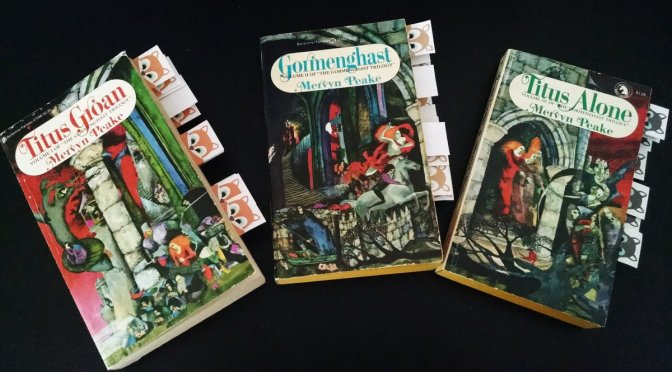
I actually tried to read Gormenghast back in the early aughts, but the enormous annotated version of the trilogy I bought back then was impossible to enjoy—too-small print, too-thin pages, too heavy to hold comfortably and too large to fit in any purse I owned—so it went the way of my old copy of Ulysses, which I also never got more than a couple dozen pages into. This time around, I knew I needed to look for some more manageable copies of the books if I was going to spend some months reading and writing about them.

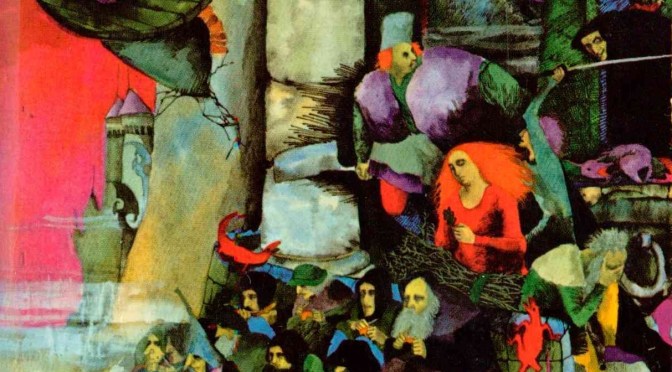
In the end, I settled on the Ballantine mass markets first printed in the late 1960s (though mine are later printings ranging from 1974 to 1977—Titus Groan, Gormenghast and Titus Alone, if you’d like to copy my exact reading experience. These editions have some gorgeously strange cover art Bob Pepper, whose work you might recognize from numerous other Ballantine covers from the 60s and 70s (including works by Asimov, Ellison, Moorcock, Dick and others). They also include the author’s original illustrations inside the books, a reasonable print size, and the pleasant weight of paper and nice glued bindings that characterize older mass markets. These things, if you take care of them, will last practically forever. Plus, old books smell amazing (if you’re into that sort of thing, and I am).

That said, all three books in the trilogy are conveniently broken up into chapters, which is how I’ve split them up into bite-sized sections—fifteen sections around 34 pages each in the first two books and ten sections around 28 pages or so each in the third one, which is a good deal shorter than the first two. I’ll be covering three sections per week starting on Monday, June 5. I’m also planning on, perhaps after the first book, perhaps at the end of the project, rewatching the 2000 mini-series to see how it holds up after all these years and examine how it works as an adaptation of the books.

The first three posts will cover:

  • Part One: Chapters 1-3
  • Part Two: Chapters 4-9
  • Part Three: Chapters 10-13

After this, I will include further section information as part of my weekly State of the Blog post as well as at the end of the last post in the series each week. Additionally, each post will be tagged “Let’s Read! Gormenghast” and there will be a link straight to the project on the navigation bar at the top of the blog.

Readers, I am so excited about this project. While the US might be going to hell in a handbasket, I have no expectation of any barriers on my end to staying on task and finishing this project as planned, and having started the reading, I can already tell I’m going to love these books. It’s going to be a fun summer here at SF Bluestocking.

Sci-fi and Fantasy books, tv, films, and feminism