Category Archives: Television

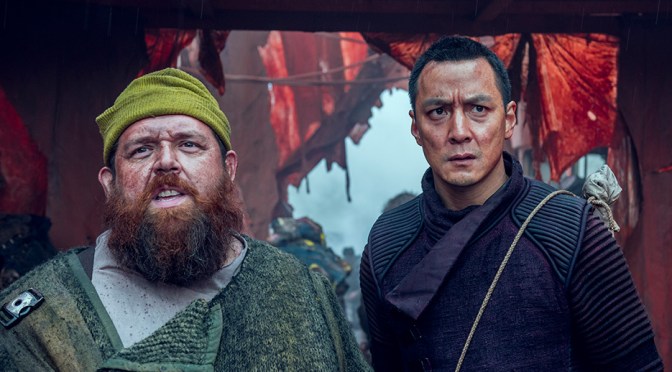
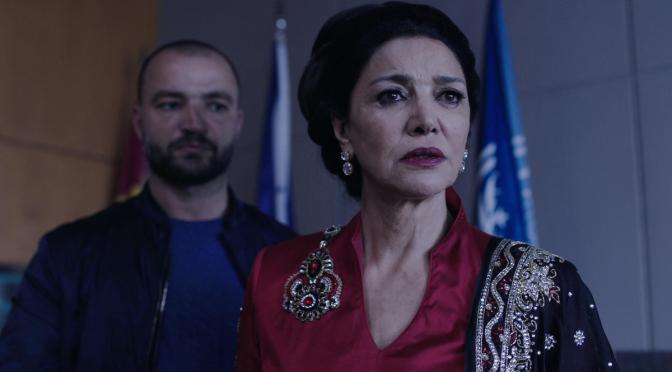
Into the Badlands: “Leopard Stalks in Snow” takes some [possibly unnecessarily] dark turns

Into the Badlands has always been a show with sharp edges and dark corners, and “Leopard Stalks in Snow” takes things to perhaps the darkest place the show has ever been. We’re past the halfway point of the season now, and already we’re starting to see all the show’s disparate storylines begin to converge. This week showcases more than one significant reunion, a couple of big revelations and several potential major conflicts on the horizon. All in all, there’s a definite sense of an enormous storm brewing; it just remains to be seen if all this build-up is going to pay off in the end.

**Spoilers below.**

The pre-credits scene this week picks up right where last week’s episode ended. Lydia is reeling, disoriented and bloody after the explosion at the entrance to Quinn’s secret compound, and the men she led there are strewn about, some in actual pieces, as Quinn walks among them cutting the throats of the wounded. It might be the most gruesome scene of the show to date, to the point that it’s uncomfortable to watch. It’s saying something, really, that this isn’t the hardest to watch scene of the episode, to be honest, though Quinn’s quiet “Hello, Lydia” is chilling. Their reunion goes about as well as one might expect. Lydia is angry about Quinn killing Ryder; Quinn makes things all about himself; Lydia tries to stab her estranged husband; Quinn kisses her; and things get weird. I’m curious to find out if Lydia’s response here is real or if it’s calculatedly feigned. Either way, gross, and we don’t see Lydia again this week.

Sunny and Bajie get rid of Portia and Amelia early and unceremoniously, which is disappointing. I didn’t expect for those two to become a permanent fixture in the show, but the way they’re so quickly disposed of here—I don’t recall even seeing Amelia onscreen, and we only see Portia for a moment—borders on disrespectful and practically reduces them to furniture in Sunny and Bajie’s story. While Sunny does have a short talk with the man they leave Portia and Amelia with, that conversation is almost entirely about reassuring Sunny that he’s an okay guy and absolving him of responsibility for Portia’s injury. Sure, Into the Badlands has no dearth of interesting, complex and empowered female characters with stories of their own, but it wouldn’t have taken that much time to give Portia and Amelia the dignity of a proper ending to their story that wasn’t all about Sunny and his feelings.

Elsewhere, Ava catches up with M.K. and they continue traveling together, hoping to escape the Abbots, who are already hunting them using a device that can track M.K.’s gift. Before the Abbots catch up to the young fugitives, however, they’re sidetracked when the device picks up something else and leads them right to Bajie, who evades them by hiding underwater. Sunny follows the Abbots alone when Bajie refuses to go with him, and he catches up to them about the same time they catch up with M.K. and Ava, who are camping in an abandoned shopping mall Christmas display. This leads to the big showpiece fight scene of the episode, which is fine. We get to see Daniel Wu square off again Cung Le, which is cool; we learn that Bajie’s was once an Abbot as well, which is interesting; but the whole thing is marred by the tragically predictable fridging of Ava, who dies in the battle. And this after a genuinely compelling scene between M.K. and Ava where they Ava talks about her feelings of loss of identity now that they’d left the temple. This comes into play during Ava’s actual death scene, when she fears that if the Master lies, there may be no rebirth for her after death, just nothingness. Unfortunately for Ava, Sunny steals her thunder by having some kind of heart attack and collapsing, drawing M.K.’s attention away from her final moments so that it’s not just a fridging—it’s a poorly executed one in that the full impact of Ava’s death is considerably blunted.

I’m starting to think that, ultimately, the biggest and most interesting conflict of the season may end up being between the Widow and Tilda. Tilda’s big scene this week is with new butterfly Odessa, who is planning to leave after hearing that the Widow is planning to ally with Quinn to take down the other Barons. In response to Odessa’s concerns, Tilda shares her own story of how she met the Widow and why she calls the Widow “mother.” I’m not sold on the necessity of yet another story involving sexual abuse of a child, even if it does end with the Widow murdering her rapist husband and apologizing to Tilda for not doing it sooner, but it does set up a fascinating potential for future conflict. Tilda has deeply personal reasons for standing by the Widow, and Odessa brings an important outside perspective to challenge Tilda’s loyalty to her baron, but there’s an even bigger test of Tilda’s loyalty likely coming soon.

Last week, Veil finally escaped from Quinn, and this week she and Henry are found by one of the Widow’s butterflies and brought to the Widow’s estate where she meets Tilda again. The Widow offers Veil shelter and safety, theoretically anyway, in exchange for going back to work on trying to translate a book about the mysterious city that everyone is so obsessed with. However, when Quinn learns that the Widow is sheltering Veil, he demands Veil be returned to him as a condition of the alliance between himself and the Widow. Perhaps unsurprisingly, but nonetheless infuriatingly, the Widow, in the end, decides to turn Veil over to Quinn. It’s a horrendous betrayal of Veil, and the decision of a white woman to sell out a black woman to a white man for, essentially, personal gain is much worse than I think is even intended by the show. The Widow may think that she has a just cause and a greater good that she’s serving, but this action is also a betrayal of any principle she thinks she might have, and it’s solid proof that Odessa is right not to trust her. Veil’s expression of abject horror at the prospect of being sent back to Quinn is more than enough to paint the Widow as a villain here even if the Widow hadn’t just come up with some bullshit reason for why her conscience is clear. This isn’t the sort of thing she’ll be able to keep from her Regent, though, and Tilda isn’t going to like it.

Miscellaneous Thoughts:

  • “Like you don’t have secrets.”
  • Sunny’s compunctions about killing have evaporated pretty quickly.
  • I’m curious how far in the future this show is supposed to be set. If it’s far enough in the future that a holiday as recognizable as Christmas has faded into obscurity and is just some weird thing ancient people used to do, it would be unlikely that an elaborate mall display would still be intact. Alfred Gough and Miles Millar had a similar scene in their other far future fantasy show, The Shannara Chronicles, and it was just as weird and out of place there. I guess they just like that juxtaposition of the future-fantasy with ruins of modern times, but it’s not nearly as visually interesting or thematically compelling as they seem to think it is.
  • I wish Tilda and Odessa would have had a couple more scenes before now to lead up to their romance a little slower. There was that one scene a couple episodes ago where I was pretty sure they were flirting, but that was it until now. For all that the Widow fills her home with younger women, Tilda often feels very isolated, and the emotional intimacy she has with Odessa feels very abrupt, which makes the physical intimacy feel rushed as well. I like these characters together, but I’d love to see their story have a little more space to grow at a more leisurely pace, especially considering that the conflict between Tilda and the Widow seems likely to be hugely important in the coming weeks.
  • I would also love to go at least one episode without having to listen to Waldo mansplaining something.

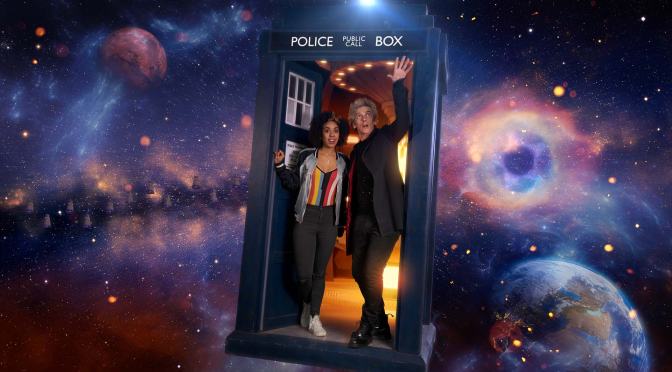
Doctor Who: “Smile” has too many ideas and not much to say about any of them

True to Doctor Who tradition, the second episode of season ten sees the Doctor and Bill Potts traveling far into the future. Usually these far future trips are less plot-focused and more character-driven, often with a commentary about the human condition, and “Smile” is definitely in all of those neighborhoods. If last week’s “The Pilot” was about introducing the show to new viewers and putting the new companion through some of her madcap adventuring paces, “Smile” (like “The End of the World,” “New Earth,” “The Beast Below” and others) is about testing the companion’s limits and challenging her (and the viewer’s) expectations about the future. Unfortunately, not every episode of this type can be a classic like “The End of the World” or “The Beast Below,” and “Smile” isn’t great, mostly because it gets a bit bogged down in being a sort of vaguely anti-technology polemic against emoji.

**Spoilers below.**

Our first glimpse of Gliese 581d is of vast wheat fields and blue skies over a beautiful, albeit stark, white building. It’s not a particularly unique setting for a Doctor Who episode, and it’s the sort of bland sci-fi futurist imagery that just screams dystopia. It’s fine. It is a kind of dystopia, as we’re soon to find out, inhabited by emoji-faced robots, swarms of murderous microbots (Vardies) and a ship full of refugees from a future Earth crisis. The Doctor and Bill arrive right after the robots have murdered the first wave of human colonists who were responsible for preparing the planet to receive the rest of the refugees, who have been kept in stasis. After making a macabre discovery in a greenhouse, the Doctor and Bill have to piece together what happened to the original people before a bunch of very confused robots kill them all.

The emotional core of the episode is Bill coming to terms with a future for humanity that isn’t what she expected or hoped, and Pearl Mackie continues to play Bill with such expressive sensitivity (balanced by heaps of cleverness) that this emotional journey mostly works. There’s some incoherence in the middle as Bill throws herself into uncovering the truth about what’s happened on Gliese, but for the most part it’s easy enough to understand Bill’s feelings. Her sadness and distress as she learns about the future history of Earth are relatable enough, though the episode would have benefited from spending a little more time on Bill’s feelings, just in general. Mackie is such a beautifully emotive actor that it’s a shame to force her to cycle so quickly between feelings-having and doing cleverly competent companion stuff without allowing the feelings to breathe.

One could make the argument that this was intentional and thematically consistent in this episode, what with the enforced cheerfulness that Bill is forced to perform for the emoji-bots, but it’s an episode that is, frankly, full of mixed messaging and missed opportunities for thematic resonance. It touches on several theoretically interesting ideas—the alleged shallowness and limitations of emoji-based communications, the potential for miscommunication when using emoji, and the gendered (and age-dependent) enforcement of public happiness—without managing to have much to say about any of them. As uncomfortable as it is to see an older white man constantly reminding a young woman to “Smile!” the episode has remarkably little to say about the phenomenon, which seems like a huge missed opportunity, and I would love to see this idea tackled by a capable female writer with some awareness of the discourse surrounding this particular patriarchal expectation for women and children.

When it comes to being critical of emoji, the episode is a little more capable, but it relies on a straw man conception of what emoji are, how they are used and what they might be used for in the future. Rather than making any kind of insightful point, there’s an underlying tone of a middle-aged man grumbling about kids these days. Similarly, the warning tone the episode takes towards human reliance on automated technology in general suggests a, frankly, boring Neo-Luddite alarmism about the dangers of artificial intelligence and the hubris of human ingenuity. This messaging becomes even more muddled when combined with the seemingly agrarian aspirations of the Gliese settlers, which is strongly at odds with the warlike, violent humans that are awoken by the end of the episode, whose first instincts are to defend themselves with force against the confused robots that killed their friends.

There are a whole slew of popular sci-fi concepts and tropes in play here, but “Smile” would have been a stronger episode if it decided to focus on one or two and commit to exploring a strong central thesis. It’s not a terrible episode, and Bill continues to charm (she’s the most promising new companion since Donna, in my opinion), but it’s definitely a case of an episode trying to do both too much and too little, with a lazy premise and overall lack of cogent vision.

Miscellaneous Thoughts:

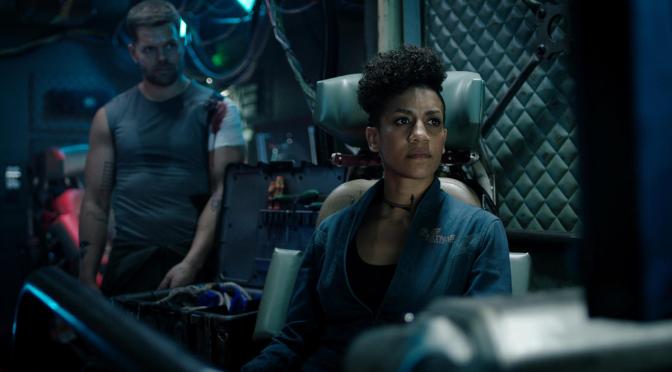
The Expanse: “Caliban’s War” reveals some things but resolves too little to be truly satisfying

I suspect I’m about to express an unpopular opinion, but here it is: I found “Caliban’s War” a little disappointing. It’s a solid enough episode, and it was enjoyable to watch, but not much actually happened or was resolved and after last week’s stellar penultimate episode it felt a bit anticlimactic. There’s still plenty to be excited about looking forward to season three, and I am excited and looking forward to it, but I was hoping to a more conclusive ending to this season or perhaps a bigger reveal. Instead, we got an hour that picks up right where “The Monster and the Rocket” left off and happens almost in real time before capping the season with a(n admittedly great, if grim) final montage. It’s fine, but it’s not as big or dramatic as it could or should have been. It just doesn’t feel like a season finale, which makes it even more sad that we’ve got to wait until 2018 for season three.

**Spoilers Below**

The biggest disappointment, for me, was the wrap-up of events on Jules-Pierre Mao’s yacht. Last week ended with guns drawn, and this episode starts with shots being fired. Cotyar is shot right away, and they’ve only got the one small gun against several of Mao’s security guys, so they’ve got to think their way out of the situation they’re in, which is hiding behind a table trying not to get murdered. There’s some excellent banter—I love the dynamic between Cotyar, Bobbie, and Avasarala—before Bobbie heads into the wall to go to their ship and retrieve her power armor, which Cotyar brought with them for, well, reasons, I guess. It’s not really explained, and, while it makes sense why the armor might have been brought, it doesn’t make a lick of sense why Bobbie wasn’t told about it before they found themselves pinned down in a room with only one door and no pre-planned strategy.

Bobbie’s journey to get the armor out of the ship is largely uneventful. She almost gets hit by an elevator, which it’s obvious is not going to hit her because if it did she’d be splattered all over. It’s an attempt at injecting some tension and drama into the situation, but the time could have been better spent elsewhere. Similarly, while Bobbie’s conversation with the electrician that blocks the final door to the ship touches on some season-long themes about loyalty and trust and choosing who and what to fight for and what hills to die on, it’s played for laughs in a way that undermines the message and cheapens Bobbie’s character growth. There’s a short scene with Cotyar and Avasarala that deals with some overlapping ideas about loyalty and obligation and indebtedness and honor in a more serious fashion, but the overall tone of about eighty percent of the Avasarala-Bobbie-Cotyar material this week is light enough to be at odds with, frankly, any serious message they’re trying to get across.

I can see the appeal of maintaining a degree of levity somewhere in such an overall dark episode, but this storyline could have been treated somewhat more seriously, especially since it’s the one storyline this week that ends on something of a positive note when Bobbie gets back to Cotyar and Avasarala just in time to rescue them from certain death. Unfortunately, this is where I started to resent the time that was spent in the elevator. We barely get to see any actual fighting, and it’s over very quickly. I’m starting to suspect that this is due to budgetary limitations; the armor is just a costume made to look cool, after all, and it’s possible that a long, well-shot close quarters combat action scene using it would be expensive, time-consuming or otherwise difficult from a production standpoint. Still, it’s too bad. We didn’t get to see the battle on Ganymede, which at least made narrative sense since they wanted to keep it vague so the event could be slowly revealed through Bobbie’s flashbacks, but I was certain that the fight on the Guanshiyin would be a major showpiece of the finale. Disappointing.

On the Rocinante, there’s a sweet reunion (though it’s a bit hand-wavy about where they are, how Naomi and Amos got back to the ship, and how long it’s been since they left Ganymede) that is broken up when they realize that the protomolecule hybrid is down in their cargo hold. Holden, predictably, wants to go down there and shoot it, which is exactly what he and Amos do and works out exactly as terribly as anyone who’s been watching this show for two seasons now could have predicted. Holden ends up magnet-ed to the wall with his leg crushed behind a huge metal box of stuff, and Amos retreats into the ship while the hybrid starts trying to dig its way through the metal bulkhead to get to the nuclear reactor that runs the ship. Some quick brainstorming by the crew doesn’t come up with any great solutions to the problem, but they do have a limited amount of time to figure it out and rescue Holden before he dies from his injuries.

They finally settle on a plan to seal off most of the Rocinante and then use pressure to vent the hybrid into space. The problem with this, however, is that it will almost certainly kill Holden as well. The crew spends half of the rest of the episode preparing to carry out this plan until Prax has a last-minute idea that allows them to get rid of the hybrid without killing the captain. Like Bobbie’s journey up the elevator shaft on the Guanshiyin, there are parts of this storyline that feel unnecessary, and Holden’s danger never feels quite real. The time spent preparing for the plan that is never actually used does offer some time for some excellent character work on the part of the crew. Though it might feel to the audience that Holden is going to be okay, the rest of the cast does a great job selling their anxiety and regret, and there are several truly excellent apology and goodbye speeches. It’s a bit of a State of the Crew recap to establish where all these relationships are at now at the end of the season, and if it’s a little heavy-handed and somewhat maudlin, it’s still entertaining.

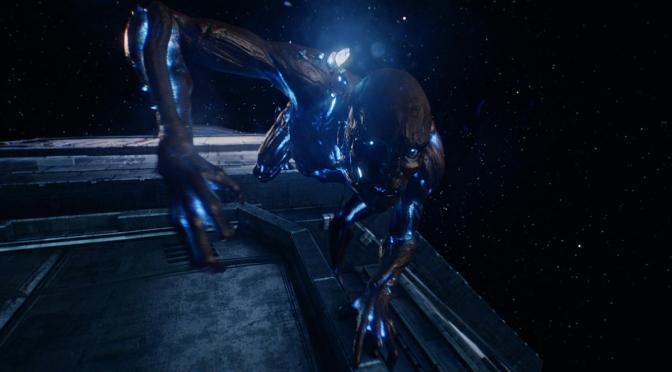
The actual method by which they lure the hybrid out of the ship is fairly straightforward. Because the hybrid feeds on radiation, they can turn off the ship’s engines, take a nuke outside, open its casing and draw the hybrid out that way. When they throw the core of the nuke into space, the hybrid leaps after it, at which point Alex fires the Roci back up and points the ship’s afterburners at the hybrid to destroy it. If there’s anything perfect about this episode, this moment is it. It’s a clear (and beautifully executed) homage to the scene near the end of Peter Jackson’s The Return of the King, when Gollum wrests the Ring away from Frodo and falls into the lava of Mount Doom. Superficially akin to Gollum in shape, the protomolecule hybrid chases after the ball of radiation with similar intensity and the pose of the hybrid in its final moments, curled in an almost fetal position around the ball as the Rocinante’s engines turn on, is almost exactly the same as Gollum’s last pose as he falls to his death. I love it.

The episode ends with a longish montage in which three major things happen. Bobbie, having retrieved her armor, rescues Avasarala and Cotyar; Naomi confesses to Holden that she didn’t destroy their protomolecule sample, and, when she thought she might die on the Weeping Somnambulist, she gave the protomolecule to Fred Johnson; and, on Venus, the Arboghast, which had been descending to investigate the Eros crater, is spectacularly destroyed, broken down to its component parts, presumably by the protomolecule there. Of these, the fate of the Arboghast has a sense of momentousness that the rest of the episode’s events didn’t have, but it’s not entirely clear what has happened or why or how or what it means. Naomi’s revelation to Holden wasn’t the revelation I was hoping to see this season end with, but it’s also important. It would have been nice to get a little more of Holden’s reaction to this news, but we’ll have to wait until next season to find out how this changes things between him and Naomi. We’ll also have to wait to see what kind of hell Avasarala is going to rain down on Errinwright when she gets back to earth, though that wait was at least expected. I already have a feeling that season three is going to be epic.

Miscellaneous Thoughts:

  • I would love for more exterior shots or maybe a virtual tour of the Guanshiyin. The outside shots of it are gorgeous, as is the room everything happens in. It’s more than pretty enough that I can forgive the hallways for being somewhat generic and plain white, but it would be neat to see more of it even if they don’t put it all in the show.
  • Holy shit, shirtless Amos was fucking glorious.
  • I loved the evolution of Iturbi and Janus into science bros.
  • Amos seems to draw a distinction between “always trying to do the right thing” and “always trying to be a good man,” and this seems like the kind of thing that one could write whole essays on. It seems like a distinction without a difference to me, but it’s one of the few (maybe the only) specific comments the show has ever made on gender. I’m still mulling over it, though.
  • If we weren’t going to see Mei get rescued this episode, I could have done without that final scene of Strickland putting her into storage. I particularly disliked that smug little “sweet dreams” line, which practically broke the fourth wall.

iZombie: In “Eat, Pray, Liv,” Ravi digs the deepest hole. He lives there now.

After the big shake-up in the season two finale and dealing with the fallout from those events in the first couple episodes of season three, iZombie is already getting back to a more routine formula, and that’s not a bad thing. The case of the week concerns a murdered yoga instructor, and it’s a below average mystery at best. There are a couple of good Liv and Clive moments during their murder investigation, and it’s interesting to see Clive getting more comfortable with Liv’s zombie abilities, but the main events of the episode all concern secondary characters.

**Spoilers ahead.**

Major is working his way through mercenary training at Fillmore Graves, where it turns out that having been a personal trainer and generally fit still puts him way behind a group of guys who were apparently already mercenaries before they even became zombies. Major also doesn’t like the brain tubes that they eat at Fillmore Graves: “It’s like someone ate old brains, then yogurt, and then mommy birded them into a tube.” Which sounds about right, but Major has bigger problems. As we’ve already been reminded last week, the non-working version of the zombie cure that Major took will likely kill him if nothing else is done, and this week Major starts exhibiting some symptoms, mostly in the form of a persistent cough that Ravi diagnoses as a mild case of pneumonia. It’s a more tangible reminder, this time, that Major’s time is potentially very limited, and this episode sees him taking more steps to try and find Natalie, a quest that has a new urgency with Major being unable to deny anymore that he may be dying. Also of interest this week are Major’s several long, sad looks at Liv. He’s obviously still in love with her, but it remains to be see whether he is going to say anything to her about it or if he’s just going to keep suffering in silence.

Blaine’s dad, Angus DeBeers, is back and in a big way. First, Angus gets his lawyer to come with him to take back Blaine’s inheritance, which gives us yet another scene that proves Blaine isn’t faking his amnesia. Angus then spends the rest of the episode working with Don E. to open a new zombie club. It’s not entirely clear what exactly they’re planning to do here and how they’re somehow going to turn it into a revenge against Blaine, but they’ve got the place, it’s zombies only, and Don E. is about to go on a scratching spree. It’ll be interesting to see how these plans work out, especially for Angus, who doesn’t seem able to inspire much loyalty in his new lackey, judging by the wistful look we see Don E. giving Blaine at the end of the episode. And let me just say, Don E. staring wistfully at Blaine through a rain-covered window might be my favorite single image of the season so far.

The big thing I want to talk about this week, however, is Ravi and Peyton. I haven’t been thrilled with how Ravi has been behaving the last couple of weeks, and I’ve been concerned that his sad man story might be dragged out for a long time. I shouldn’t have worried. This is the episode where Ravi torpedoes his relationship with Peyton and possibly their whole friend group.

After Liv stops putting up with his constant moaning about Peyton and tells him to go talk to Peyton about it, that’s exactly what Ravi does. Peyton is at first receptive to his apology, as she’s been confused and hurt about Ravi’s coldness towards her, but things go off the rails quickly, with Ravi seeming to low key blame Peyton for his intrusive thoughts and then framing his apology to her in such a way that it’s clear he’s expecting his apology to be reciprocated. It’s the worst sort of sexist bullshit, and Peyton is not having it. She doesn’t have anything to apologize for, she’s not responsible for Ravi’s intrusive thoughts, and she’s got her own shit to deal with. It’s not often that we get to see a woman on television deliver such a great shutdown of men’s garbage like this, and it’s even rarer to see it portrayed as entirely justified and correct. It’s not that Ravi is completely unsympathetic; it’s just that he is completely in the wrong here and being monstrously unfair to and manipulative of Peyton.

Things get worse later on when Ravi and Liv get Blaine to come to the morgue so they can try to convince him to test the memory restoration serum that Ravi has come up with. Blaine, very understandably, doesn’t really want to have his memories back. He doesn’t remember the evil things he did, and his amnesia offers him the chance for a fresh start. Ravi argues that Blaine owes them this, and Ravi goes on a bit of a rant that culminates with him confessing his love to Peyton. Blaine finally agrees to test the memory serum, but Peyton isn’t immediately responsive to Ravi’s declaration of love, so Ravi goes out and sleeps with his old boss, Katty. This is found out when Peyton shows up at Ravi’s place. They’re talking in the foyer, Ravi kisses Peyton, and then Katty drops a wine glass in the other room, at which point Peyton walks into the kitchen and sees the other woman wearing no pants. The whole situation is on the one hand almost laughably contrived but on the other hand not exactly out of character for Ravi at this point. Once again, Peyton is not putting up with Ravi’s shit, though, and she leaves, immediately, and goes to join Liv and Major to listen to Blaine singing.

I almost feel bad for Ravi, but only in the way that I would feel bad for anyone who repeatedly punched themselves in the crotch for no reason. He just makes all the worst possible decision with how he deals with his feelings for Peyton, and it’s hard to watch. It’s, honestly, something of a bold move for the show. Ravi is a fan favorite character, partly because he’s generally delightful, and this storyline forces the viewer to see him in a very different and extremely unflattering light. That said, I am so glad that it’s made so clear that he’s the bad guy here. Peyton hasn’t done anything wrong, and Ravi hasn’t done anything right with her for a while now. We’re seeing something of a darker side to Ravi this season, and while I’m glad this storyline is moving along quickly I also hope the show doesn’t let Ravi out the hole he’s dug for himself anytime soon. He’s not the worst, and he’s not irredeemable, but they definitely should take their time.

Miscellaneous Thoughts:

  • Blaine’s new job is as a lounge singer, which is obviously/hopefully just a perfect excuse to have David Anders sing every week.
  • Justin seems nice, and I’m glad Major is making a friend. They’re adorable together, and I feel like there’s already a subtext of “It would be a shame if something happened to one of them,” and I hate that subtext.

Into the Badlands: “Monkey Leaps Through Mist” is a solid transitionary episode after last week’s big events

Sunny and Bajie are back this week, M.K. still doesn’t get much screen time, the Widow is reassessing her situation, a major character death is dealt with, and things are not going super well for Quinn. “Monkey Leaps Through Mist” is primarily an episode about regrouping after last week’s events, and, consequently, it feels relatively slower-paced, especially with only one fight scene. Still, there’s some good character work, a couple of surprises and the beginnings of what might be the show’s next major shake-up.

**Spoilers below.**

The pre-credits scene confirms Ryder’s death. I was pretty certain he was dead last week, but I was also pretty certain that Quinn was dead at the end of the show’s first season. Given this show’s tendency to the occasional soapy plotline, a fake-out wouldn’t have been terribly surprising. What is surprising, however, is the ease with which Jade takes up her husband’s title. Ryder’s regent, Merrick, administers Jade’s oath right over Ryder’s dead body, with no fuss at all. There is a slight tension to the moment, but only because viewers may be primed by years of pop culture consumption to expect a group of fighting men to reject the leadership of a woman. Personally, I appreciate the matter of fact subversion of that expectation, especially because it does seem so normal within the world of the show, or at least within this moment in that world.

The other thing that Jade accomplishes more easily than I would have expected this week is getting Lydia to work with her to avenge Ryder’s death. It makes sense that Lydia would want to kill Quinn for what he’s done—and even more sense when we learn that Lydia had always wanted more children but been unable to have them—but the arc leading Lydia to this feels unfinished. She hasn’t gotten much to do so far this season, and we’ve been shown that she isn’t exactly fitting in back with her father’s pacifist cult, but it still seems almost inexplicable that she would so quickly join with Jade, be given command of clippers (whether she knows where Quinn’s hideout is or not) and take up a sword to lead an attack. Fierce as Lydia is, there’s never been any inkling that she was a trained fighter and in fact we’ve only been shown that she’s quite capable of defending herself through sheer grit and has a willingness to kill when desperate. Which is something to build on, but this week’s developments are abrupt and somewhat disorienting. It’s easy enough to buy Jade’s elevation to Baron—she was always ambitious—but Lydia’s sudden shift from trying to make it work with her dad’s pacifists to leading the attack on Quinn is harder to justify as a natural character progression.

Sunny and Bajie arrive at a town that is controlled by a friendly acquaintance of Bajie’s, Nos, who trades in metal and sex slaves. They trade Nathaniel Moon’s sword for a way into the Badlands, but before they go they have to get through a night in Nos’s village. Bajie settles in well enough, enjoying the company of one of Nos’s Dolls, but Sunny is unsettled by it all, especially when he meets a little girl named Amelia and her mother Portia. Knowing that Amelia will soon be used as a Doll, Portia approaches Sunny to ask him to kill Nos, but he refuses. When Nos finds out about this, he cuts Portia’s face, and prepares to use Amelia sooner rather than later. This finally spurs Sunny into action, and he and Bajie manage to rescue Portia and Amelia before escaping in the vehicle Nos has provided to get them to the Badlands.

I liked this fight scene, but Sunny’s newfound set of rigidly (and stupidly) inflexible morals are going to get people killed. His proscription against killing for hire almost does get Portia killed this week, and he was willing to let a little girl be trafficked into sex slavery before killing an evil man. It doesn’t exactly speak well of where Sunny’s priorities are, and it’s not clear that he’s truly learned anything from this most recent experience. In the end, he still didn’t kill Nos, which leaves numerous other women and girls trapped in a terrible situation and sets up Nos to be a recurring adversary along with the Engineer and Nathaniel Moon, both of whom are still floating around somewhere and almost certainly wanting Sunny dead. This cycle is starting to get repetitive, but I’m encouraged by the fact that Sunny now knows that Quinn is alive and at least suspects that Veil may be with Quinn. It makes Sunny’s goal moving forward a little clearer. Now he just has to get there without trailing a bunch of pissed off murderous bastards behind him.

Elsewhere, Tilda is apologizing to her mother for disrupting the conclave. However, the Widow isn’t upset. She even praises Tilda’s instincts and encourages her to trust her gut feelings. The Widow is not happy with Waldo, though. Waldo advises that the Widow earn back the other barons’ good will by capturing or killing Quinn, but she’s having none of it. Instead, she says that she plans to ally with Quinn against the other barons, which seems like a completely terrible idea, but she basically tells Waldo that he needs to make it happen. I mean, honestly, this seems like the worst idea, and there’s not much attempt made to justify it in the text, either. It seems impulsive, which is in character for the Widow, but there’s no clear gain for her in allying with Quinn, who she doesn’t know well and who has turned into an unpredictable force of chaos. Granted, the Widow can’t have much of the information that the audience has about Quinn’s illness and deteriorating mental state, but that seems like even more reason for her to avoid him. Their opinions were never aligned before, so what on earth could she be thinking now?

Speaking of Quinn’s deteriorating mental state, he is not doing well following the murder of his son. He’s followed throughout the episode by visions of Ryder’s ghost, and ghost Ryder has lots to say, digging at every one of Quinn’s insecurities and fears until Quinn is having a full-on paranoid psychotic break and threatens to kill baby Henry until Veil is able to calm him down by reassuring him of her care and appreciation of him. It’s a week of close calls for Veil, who has already in this episode had to explain (and not very well) to Declan what happened to Edgar and why she’s hiding x-rays that still show Quinn having a tumor. All that tension leads, ultimately, to Veil’s newest escape attempt. When Lydia and her clippers show up, a booby trap goes off at the entrance to the underground compound, and Veil manages in the confusion to run out into the woods with Henry. It doesn’t take long for Quinn to notice she’s missing, though, and it remains to be seen how Veil’s latest gambit works out.

Miscellaneous Thoughts:

  • “Peace through force and justice without mercy” might sound cool, but that’s no philosophy for an effective form of government.
  • I’m not convinced that it was really necessary to make such a big show about how vile Nos is, especially with Amelia. It was genuinely upsetting to watch.
  • When I first saw M.K. this week I thought perhaps he was rededicating himself to his studies. LOL. Nope.
  • Why is there a tree full of hanged men in the middle of the woods?

Doctor Who: “The Pilot” is a reasonably well-done soft reboot for the beginning of the end of the Moffat Era

Last time I reviewed Doctor Who it was the most recent Christmas Special, “The Return of Doctor Mysterio,” which was enjoyable garbage. I haven’t been particularly excited about the show in several years, to be honest. Like many people, especially feminist people, I’ve found the Moffat era, well, trying, to say the least, so I was pretty certain that the best news about series 10 of the rebooted show was that it was Steven Moffat’s last one as showrunner. Then the announcement came that Pearl Mackie would be playing new companion Bill Potts, and she seemed delightful. Then a couple weeks ago the news broke that Bill was to be the show’s first gay companion, which brought a new round of both delight and apprehension. It turns out, however, that the first episode of the new series, “The Pilot” is neither as wonderful as long-time fans might have hoped nor as disastrous as pessimists might have thought a Moffat-penned episode introducing a black gay woman would be.

Peter Capaldi is back as the Doctor, and this time he’s been lecturing, for decades apparently, at St. Luke’s University in Bristol. Bill Potts works at the university canteen, but she also attends as many of the Doctor’s lectures as she can get to. The episode opens with the Doctor wanting to know why. He likes Bill—partly because, he says, when she doesn’t understand something, she smiles, which is a nice bit of characterization that, if it doesn’t set Bill apart from previous companions, is a great memorable line of description that quickly gives us an idea of who Bill is. At any rate, it’s a good sight better than Bill’s rambling story about her crush on a girl who comes into the canteen every day, which is cute—and it’s nice to see Bill’s gayness treated so casually—but also somewhat silly. When the Doctor offers to tutor Bill privately—on “everything”—Bill naturally jumps at the chance, although her emotionally distant foster mother is less than supportive.

The episode’s rather slight plot starts and ends with Bill’s newest crush on Heather, a quietly misanthropic girl with a distinctive star-shaped defect in one eye. Heather shows bill a strange puddle that is surrounded by a circle of scorch marks, and when Heather gets swallowed up by the puddle and then starts chasing Bill around, the Doctor gets involved. Amidst a great deal of the kind of 101 level exposition—TARDIS, cloaking device, chameleon circuit, bigger on the inside, Daleks, etc.—that will be redundant and boring to longtime fans but invaluable to first time watchers, we find out that the puddle is actually a sort of sentient space oil left by a now-departed spaceship. If that seems like pure, nonsensical speculation, just wait until the scene where the Doctor and Bill are talking it through and figuring out how it works by using basically the same kind of deductive reasoning used by Sir Bedivere and a horde of angry peasants to identify a witch in Monty Python and the Holy Grail. This would be funnier if it was obvious that it was an intentional reference, but it’s, frankly, just the kind of low-substance mystical gobbledygook that has characterized many Who episodes during Steven Moffat’s tenure as showrunner.

It’s fine, though. Bill’s not-quite-fledgling romance with Heather is sweet, and Pearl Mackie plays Bill with a lovely sensitivity and vulnerability that makes it easy to believe that Bill could be deeply affected by what has been just a fleeting connection with Heather. The scenes of Bill being chased by the drowned Heather from the puddle are suitably frightening in the ordinary PG way one expects of the show, and there are even one or two almost-jump-scares that heighten the sense of fear and urgency. The chase gets Bill onto the Tardis and offers as good an excuse as any for her to get a bit of a tour and for the Doctor to put the Tardis through her paces, again presumably for the benefit of new-to-the-show viewers. It’s a good way for everyone to get the lay of the land after so much time without regular episodes of the show, and it also takes time to introduce the beginning of what seems likely to be the season-long arc: What is the Doctor hiding at St. Luke’s, and why?

It’s not quite as whiz-bang as some other Moffat-penned episodes, but “The Pilot” is quick and snappy, filled with short scenes, fast talking, and lots of running around. It at times feels as if it’s going through a checklist of “Things Steven Moffat Wants Us to Know About the Doctor and His New Companion,” but it’s mostly coherent, albeit sometimes absurd. Increasingly in recent years, I find that the less I think about Doctor Who the more I enjoy it, and that is almost certainly still going to be the case in this new season. “The Pilot” wasn’t as bad as I worried it might be; it’s just exactly what the show has been since Steven Moffat took it over. I’m optimistic about Bill, who I’m already half in love with, but only time will tell if she’s going to get the well-written adventures she deserves. As a soft reboot of a well-loved show, “The Pilot” is a mostly successful, with enough information and thrills to hook new viewers, a promising new companion, and plenty of references to the show’s past to please old-timers.

Miscellaneous Thoughts:

  • It’s good to see another companion with an actual backstory and identity outside of “companion to the Doctor.” Bill already has more depth than Clara was ever given, though it remains to be seen whether Bill will be more consistently written than the Ponds.
  • I like Matt Lucas, but Nardole was utterly forgettable in this episode. It seemed as if they didn’t know quite what to do with him this week, which is too bad.
  • Why didn’t Bill ask the Doctor about his appearance in one of the photos of her mother?

The Expanse: “The Monster and the Rocket” is a brilliantly multilayered penultimate episode of the season

Every time I’ve seen the best The Expanse has to offer this show manages to reach a new height of exciting and thought-provoking entertainment, and “The Monster and the Rocket” is its newest leveling-up episode. It’s a tightly plotted and paced episode that hits every story beat and emotional note exactly right; it’s got layers of meaning and metaphor that make it ripe for critical analysis; and it ends each of its storylines in such a way as to build up maximum anticipation for next week’s season finale.

**Spoilers below.**

The episode opens with Sadavir Errinwright shaving and replaying Avasarala’s recent advice to him in his head. I started humming “Needle in the Hay” about the time he nicked himself and stared pensively into the mirror, but then it cuts to him walking his teenage son, Jefferson, to school. We learn that the elder Errinwright has been having nightmares, and his son is as sweetly concerned as any teenager ever is when their parent is acting strange. Sadavir tries to impart what sounds like some final advice to the boy, which freaks him out enough that Sadavir tries to calm him down with a particularly unconvincing “Everything is gonna be okay.” If there’s any part of this episode that I didn’t love, it’s this opening sequence, partly because the shaving scene feels a little on the nose and partly because, while I appreciate the attempt to humanize Sadavir Errinwright and make sure the audience knows that he’s got a whole life that he’s pissed away on his scheming with Mao, I have a hard time caring too much about this teen son at this point unless he’s going to be more than a throwaway character.

Before the Eros hearings begin, Errinwright meets with Avasarala, who feels bad for him but is still unwilling to sacrifice her own career and credibility to save him from the consequences of his own actions. Chrisjen tries to reassure Errinwright about the outcome of the hearing, but he’s not encouraged and in fact seems very agitated as he forces Chrisjen to hold onto a medal that he hopes she’ll give to his son if things go poorly. She also tells him about her upcoming meeting with Jules-Pierre Mao, and Errinwright insists to her that Mars would use the protomolecule weapon to destroy Earth. Avasarala doesn’t believe that, but Errinwright insists that she must convince Mao of it as well. She doesn’t get to do that, however, because Errinwright’s plan to get himself out of any consequences for his horrible actions is about to be set in motion.

If it wasn’t obvious enough after the opening scene and the short conversation with Avasarala before the hearing that we’re mean to think Errinwright is on the road to suicide, there’s a scene for that. He writes what appears to be a suicide note to his ex-wife, Jodie, and then plays with a small green vial that looks like poison. In hindsight, it’s almost a little too heavy-handed a red herring (not quite, though—I was momentarily fooled), and the next time we see Errinwright he’s coming back into his office after visiting the opera with the Martian defense minister, Pyotr Korshunov. Errinwright pours from a 107-year-old bottle of scotch and starts a sort of “let’s be real” talk about the protomolecule. Soon enough, however, Korshunov collapses, having a heart attack from the poison Errinwright has slipped into the scotch. The poison is one that specifically targets only Martians and was banned under international law, but Errinwright points out that “if you give a monkey a stick, eventually he’ll beat another monkey to death with it.”

Errinwright isn’t willing to let Mars have sole access to the protomolecule—even though Korshunov says they would use it to accelerate their terraforming project—and he’s willing to kill to make his point. At the same time, we learn, Errinwright has the MCRN ship Karakum destroyed before it can pick up the protomolecule on Ganymede. The last step of Errinwright’s plan, it turns out, is to call up Avasarala and Mao, now in orbit on Mao’s ship, and let them know how things are going to be. Mao is instructed to kill Avasara and come back to Earth so he and Errinwright can continue their partnership. As soon as the message ends, guns are drawn and Mao is out the door, leaving Avasarala, Bobbie, and Cotyar in the ship’s lounge with one tiny gun against several of Mao’s security force. And that’s where this story ends for the week! They’ve changed things just enough from the book that I’m not quite sure how it’s going to go down in the season finale, but however it does, Avasarala is going to be furious, and I suspect it’s going to be amazing.

It’s somewhat weird, this late in the show, to shift the primary point of view of a storyline like this, and I wasn’t sold on the change from Avasarala and Bobbie’s POVs to having this part of the story told more from Errinwright’s perspective, but it works well on several levels. Having read some of the books, even knowing that the show has deviated somewhat from how these events occurred in Caliban’s War, it’s interesting to get a POV that we didn’t get in the novel. The POV change is also a great way of revealing the rather vast difference between the way that Chrisjen perceives and understands Errinwright and the way that he really is, which is much more underhandedly ambitious than she has given him credit for before now. Both Avasarala and Mao are caught flatfooted by Errinwright’s actions this week, and so, to a certain extent, is the audience, who has been primed all season long to think the same way Chrisjen does about Errinwright and to see him as a pawn of Mao’s rather than a competent and cutthroat schemer in his own right. Smart writing combined with capable performances on the part of all involved have paid off wonderfully in the form of a genuine surprise and a cliffhanger ending that feels truly consequential.

On Ganymede, the Roci crew is still split up. Holden, Prax and Alex are hunting for the Caliban hybrid in the wreckage of the domes while Naomi and Amos go to see what they can do to help Melissa get the Weeping Somnambulist airworthy so they can help evacuate the collapsing station.

When they arrive at where the Weeping Somnambulist is docked, Naomi and Alex find near chaos and no welcome, as Melissa is still angry about them getting her husband murdered. However, Naomi insists on helping to repair the ship, and Melissa eventually lets her since it needs doing. While repairs are going on, conditions on the station continue to deteriorate, more people keep showing up outside, and things start to get increasingly chaotic as people start to get frightened. Things get worse when Melissa tells Naomi that they only have enough air on board to take fifty-two people out of the well over a hundred who are waiting outside. Melissa closes the door to the ship when people start to get violent, and she and Amos don’t think it’s safe to open in again. Naomi, however, can’t bring herself to leave everyone, and she insists on going out to talk to the crowd, organizing them into groups and taking children first, then young women and men until they can’t take any more. It’s a truly heart-wrenching scene and a superbly executed redemptive moment for Naomi, who desperately wanted to help at least some of Ganymede’s people.

Meanwhile, the hunt for the hybrid isn’t going super well, as it’s hiding and darting about so that Holden can’t see where to shoot it, which has him very much on edge. Holden’s state of mind isn’t helped by Prax being against killing the creature altogether—since they don’t actually know what it is and it might be someone’s young child and the victim of an evil science experiment—and Alex being concerned about damaging the ship and/or getting caught by the MCRN and shot. In fact, Holden seems to have finally gone full Ahab on us, and he’s being absolutely monstrous to the other two men about everything. It’s only when the Karakum is destroyed and it becomes obvious that ships leaving the station—like the Somnambulist—are in need of assistance that Alex puts his foot down and refuses to keep hunting the hybrid. He takes the Rocinante to help, intercepting a torpedo launched at the relief ship, and by threatening (bluffing?) to take out the rest of the Martian fleet they’re able to stop the MCRN from firing any more.

The episode ends with the Rocinante escorting the Weeping Somnambulist to safety, but they don’t know yet that the Roci has a stowaway. The hybrid has torn into the side of the ship, so that’s gonna be a fun discovery next week. Personally, I almost didn’t notice it this week, watching the episode for the first time on a computer monitor; even on a 21” wide screen, it’s small, and the episode was exciting enough that, if you don’t know to look for it, you might be too busy breathing a big sigh of relief for the Somnambulist to catch it. That said, on a 50”-ish television screen, the hybrid tearing into the side of the Roci is pretty clearly visible, so anyone watching the show more traditionally should have no problem seeing it.

Miscellaneous Thoughts:

  • Errinwright’s advice to his son—“listen to your heart”—is reminiscent of Polonius’s advice to Laertes in Hamlet, and the stage metaphor is continued explicitly in Errinwright’s conversation with Pyotr Korshunov later on. I’m not really equipped to analyze that much more deeply, but I’m certain the Shakespearean allusion is intentional and I will read the shit out of anything that someone else wants to write about it.
  • Speaking of “Korshunov,” I choose to believe that’s not a reference to Air Force One.
  • Bobbie and Cotyar bickering is my new favorite thing. I’m definitely going to be looking for fanfic while I wait for season three of the show to come out.
  • Avasarala is a terrible traveler.
  • Chrisjen’s short speech about “Earth’s real gravity” is excellent.
  • “You even arrested my cousin! He’s a monk.”
  • “You people are shit magnets.” #ACCURATE
  • “Please, put those down and step away from the panel right now.” Delivered with exactly the right air of exasperated outrage at seeing something done wrong.
  • “You’re not finished yet.” Not finished crying, that is.
  • “Give me an open channel.”
    “Oh, man…”

iZombie: “Zombie Knows Best” would be better if it wasn’t a showcase for Whiteness

iZombie is a show that has always struggled with issues of race (and even, at times, gender), and “Zombie Knows Best” functions as a showpiece of several of the show’s general race/gender problems. I suspect it’s a writers’ room (more like Whiteness room) problem, to be honest. Still, it manages (though not impressively) to be a solid episode with some enjoyable moments. Clive gets some much needed, albeit extremely belated, backstory; we learn some more about what’s going on at Fillmore Graves; there’s a decent-but-not-stand-out case of the week; and for all that there are significant flaws in the execution of it, Liv and Major on father-daughter brains still delivers some humor if you don’t think too hard about any of it. I’d like to see the show do better, but this episode could have been worse.

**Spoilers below.**

The episode opens with Clive being questioned by Detective Cavanaugh, which seems to have taken place the night before the events that make up this week’s case. Cavanaugh wants to know more about Clive’s relationship with Wally. Clive at first tries to downplay the relationship, but he’s forced to spill when Cavanaugh pulls out a photo of Clive with Wally and his mother, Anna (Caitlin Stryker), in which they all look very cozy. Clive’s answer to Cavanaugh and his memories of Wally and Anna are metered out over the course of the episode, and we learn that Anna’s husband was abusive, which landed him in prison. While the husband was in prison, Clive grew close to Anna and Wally, almost becoming romantically involved with Anna before he went undercover and Anna and Wally moved in with Anna’s brother, Caleb, and somehow got turned into zombies, at which point Anna sent Clive a letter telling him they didn’t want to keep in touch.

This is the most we’ve learned about Clive since the show started, and it’s by far the most real Clive has ever felt. It’s just unfortunate that Anna and Wally had to be fridged in order for Clive to develop as a character, especially when we see how wonderful Anna is and especially especially considering how few women of color have been featured on this show in any kind of positive capacity. And listen. I get it. I understand that this is all about Clive’s regrets and doubts and what-might-have-beens. It’s meant to give a previously enigmatic character some more depth and shape, and there’s nothing like a tragedy to make that happen. However, this is the same show that screwed around for months having Clive date that Dale woman last year only to have nothing ever come of it. They could easily have introduced Wally and then Anna as a love interest for Clive, given them basically the same backstory with the abusive husband and zombification and lost contact, and written a story about Clive reconnecting with Anna and coming to terms with her being a zombie as he comes to terms with the whole zombie thing in general. Instead, we get a pretty much textbook fridging leading to what is moving towards revenge quest territory.

Anna deserves better, and the audience deserves better than this kind of lazy, cliché nonsense, no matter how cleverly the story is told in intricately woven together flashbacks.

The case of the week concerns a father and daughter, Stan and Cindy Chen, who are killed in an obviously suspicious hit-and-run. When Cindy’s friend Winslow sent Cindy a photo of Winslow in bed with her step-dad, Cindy showed it to her father, who insisted that they had to tell the authorities, which turns out to be a motive for murder when Winslow’s mom finds out. There are a couple of interesting twists and turns here, and even a nicely done red herring moment—when we see Major’s flashback to Cindy showing her dad the image on her phone and exclaiming “gross,” the context suggests (briefly) that it could be something zombie-related—but the truth is that this whole case just seems like an excuse to have Liv and Major eat these brains for humor reasons.

Literally as soon as we meet Winslow’s mom it’s obvious that she’s the murderer and the case is solved without much more trouble. Much more time is spent on Major and Liv being entertainingly effected by Cindy and Stan’s brains, which is definitely funny, and it helps to lighten things up since Clive’s story line this week is so dark and sad, but it’s a bit of a cheap laugh. Robert Buckley hamming it up stereotypical teenage girl style loses its charm quickly, and dad Liv isn’t much better. The problem with both of these is that they rely on only stereotypes for their characterization this week, and they’re positively archaic stereotypes at that. Teen girl Major could have been based on the teen daughter in any movie from about 1975 to the present, and Liv’s dad brain seems straight out of the 1950s. Neither of them give us any insight whatsoever into who Cindy and Stan were as individuals, though we know that they were killed on the way to an ice skating practice at 4 am and that they surely had complex internal lives that weren’t boring clichés. That Cindy and Stan were Asian American is entirely ignored in favor of playing with the lower-hanging fruit of “jokes” that are more “relatable.” I suppose it’s for the best that they didn’t go for mocking Asian stereotypes, but I don’t think what they did do, just ignoring the individuality of the characters altogether, is much better.

The worst effect of this is that it makes it difficult to become emotionally invested in the murder victims. Instead, the audience is encouraged to identify more with rich white girl Winslow. Even though Winslow isn’t painted as a particularly sympathetic victim, she still gets significantly more screen time than Cindy and Stan Chen together. We never even learn if Cindy has a mother or if Stan has a wife, and we certainly never meet her if she exists. However, we meet Winslow’s mother and step-dad, we see their business, we learn their history and see something of their family dynamic. It’s a lot of information about them and a lot of attention paid to Winslow’s victimization—we even get to see her skeevy step-dad’s booking on screen—but we don’t meet a single other soul who’s even met Cindy or Stan. I doubt this is maliciously intended, and it’s common for the show to focus on suspects and the main cast rather than on its murder victims, who are often simple plot devices, but still. They usually do better than this at giving us an idea of who their murder victims are and why we should care about them, at least for forty or so minutes.

Miscellaneous Thoughts:

  • Clive’s flashback mustache is surprisingly hot.
  • Liv’s “King of the Grill” apron might be my favorite thing about the episode.
  • Ravi’s angst over Peyton is already boring, and it, frankly, makes him seem like kind of an asshole.
  • Speaking of Peyton, she’s absent this week, as is Blaine. They’re missed, but I don’t know when they could have been squeezed into the hour.
  • The Fillmore Graves zombies eat a mash of different brains that keeps them from having the personality shifts and flashbacks that Liv and Major experience.
  • While much of dad Liv fell a little flat for me, “In this house we eat brains and solve murders!” made me laugh.
  • I’m not sure about the creepy IT guy. His role here seems like a new character introduction, but he’s weird and unfunny and bland enough that I can’t even remember his name. He’d definitely be an unnecessary addition to an already large cast.

Into the Badlands: Sunny’s absence lets the show shine some light on other characters in “Palm of the Iron Fox”

After last week’s relatively slow episode and its extremely frustrating ending, “Palm of the Iron Fox” provides quite a lot of payoff, though it’s not without its own frustrations. I’m glad that we finally get to see the Barons’ conclave, but there’s a major plot event that feels somewhat abrupt, especially this early in the season. Veil finally gets a plot that’s just hers, which might be my favorite thing about the episode, but I missed Sunny and Bajie this week, even if their absence works well to give the other plots, especially Veil’s, more space to breathe. As always, the fight scenes are well done, and the showpiece of the episode—the fight at the Barons’ conclave—is worth the wait.

**Spoilers below.**

Rather than just a pre-credits scene, this week there’s a rather long pre-credits sequence at Quinn’s underground compound, where Quinn’s making the final preparations to make his move against the other Barons. Veil, on the other hand, is clearly angling to get him to leave her alone in the compound with baby Henry because she wants to escape. Unfortunately, though Quinn doesn’t seem wise to Veil’s desire to leave, he is also too canny to leave her alone. He informs her that he’ll be leaving Edgar with her to be sure she’s “safe” and then goes to give a gloriously unhinged speech to his men. I know many reviewers like to criticize Marton Csokas’ accent as Quinn because it’s bizarre, but I genuinely love the over-the-top campy flair that Csokas brings to the role and it’s turned up to eleven here in an atmosphere that’s nothing short of cult-like.

Veil’s first escape attempt, once Quinn and the rest of the men leave, is to climb out through the roof of the ventilation room where she takes Henry for his daily dose of sunshine. Unfortunately, climbing up a rope while wearing an infant is harder than she seems to have anticipated and Edgar gets suspicious and comes to check on her before she’s out, putting an end to that plan. Later, Veil decides to drug Edgar and just go out the front door of the compound, but this too proves difficult. The gate to the outdoors is locked, and before Veil can break the lock Edgar wakes up and attacks her. He’s angry at being drugged and furious at what he sees as Veil’s betrayal of Quinn and the men, and he nearly strangles her to death before she’s able to fight him off and eventually kill him. Unluckily, a key that Veil managed to get away from Edgar has broken off in the gate’s lock, and when we see her last she seems to be still trapped underground, but now also traumatized, injured, and with Edgar’s dead body to explain if Quinn and company get back before she figures out another way to get away.

After spending the last couple episodes quietly making it clear that Veil wasn’t staying with Quinn of her own volition, it was nice to see Veil finally make her move to leave, but neither of her plans were fully thought out or explained very well. This ends up leading to some mixed messaging. On the one hand, Veil is explicitly portrayed as patient and methodical, willing to endure indignity and frustration to keep her child and herself safe. We’re also shown that she’s smart and resourceful and able to think quickly to avert disaster. On the other hand, she’s apparently not smart, resourceful or quick-thinking enough to make a success of either of her plans in this episode, and neither of those plans are particularly indicative of patience or of methodical planning. That said, Veil’s story this week ended on a little bit of a cliffhanger, with her collapsed and sobbing after fighting Edgar, so it’s still entirely likely that she’ll come up with some smart, resourceful, quickly-thought-up plan between now and the time Quinn gets home. Things are just uncertain enough that whatever happens next could shift the narrative and clarify the messaging we’re supposed to be getting about this character.

I’m also unsure how I feel about Veil killing Edgar. While, no doubt, even the gentlest person can probably kill in a fight for their life, Veil is the second woman this season (after Lydia) who has killed in self-defense after being characterized clearly as not a killer. Veil, for most of the show so far—and especially this season—has been a Penelope to Sunny’s Odysseus, not a damsel in distress waiting to be rescued (fortunately), but still a largely passive character whose agency in the story has been compellingly subtle up until now. In a show that has the ethics of murder as a major thematic concern, it has felt significant that Veil was so clearly not a killer. Even her refusal to treat Quinn’s tumor and her decision to keep his condition secret from him aren’t particularly murderous actions; it’s likely that Veil is simply without the means to cure the cancer, and it’s obvious how she benefits from using her status as his doctor to manipulate Quinn and ensure at least something akin to safety for herself and her child. At the same time, it also makes sense that Veil would want to escape; her situation with Quinn is tenuous at best. He might discover her ruse, he might go completely insane, he may die and leave her alone with a group of trained killers, at least some of whom still retain some hero worship of Sunny that may put her in a weird situation during any kind of power struggle.

Still, Veil killing Edgar feels out of character and unnecessarily tragic. Edgar seemed kind—though that is shown to be highly conditional—and seems to be one of Veil’s few friends and potential allies in this place. It’s possible that this is what is meant to be the real tragedy here—that a man who seemed so caring could so quickly turn on Veil and try to kill her, but if that was the case it’s muddled by the fact that he only turns on Veil after she poisons him (and does it knowing that he could be killed if Quinn returned to find Veil missing). While this, too, may all become less confused once we find out what Veil does next, it all just amounts to a failure of the fantasy morality of the show. It’s a show in which violence and killing are common—and commonly depicted with artful blood splatter as scores of nameless extras are slaughtered in battles between named antiheroes of various stripes—and life is decidedly cheap. Veil’s killing of Edgar is different, more personal and more ethically acceptable by real world standards, but it’s nonetheless hard to feel the full impact of it when ten minutes later we’re watching a gleefully wet bloodbath.

Finally, Veil’s purity, primarily expressed as nonviolence (even in resistance), and her penchant for healing rather than harming have been so essential to her character and to her dynamic with Sunny that her killing of Edgar feels like a despoiling event, complete with the lingering shot of baby Henry with Edgar’s blood splashed across his little face. There’s a sense here that, whatever happens next, Veil has been tainted by her experiences, and that it touches her baby as well. Considering the degree to which Veil’s resolute purity has always stood in contrast to Sunny’s corruption, it’s surely significant that Veil would find herself damaged just as Sunny has gotten well and truly started on his redemption arc (highlighted last week in his refusal to kill Nathaniel Moon).

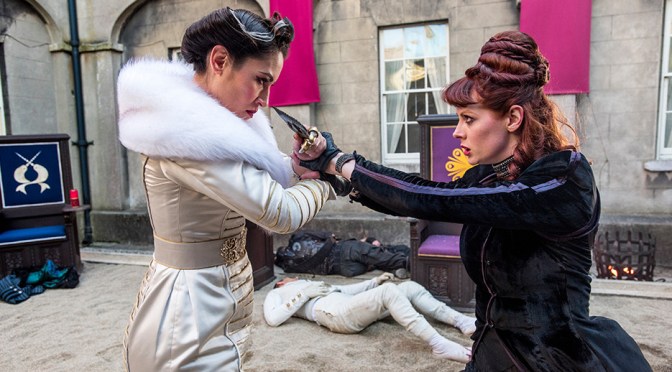
The other major plotline of the episode concerns the Barons’ conclave that Ryder called for two weeks ago. This all opens with a scene of the Widow getting dressed for the actual event, which seems a little redundant since she just got to the estate, but okay. Waldo advises her to be fearless in a pep talk that is only just this side of insufferable mansplaining. I’m starting to wonder just how the Widow ever managed to become a Baron in the first place if she is as incompetent at politicking as Waldo treats her like she is. The only new Baron we’re introduced to at any length this week is Baron Chau, the only other woman Baron and a strict traditionalist, probably because she’s the Baron who is the source of all the cogs owned by the others. Chau offers her support to the Widow in exchange for a promise not to shelter any more runaway cogs, which the Widow at first balks at before being convinced by Waldo (natch) to take Chau’s offer. Still, it’s not enough, and when it comes time all five of the other Barons, Chau included, vote to strip the Widow of her title and banish her from the Badlands all together.

Just as an all-out battle royal is about to start, Quinn and his men show up to crash the party. This sends Ryder fleeing through a window with Quinn in pursuit, but it leaves the rest of the Barons free to fight amongst themselves in a cleverly conceived and gorgeously executed battle scene in which each Baron must rely on small weapons they were able to hide on their person and whatever they can improvise from what’s close at hand. The standout here is Waldo’s weaponized wheelchair, but Chau and the Widow trying to stab each other with their stiletto heels is pretty cool as well. Sadly, this fight is over almost too quickly when Tilda shows up to help her mother and Waldo even the odds a little. The other Barons flee while these three stand over a courtyard full of dead and dying clippers. Something tells me that the Widow isn’t going to abandon her lands without a fight, vote or no.

The second major emotional climax of the episode is Quinn’s final confrontation with Ryder. First, however, Quinn comes face to face with Jade, who begs Quinn for Ryder’s life. It’s an interesting moment for Jade, who has at times seemed cold and patronizing towards Ryder and is certainly a master manipulator of her husband, but who here seems truly desperate to save him from Quinn. It smartly complicates Jade’s character to have her love for Ryder be genuine, and not a moment too soon as she seems poised by the end of this episode to become a much bigger player over the rest of the season. Quinn is almost respectful towards Jade and ends up ignoring her to chase after Ryder, who has entered an enormous hedge maze.

The race through the maze ends in front of a statue of Laocoön that Quinn mistakes for Kronos, an intriguing classical allusion that I spent far more time than I’d like to admit today trying to figure out the symbolism of. It’s obvious that Quinn sees himself as Kronos, but it’s less clear what connection we’re supposed to draw between the story of Quinn and Ryder and the story of Laocoön and his sons. Even less clear than that is where either of these guys learned classics with no formal education. In any case, Quinn wants Ryder to kill him, while Ryder still just wants his dad to love him. It’s a tragedy waiting to happen, and it does. In the end, Quinn is the one who ends up killing Ryder (or at least it looks like Ryder is dead) and immediately regretting it before running away. The final shot of the episode is Jade weeping over Ryder’s body as Quinn retreats. It’s a surprising and abrupt ending for a character who had seemed to be just at the beginning of his story.

Miscellaneous Thoughts:

  • What’s the deal with the white streaks in so many people’s hair this week?
  • M.K. probably killed his mother himself, apparently, which would explain why he dissociated from it so much that he can’t remember what happened and it’s fractured his personality.
  • I missed Chipo Chung this week.
  • Are Tilda and Odessa getting flirty?
  • How, exactly, did Quinn get Gabriel into Ryder’s household as an inside man? When was this decision made? Quinn’s whole plan here is woefully underdeveloped.
  • I worry that we’re getting into “Strong Female Characters must be Buffy-style ass-kickers” territory with all the show’s women. Lydia having to kill in self-defense made a certain sense; Lydia was always fierce in a way that suggested that she had the potential for that, and that fierceness was at least part of why she left her father’s cult to begin with. Veil has always had other strengths, though. And with Ryder’s probable death at the end of this episode, it seems as if Jade may be being set up to become another Widow-type character. Part of what I’ve always loved about this show was that it had a decent variety of women with different types of strength. It would be a shame for that to change.

The Expanse: In “Here There Be Dragons” lines are drawn and sides are chosen

“Here There Be Dragons” is, in general, another solid episode of The Expanse, though it’s central metaphor—relating the search for the protomolecule to historical exploration, where exploration is supposed to represent human advancement—falls a little flat and nearly obfuscates the much more impactful way in which the episode is about breaking points and choosing sides. The overall effect is sadly somewhat muddled, but there are enough smartly written, powerfully realized scenes that get their point enough that most of the episode’s flaws are forgivable in context.

It’s also starting to be very apparent that the show is diverging from the books in some significant ways. I’d planned on reading one book ahead of each season, but I’m increasingly feeling as if—if I want to continue reviewing the series as an adaptation of the source material—I’m going to have to go ahead and read the rest of what’s already been published, sooner rather than later. In the meantime, and for the foreseeable future since I don’t expect to read another four books and several novellas before the end of this season, expect less book-related commentary here. Instead, I’ll for the most part just be analyzing and commenting on what they put on screen unless there’s some very important book versus show connection to be made.

**Spoilers ahead.**

The episode starts with a flashback to Ganymede Station, before the mirrors fell, in which we see Dr. Strickland with Mei and a woman doctor or scientist walking through the station, apparently to the secret tunnels and rooms under the station. There are several of these flashbacks throughout the episode, and they don’t do much besides confirm that Mei was alive before the mirrors came down and that Dr. Strickland is an absolute monster. There’s not enough new information in these scenes about either Strickland or what he’s doing on Ganymede to really justify their existence, and as adorable as Mei and her backpack are every one of these scenes was a speedbump that distracted from actual current events in the show without being particularly entertaining. These kinds of running flashbacks have been used to great effect in the past to reinforce a thematic thread of an episode—the Epstein story was almost perfectly utilized in this way—but even Strickland’s late-in-the-hour speech to Mei about imagining themselves as explorers, a sinister echo of something Iturbi says earlier in the episode, isn’t impactful or memorable enough to feel necessary to the broader plot or message of the show or even just to this episode. This material could all have been left on the cutting room floor and the episode would have been better for it.

On Ganymede in the present, Holden, Naomi, Amos and Pax are working their way down into the depths of the station to search for Strickland and Mei. While still on their way down, Amos points out to Holden that Holden didn’t even try and stop him from killing Roma. Holden replies that he “[doesn’t] mind bashing some asshole’s head in” if it’s for a greater good, in this case finding and eliminating the protomolecule, which has clearly become Holden’s white whale at this point. Holden’s increasing tendency towards violence and amorality when it comes to achieving his, frankly, ill-defined objective continues to drive a wedge between him and Naomi. By the end of the episode, after Holden cruelly (and stupidly, from a strategic standpoint, to be honest) allows the final (barely) surviving Project Caliban scientist they’ve found to bleed to death before she can give them any useful information, Naomi has reached her breaking point.

While Holden, Pax and Alex are going to continue hunting for the Caliban creature and the protomolecule, Naomi is staying on Ganymede, where she intends to help Melissa on the Weeping Somnambulist evacuate people from the station. They can’t stop the protomolecule, she says, but she can do some good here and now for the people who need help on Ganymede. It’s probably the best thing Naomi has done for herself or anyone else all season. Holden is unhealthily obsessed with the protomolecule, and he’s dragged the rest of them along with him for more than long enough. That Holden feels the need to send Amos with Naomi as a protector is exactly the kind of sexist garbage I would expect from him, and Holden’s final kiss to Naomi is ugly and possessive enough—though I suspect it was intended to be bittersweet—that I’d be fine if she was rid of him for good. Losing Naomi may be the wake-up call Holden needs to get his act together, but he’s got a long way to go to deserve her.

On Earth, Bobbie gets a lecture from Captain Martens about duty before being informed that she’s out of the marines when they get back to Mars. When they go to leave, however, their dropship isn’t allowed to land and pick them up—something about an attempted OPA attack, straight from the desk of Undersecretary Avasarala. While they’re waiting for their next chance to leave, Bobbie goes to Martens’ quarters, where she gives him one last chance to come clean with her about what happened on Ganymede before she beats the information out of him. When she gets the story—“We were a goddamn sales demo!”—Bobbie flees (or, rather, walks quickly) through the Martian embassy before having to run the rest of the way to the Earth border, where she requests political asylum.

Everything about this sequence of scenes is done well, from Bobbie’s subtle expressions as she’s told that she’s no longer a soldier—which has been the core of her identity before now—to the restrained brutality of her attack on Martens—she wants information, not to kill him—to the tense drama of her flight from the embassy. Everything is crisply filmed and artistically composed, and I love the contrast between the artificial lighting inside the Martian embassy and the bright natural sunlight outdoors. Bobbie’s decision to go after Martens for information and her even more important choice to take what she’s learned to the U.N. represent hard-earned character development, and the beating she gives Martens is a great catharsis for both Bobbie and the viewer, especially in light of the confirmation that Mars is looking to buy Project Caliban. That we also get a nicely done scene with Bobbie, Cotyar and Chrisjen is just icing on the cake of this storyline this week.

Chrisjen herself is still dealing this week with fallout from Eros and doing her own work to find out as much as she can about the protomolecule and what’s going on in the solar system. Iturbi is still sending her regular updates from the Arboghast at Venus, where he and Janus have almost buried the hatchet and managed to get some science done. In another standout scene, Errinwright comes to Avasarala with an idea to get at Jules-Pierre Mao through his daughter, Clarissa, though Chrisjen cuts him off to break the news that he’s about to face some consequences for his role in what happened with Eros. Errinwright seems to think that he’s taking the fall just because Mao isn’t available, and he even has the balls to ask Avasarala to speak in his favor—which she, of course, won’t do—before kind of sighing and resigning himself to the fact that he’s on his own. Still, Errinwright seems at least slightly certain that he’ll get through this mess, at least to judge by his slightly ominous parting “somehow” to Chrisjen. Shohreh Aghdashloo and Shawn Doyle have a great onscreen chemistry together, and they do a wonderful job of selling the scene and making the audience really believe that these characters have a long, somewhat tumultuous, history as colleagues and political adversaries while still having a friendship (for lack of a better word) that goes quite deep.

As if a great Avasarala/Errinwright scene wasn’t enough, we’re also treated to a brilliant Avasarala and Cotyar scene late in the episode when Chrisjen receives a message from Jules-Pierre Mao himself, inviting her to parlay with him at a place of his choosing, off Earth, with a limited escort of her own. Cotyar insists that it’s a trap but then makes Avasarala’s own arguments to her, and it’s nice to see how much he’s come to care for her. His protective concern and her need for him to validate her opinions establishes an almost familial closeness between the two of them, and it’s sweet.

Miscellaneous Thoughts:

  • While I didn’t like the flashbacks in general, I appreciated the contrast in the job done by the set dressers to transform the hallway between pre- and post-incident looks.
  • I want a Misko and Marisko backpack.
  • So, Naomi had a kid. Nice to have that confirmed, but it’s been so strongly hinted at this season that the revelation wasn’t surprising.
  • Alex scenes on the Rocinante are delightful. There’s one moment during their slingshotting path to Ganymede where they come around the turn of a moon and Alex sees Jupiter and several other moons ahead of them, and it’s beautiful. I suspect that sort of thing would never get old, no matter how common space travel gets.
  • While Alex’s slingshot maneuver has already been criticized for its science fail—which showrunner Naren Shankar has already addressed—that wasn’t the most absurd thing to happen in the episode. That honor belongs to the coffin pod thing that they find in what Holden calls an incinerator but that seems to work much more like a near-magical vaporizer. It looks ridiculous when they zap it, the sound it makes is silly, and calling it an incinerator is just plain inaccurate. There’s not even any ash or melted plastic or metal left over. Just *fwoop!* out of existence.
  • Bobbie to Cotyar: “What the fuck are you looking at?” She’s a people person.
  • The protomolecule sure has set up house on Venus.