Category Archives: Books

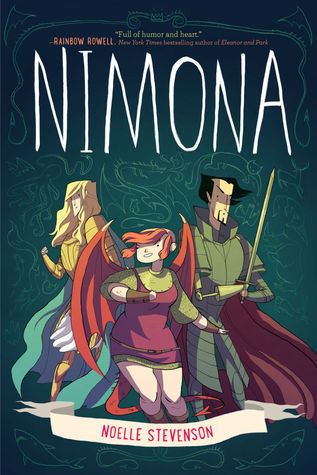
Book Review: Nimona by Noelle Stevenson

Nimona is actually my twelve-year-old daughter’s book. I knew it was good when she didn’t even want to put it down long enough for us to check out at the book store. When she finished it the next day, I knew I had to read it myself. I’m so, so glad I did.

So, apparently Nimona started life as a web comic,  but to read the whole thing now you have to buy the book.

It’s totally worth it. You should go buy it right now. Maybe even buy two copies, because this is a book that I could easily see reading over and over again. Also the sort of book that your friends aren’t going to return after you force them to borrow it, so it won’t hurt to have an extra copy laying around.

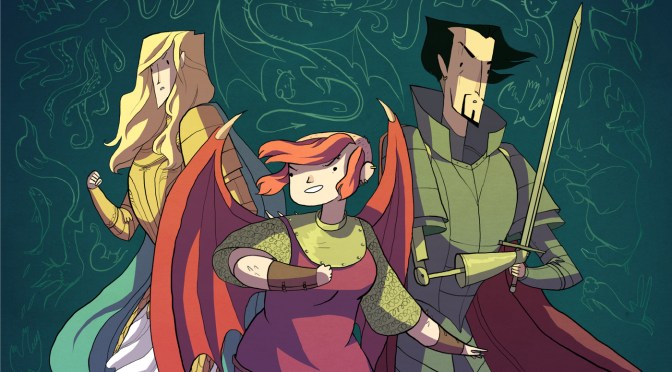
The art is simple, especially at the beginning, which again betrays  Nimona‘s internet origins, but I found it enjoyable to see the work evolve over the course of the story. Noelle Stevenson’s style is fluid and impressionistic. Every panel looks as if it’s in motion, which adds a sense of realism that is reflective of the naturalistic portrayal of the characters and their relationships. At the same time, Stevenson avoids realistic or consistent color schemes in favor of constantly changing palettes that tell a story of their own and convey moods extremely effectively. I especially liked the oranges in the middle of the book and the acid greens near the end.

Nimona herself is a great character. Though at times she skirts a little too close to Manic Pixie levels of quirkiness, she doesn’t exist in service to anyone’s story but her own. I love the growth of her friendship with Lord Blackheart, and it’s nice to see a bit of gender role reversal here, with Nimona as the rash, bloodthirsty one and Blackheart as a temporizing force and voice of reason. Blackheart and Sir Goldenloin are both nicely written, with a good backstory, and the ending of their story feels organic and earned. I also really appreciate that the only other two significant characters, The Director and Dr. Blitzmeyer, are women, another smart authorial choice that avoids the fantasy convention of marooning female characters in a sea of testosterone. While Nimona doesn’t get much interaction with these women, just their existence avoids one of the biggest problems I tend to have with fantasy stories in general.

The thing about Nimona is that it’s utterly charming. It’s funny and smart and sweet and deploys its pathos in exactly the right ways at exactly the right times to tug at the reader’s heartstrings. Like many web comics, it does tend to meander now and then, but the story is overall well-conceived and deftly executed with a minimum of sidetracking so that it’s cohesive when published in a single volume.

Nimona is a great book and a fast read, and it might (probably) will make you cry. Highly recommend.
 

The SF Bluestocking 2015 Summer Reading List Report

Well, perhaps predictably, I have not managed to finish my own summer reading list. Best laid plans, and all.

Breaking my foot back in May and being laid up with that most of the summer sounds like the sort of thing that would have given me all kinds of extra time to read, but instead I’ve found myself in a bit of a reading slump and spent most of the first half wallowing in pain and self-pity. The last month or so since getting my cast removed has been a significant improvement. Though I’m still not 100% better, I’ve started working out again, and this week I think I’m going to start walking daily to try and work back up to doing 2-3 miles a day like I was before the broken foot–ideally before it gets too cold and unpleasant for me to be out. In the meantime, I’ve been trying to enjoy the last bits of summer that are left, going to outdoor plays, checking out food festivals, hitting farmer’s markets, and just generally trying to be out of doors as much as I can.

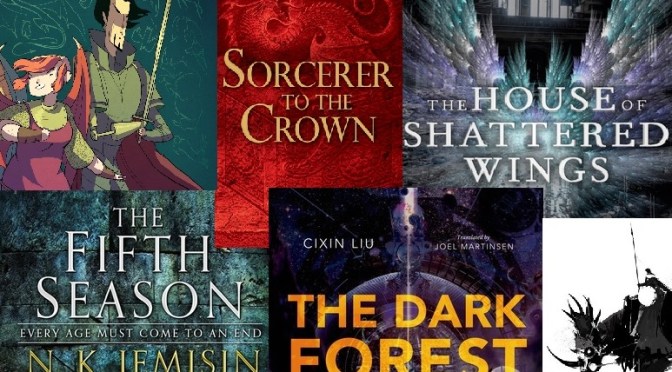
The good news is that I think I’m coming out of the funk I was in most of the summer. The bad news is that I’ve so far been doing other stuff besides reading, and I’m also behind on some writing stuff as well. While I’m finally catching up on my reading some, I’ve not yet gotten back on track with writing book reviews, though that’s changing as well. I should have reviews coming out this week and next for The Fifth SeasonNimonaRat Queens Volume 1: Sass & Sorcery, and The House of Shattered Wings. By then, I should also be done with The Dark Forest, and hopefully that will get me more or less back on track with what I’d like to be doing in terms of output.

So, here’s what I did manage this summer:

  • Annihilation by Jeff VanderMeer – This one was on my list, and I finished it. Review here.
  • An Ember in the Ashes by Sabaa Tahir – List, finished. Review here.
  • The Philosopher Kings by Jo Walton – List, finished. Review here.
  • Shadowshaper by Daniel José Older – List, finished. Review here.
  • The Long Way to a Small, Angry Planet by Becky Chambers – List, finished. Review here.
  • Childhood’s End by Arthur C. Clarke – List, finished. Review here.
  • The Dinosaur Lords by Victor Milán – List, finished. Review here.
  • The Fifth Season by N.K. Jemisin – List, finished. Review here.
  • The House of Shattered Wings by Aliette de Bodard – List, finished. Review soon.
  • The Dark Forest by Cixin Liu – List. Currently reading.
  • Spindle by W.R. Gingell – Self-published by the author. ARC received through NetGalley. Finished. Review here.
  • Sorcerer to the Crown by Zen Cho – NetGalley ARC. Finished. Review here.
  • Empire Ascendant by Kameron Hurley – NetGalley ARC. Finished. Review here.
  • Nimona by Noelle Stevenson – Borrowed from my 12-year-old. Review here.
  • Rat Queens Volume 1: Sass & Sorcery – Not on my original list. Review soon.

I actually didn’t do too bad, all things considered. Fifteen books in the last two months. Ten of the fifteen from my original reading list, plus five that weren’t on there. Of the five books that I didn’t get to, one I’ve sort of lost interest in due to mediocre reviews (The Invasion of the Tearling), one is an ARC that I will definitely be reading within the next month (The Heart Goes Last), two are more literary works that I really could read anytime (Station Eleven and The Buried Giant) and one (The Magicians) is the basis of a tv show that I’m looking forward to, but that won’t be starting until at least February of 2016, so it’ll keep, too.

Probably a couple of these will make it on to my fall reading list, which can be looked for this week as well. It looks like I probably won’t be as lucky with ARCs this fall as I was over the summer, but there are plenty of upcoming releases that I’m pretty excited about that I’m sure will keep me busy. Which doesn’t even touch on the new fall shows I plan on checking out, which will be another separate post in the next week.

2015 Hugo Awards – The Year of the Best Case Scenario

The lead up to this year’s Hugo Award ceremony reminded me a little of the 2012 election. All the polls and buzz at the time (and for months in advance) seemed to indicate that inveterate slimeball Mitt Romney was going to lose, but Mitt and Fox News seemed so convinced that they were going to win that I found myself in a knot of stress until Ohio was called for the President. In much the same way, the majority of reaction and community response to this year’s Puppy slates has been decidedly not in the Puppy’s favor, but they’ve seemed so certain all along that they were going to prove, well, something. Like the jerkwads at Fox News, they seemed certain that they were going to win–certain enough that they had everyone else on edge.

Even streaming the Hugo Award ceremony, the tension in the room felt palpable Saturday night, and it wasn’t until the announcement of the winner of the first major award that the atmosphere began to lighten. Anyone following the Puppy mess very closely knew that the John W. Campbell Award was going to be the bellwether, and as soon as non-slate nominee (the single non-slate nominee for that award) Wesley Chu’s name was read, it was as if everyone there breathed a collective sigh of relief and started to actually have fun.

The rest of the ceremony went off without a hitch. There were a couple of very nice acceptance speeches–Wesley Chu’s was notable, as well as Julie Dillon’s, Ken Liu’s (accepting for Cixin Liu’s The Three Body Problem), and those from the editors of Journey Planet and Lightspeed Magazine. David Gerrold and Tananarive Due were excellent once the mood in the room loosened up. Connie Willis was wonderful.

There were a couple of real surprises in store, which was nice. Unsurprisingly, No Award was the big winner of the night, taking five categories in which the Puppies had managed to secure all of the nominees. In more interesting news, though, Orphan Black won in Best Dramatic Presentation (Short Form), which is excellent. It’s a great show, and it’s nice to see it finally getting some awards recognition (although Tatiana Maslany’s Emmy nomination this year is promising). In Best Graphic Story, Ms. Marvel took home the rocket, which was surprising to me, at least–I was fairly certain it would go to Saga.

Perhaps the biggest upset of the night, though, was in the Best Novel category. I LOVED The Three Body Problem, but it seemed to be considered a long shot to win. Most of the speculation I saw leading up to the awards seemed to agree that Best Novel would go to either Katherine Addison’s The Goblin Emperor or Ann Leckie’s Ancillary Sword, and the reaction to The Three Body Problem‘s win seemed to be generally pleasant surprise, but surprise nonetheless. It’s the first ever translated novel to win a Hugo Award, which makes the win historic as well. And if that wasn’t enough to hammer home the point that the Hugo Awards are about progress and change and forward thinking, the Best Novel winner was literally announced from space.

The full list of 2015 Hugo winners:

  • Best NovelThe Three Body Problem by Cixin Liu, translated by Ken Liu (Tor Books)
  • Best Novella – No Award
  • Best Novelette – “The Day the World Turned Upside Down” by Thomas Olde Heuvelt (Lightspeed, April 2014)
  • Best Short Story – No Award
  • Best Related Work – No Award
  • Best Graphic StoryMs. Marvel Volume 1: No Normal (Marvel Comics)
  • Best Dramatic Presentation (Long Form)Guardians of the Galaxy
  • Best Dramatic Presentation (Short Form)Orphan Black: “By Means Which Have Never Yet Been Tried”
  • Best Professional Editor (Short Form) – No Award
  • Best Professional Editor (Long Form) – No Award
  • Best Professional Artist – Julie Dillon
  • Best SemiprozineLightspeed Magazine, edited by John Joseph Adams
  • Best FanzineJourney Planet, edited by James Bacon, Christopher J Garcia, Colin Harris, Alissa McKersie, and Helen J. Montgomery
  • Best FancastGalactic Suburbia Podcast
  • Best Fan Writer – Laura J. Mixon
  • Best Fan Artist – Elizabeth Leggett
  • The John W. Campbell Award – Wesley Chu

Probably the best general piece published this weekend about the Hugo Awards was over at Wired: “Who Won Science Fiction’s Hugo Awards and Why it Matters”.

io9 gives us an idea of the Hugo Awards we would have had if it wasn’t for the Puppies’ slates.

If you’re into that sort of thing, you can just read the full 2015 Hugo voting stats for yourself.

Black Gate is succinct in saying “Dear Puppies: Your Taste Sucks”.

And Foz Meadows’ piece is worth a read, “Hugos and Puppies: Peeling the Onion”.

I’m not naive enough to think this mess is going to be laid to rest after this, especially not when Vox Day has already published like eight posts since Saturday night threatening that he’s going to keep trying to destroy the awards. However, just looking at this year’s voting stats, it seems to me that his claim of 400 voters is actually somewhat exaggerated. I’d guess there were closer to 275-325 dedicated Puppy voters, and so I’m also guessing that Day’s claims that there are many more where those came from can be largely chalked up to Day’s delusions of grandeur.

I expect that there will be a Puppy slate or two next year, but I don’t expect they will be as successful as they were this year. We certainly aren’t going to be free of the Puppy whining and pouting (when they aren’t insisting that they were wildly unsuccessful on purpose) for some time, but I imagine they will lose interest after 2016. Surely, by 2017, someone, somewhere will have done something to earn a harassment campaign from these assholes that will direct their attention elsewhere.

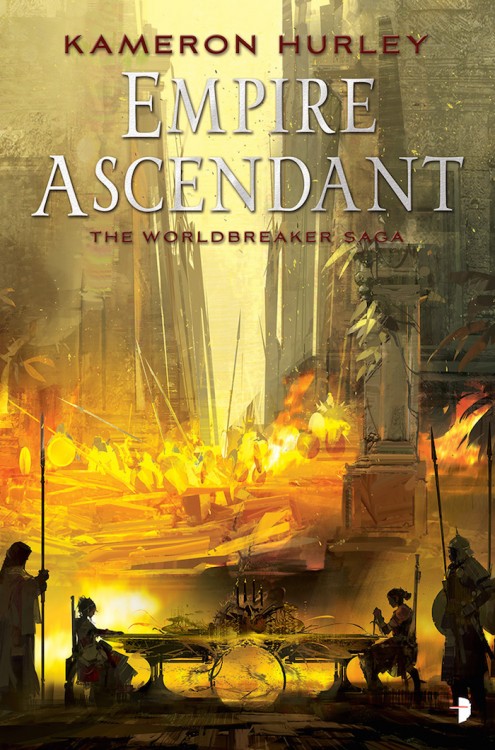
Book Review: Empire Ascendant by Kameron Hurley

empire-ascendant-by-kameron-hurley-495x750[This review is based on an advance copy of the book received through NetGalley.]

Empire Ascendant is a brutal read, which is somewhat to be expected from Kameron Hurley in general, and certainly to be expected in the follow-up to The Mirror Empire. The world of The Worldbreaker Saga is a harsh one, and this second book in the series turns the grimdark up to eleven.

Unfortunately, I’m just not loving this series the way I did Hurley’s God’s War trilogy. I liked The Mirror Empire well enough, but it took me about a third of Empire Ascendant to get my bearings and figure out what was going on. In addition to the increased blood and higher body count, there are several new POV characters who I had a hard time placing in the narrative, which was confusing. Additionally, though it’s been less than a year since I read the first book, it turns out that it wasn’t actually all that memorable.

Except for Zezili, a character I adored in the first book but whose page time in Empire Ascendant is greatly reduced, I found myself barely recognizing most of the characters until partway through the novel. I did enjoy Anavha’s parts, but his story line seemed to move at a painfully slow pace. Ahkio spends most of the book being ineffectual, as does Lilia. The invading empress from the other world is somewhat humanized, but we don’t see much of her except near the beginning and end of the book. For basically all of the characters, everything just goes from bad to worse to worst for some five hundred pages, and by the end of the book I found myself just unable to engage with that level of darkness any longer.

The thing is, this isn’t a technically bad book. Quite the opposite, actually. It’s a technically brilliant book that I just don’t know if I’m capable of appreciating right now, which is sad because it’s a book that I’ve been eagerly anticipating for months. There’s still a lot going on in this series that I think is fascinating, and I have no doubt that I’ll go on to read the third book in the series when it comes out as well.

I think, though, that the reality is that this is not a series for the faint of heart. The role reversal and the interrogation of gender and the implicit (so implicit they actually become explicit) criticisms of genre mainstays are well worth checking out, but I think that it’s the very subversiveness of this series that makes it such difficult reading. Empire Ascendant isn’t a book that can be read lightly. It demands (and deserves) all of the reader’s attention, but it’s, frankly, so  concerned (and rather self-consciously so) with subverting tropes and challenging expectations that it becomes weighed down with it’s own seriousness and self-importance.

In the end, I want to love everything about this series as much as I loved Zezili in the first book or as much as I loved all of the God’s War books, but I think I’m going to have to settle for only being able to objectively know the value of them and recognize the excellence of Kameron Hurley’s craft–which has certainly improved since her God’s War days. Empire Ascendant shows Hurley’s growth as a writer, but I feel like it also shows a notable lack of joy or humor when compared to her earlier work–which translates directly to me finding this new series increasingly unenjoyable.

Book Review: Sorcerer to the Crown by Zen Cho

[This review is based on an advance copy of the book obtained through NetGalley.]
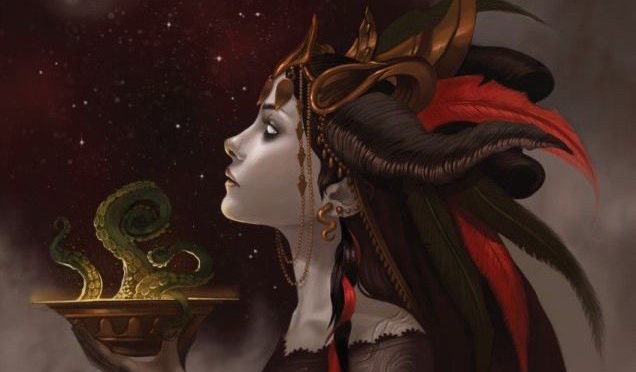
If you loved Jonathan Strange & Mr. Norrell, you owe it to yourself to read Zen Cho’s Sorcerer to the Crown. At the same time, though, I’m not sure I’d compare it to Jonathan Strange & Mr. Norrell if I hadn’t just recently read the older novel.

Sorcerer to the Crown really has much more in common with the works of Jane Austen in both style and tone. While Jonathan Strange & Mr. Norrell is a broad-ranging pastiche that pays tribute to many genres while being very much its own thing, Sorcerer to the Crown is something simpler and purer–more earnest in its adherence to old-fashioned language and storytelling conventions. That said, Sorcerer to the Crown is a wildly original and deeply unconventional twenty-first century novel and a great deal of fun.

The book opens with a very young black boy named Zacharias being shown off to a bunch of white men to prove his (and his race’s) magical capabilities. While the ominous tone of the prologue is somewhat at odds with much of what follows in the novel, I think it’s a pretty excellent way of infusing the rest of the book–which would not be inaccurately described as a “romp”–with an undercurrent of darkness that keeps things grounded and provides a sort of baseline for the exploration of POC experiences in the rest of the story. It’s a prologue that shows the reader immediately what kind of book this is, which is the perfect sort of prologue if an author really must include one.

The rest of the story takes place after Zacharias has managed to find himself in the position of being the most eminent sorcerer in England. We quickly learn that his high office has earned Zacharias no shortage of enemies and is more a nuisance than anything else. He’s not even certain he wants the office at all, but there’s no way for him to give it up. Instead, he determines to make the best of it and try and enact what change and bring what progress he can while he still has time. To that end, Zacharias has to deal with magical school girls, Malaysian vampires. scheming racists, and angry dragons.

It’s a wild ride.

The characters in Sorcerer to the Crown can all be a little one-dimensional at times, and I didn’t always find Zacharias to be particularly likable, although I absolutely loved Prunella. Some things seemed a little too tidy at the end, and I’m not sure I entirely buy the romance, which was so restrained as to be almost nonexistent. Although it is kind of refreshing that the book isn’t overly focused on the romance, I would have preferred a more gradual growth of affection over time. As it was, the resolution of the romance felt somewhat tacked on and less earned than it could have been.

Still, Sorcerer to the Crown is a thoroughly enjoyable read. From beginning to end, it hits all the right notes that I look for in a book. It’s a very different perspective than we’re usually offered in Regency-set fantasies. It’s fast-paced and interesting enough that even though a great deal happens it never feels overstuffed or overlong. It’s whimsical without being precious and clever without being pretentious. Best of all, it’s a downright funny book, and I found myself chuckling aloud more than once. Definitely in my top ten books of the year so far.

Pretty stoked about this new Lovecraftian women anthology

She Walks in Shadows is edited by Silvia Moreno-Garcia and Paula R. Stiles, and all of the writers and artists involved in this anthology are also women. It’s been probably 10 years since the last time I was this excited about something even remotely Lovecraftian.

I mean, look at this table of contents:

“Bitter Perfume” Laura Blackwell
“Violet is the Color of Your Energy” Nadia Bulkin
“Body to Body to Body” Selena Chambers
“Magna Mater” Arinn Dembo
“De Deabus Minoribus Exterioris Theomagicae” Jilly Dreadful
“Hairwork” Gemma Files
“The Head of T’la-yub” Nelly Geraldine García-Rosas (translated by Silvia Moreno-Garcia)
“Bring the Moon to Me” Amelia Gorman
“Chosen” Lyndsey Holder
“Eight Seconds” Pandora Hope
“Cthulhu of the Dead Sea” Inkeri Kontro
“Turn out the Lights” Penelope Love
“The Adventurer’s Wife” Premee Mohamed
“Notes Found in a Decommissioned Asylum, December 1961″ Sharon Mock
“The Eye of Juno” Eugenie Mora
“Ammutseba Rising” Ann K. Schwader
“Cypress God” Rodopi Sisamis
“Lavinia’s Wood” Angela Slatter
“The Opera Singer” Priya Sridhar
“Provenance” Benjanun Sriduangkaew
“The Thing in The Cheerleading Squad” Molly Tanzer
“Lockbox” E. Catherine Tobler
“When She Quickens” Mary Turzillo
“Shub-Niggurath’s Witnesses” Valerie Valdes
“Queen of a New America” Wendy N. Wagner

If you pre-order the book now, you’ll save $2 off the cover price. It’s officially being released on October 6, and a $5 ebook will be available a few weeks later.

Book Review: Spindle by W.R. Gingell

Spindle is a charming little self-published title by Tasmanian author W.R. Gingell. I received a copy of it through NetGalley, where I was drawn in by the book description and a surprisingly nice-looking (for self-publishing) cover image. It turns out that Spindle is a fast, fun read, well worth $2.99 for the Kindle version.

It’s a Sleeping Beauty story that begins with our heroine, Poly (short for Polyhymnia), being kissed awake by an enchanter named Luck, who managed to find a loophole in the curse. The rest of the book details their adventures as they work together to find a way to break the curse once and for all and defeat the evil wizard who created it.

Spindle definitely has some problems, most of which I think would have been solved by being put through a professional editorial process. There are a lot of adverbs as dialogue tags, which I find to be generally either distracting or redundant. There are a handful (but literally only a handful) of typos that might have been caught with just another once-over by someone detail-oriented. There is a lot of reusing of phrases and words that I can tell the author really likes, and I have some issues with a lot of word choices. The language often verges on pretentious and the book overall ends up being almost (but not quite) too preciously quirky.

All that said, I enjoyed Spindle a great deal, mostly because Gingell has come up with a great cast of characters, whose interactions with each other are interesting and compelling. I appreciated that Poly’s ending up with Luck wasn’t entirely a foregone conclusion from the first page, and I liked that she got to explore a couple of other romantic attractions with men who respected her. Poly’s adoption of Onepiece and her growth in her role as a parent to him is nice and gives Poly something to do and focus on besides dealing with her curse and sorting out her feelings about Luck. There are a good number of other female characters that Poly befriends, and I’m always happy to read about women having relationships that aren’t toxic. I particularly liked Poly’s friendship with Margaret.

Of course, probably the most important relationship Poly has is with Luck, the enchanter who woke her up. I’m not sure how I feel about this one, to be honest, because Luck is often a terribly annoying character. I didn’t care at all for the repeated descriptions of Luck as vague. It made him seem both boring–with just the one character trait–and it created a consistently comical image in my head of a dude just staring off into space all the time. It’s a poor word choice, in my opinion, and not one to inspire romantic feelings. As far as what we’re shown about Luck (as opposed to told), he’s often self-centered, distractable, uncommunicative, needlessly obscure, and awfully inconsiderate of nearly everyone around him. It seems like the relationship between Poly and Luck is supposed to be evolving over time, but mostly I felt like Poly just learned better coping mechanisms and became more self-sufficient. This is nice, but I found myself wondering why they needed to end up together at all.

In the end, the mad-cap high energy of Spindle manages to be more fun than annoying, and I’d recommend it as a piece of light reading that is a little reminiscent of Howl’s Moving Castle (the Studio Ghibli movie, not the book). I’m not dying to read any of W.R. Gingell’s older work, but I might keep an eye out for things she publishes in the future, especially if she gets picked up by a proper publisher who could help iron out some of the wrinkles in Gingell’s style.

Book Review: Shadowshaper by Daniel José Older

Shadowshaper seems to be most often compared to Cassandra Clare’s Mortal Instruments, but it’s a terrible comparison. In fact, there is no comparison to be made that isn’t entirely superficial. Shadowshaper isn’t a flawless piece of work, but it’s not a mess of derivative, hackneyed tropes like the Mortal Instruments series was, either.
Yes, Shadowshaper also takes place in New York, but where Clare’s series was generic and poorly researched, Older’s book is set in the Bedford-Stuyvesant neighborhood that he resides in himself and has a strong sense of place that helps to draw the reader into the world he’s created.

Yes, Shadowshaper also has a teenage girl protagonist whose story starts when she begins seeing weird stuff and finds out she has magical powers, but where Clare’s Clary Fray is a bland cipher upon which the reader can self-project fairly freely, Older’s Sierra Santiago has a vibrant personality and a specific identity that invites the reader to share and understand her but not to become her. While Sierra has plenty of likable traits–she’s clever and brave and kind, for example–there are many things about her that I don’t expect will be universally relatable. As a white reader, I appreciate the gift that Older offers me–a tiny window into an experience of the world very different from my own–and I can only imagine how gratifying it must be for young people who share more of Sierra’s experiences to discover this book in libraries and bookstores that are far too full of characters like Clary Fray.

Yes, like Clary Fray, Sierra has a group of friends who help her fight the forces of darkness, but where Cassandra Clare’s Shadowhunters are a group thrown together by the most boring sort of destiny ever (and often don’t even seem to like each other), Sierra’s friend group in Shadowshaper is made up of people who are part of a community, and that community is really the whole point of the book. It feels real and organic, and the emotional payoffs, for the most part, feel earned.

Shadowshaper even has romance, but it doesn’t take over the novel, and it develops sensibly; at the end of the book, I felt like Sierra and Robbie were embarking on an exciting new part of their lives, but not as if everything was settled before the characters even graduated high school.  I always appreciate when authors do YA romance without turning it into some sort of star-crossed, destined, One True Love situation. Young love deserves to be treated seriously, and teenagers’ emotions are deep and strong, but we seldom meet The One at that age. I tend to enjoy YA romance much more when authors keep it in perspective, and Older has done a nice job with it here, creating a heroine who likes a boy but doesn’t waste too much time overthinking the situation. Sierra has more important things to deal with, after all.

I would have liked this book to spend more time with Sierra’s mother, who I think is interesting enough to carry a book of her own. I felt like Maria’s change of heart about shadowshaping at the end of the book felt abrupt and more driven by what the author wanted to happen and how he wanted to end things than it was by anything that would normally have naturally happened with these characters. I understand wanting to write the happiest possible ending, but the way that this happens felt pretty inexplicable to me.

The shadowshaping magic itself was on the one hand really interesting, but on the other hand slightly nonsensical. It’s not exactly clear what this magic is capable of, and some of the descriptions of the magic Sierra works are confusing. One of the reasons I read this book in the first place was that it promised Caribbean magic. While I think it does a good job of capturing the sense that shadowshaping is specific to the culture depicted in the book, it’s on a bit more shaky ground when compared to other fantasy magic systems (but still worlds better than anything Cassandra Clare has written).

Shadowshaper is an excellent read overall, though. It’s fast-paced, and I had a hard time putting it down because I always wanted to know what happened next. While its flaws aren’t inconsiderable, I think they are more than made up for by its strengths–namely, it’s beautifully crafted setting and a delightfully plucky heroine. Also, it’s got an absolutely gorgeous cover.

Book Review: The Philosopher Kings by Jo Walton

I’m not sure that most people would agree with me that The Philosopher Kings is a fun read, but I enjoyed it at least as well as I did its predecessor, The Just City.  After the rather abrupt and somewhat shocking ending of the previous book, I couldn’t wait to see what happened next.

This book returns to the Just City, but after a gap of about twenty years. Since the Last Debate (between Socrates and Athena) things have changed considerably. After transforming Socrates into a gadfly, Athena departed in a huff, taking all but two of the robot Workers with her. Kebes and about a hundred and fifty other people (including several Masters) disappeared with one of the settlement’s two ships. After all this, the remaining people in the city split into more cities, each dedicated to realizing Plato’s Republic in slightly different ways. This went well enough at first, but in later years the cities have begun to fight over the art that was originally brought to the Just City, and there are now frequent battles between cities and works of art are stolen back and forth between them.

The Philosopher Kings begins with one of these art raids in progress, and Simmea (one of the points of view in The Just City) is killed in the fighting. Pytheas could have killed his human body, regained his powers as Apollo, and healed Simmea before she died, but she stopped him. The rest of the book is, ostensibly, about Pytheas’s quest to figure out why Simmea did this. Really, though, The Philosopher Kings picks up where The Just City left off with exploring the answers to the question: What would happen if people actually tried to put Plato’s ideas into practice?

It turns out that all sorts of things could happen, and we get to see several of them in this book. It’s fascinating to see how the different cities that split off from the original one have turned out, and it’s interesting to see what Kebes and his people have done after leaving the island. I like that even though the original city has fractured into smaller groups, even those smaller groups aren’t entirely like-minded.

The new narrator for this book is Simmea’s daughter with Pytheas, Arete (“excellence”), who is fifteen. She’s smart and kind and likable, but she still manages to seem like a fifteen-year-old. It’s nice to read a teen protagonist who isn’t overly precocious and who doesn’t have everything all figured out. Besides Arete, Pytheas returns as an occasional narrator, and it’s clear how much he’s grown up in twenty years. However, Simmea’s death affects him deeply and forces him to go through yet another sort of coming of age in this book. We really get to see how much he depended upon Simmea and how pretty much his entire life was his relationship with her, especially as the children they’ve raised are all adults now except for Arete. For Pytheas, this book is about finding his place in the community outside his own family. Also returning with point of view chapters in The Philosopher Kings is Maia, who is now in her fifties. While few in number, her chapters are by far my favorite parts of the novel.

The only problem that I had with The Philosopher Kings is the way it dealt with rape. While I appreciate that this book didn’t forget Maia’s or Simmea’s rapes in The Just City, Simmea’s rape is used too much as a motivating force for Pytheas and Maia’s rapist, Ikaros, is largely redeemed by the end of the book, in the narrative if not in the eyes of the reader. While I think the intent is not to treat rape lightly–rather, the impression I got was that it’s just one more messy aspect of human interactions that would be better in a more just society–I also think it kind of does treat rape lightly. Ikaros, in particular, is given too much credit, in my opinion, for being a fundamentally decent person, and there are some things he says to Maia in this book that had me absolutely seeing red on her behalf.

Some readers have complained that the book is overly philosophical with too much debating going on, but I, personally, adore the debates between characters. This was a common complaint about The Just City as well, so if you didn’t like that book you probably won’t enjoy this one any more. Another complaint that I’ve seen about this book in particular is that it abruptly and unexpectedly turned into science fiction at the end, but this is also something that appealed to me. Of course, that’s partly because, to my mind, this series has always been science fiction (I mean, robots.), but it’s also because I enjoy heavy handed genre bending of this kind.

With that in mind, I was super thrilled to learn that this isn’t a duology as I originally thought, but a trilogy. The bad news, of course, is that it’s not a six month wait like between the first two books. Per Jo Walton herself, it looks like we can’t expect to see Necessity before mid 2016.