All posts by SF Bluestocking

Let’s Read! Up and Coming: Part 9

So, the good news is that I still have time to finish this project by the end of the day on Wednesday. The bad news, of course, is that I had about a two-day-long funk last week that has put me pretty far behind where I’d intended to be by this point. This was compounded over the weekend by family obligations and the fatigue brought on by my allergies when I’m pretty sure literally every tree in my town bloomed at once. It’s pretty, and the whole town smells like flowers, but it makes me feel like I’m going to die. However, today I’ve got some non-drowsy allergy meds in me and I’m feeling productive, so I expect to get, well, not caught up, quite, but close.

I think my favorite thing about this project so far—though it makes it hard to really compare these authors to each other—has been that Up and Coming showcases an incredible number of ways of being good. There’s really no way that any reader is going to universally enjoy the stories on offer, and every group I’ve written about has been a mixed bag, but it’s always interesting.

Kelly Robson

I only read a page or two of the excerpt from The Waters of Versailles before I switched over to Some of the Best from Tor.com 2015 in order to read all of Kelly Robson’s novella. It didn’t turn out to be as superlatively excellent as I’d hoped, but it is a great read, perhaps enhanced by my having recently watched A Little Chaos, about a totally different project at Versailles, which had the setting fresh in my mind. Kelly Robson does a much better job than that film, though, of utilizing Versailles, and Sylvain de Guilherand is a much more interesting fictional character than Kate Winslet was, even if the stories do both deal with people who feel somewhat unhappy and displaced at the French court.

“The Three Resurrections of Jessica Churchill” is a weird story. It’s beautifully written and powerful, but it also includes an extremely brutal and graphic rape/murder that I wasn’t prepared for and it touches specifically on the sadly still-timely issue of the disappearance of First Nations women in Canada. On the author’s website, she does warn that the story is extremely violent, but it doesn’t seem to have been published with any kind of warning elsewhere, and I think that this is a case where a trigger warning might be necessary to give readers some advance warning.

I don’t think I quite get “Two-Year Man” as it’s a story with some weird messaging. It’s just as nicely written as the other Robson pieces included here, but the main character is very unsettling. While I finished the story, I found it to be a largely unpleasant read that left me with more questions than I like to have at the end of a short story. There’s something to be said, I suppose, for not tying everything up too neatly, but I don’t like it when I have questions about everything from world building issues to thematic concerns to character motivations.

Andy Rogers

Andy Rogers’ “The Doom of Sallee” is, I guess, a time travel story, or maybe some kind of alternate universe? It wasn’t terribly clear, and it wasn’t interesting enough for me to keep reading and rereading it to try and figure it out. I tried to read his novella, Brothers in Arms, but got about three pages into it before I couldn’t take anymore sci-fi soldier talk. That said, I don’t have anything bad to say about Andy Rogers. His work seems fine, just decidedly not for me.

Lauren M. Roy

“The Eleventh Hour” contemplates what one might do if given an hour—a literal, physical hour in this case, which is a moderately cool idea—to save the world. It’s a clever story, but not especially impactful or memorable aside from the idea of a physical representation of an hour that the main character has to decide how to spend.

Steve Ruskin

“Grand Tour” is a nicely structured piece with an interesting speculative element. Steve Ruskin’s story of a widowed artist with a magical camera lucida makes for an entertaining read, and it’s smartly bookended with complementary scenes that have unifying motifs. Séances (really, Spiritualism in general) don’t appear enough in fantasy, to be honest, and it’s good to see an author utilizing some of that history in a compelling way.

K.B. Rylander

“We Fly” by K.B. Rylander is a story with some interesting ideas, and Rylander speculates on an interesting possible dilemma related to the mind-uploading technology that she’s writing about. However, the devil is always in details, and there were some small things that I didn’t like, just casual mentions of unsettlingly authoritarian policies in the world of the story that make it feel dystopian in way that is both frightening and largely unexplored in the narrative. I did like Natasha’s gesture of resistance at the end, but I’m not sure if it matters. Then again, that could be the point. I would love to give this story to a classroom full of eighth graders and ask them what they think; it seems like a perfect story for that kind of analysis.

Hope Erica Schultz

Hope Erica Schultz leads with “Mr. Reilly’s Tattoo,” which I didn’t hate, though it was a bit too saccharine for me to truly like it. “The Princess in the Basement” is similarly sweet, and a little too heavy-handed with its messaging right at the end, but it’s a decent enough modern fairy tale.

Effie Seiberg

I vaguely remember something about the story Effie Seiberg had in Women Destroy Science Fiction! a couple of years ago, but I’m pretty sure that the three newer stories she’s included in Up and Coming are going to stick with me much longer. “Re: Little Miss Apocalypse Playset” is a story about corporate evil (and the apocalypse) told in the form of an internal email chain. It’s smart and funny, but not too precious. “Thundergod in Therapy” tells the story of a retired Zeus, and I liked it well enough that I can forgive it for not really delivering on the “in Therapy” part of its title.

The best of Seiberg’s three stories here, however, is hands down “Rocket Surgery.” Of these selections, it deals with the biggest ideas and has the most ambitious themes. It’s also the timeliest and most insightful as a piece of science fiction that can be read as a commentary on current trends in technology and society. Most importantly, when looking at Seiberg as a contender for a major award, “Rocket Surgery” works to show that the author has more range as a writer and depth as a thinker than is exhibited in her more humorous pieces. I’m not sure where Seiberg will ultimately end up when I make my final decisions on who to nominate for the Campbell Award, but “Rocket Surgery” is an early addition to my longlist for next year’s Best Short Story Hugo.

Tahmeed Shafiq

I’m very sad about the 2014 publication date for “The Djinn Who Sought to Kill the Sun.” If it had been published in 2015, it would definitely be a shoe-in for a Best Novelette Hugo nomination. It works wonderfully as a fairy tale and as a gorgeously imagined story about healing from grief and trauma by finding purpose and a way forward into the future instead of dwelling in the past. I can’t find that Tahmeed Shafiq has published anything else since this story, but if this is the quality of work he was producing at age sixteen(!), I am very excited to see what he might produce in the future.

Iona Sharma

This is the first time I’ve read anything by Iona Sharma, and I can’t believe it’s taken me so long to find her. “Archana and Chandni” is the sci-fi lesbian wedding family dramedy I never knew I desperately wanted to read. It’s seriously a kind of perfect story. I didn’t love “Alnwick” quite so much, but it’s a well-executed blend of relationship drama and hard sci-fi that manages to do all of its ideas justice, even if it doesn’t have the sheer charm that “Archana and Chandni” possesses in spades.

Anthea Sharp

“Ice in D Minor” is a beautifully melancholy (though ultimately hopeful) piece about a composer tasked with writing music that will help to cool the warming planet. “The Sun Never Sets” is a first contact story set in Victorian England, which I was predisposed to love—especially when it opened with a young woman who is an amateur astronomer. Unfortunately, the story takes a weird, imperialist turn that, in hindsight, is telegraphed by the title, and isn’t as clever or amusing as I think it is intended to be. Sadly, my overall opinion of Anthea Sharp’s work isn’t improved by her final piece, “Fae Horse,” which starts with a young woman trying to escape being burned as a witch and finishes with that young woman sacrificing her identity and humanity in order to rescue a man. It’s finely written, but I would have liked it better if Eileen didn’t get such a raw deal in the end.

Final Verdict:

Iona Sharma and Effie Seiberg are new favorites, for sure, and I was disappointed that Tahmeed Shafiq doesn’t seem to have published anything in the last two years, but the majority of authors in this group were only okay. I’m sure I’ll be happy to read some of them again if I come across them in the future, but I doubt I’ll be seeking them out particularly.
Hugo Recommendations: Best Short Story and Best Novelette

The short fiction categories are probably the hardest Hugo Awards to nominate for, if only because of the immense body of work that is published each year. It also doesn’t help that, while I read what I consider a good amount of short fiction, it’s by no means anywhere near even a representative section of what is out there. I only habitually read a handful of magazine issues and whatever free work I come across by authors that I already know and like or that sounds interesting (vague criteria for choosing what to read, I know). To make a long story short the reason it’s taken me until now to get this list out is simply because it’s taken me this long to cram a bunch of extra reading in, and it’s still not as much as I would have liked—and, at the same time, far too much, because now I have just a couple of days to whittle each of these lists down to just five.

Best Short Story
Best Novelette

Hugo Recommendations: Best Fancast, Best Related Work, Best Fan Writer

I read a bonkers number of blogs and so on, so you’d think I might have a ton of opinions about these categories. However, now that I’m to the point of actually working on filling out my ballot, I don’t have as many opinions as I thought I would. I won’t be nominating anything at all for Best Fancast, actually, since I have only recently started listening to more than the occasional one, and I’ve only got one nomination for Best Related Work: Adam Whitehead’s History of Epic Fantasy over at The Wertzone, which was a superb piece of work and great reading.

For Best Fan Writer, I will be nominating some number of the following:

Foz Meadows

Mark Oshiro

Chuck Wendig

Aliette de Bodard

Alexandra Erin

Rhiannon Thomas

Philip Sandifer

Mike Glyer

Hugo Recommendations: Best Semiprozine and Best Fanzine

Best Semiprozine and Best Fanzine are another weird couple of Hugo categories that can be a little confusing if you don’t read much online content. However, if you do read a lot online, you can easily find yourself with a ton of options for both of these categories. On the bright side, at least there’s a fair amount of information available as far as eligibility and so on, so it’s not too hard to sort out the category placements once you decide who you want to nominate.

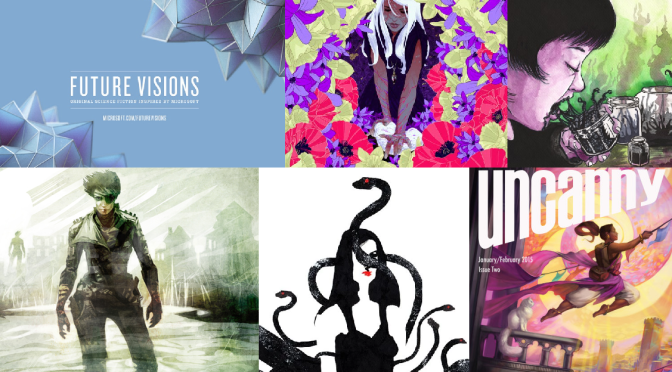
For me, Best Semiprozine is the toughest category because there are just so many amazing publications to choose from. I’ve been making a real, concerted effort to read more short fiction in the last year, and the first quarter of 2016 has partly been spent playing catch up so that the possible nominees for this category are all very fresh in my mind. Here’s my thoughts so far:

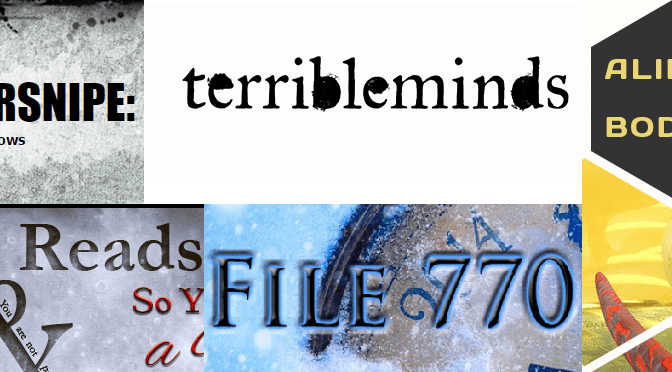
Best Fanzine is a little easier, though it’s still a crowded category that I haven’t made any final decisions on just yet:

  • Mark Reads/Mark Watches, because Mark Oshiro is a constant delight. He recently finished reading all of Tamora Pierce’s work, which I love, and he’s currently watching Star Trek: The Next Generation and DS9. He publishes an enormous amount of great content and is also just a very cool person.
  • SF Mistressworks is one of the best resources around for reviews and information about women SFF writers, which is relevant to basically all of my interests.
  • Lady Business is great, although they are slightly more interested in fan-work than I tend to be.
  • nerds of a feather, flock together is one of my most trusted review sites…
  • As are Fantasy-Faction and Fantasy Literature.
  • Finally, File 770 is a regular source of excellent news and information on fandom stuff.


Weekend Links: March 26, 2016

This has been another busy week with the Up and Coming project, which I’m still (fingers crossed!) on track to finish (if only by the skin of my teeth) by Wednesday. Probably after that I will take a couple of days to do nothing but play Destiny, but then I will have at least one new project to announce, plus a busy (but exciting) month in April of reading the ARCs I’ve got waiting for me on NetGalley.

My favorite things of the week were all funny things:

In awards news:

In other news:

Interviews I read/listened to this week:

Miscellany:

Let’s Read! Up and Coming: Part 8

I’m still struggling to get caught up to where I’d like to be with this project, but I’m also still on track to at least finish it when I originally planned. Sadly, today was not a day for stand-out stories, either bad or good, which made this section a bit of a slog to get through.

Samuel Peralta

Both of Samuel Peralta’s stories are highly conventional and rather cloyingly sweet. “Hereafter” is a time travel romance that may lean towards bittersweet, but it’s overall fairly low drama and ultimately low risk, with very little to say about time travel or the human condition. “Humanity” is interestingly put together, interweaving news clippings with the more personal story of a first responder tasked with rescuing a woman and her robot daughter from a serious car accident. It’s not bad, but the ending is expected, and the slight message doesn’t really justify the gravitas of the story’s title.

All that said, it may be that Peralta’s gifts are more focused on editing; many of the authors in this collection are ones who have had their first work published in Peralta’s ongoing series of SFF anthologies—the Future Chronicles, which is up to fourteen titles now, all available for under $6 each for the Kindle.

Andrea Phillips

Andrea Phillips’s “In Loco Parentis” is a compelling take on the future of parenting, though in a definitely “the more things change, the more they stay the same” way. Still, Phillips has imagined some interesting technology and tells a story that is firmly grounded in current trends in parenting and tech. I went ahead and read the included excerpt from Phillips’s novel, Revision, and then immediately wished I hadn’t; it’s gone straight to my to-read list, but there’s no telling at this point when I’ll get around to it, which is a bummer.

Mark Robert Philps

I didn’t expect to like this novella that much in the beginning, but “Dragonfire is Brighter That the Ten Thousand Stars” is much better than its unwieldy and moderately pretentious title lets on. The real accomplishment here, though, is in the world building. Mark Robert Philps has created a really interesting alternate history that could easily carry a whole series of longer works if he’s of a mind to write them. The plot here is relatively simple, with no particularly surprising twists, but it’s well-paced, highly readable, and overall nicely executed enough that I would be happy to read more by this author.

Monica Enderle Pierce

“Judgement” is a somewhat overlong sort of wild west fantasy, which aligns it with current trends in fiction, Monica Enderle Pierce doesn’t quite manage to pull it off here. I rather like her dragon-as-executor-of-frontier-justice idea, which is a concept I haven’t come across before, but none of the human characters were very interesting and the protagonist, Peregrine, is actively unlikeable. Furthermore, everything is tied up far too neatly at the end, with a surprise revelation of Peregrine’s conveniently useful magical abilities and a too-large infodump that tosses in several hackneyed ideas at the last minute.

Ivan Popov

“The Keresztury TVirs” is the first translated piece (from Bulgarian) in Up and Coming, but it’s unfortunately not that impressive. It’s a story about TV viruses told in the form of a review of a book about the history of their creation and usage as tools of propaganda and mind control. I suppose the story has a moderately interesting retro sensibility, but it just didn’t work for me.

Bill Powell

Due to formatting issues, I had a hard time just reading “The Punctuality Machine, or, A Steampunk Libretto.” It’s written as a short, farcical play, but half of the first word of almost every line was cut off in the epub version of the book that I’m reading on my Nook. Still, I was mostly able to muddle through, and I enjoyed Bill Powell’s clever wordplay and sense of comedic timing.

Stephen S. Power

“Stripped to Zero” is a solidly well-written and timely story about the steady creep of technology into our lives and the ways in which we’re always being watched, analyzed, and advertised to. It’s somewhat pessimistic, but not crushingly so. In “Wire Paladin,” Stephen S. Power continues to examine some of these same big ideas, but with a darkly funny twist at the end. I was glad to have read these two stories together, as they complement each other well. I didn’t like “Automatic Sky”—about a pair of somewhat star-crossed lovers—at all, but I expect your mileage may vary with it.

Rhiannon Rasmussen

I vaguely remember reading “The Hymn of Ordeal, No. 23” in Women Destroy Science Fiction, but only vaguely, and it didn’t make much more of an impression on me this time around. My love for second person point of view is well-known, but I just didn’t connect with this story the way I feel is intended. On the bright side, Rhiannon Rasmussen makes up for this by offering two more stories that I loved. “Charge! Love Heart!” is a kind of great, somewhat meta teen rom-com, and “How to Survive the Apocalypse” is a definitely great, very meta piece that pokes fun at a lot of zombie apocalypse tropes.

Chris Reher

From Chris Reher comes “The Kasant Objective,” about a crew hired to find a lost research team, only to find out that they are really being asked to aid in an alien invasion. There’s a lot going on here, and it’s frankly more than can be really effectively dealt with in a short story. The basic idea is moderately interesting, but this treatment of it was just too shallow to be good.

Ethan Reid

This excerpt from Ethan Reid’s sequel to his first novel seems fine, but I have basically negative interest in post-apocalyptic horror of this kind. For the right reader, I’m sure this is very good, but for me it’s a hard pass.

Final Verdict

Overall, today’s bunch was just average, but I do look forward to reading more in the future by Andrea Phillips and Rhiannon Rasmussen. I also think I might have to start buying some of the anthologies Samuel Peralta puts out, even if his own writing isn’t really my jam.

Let’s Read! Up and Coming: Part 7

So, I’m not behind, exactly, since I’m still well on track to finish this project by March 30th, but the last couple of days have not been particularly productive ones. Bad news always puts me in a bit of a funk, and it hasn’t helped that my partner has been home sick for a couple of days, which is a huge distraction. In any case, by the end of day on Monday, I was about a full day ahead of my reading schedule, and I don’t expect to be fully caught up until probably the end of day tomorrow. That said, I plan to finish the reading part of this project by Sunday evening and have the final few parts up by Wednesday afternoon.

On the bright side, today’s group of writers are some of my favorites yet, and there are several very strong possible nominees for Best Short Story in addition to at least one author that I can already tell you is likely to make my list of Campbell nominees.

Wendy Nikel

“Rain Like Diamonds” is a slightly underwhelming fairy tale, with an ending that is just a little too expected to be truly clever or particularly impactful. However, I adored “The Tea-Space Continuum,” which has a delightfully funny time travel paradox. Unfortunately, “The Book of Futures” was another miss for me. I like short detective stories, and I found the steampunk-ish setting intriguing, but the story just didn’t work. It actually had two endings; one was pedestrian, and both were trite.

George Nikolopoulos

I rather liked “Arise to the Surface” at first, even if it was obvious very early on what the story’s “twist” was, but it lost me when it had an alien woman with sexualized breasts. Randomly mammalian space people, seemingly for the sole purpose of describing sexualized breasts, is a major pet peeve of mine, and the rest of the story wasn’t good enough to overcome my distaste for that uncreative nonsense. “Razor Bill vs. Pistol Anne” is a very short, mildly amusing post-apocalyptic gladiator story, but it’s not particularly memorable.

Megan E. O’Keefe

“Of Blood and Brine” is a superb example of short fiction world building, and Megan E. O’Keefe backs it up by telling a compelling story as well. This one is eligible for the Best Short Story Hugo Award as well, and it’s definitely one to consider. I did skip her novel excerpt, however, as I’d like to read the whole book, though I’m not sure when I’ll get around to it.

Malka Older

“Tear Tracks” is a very good, but not great, first contact story. Malka Older does an amazing job with her world building, and I love the alien culture she’s conceived here, but the actual story is fairly slight and it gets a bit info-dumpy at the end, which makes it slightly insincere feeling. A+ ideas, but C+ execution.

Emma Osborne

“The Box Wife” was hard to read as it features one of my all-time least favorite sci-fi tropes: a sexbot. Even when it’s used in the best possible way, even when it’s done to interrogate or subvert as it is here, I find this trope viscerally upsetting. Still, it was promising enough for me to move on to Emma Osborne’s other stories. I rather liked “Zip” which is reminiscent of good Star Trek, but “Clean Hands, Dirty Hands” was another fairly dark and unpleasant story to read; I liked its Australian gold rush setting, which is pretty unique, but it’s an extremely grim tale, and I increasingly find these days that I’m simply not in the market for that kind of bleak grimness.

Chris Ovenden

“Upgrade” has a moderately interesting premise, but it reminds me far too much of last year’s film Advantageous, which explored similar ideas much more effectively. “Peace for Our Times” has got to be at least the third or fourth “deal with the devil” story in this collection, and it’s one that doesn’t manage to be either very insightful or fun. “Behind Grey Eyes” does manage to be fun, but I’m unfortunately just not a fan of zombies-as-metaphor in general. I’m not super impressed by any of Chris Ovenden’s stories here, but he’s objectively talented and I feel like he’s an author who is going to publish something any day now that I’m going to love. In the meantime, I could easily imagine any of these stories being someone else’s favorite even if they aren’t for me.

Steve Pantazis

Steve Pantazis’s novelette, “Switch,” would make an excellent episode or two for a futuristic cop show that I might enjoy watching, but it’s of a genre that I find unreadably boring. I can tell that it’s well-written and nicely structured and paced, but there’s no more boring protagonist for me to read about than a slightly dirty, but essentially decent policeman.

Carrie Patel

Carrie Patel is an author who has gotten a good amount of buzz in the last year, but this is the first time I’ve actually gotten to read any of her stuff. I don’t know what I was waiting for. “Here Be Monsters” is a shipwrecked story that is fantastic and horrific in turns, with a wonderfully ambiguous ending. I’m not always into unreliable narrators, but I enjoyed this one. Also, the abyssus is a great creepy monster. “The Color of Regret” is a total change of pace, and its speculative elements aren’t as central to the story—in fact, Nasrin’s ability to see auras is almost incidental to the plot—but the tale straddles the worlds of family drama and revolutionary intrigue in a compelling fashion. The Buried Life is a novel that’s been on my to-read list for ages, so I skipped the excerpt from it here.

Sunil Patel

Sunil Patel’s first contact tale, “The Merger,” is one of the funniest stories so far in Up and Coming, and I laughed out loud more than once while reading it. Paresh is lovable, and his wife Sita is a constant delight. Plus, there’s very little that I find funnier than unconventional contract negotiations. Especially with aliens. In contrast, “The Robot Who Couldn’t Lie” had me in tears well before the end. It’s nice to see an author with this sort of range in their writing, and this is further highlighted by Patel’s third story, “The Attic of Memories,” which I didn’t like as well as the first two but which is something entirely different again. The only thing that all of these stories have in common is a professionally polished quality that is often lacking in work by writers at the beginning of their careers. I can’t wait to see what Sunil Patel does next.

Laura Pearlman

From Laura Pearlman, we get a trio of very amusing stories that made me laugh even more than “The Merger.” First up, “I am Graalnak of the Vroon Empire, Destroyer of Galaxies, Supreme Overlord of the Planet Earth. Ask Me Anything” is exactly what it sounds like—an AMA with the leader of an army of radish-loving alien invaders. “A Dozen Frogs, a Bakery, and a Thing That Didn’t Happen” is a fabulous and very clever modern fairy tale. I wasn’t sure at first about “In the End You Get Clarity,” but it’s not like other superhero stories, and by the end I loved it.

Final Verdict

Carrie Patel and Laura Pearlman are both in their final year of eligibility for the Campbell, and either could be a strong choice, but the sheer versatility of Sunil Patel is what I found most exciting in today’s reading. I wouldn’t pick Megan E. O’Keefe and Malka Older for this year’s award, but they’re both writers to watch for, each with a first novel being published this year.

iZombie: “He Blinded Me… With Science” is full of almost-revelations

I’m pretty sure I had a permanent look of delight on my face throughout this entire episode, which managed to squeeze an enormous amount of story into its 43 minutes—including a ton of set up for the final four episodes of the season, which I can already tell are going to be a wild ride. “He Blinded Me… With Science” might be my favorite episode of this show to date, to be honest; it’s certainly the best episode of this season, and it included some of everything I love about iZombie except for Peyton. There was even a somewhat minimal amount of Major this week and signs that all of Major’s chickens will be coming home to roost very soon. Of course, it looks like everyone’s chickens are coming home to roost, so it’s not exactly like Major is exceptional in this. There’s just a bonkers amount of plot this week, with an equally bonkers amount of character work, all leavened with liberal amounts of wry humor.

This episode is dominated by its villains, however. Both Blaine and Vaughn get significant amounts of screen time and some big developments in their respective plots. After an excellent cold open that introduces Liv’s case of the week and contains more than one great Ravi line, Liv leaves with Clive just in time for Blaine to show up covered in dirt and wrapped in a blanket. Blaine needs brains, clothes, and an Uber, all of which Ravi helps with, but not before delivering some more bad news about the progress—or lack thereof—on the zombie cure front. The rest of the episode sees Blaine dealing with this information and essentially making his final arrangements, from giving his henchmen the keys to the business to picking out a casket. Ravi does come up with another untested version of a possible cure that he gives to Blaine, and our final shot of Blaine this week is him injecting himself with it.

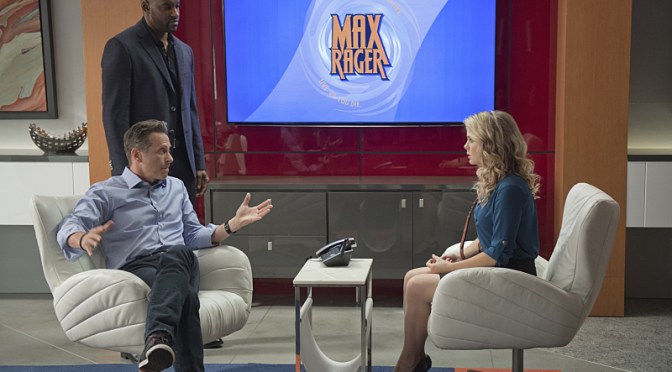
Vaughn, on the other hand, is becoming increasingly erratic and crazed under the influence of copious amounts of his own energy drinks. This episode sees him try to attack Major after giving a positively manic speech in which Major learns that Rita is Vaughn’s daughter. Vaughn manages to mostly keep it together when he’s interviewed by Clive and Liv about their dead woman, and he’s even more or less normal when he catches a disguised Liv snooping around Max Rager’s labs later on. However, things get weird when Vaughn and Gilda are down in the not-technically-secret basement after hours. Vaughn harasses one of their zombie test subjects until she breaks free, kills a scientist, and then comes for Vaughn and Rita. Vaughn manages to escape, but only by abandoning Rita to her fate. When his daughter manages to fight her way free of the zombie, Vaughn has locked himself in his office and refuses to let her in. He’s clearly shaken by this experience, but it’s pretty much impossible to feel bad for him. Rita, of course, is slightly more sympathetic here, but I’m much more excited to hurry on to next week or whenever we find out what zombie Rita is going to be like.

Liv actually has a lot going on herself this week, but she almost fades into the background in the face of all the Blaine and Vaughn stuff which is much more interesting than the case of the week. Still, the case—with a twin twist!—isn’t bad, and it leads Liv much closer to figuring a whole lot of things out. I don’t love her slightly creepy stalking of Drake, though. Liv’s love life has been a common thing for the show to explore this season, and the show always seems to tie her bad relationship behavior to the brains she eats, but at some point I feel like we have to start to accept that Liv just isn’t great with relationships. The thing is, I would be fine with that just as a part of Liv being a complex and flawed character, but the show seems to want to play this stuff for laughs and consistently shifts all responsibility away from Liv instead of really examining how kind of messed up Liv’s trust issues are and how they are negatively impacting her life, which could be really compelling if the writers would spend some time on it.

Overall, though, “He Blinded Me… With Science” is a top notch hour of television that leaves things nicely set up for the rest of the season. The show is juggling an awful lot of stories right now, but it’s managing, and we’re seeing all of iZombie’s scattered threads starting to converge. Next week, Peyton is back and I expect that we’ll see even more connections made and possibly even a couple of things made clear after this week’s string of near-revelations. I can’t wait.

Miscellaneous thoughts:

  • Loved Blaine and Liv on the same brains.
  • “In case you haven’t noticed, our popular culture is quite inundated with zombies.”
  • I wish we could have seen Rita fight off that zombie using just her high heel.
  • Could have used more of Stacey Boss, but what little we got was very good.
  • NEXT WEEK PEYTON IS MOVING BACK IN WITH LIV.

Let’s Read! Up and Coming: Part 6

This group of authors is sort of a love it or hate it group for me. The stories I didn’t like, I really disliked, but the ones I liked, I loved. There’s not much here that I have lukewarm feelings about.

S Lynn

S Lynn’s “Ffydd (Faith)” is a strange story to be included in this collection because it doesn’t seem to have any actual speculative elements. Instead, as far as I could tell it’s a fairly straightforward piece of historical fiction, perhaps leaning a little towards magical realism. Which is fine, but I generally expect a little more of the magical than exists here before I consider a story to fall under the speculative fiction umbrella.

Jack Hollis Marr

“into the waters I rode down” is an interestingly experimental stream of consciousness sci-fi story told from the point of view of a deaf, disabled woman who seems to be being used against her will for spying during a war. While the story at times becomes almost incoherent, I think this is by design, and it’s a story that I intend to come back to when I have more time to really spend mulling this one over.

Arkady Martine

From Arkady Martine, we get two lovely stories and a third one that is so arcane as to be incomprehensible. “City of Salt” is a gorgeous piece of what I usually think of as highbrow sword and sorcery, and it has a fantastic amount of mythology crammed into very few words that demonstrates Martine’s facility with language and an almost fairy tale sensibility that reminds me a little of Catherynne Valente. In “When the Fall is All That’s Left” Martine switches gears completely to tell a sci-fi story about a pair of friends who have just flown through a star. While there’s no particularly remarkable elements here, the story pieces that Martine has chosen are well-picked and artfully put together. For contrast, however, she’s included “Adjuva,” a story so arcane as to be incomprehensible and which I could barely make it through at all, much less enjoy.

Kim May

“Blood Moon Carnival” is a punctuation atrocity visited on what might otherwise have been a halfway decent story idea. Unfortunately, the absurd number of exclamation points just destroy any sense of suspension of disbelief or immersion in the story I might have felt. Drama has to come from the events that are unfolding, not from a half dozen paragraphs in a row ending with an exclamation that doesn’t actually convey any shock or surprise or urgency.

I almost didn’t read “The Void Around the Sword’s Edge,” and I wish I had followed that instinct. It’s riddled with copy editing issues, misspellings, and poor word choice, but it’s also a very silly story with an ending that can be seen coming a mile away and that is far too easy to be at all interesting.

Alison McBain

I’m of two minds about Alison McBain’s work. On the one hand, I kind of love that it’s a throwback to the sort of very old fairy tales that don’t always have any positive moral or message. My favorite old fairy tales have always been the ones about amoral tricksters or wicked witches who don’t actually get vanquished or where magical things just happen without necessarily meaning anything at all except maybe something about our collective id or whatever. All three of McBain’s stories here capture something of those qualities. At the same time, however, there’s a certain sense of smug, postmodern nihilism as well that is almost unpleasant to read and makes me feel a little bad about enjoying these stories so much.

Rati Mehrotra

Both “Charaid Dreams” and “Ghosts of Englehart” deal with children who have been changed by exposure to aliens. The first is a sort of frontier story about a family living on a remote planet that is largely inhospitable to human life, while the second is an alien invasion story, but they otherwise have a lot in common. Both are family dramas, both involve aliens who only seem to interact with children, and both have very little to actually say for themselves that isn’t something relatively platitudinous about how children are the future.

Lia Swope Mitchell

“Slow” is a marvelous little horror story about a sculpture that is sucking the life out of its artist. I don’t think Lia Swope Mitchell’s current, very small body of work is quite enough for a Campbell nomination, but she’s only in her first year of eligibility. I’ll definitely be keeping an eye out for her stuff over the rest of 2016.

Allison Mulder

I loved “Decay.” This story about body-snatching tooth fairies was delightfully unexpected. It’s good and creepy, with a surprise ending that is actually legitimately scary. Allison Mulder is another first year author who I hope publishes a few more things in time for me to consider her for next year’s awards.

Ian Muneshwar

Ian Muneshwar’s “Ossuary” is a wonderfully unique take on the AI-searching-for-a-body trope that seems to keep popping up in this collection. It’s also just beautifully written, the kind of story I want to read over and over again to search for all its shades of meaning. Also, to just admire Muneshwar’s consistently excellent word choice and structures. “Ossuary” isn’t a very long story at 2570 words, but Muneshwar makes every one of those words count.

Brian Niemeier

“Strange Matter” is a more science-y, more cynical version of Groundhog Day, but I adored the ending of it, which surprised me by turning out to be something funny and sweet. I would love to have time to actually read all of Brian Niemeier’s novel, Nethereal, but I won’t be getting to it in the next week.

Final Verdict:

None of today’s authors have published enough notable work for me to really get excited for them as Campbell prospects for this year, but Arkady Martine, Lia Swope Mitchell, Allison Mulder, and Ian Muneshwar are all on my list of authors to follow for the rest of 2016 and see if that changes.

Supergirl: “Manhunter” has a lot going on, leaving me with a lot of mixed feelings

“Manhunter” picks up more or less where last week’s episode ended and deals primarily with the fallout from the revelation that Hank Henshaw has been an alien in disguise for the last ten years. It’s good to see that the events of “Falling” aren’t going to be dealt with quickly, and at this rate it seems likely that we won’t be seeing a proper resolution to things until the season finale. Unfortunately, “Manhunter” falls apart a bit at the end, with some weird shuffling around of things and a couple of revelations, all of which I have some mixed feelings about.

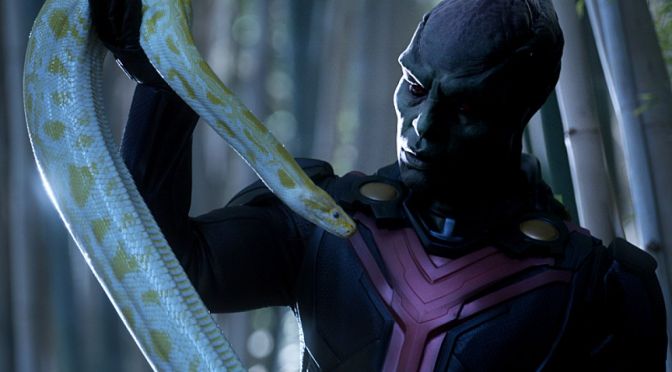
While the episode is ostensibly dealing with the immediate consequences of last week’s episode, most of the hour is actually spent in flashbacks, with mixed results. The Martian Manhunter flashbacks weren’t actually that interesting and don’t tell us anything in particular that wasn’t already shown in previous flashbacks or couldn’t have been summed up in a line or two of dialogue. It also didn’t help that the interrogator, Colonel Harper, is supposed to have some kind of personal connection to Hank Henshaw—they’re best friends, apparently—but we’ve literally never seen him before, so there’s no context for his feelings of hatred and betrayal. This might have worked better if these things were intended to add some nuance or gray areas to the situation, but Harper is just a cardboard villain who ends up fairly easily defeated in the end.

The Alex flashback—where we learn that she was basically an unmotivated party girl (with a doctorate, I guess) before being recruited to the DEO—was good in theory, but the execution wasn’t great. I really appreciate that Hank didn’t rescue her from a date rape or mugging or something like that, but rescuing her from being busted for public intoxication doesn’t quite make the case for how adrift and struggling we’re supposed to believe Alex was during that time, either. It’s just mildly humiliating, not a total crisis.

The final flashback belongs to Kara, as she finally tells Lucy Lane about her identity. I like the material shared in this flashback best, as it actually gives us new insights into Kara and her childhood as an alien trying to fit in on Earth, her relationship with Alex, and her relationship with her adoptive father, Jeremiah Danvers. Unfortunately, the thematic connections between this little saga, J’onn J’onnz’s decision to impersonate Hank Henshaw, and Lucy’s own desire to fit in just don’t work. These are all very different situations, and the extremely superficial similarities aren’t enough to tie things together in a satisfactory way.

This thematic dissonance is further complicated this week by Siobhan’s storyline, which just keeps happening for some reason. While Kara is out of the office, Siobhan sneaks in and sends a nasty email to Cat Grant from Kara’s computer, but Cat—with Winn’s help—sees right through it. Winn tries to comfort a distraught Siobhan, but she breaks a heel and falls off a roof, screaming, only to have the power of her screams stop her fall. WHAT. After doing some reading about it this afternoon, apparently, this is because Siobhan is the Silver Banshee, a comic book villain I know nothing about, but who is apparently a pretty significant player in the Supergirl story. Siobhan makes a lot more sense now, and I figure we can expect her to show up as a villain of the week sometime before the season finale, but still. Her whole storyline seems like an awful lot of work for another villain of the week, and I don’t think there’s enough substance to her—especially to her interactions with Kara—to carry more than an episode.

The biggest real development in “Manhunter,” though, is the change in leadership at the DEO. While I’m not totally happy with the way they got there, I’m thrilled to see Lucy Lane take it over, mostly because I see this going one of a couple different directions. Either Lucy takes over the DEO and we see much less of it because of Jenna Dewan Tatum’s guest star status, which could be a good thing since the multiple disparate settings of the show have always been to its detriment OR Lucy takes over the DEO and she and Kara work together to protect the planet and become best friends, which would be excellent, since this episode just proved that they can work really well together—even if the stealth bikes were kind of silly. Either way, I think I’d be pleased.

It’s hard to believe there are only three episodes left in the season, to be honest. There are an awful lot of stories going on—Lucy at the DEO, Kara and James’s romance, Siobhan and Winn, Alex and Hank going after Project Cadmus and Jeremiah Danvers, whatever Non is up to these days, plus that much-hyped crossover with The Flash—that need to be at least partially sorted out by the end of the season, and I’m curious to see which ones the show does justice. We’ll see!

Miscellaneous thoughts:

  • I also have mixed feelings about how kind of sexy chubby Dean Cain is.
  • That poor boa. Just minding its own business when some dude thinks he needs to manhandle it.
  • When did Hank get better at wiping memories? Who has he been practicing on? And what happened to his ethical concerns about doing it at all?
  • I can’t be the only person who gets more of a romance vibe than a father-daughter vibe from the relationship between Alex and Hank, right?
  • Lucy’s face when she learns that Kara is Supergirl is priceless. Because of course. Poor Lucy.
  • Jeremiah Danvers is still alive, supposedly trapped at this Project Cadmus thing, but I’d give even odds that he’s actually the mastermind behind it. I guess we’ll find out in the next couple of weeks, with Hank and Alex going after him.
  • Also even odds on Siobhan somehow corrupting Winn and turning him into Toyman 2.0 or something.
  • Lucy stepping into her place at the DEO was #ICONIC.