All posts by SF Bluestocking

Weekend Links: June 4, 2016

Last week was a bit of a nightmare, with the trip to Huntsville and all, and I have to admit that it took a bit more out of me than I thought it did when I got home. What that means, unfortunately, is that I’ve spent much of the last week recuperating, physically and emotionally. The good news is that I’m much better now. The bad news is that I didn’t really get as much done as I would have liked this week. On the bright side, I’m feeling pretty recharged now, and I am finally making some headway this weekend on catching up with book reviews and getting back on track with the Dune readalong. I’m not thrilled with my lack of productivity, but I’m happy to finally be settled back in at home and getting to work now.

I’m also happy to have some links to share this week, even if it’s not as much as usual. I rather thought there would be a ton of stuff to share after a full week away, but there’s really only about as much as normal. I’m still getting used to the absence of SF Signal, to be honest. I read a ton of blogs and stuff, but it turns out that I relied on them a lot for keeping track of reviews, author interviews, and SFF-related pieces on some sites that I don’t habitually read. I always knew SF Signal was a treasure, but I thought I’d get over the loss. Instead, it’s turned out to be a resource that I miss on almost a daily basis. I have some ideas for how I can find more content without spending hours a day on it, but I can’t help but hope that someone with the time steps in to fill that void.

This week also saw my first bout of mid-season Game of Thrones ennui, as I struggled to find the energy to write extensively on the show’s latest episode. I’m hoping that most of this can just be chalked up to exhaustion from last week’s trip, but no small part of my frustration with writing about the show is due to the fact that there’s just not much left to say about it anymore. Marveling at the terribleness of it all only takes one through so many thousands of words, you know?

Fortunately, there’s not much Game of Thrones left after this year.

The Mythopoeic Society announced the finalist list for this year’s Mythopoeic Awards.

Fantastic Stories is looking to keep their doors open by utilizing Patreon to support the publication.

Gillian Anderson is going to be in American Gods. I’m not sure how much more excited I can get about this adaptation.

This month’s Trope Anatomy 101 at the Book Smugglers deals with the waving away of disability and chronic conditions in fiction.

I’m always on the look out for nonfiction to read, even if I don’t get around to reading as much of it as I’d like. This list of 17 genre-related essay collections and biographies added several new things to my Amazon wishlist.

Alexandra Erin is still doing her Sad Puppies Review Books posts, and The Giving Tree might be my favorite one yet.

You can now read Mary Shelley’s Frankenstein in her own handwriting online.

Kat Howard’s Big Idea is up at John Scalzi’s blog. Her novel, Roses and Rot is lovely.

I adored All the Birds in the Sky when I read it earlier this year, and there’s a nice new interview with the Charlie Jane Anders over at Lightspeed.

Ada Palmer’s Too Like the Lightning is one of the best books of the year so far, and she’s got a new guest post up at Sci Fi Chick.

Tor.com revealed the cover for Kai Ashante Wilson’s upcoming novella, A Taste of Honey, and it’s gorgeous.

I don’t know if this is the last trailer for Independence Day: Resurgence, but it’s the last one I’ll be watching before the film comes out. I’m sufficiently excited. Also, Jeff Goldblum is like a fine wine.


The SF Bluestocking 2016 Summer Reading List

So, last year, I didn’t manage to make it through my whole summer reading list, so this year I’m going to do something a little different since there’s even more this year than last year that I want to get through. So, instead of pretending as if I’m definitely going to get through everything, I’m just going to treat this as a sort of long list that I’ll be pulling from for my reading over the next three months or so. There are definitely a few must-reads here, but there’s many more nice-to-reads that I don’t know if I’ll get to. It’s just going to depend on how much time I’m able to spend reading and writing, to be honest.

AlreadyRead

Summer and Summer-ish Books I’ve Already Finished, With Reviews Coming Soon

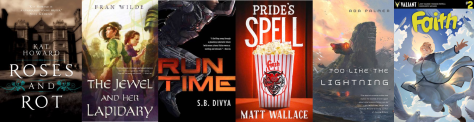
  • Roses and Rot by Kat Howard
  • Central Station by Lavie Tidhar
  • Too Like the Lightning by Ada Palmer
  • A Court of Mist and Fury by Sarah J. Maas
  • The Jewel and Her Lapidary by Fran Wilde
  • Runtime by S.B. Divya
  • Return of Souls by Andy Remic
  • Pride’s Spell by Matt Wallace
  • Rat Queens Volume 3: Demons
  • Lumberjanes (comic)
  • Faith (comic)

Tor.comNovellas

Tor.com Novellas

I generally read all of these either through NetGalley or as they come out, but I’m thinking of relaxing on that after this summer, particularly in regard to series that I don’t care much for. That said, I do plan to finish reading all of this summer’s titles at least.

  • The Jewel and Her Lapidary by Fran Wilde (already read)
  • Runtime by S.B. Divya (already read)
  • Return of Souls by Andy Remic (already read)
  • Pride’s Spell by Matt Wallace (already read)
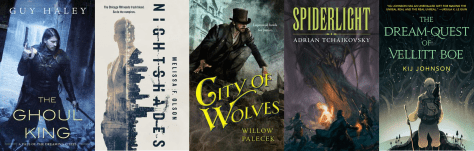
  • The Ghoul King by Guy Haley
  • Nightshades by Melissa F. Olson
  • City of Wolves by Willow Palecek
  • Spiderlight by Adrian Tchaikovsky
  • The Dream-Quest of Vellitt Boe by Kij Johnson

SciFiMustReadsScience Fiction Must-Reads

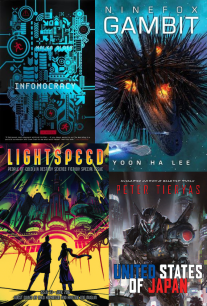
  • Infomocracy by Malka Older
    I’m not super into near-future stuff, but I’ve been making a real effort to read outside my comfort zone in the last couple of years and I got an ARC of this one through NetGalley.
  • Ninefox Gambit by Yoon Ha Lee
    Yoon Ha Lee’s short story collection, Conservation of Shadows is one of my favorites in recent years, so to say that I’m super excited about this novel is something of an understatement. It’s definitely one of my most anticipated books of 2016.
  • Lightspeed’s POC Destroy Science Fiction! Special Issue
    Rewards were just delivered for Kickstarter backers the other day, and I can’t wait to dig into this over the weekend.
  • United States of Japan by Peter Tieryas
    I feel like this is going to be a perfect summer blockbuster of a novel.

FantasyMustReads

Fantasy Must-Reads

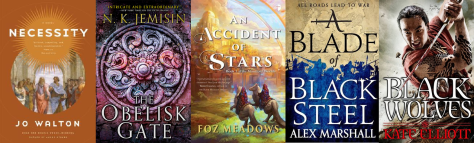
  • Necessity by Jo Walton
    The first two books in this trilogy were some of my favorite reads last year, and I am very much looking forward to this volume.
  • The Obelisk Gate by N.K. Jemisin
    The Fifth Season was hands down my very favorite novel of 2015, and I fully expect this one to be every bit as good.
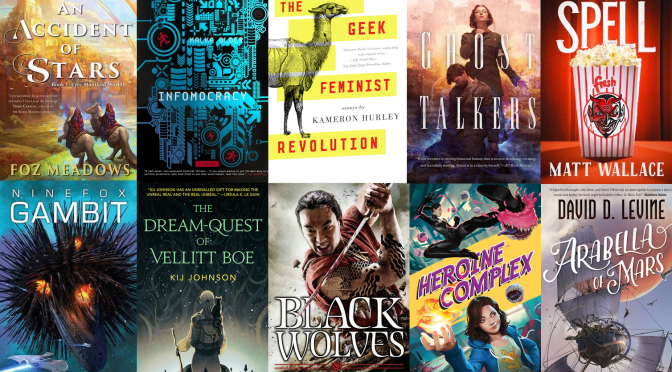
  • An Accident of Stars by Foz Meadows
    Foz Meadows’ “Coral Bones” was a wonderful read, and this book has people riding kangaroo things on the cover, so I’m excited for this novel-length work.
  • A Blade of Black Steel by Alex Marshall
    Second in a series. I loved the first one, so I can’t miss this one.
  • Black Wolves by Kate Elliot
    I’ve never managed to really fall in love with anything by Kate Elliot, in spite of it her work, objectively, ticking off basically all my boxes for favorite book criteria, but I’m still going to give this book a go because it’s so highly recommended and often suggested by literally everyone else who likes the same stuff I do.

Miscellaneous Must-Reads

  • The Geek Feminist Revolution by Kameron Hurley
  • ODY-C Volume 2 Sons of the Wolf by Matt Fraction and Christian Ward
  • The Paper Menagerie and Other Stories by Ken Liu

Books I Really Want to Read, But Am Not Sure I Realistically Will Be Able To Because I’m Only Human

  • The Devourers by Indra Das
  • Ghost Talkers by Mary Robinette Kowal
  • Heroine Complex by Sarah Kuhn
  • Arabella of Mars by David D. Levine
  • The Dinosaur Knights by Victor Milan
  • The Vagrant by Peter Newman
  • The Cupid Reconciliation by Michael R. Underwood
  • Strangers Among Us edited by Susan Forest and Lucas K. Law
  • Invaders edited by Jacob Weisman
  • Hunger Makes Me a Modern Girl by Carrie Brownstein
  • My Life on the Road by Gloria Steinem
  • The Notorious RBG  by Irin Carmon and Shana Knizhnik

Game of Thrones Recap/Review: Season 6, Episode 6 “Blood of My Blood”

If I could only use a single word (instead of the thousand I likely will use) to describe “Blood of My Blood” it would be “predictable.” This has been increasingly true of the show for some time now, and I know I’ve mentioned in the past that it’s gotten extremely easy these days to extrapolate nearly all the events of each episode from just the “previously on” reel at the beginning. There were a couple of “twists” this week, but none of them were particularly interested, and all have been heavily, ham-fistedly foreshadowed either in earlier seasons or, sometimes, simply in the involved characters’ previous scene in this very episode. Alternatively, said “twists” come with no warning at all and make basically no sense if you think about them for more than a moment or two, which may make the “twists” somewhat unpredictable but is pretty much par for the course for the show. I’m never less surprised than when the show has a completely unearned and nonsensical plot twist thrown in to season the pot of badness it’s become.

Spoilers below! Continue reading Game of Thrones Recap/Review: Season 6, Episode 6 “Blood of My Blood”

Personal/Blog Update: May 29, 2016

Well, as you can see there are no Weekend Links this week (though there is a funny picture–I haven’t been completely cut off from the world).

My partner and I were out of town all week to take care of his dying mother in Huntsville, which has been exhausting, physically and emotionally. Between that and there just not being any reliable internet access at the Huntsville Hospital, I honestly haven’t read a thing. I did think about trying to rush and put something together, but after coming home yesterday to find the beautiful tree outside my apartment cut down and my view (such as it was) completely destroyed–like, the new aesthetic here is apparently “edge of a stripmine”–I frankly don’t have the energy to do it.

My plan right now is that I will be watching and tweeting Game of Thrones tonight as normal. I usually do my recap/review posts on the Monday following the episode, but tomorrow is a holiday and we will be going to my grandmother’s house, which will take up a good part of the day. I am hoping to still get the post out as usual, though probably late in the afternoon or evening, but it may have to wait until Tuesday. As far as the rest of the week goes, we aren’t planning on heading back to Huntsville for a couple of weeks, so I’m hoping to keep things as normal as possible in the meantime.

The good news is that, while I didn’t have time to read the internet this past week, I did read several books, and I’m planning to finish another one or two by the end of the week, so there should be a whole bunch of book reviews coming soon. I’ll also be working this week to get back on track with my Dune readalong. In addition to that, I have several other posts and essays in the works, and the Hugo Voter’s Packet is finally available so I can start figuring out what I’m going to do with that. I’d originally planned to blog my way through it, but I don’t know that I’ll have the emotional fortitude to deal with it at this point.

Obviously, all of this is going to be (unfortunately) very conditional on how my partner’s mom does over the coming days and weeks. I think his next visit to Huntsville is going to be made alone, but I will surely be joining him at times as well if his mother lingers on and of course when she does finally pass, which could be right now or six months from now.

As I said above, I’m otherwise going to just do my best to run things as normally as possible here as we get into summer. Even just a day of being home, relaxing and eating food that isn’t from McDonalds has worked wonders, so I fully expect to get back up to speed this week.


Game of Thrones Recap/Review: Season 6, Episode 5 “The Door”

Like basically every episode of Game of Thrones in the last three years, “The Door” is a mixed bag. However, like most episodes in the last two seasons or so, the bag is mostly full of shit. Interestingly (and disappointingly), this episode spends a ton of time either retreading ground that has already been covered in the series or lampshading some of the show’s more nonsensical decisions.

Speaking of lampshading nonsense, the episode jumps right into that at the start of the hour, which opens with Sansa receiving a letter from Littlefinger and going to meet him in Mole’s Town. The scene that ensues is at once glorious and absurd as Sansa takes Littlefinger to task for selling her to the Boltons, tells him that he’s either stupid or evil, and threatens to have Brienne kill him before rejecting his offer of military help and sending him on his way. I want to love Sansa’s dressing down of the man who bartered her into an abusive marriage, and it’s obvious that the show’s writers expect us to cheer for her newfound empowerment, but it’s simply not even a little bit earned. Mostly, it just feels somewhat out of character for both Sansa and her erstwhile “ally” (though not for Brienne, who continues to be portrayed on the show as one-dimensionally brutish).

Sadly, the recognition—nearly a full season’s worth of episodes later—of Sansa’s wedding night trauma and the horrors of what she endured at Winterfell rings somewhat false. Sansa tells Littlefinger and the audience how she feels, but there’s been no other indication before now of these feelings. I suppose several episodes of Sansa looking sad let us know that something bad was happening to her, but since her escape there’s been not a peep about how she’s dealing with things. I can’t remember it being mentioned at all before now, and in fact much of Ramsay’s abuse of Sansa has only been implied, mostly by Sansa looking wan and puffy during her time at Winterfell. For a show that is all about being shocking, this one is remarkably coy when it comes to addressing something real (domestic abuse) and seems more than content to spend much more time dealing with the more fantastical elements of the stories it’s trying (rather unsuccessfully) to tell. And so far more time has been dedicated to Ramsay’s daddy issues, Theon’s redemption arc, and even to the touching reunion between Jon and Sansa (another emotional moment that was entirely unearned) than on Sansa’s character growth and recovery from the trauma she’s supposed to have experienced. Even Sansa’s sudden closeness with Brienne doesn’t feel quite real, since we’ve barely seen them on screen together and they’ve hardly exchanged more than a couple of words with each other.

One of the biggest problems I’ve had with Game of Thrones for some time has been exactly these kinds of scenes. They’re moments that work, sort of, out of context and by giving the writers a lot of credit for all the things that can be kinda-sorta inferred from the show enough to make some kind of sense out of what we’re seeing. But these moments never hold up to any kind of scrutiny, and the application of just the tiniest bit of critical thinking will break whatever spell the show has managed to cast. Sure, we can use our imaginations about Sansa’s abuse at Ramsay’s hands. We can assume that she has been experiencing cold sweats and nightmares and other effects of that trauma. We can guess that during the journey to the Wall she and Brienne bonded and she shared some of that with her new friend, which forged a bond between the two women. But why should we, the audience, have to do all that work? There is always a certain amount of filling in of blanks when we consume stories, but this show relies on the audience’s knowledge and understanding of storytelling conventions (and often on the audience’s familiarity with the books) to a shamefully degree. It’s lazy, and it’s disappointing, and it only gets worse the longer the show goes on.

When the show isn’t condescending to the audience with pathetic narrative shorthand, it’s simply spinning its wheels, as it is in Arya’s Braavos storyline. Nearly three full minutes are spent on Arya receiving another beating from the Waif, and it’s as senseless as it is repetitive and visually uninteresting. It’s well-worn ground at this point, and it’s frankly boring. Even Jaqen H’ghar’s story about the origins of the Faceless Men is dull, and it’s not helped by the fact that it’s close enough to the story given in the books to show that the writers did actually read them but different enough from the book story to prove that D&D didn’t actually understand it. I know David Benioff has said that “themes are for 8th grade book reports,” but shit like this makes me doubt he reads and comprehends material on an 8th grade level at all. Like, when Benioff said this it was kind of derisively–as if he’s beyond all that, with his MFA and all, but it seems much more likely that he just really, really doesn’t “get” ASOIAF.

Moving along, though, Arya gets her second official assignment as a prospective member of this cult of death. This time, she’s to assassinate an actress, Lady Crane (played by Essie Davis from Miss Fisher’s Murder Mysteries!), who performs with her troupe near the docks. I guess this is supposed to be a very loose adaptation of the Mercy chapter from The Winds of Winter that GRRM released ages ago, but it isn’t, at least not in any meaningful way. I did kind of love the pro-Cersei propaganda play that we get to see parts of in this sequence, which has better dialogue than most of the show has had for two and half seasons. I could have done without the close-up shot of the Joffrey actor’s diseased dick, but this stuff is otherwise fairly unobjectionable, if only due to its extreme blandness. Arya’s misgivings about killing Lady Crane could be interesting, but we’re given such a small glimpse of the actress (most of the time spent with the troupe is dominated by the male actors) that it’s hard to have any particularly strong feelings one way or the other about the matter. And, really, Arya having to make a hard choice in order to gain or keep her place at the House of Black and White is “dramatic” fodder that was already chewed over last season. It’s fine, but it would be nice to see more forward movement in this story line, especially as all the rest of the Stark kids seem to be moving towards some kind of reunion.

From Arya, we travel north of the Wall to see what Bran Stark is up to, which is not a whole lot. However, this brief (right around two minutes) scene contains what ought to be a major revelation: that the Children of the Forest are the ones who created the White Walkers, as weapons to fend off the invading humans. The impact of this information is somewhat diminished by the short length of the scene, however. There’s barely time to process the news before we’re whisked away to the Kingsmoot.

Which is an enormous letdown. First, no one but Yara is willing to make a claim to the throne. Then Yara is quickly shouted down by men who would rather have Theon than his sister because she has a vagina. Also, apparently all the reasons why Theon got a cold welcome at Pyke years ago after being raised at Winterfell no longer matter, even though he’s just as dickless these days as Yara is (unlikely, to say the least, to produce a legitimate heir of his own) and clearly broken down by the torture he experienced at Ramsay’s hands. It’s okay, though, because Theon throws his support behind Yara, which gets this apparently very fickle crowd chanting for her after all. But, surprise! Old (well, young) uncle Euron is home, and he’s going to win the Ironborn over by bragging about how he’s got a big dick. Yara accuses him of murdering Balon, even though there’s no reason for her to think this, but Euron’s just like, “Yeah, I did. What are you going to do about it?” because it’s not like kinslaying is one of the worst cultural taboos in Westeros or anything. The men quickly shift their allegiance to Euron, so Yara, Theon and some men loyal to them book it out of there and steal the whole Ironborn fleet while Euron is busy being drowned and crowned. This is probably a wise decision on Yara and Theon’s part, since the first thing Euron does once he’s done coughing up sea water is round up a mob to go murder his niece and nephew, only to be comically amazed as he sees the whole Ironborn fleet hightailing it out of there.

This is definitely the most unintentionally hilarious sequence so far this season, but it’s also one of the most disappointing ones. None of this makes very much sense, and it’s a sad bastardization of this plot from the books. GRRM’s Iron Islands chapters are generally considered a weak spot in the books, but they’re at least coherent there, and the actual Kingsmoot chapter is an excellent one. Here, it’s reduced to a couple of minutes of spiritless stump speeches and dick measuring, with Yara and Theon’s leaving, presumably for Essos, the most interesting thing about it. It’s a weird adaptational decision, really, to have Yara taking over (at least in some measure) the role filled by Victarion Greyjoy in the books. It works, theoretically, and well, on several levels, but the show could have told a much more economical and sensible story around this decision by simply giving the Ironborn to Yara after Balon’s mysterious death and having her make the choice under her own steam to go join forces with Daenerys, especially if they aren’t going to introduce the dragon-controlling horn Euron brings back from his travels. In a season that has so far been characterized by a growing string of significant character deaths and a systematic working towards bringing all its various plot strands together, it seems strange to introduce Euron at all and stranger still to write this conflict with Yara. Are they really going to waste time having Euron chasing Yara down all across the world? That seems stupid. Also, what factor of warp speed do we think the Ironborn fleet is going to use to get to Meereen in two episodes (since it looks like we won’t see them next week)?

Next up is some Daenerys stuff, because why not? She’s still pissed off at Ser Jorah, but his saving her life (him?) complicates things. Just as she’s about to probably forgive him, Jorah shows her his greyscale-covered arm and tells her that she has to send him away. This forces her to recognize that she really does love him (him?), though, so she commands him to go find a cure for the disease. Meanwhile, Daario stands around awkwardly because he’s clearly a third wheel here. In any case, they finally part ways, with Dany leading her khalasar back to Meereen I guess and Jorah heading off into an uncertain future. I guess we’re supposed to find this sad, but Jorah is unlikeable and Daenerys is so stoically wooden that it’s hard to have any very strong feelings about it other than relief that this garbage storyline is drawing to a close. While the whole Daario/Jorah rescue thing was ill-conceived from the start, the truth is that this amounted to some fairly significant forward movement for Dany, and at this rate I fully expect to see her at least setting out towards Westeros by the end of this season or the first episode of the next one.

Meanwhile, in Meereen, there’s another storyline spinning its wheels and retreading old material. It’s been two weeks since the deal with the slavers to stop the Sons of the Harpy from terrorizing Meereen, and the previously daily killings seem to have stopped. Varys is ready to call this a win, but the next concern on Tyrion’s plate is public relations. They need to find someone the people like to convince the Meereenese how awesome Daenerys is, which is a speech Tyrion delivers like he’s on an episode of Mad Men. Cut to the next scene, when they’ve managed to bring in Kinvara, the High Priestess of the Red Temple of Volantis (and a bunch of other titles, enough to give Daenerys a run for her money), who is definitely on board with talking up the Dragon Queen to the people of Meereen and elsewhere. What’s not explained is why anyone cares who Kinvara is or what she has to say, since she’s the leader of a minority religious cult from Volantis, and there haven’t been many red priests and priestesses in Meereen. It’s not even very clear how she managed to get here from Volantis so quickly. Varys isn’t really on board with this whole religion thing, but Kinvara impresses him/cows him into submission by bringing up Varys’s traumatic childhood experiences, because goodness knows we could all stand to hear more stories about how Varys became a eunuch.

Kinvara might seem creepy, but she’s not as creepy as this show’s writers’ obsession with castration. They literally don’t go an episode without bringing it up at least once anymore. It’s interesting that, in a season that is so heavily buzzed about for the increased prominence of women in the narrative, the writers are more obsessed than ever before in exploring themes of emasculation, both literal and figurative. It betrays a kind of bizarre neuroses on their part and they subtly cast aspersions on nearly every woman on the show. Even as the show is being talked up for improving its treatment of its female characters, nearly every one of them is being shown as mannishly aggressive, irrational, deceitful, or shrewish. In the meantime, there are multiple occurrences each week of insecure, toxic masculinity. Neither of these trends are new ones for the show, but they certainly seem to have been ramped up this year.

Back at the Three-Eyed Raven’s tree, Bran is bored while everyone else is asleep, so he decides to go into a vision without his mentor’s guidance. He gets to see the army of the dead, which is big enough to fill a whole valley. He walks through the ranks, and I was certain he was going to see a face that he knew—his uncle Benjen, maybe—but he doesn’t. Instead, when he gets to the other side of the snow zombie army, he gets grabbed by the Night King. This breaks the vision, and the Three-Eyed Raven tells Bran that the Night King is coming for him, so it’s time for Bran to take the Three-Eyed Raven’s place. Bran isn’t ready, obviously, which isn’t very encouraging. While Meera starts packing their things and getting ready to escape, Bran goes into another vision and we’re taken to Castle Black, where Jon and Sansa are hammering out some war plans.

Jon quite rightly points out that they need a lot more men than they have if they want to take Winterfell, but then the rest of the discussion is driven by Sansa and Davos, who are arguing over the best way to bring in more men. Sansa suggests going after the smaller houses of the North, which Davos dismisses until Jon backs up the idea as a good one. Sansa also lets slip about the Tully army to the south, but she lies about how she knows about it. Soon, things are settled. Jon, Davos, and Sansa are going to round up men in the North, and Sansa is sending Brienne to Riverrun for the Tully troops. Brienne is worried about leaving Sansa unprotected—Brienne doesn’t trust Davos and Melisandre, which is smart even though it’s framed as unreasonable in the narrative here—but it looks like she’s going to go after all, though she leaves at the same time as the rest of them. As they all ride out of Castle Black together, Dolorous Edd realizes that he’s Lord Commander now, by default I guess.

Honestly, I just have a hard time caring very much about the Jon and Sansa stuff right now. I did like Sansa’s gift to Jon of a furred cloak like their dad used to wear. That was sweet, although I wonder where Sansa got velvet for the new dress she made for herself. And I laughed out loud when Brienne called Jon brooding. And I don’t think I’ll ever get tired of Tormund making eyes at Brienne. But I could have done without Davos mansplaining to Sansa and Jon having to step in to rescue her by saying the same stuff she’d just said. This isn’t the worst plot going on in the show right now, but it’s not exactly a standout bit of writing, either.

The episode ends back with Bran and company. Meera and Hodor are still packing when the temperature suddenly drops cold enough that you can see their breath on the air. Meera runs outside, only to find that the place is surrounded by zombies led by the Night King and three more White Walkers. What ensues is a frantically paced action sequence (think World War Z-ish) that is poorly lit, fake-looking, and results in the deaths of everyone except for Meera and Bran. Somehow, it manages to feel underwhelmingly low stakes even as several characters are killed in quick succession, and none of the deaths of all the remaining Children of the Forest, the Three-Eyed Raven, Summer, and Hodor feel as momentous as they ought to. After the revelation earlier in this episode, it might have seemed as if the Children might play some important role in stopping the menace they created, but apparently not. The Three-Eyed Raven gets a cool death effect as he explodes into black scraps of stuff in Bran’s vision, but it’s moved past so quickly that there’s barely time to register it happening, much less mourn.

Of all the character deaths so far this season, Summer’s is the most legitimately shocking and arguably the most infuriating. The show has always struggled with figuring out how to integrate the Stark children’s dire wolves, and the last couple of seasons they seem to have just given up on the whole idea, symbolism and thematic significance be damned. This season, however, the show has moved on to just unceremoniously killing the poor things. Bran’s bond with Summer in the books is perhaps his most important relationship as he discovers his powers, and it’s one of the few things that made his chapters readable at all, so it’s been very disappointing that the show has basically pretended as if the wolf doesn’t exist at all. This quick and dirty death only adds insult to injury.

The death that gets the most screentime this week is Hodor’s and it’s absolutely agonizing to watch. We learn that “Hodor” is a corruption of Meera’s pleas to Hodor to “hold the door” behind them as Bran and Meera flee into the snow, leaving Hodor to die. This death is certainly better thought out than Summer’s, but I’m not sure it’s any less awful. Certainly, it’s terrible to watch, but it’s also, from a meta standpoint, terrible to the character as well. The explanation offered here for Hodor’s disability is contrary to what is given in the source material (even if D&D do say that GRRM told them this), and it makes Hodor’s very existence—at least as we know him—all about Bran and this single moment. Sure, there’s a sort of tragedy about that, but it also leaves Hodor as a disposable character, without even the agency to make the decision to sacrifice himself for Bran. Considering how the books explore some ideas related to the ethics of Bran warging into Hodor at all, the idea that Hodor would be used this way in the show is actually pretty fucked up. That the show goes on to turn it into a lengthy scene of hyper-tragic torture porn, blatantly manipulating the audience, only makes it worse.

Weekend Links: May 21, 2016

Well, it’s been another rough week, with a lot of emotional energy spent dealing with the news that my partner’s mom is sick and trying to figure out what he/we need to do in order to deal with that. I also expect this to be a continuing drain for the foreseeable future, which means that I am scaling back some of my writing goals temporarily. The main thing that will be affected by this is my Dune readalong, though I’m still making my way through the book at a decent rate even if it’s not going quite as quickly as I’d like.

That said, I have some other things in the works for the next few weeks that will hopefully make up for the slower pace of things. I have a couple of movie reviews planned for some recent DVD releases that I missed at the theater, a several long-ish essays outlined, some listicle ideas that I think could be good, and I’m working on getting back on track with my regular book reviews. On the bright side, I have been staying caught up on writing my weekly recap and reviews of Game of Thrones, and I don’t expect that to be a problem, even if progress on all other work comes to a standstill. I will always make time for wine, Game of Thrones, and Twitter on Sunday nights. There’s very little else about which I can consistently churn out 3-5k words a week.

Last weekend, the winners of this year’s Nebula Awards were announced, and women won pretty much everything.

Today, Shaun Duke announced the winners of his own WISB Awards. Even better, though, is his longlist, which is excellent.

Hugo Awards voting is open from now until July 31st. I wish I was more excited about this, but it feels more a chore than anything else this year. Once the voter packet is available, which should be early this week, I’ll make my decision about whether or not I’ll be blogging my way through any or all of it.

If I don’t do it, you can always check out Joe Sherry’s blogging of this year’s categories over at Nerds of a Feather. It looks like he’ll be working on it over the course of the next couple of months, but his first post–on the nominees for Best Dramatic Presentation, Long Form–is already up to kick off the project.

I have a feeling that a lot of the discussion surrounding the awards this year will be centered on how to fix them or if that’s even possible. To that end, File 770 has a good post up detailing some of the current proposals and ideas for dealing with the Puppy problem. There’s also a Hugo Voting Idea Toolkit, if you want to try your hand at coming up with an idea and need some guidance. Sadly, the problem is much easier to define than it is to solve.

Tom Hunter, the Award Director for the Arthur C. Clarke Award, shared a very informative and interesting letter this week over at Medium in which he discusses some of his thoughts on the future of that award.

In other news, this week has produced a bumper crop of aggrieved male bullshit, mostly in regard to the release of a new Ghostbusters trailer, which is significantly better than the first one but still has ladies in it and is therefore ruining the childhoods of sad manchildren (and the women who inexplicably cater to their nonsense) everywhere. Here’s the trailer:

And here’s a good script for when some angry baby you know complains at you about it.

It turns out that hordes of angry men aren’t just vocally complaining about how women ruin everything just by existing. They’re also taking action! Apparently by giving low ratings on IMDb to things that women like. The revolution is at hand, clearly.

In a week with genre gatekeepers seemingly out in force trying to suck the fun out of things, Kameron Hurley’s reminder that the establishment has always hated the new kids was especially welcome.

As was Kay Taylor Rea’s reminder that it’s not our responsibility to educate peopleWomen (and POC and LGBTQ people) have always been around in SFF. We’re not interlopers, and we’re not fresh on the scene.

Even if that is sometimes hard to tell if you just look at the recommended reading and Best of lists people make. It’s a good thing that some brave soul is quantifying how fucked up that is over at the new Tumblr blog, Your Book List Will Be Graded.

Fun Fact of the Week: Hand flails have never really been a thing.

George R.R. Martin was interviewed in this month’s issue of Galaxy’s Edge.

Victor LaValle was interviewed for the Lovecraft eZine. I loved his Tor.com novella, The Ballad of Black Tom, and the prospect of a sequel is pretty thrilling.

Rachel Swirsky interviewed Ken Liu. I’m so excited for The Wall of Storms later this year, and am feeling extra sad right now because I haven’t gotten around to reading The Paper Menagerie and Other Stories yet.

Lin-Manuel Miranda is in the group of people kind of around my age that make me feel equal parts super-motivated and completely ashamed and despairing of my abilities, and the commencement address he gave at UPenn last weekend needs to be listened to.

I’m sad to report that Fantastic Stories has cancelled their Kickstarter campaign for their Queers Take Over project. However, the idea isn’t dead. Instead, they’re working on regrouping and are currently asking for suggestions on how to improve their next attempt.

I’ll leave you this week with this amazing trailer for a movie I hadn’t heard of before today, Yamasong: March of the Hollows. It looks GORGEOUS:

https://vimeo.com/126826275

Let’s Read! Dune, Part Five

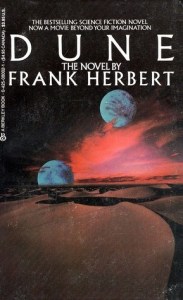
13249366These last few chapters of Book One are a welcome payoff after the first third of the book was spent so much on occasionally-interminable-feeling exposition and set-up. When the Harkonnen coup—apparently backed by the Emperor as well, who even lends some of his own men to the Baron for the event—against House Atreides finally comes, it’s swift and brutal, though we’re spared any particularly gory details. It’s a restraint that dates the novel a little, as modern trends in SFF have skewed heavily towards more graphic depictions of violence, but Frank Herbert manages to convey the horror of the Harkonnen invasion just fine and without being coy, either. It’s actually a superbly imagined sequence, with clear thought being put into the language used, exemplified in the recurring food metaphors and descriptions of the rapacious Baron’s conquest of Arrakis in terms of eating and consumption.
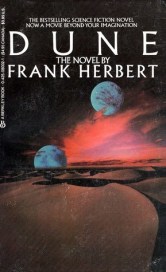
If it feels slightly anticlimactic, it’s only because most of the death and suffering belongs to unnamed characters—guards, servants, and the like—who are largely unmourned (or only mourned en masse and in brief passing) in the narrative. Instead, like many genre works that feature Chosen Ones and prophesied leaders, the focus here is squarely on the troubles and experiences of the nobility. This narrowness of scope is more generally associated with epic fantasy novels, but it’s not necessarily at odds with the science fictional elements of Dune, either. Instead, it simply marks it as belonging to the same essentially conservative and sometimes regressive school of thought that a lot of epic fantasy belongs to. Which is fine. A little boring, with so much storytelling energy being spent on debating the qualities of a good dictatorial ruler rather than imagining a world free of dictators and kings altogether, but fine. Sometimes it’s nice to read something so familiar, and I’ve been enjoying Dune so far, for the most part. Anticlimactic and expected as it is, this section of the book does contain as much that is interesting as the first 160 pages or so did.

Yueh’s guilt and shame over his betrayal of the Atreides family leads him to make arrangements for Jessica and Paul to survive the Harkonnen attack, a redemption which allows Yueh’s death to be tragic rather than otherwise. Duke Leto’s death is likewise sad, though even more expected than Dr. Yueh’s. I was surprised that Leto didn’t manage to take the Baron with him, as I thought the rest of the story would be a conflict between the heirs of the two men, and I thought Piter would be a more important character considering how significant he seemed when he was introduced, so I suppose it’s not fair to say that this first climax was entirely dull. Still, these are ultimately minor deviations from a common story type. Even the revelation near the end of the section that Jessica is the Baron’s daughter—and Paul his grandson—doesn’t do much to break the mold. It’s certainly an aggravating circumstance, and I expect this to figure largely in Paul’s internal conflict going forward (oh, god, I hope he has some internal conflict), but it’s not enough to elevate the story much above the pedestrian. The revelation that Paul and Jessica are likely trapped on Arrakis for life is interesting, and there is some poignancy in the realization, but, again, this isn’t a detail that is particularly out of the ordinary for these kinds of tales.

From a critical feminist perspective, however, perhaps the most interesting (and frustrating) part of these chapters comes in the last one before the break between Book One and Book Two. While Paul has been much talked about in this first third of the book, Jessica has been far more a main character than he has, and there has been much more written from her point of view. I complained in my last post that I felt that she was kept too subservient to Leto and Paul, and that continues here. With Leto’s death, Jessica seems almost broken; she’s pregnant with his daughter, but now is without any social standing or apparent means of survival so she turns to her teenage son, whose mystical-seeming abilities have already surpassed her own. Paul, for his part, is angry with his mother for making him into, well, whatever he is, and Book One ends with Jessica quite cowed in the face of her son’s anger as well as a little in awe of his burgeoning power. While Paul may see several possible paths for their future, my only big prediction is that the rest of the book is going to further marginalize Jessica and continue to keep her subordinate to her son.

Also, how gross is the Baron’s sexual obsession with Paul? I basically hate everything about this, especially since there’s no positive depictions of queerness in the book so far to balance it out. It’s no coincidence, I think, that both the Baron’s relationship with Feyd-Rautha and his fixation on Paul are incestuous. With no other representation, this stands out sharply in contrast to the highly conventional heterosexuality of the Atreides family and sets up a clear dichotomy in which the Baron’s queerness is depicted as evidence of his evil and depravity rather than incidental to it. It’s like it wasn’t enough for the Baron to be wickedly gluttonous; Herbert wanted to make certain that his readers knew the guy was a real fucking deviant, and queer-coding villains—or, here, just making them explicitly homosexual—is a classic move.

Let’s Read! Dune, Part Four

13249366I feel as if I could just title all of these posts so far “Duke Leto Deathwatch 2016” considering the amount of time I spend speculating on the time and manner and necessity of the Duke’s demise. I’m sad to report that after 162 pages, a full third of the way through this book, Duke Leto remains in the land of the living. There’s a light at the end of the tunnel, however, as Dr. Yueh finally makes his move and attacks the Duke in chapter eighteen. Before we get to that, however, there’s a good deal more set-up for the imminent tragedy.
The sixteenth chapter opens with an epigraph on greatness and myth-making from “Collected Sayings of Muad’Dib,” and the chapter sticks fairly closely to these themes as it continues to explore Duke Leto’s character and touches on Paul’s precociousness and the likelihood that Paul is this mythical Kwisatz Haderach figure. I still feel as if this is an enormous amount of ground-laying for a plot that is so highly conventional that surely people knew it by heart even in 1965. Most of the chapter is taken up with a long dinner, in which the Duke discusses his progressive goals for Arrakis and some of the recent problems on the planet with several locally important men. The thing that is most interesting here, however, is the dynamic between Duke Leto and Jessica. He doesn’t publicly disavow her like I thought he might, but he’s certainly cool and mistrustful towards her, and Jessica definitely notices.

It’s not until the next chapter, however, that Jessica takes action, and this is only when she’s directly confronted by a very drunk Duncan Idaho (literally the worst character name so far in the book; what was Frank Herbert thinking?) who accuses her to her face of being a Harkonnen spy. This finally helps her understand the Duke’s weird behavior, and Jessica is livid. She goes to discuss this garbage with Thufir Hawat, who is a massive dick to her because he doesn’t understand or trust the Bene Gesserit. A couple of major pieces of information come out of this interview, though. First, neither Jessica nor Hawat suspect who the actual spy/traitor is. Second, Jessica is pregnant with the Duke’s daughter. Third, Jessica is a woman of considerable intelligence and power in her own right.

Here’s the thing, though: If Jessica is so intelligent and powerful, why must she be so meek and subservient to Duke Leto? Serious question. It’s not that I don’t understand politics or the long-game scheming the Bene Gesserit seem to be engaged in. Sure, I buy it. They’re shaping the future of the galaxy, one eugenically planned Chosen One and one meticulously orchestrated and seeded “prophecy” at a time for some reason. Ethics or something, I guess, since Jessica seems to be somewhat unwilling to just straight up mind control dudes in order to get her way, although she’s not above terrifying poor old Hawat. And so, Jessica is a devoted concubine and attentive mother, demonstrably powerful but with no apparently ego or ambitions of her own. Instead, she’s focused almost entirely on securing her husband’s legacy and her son’s future, and her entire identity is wrapped up in these concerns.

I just find this stuff tiresome and sadly characteristic of many of the male-penned, progressive-for-their-time novels that make up so much of the SFF canon. Frank Herbert, like many authors of his age (and our age, if we’re being honest), can imagine a woman who is beautiful, strong, intelligent, brave, principled, and powerful, but only insofar as she’s appropriately in thrall to a Great Man™, busy nurturing a future Great Man™, or otherwise safely ensconced in some version of a 1950s gender role while the real protagonists (all men) do all the truly important stuff.

Jessica is too tamed by heteronormative not-marriage and by doting motherhood to be truly powerful, and she’s never treated as an equal to Leto or Paul in the narrative. When she does show her considerable power, it’s framed as irrational—she’s goaded into it by Hawat’s suspicions about her motives—and her connection to the Bene Gesserit, who are actually powerful, is portrayed as legitimately questionable. Certainly the Revered Mother is treated as a somewhat sinister figure, even as she’s also treated like an irrational old hag who isn’t to be taken seriously. It’s a treatment of women that is condescending in its magnanimity—because, you see, women can be powerful—but also sadly limiting of women’s opportunities and stories—because powerful women are frightening and emasculating, so they must be controlled in the narrative, preferably by men, at all times.

Maybe I’m wrong, but with the Duke’s demise imminent, I can’t help but feel that Jessica is going to spend the rest of the book subservient to her own son. And that’s if she’s not fridged for Paul’s character development, which seems like a distinct possibility at this point.

Game of Thrones Recap/Review: Season 6, Episode 4 “Book of the Stranger”

The main theme of my thoughts on last night’s Game of Thrones episode, “Book of the Stranger,” could probably be best summed up as “well, that could have been worse.” In many ways, season six is increasingly proving itself to be an improvement over last year’s stinking garbage fire of a season, but obviously “it could be worse” isn’t exactly a glowing endorsement, either. The good news, I suppose, is that there was some real forward movement in several storylines last night. There were even a few scenes that were really nicely done. However, there is some clumsy (and downright unpleasant, if not unsurprising) tying up of loose ends, a lot of hand-wavy “storytelling,” a some highly questionable (to say the least) messaging.

As always, spoilers under the cut. Continue reading Game of Thrones Recap/Review: Season 6, Episode 4 “Book of the Stranger”

Weekend Links: May 14, 2016

This week I’ve gotten a little farther into my Dune readalong, though not as far as I’d like. Unfortunately, I’ve still been dealing with some seasonal allergy and sinus issues (Thanks, Cincinnati spring!) and a bout of sort of generalized malaise that I’m trying to avoid nurturing into a full blown depressive episode. Instead, I’ve been trying to take it easy and go out in the sunshine when it’s available and avoid negative news, which is harder than you’d think. In any case, as a result, I haven’t actually done much internet reading this week aside from some entertainment news and a few author interviews.

Supergirl finally got its second season renewal confirmed, but with mixed news. Season two will be at the CW instead of CBS. The show always felt more like a CW show, and it seems like a better fit for that network, but I am concerned about the likely smaller budget it will receive over there. Still, I’m happy to see the show going on. Its first season was a mixed bag, but maybe season two will see Supergirl hit its stride.

Ronald D. Moore and Bryan Cranston are putting together a new sci-fi anthology series based on the works of Philip K. Dick.  On the one hand, I’m always glad to see a new sci-fi project getting made. On the other hand, I’d love to see something new and different instead of these endless reinterpretations of classic material.

On that note, I was excited to hear that an upcoming short story by Ken Liu, “The Hidden Girl,” has been optioned for film.

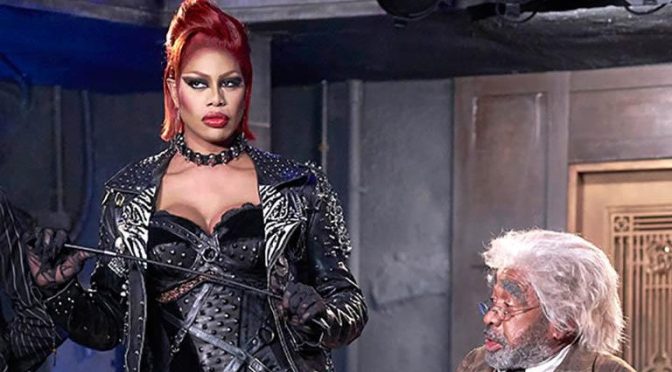
The first pictures from the upcoming Fox production of The Rocky Horror Picture Show are looking pretty decent. Laverne Cox looks incredible in costume.

It’s Eurovision Weekend! Which is the actual most wonderful time of the year.

I haven’t been completely able to avoid bad news this week, sadly. It was no surprise, however, to learn that sci-fi media coverage continues, in 2016, to be mostly by and about men. Because of course it is.

LitHub explains why fiction needs more women scientists.

Hodderscape takes us around the world with 18 book recommendations.

Book Riot suggests 5 queer comics for sci-fi fans.

Find out what Ursula K. LeGuin thinks you ought to read.

Fantasy Faction takes a look at the opposite of the Hero’s Journey.

Tor.com has a great piece on modern witches in fiction.

Ada Palmer’s superb Too Like the Lightning came out this week, and I’m slowly working my way through it because it’s a big, beautiful, challenging novel that deserves to be savored. In the meantime, I’ve been enjoying reading her interviews and guest posts when I come across them.

Finally, if you’ve enjoyed Michael R. Underwood’s first couple of Genrenauts novellas, published through Tor.com, you will want to check out his Kickstarter, which aims to publish the rest of Season One of the series by the end of this year.