I’m pretty sure that part of my lack of enthusiasm for this show is because I never made it past the second season of The Walking Dead. I’ve still been somewhat following the promotion of the prequel spinoff series, though. Between the boring as fuck title (Fear the Walking Dead, really?) and this first teaser, I can’t say I’m very encouraged.
Jurassic World is full of dinosaurs, which is pretty much all I wanted. I went to the drive-in (which I highly recommend, as in my opinion this is the best way to see these sorts of movies) to see dinosaurs eat people, and that’s exactly what I got.
It’s not a cinematic masterpiece, and the story isn’t great or even very good. I’m still not entirely sure I understand why the military would think training dinosaurs for battle would be a good idea, and I don’t really understand what B.D. Wong was getting out of the arrangement since he was already living in paradise getting to make dinosaurs for a living. I also don’t know whether the parents actually got divorced or not, which I guess doesn’t really matter, since all of the characters were basically cardboard cutouts of people who only existed so we could see a two hour movie about CGI dinosaurs.
Chris Pratt’s velociraptors were predictably silly, but that doesn’t stop me from feeling like it would really be pretty rad to ride a motorcycle with my own personal pack of prehistoric killing machines. The mosasaur was gorgeous, although I don’t see how it could be kept in any way that would be safe for people or healthy for the animal. The pterosaurs were pretty cool, and I loved the dinosaur petting zoo. Of course there’s a dinosaur petting zoo, and it’s adorable.
Bryce Dallas Howard was fine as Claire. I’ve seen some complaints about the shoes she wears throughout the movie, but they’re plain old less-than-two-inch pumps that were perfectly sensible for the day the character planned on having. The way some people went on about the shoes, I rather expected some kind of six inch high spiked monstrosities, but that wasn’t the case, and I actually kind of appreciate the ability of the character to stay tough in a crisis. Honestly, I’m more amazed by her decision to wear a completely white outfit for a full day–personally, I’d have a stain or smudge on it by 10 am on a good day. I also kind of like that she’s the real hero of the movie. Chris Pratt and his raptors have gotten most of the attention, but Claire’s the one who orchestrates the, frankly, epic dinosaur fight at the end of the movie, and it’s nice to see a heroine being rewarded with a man at the end of a story for once rather than the other way around.
My only complaints are, first, that I really like Irrfan Khan and would have liked for him to get more screen time and, second, that the first death of a woman by dinosaur was so damn torturous. Zara’s death felt unnecessarily gruesome and drawn out for someone whose worst trait seems to be that she is easily outwitted by a couple of asshole kids. I know I said that I basically saw this movie just to see dinosaurs eat people, but I’d generally prefer that the really nasty deaths be reserved for actual bad guys.
Finally, the dinosaurs are the real star of this movie, just as they’ve been since Jurassic Park came out in 1993. I have to say that I’m not super impressed with the CGI. It’s okay, but I disagree with the people who say this movie’s dinosaurs are as good as the originals. It may just be that there’s no way I’m ever going to quite recapture what it felt like to see Jurassic Park when I was ten years old, but I felt like the comment in Jurassic World that people want their dinosaurs bigger, with “more teeth” is also true of audiences now.
Jurassic World is so packed full of dinosaurs of all shapes and sizes that they do start to seem a little commonplace. While there are a couple of new species in this movie, the overall look of the dinosaurs is the same as it’s ever been. It’s at once comforting and boring, to be honest. I do think that for it to still be a Jurassic Park movie, they can’t change the raptors or the t-rex that are so emblematic of the brand, but it would have been nice to see at least some of the last twenty-odd years of paleontological advancement shown on screen.
The indomitus rex and mosasaur were neat, but I’m starting to be a little concerned about the responsibility of continuing to portray dinosaurs in the same way they were shown decades ago. Jurassic Park was the definitive dinosaur movie of my generation, and I’ll probably always get teary-eyed watching the first big dinosaur reveal, but I’d hate to think that dinosaurs were being defined the same way for my daughter’s generation when we know so much more about them now.
Well, with the final episode of the season, Game of Thrones returns to inconsistent form. There are several really nicely done scenes, a lot of garbage, and the season ends more or less where A Dance With Dragons does for Daenerys, Jon Snow, and Cersei. For everyone else, everything is terrible and makes almost no sense. I mean, it’s terrible and nonsensical for Daenerys, Jon, and Cersei, too, but at least their story lines have something to do with the books the show is ostensibly based upon.
Melisandre sees the melting ice as proof of R’hllor’s favor.
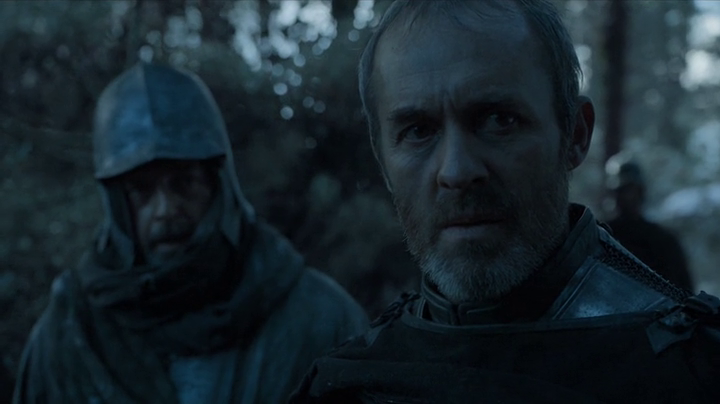
Like last week, this episode opens with Melisandre, who is much more sanguine following the sacrifice of Shireen and in light of an apparent thaw. Icicles are melting inside Melisandre’s tent, and outside she’s ankle-deep in mud as she heads off to tell Stannis the good news. Stannis is cold towards her, however, which is just as well since Melisandre’s news of a break in the weather is the only good news he’s going to get all day. Half his men have deserted in the night, taking all the horses, and Selyse has killed herself. While Stannis is still processing this, another guy comes to tell him that Melisandre has just ridden out of camp.
Stannis Baratheon and the no good very bad day.
I hate that Selyse is killed off this way. During Shireen’s burning last week is the first time we’ve seen any maternal warmth from Selyse at all, after two seasons of her Lady Macbeth-ing it up and mostly just ignoring Shireen altogether. And now this week we’re supposed to believe that she’s abandoned her faith and lost hope so completely that she’s killed herself without even waiting to see if the sacrifice paid off? Bullshit. Like with Talisa’s presence and death at the Red Wedding, it’s a case of the writers wanting to dispose of an inconvenient female character and counting on the audience caring as little as they do about whether the women in the story get treated with dignity.
Also, if all the horses are gone, how did Melisandre ride out of camp on one?
At Castle Black, we get the first scene of the episode that I mostly like. Jon and Sam are catching up after their separation, and it’s actually an almost great scene for Sam. Jon tells Sam about the army of the dead and seems to acknowledge the futility of the Hardhome mission. Also, the futility of pretty much anything the Night’s Watch can do to stand against the dead, which has things looking pretty bleak for the watchers on the Wall.
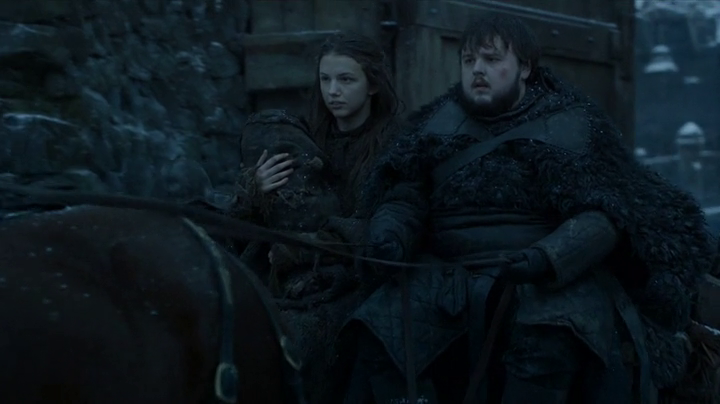
Sam and Gilly start off on their journey.
Sam, on the other hand, wants to ask Jon a favor. He requests that Jon send him, Gilly, and the baby south to Oldtown, where Sam will train to become a maester and then return to the Wall. I’m so happy that this is happening, even if it is belated. I also like that they made it Sam’s idea, giving him a bit more agency in his own story and letting him come up with an idea that actually makes sense for once. I was really disappointed by how much the election of the Lord Commander was abbreviated earlier in the season, and this helps make up for that a little by at least showing some small part of Sam’s character growth. Then it’s ruined with some gross comments about Sam’s sexual relationship with Gilly, but it was nice while it lasted. Our last view of Sam and Gilly this season is them loaded up in a cart and leaving Castle Black.
As Stannis and his remaining men approach Winterfell and get ready to settle in for a siege, it soon becomes apparent that won’t be necessary, as an enormous host of Bolton soldiers rides out to meet them in the field.
Sansa just can’t catch a break.
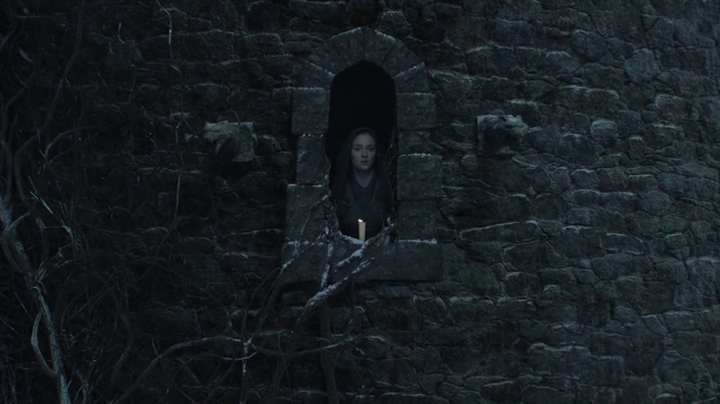
Inside Winterfell, Sansa sneaks out of her room to light the candle in the broken tower herself. Elsewhere, Podrick sees Stannis’s army on the move and goes to tell Brienne, who stops watching for Sansa’s light literally seconds before Sansa gets it lit. Because, of course. This sort of “near miss” situation is what passes for drama in the world of Benioff and Weiss, even though it would have been even more interesting to let Brienne see the light in the tower and force her to choose between her perso0nal vengeance against Stannis and her vow to protect Sansa. Trust D&D to always do the easy thing, though.
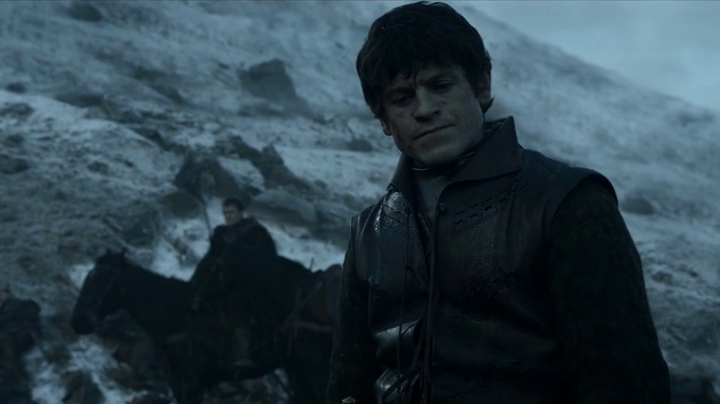
We do get to see Ramsay going around finishing off some of the wounded, but his heart just doesn’t even quite seem in it.
There’s no budget for an actual battle scene at this point in the season, so we just get to see a bunch of dead bodies in the snow while the Bolton troops are mopping up. Somehow, Stannis manages to survive long enough for Brienne to find him so she can pontificate embarrassingly at him when he obviously just wants to die in peace. In the end, it’s not even clear whether Stannis has really died at all because we don’t actually get to see it. Which doesn’t make sense at all.
After Stannis’s sacrifice of Shireen last week, I’m pretty sure everyone hates him enough that his death would feel like some kind of justice–unless, of course, we’re supposed to direct all our anger over Shireen’s death at Selyse, who’s already dead by her own hand, and Melisandre, who is currently compounding her villainy by abandoning fan favorite Stannis in his time of need. Which is pretty much exactly what I think we are supposed to be doing. Because, somehow, after everything, I don’t feel like we’re supposed to really hold Stannis accountable for his own actions. We’re supposed to see him as tragic and noble in this final scene, and we’re supposed to think that maybe Brienne will turn her blow aside at the last minute after all, even though she has no reason to and we won’t find out for sure until next year.
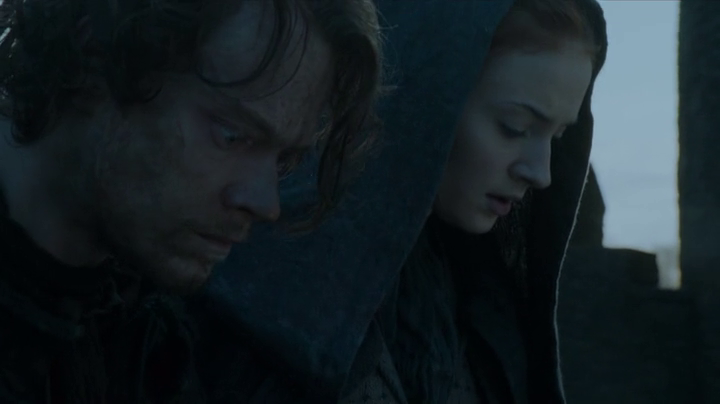
Back at Winterfell proper, Sansa tries to return to her room without being seen and is caught by Myranda, because goodness knows we haven’t had a scene of Myranda gloating over Ramsay’s abuse of Sansa in a couple of weeks. This is just as pathetically misogynistic as previous, similar scenes, but it does somehow manage to spur Theon into doing something. As Ramsay arrives back at the castle, Theon pushes Myranda off the ramparts to her death, grabs Sansa’s hand and drags her up the wall of the castle, where they leap off into the snow, which doesn’t look nearly deep enough to break their fall.
Theon and Sansa prepare to jump.
Myranda might be the thing I hate most about all of the Ramsay stuff because, on the show, Myranda’s support of Ramsay and her participation in his depravity makes her look worse than he is. Because Ramsay is evil, but Myranda is stupidly evil for being with him because it’s super obvious that he’s not safe for her. I hate how Myranda has been created on the show exclusively as a character for the viewer to hate without remorse, even as Ramsay has been given greater depth in the show because D&D wanted to explore his daddy issues. I especially hate it here because we’re supposed to cheer for her death. And we’re not cheering for her death at Sansa’s hands, which could have been read as Sansa’s (another woman’s) victory over internalized misogyny (represented by Myranda). We’re meant to cheer Theon for rescuing Sansa from Ramsay, for whom Myranda acts as a stand-in.
In every way, Sansa has been systematically regressed and robbed of agency and power this season, and her character growth has been completely sacrificed in order to give Theon an opportunity for redemption. I won’t even dignify it by calling it a redemption arc because it’s literally only in the last seconds of this scene that Theon seems to regrow a spine. It actually begins with Theon entreating Sansa to go back to her room while Myranda aims a bow at her, and it’s only when Sansa seems to refuse that Theon finds his own courage. Tellingly, though, it’s not Sansa who grabs Theon’s hand, and it’s not Sansa who leads the way up to the wall they leap from.
For a show based on source material that is so lauded for subverting and questioning standard fantasy tropes, Game of Thrones will always do the boring, hackneyed thing if given half a chance. The interesting thing to do here would have been to have Sansa leap on her own. Or to reverse the damsel in distress trope and have Sansa kill Myranda in her own self defense and then rescue Theon as she makes her own escape. This second option would even have offered interesting character growth for Sansa, as we’ve already gotten to see her feelings for Theon evolve from hatred and disgust to a sort of pity–they could have evolved again here to a sort of forgiveness that would allow her to take him with her. This even would have given Theon the opportunity for an actual redemption arc in the future as he tries to prove his usefulness and loyalty to Sansa after she rescued him.
That’s not what we get, though, because D&D are hack writers who have proven for two straight seasons now that they both do not understand or respect the spirit of the source material at all and are incapable of any actual independent thought. They hew close to the source material when it’s convenient to them, and they seem desperate to include certain events come hell or high water, even if the events no longer make sense in the context of the show. Otherwise, they shit all over fans of the books and insult the intelligence of even the most unsullied viewers by filling the rest of the show with just the sort of tired, dated, boring tropes and storytelling tricks that the books are so famous for critiquing.
Honestly, I don’t think this was even that cathartic for Arya.
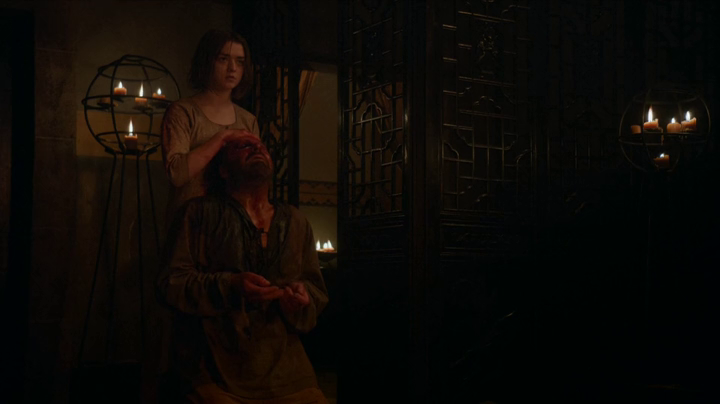
Meanwhile, in Braavos, we’re back to Meryn Trant and the brothel, which has managed to provide him with not just one but three children to abuse this week. As Trant walks down the line of girls, beating them with a cane, it’s obvious that one of these girls is not like the others. Oh, shit, it’s Arya. Who could possibly have seen this coming? Oh, everyone? Well, I guess that just makes this a disgusting and gratuitous scene of a grown man sexually abusing children in a brothel for no other reason than as window dressing for a preordained scene of Arya’s bloody revenge. This is the most gruesome death scene since we saw Oberyn Martell’s head squished like a grape last season, but I couldn’t enjoy it because it was coupled with yet another scene of sexual violence. It’s exactly what I predicted last week, but it’s still a little sad that the show’s reliance on sexual violence for shock value and titillation is so predictable. I guess I should just be thankful that these poor girls were all reasonably covered up.
When Arya returns to the House of Black and White, she’s met by Jaqen and the Waif, and she’s punished by being made blind. There’s also a bit of a mindfuck here where there’s a fake Jaqen H’ghar who kills himself and Arya starts pulling a bunch of faces off him, but I’m honestly just terribly bored by this stuff. The House of Black and White is gloomy, the Waif is cruel, Jaqen is mysterious, Arya is vengeful, and everything about this is horribly predictable.
Oh, Ellaria. I honestly don’t see how no one guessed what you were up to, but okay.
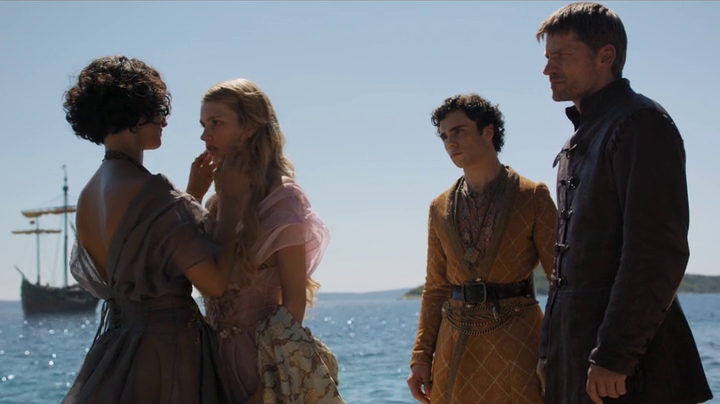
In Dorne, Jaime and Bronn are departing with Myrcella and Trystane, which starts off uneventfully enough. Even Ellaria and the Sand Snakes seem resigned to how things have turned out, and Ellaria gives Myrcella a motherly kiss goodbye while Tyene tries to bite off Bronn’s ear in what is hopefully the last bit of that particular piece of vomit-inducing trash writing.
Once the boat is on its way, Jaime tries to have a heart to heart with Myrcella, who isn’t as stupid as D&D have previously written her to be. She figured out about her mom and uncle father Jaime ages ago and is totally cool with it. This conversation could be sweet if it wasn’t so anti-climactic, and it could offer some hope that Myrcella might turn out to be an interesting and canny player of the game once she gets back to King’s Landing. Unfortunately, that’s probably not in the cards for her, since she keels over in the middle of hugging her dad, showing signs of the same poison that almost killed Bronn in the dungeon. Back on the dock, Ellaria’s nose starts to bleed as well, and she wipes off her poison lipstick and quaffs a tiny bottle of antidote.
The whole Dornish plot this season has barely even qualified as a plot, and these last couple of scenes are no different. I’m sure that the poisoning and likely death of Myrcella are supposed to be shocking, but I really just feel mildly annoyed at how little sense any of this makes. Many readers of the books have complained about the Dornish plot and how it doesn’t seem important to the main story, and though I’m not one of those readers–I actually love the Dornish plot in the books–I do think that if they weren’t going include any of the actually interesting stuff about Dorne in the show they shouldn’t have bothered including it at all. Even without any Bran Stark or Yara Greyjoy scenes this season, basically all the story lines they covered could have used a few more minutes of screen time. Instead of doing the Iron Islands, which with the horn of dragon controlling and the part they play in the Battle of Meereen in the books would make more sense, Dorne was implemented in a way that adds nothing to the main story at all.
With no Aegon plot (fake or otherwise) and no Quentyn in Meereen, Dorne in the show feels pretty much completely cut off from everything else important that’s going on, and Jaime and Bronn’s sojourn there feels like filler created just to give those two something to do. I’m inclined now to think that Bronn should have just been written off with his marriage to Lollys as he was in the books, and Jaime should have been sent to the Riverlands to deal with things there offscreen. Everything that has happened this season in Dorne could have been handled better by raven. Or not at all because it was entirely poorly written crap that doesn’t make any sense to add to the story in the first place. Poor Trystane, though, I guess. That kid is fucked when they get to King’s Landing. I could imagine Jaime giving him a break, but Cersei is going to lose her shit if Myrcella is for real dead.
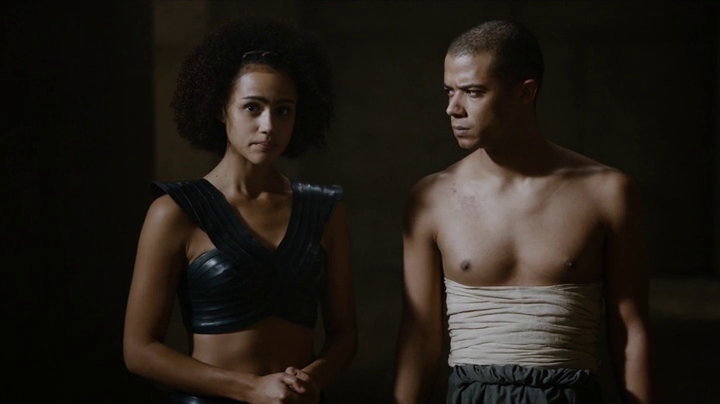
I love Missandei’s new costume.
On the other side of the world in Meereen, it’s time to see how Tyrion, Jorah, Daario, Missandei, and Grey Worm are holding up since Daenerys flew off on Falcor Drogon last week. Without addressing how they managed to fight off the Sons of the Harpy, escape the Pit of Daznak, and retain control of the city, we’re taken straight to Daenerys’s throne room, where Tyrion, Jorah, and Daario are bickering about which one of them deserves to serve Daenerys more. Missandei brings a still injured Grey Worm in so he can join in on the fighting over who gets to go searching for Daenerys. In the end, it’s decided that Jorah and Daario will ride off in search of their queen. Tyrion, Missandei, and Grey Worm will stay in Meereen to rule the city. Which doesn’t make as much sense as Daario and the show writers seem to think it does, but sure.
I am still uncritically thrilled about this development.
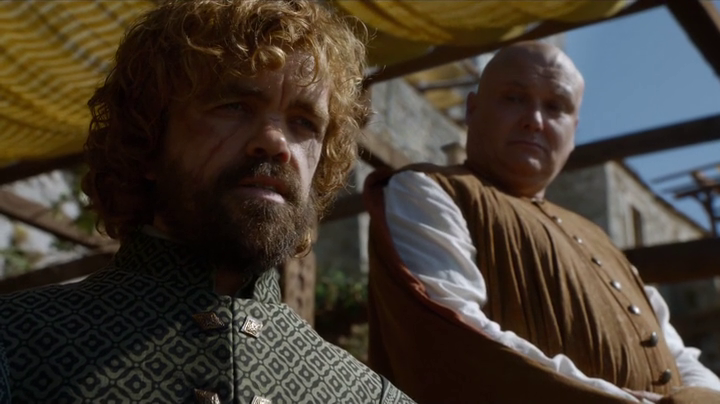
As Jorah and Daario exit the city, again mysteriously unmolested by the Sons of the Harpy, Tyrion is watching from the walls above when–surprise!–Varys shows up. I kind of uncritically love all conversations between Varys and Tyrion and this is no different. I’m unashamed to say that I don’t care how this happened; I’m just happy that Varys is here because I’ve missed him since Jorah kidnapped Tyrion, and even though every line of dialogue in this short conversation is redundant and verging on silly I just ate it up because these two characters are my favorite on-screen pairing in the show. This is also the first moment in the episode that made me think that maybe I’ll watch next season after all (still 85% not watching, but I was 95% not watching going into this episode).
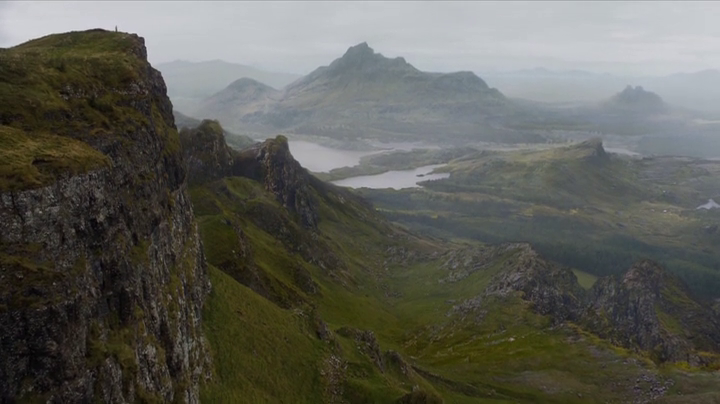
This is some scenery porn, right here.
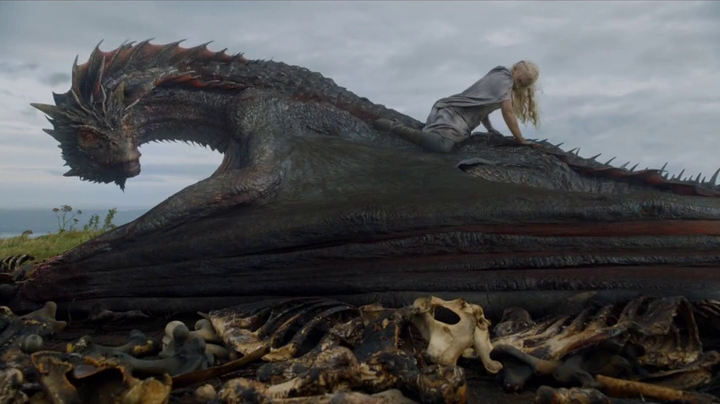
Somewhere green and beautiful, a good distance away from Meereen, Drogon has brought Daenerys back to his “lair,” which is really just a kind of scorched spot on the ground filled with bones from things he’s eaten. Daenerys tries to get Drogon to take her back to Meereen, but he basically turns into a very large scaly cat and pretty much ignores her in favor of licking his wounds and snuggling down in his bone pile. She even tries just hopping on his back, only to be unceremoniously dumped off. When she realizes that Drogon isn’t in a mood to be helpful, Daenerys wanders off to look for food or something, but instead she finds a whole army of Dothraki. As they surround her, she removes an enormous ring from her finger and drops it on the ground.
I say I hate this being played for laughs but if it wasn’t, I wouldn’t have this screen shot.
I hate the way this happens in the show. I hate that they played the interaction between Daenerys and Drogon for laughs. I hate that they don’t deal with the several weeks of time that pass in the book while it’s just Daenerys and Drogon. And I hate that it looks like they are separating Daenerys and Drogon and having Daenerys captured by the Dothraki instead of the way it happened in ADWD where she’s standing right next to her dragon when she meets the Dothraki. Between that, her look of fear, the way she drops her ring, and the knowledge that Daario and Jorah are already looking for her, it looks like even being an actual dragon queen isn’t enough to keep a woman from becoming a damsel in distress on this show. I could be wrong, but I’m probably not, and it really seems like they’re setting Daenerys up to be in need of rescue next season.
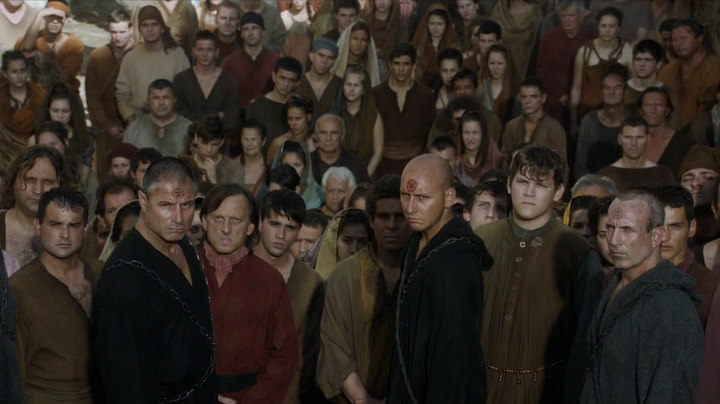
Pretty much how I imagine YouTube comments, tbh. Interestingly, the crowd in King’s Landing was probably 80% men. Because of course it was.
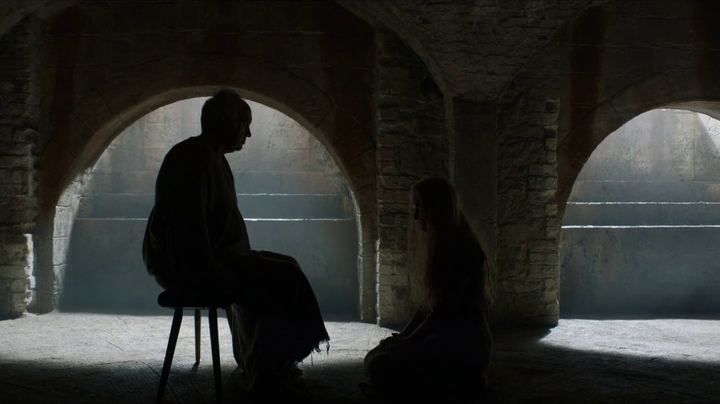
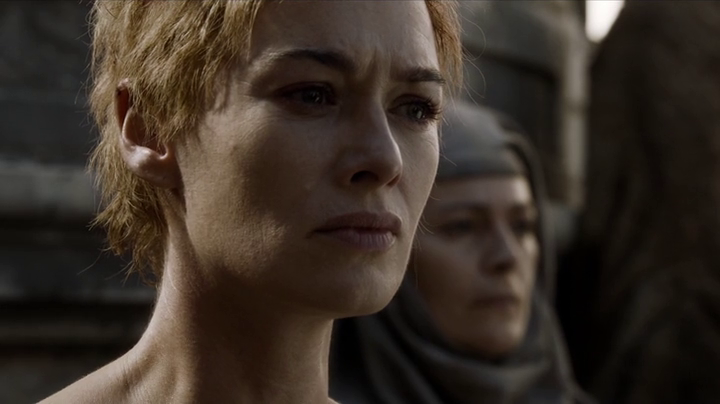
Next up is Cersei’s confession and walk of atonement, which I am surprised and pleased to report manages to mostly do the source material justice, although this is entirely due to Lena Headey’s superb talent as an actor, since the writers seem to have been more concerned with really capturing the feel of what it might be like for a woman to walk through a YouTube comments section brought to life.
Very reminiscent of Ellaria kneeling before Doran, which I kind of hate.
The High Sparrow seems to betray his political sensibilities after all when he accepts Cersei’s confession so easily and doesn’t pressure her to confess to more. Perhaps Cersei’s confession, the walk, and the planned trial are enough for him. It seems likely that, even if he’s a zealot, the High Sparrow recognizes the value of maintaining a stable monarchy in a wartorn country, especially if the monarch is a child who can be easily controlled by holding his mother (and wife and brother-in-law, although there’s no mention of the Tyrells in this episode) hostage. In any case, for all the the High Sparrow has ostensibly been above such worldly concerns, his satisfaction with Cersei’s minimal confession and his willingness to let her return to the Red Keep suggests that he’s not entirely above politicking after all.
Resolve.
The walk itself is harrowing, and while watching it isn’t the same as reading it from Cersei’s point of view in ADWD, you can clearly see the progression of Cersei’s emotions. During her confession she’s calculating, and she simmers with fury even as she kneels before the High Sparrow. As the septas wash her and cut off her hair, Cersei’s eyes glitter with rage. Even as she stands in front of the crowd while the High Sparrow recounts her confession, her head is held high, and she gives every impression of being a person just going through whatever motions she needs to in order to get what she wants. It’s not until near the end of her walk that Cersei’s stony demeanor starts to crack, and it’s only as she actually begins crossing the final bridge into the Red Keep that she actually breaks down sobbing.
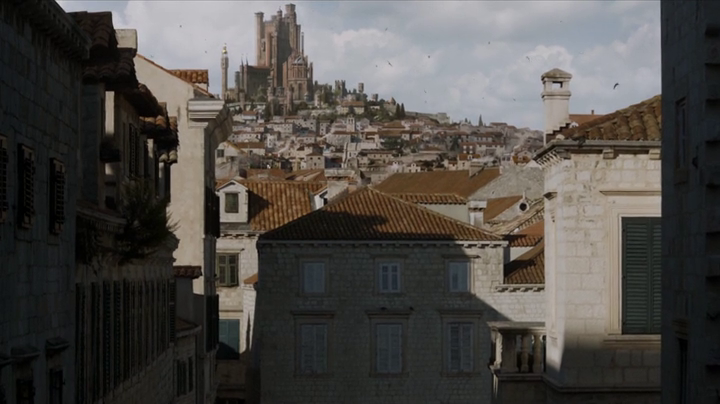
I really liked the periodic views of the Red Keep as Cersei gets closer to it.
Lena Headey deserves an Emmy for this performance, but I actually have to give some credit to the rest of the production here as well. It’s not often that Game of Thrones handles nudity with maturity and sensitivity, but they manage to do so here for the most part. There’s a good amount of Cersei’s body on display, since it is a fully nude walk, but I didn’t get the sense that anyone went out of their way to focus on her tits the whole time. That said, the scene did start to drag a little after a while, and it did begin to seem as if someone in the production was reveling a little too much in yet another instance of the show sensationalizing the degradation of one of its major female characters.
Yup That is definitely murder in her eyes again.
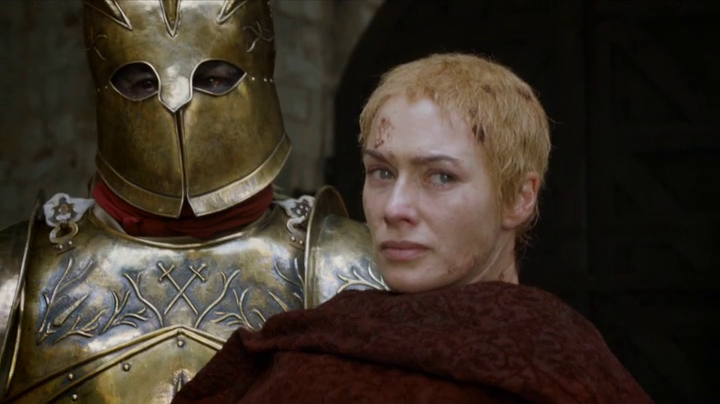
I would say that at least Cersei’s walk of shame gets to be wholly about her, but I don’t think that’s actually the case. She has to share the spotlight, in the end, with Qyburn and Qyburn’s monstrous creation, who is the newest member of the Kingsguard. Zombie Gregor Clegane actually looks pretty cool, and the slightly warped armor that doesn’t quite really fit is a very nice touch to show that something isn’t quite right here. My question about this is the same as my question about it in the book, though. How does no one else notice? I’d just think that someone would point out that this new Kingsguard guy is real weird, especially since Cersei has been temporarily out of power. The look on her face as Ser Zombie carries her away definitely underlines that “temporarily” though. She’s had her little breakdown, but she’s already scheming again because Cersei Lannister is nothing if not resilient.
Poor Davos.
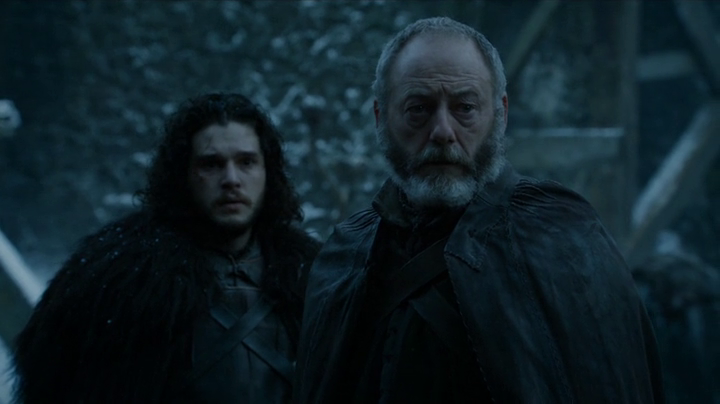
Finally, the episode (and the season) ends with Jon Snow at Castle Black. First, he’s dealing with Davos Seaworth, who is trying to convince Jon to send some men south to help Stannis at Winterfell. Then Melisandre shows up alone and completely changed from the confident woman who rode out with Stannis earlier this year. The good news, I suppose, is that Jon is off the hook for helping Stannis. The bad news is literally everything else, and Davos’s face at the news Melisandre brings is the most heartbreaking possible thing I could have seen in this episode.
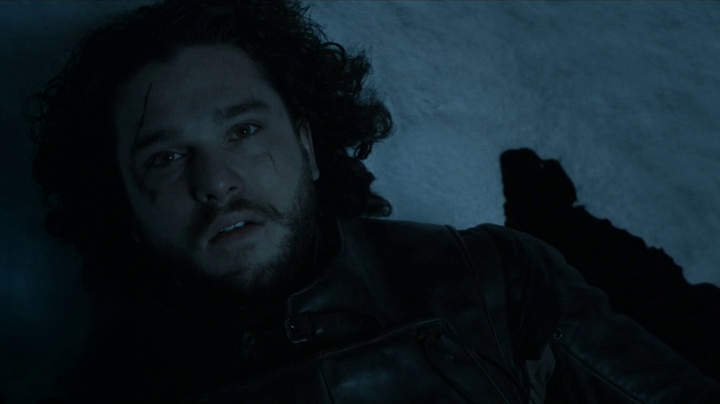
Later that night, Jon’s steward, Olly, comes to tell him that there’s been some news of Jon’s uncle, Benjen Stark, who’s been missing in action since season one. Surprise, though! There is no wildling with information about Benjen; there’s just a grave marker looking thing that says “TRAITOR” on it and a bunch of men of the Night’s Watch with knives. Alliser Thorne looks almost regretful as he drives the first dagger into Jon’s chest, and Olly looks absolutely conflicted as he drives home the last one, but none of the men look back as the walk away to leave Jon bleeding out in the snow. The last shot of the episode is of Jon’s dead face–no white eyes to suggest that he’s warging, although a screenshot leaked prior to the episode airing would indicate that this was at least a possibility. Just going by what we’ve seen on screen, then, it would seem that Jon Snow is actually dead, making this almost certainly the largest body count for major characters in any single episode of the show.
Looks pretty dead to me.
The thing is, it’s not entirely certain which characters are actually dead and which ones may still have a little life left in them. That, of course is the big question we’re left with at the end of this season, if we ignore other important concerns like whether or not the show runners will ever get tired of heaping violence and humiliation upon the show’s women and girls or if the writers will ever stop wasting the immense talents of actors like Alexander Siddig and Indira Varma on horrible tripe like, oh, every scene in Dorne this year. I tend to be at least slightly skeptical of the permanent death of any character whose cold, dead corpse I don’t definitely see on screen, so here’s my best guesses:
Selyse Baratheon – Definitely dead, because she’s outlived her narrative usefulness and D&D are generally quick to dispose of female characters who don’t have a particular reason to exist any longer. Much like Talisa Stark, Selyse has to die in the show so no one has to think of something for her to do without her husband (or daughter, in Selyse’s case) to give her life purpose. Much like Ros, Selyse’s now-inconvenient existence is ended off screen, although at least Selyse was given the dignity of keeping her clothes on when we see her dead body.
Meryn Trant – Definitely dead, and gruesomely so. This is probably the only death in this episode that everyone can agree on the finality of, although Trant wasn’t exactly a major character, either.
Stannis Baratheon – I would say definitely dead. With no army, no wife, no daughter, and with Melisandre having abandoned him, there’s not really anything for Stannis to do if somehow Brienne missed her strike. And I can’t imagine that she did or that she’d suddenly have a fit of mercy and change her mind. While her revenge against Stannis didn’t really feel earned, and sentencing and executing him while he’s already bleeding out after a spectacularly disastrous military loss doesn’t seem sporting, I don’t think Brienne is actually all that honorable when it comes down to it. Not on this issue. Mostly, though, if Stannis isn’t going to win the Battle in the Snow, I don’t see that there’s any reason to keep the character around any longer. With screen time already at a premium and going into the sixth of seven planned seasons, it’s about time to start paring things down, and it’s not surprising that Stannis is the first to go as he was never a serious contender for winning the Iron Throne in the long run.
Theon and Sansa – Definitely alive, although battered probably, from jumping off of Winterfell. That snow was nowhere near deep enough to completely cushion their fall. The big question regarding this pair is where do they think they’re going? With Stannis’s army slaughtered and the Wall a month’s ride away when they’re on foot, their only chance is probably Brienne and Pod who don’t know to be looking for them–and going to the nearest town would probably be a terrible idea since that would probably be the first place that Ramsay would look for them.
Myrcella Baratheon – Almost definitely dead, which is too bad. Myrcella’s knowledge and acceptance of her true parentage suggests a character who could have been an interesting player in the game of thrones, especially if she’d returned to King’s Landing bringing Dornish values with her–namely the Dornish custom of eldest children inheriting regardless of gender. She and Trystane could have been a formidable couple, and I would have loved to see them go up against the formidable-on-her-own Margaery and puppet Tommen. Alas, I think this is not to be. While Bronn could likely identify the poison Ellaria used, I doubt they have any antidote handy, and I don’t expect the writers intend to introduce another new power dynamic to King’s Landing this late in the series. Also, admittedly, a dead Myrcella will likely introduce just as much chaos as a live girl could have. There’s no way Cersei is going to take this well.
And, finally, Jon Snow:
I have to only give Jon even odds at this point. His on screen death looked pretty final to me, and Kit Harington has outright said that he won’t be returning in season six. If that’s not true, it would be the first time in the show’s history that they’ve pulled this kind of bait an switch, so I’m half convinced. I’d like to think that Kit and the show runners wouldn’t fuck with their fans like that.
However, I don’t believe Jon Snow is dead in the books, and I do believe that, even if he’s not endgame going to sit the Iron Throne, he still has an important part to play in the future. Additionally, it just doesn’t make sense to kill him off right now.
With Sam departing Castle Black with Gilly, losing Jon would leave us with no main point of view character at the Wall. Also, with Jon dead, there would no longer be any reason for Sam to return to the Wall after becoming a Maester.
Davos and Melisandre are both there, but without Jon there’s no reason for them to remain there and no particularly direction for them to leave.
With Stannis dead, the Wall and Jon Snow is the only logical destination for Sansa and Theon, which could ultimately force a confrontation between the Boltons and the Night’s Watch that would only work if Jon Snow was at Castle Black.
If Jon Snow is dead, who is going to take over the defense of the Wall? Alliser Thorne seems the likely answer, but to what end? While Thorne disagreed with Jon’s decisions about the Free Folk, I can’t see Thorne leading the charge to murder women and children, either, especially with the army of the dead on the way. In this respect, the way the show has handled things, it actually seems a little silly to even have the attempt on Jon’s life in the first place except for dramatic reasons–basically to be a thing that happens to grow Jon as a character who learns or changes from the experience.
Essentially, if Jon Snow is really dead, then all bets are off for how the rest of the show plays out. I have no predictions for that scenario, because I think Jon Snow is that important to the story.
The worst thing? I don’t even particularly like Jon Snow. I’ve often jokingly thought and said that it would be great to not have to read through any more of his mopey POV chapters in the books. But the truth is, I don’t see how the story goes on without him.
Jon Snow’s apparent (or actual) death could be compared to the offing of Ned Stark in the first book/season of the show, but it’s not like that at all. Ned Stark was doomed from the start, and his death was honestly not nearly as shocking as its sometimes made out to be. Indeed, Ned Stark’s death was heavily telegraphed (as was Robb Stark’s, later on). Also, even if someone missed the hints that Ned Stark was fucked, A Game of Thrones is the shortest book in the series so there wasn’t that much time to get attached to Ned (who wasn’t that likable anyway) AND it’s Ned Stark’s death that sets off most of the events in the rest of the series. As far as Robb Stark’s death, well, Robb wasn’t even a POV character.
This isn’t the case with Jon Snow, who has been a POV character for the entire series, with the second most chapters in the books after only Tyrion Lannister, and who is central to numerous fan theories. Even if all of the fan theories and speculation are wrong, there’s an incredible amount of hinting and foreshadowing in both the books and the show that Jon is going to play a significant part in the future–which he can’t play in the show if he’s dead.
Even though all the evidence on the show and the statements to date from people involved in the production seem to say that Jon is dead and Kit Harington isn’t coming back, I have to say I don’t know how they can be serious. Certainly I hope they aren’t. Going into this episode I was about 95% not planning on watching the show in season six, but by the time Varys popped up in Meereen I was about 60% going to watch it. When I was finished, I was about 80% in for next season, but Jon Snow’s actual death could be a dealbreaker for me. Not because I like the character that much, but because I just don’t see how the story continues without him unless every single fan theory and speculation over twenty years of ASOIAF fandom and, for me, over seven years of personal participation and investment in the GoT/ASOIAF phenomenon is totally wrong.
I’m slowly coming to terms with the increasingly obvious fact that this show/book fandom is something I’m in for better or worse. If the last two seasons haven’t completely killed my love for it, I’m not sure what could–except the sort of complete betrayal that would be the permanent death of Jon Snow at this point.
“The Friends of English Magic” covers a good deal of the first third of its source material, but it still feels as if things are starting off pretty slow. This is reflective of the style of the book, which starts slowly as well and builds up into a dramatic juggernaut over time, and I’m not sure if anything could have been done differently and remained a faithful adaptation. Still, it might have been nice to have a little more excitement.
The episode opens with John Segundus and the question that he puts to the York Society of Magicians and later to Mr. Norrell:
Why is there no more magic done in England?
Quite a tolerable practical magician.
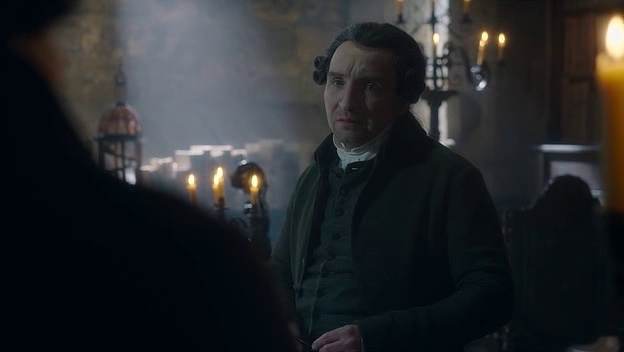
I’m happy to see this being translated to the screen so exactly, but I felt like the introduction of Mr. Norrell, in particular, was rushed, and the delivery of Norrell’s statement that he, himself, is a quite tolerable practical magician just didn’t quite work for me. Eddie Marsan looks the part, but his performance, at least in this crucially important scene, is unpleasantly affected-seeming.
Enzo Cilenti as Childermass is a little better. Although I imagined Childermass taller and darker, my main complaint about Cilenti’s portrayal is that he mumbles his lines to a degree that he’s nearly unintelligible. Edward Hogg as Segundus is a little too reminiscent of Sleepy Hollow-era Johnny Depp, but I find the sort of nervous energy he brings to the role endearing rather than otherwise.
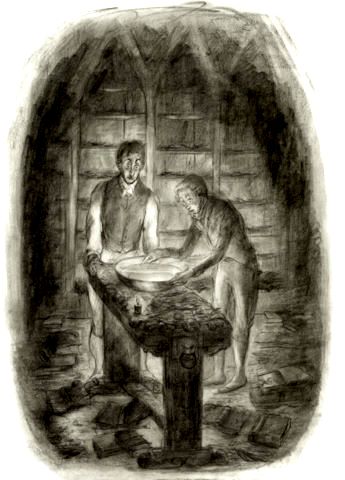
I didn’t love the exterior shot of Hurtfew Abbey. It seemed run-down when I think they were going for gloomy, and I don’t really think either of those things are quite right for the magician’s house. Inside, I think they nailed the weirdness of Norrell’s labyrinth, but the library was a bit too medieval-looking. when I would have expected it to be a little more comfortable. The windows and light were nice, but just, in general, I find everything to be a little too grey and brown, which is too bad because I think grey and brown and dull is sort of the aesthetic the show is going for.
Norrell’s feat of magic at York Minster was similarly rushed feeling, almost frantic-seeming, and visually disappointing, again mostly because everything sort of congeals into a monochromatic grey dullness that sucks the life out of every scene.
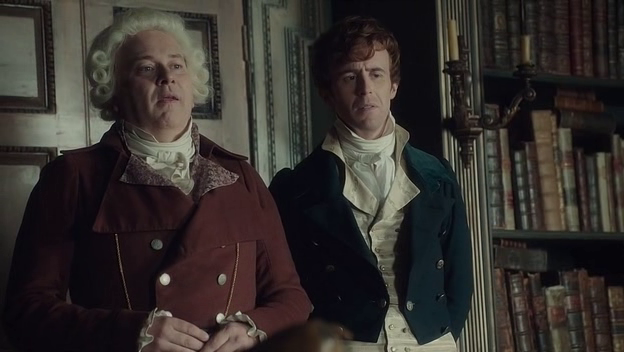
Drawlight and Lascelles
Even Norrell’s arrival in London only shifts tone from grey to beige; it’s less gloomy but not much more visually interesting. Even Drawlight (a poorly cast, too old, and obnoxiously lisping Vincent Franklin) is sadly muted in a muddy pepto-bismol pink. John Heffernan as Lascelles, on the other hand, is a perfectly bored and jaded almost-aristocrat, and is one of the few casting choices that I wholeheartedly approve of.
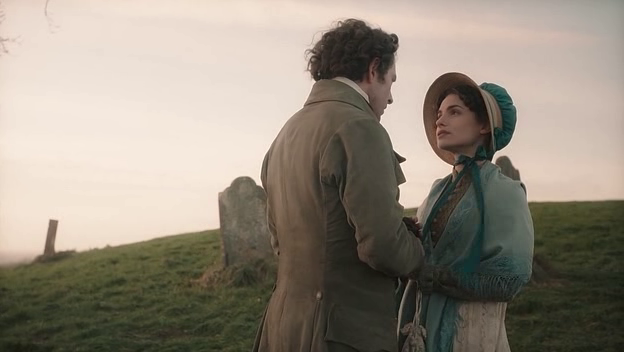
Jonathan and Arabella.
Since everything concerning Norrell is so shrouded in gloom, I would have expected Jonathan Strange’s scenes to be a little more bright and colorful, but that’s hardly the case. However, the casting of Jonathan Strange, Arabella, and Henry is on point. Charlotte Riley, in particular is everything I could have hoped for in Arabella, and her expressive face is put to good use in these early scenes. Bertie Carvel’s Jonathan Strange is perhaps a tad too ingenuous, especially since he’s a good deal older here than Strange is when he’s introduced in the book, but he’s likable and not too handsome for the role.
I was very happy to see Jonathan Strange’s father included, although I suppose the time could have been better spent on other material. There were several scenes that I though could have used just an extra thirty or sixty seconds, and the elder Strange just isn’t that important in the grand scheme of things. As a reader who loved all parts of the book, I’m glad this made the cut, but I can definitely think of more than one better use of that time.
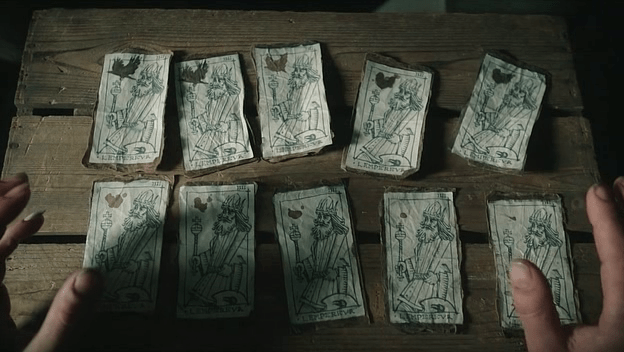
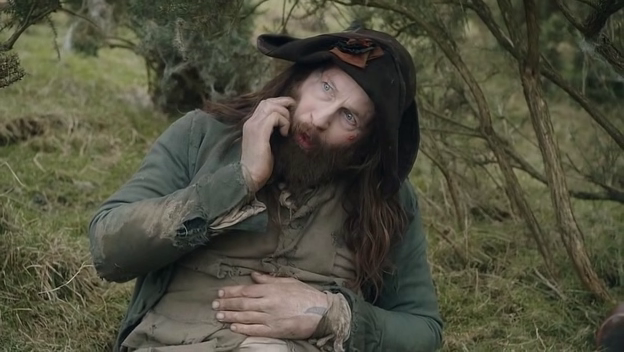
Possibly the greatest disappointment of this first episode is how quickly they fly through everything concerning Vinculus (Paul Kaye, perfectly cast). There’s no particular scene that has been cut from the source material, and all of the most important events happen in the show just as they did in the book, but every scene with Vinculus is one that could have run just a little longer to better effect. In particular, I would have liked to see the part with Childermass, Vinculus, and the cards of Marseilles taken a lot more slowly, and I think Vinculus’s prophecy to Norrell in the alley could have just been enunciated a little better. I’ve watched it twice now, and both times it came across garbled.
Vinculus.
On the bright side, Vinculus’s meeting with Jonathan Strange was done nicely. Again, with the mumbling of lines, when I feel like important prophecies should be pronounced more clearly, but overall well-done. This is followed up with Jonathan’s revelation to Arabella and Henry that he plans to study magic, and this scene is one that probably couldn’t have been done better. It bothers me a little that the “enemy” is so clearly recognizable as Norrell, here, but I don’t know how it could have been done differently. When reading the book, this is one of those things that is obvious to the reader but not to the character, and by the time Strange and Norrell meet in the book it’s nearly forgotten because it’s been over a year of book-time. I just have a feeling that it’s going to have to be dealt with differently in the show to avoid making the Stranges seem stupid, and I’m not sure how I feel about that.
The episode ends right where it ought to: with Mr. Norrell’s resurrection of Miss Wintertowne (later, Lady Pole) and the introduction of the gentleman with the thistledown hair. I didn’t love this. In fact, I feel let down by it.
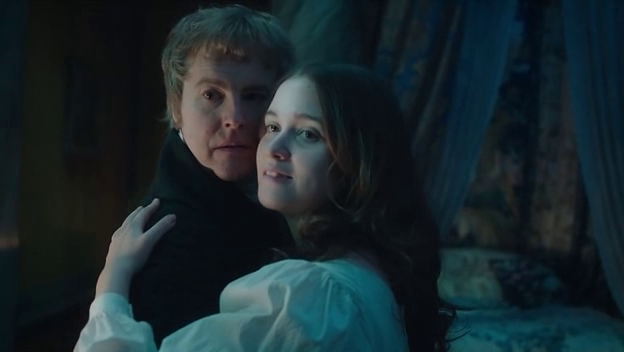
Sir Walter and his resurrected bride.
First, let me say that I actually love Alice Englert as Lady Pole. When I heard that the girl from Beautiful Creatures (which was a turd of a film based upon a book that I found unreadably bad) was playing one of my favorite characters, I was definitely apprehensive, but I think she’s going to be okay.
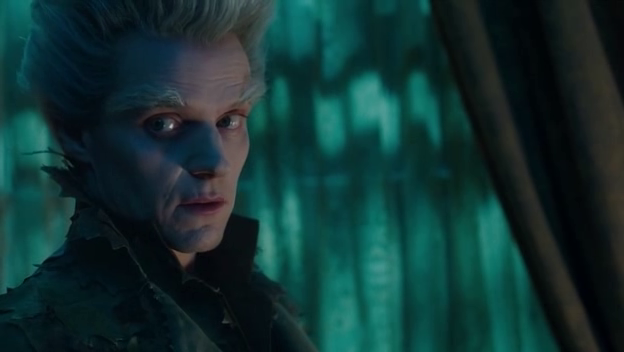
Second, I have to admit that I find myself liking Marc Warren’s Gentleman in spite of myself. I would have preferred a younger actor for the role, but I think he will work after all, once I adjust my expectations.
The fairy gentleman.
What I feel let down by, though, is the sheer level of gloom that seems to settle over everything. Like Drawlight’s puke pink suit, the Gentleman’s rather moldy-looking green ends up looking grimy rather than atmospheric, and the leafy cutouts around the edges of it are just a bit too heavy-handed a sign of him being a fairy. It’s certainly not magical, and I would have expected this scene, at least, to have something otherworldly about it. It’s not terrible, I suppose, but I find the sort of ever present pall over ever bit of the show to be a little depressing in a way that the book never was. While the show isn’t devoid of humor, I would like to see it being a little more fun. I think the worst thing that could happen would be for it to take itself too seriously.
The Mary Sue on Age Gap Films – As someone in an age gap relationship myself, I really appreciate this piece. The problem with cinematic age gaps isn’t so much that they exist, it’s that we aren’t supposed to think they are age gaps. We’re just supposed to think that women look the same for all the years between around age 23 and age 50.
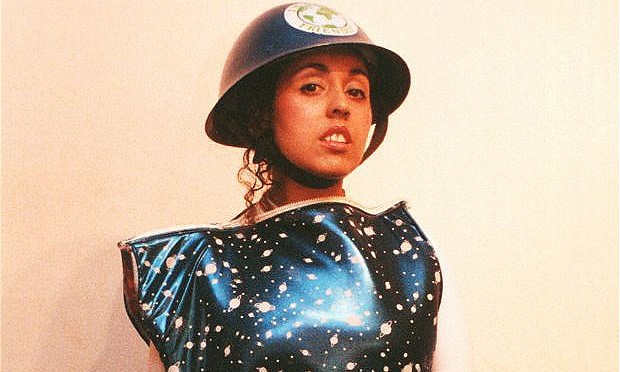
Photo by Ian Dickson / Rex Features ( 750588ck ) X-Ray Spex – Poly Styrene Various
Check out the newly revealed covers for Tor.com’s upcoming novellas. I’m probably most excited about Nnedi Okorafor’s “Binti,” but there are only a couple of these that I’m not really looking forward to reading.
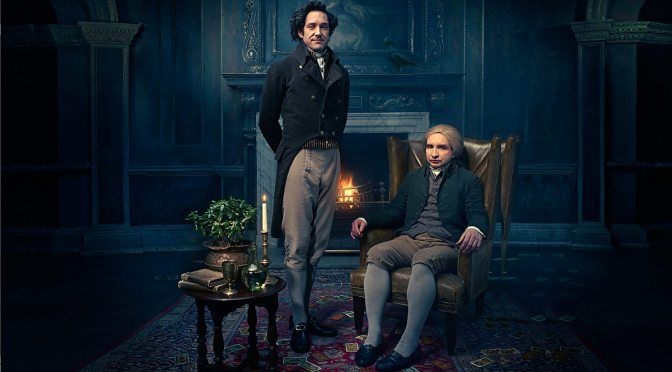
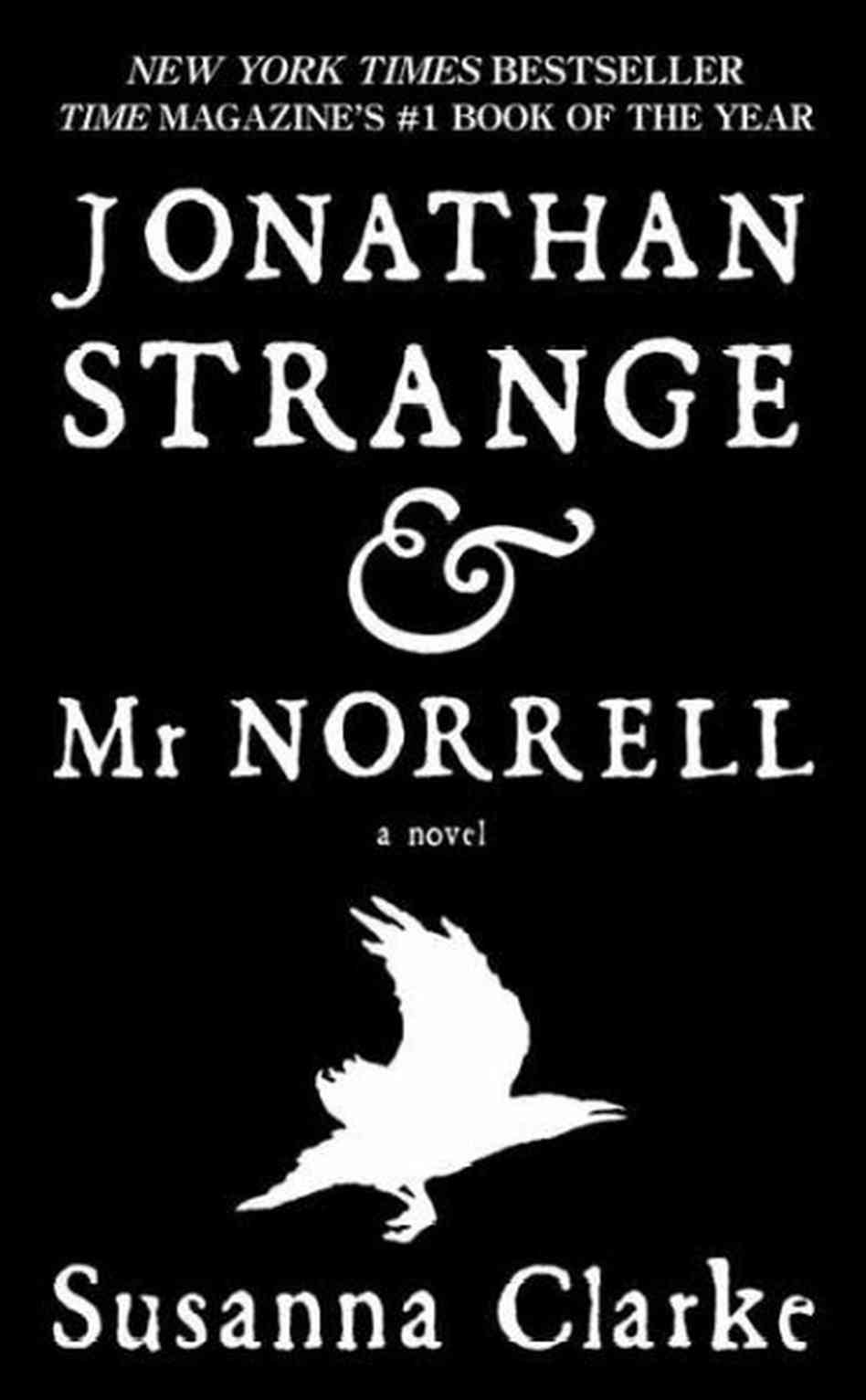
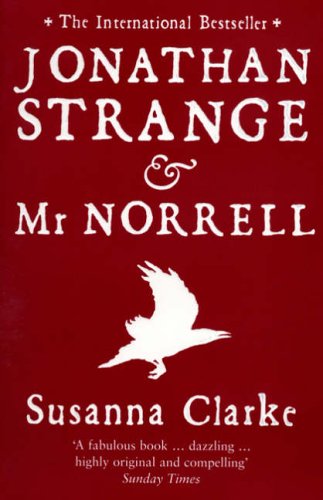
The great Jonathan Strange & Mr. Norrell reread is finished, and tomorrow the show starts airing in the US. I will be posting a recap and analysis of each episode the Monday after it airs.
After the relative calm of the last three chapters, the penultimate chapter of the book contains another flurry of events described in short vignettes:
Jonathan Strange and Mr. Norrell discuss their shared experience of wanting John Uskglass’s attention and their shared desire to impress their mutual master. To that end, they begin looking for a spell that might do the trick.
The gentleman with the thistledown hair approaches Starecross, bent on revenging himself against Lady Pole.
Lady Pole is furiously writing letters to expose Norrell’s treatment of her when she sees the gentleman and Stephen Black approaching and runs out to meet them. John Segundus follows her.
Back at Hurtfew, Strange and Norrell locate the book they’ve been searching for and begin their spell, targeting the “nameless slave.”
Outside Starecross, Stephen Black suddenly finds all the magic of England at his disposal. Quickly working through some of his complicated feelings about England, Stephen Black uses the enormous burst of magic to kill the gentleman with thistledown hair. While the gentleman warns Stephen that he will never know his true name now, Stephen has come to terms with being the nameless slave.
At a house in Padua, Arabella Strange steps out of a mirror and into the arms of Flora Greysteel.
Stephen wakes up to Lady Pole calling him from far away. He ignores her, “[casting] off the name of [his] captivity,” and walks further into Faerie, where he finds himself at Lost-hope. There, he is welcomed by the inhabitants as their new king, fulfilling his part of Vinculus’s prophecy.
Once more at Hurtfew, Jonathan Strange and Mr. Norrell finally feel as if they’ve gotten the attention of John Uskglass, and they find it rather disturbing. Norrell locates Lady Pole (in Yorkshire) and Arabella (in Italy), but Strange doesn’t seem particularly interested in the news.
The final chapter of the book does two things.
To start with, it mirrors the first chapter of the book by focusing on a meeting of Yorkshire magicians. This one is every bit as raucous and argumentative as the first one, especially when they learn the reason for their having been called together. Childermass is there, and he’s come to tell them that their previous agreement with Norrell is null and void, that anyone can practice magic now however they like. When they complain of their lack of books, Childermass brings forth Vinculus, whose tattoos have been rewritten entirely.
Finally, the book ends in Padua, where Arabella Strange has been recuperating with the Greysteels. She and Flora have become fast friends, and they are getting ready to return to England when a spot of darkness appears, heralding the arrival of Jonathan Strange. Arabella goes to meet her husband, but this last reunion of the novel is bittersweet.
This, I think is my favorite part of the whole book, and I will love Arabella Strange forever for not going into the Darkness with her husband. It makes for an ending that is heartbreakingly sad, but also beautiful and just and completely perfect for the story. Because, ultimately, Jonathan Strange and Mr. Norrell deserve each other.
These chapters continue to examine pairs of characters: Stephen Black and the gentleman with thistledown hair; Jonathan Strange and Mr. Norrell; and Childermass and Vinculus. Then last line of Chapter 67 is also what I would call the proper climax of the book, the final revelation before the denouement in the last couple of short chapters.
These three chapters are each rather short, and after the sort of frantic pace of happenings in the last few chapters, these chapters are comparably calm.
Stephen Black’s Name
Chapter 65 is half taken up with the story of how the gentleman with the thistledown hair found out Stephen Black’s true name. It’s a fascinating story, although we don’t actually find out Stephen’s name.
Primarily, this chapter contains three events. The gentleman finds out that Jonathan Strange is back in England, and then he learns that Lady Pole has been released from her enchantment. Sandwiched between these two revelations, Stephen Black and the gentleman encounter Vinculus. In a fit of malicious caprice, the gentleman hangs Vinculus from a nearby tree before Stephen Black can even protest, and then they are off again. The gentleman intends to cast a spell on Lady Pole so that she won’t live long now that she’s free of him.
Jonathan Strange and Mr. Norrell together again.
“Let you and me do something extraordinary.”
In Chapter 66, Norrell finally makes it to his library, where he finds a disheveled Jonathan Strange poring over the books. I love every single thing about this reunion. I love that it’s Jonathan Strange’s totally normal noise-making that emboldens Norrell to enter the room, and I love that the two men so quickly revert to something like their normal interactions. I love that Norrell is so easily seduced by Strange’s enticements–because no matter how repressed Norrell has been, he loves magic, and all he has wanted to do is magic, and the scary shit that Jonathan Strange is up to is exactly what Norrell has always wanted to do. I love that they find themselves stuck in Eternal Darkness together–because of course the are.
Aside from the reunion of the two magicians and all the feelings that generates, the only thing to really happen in this chapter is their attempt to summon John Uskglass. While he doesn’t show up in the room with them, Strange and Norrell are able to use a locating spell that places him in Yorkshire, and close.
John Uskglass’s Spell
Chapter 67 contains another reunion, this time between John Childermass and Vinculus, who is lately dead. Childermass comes upon Vinculus’s hanging corpse as he makes his way back towards Hurtfew Abbey, and this distracts Childermass from his stated mission to help Strange and Norrell. Instead of continuing his journey, Childermass stops to try and figure out a way to preserve the precious writing that covers Vinculus’s body.
As Childermass tries to figure out what to do, a mysterious man in black shows up. It’s obvious to the reader that this is the Raven King himself, but Childermass is unable to recognize him, probably because of magic. The Raven King resurrects Vinculus and disappears.
Vinculus awakes and Childermass thinks now that Vinculus was only unconscious. Vinculus tells Childermass some more about the prophecies that he’s told. Childermass expresses his loyalty to John Uskglass, but states that the restoration of English magic is the work of Strange and Norrell, not the Raven King. At this, Vinculus laughs outright:
“Their work!” Vinculus scoffed. “Theirs? Do you still not understand? They are the spell John Uskglass is doing. That is all they have ever been. And he is doing it now!”
If you only see one movie this summer, make sure it’s Mad Max: Fury Road.I haven’t enjoyed a movie so much in years, and I can’t remember any time that I’ve come away from a film with so little to complain about.
Fury Road begins with a short introduction to Max, but he’s shortly captured and taken to Immortan Joe’s citadel to be used as a blood bag. There’s a lot of worldbuilding going on here, and within he first ten minutes or so of the movie you get a pretty good idea of the post-apocalyptic world that George Miller envisions. Fans of his older Mad Max movies will recognize the aesthetic, which (refreshingly) avoids the gloom and doom that has become characteristic of the post-apocalyptic and dystopian genre (and, really, of sci-fi and fantasy in general) over the last few years. The darkness here is more akin to the surrealism of a Heironymus Bosch painting than the soul-crushing grimness of Game of Thrones or a Christopher Nolan film. While there’s not a lot of color (the palette sticks to shades of sand and black for high contrast) and there is a lot of dirt, Fury Road still manages to be full of light and warmth that endures even through night scenes.
The Doof Warrior
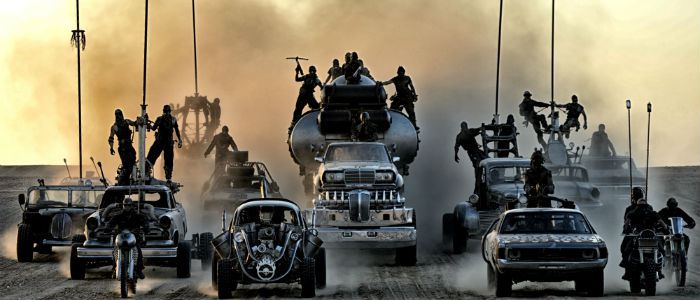
The plot is simple, and the movie is light on dialogue. I’m not being facetious or hyperbolic when I say it’s a two hour car chase. It is literally two hours of car chase, punctuated with stops for repairs. It’s an incredible spectacle, made even more amazing by the knowledge that Miller prefers to eschew CGI in favor of stunts and conventional effects. It’s also notable that, while there’s a lot of violence, there’s very little graphic violence. Indeed, much of the film’s violence is only implied. People die, but there are no long, lingering shots on dead bodies. People are injured, but there are no enormous blood splatters. Women have been kept as sex slaves for breeding and for milk, but there’s no explicit sexual violence on screen. Most of the violence is conveyed through explosions and flamethrowers and cars with spikes ramming into each other, and it’s all set to the aggressive rock music provided by the Doof Warrior (pictured above).
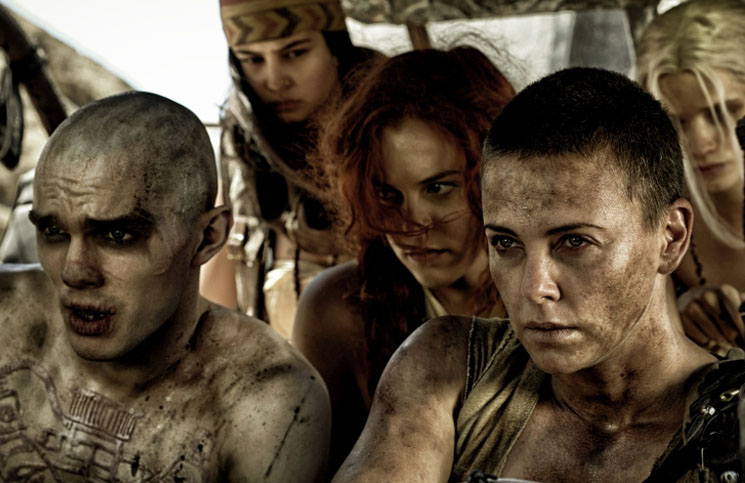
The wives (clockwise from back left): The Dag (Abbey Lee), Cheedo the Fragile (Courtney Eaton), Capable (Riley Keogh), The Splendid Angharad (Rosie Huntington-Whitely), and Toast the Knowing (Zoe Kravitz)
Speaking of women, Fury Road is just full of them. Imperator Furiosa (Charlize Theron) is an excellent hero, with an appropriate amount of depth of character for the type of movie she’s in. Immortan Joe’s five runaway wives each have a personality of their own, and all of them are shown to be tough and resourceful along with Furiosa. The Vuvalini of Many Mothers, who Furiosa and company meet in the desert, are also amazing and are part of the coolest fight/chase sequence in the film. At the same time, George Miller doesn’t shove any of these women into the normal Strong Female Character box that is generally reserved for women in action flicks. Just the sheer number of women included creates plenty of room for them to be different from each other, and in addition to being badass fighters and all around tough broads, the women of Fury Road get to be frightened, sad, kind, nurturing, and gentle as well as brave and defiant. Even Furiosa, who it would have been very easy to turn into a caricature-like collection of girl power tropes, doesn’t have to be an automaton of “strength” all the time, and it’s very nice to see an action heroine who understands the value of community and the wisdom of being able to depend on others sometimes.
What I love most about the women of Fury Road, however, is that none of them are grossly sexualized. The wives where diaphanous, skimpy white outfits, but there was never a shot that perved on their bodies–which is nice, since they are survivors of rape and reproductive coercion who are fleeing the man who abused them. There are no long, slow pans up from crotch to tits. There are no artfully posed bodies for maximized boner potential. There is no absurdly and inexplicably perfect hair and makeup in the post-apocalyptic desert car chase. Instead, everyone looks filthy and sweaty and slightly unhealthy, covered in dust and engine filth and definitely not packaged for male consumption.
All this said, there are a couple of issues with the film.
First, for me, the milking mothers were a bit of a sour note. I know that this is a post-apocalyptic world and all, but this seemed a little over-the-top, and it felt somewhat gratuitous and done for shock value. I think I would have felt differently if these women were given the same level of attention and agency as the wives, but we barely see them.
Second, for a post-apocalyptic Australia, everyone is awful white. It does seem to me that I saw some darker faces in the crowd scenes at Immortan Joe’s citadel, but I feel like I could have blinked and missed them. And I know that several of the women characters are women of color, but including a couple of women who are approximately the same color as the sand everyone is covered with maybe doesn’t count as diversity, especially when the main characters are all so, so white.
Still, Mad Max: Fury Road is an excellent film, with a strong (if fairly uncontroversial) eco-feminist message and a cast so full of women that the Bechdel Test need not even be mentioned as a metric to judge it by. It’s a big, beautiful action film with a great adventure and no romance. There are rad vehicles covered in spikes and enormous explosions and beautiful scenery and awesome fight scenes.
Mostly, it’s just great fun to watch, and when the movie ended I could have watched it again right away. I’m definitely looking forward to watching it over and over again at home when it comes to DVD/Blu-ray.






 SF Bluestocking