Category Archives: Television

iZombie: “Heaven Just Got a Little Bit Smoother” establishes a new and problematic normal

**This is a pretty spoilery review from start to finish.**

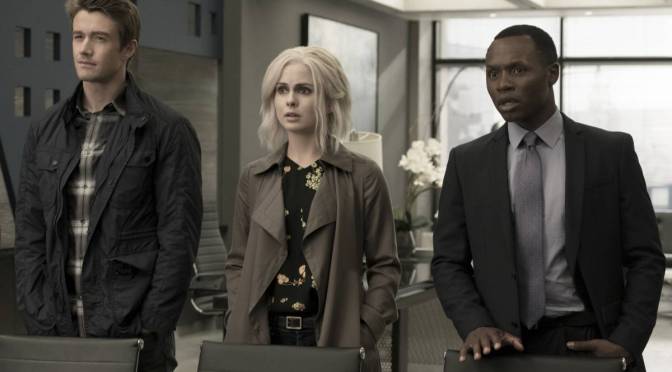
iZombie’s season two finale cleared the board, killing off or otherwise getting rid of the show’s major villains while ending the season with a zombie- and energy-drink-fueled conflagration that threatened to alert the whole world to Seattle’s undead problem. The first episode of season three, “Heaven Just Got a Little Bit Smoother,” is all about establishing a new baseline for the show and for all its characters, starting with everyone getting their stories straight about what happened at the Max Rager party, as the episode picks up 2.8 minutes after the last one ended. It’s a tense beginning, with Clive, Liv and Major coordinating their stories with new character Vivian Stoll (Andrea Savage) while on the other side of town Peyton, Ravi and Blaine are dealing with the aftermath of the shootout with Mr. Boss’s men after they’d kidnapped Peyton.

After this initial excitement, however, things slow down for a minute so we can get a slightly info-dumpy Liv voiceover that catches us up on the current state of the team—Liv, Ravi, Major, Peyton, and Clive—who are gathered together at Liv’s place to figure out what to do next. Liv suggests that they adopt a new “no secrets” policy between the five of them, and in the interest of that agreement tells them about her first meeting with Vivian and Vivian’s idea of making Seattle the capital of a zombie homeland. Interestingly, instead of jumping to conclusions and immediately labelling Vivian as a villain, Liv, Major and Clive take the time to set up a meeting with Vivian the next day to find out more about what she and her company (Fillmore Graves!) have planned.

Meanwhile, Blaine has headed back to his funeral home, where he’s confronted by Don E., who is convinced that Blaine is faking his amnesia. It’s an interesting and entertaining way for Blaine’s past to come back and haunt him, but even more interesting is to see a glimmer of the old Blaine when he realizes that the business is his and that Don E. and Chief were taking advantage of him when he first lost his memories. He lets Don E. quit, but before Don E. leaves, he finds Blaine’s frozen dad. It’s no surprise later in the episode to find Don E. unfreezing the old man so they can plot revenge against their mutual enemy, but it is a positive development, at least for watchers of the show. I’m encouraged that the show seems to have found a balance between Blaine having amnesia and Blaine still being Blaine, deep down.

The meeting with Vivian is delightfully unexpected. I rather thought she was going to replace Vaughn Du Clark as the show’s manically wicked corporate bad guy, and Andrea Savage would be great in that type of role, but that doesn’t seem to be the direction the show is going at all. Instead, Vivian’s preparations for “D-day” (“D” for discovery, when humans learn about the zombies in their midst) are actually mostly sensible. I mean, if she’s really concerned about humans taking military action against zombies, I’m not sure that moving every zombie man, woman and child to a tiny island is the best strategy, even if she does have her own zombie militia, but it’s not the worst idea, either. Sure, it sounds like a made-to-order target for drone strikes, but it could also work to prove that zombies are peaceable, normal people capable of existing in regular society if given the chance. If nothing else, Vivian thoroughly shows here that she’s not planning a pre-emptive strike or anything of the sort, and this gives Liv, Major and Clive quite a bit to think about regarding whether humanity is ready to know about zombies at all.

Unfortunately, after this promising start to the episode, the rest of it turns into a little bit of an overstuffed mess that all the smart, snappy dialogue in the world can’t completely make work. Here’s a list of things that happen in the final two thirds of “Heaven Just Got a Little Bit Smoother”:

  • Ravi isn’t dealing well with the news that Peyton and Blaine slept together, and he’s being a dick about it. Peyton hasn’t been entirely fair to Ravi, what with totally bailing on him without a word and all, but Ravi needs to grow the fuck up. I almost audibly cheered when Liv told him to stop it.
  • Peyton goes to see Blaine to thank him for saving her life, and he asks her straight up if they’re a couple. Whatever conversation that leads to happens off-screen, however, which makes it not really clear to anyone, viewer included, exactly where these two stand.
  • Major is looking for a job, but everyone still thinks he’s probably the Chaos Killer, which sucks. He eventually takes a job at Fillmore Graves. Because of course he does.
  • Ravi and Clive have a genuinely excellently done expository scene where they talk a lot about Ravi’s seventeen remaining doses of zombie cure and Liv and Major’s options re: getting cured and losing their memories versus just sticking this zombie thing out for a while longer. We’re also reminded that Major must make a choice sooner rather than later before the first non-working cure he took horribly kills him.
  • The security guard from the Max Rager party goes on a right-wing conspiracy theory radio show and spills about the zombies he saw tearing through the event. Liv and Clive try to stop him, but this only makes matters worse by adding fuel to the government cover-up fire.
  • Liv keeps staying on soldier brains to try and keep from feeling her feelings about having to shoot Drake, but it obviously stops working. Clive gets her extremely drunk, off-screen, which is sweet, but now it feels like the show is trying to avoid letting anyone have any feelings about this.
  • Peyton is being harassed and/or threatened on Twitter, and it frightens her. She tries to call Ravi, who petulantly refuses to answer the call, so instead she turns to Blaine for comfort. Nice going, Ravi.

What I want to talk about is the end of the episode. Early on, when Vivian is showing Liv, Major and Clive around Fillmore Graves and explaining what they do there, they meet a little boy, Wally, who knows Clive. It turns out that Wally and his parents are zombies, but they also used to be Clive’s neighbors, and Clive is happy to see Wally again so they agree to make plans to get together later. At one point in the hour, we hear a caller on the radio talking about how he thinks his neighbors are zombies, and the episode ends with Wally and his parents being murdered, each one shot in the head, presumably for being zombies. I suppose this can be interpreted, generously, as a way for the show to make the zombies’ potential plight real and to give Clive a very personal reason to care about what happens to the zombies in case his friendship with Liv isn’t enough.

Okay, sure. But there is a lot of weird coding going on here. While Malcolm Goodwin and Rahul Kohli have been regular cast members since day one, the show has otherwise struggled at times with diversity and hasn’t spent much time dwelling on race at all. However. There are some definite parallels emerging between the zombie experience and the experiences of immigrants and people of color in the US, and it’s uncomfortable, to say the least. All but one of the show’s notable zombies (good and bad) before now have been white, and it’s bad optics—at the very least—for the first black zombie family on the show, including a young child, the be murdered before we’ve even been properly introduced to them. At worst, it’s lazily racist shorthand to reiterate—in case the violent anti-zombie rhetoric that sounds very like ordinary right-wing vitriol wasn’t enough—that the show’s white zombies are, in the universe of the show, an oppressed minority. That the instigator of the anti-zombie frenzy that led to Wally and his family’s murders is also black doesn’t seem coincidental. It’s weird messaging all around, and I’m not sure that I’m willing to give it the generous interpretation when the show has failed on race in several other ways.

Finally, and still speaking of race, let’s talk about why this show, now in its third season and having received criticism for it for years, still can’t seem to cast a woman of color in any significant role. In addition to Vivian Stoll, the show also introduced us to Ravi’s ex-boss, Katty Kupps (*groan*), who is (surprise, surprise) also white. Listen. I love this show, and I love Liv and Peyton, and I liked Gilda or Rita or whatever her name was last season, but the most memorable woman of color that’s ever been on the show is memorable primarily for being a horrendously offensive racist stereotype of black women. No woman of color has ever had a multi-episode arc, and Liv has never been shown to be friendly with any woman of color. We couldn’t even get a woman of color as a love interest for Clive, who when he was dating dated a white woman, or Ravi, who is very hung up on Peyton.

This is bullshit. Women of color deserve better, and white women don’t deserve to always have even fictional worlds revolving around them a hundred percent of the time. Maybe I’ll be pleasantly surprised later this season, but I’m not going to hold my breath.

Miscellaneous Thoughts:

  • Considering this show’s predilection for slightly on the nose joke-y names, I googled “Stoll” and was not disappointed: Vivian Stoll could be roughly translated to “life support.”
  • So… do zombie kids grow up? Or are they trapped as children forever? This is important.
  • “We’re trying to keep a secret here.”
  • “I don’t like thinking about that!”
  • David Anders should sing in every episode.
  • Aly Michalka has finally gotten promoted to series regular, which means we should be seeing a lot more of Peyton from here on out.

Into the Badlands: “Red Sun, Silver Moon” is fascinating and frustrating

After a great season opener and a solid episode last week, “Red Sun, Silver Moon” is something of a letdown. It’s not a bad episode, and there are a couple of excellent scenes, but the whole thing feels decidedly slow-paced. This is mostly due to a major event teased in episode two not happening this week at all. “Red Sun, Silver Moon” is a lot of exposition and set-up with a deeply frustrating ending. The exposition is interesting, but it’s not particularly exciting for a full hour when you’re waiting on something else to happen.

**Spoilers ahead.**

Sunny and Bajie are still crossing the Outlying Territories, where apparently “everything is barren and windswept,” when they arrive at a bridge where their way is being blocked by a new character. Before we get a proper introduction, a group of bounty hunters show up—down ask where they came from—to try and capture or kill Sunny for the price that’s been put on his head. It’s nice to get a good fight scene in before the opening credits, but this is the most interesting thing that happens to Sunny this week. The new character, Nathaniel Moon (Westworld’s Sherman Augustus), is cool—an ex-Clipper with even more kill tattoos than Sunny (999 to Sunny’s 404)—but his purpose in the story is fairly predictable, and he never feels like a credible threat. That’s he’s left alive and missing a hand as Sunny and Bajie move on (with Bajie taking Nathaniel’s sword), likely means that this isn’t the last we’ve seen of Nathaniel. I only hope that means better use will be made of him in the future.

Nathaniel Moon serves a couple of purposes in the episode and in Sunny’s overarching hero’s journey, a questing storyline that’s sometimes (like this week) a little too conventional for its own good. First, Nathaniel a barrier in Sunny’s path back to Veil, both literally and metaphorically. Like Odysseus, Sunny is finding himself side-tracked this season by other characters and events that demand his attention, and this week that’s Nathaniel Moon, who Sunny must physically best in order to move on to the next step of his journey. Secondarily, Nathaniel represents a version of Sunny himself, but a failed version with a fridged wife and son to function as a cautionary tale for Sunny, and in this sense Nathaniel exists to instill doubt in the hero. Nathaniel, grieving and broken and cynical as he is, is Sunny’s worst fear of what he could become if he doesn’t get back to Veil. The problem with this is that it is such an archetypal externalization of internal conflict that it’s not surprising or even particularly compelling. We even saw a similar, but more visually interesting, storyline play out with M.K. just last week, so it’s repetitive as well.

Speaking of M.K., this episode finds him still dissatisfied with his lack of progress at the Temple. The Master won’t let him back in the mirror room, advising him to stop fighting himself, which suggests that, whereas last week M.K. needed to conquer his darker side (and this week, Sunny needed to physically overcome a symbol of his own darkness and doubt), the Master’s ultimate goal for M.K. isn’t for the young man to beat his darker self into submission. Rather, M.K.’s goal should be a more holistic solution to his problems; he must reintegrate the fractured part of his personality in order to find wholeness and discover the answers to his questions about his past. M.K. doesn’t have the patience for this yet, though. Instead, kept awake by his anxious desire to be finished with the Temple, M.K. snoops around until he observes something frightening: the nomad boy, Tate, being tortured, which we find out from Ava is how the monks cleanse failed initiates of the gift. Instead of taking that information, heading back to bed and rededicating himself to his studies, M.K. asks Ava to leave the Temple with him.

At Quinn’s secret villain lair, which is still one of the coolest secret villain lairs I’ve seen in ages, Quinn is reading “Rumplestiltskin” to baby Henry when Veil tells him that it’s time for his x-ray. Perhaps unsurprisingly to the viewer, given his bizarre behavior, Quinn’s brain tumor is frighteningly large. We learn, however, that Veil has told him that the tumor is cured, although she’s still treating him with some kind of unusually blue potion that apparently just keeps his headaches under control. It’s an intriguing new shade of nuance added to the power dynamic between these two characters, and adds some nice depth to Veil, who can sometimes feel a little one-note. While last week it seemed as if she was primarily Quinn’s prisoner, here we see that if he’s guarding her very closely it’s because he’s actually extremely dependent upon her, both physically and—it seems—emotionally, though the show seems to have abandoned the idea from season one of Quinn having a sort of sexual obsession with Veil. Instead, we’re now getting something much weirder and more compelling. It’s going to be interesting to see which happens first—Quinn finding the real x-rays that Veil is just keeping in an unlocked drawer or Veil making her escape as its heavily implied she’s planning.

We first heard of Ryder calling for a conclave of barons last week, and I rather expected it to happen in this episode, but it doesn’t and it’s hugely anticlimactic. Instead of the conclave, we get a pre-conclave planning session with the Widow, Tilda and Waldo, which is at least a well-conceived and nicely acted scene, even if it is a huge disappointment to not see more forward movement in this storyline. The short story here is that the Widow isn’t taking her official Regent, Tilda, with her to the conclave; she’s taking Waldo, who has advantages of experience and knowledge that Tilda doesn’t. Tilda isn’t thrilled about this, but she’s mollified when her mother leaves her in charge, though the Widow’s “if I die, destroy the oil fields” feels worrisomely like foreshadowing, and I will burn some shit down if anything happens to her. The episode ends with the Widow and Waldo arriving at Ryder’s new mansion for the conclave, and things look bad. The place is absolutely crawling with clippers, the Widow and Waldo are unarmed, and Ryder and Jade look like murder is on their minds. Unfortunately, that’s it for this week, and now I have murder on my mind because that’s no way to end an episode.

Miscellaneous Thoughts:

  • I’m still slightly unclear on some things about the setting for this show. Like, I’m sure there are some rules for the worldbuilding, but I’m not at all certain what they are. That said, the monks’ secret science rooms are fascinating.
  • Sunny finally got a shave and a change of clothes, and holy shit Daniel Wu is a beautiful man.
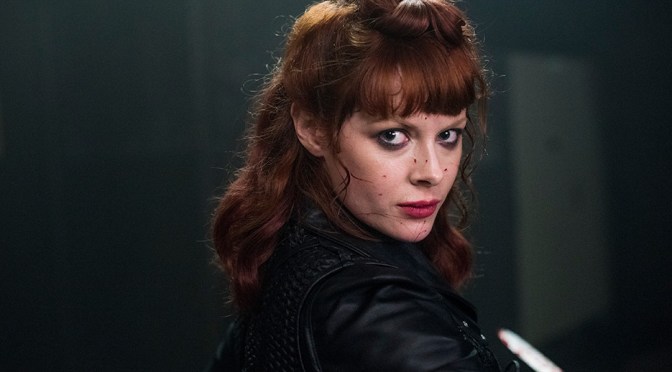
  • I love Jade’s red eyeliner and dark red lip, but that dress is a little too matronly for a femme fatale look. Still, I’m digging the clash between her true red look and Ryder’s almost magenta suit. I have no idea how people in this kind of bonkers post-apocalypse are getting such great clothes, but the show’s costume designers do a great job of using costume to tell a story.

The Expanse: “Cascade” is an incisively thoughtful exploration of systems failures

I suspect that “Cascade” may not end up being a fan favorite episode due to its lack of action and excitement, but it’s one of the best written episodes to date when it comes to thematic coherence and the emotional weight of its character arcs. It’s also an episode that gives us a much better look at the show’s imagined future of Earth, a deftly accomplished bit of revelatory exposition that gives us a fuller picture of the context in which the events of the show have happened. There’s not a ton of forward movement on the main plots this week, but the character work, exposition and set-up in “Cascade” seem sure to be invaluable as we move into the final three episodes of the season.

**Spoilers below.**

On Ganymede, the Rocinante crew split up to look for news of Mei and Dr. Strickland, Holden and Naomi going one direction while Amos and Prax go another. While their search makes up their plot and accounts for most of their actions in this episode, it’s secondary to the deeper story being told here, which is about the breakdown of communications and relationships between members of the crew, a system failure that is paralleled and emphasized by the cascading system failure—helpfully explained by Prax—that is currently taking place on Ganymede Station. Prax’s line, “The station’s dead already; they just don’t know it yet,” is positively foreboding, implying a time limit on the group’s activities on Ganymede (a feeling backed up by the social and governmental breakdowns we see on the station—the place is a powder keg) as well as suggesting that the damaged relationships between the Roci crew members may also be past a point of no return.

Against the backdrop of the dying station, Naomi and Holden, unquestionably the leaders (in an almost parent-like role) of the Rocinante crew, are still and increasingly at odds over the way things have been going, primarily because of Naomi’s growing discontent over the amount of violence and damage that they bring with them wherever they go. The tragedy on the Weeping Somnambulist has exacerbated the situation, and Naomi is not dealing well with Holden’s seeming indifference to the event. For his part, Holden feels guilty, but he’s rather desperately holding to the debatable belief that they did the right thing. Meanwhile, Amos seems to be becoming both increasingly unhinged and increasingly introspective, on a necessarily self-centered, inward-looking journey as he examines and tries to understand his own violent tendencies. Perhaps paradoxically, Amos’s disconnection from his friends only seems to leave him further unmoored and more prone to acts of extreme violence, though he’s so far still been able to be reined in before actually senselessly murdering anybody.

The good news for the Roci crew this week is that they manage to find a solid lead on the whereabouts of Mei and Dr. Strickland, though they still have no idea why Strickland took the girl in the first place and there’s plenty of reason to be apprehensive about what’s going on. Though Holden and Naomi haven’t found any evidence of protomolecule infection on Ganymede, it seems likely that the off-the-beaten path unsurveilled sections of the station where Strickland took Mei would be a perfect hiding place for some secret mad scientist stuff. The bad news is that Mars has ordered a no-fly zone around Ganymede, which will make it difficult, if not impossible, for Alex to retrieve them even if they are successful in rescuing Mei and discovering what Strickland is up to.

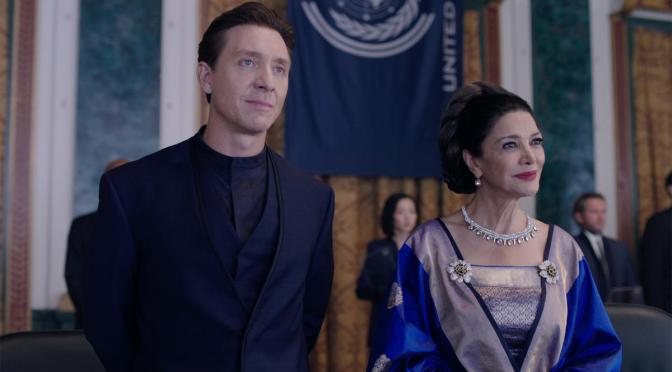
On Earth, the “peace conference” is wrapping up. Though Admiral Nguyen thinks that Bobbie has simply cracked from the trauma and stress of her experience on Ganymede, Avasarala still has some questions she hopes Bobbie can answer. Unfortunately, Bobbie is locked in her room until the Martian delegation is prepared to leave. While Bobbie is using every sharp metal implement she can find to break out of her room so she can see the ocean, an increasingly distraught-seeming Errinwright is going through the data from Bobbie’s armor, which evidently confirms to him that the events on Ganymede were connected to whatever Jules-Pierre Mao is up to. Apparently wracked with guilt and worry about the consequences, Errinwright finally goes to Avasarala and tells her everything he knows, giving her all the information he has on the protomolecule project. This Errinwright and Avasarala scene is great, if only because of the complexity and nuance of feeling both actors are able to convey with relatively few words. It’s not a long scene, but it’s something of a watershed moment, with Errinwright essentially throwing himself on Avasarala’s mercy. While Chrisjen’s not ready to tear up the existing government of Earth just yet by outing Errinwright for his illicit activities, it’ll be interesting to see just how it plays out in the coming weeks.

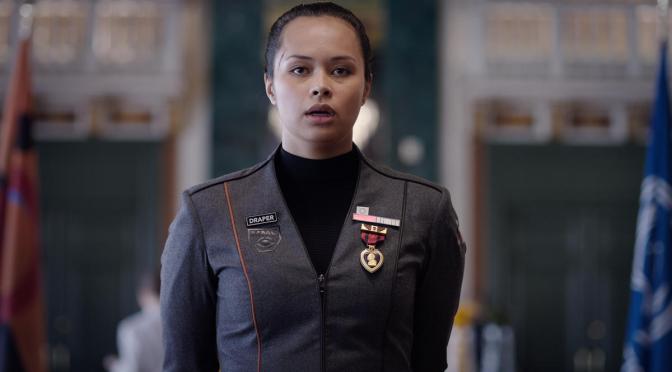
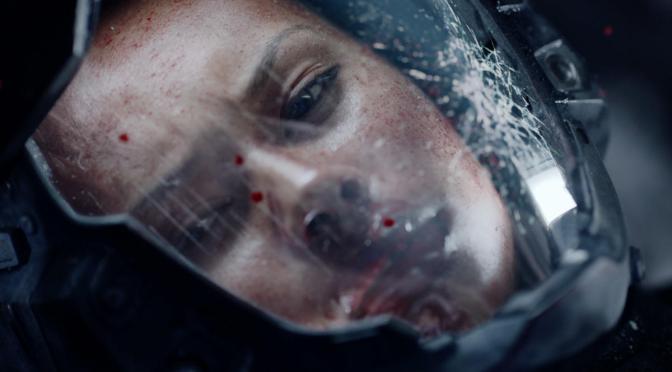
The showpiece and most deeply impactful part of “Cascade,” however, is Bobbie Draper’s journey through the streets of New York to see the ocean. Once she escapes from her room, Bobbie quickly realizes that she has no idea how to get to the ocean, and she’s disoriented and kept perpetually off balance by the bright sunlight and open spaces. She also finds that Earth isn’t very much like what she thought (or was taught) it was at all. As she roams the streets of New York near the UN, she finds not a decadent world of lazy, entitled people, but a dystopian hellscape where many people are barely subsisting on basic income, at least some healthcare needs aren’t being met, the environment has been significantly poisoned and opportunities for legitimate work are scarce. I imagine that this view of The Expanse’s Earth is no more completely representative of the state of the planet than a view inside the UN or of Holden’s parents’ farm, but it’s an important counterpoint to those more sanitized images that has been completely missing up until now. So far, Earth, largely due to Chrisjen’s self-assured and hyper-competent presence on screen, has been allowed to see like one area of the solar system that more-or-less had its shit together, but it’s revealed here—to Bobbie and the viewer—to be just another broken and possibly failing system. Bobbie’s emotional journey in this episode is one of the most compelling single-episode arcs of the show to date, and it marks Bobbie’s arrival, finally, as a primary protagonist that the viewer can truly empathize and identify with.

Miscellaneous Thoughts:

  • I loved the Alex scene on the Rocinante. It was a nice bit of levity in an otherwise serious (and at times quite dark) episode. However, it was slightly overlong, especially with that obnoxious music playing.
  • “Truth and fact aren’t the same thing” might be the best evidence yet that Martens is fucking evil.
  • I loved the small but significant detail of Bobbie using her Purple Heart to finish popping out that window. Nice symbolism, if a little on the nose.
  • I want more Cotyar scenes.
  • “Every shitty thing we do makes the next one that much easier.”
  • Chrisjen tells Bobbie that Mars was testing the protomolecule as a weapon, which seems somewhat supported by the no-fly zone around Ganymede, but I didn’t think Mars had any more official connection to Mao and the protomolecule than Earth did. Interesting.
  • “Fuck you, ma’am.”
Me too, Naomi. Me, too.

Into the Badlands: “Force of Eagles Claw” goes a little slow, but with an eye to the future

After last week’s excellent season premiere, “Force of Eagle’s Claw” slows things down a little and switches point of view less often for longer scenes and some quieter character work. Even the fight scenes this week were for the most part less flashy and even more utilitarian to the plot. It’s a good change of pace and provides an even fuller picture of the current state of affairs in the Badlands than we got last week. There’s a certain amount of unevenness, if only because Sunny and Bajie are so much more fun to watch than everything else, but it’s a solid episode, overall, that sets up some compelling options for the future of the show.

**Spoilers ahead.**

After being sold out to the Engineer last week, Sunny finds himself being prepped to fight to the death with Mouse for the privilege of being the Engineer’s new champion. He tries to refuse, stating that he doesn’t kill for others anymore, but he’s not being given an option. Instead, Sunny’s shackled to the treacherous Bajie and tossed into what passes for a fighting ring. Rather than staying and fighting for the Engineer’s entertainment, Sunny and Bajie flee up some stairs towards freedom, but they still have to fight their way out in a fight sequence that gets as bloody as I think this show has ever gotten when they escape through a huge fan and toss Mouse back into it, where the unfortunate man is practically vaporized into red spray all over the Engineer and his henchmen. As a fan of comic levels of gore, I appreciated this scene.

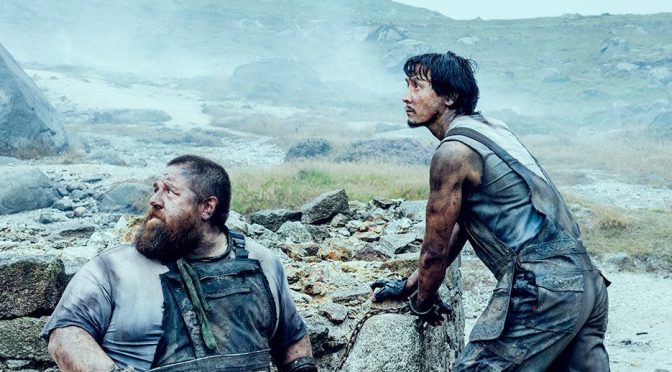
Sunny and Bajie finally escape the mines, but not without a vow from the Engineer that he’s not letting them go so easily. Nonetheless, the rest of their journey in this episode is largely uneventful. They hike through a land of rather lovely rolling green hills that Bajie calls the Outlying Territories, which is almost suspiciously devoid of any signs of other human life but provides a gorgeous backdrop to Sunny and Bajie’s bickering. Daniel Wu and Nick Frost have a great chemistry together, and their characters are near-perfect foils for each other. Watching Bajie’s seedy charm bounce off Sunny’s taciturnity is consistently entertaining with plenty of sharply-written dialogue and a couple of nice surprises. It turns out that Sunny isn’t completely humorless, and we get further confirmation that Bajie has some useful skills. They end the episode on the wrong side of an enormous, ancient wall that runs the whole border between the Badlands and the Outlying Territories, but I expect both their skills will come in handy in the weeks to come.

After leading her Butterflies to kill a group of rapist Clippers last week, Tilda is due for a stern talking to from Waldo, who is apparently working directly for and with the Widow now. Waldo advises Tilda that part of the key to being a good regent (and to just staying alive) is being able to bottle up one’s feelings and follow orders. Tilda insists, however, that killing those rapists was the right thing to do, and I agree. Waldo’s advice to Tilda in this scene comes off as somewhat mansplain-y, and I don’t love the way he compares her to the absent Sunny, especially when even Waldo admits that Sunny wasn’t immune to emotion, either. It’s also worth pointing out that Waldo is somewhat hypocritical here, since he’s apparently been subtly undermining the whole system for years, which seems like a much bigger act of rebellion than Tilda executing some rapists.

Later, we come upon Tilda and the Widow practice sparring, which Waldo is interrupting to have a sort of strategy meeting with the Widow. Ryder has called for a conclave of all the Barons, where he’s going to complain that the Widow’s taking back of her oil rigs is unlawful. It’s a way to avoid an all-out war, apparently, but it’s also baldly cowardly, which seems like a semi-ballsy move for a guy who has managed to get himself installed as the Baron of multiple territories. The Widow is ready for war, but Waldo advises caution and diplomacy. This conversation as well had the potential to come off as mansplaining on Waldo’s part, but I think it worked better than the previous talk between him and Tilda. The Widow is a mature woman, and Emily Beecham imbues her with a sort of ambitious, very physical energy that prevents her from ever seeming subservient. Whereas Tilda may look up to Waldo as a mentor, the Widow keeps him as an advisor and their interactions—even when they don’t entirely agree—have a strong sense of collaboration and equal footing.

Ex-Baroness Lydia ended last season by returning to her father’s religious commune, and we see her in this episode seeming to have settled back in nicely. At any rate, she’s officiating a marriage ceremony and looks as happy and content as we’ve ever seen her, though the rebuke she receives after thanking the community for accepting her back suggests that she isn’t quite as accepted as she thought. When a couple of Nomads arrive and disrupt the wedding, killing the groom and several more men before making to steal and rape the bride and other women, it’s Lydia who leaps into action to protect the group. This fight scene, brutal and harrowing as it is with the threats of rape, is probably my favorite of the season so far as it shows us a side of Lydia that we haven’t seen before and reveals just how much she’s been changed by her time away from her father and these people.

Unfortunately, Lydia’s reunion with her son Ryder later in the episode isn’t as successful a scene. It works well enough as a continuation of Lydia’s themes from earlier and to further highlight Lydia’s change in status since last season, but the revelation that Quinn was responsible for protecting Lydia’s father and his flock isn’t particularly surprising or interesting, and neither is the family drama between Ryder and his estranged mother. Judging from how much Ryder seemed to rely on Jade for leadership last week, it’s hard to disagree with Lydia’s assessment of her son’s abilities as a Baron, and if she was just planning to reiterate that hurtful truth I’m not sure what she hoped to gain by visiting her son at all. I feel like, ultimately, the real conflict here is still between Lydia and Jade, but we don’t see Jade in this episode at all, which is a shame. I can think of several ways that Jade’s presence, either to interact with Lydia or just to interact with Ryder about Lydia, could have improved this storyline.

At the temple, M.K. continues to train with the Master, who takes him to a room full of mirrors and tells him that there are many versions of himself living inside him and that it’s one of them that is blocking his progress. In order to move forward, M.K. must defeat this other self, which also turns out to mean that he must come to terms with a significant event in his past. It’s pretty straightforward, with some expected callbacks to Luke Skywalker’s similar journey in Star Wars, but things aren’t made so easy for M.K. While his showdown with Dark M.K. is the most visually striking fight scene of the episode, M.K. is ultimately unsuccessful in defeating his darker impulses and must be pulled out of the vision (or whatever it is) by the Master. I don’t expect this storyline to be narratively groundbreaking stuff, but it’s nice to see M.K. being allowed to face real obstacles in his path to enlightened heroism.

The final thread of this week’s story confirms that Quinn is, indeed, alive and not some kind of awful hallucination of Veil’s, and this is where things get weird. Apparently, after what looked like a fatal ass-kicking from Sunny, Quinn was found by Veil as she was leaving town. Instead of leaving him to die like she probably ought to have, she rescued him and doctored him up until he could turn right around and keep her a prisoner in his very creepy (kudos to the set designer and props department) underground lair. Quinn still has several dozen clippers who have remained loyal to him in his current exile, and he’s styled himself as something of a religious leader, blaming his previous failures and current problems on his lack of faith and failure to observe old rites. To avoid such failure in the future, Quinn has become newly dedicated to religion and is baptizing Veil’s baby, Henry, in blood. It’s strange and gross and melodramatic and Marton Csokas is really living it up as Quinn. I have no idea where this is going, but it’s fun as heck to watch.

Miscellaneous Thoughts:

  • Is it weird that I think Nick Frost is moderately sexy, even covered in dirt and wearing those awful overalls?
  • M.K.’s roommate has run away, which seems significant. I smell a future nemesis in the making.
  • So, is Lydia going to end up with the Widow or will she somehow reconnect with Quinn? Or is she going to do something else entirely, since she has tons of information and expertise about things? She pointed out that most of Ryder’s cogs worship the same gods as she does, and that feels like foreshadowing.

The Expanse: “The Weeping Somnambulist” has some great scenes but also some dead weight (**cough**Holden**cough**)

“The Weeping Somnambulist” is only a middling episode of a great show, but it covers a good amount of storytelling ground and marks the very welcome return of Chrisjen Avasarala after several episodes in which she had minimal presence. The scenes on Earth are excellent, there’s some surprisingly good character work for Bobbie Draper (Frankie Adams), and the Rocinante is off on a new mission which wasn’t that interesting this week but seems likely to improve in the next episode or so. After a couple weeks of main characters mostly reacting to events that have happened to or around them, this episode feels much more proactive and forward-moving, even if it’s not always riveting stuff.

**Spoilers below!**

The episode opens with an irritating fake-out. A Ganymede relief ship called The Weeping Somnambulist is boarded by a couple of gun-wielding men wearing the livery of the Martian navy, but it turns out it’s just Holden and Amos in disguise. Apparently the Rocinante is too recognizable to take to Ganymede, so they’re going to commandeer the Somnambulist to get them the rest of the way there. The husband and wife team flying the Somnambulist don’t get any characterization aside from “pissed off at Holden,” so the eventual tragedy they experience isn’t particularly impactful. It doesn’t even work as something that should deeply affect the Roci crew, since they can’t reasonably be held responsible for the Ganymede dock workers’ initial attack on the Somnambulist and it’s similarly unfair to blame them for escalating a situation that had already escalated to guns to heads. Sure, Holden and company might feel guilty for having failed to rescue the couple, but it’s an unreasonable guilt and therefore hard to take seriously. I mean, okay, Holden and company had to get to Ganymede somehow, but it was truly, deeply unnecessary to spend so much time on this boring and trivial plot when there was so much more interesting stuff going on elsewhere in the episode. It dragged the whole episode down into mediocrity, and that’s a shame because the rest of the hour was very good.

On the bright side, Bobbie made it to Earth this week, and the brilliance of execution in this storyline almost makes up for the Roci crew stuff being so dull. When we first see Bobbie this week, Martens is helping her prepare for Earth with necessary drugs and supplements to minimize her discomfort on the planet’s surface. It’s a smart bit of worldbuilding exposition that also works nicely as a character beat, showing us more of Bobbie’s feelings about Earth. These early Bobbie scenes also work as a really wonderfully composed and acted bit of speculative fiction, even out of context, offering the viewer some insight into what it might be like for a human to be setting foot on Earth for the first time ever. Frankie Adams perfectly conveys Bobbie’s complicated feelings of curiosity, awe, pride in her own planet, resentment towards Earth and something a little like nostalgia, and Bobbie’s reactions to her first glimpses of Earth are truly moving stuff.

The peace conference at the UN is predictably unpleasant for pretty much all involved, though it’s highly entertaining for the viewer. The petty one-up-manship is passive aggression hovers somewhere between hilarious and too real as the delegations from both Earth and Mars take calculated swipes at each other before getting down to business. Shohreh Aghdashloo as Chrisjen is always delightful to watch, but it’s again Frankie Adams who steals the show in these scenes. Her frustration and anger at being asked to throw her fellow marine under the bus is palpable, and Chrisjen easily picks up on the lies Mars is telling to try and smooth things over. Even though things are being smoothed over in a way that heavily favors Earth (and at the Martians’ considerable expense), Chrisjen’s priority is ferreting out the truth about what happened on Ganymede. Her second interview with Bobbie is illuminating, but I can’t wait to see these two characters alone together.

The third storyline of the episode concerns Colonel Janus, Dr. Iturbi and their journey to Venus to see firsthand what has happened to Eros. I wasn’t expecting this material, which is either invented for the show or is drawn from the books in the series that I haven’t read yet, but it’s good stuff. The personality conflict between these guys is engaging, though perhaps a little on the nose with their sniping at each other about which one has the corner on Real Science™. As much as I liked these scenes, the only truly important one comes near the end of the episode when they finally get a look at the crater left by Eros and see that there’s some kind of biological material floating around the hole. Iturbi streams the information to Avasarala back on Earth. Learning what Chrisjen will make of this, seeing how she’s already making a connection between Eros and Ganymede and the rest of the generally strange events that have been happening in the solar system, is the other thing I can’t wait for next week.

“The Weeping Somnambulist” is a frustrating episode to watch without another one to follow it with, and this is mostly owing to its very abrupt and, frankly, anticlimactic ending. Bobbie’s emotional distress felt real and her clamming up under orders was a nicely final ending to the peace conference, and the revelation of the Eros crater information felt significant and game-changing, but the ending of the Roci storyline was too slight to compare and not consequential enough to qualify as a cliffhanger. Still, though this whole episode felt somewhat disjointed, inconveniently punctuated as it was by all the boring stuff Holden was doing, I expect the next couple of episodes to have some big narrative payoffs, exciting moments and the thematic coherence that this one lacked.

Miscellaneous Thoughts:

  • I was happy that Doris wasn’t completely forgotten, even if Prax didn’t get to actually send his message of condolences to her family on Mars. It’s still a pretty textbook fridging, though.
  • While the Roci and Somnambulist stuff was boring, Amos and Alex both managed to have individually compelling moments.
  • That necklace that Avasarala wears is a gorgeous piece.
  • I already miss Fred Johnson and Drummer, and there’s no telling when we’ll get to see them again.

Into the Badlands: “Tiger Pushes Mountain” is a beautiful, bloody start to the season

I loved Into the Badlands when the first six-episode season aired back in late 2015, and I was thrilled when confirmation of its second season finally came. It has a unique concept with a distinctive and striking visual style, a diverse cast, and excellent fight choreography, and it even has a decidedly progressive sensibility so I was genuinely confused and disappointed when it seemed that no one I knew was watching it. The good news is that season one of the show is now on Netflix, everyone is watching it (finally, belatedly), and season two has begun and is off to a great start.

“Tiger Pushes Mountain” picks up six months after the end of the first season’s finale, which had several cliffhanger-ish endings, and it serves both as a where-are-they-now episode for those of us who watched the first season and a sort of soft reboot of the series that is mostly accessible to new viewers (though I still highly recommend checking out the first season on Netflix). It’s an episode that shows exactly what kind of show this is, and it sets a tone for the new season that is already proving to be slightly darker, definitely faster paced, and a good deal bloodier than season one was.

**Spoilers below**

Sunny (Daniel Wu) ended season one being betrayed by the River King, and season two opens with Sunny arriving in shackles at the Bordo Mines, which gives us our first action scene of the season before the opening credits even roll. The troll-like overseer of the mine (Stephen Walters, credited as “The Engineer” and bringing a delightful touch of madness to the role) orders the murder of one of the other new arrivals, and Sunny chooses this time to take a stand. He kills several of the Engineer’s henchmen and at least temporarily prevents the murder before being recaptured knocked unconscious.

Sunny wakes up to find himself chained to Bajie (Nick Frost), a disreputable sort of grifter character who immediately assesses Sunny as someone who “looks like trouble.” Nick Frost brings a garrulous energy and louche charm to the role of Bajie that makes him great fun to watch in scenes with Sunny, who has always been a quieter character and spends much of this episode silently trying to think his way out of his current predicament. It’s only about halfway through the episode when Sunny approaches Bajie for help, but Sunny makes a mistake when he lets on to Bajie that he’s planning to escape alone. Bajie’s betrayal of Sunny to the Engineer is expected, but Nick Frost is so likable in the role that I can’t help but hope these crazy kids work things out enough to go on a bigger adventure together.

At the end of season one, M.K. (Aramis Knight) was kidnapped by mystery monks who seemed to share his magical powers, and here we find him several months into his training at a secluded monastery. His mentor at the start is a young woman named Ava (Eve Connelly), but M.K. is anxious to meet the Master. There’s an interesting scene with M.K. and a Nomad boy that he’s sharing a room with in which we learn that the stigma M.K. has faced regarding his powers isn’t the norm everywhere. Among the Nomads, the other boy was treated almost like a god and granted special privileges, so he’s skeptical of the training the Master offers to/forces on them. It’s a smart way of recontextualizing M.K.’s role—he’s not unique, and his understanding of his own powers isn’t the only way of understanding them—and helping the viewer to understand the way in which magic fits into the world of Into the Badlands.

When M.K. finally meets the Master (Chipo Chung, who some will recognize from a couple of memorable turns on Doctor Who), we again get a different perspective on and deeper understanding of M.K.’s gift. M.K., however, just wants to finish his training as soon as possible so he can get back to the Badlands and his friends there. There’s not a ton of forward movement on this storyline this week, and the episode ends with M.K. still firmly stuck at the monastery, but the Master is going to personally take over his training from now on. I expect things are going to get interesting for M.K. next week.

Meanwhile, Ryder (Oliver Stark) and Jade (Sarah Bolger) have abandoned the plantation house and are ruling their three territories from Jacoby’s mansion. Unfortunately, this information is delivered in clumsy exposition in a scene right back at the supposedly abandoned plantation house, which is weirdly overgrown and dusty for just a few months’ absence, especially since all the furniture and stuff is covered and they supposedly left on purpose. Apparently, this is where Ryder hangs out when he’s feeling pensive or just needs a retreat from the responsibility of being the Baron of three territories, even though it seems pretty obvious in this episode that Jade is the one doing the heavy lifting of actually leading and managing things in their new situation. Still, this isn’t the worst way of working in some necessary exposition, and the scene is mercifully short as Ryder is shortly called away to deal with a problem at an oil refinery and Jade joins him.

It turns out that the Widow (Emily Beecham), after the late revelation of her revolutionary ideals last season, has spent the last several months building up her forces and planning to take back the territory she lost. This episode finds her making her first major move, and she and her daughter/Regent, Tilda (Ally Ioannides), meet Jade and Ryder at the refinery. When Tilda explodes a vehicle piled with oil barrels, the Widow chases Jade through the refinery killing every man in her way in a gloriously fun-to-watch fight sequence that culminates in an encounter between Jade and the Widow that I’m certain launched a thousand ships. Seriously. I’m not sure how to read Jade’s expressions as she watches the Widow as anything other than intrigued arousal.

It’s also a fight sequence that works interestingly to lead the viewer to contrast the Widow and Sunny. Both characters ended season one rather down on their luck—Sunny betrayed and captured, the Widow at least momentarily beaten and robbed of her territories and prestige—and their arcs towards regaining what they’ve lost and achieving their goals (which are broadly similar) are rife with parallels and points of obvious comparison. Daniel Wu has said that they wanted to make the action scenes more in service to character and story this season, and they’re successful so far. Though Sunny’s and the Widow’s respective sequences don’t appear exactly at opposite ends of the full episode, they still work to neatly and symmetrically bookend the what-are-they-up-to-now portion of the hour before the show moves on to actual moving-along-the-plot and introducing-the-rest-of-the-season’s-conflicts stuff.

Miscellaneous Thoughts:

  • I was certain the mines were going to be coal mines or, possible, precious metals or gems, but they aren’t. They’re digging for relics from the pre-apocalyptic past, which is a neat idea executed nicely. The dark, filthy mines and the violent overseers with their dilapidated gas masks are downright creepy.
  • Jade’s blue dress is stunning. Best costume of the episode, for sure, though I appreciate the grime on every single inch of the Bordo Mines scenes.
  • Tilda and her sisters killing those rapists was a great scene—I’m always happy to see rapists die—but it also introduces a smidgen of doubt about Tilda’s loyalty to her mother. They clearly don’t agree on every single particular of how they should remake their world, and there’s a potential mother-daughter conflict in the making here that could make for great television.
  • Odds on whether Quinn is really still alive or if this is some kind of nightmare Veil is having after just giving birth? I might have yelled “WHAT THE FUCK?!” out loud when that happened.

The Expanse: “Pyre” isn’t that hot, but it gets the job done

After the major climax of Eros crashing on Venus (ending the Leviathan Wakes part of the show) and the last couple weeks of gear-shifting as we move completely into Caliban’s War territory, “Pyre” is a somewhat strange episode. Last week’s “The Seventh Man” is probably my favorite episode of the show to date, but “Pyre” is possibly the worst episode of season two so far. Appearing in just a single short scene in “The Seventh Man,” Avasarala is completely absent from “Pyre,” as is Bobbie, who is presumably en route to Earth. “Pyre” introduces a new character, Praxidike Meng (Terry Chen), and then spends most of the episode working to connect him to the Rocinante crew. Meanwhile, Fred Johnson faces a major challenge to his authority that threatens to undo his work for the Belt and jeopardizes the safety of Tycho Station itself. At times, The Expanse has done well with these sorts of more focused episodes, but this one just doesn’t quite work the way it ought. It accomplishes what it needs to do, but without the show’s characteristic deftness and panache and not without some frankly awkward moments.

**Spoilers below!**

The episode starts with a flashback/dream sequence that introduces Praxidike Meng and his daughter, Mei, and this is the first weird moment of the hour. First, we see Prax (as yet unnamed) doing something with plants. Then we see overhead shots of the greenhouses on Ganymede, which is a cool (if belated) way of finally giving the viewers an idea of how Ganymede works. Finally, we see Mei as the figure waving her arms at the marines outside on the surface of Ganymede (as seen very briefly and indistinctly in “Paradigm Shift”) just before the orbiting mirror shatters and comes crashing down through the glass roof.

Cut to Prax waking up on a freight ship that has been commandeered for moving refugees from Ganymede to other stations. He’s found there by his friend, Doris, who breaks the news of his daughter’s death—although it, confusingly, turns out that Mei wasn’t in the greenhouse dome with Prax, but at a doctor’s appointment—and offers to take him with her to Mars, where she still has family and suggests they’ll be able to find work in the terraforming project. The grieving Prax rebuffs her but then changes his mind as the Belter crew of the ship prepare, supposedly, to shift any refugees from Earth and Mars to another ship to be taken back to their planets of origin. As the Inners are being herded to an airlock, Prax isn’t allowed on, because obviously the Inners are going to be spaced, which is exactly what happens. Seriously, this is so heavily telegraphed from the moment Doris first says “Mars” that it’s almost comical. It’s also a significant change from the source material, as nothing like this happens in the books (at least in the first two that I’ve read). More importantly, it’s upsetting and problematic on several levels.

First, it’s a monstrous act of hatred on the part of the ship’s Belter crew. Yes, the man who actually does it tells Prax that “Inners wrecked Ganymede,” but that’s a very thin excuse for capriciously and incredibly cruelly murdering an airlock full of people who not only had nothing to do with the destruction of Ganymede but were themselves displaced victims of the attack. This demonizing of Belters has been something of a theme this season, but this is definitely the worst example of the trend so far and it’s not helped by the other events of this episode. It’s genuinely starting to feel like the show’s writers hate Belters as they depict them over and over again committing increasingly senseless acts of destruction and violence. Anderson Dawes and Fred Johnson’s nuanced rivalry makes sense and is deeply compelling, but most of the rest of the Belters we see aren’t complex, just wantonly, cartoonishly evil and stupid.

Second, the way this event is shown on screen is not far short of sadistic. Because it’s so heavily telegraphed, the viewer knows what is coming early on—if not when Doris first mentions Mars than certainly by the time all the Earthers and Martians are being removed from the main group—and yet we’re still forced to watch it happen in excruciating real time as they’re marched to the airlock, shift to zero-g, Prax and Doris touch fingers through the glass, and then the airlock opens. Even after this bit of lovingly crafted torture, we’re not done yet because there’s still time for a long and unnecessarily gruesome shot of poor Doris gasping for breath in space as she slowly asphyxiates and freezes at the same time. It’s deeply unpleasant to watch and only serves to highlight how terrible the practice of “spacing” really is while pointing to the apparent hypocrisy of Belters who fear that fate themselves but are willing to inflict it on others.

Finally, it’s a pretty textbook fridging of a newly introduced female character in service of Prax’s storyline. Or it would be if Doris’s death was treated as truly impactful and important. Instead, while Prax does try to report the crime when he arrives at Tycho, he doesn’t know the name of the ship he was on or the names of the perpetrators, and although he was on a ship full of other refugees I guess none of them are willing to corroborate his story. When the station doctor on Tycho says she can’t help him, this is the last we hear of it, as the show seems to be pivoting straight into the rest of Prax’s Caliban’s War story instead of dealing appropriately with the tragedy that they invented to fill some time in the episode while other things are happening on Tycho before Prax gets there.

On Tycho, we kick off the episode with Alex and Naomi returning on the Rocinante with Diogo in tow. They’re met at the dock by Holden and Fred Johnson, but when Diogo refuses to tell them anything about where Anderson Dawes has taken Cortazar he’s shuffled off quickly to Tycho station jail and not seen or heard from again from the rest of the episode. This is slightly anti-climactic because it happens so quickly, but we quickly move on to Fred, Drummer, Holden, and Naomi working to figure out how Dawes could get away from them without help (he couldn’t, obv). Fortunately, they don’t have long to wait before Dawes calls them up to officially break up with Fred. Dawes accuses Fred of withholding secrets from the rest of the Belt, which is accurate, and confirms that he has Cortazar. This is also when it comes out that Cortazar wasn’t just puttering around in his cell aimlessly; he’d found evidence of more protomolecule, and it was chattering like it had on Eros. There’s more of this stuff out there, but they aren’t sure yet where it is.

Naomi and Drummer head out to physically go to the antenna Cortazar was using for data collection to find out what he’d learned. I suppose there’s some unspoken concern that Cortazar could have been in contact with the sample that Naomi keeps failing to fire off into the sun, but it rather predictably turns out not to be that. Instead, there’s protomolecule on Ganymede. This sends Holden and Naomi to definitely-not-just-space-google former Protogen employees who may have been working on Ganymede at the time of the attack. In about thirty seconds, they discover Dr. Strickland, a suspiciously overqualified pediatrician who has conveniently been recently photographed with Praxidike Meng who is conveniently on Tycho right this instant. It’s the most egregious example of plot convenience theatre I’ve seen in ages, and I literally laughed out loud when Holden was like, “It can’t really be this easy.” No shit, it can’t, but it is, because this is what the show’s writers decided to go with instead of any number of more organic and less profoundly silly ways of getting Prax onto the Rocinante and all of them on the quest to find Mei.

The other major plot this week isn’t much less absurd than this, and it continues the aforementioned trend of mass Belter character assassination. After it’s pretty well confirmed that Drummer is not the traitor on Fred Johnson’s team, we learn that it’s been one of the other people working on the Tycho control room all along, a man named Edin, who has an unspecified technical job that gives him access to a lot of controls on the station. He’s in league with the OPA faction leader, Staz, and they’ve got a genius plan to take over the station, steal all Fred Johnson’s nukes, and fire them at Earth because what could possibly go wrong? They manage to take over the station’s control room, kill a couple of hostages, and shoot Drummer while trying to get the launch codes for the nukes, but they’re easily defeated when Holden finds out and sends Amos outside the station to cut off the air supply to the control room. Once everyone has passed out, Holden, Naomi and Alex show up and rescue Fred and Drummer.

None of this would be even remotely acceptable—because it’s a hilariously badly conceived plot from start to finish—if it wasn’t for a couple of saving graces. First, I love that when Staz shoots the first hostage Fred basically just shrugs and is like “I’ve seen plenty of death in my time.” Fred Johnson is a consistently well-drawn character, and this coolness under pressure is exactly what I’d expect from him. Second, after the rescue, when Alex is trying to help Drummer stand so she can go get medical attention, she grab’s Alex’s gun and puts bullets in the heads of both Edin and Staz before she limps off on her own. After an episode full of Belter’s being wantonly evil and/or stupid, it’s nice to see a Belter get the chance to do the sensible (albeit brutal) thing, and it further proves that Drummer is a badass.

The episode ends with the Rocinante crew leaving Tycho to investigate Ganymede and search for the protomolecule and Mei Meng, but not without one last fraught exchange between Holden and Fred. In the book it was much more clear that Fred Johnson wanted the Roci crew to stay in his exclusive employ to protect and advance his interests in the Belt, but here the reason for this little break-up is somewhat muddled. Fred and Holden had seemed to be of one mind on most issues over the last couple of episodes, and this week they worked well together and seemed as friendly as they’ve ever been, so Holden’s antipathy towards Fred feels sudden and unearned. On a second, closer, viewing of the episode, this feeling wasn’t as pronounced, but their dynamic still doesn’t quite make sense either.

In the end, I’m not sure it really matters, though. This episode felt oddly cobbled together from disparate parts, as if the writers were working with a checklist of things that needed to happen rather than telling a harmoniously balanced and truly well-conceived story. At the same time, much of the episode felt like filler used to flesh out material that is much less meaty on screen than it seemed in the novel. It’s probably the farthest from the source material the show has ever strayed, and though it remains mostly true to it in spirit, it’s still not an encouraging example of what happens when the writers have to solve adaptational problems. Here, my guess is that they didn’t want the Bobbie and Avasarala plots to get ahead of this one, or perhaps they thought the episode might be overstuffed if they tried to give each plot some time. Either way, coming up with some nonsensical melodrama to fill space and time was the wrong answer and speaks to an unfortunate laziness that I hope we don’t see more of in the future.

On the bright side, next week Bobbie and Chrisjen are back and hopefully in a major way. Thank goodness.

Miscellaneous Thoughts:

  • Love Mei’s backpack. It’s a nice touch with the hologram characters, though I’m now wildly curious about the economics of that kind of disposable consumer good being sent to someplace as far as Ganymede.
  • Holden accusing Drummer of being a traitor made me want to punch him right in the throat more than I usually want to punch Holden in the throat. Peak asshole Holden, for sure.
  • I’m still not loving this Amos subplot, though I felt this week like I had a better idea of where the show is going with it (something something tragic backstory, probably). The whole thing feels almost like an afterthought and understanding what the point of it is requires a pretty significant attention to detail.

The Expanse: “The Seventh Man” is a perfect balance of personal and political

This week, The Expanse shifted gears again in “The Seventh Man.” After last week’s fast-paced mix of exposition and set-up, capped off with a decided feeling of consequence by the Ganymede incident, this episode takes the time to do a couple of hugely important things. On a Martian ship, Bobbie Draper is recovering from her injuries and trying to make sense of her jumbled memories, while on Tycho station there’s a struggle for control as Anderson Dawes and Fred Johnson compete with each other for the opportunity to determine the future of the Belt. It’s an episode that’s light on action but heavy on talking and politics and full of some of the show’s best writing to date.

Spoilers ahead!

There’s only one scene on Earth this week, but it’s a good one. When the news comes in about Ganymede, Avasarala and Errinwright are watching with the Secretary-General and they have to make a quick decision about what to do about it. Errinwright pushes for attacking a Martian target, but Chrisjen advises caution and calls for a peace conference on Earth, where she argues that Earth would have the advantage. The Secretary-General is convinced, so that’s happening, probably next week. It’s interesting to see how the balance of power has shifted in Chrisjen’s favor since Eros, but it’s also obvious that she’s still wary of Errinwright, with whom she’s increasingly at odds.

At Tycho Station, refugees from Ganymede are flowing in, and the Rocinante crew is helping to get people settled on the station. Meanwhile, Anderson Dawes has also arrived on the station, where he’s inviting refugees to Ceres as well as rallying Belters on Tycho. We soon find out why: Having wrangled Ceres, Dawes is on Tycho to make a decisive play to wrest control from Fred Johnson. We get to see Dawes publicly debate Johnson over what the OPA’s next steps should be, and it’s riveting stuff. The real ideological differences that have previously been implied or inferred are made explicit when the two men have to stand in front of a parliament-esque gathering of OPA faction leaders and make their cases. Later, as Dawes schmoozes his way around the station trying to ingratiate himself with Holden and Naomi, then Drummer, then Diogo, pumping them for information, we get a real sense both of how deep the divisions go and how different Dawes and Johnson’s tactics are.

The Tycho sequences are (except for a weird Amos segment) by far the strongest parts of “The Seventh Man,” and they’ve got several things going for them. The dialogue is smartly written. The speeches are entertaining to watch and effectively communicate complex arguments. The increasing tension between Holden and Naomi is well-conveyed as their relationship frays at the edges. Dawes’s connection with Drummer is clearly depicted, with enough on-screen information to intrigue the viewer but without telling us the whole story all at once. Dawes’s encounter with Diogo is pitch perfect and a great/chilling example of the ease with which young people can be manipulated by those they admire. The final short action sequence as Dawes abducts Cortazar is a much-needed break from talking scenes and gives Fred Johnson a clear goal going into the next few episodes. In short, it’s a balanced, cleverly plotted, and well-thought-out storyline that admirably holds up its half of the episode.

If there’s any major criticism I have of the Tycho story this week it’s that Holden’s “character development” doesn’t feel particularly earned. The foreshadowing of having Dawes compare Holden directly to Miller didn’t quite work because there’s not any actual evidence before this episode that Holden has evolved into anything at all, much less into a new Miller. To be fair, I suppose Holden has become more circumspect this season about shouting sensitive and inflammatory information to the whole solar system willy-nilly, but he’s still pretty much the same old frustratingly naïve and self-righteous Holden we’ve come to barely tolerate over a season and a half of the show. His late-night attempted attempt on Cortazar’s life was genuinely unexpected, and not in a good way. That said, his decision to shout over Belters to support Fred Johnson (and his dipshit defense of his actions to Naomi) was exactly what I would expect of him.

The part of the episode I was most excited to see was the Bobbie Draper stuff, which was both just what I predicted it would be and much better than I thought it would be, primarily due to Frankie Adams’ strong acting as she works through Bobbie’s trauma and confusion after the Ganymede incident. After being rescued from her damaged exo suit, Bobbie is taken to the Scirocco for treatment for her injuries and multiple rounds of questioning about what happened on Ganymede. It’s during this questioning that we get some of the blanks from last week filled in, which is pretty much how I suspected things were going to go. I thought we’d see more flashes of the seventh “man” that gives the episode its title, but the Ganymede monster is kept deliberately mysterious and Bobbie is told to not speak of it when she finds out at the end of the episode that she’ll be going to Earth to testify at the UN.

“The Seventh Man” (and The Expanse in general, if we’re honest) is, ultimately, a story about storytelling, but it’s also a story about the personal nature of politics. Powerful people vie to shape narratives to their own purposes, both selfishly and not. Avasarala has an almost preternatural ability to read situations and come up with creatively constructive sources of action to prevent all-out war. We see that she has counterparts among the Martians as well, people with cooler heads than the common soldiery who are working hard to keep the peace as well, even if that means making up a plausible story to cover up an implausible event. Fred Johnson and Anderson Dawes both have stories to tell this week, and both of them are true in their ways—humanity is stronger if they can live peacefully together, and the Belt and Outer Planets need to be self-governing and united against those who don’t have their best interests at heart.

Identity figures largely into all these storylines this week. Avasarala is still working to assert herself in her stronger position following the destruction of Eros; she sees herself as an iconoclastic champion of Earth, and perhaps her greatest pressures come from her own expectations of what she should be achieving. Bobbie Draper has lost her unit in a tragedy that she doesn’t yet understand, which has left her unmoored, and now she’s being sent to Earth, but not as a conqueror or even as a warrior; her navigation of this unfamiliar territory is going to be fascinating in weeks to come. Anderson Dawes sees himself as the true leader capable of uniting the OPA under his control, and his work for the Belt and Outer Planets is confirmed to be real and sincere. However, he also seems burdened with something like self-hatred—a sort of archetypal man-willing-to-do-bad-things-for-good-reasons who knows how to fight, but not how to achieve and maintain peace. Fred Johnson, on the other hand, dreams of real and lasting peace, but his history and status as an Earther makes him an eternal outsider in the Belt. They may respect and appreciate him, but they won’t follow him like they’ll follow Anderson Dawes.

All these various takes on identity are at work with Naomi and Holden. We saw last week that Naomi is identifying more and more strongly with her Belter roots, and this episode continues that trend. She is fully invested in the suffering of those she sees as her people, and she’s deeply admiring of and moved by Anderson Dawes. She’s definitely struggling with some feelings of guilt over deceiving Holden about the hidden protomolecule sample, but her feelings of resentment towards him for his lack of understanding of her are even stronger than guilt. In some ways, Holden’s motivations mirror Fred Johnson’s—he wants to do what he can to help people in the Belt, but he also wants peace in the solar system—but Holden has heroic aspirations as well and is (we learn) at least open to the idea of modelling himself more after his friend Miller. Holden’s arc here isn’t as well-defined as Naomi’s, and it’s certainly not as relatable or likeable, but it does fit within the general thematic neighborhood of what’s going on with everyone else.

The Expanse is always good, but this episode and last week’s “Paradigm Shift” have been truly superb. The show’s characteristically high production values, powerful writing, excellent casting choices and solid acting have worked together to create a deeply affecting new direction for things now that we’re past the relatively weak Leviathan Wakes source material. The deeper we delve into Caliban’s War territory, the better things are getting, and that’s an awesome achievement for a show that was already the best thing on television.

Miscellaneous Thoughts:

  • The blood snowflakes in the opening scene were beautifully gruesome and make for a great image, but that is not how blood works.
  • I didn’t really “get” the Amos stuff. This wasn’t quite a flashback, there wasn’t enough information given about Amos’s past to make sense of his actions, and things are left basically unresolved after he has the conversation with Cortazar about the “procedure.”
  • Jared Harris is perfectly cast as Anderson Dawes. Absolutely magnetic and probably my favorite character to watch aside from Shohreh Aghdashloo as Avasarala.
  • Not enough Alex this week, and I did not like how he talked to Naomi.
  • I feel like Naomi and Holden’s relationship is quickly headed for Greek tragedy territory, but they were still going strong at the end of Caliban’s War, so I’m very interested to see how that shapes up over the rest of this season.

The Expanse: “Paradigm Shift” is great start to a new chapter in the show’s story

I’m sure I’ve said it before, but season two of The Expanse is goddamned fantastic. After last week’s wrap-up of the last of the Leviathan Wakes storyline, I expected this week’s episode to be something of a bridge between two distinct parts of the season. “Paradigm Shift” is that, to some degree, but it feels even more like a whole new season premiere in structure and tone, with some humor (welcome, after a largely serious couple of weeks), some thematically relevant exposition, some set-up for future plots, great character work and a flashy (if slightly confusing) cliffhanger to leave us wanting more. In a season already full of great episodes, this one might be my favorite yet.

Spoilers below, natch.

There’s no pre-credits scene this week, and the first scene of the episode starts with a look at Mars from space that segues into a flashback to the Mars of 137 years ago, where we meet Solomon Epstein (guest star Sam Huntington), inventor of the Epstein drives that power the ships used in the solar system of The Expanse. Apparently, Epstein was simply trying to get a minor increase to fuel efficiency when he accidentally built the drive that was fast enough and fuel efficiency enough to change the course of human history in the solar system. The Epstein drive is the technology that allowed Mars to gain independence from Earth and enabled the colonization of the Belt and the Outer Planets, but this has also led to the complicated political and military situation between Earth, Mars, and the OPA that fuels the show. It’s an interesting bit of worldbuilding exposition that is spooled out in short pieces over the course of the episode, but it also serves as a thesis statement for the episode and, perhaps, for the rest of this season: the benefits of technological advancement never come without costs. If the protomolecule is, as Colonel Janus tells Avasarala in the U.N. situation room, “the greatest technological leap since the Epstein drive,” what will it mean for humanity?

Things on Earth are relatively quiet this week starting with the abovementioned situation room scene, which primarily works to establish that the Earth government doesn’t know what’s going on yet. They don’t know what happened on Eros, they’re no longer in contact with James Holden or Fred Johnson, and they’re missing some thirty nuclear missiles. They are going to mount a mission to Venus, however, to find out what they can about Eros. Because what could possibly go wrong? Avasarala is even going to send her ex-boyfriend, one Dr. Michael Iturbi (played by the very handsome Ted Whittall), to be her eyes and ears on Venus.

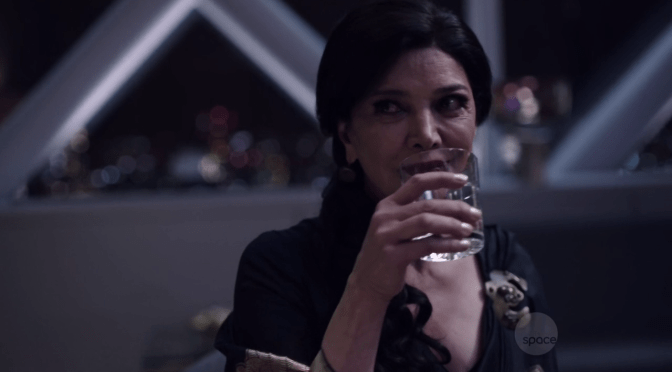
The standout Earth scene of the episode, however, doesn’t come until late in the episode when Chrisjen approaches Errinwright to talk about Jules-Pierre Mao. In short, Avasarala advises Errinwright to use whatever influence he has with the Mao family to get Jules-Pierre to turn himself in, and she gives a compelling speech about what the consequences will be if he doesn’t. Chrisjen Avasarala has been an iconic character since day one, but her rage-filled speech to Errinwright here is certainly her most iconic moment yet. Shohreh Aghdashloo is always glorious in this role, but she’s in rare form throughout the scene, full of arch looks and knowing smirks that shift to barely restrained fury as she makes clear to Errinwright both that she knows about him and Mao and that she has the power and will to destroy them both. Her small hair toss as she walks out the door at the end is a nice little visual punctuation for what just happened.

The Rocinante makes it back to Tycho Station, where they’re greeted as heroes, something that they aren’t all comfortable with. Amos and Alex head off into the station, while Holden and Naomi head straight to Fred Johnson to make their report, where they find out that Fred Johnson has the missing missiles from Earth. Holden is self-righteously pissed off about this, because of course he is, but not everyone on the Roci agrees with him. There’s a pretty obviously impending break between Holden and Fred Johnson, but we also see the seeds of a significant potential break between Holden and Naomi as well. While Holden might believe there shouldn’t be any “sides” he doesn’t seem to be at all aware of the ways in which his own indecision and lack of conviction are pushing Naomi to choose one on her own.

Identity is at the core of the dynamic between the members of the Roci crew. Holden imagines them as a family, and he might think that they’re above the factions and infighting in the solar system, but he is also still very much shaped by his birth and upbringing on Earth. Alex, even as a Martian expat, still retains some of the Martian nationalism that he was raised with, which we see when he suggests that they turn their hidden protomolecule specimen over to Martian scientists. Amos is practical and has a tendency to be a bit of a follower, and it seems that he’s at least partly transferred his loyalties to Holden, leaving Naomi as the only Belter on the Rocinante now that Miller’s gone. Her Belter identity is important to her, as evidenced by her easy connection and bonding with other Belter characters, and we can already see her chafing at being outvoted by the others on the Roci. She craves the company and camaraderie that comes from shared experience, especially when faced with a situation where she disagrees with Holden so profoundly, and it’s easy to see why she pursues a friendship with Samara and aligns herself with the OPA. What’s less easy to see is how this is going to work out; the current state of affairs is definitely not sustainable for either Holden and Naomi’s relationship or for the Roci crew as a whole. Something’s got to give.

The episode ends on Ganymede, where Bobbie Draper and her unit of Martian marines are stationed and complaining loudly of being stuck guarding farms. Things get interesting pretty quickly, though, when they’re attacked by unknown forces that destroy the Martian ship in the sky and leave Bobbie seemingly the only survivor on the ground. The problem is, it’s difficult to understand exactly what’s happening in the final few shots of the episode. The battle in the sky is visible to the marines down on the surface of Ganymede, and we know that the Martian ship is destroyed and Sutton is killed, but it’s not clear who’s firing on who in the air (though I think we’re meant to understand that it’s Mao’s stealth ships doing most of the shooting). Down on the ground, we see more of what Bobbie sees, so we can see that the U.N. soldiers that she thinks are charging her group are in fact being chased by a seventh figure behind them. It’s also clear enough at the end that the other three members of Bobbie’s team are dead, with their suits slashed open and helmets smashed. The final shot of the episode as well is clear enough, as Bobbie looks up to see a glowing protomolecule blue figure looming over her.

However, while it’s easy enough to understand what has happened if you think about it—or if you just rewatch it several times like I did—I think they could have shown a bit more of the actual action without giving it away entirely. Having read Caliban’s War, I expect that more of this stuff is going to be metered out through flashbacks in future episodes as Bobbie tries to get to the bottom of what happened, but I think that without that outside knowledge I might have been totally lost as to what I’d just watched. Not to mention even more frustrated than I already am at having to wait another full week for resolution to the cliffhanger ending.

Miscellaneous Thoughts:

  • I loved the Epstein scenes, but I didn’t love the choice to have him narrate it himself if he dies like that. That said, I don’t know how else the show could have communicated the information we get from Epstein’s narration, there’s no other character who would have been an appropriate narrator, and what we see on screen wouldn’t have made a lick of sense without narration. So. I guess they kind of had to do it like this.
  • That said, I expect the Epstein scenes are going to be divisive among show watchers. I really liked them and felt they were a smart way of giving us some history of the world while working up to an explicit statement of a thematic thesis. My partner, however, hated the Epstein stuff with a passion and found it unnecessary and jarring. I’m sure he isn’t the only one with that opinion, even if it is totally incorrect.
  • Avasarala’s costumes this week were stunning, as usual, but I loved that soft, flowy black gown she wore to talk with Errinwright best. It’s perfectly, artfully chosen to be restrained and unthreatening, very comfortable-looking and with relatively plain make-up and no jewels. It’s about as laid-back as we’ve ever seen Chrisjen looking, and then she pounces.
  • Holden’s message home was cute, but I think Naomi shouldn’t have to work so hard at managing Holden’s feelings. Yeah, he’s the captain of the ship, but why if he doesn’t want to be and there are at least a couple more people on the Roci who are almost certainly more capable?
  • The martyrdom of Miller and his elevation as a folk hero is predictable, as is Diogo’s almost religious fervor about spreading the news. I like this small detail, though, and it will be interesting to see how that movement develops over the next few weeks.
  • I ship Naomi and Samara so hard.
  • I wish that Bobbie’s exo suit was bigger and tougher looking, but I love the heads up display on it, which was used really smartly in this episode.

The Expanse: “Home” is a one way trip to total emotional devastation

I know I complained a little last week that this week’s material wasn’t covered in that episode, but after watching “Home” I have to take most of that complaining back. This content deserved its own episode, and the execution of it—shifting between point of views, building tension, and ending with a pivotal shared moment—is truly marvelous. “Home” does a brilliant (and beautiful) job of examining the complexity of a single event, and it’s completely emotionally devastating. Well-constructed, perfectly paced, and thematically coherent and powerful, this is hands down the best episode of the show to date.

**Spoilers below!**

Every episode this season has made good use of its pre-credits scenes, but this one is my favorite. Last week’s episode ended with the Nauvoo missing Eros, and this one picks up right at that moment again, with a pre-credits montage of everyone basically trying to figure out what happens that sets the tone for most of the rest of the episode. On Eros, Miller is still busy holding down a button to keep a bomb from exploding. At the UN, Avasarala is being briefed on what is known about Eros so far, which isn’t much. And on the Rocinante, the crew is scrambling to figure out what happened and what to do next, as Eros is on a collision course straight for Earth. It’s a dramatic and effective introduction to the holding pattern that defines the episode. Earth, the Rocinante, and later Fred Johnson are made desperate and helpless by their inability to stop Eros as it becomes clear that the protomolecule won’t allow itself to be destroyed, so the episode is split between their increasingly futile actions and Miller, who goes on a journey that allows him to finally finish his quest for Julie Mao.

The UN Security Council is in disarray as they work to do something to prevent the impending apocalypse that would be caused by Eros—an asteroid three times the size of the one that killed the dinosaurs—striking the planet. The two-pronged solution is to evacuate as many people as possible while launching half of Earth’s nukes at the asteroid in the hope of destroying it before it reaches the planet. In short scenes, we see the initial chaos and disagreement slowly shift to grudging consensus, though not true unity of purpose. The divisions in Earth’s government run deep, and Errinwright will have a lot to answer for when his conspiracy with Jules-Pierre Mao eventually comes out.

In the end, however, we’re reminded that the Earth material really is Chrisjen’s story, and it’s her reactions and her emotional arc that we’re meant to follow here. Shohreh Aghdashloo has an incredible, room-filling presence, and in all the scenes in the UN situation room there’s always a sense that it’s Chrisjen who is in charge. It’s her solo scenes, however, that hold most of the power this week. Though it was her conversation with her husband, Arjun, that brought tears to my eyes (that time delay was absolutely gutting), it’s her quiet strength in choosing to stay on Earth—the classic heroism of any captain going down with their ship—that made me really cry. It’s a role and responsibility seldom given to women in fiction and perhaps never depicted with such craft. The production values and cinematography on this show have always been excellent, but the set for Avasarala’s office, her beautiful costume, the lighting, and the framing of the shot all work together to create an iconic moment for the character.

On the Rocinante, the crew starts the episode scrambling to figure out a way to rescue Miller before they’re commandeered to help target the Earth missiles that have been sent to destroy Eros. I love that the show has made Holden and Naomi into more nearly equal partners than they ever were in Leviathan Wakes, and it’s great to see the whole crew working so well together in this episode as they chase Eros sunwards. The building sense of drama works surprisingly well as the ship speeds up to keep pace with the asteroid and the crew is forced to turn to a drug cocktail that will allow them to withstand the high-G force. I do wish that more time had been dedicated to Holden working out his differences with Miller; that all has seemed somewhat glossed over in the last couple of episodes. That said, by making Naomi a better developed character and having her connect with Miller, it’s not entirely necessary for Holden and Miller to have some kind of big hug-it-out scene about things. It’s enough that Holden cares because he’s a decent guy when Naomi cares because of a genuine bond of friendship with the other Belter, and allowing these characters to share the emotional weight of dealing with this stuff is a big improvement over the way it was handled in the source material, where the whole first book was told from just Holden and Miller’s points of view.

While everyone else is trying without success to find a way to stop Eros from crashing into Earth, Miller must travel through the insides of Eros to find the heart of the protomolecule infection. The show smartly limits the other characters all to, essentially, single rooms from which to work while emphasizing Miller’s arduous physical journey, which has elements of dreamlike wonderland mixed with eldritch horror. The on-screen journey parallels what has become, for Miller, and almost spiritual journey, and the moment when he realizes that the center of the protomolecule infection is at the Blue Falcon where they found Julie in season one is only surpassed by his awestruck explanation to Holden and Naomi about what he’s seeing. The juxtaposition of Miller’s travels through Eros with the relative stillness of the rest of the cast is a perfect way of heightening the sense of epicness, and I must reiterate that I’m so glad this portion of the story was given a full hour so it has plenty of time to breathe and build up to the final scenes.

When Miller finally reaches Julie herself, she’s unconscious, covered in the protomolecule and dreaming of flying her racing ship back to Earth. He’s able to gently her, but she’s confused and disoriented, and it’s heartbreaking how all she wants is to go home. It’s melodramatic, but it’s a kind of melodrama that I love and when Miller tells her that she can’t go home anymore I about lost it completely. There’s a part of me that feels as if I ought to hate this story, and I didn’t love it in the book if I’m perfectly honest. However, Thomas Jane’s Miller is much, much better than Miller ever was in the books, and his desire to find and help Julie has always felt sweet rather than creepy. This meeting at the Blue Falcon is the final test of the show’s ability to really make this story work, and it does. Miller’s gentleness with Julie is beautiful and represents a real character development on his part, and even the way he kisses her and lays his head on her chest as they head off to eventually crash into Venus feels like a kindness that stems from feelings of true and selfless love. The moment felt truly earned by the time it had arrived, and I found that I mostly just felt glad that Julie wasn’t alone any longer.

The episode ends with a short montage of characters watching Eros make its way to Venus, and it’s a wonderfully low-key way to wind things down after the tension and stress of the preceding hour. Miller’s protégé Diogo is getting OPA tattoos, which hopefully bodes well for his continued presence on the show. Avasarala is lying on her rooftop watching the night sky, a lovely callback to a similar scene in season one but also a great image in its own right; she was willing to die with the planet she loves, and now she can relax knowing that it’s safe, at least momentarily. Fred Johnson watches the last leg of Eros’s journey on the news feed on Tycho while the Rocinante crew watches the same coverage on their ship. Finally, as Eros silently crashes on Venus, the Rocinante crew has a drink and toasts Miller’s empty chair. The quietness and stillness of all these moments, free of dialogue as they are, is exactly the right way to have ended an episode that was split between frantic activity and a fraught journey. There’s a sense of the momentousness of it, but also the sense that life keeps going on even after such a major crisis. As a way of wrapping up the material from the first book in the series, “Home” couldn’t have been much better.

Miscellaneous Thoughts:

  • Errinwright’s panicked, furious call to Jules-Pierre Mao is a great scene. Errinwright can be a bit of an opaque character at times, and this is probably the most emotion he’s shown about anything so far on the show.
  • Fred Johnson doesn’t get a ton of screen time this week, but he makes the most of what he gets, planting the seeds of a fragile accord with Earth, or at least with Chrisjen Avasarala. His “And so it goes” brought a tear to my eye, as all Vonnegut allusions, even much cheerier ones than this, are like to do.
  • I love Chrisjen’s conversation with Arjun, but it would have been even more heartbreaking if we’d seen even a little bit more of him in the preceding four episodes. One can easily believe the love between these two characters as portrayed by two skilled actors, but a little more showing of their relationship would not have been amiss.
  • We don’t see any Mars action, though we do hear about the Martian government. It makes me almost wish for some Mars POV analogous to Avasarala, but I must admit that it would only make the show bloated. Still, Mars is such a big part of things that it’s too bad we don’t get to see and root for them the way we do with Earth and the Belters.
  • A+ use of music this week. This show always does a great job in this department, but this episode was superb.