
 I don’t know if I’ve mentioned this lately, but I love Matt Wallace’s Sin du Jour series so very, very much. Sure, I might have started off feeling a little tepid towards it, but it’s new entries have quickly become some of my most anticipated new releases. They’re only getting better over time, and Pride’s Spell is the best one yet. It’s a smart, action-packed, hilariously absurdist romp and probably the most fun thing you can read this summer.
This installment takes half of the team to Hollywood, where they’re doing the catering for an important movie premiere that takes a sinister turn. That doesn’t mean the folks who stay behind in New York are off the hook, though. There’s not a lot to be said about the plot without giving the whole thing away, but if nothing else about this book appeals to you, it’s worth reading just to read the truly superb action scene where a dude fights an evil Easter Bunny.
That said, there’s a lot to love about Pride’s Spell, and it’s good to see the world Matt Wallace is creating start to feel a bit more lived in. There’s a definite monster-of-the-week feel to it that keeps each installment fresh and interesting, but three books in there’s also an internal logic emerging that is finally making the Sin Du Jour world feel fully realized. It also helps that the overarching plot of the series is starting to take shape and make a bit more sense out of the sometimes random-seeming events. The copious pop culture references will likely date the books in the future, but right now they work well to keep these stories grounded enough in reality that the reader can accept some of their more surreal qualities.
Distinct character arcs are starting to come together as well, particularly Lena’s, which was the biggest surprise of this book for me. When I read Envy of Angels, I rather thought that Lena’s roommate, Darren, would end up being the main character, but instead it’s Lena and her experiences that have been increasingly foregrounded. I’m glad because, while Darren’s rocky adjustment to the new job isn’t completely boring, I’d much rather read about Lena’s burgeoning friendships with other women, her professional accomplishments, and even her messy relationships with men. She’s a delightfully complex character who does everything with an admirable if occasionally ill-advised fierceness that makes her both admirable and relatable.
The only major issue I see with Pride’s Spell is that I don’t know if anyone will be able to make heads or tails of it without having read the previous installments of the series. While each novella is a self-contained adventure, there’s a lot going on, and enough references here to the previous books that I could definitely see an uninitiated reader feeling a bit adrift. The good news is that the series is really excellent and improving over time, and it’s not too late to start from the beginning. Sin Du Jour is a fast, fun read perfect for breaking reading slumps or relaxing between more challenging books. You could start with Pride’s Spell, and a clever reader will catch up quickly, but you really owe it to yourself to go back and read the first couple installments.
This review is based on an advance copy of the title received from the publisher through NetGalley.
 A Criminal Magic is a weird book. To begin with, it was a slow starter for me, as neither of the point of view characters—Joan and Alex—really grabbed my attention until two or three chapters in for each. Once I got into it, though, I kind of loved it, in spite of some rather glaring flaws. This isn’t a great book, but it’s highly readable and very entertaining with a boldly non-normative ending that establishes Lee Kelly as a talented author willing to take significant risks.
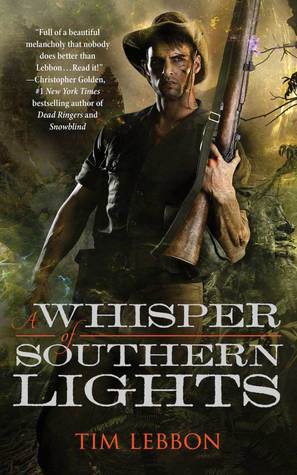 A Whisper of Southern Lights is the second novella I’ve read by Tim Lebbon, and it’s probably the last. I didn’t care much for Pieces of Hate a couple of months ago, or that book’s bonus novelette “Deadman’s Hand,” but I thought I would check this one out nonetheless. Generally Tor.com’s novellas are of good quality, and I thought that perhaps I just needed to give Lebbon’s Assassin Series a second try. Unfortunately, I liked this entry of the series even less than the previous installment.
 Somehow, I’ve never gotten around to reading much by Jane Yolen, so I was excited to see this title pop up on NetGalley prior to its rerelease (with new and striking cover art) as an ebook. Sadly, it was just okay. First published in 1988, Sister Light, Sister Dark has aged fairly well, all things considered, but like many feminist fantasy works of the ‘80s, it tends towards second-wave gender essentialism and a sort of pseudo-pagan sensibility. There’s nothing particularly offensive or terribly problematic about it, really, but it’s a subgenre that has just been done to death and has a definite sameness to similar work that will almost certainly make it feel dated and derivative to modern readers. It’s also a book that has some definite love-it-or-hate-it qualities.
 It’s easy to see why Sylvain Neuvel’s debut novel, Sleeping Giants, is one of the most talked about sci-fi novels of the year. It’s got a gorgeous cover, a great (in very inaccurate) mash-up description (World War Z meets The Martian? Not really.) to sell copies, and it’s compulsively readable from page one. It’s also a book that can be read as seriously or unseriously as you like; on its surface, Sleeping Giants is a blockbuster thriller that (judging from its recently being optioned for film) would be right at home at a movie theater in June, but there’s a good amount of depth to it as well if one cares to look. In short, it’s an excellently written middle brow novel that defies strict genre classification. Between its broad appeal and heavy advance promotion (it’s been on NetGalley since before Christmas, I believe), Sleeping Giants is well-positioned to be one of the most widely read sci-fi novels of 2016. Even better, it’s a novel that deserves to be widely read. Because it’s really, really good.
 The Emperor’s Railroad is an utterly pedestrian story that is only rescued from total mediocrity by some intriguing world building. Unfortunately, Guy Haley’s novella never manages to full utilize the potential of its setting, and the ending leaves the reader with far more questions than answers.
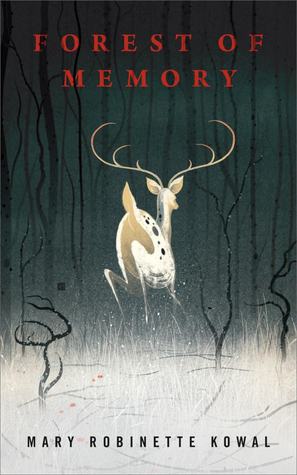 Mary Robinette Kowal’s Forest of Memory is one of my favorite of Tor.com’s novellas to date. It’s an interesting exploration of memory and the authenticity of experiences in a world in which nearly all human experience is filtered through a technological lens. Smartly, Kowal doesn’t dwell much on the actual future technology she’s imagined, and she also avoids the pitfalls of attempting to examine the broader societal effects of that technology. Instead, she focuses squarely on a single character and her personal experiences in order to tell a singularly excellent story.
 Every Heart a Doorway is a sort of interesting twin to The Girl Who Raced Fairyland All the Way Home, which I reviewed yesterday. In many ways, they are very similar books, both being fairly sophisticated examinations of the children’s portal fantasy genre, but Seanan McGuire’s novella of course has sharper edges and a more nuanced message than Catherynne M. Valente’s middle grade masterpiece. Like Valente’s series, however, Every Heart a Doorway is a book that is absolutely necessary for its audience, which I would say is primarily teens and young adults, but ought to include basically everyone. It’s a book that many people will identify with, and those who don’t see themselves in its pages could probably stand to learn a few things from it.
 Catherynne M. Valente’s first Fairyland book, The Girl Who Circumnavigated Fairyland in a Ship of Her Own Making, established this series from the very start as a superbly written and sublimely beautiful story for children, and The Girl Who Raced Fairyland All the Way Home is a totally fitting conclusion to the story of September and her friends. It would perhaps be too much to ask for every installment of the series to be as good as the first one, and the fourth one (The Boy Who Lost Fairyland) stood out as decidedly different from the rest. Still, it did help to set up this finale, which is every bit as good—and even a little more polished—as the rest of the series.
 SF Bluestocking