All posts by SF Bluestocking

The Best of 2016: Novellas

love novellas, and this year they constituted about a third of my reading. I’m still reading almost all of the Tor.com novellas as they come out, and I’ve started paying more attention to other novella-length work, though I still stick to professionally published books rather than delving into the vast world of self-pubbed stuff out there. Consequently, this list is definitely a bit biased towards the Tor.com books, but I did try to check out some different stuff in 2016. If I missed one of your favorites, be sure to leave it in the comments.

Coral Bones by Foz Meadows
2016 was a good year for Foz Meadows, whose most recent novel, An Accident of Stars, is a fun, fresh and feminist take on the portal fantasy genre. However, this short novella–included in Abaddon Books’ Monstrous Little Voices: New Tales from Shakespeare’s Fantasy World–is wonderful. It’s a new perspective on The Tempest‘s Miranda, and Meadows takes a look at what it might really mean for a young person’s identity to be brought up in that kind of isolation. It’s a thoughtful portrait of an outsider figuring out their place in the world, a clever riff on Shakespeare’s own themes, and a playful update to a very old classic.
Buy it here.
Or buy the collection here.

The Ballad of Black Tom by Victor LaValle
There were several Lovecraft-inspired novellas published in 2016, but Victor LaValle’s is definitely the best of them. The Ballad of Black Tom is directly in conversation with Lovecraft, being a retelling of sorts of the insidiously racist short story “The Horror at Red Hook,” and LaValle ably weaves together a general critique of Lovecraft’s racism with a fairly straightforward tribute to Lovecraft’s enduring influence on the genre, crafting a smartly written and well-paced homage that perfectly encapsulates the complicated feelings that many people have towards Lovecraft.
Buy it here.
Read “The Horror at Red Hook” here.

Lustlocked and Pride’s Spell by Matt Wallace
Matt Wallace’s Sin du Jour series continued this year with its second and third installments, and they are excellent. Matt Wallace has a gift for telling funny stories that aren’t trying to be too clever, and each volume of this series is better than the one before. Wallace starts with a simple joke and focuses on creating a diverse cast of interesting characters to carry the story, and it works. Every time.
Buy Lustlocked.
Buy Pride’s Spell.
Buy Envy of Angels (the first book in the series).
Pre-order book four, Idle Ingredients.
Read the Sin du Jour short story, “Small Wars.”

Runtime by S.B. Divya
I would never have guessed I would love Runtime as much as I did, as I’m generally not into anything even remotely sports-related, but this story about a young woman entering a cyborg race with the hope of bettering herself and achieving a more secure future for her family is a fantastic fast read.
Buy it here.
Spiderlight by Adrian Tchaikovsky
While I haven’t been as into nostalgia in my media as some have this year, I absolutely adored this D&D-ish sword and sorcery adventure from Adrian Tchaikovsky. It’s got an unexpected and unique protagonist, some interesting ideas, and an entertaining villain. Tchaikovsky pokes gentle fun at some classic tropes and deftly uses others in a way that shows his deep love for and broad knowledge of the genre.
[Edit: Just learned that Spiderlight is actually 300 pages long, so not actually a novella. I was so delighted by it that I rushed through it in a single sitting and didn’t even notice.]
Buy it here.

A Taste of Honey by Kai Ashante Wilson
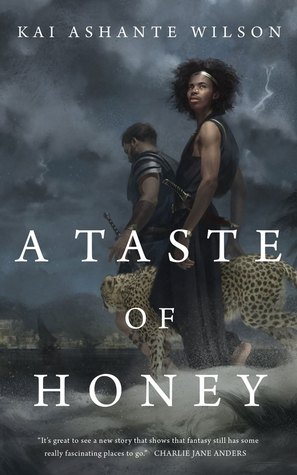
Kai Ashante Wilson’s 2015 novella, Sorcerer of the Wildeeps, marked him as an author to watch, and this 2016 effort, set in the distant past of the same world, establishes Wilson as one of the most original and compelling voices in fantasy right now.
Buy it here.

The Convergence of Fairy Tales by Octavia Cade
The Convergence of Fairy Tales is this year’s Book Smugglers Halloween horror story, and it’s also their very first novella. Hopefully, it’s the first of many, because it’s really, really good. The unifying theme behind many of my favorites of 2016 is rage, and this is a very angry book. Which makes sense, as it’s the story of the princess from some of Western culture’s most beloved–and most monstrously unfair–fairy tales, stitched together here as the story of a singular heroine who learns to channel her pain and fury into action that helps her move on from what has been done to her. It’s a powerful validation of rage as a response to injustice and victimization, and it’s beautifully written to boot.
Buy it here.

carrigernovellasPoison or Protect and Romancing the Inventor by Gail Carriger
I have enjoyed Gail Carriger’s steampunk-ish romance adventure novels in the past, but I’ve never gotten hugely into them, and this year I learned why. They’re all just too long. 2016 found Carriger kicking off not one but two novella series–the first dealing with the now-grown characters from her YA Finishing School books and the second detailing the romances of queer minor characters from the Parasol Protectorate and Custard Protocol series–and the first installments of both are delightfully fun and sexy enough to be exactly what I need to fill my occasional desire for light smut.
Buy Poison or Protect.
Buy Romancing the Inventor.

The Raven and the Reindeer by T. Kingfisher (Ursula Vernon)
The Snow Queen reimagined as a queer romance adventure? Yes, please. I do think this book might be over the word count for eligibility as a novella for the Hugo Awards but not by much, and it’s short enough and a fast enough read that it feels more like a novella than even a short novel. Simply magical. If you haven’t read this one yet, it’s the ideal book to curl up with a cup of hot cocoa and a blanket and read on a cold winter’s night.
Buy it here.
The Best of 2016: Short Fiction

I didn’t get to read nearly as much short fiction this year as I’d have liked, but I definitely read more than I have in other recent years and I expect to continue reading more short fiction, especially in magazines and anthologies, as we head into the new year. I haven’t been this into short fiction in probably twenty years, but I’m loving it, as evidenced by my multiple new subscriptions and the number of new anthologies on my TBR list and backed on Kickstarter.

Readers, there is so much great stuff out there, and though 2016 was a garbage fire in general there was nonetheless some truly superb stories to read this year. While I don’t think I’ll ever be able to read as much as I want to, I think I managed to catch a few of the year’s best stories. Here, in no particular order, are my favorite short reads of 2016.

“The Super Ultra Duchess of Fedora Forest” by Charlie Jane Anders
In The Starlit Wood: New Fairy Tales (ed. by Dominik Parisien and Navah Wolfe)
Listen. This is certainly not the best story I read in 2016, but it might be my favorite simply because it’s so delightfully unexpected. The thing is, while princess story retellings and reimaginings are a dime a dozen, no one ever goes for the really weird stuff. Charlie Jane Anders goes for the weird stuff, and it’s awesome.
Buy the book here.

“Spinning Silver” by Naomi Novik
In The Starlit Wood: New Fairy Tales (ed. by Dominik Parisien and Navah Wolfe)
“Spinning Silver” is both retelling and reclamation, and Naomi Novik has made something very old and rather ugly into something new and clever and beautiful.
Buy the book here.

“Seasons of Glass and Iron” by Amal El-Mohtar
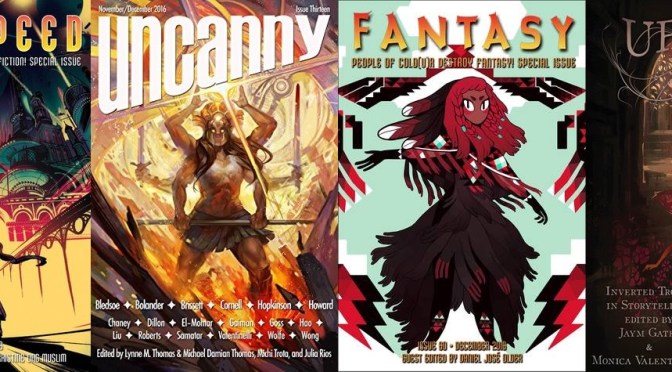
In The Starlit Wood: New Fairy Tales (ed. by Dominik Parisien and Navah Wolfe) and Uncanny #13, Nov/Dec 2016
Even I occasionally like to read a good retelling of a princess story, and “Seasons of Glass and Iron” is a mashup of a couple of lesser-known ones. Amal El-Mohtar’s distinctive voice and lovely prose elevate this short romance to something far more like myth-making.
Read it online here.
Buy the book here.
Buy the magazine here.

“Fifty Shades of Grays” by Steven Barnes
In Lightspeed Magazine #73, June 2016, People of Colo(u)r Destroy Science Fiction! Special Issue
Wickedly smart, darkly funny, and just the right amount of fatalistic.
Read it online here.

“The Beasts Who Fought for Fairyland Until the Very End and Further Still” by Catherynne M. Valente
Self-published on her website.
My favorite of several stories I read in November that were born from the grief and anger many felt (and still feel) following Donald Trump’s election.
Read it online here.

“Can You Tell Me How to Get to Paprika Place?” by Michael R. Underwood
In Upside Down: Inverted Tropes in Storytelling (ed. by Jaym Gates and Monica Valentinelli
I never would have guessed that in 2016 I would find myself crying over a couple of Sesame Street-esque characters who have been turned into super soldiers and are trying to find their way home after a war with something very like Disney, but I did.
Buy the book here.

“Our Talons Can Crush Galaxies” by Brooke Bolander
In Uncanny #13, Nov/Dec 2016
This story has gotten a lot of buzz among people whose opinions I value, and it’s easy to see why. It’s a story about rage, revenge and catharsis, and it turns out that these are timely themes in late 2016.
Read it online here.
Buy the magazine here.

“43 Responses to ‘In Memory of Dr. Alexandra Nako'” by Barbara A. Barnett
On Daily Science Fiction, February 5, 2016
“43 Responses” utilizes a format–of an internet comments section–that could have been gimmicky or too-precious in a genuinely interesting way, and I love the way Barbara A. Barnett uses this form to slowly spool out story for the reader and create an immersive reading experience.
Read it online here.

“This is Not a Wardrobe Door” by A. Merc Rustad
In Fireside Magazine Issue 29, January 2016
If you liked Seanan McGuire’s novella, Every Heart a Doorway, at all, you should definitely be sure to read this story.
Read it online here.
Support Fireside Fiction on Patreon.

“Red Dirt Witch” by N.K. Jemisin
In Fantasy Magazine #60, December 2016, People of Colo(u)r Destroy Fantasy! Special Issue
I wept.
Buy the magazine here.

“Black, Their Regalia” by Darcie Little Badger
In Fantasy Magazine #60, December 2016, People of Colo(u)r Destroy Fantasy! Special Issue
Native goth kids saving the world with music. They are badasses. Darcie Little Badger is a badass storyteller.
Read it online here.
Buy the magazine here.

“The Things My Mother Left Me” by P. Djeli Clark
In Fantasy Magazine #60, December 2016, People of Colo(u)r Destroy Fantasy! Special Issue
This is the 2016 story that I most hope gets expanded upon in novel form. It’s simply a marvel of short story worldbuilding, with a capable young woman protagonist of a type that I find endlessly compelling. Also, elements of the story reminded me strongly of the Midnight Carnival parts in The Last Unicorn, and that’s never a bad thing.
Read it online here.
Buy the magazine here.

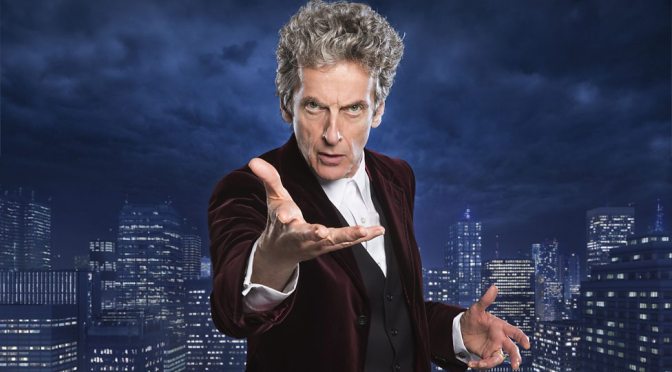
Doctor Who: “The Return of Doctor Mysterio” is a fun, fast-paced garbage fire

I’d love to say that I loved “The Return of Doctor Mysterio,” especially after it’s been such a long time since we last had any Doctor Who at all. It was an enjoyable enough hour, but of the sort that I rather hate to enjoy because as soon as I think about it for more than a minute it all begins to fall apart. This has long been true of Steven Moffat-penned episodes in general, but this one is even worse than usual. Let’s start with some positives, though. Some spoilers ahead.

First, “The Return of Doctor Mysterio” has a coherence that has often been lacking in the last couple of seasons of Doctor Who, and it’s refreshing. The episode is internally consistent, makes smart use of time travel, and overall makes good working sense. It also fits nicely within the broader timeline of the show, taking place, for the Doctor, shortly after his last long night with River Song (at the end of last year’s “The Husbands of River Song”) and addressing, sort of, some issues raised in season seven’s “The Angels Take Manhattan.” That said, these previous episodes certainly aren’t required viewing to enjoy this one, which is good. Moffat sometimes tends to show off his encyclopedic knowledge of the show, but there’s nothing too arcane here, just some mostly cleverly-worked-in references for fans who have been paying attention the last few years.

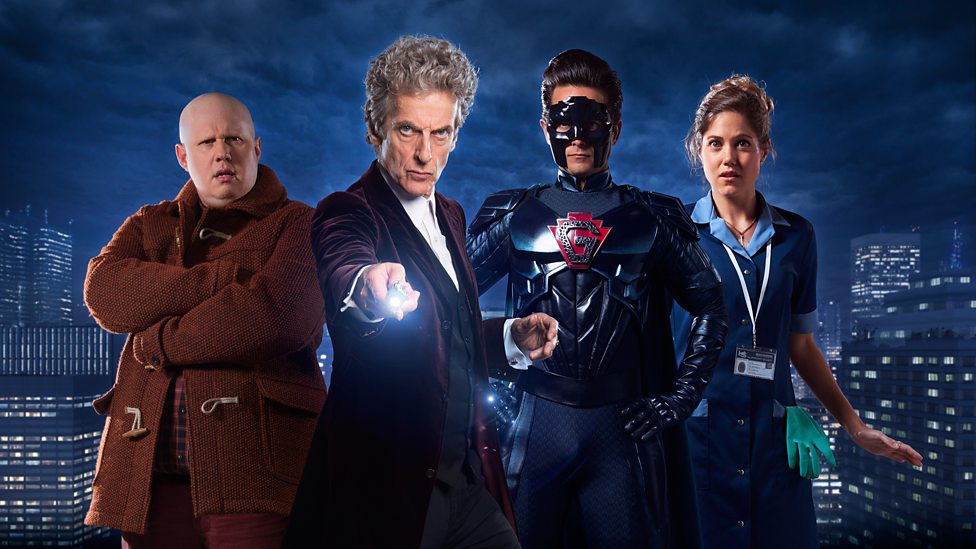
Second, Matt Lucas is back as Nardole, and he’s now the Doctor’s Companion. I’ve liked Matt Lucas for some time and thought it a shame to waste him on a throwaway role in last year’s Christmas special, so I was thrilled to see him get a chance to grow the part again this year. Nardole is excellent as comic relief, but Lucas also injects some much-needed warmth and empathy into an hour that was unexpectedly dark for a Who Christmas special. I understand that Lucas and Nardole will return in season ten as a series regular, and I’m looking forward to seeing how he fits into the Doctor’s adventuring. In this episode, he does spend far too much time on lazily-written expository speeches, but he gets to fly the TARDIS and spend some time ruling 12th century Constantinople (“firmly but wisely”).

Finally, “The Return of Doctor Mysterio” does, despite its significant flaws (which I’m getting to), manage to be fun to watch. Its pace can only be described as “romping”; the hour absolutely flew by, but without the frenetic quality of many recent Moffat episodes. I’ve often felt that Moffat era Who uses breakneck pacing to cover up hole-filled plotting with a shoddy whiz-bang veneer, but “Doctor Mysterio” avoids that, instead keeping things moving along. No fast-talking deus ex machina shenanigans here. Only sensible progression through the above-mentioned coherent storyline. Even the time travel and flashbacks make perfect sense and work well within the story being told. For Moffat era Who, this is a great episode.

Except.

What the fuck is “The Return of Doctor Mysterio” supposed to be about?

Is it about the Doctor’s irresponsibility with alien technology? Kind of, I guess. Except that said alien technology ends up saving the day in the end.

Is it about the difficulties of being a super-powered human? Not really. Masked vigilante Grant’s (a rather dull Justin Chatwin) point of view is never inhabited by the viewer. Some of his problems and concerns are alluded to, but aside from his puberty-induced x-ray vision, which is played mostly for laughs, his super powers are never an actual problem. Instead, he’s basically invulnerable and his super speed and flying powers make it possible for him to successfully lead a seemingly rich and fulfilling double life. Sure, the Doctor does some handwringing about how hard the double life thing must be, but none of the Doctor’s worries are shown to be well-founded.

Is it about the duality of man (and I do mean man—there’s only a single named, speaking woman in the episode, but more on her later)? Maybe, but if so the messaging here is much less coherent than the surface story being used to communicate it. I mean, something something parallels between the Doctor and Grant and the compartmentalization of their identities as men and as superheroes? It feels as if, by the end of the episode, we’re supposed to feel as if some profound observation has been made and we’ve been given some new insight into the Doctor’s character, but neither of those things have been accomplished.

Is it about poking fun at the absurdity of superhero genre conventions? Only if by “poking fun” one means “playing every trope pretty much completely straight.”

Is it about gender? Could be, but if so it’s a sexist garbage fire of garbled messaging on the issue.

The episode’s singular woman, Lucy (Charity Wakefield, making the most of things), is a sort of Lois Lane character, right down to her apparent inability to recognize the man she has known for over twenty years if he takes his glasses off and does his best Batfleck impression. Lucy starts off promising enough, seeming to be a competent and perceptive investigator, but she’s quickly sidelined once the Doctor arrives, gets sexualized and then damselled in the final act, and ultimately has nothing much to do other than have the wholly unearned epiphany that she was in love with the nanny all along. I’d say that this all amounts to a systemic destruction of the character, but it’s done so casually, with so little appearance of malice and with such an obvious wink and nod from Moffat (as if it’s all a big joke that we’re all supposed to be in on), that I think it’s likely that all these choices are totally intentional. Steven Moffat has always been cavalier in his disregard for Doctor Who’s female characters, with a strong penchant for robbing them of agency and turning them into prize objects to be manipulated by and in service of the always more-important-to-Moffat male characters on the show.

It’s nonetheless perversely impressive to see how efficiently Moffat can squeeze a wildly regressive character “arc” into a single episode. Lucy never does get to fully understand the story that she’s in—indeed, the story that she was actively investigating at the top of the hour. We learn from Grant that Lucy, while married and a new mother, has recently been abandoned by her husband, and this turns out—even though it’s literally never mentioned by Lucy herself—to be the problem in her life that needs solving. Instead of getting satisfactory answers to her questions or succeeding in her investigation of the alien invaders, Lucy’s “happy” ending is a renewed interest in domestic life and faith in monogamous hetero coupledom. Her career isn’t even mentioned in the end, and her emotional energies are directed more towards helping Grant—not to adjust to a new domestic life of his own, though. Rather, she encourages him to at least remain open to the possibility of continuing his super-heroics in the future.

It would be profoundly depressing if Doctor Who still had the power to surprise and dismay me with this crap. As it is, I just found myself sighing and rolling my eyes. Thank goodness, we’ve only got one more year of Steven Moffat to go. And, hey, new companion Bill looks like she has some potential. It’ll be interesting to see how Moffat manages to screw up come April.

Weekend Links: December 18, 2017

So, tomorrow is the big day, when we find out once and for all if we’re really going to be stuck with Donald Trump for the next four-to-eight years. I don’t know what’s going to happen, and there are several convincing scenarios for how this shit show could go down in the days, weeks and years to come, so I am doing my damnedest today to be kind to myself and not worry about it. Sadly, I did not have the foresight to stock up on rum, but I’ll be okay. At this point, I’m more concerned with the monster cold I’m coming down with the night before I need to start holiday baking. Also, I’ve still got no fewer than half a dozen books I’d like to finish reading by the end of the year.

So, basically, my plan is to pretty much go no-internet this coming week. In between baking French macarons tomorrow, I will be checking the news, but other than that, I’m planning on a week of total internet avoidance. My hope is that this will allow me to nurse this cold, get all my baking done by Wednesday-ish, and finish several books. With next weekend being taken up with Christmas Eve and Christmas Day, I don’t expect to do a Weekend Links post, but on the 26-30 I will be posting my year-end wrap-up posts, full of my favorite books, short fiction, TV, movies and so on from 2016. The first full week of January will likely be a light posting week as I work on settling into a new and hopefully more tranquil and productive routine, but there should be a couple of looking-forward-to-in-2017 posts in there. After that, my plan is to get back into a solid rhythm of reading/watching and reviewing, and I’ve got a couple of longer-term project ideas that I’m excited to get into more after the holidays.

In the meantime, here’s the neat stuff I’ve found on the internet this week.

If you’re looking for a fast read to finish out the year (instead of stupidly saving like five 600+ page behemoths til last like I did), Tor.com has you covered. Their full list of 2016 novels and novellas has some great stuff on it, and if you’re looking for something free to read you can check out their 2016 novelettes and short stories, which come with convenient links.

Ann Leckie and Daniel José Older talked about Why Sci-fi and Fantasy Matter on MPR.

Star Trek: Discovery has found its lead: Sonequa Martin-Green from The Walking Dead.

The next Studio Ghibli movie has a title, synopsis, and short trailer.

N.K. Jemisin answered “So what would you do if a Fifth Season happened for real?”

I was never more than moderately interested in Passengers to begin with, but I was nonetheless disappointed to find out that it’s actually gross sexist garbage.

Over at Apex, you can (and should) read Keffy R.M. Kehrli’s piece, “Tropes as Erasers: A Transgender Perspective.” This essay also appears in the collection Upside Down: Inverted Tropes in Storytelling, which is now on sale in print and ebook formats. Editor Jaym Gates wrote this week about her favorite thing about the project to celebrate its release.

After a fraught year, Chuck Wendig’s advice on How to Create Art and Make Cool Stuff in a Time of Trouble was welcome, useful, and as reassuring as anything can be these days. I expect that it will be advice that I will come back to again and again in the coming months.

Finally, here’s a video of Neil Gaiman reading “The Raven” by candle- and fire-light:

Weekend Links: December 11, 2016

Another week, another embarrassing lack of true productivity. I’m still not sure if or when I’m every going to feel normal again during this time of living in, as Chuck Wendig puts it “Fucking Cuckootown, Population All Of Us” and I, frankly, don’t want this insanity to become normal. That said, I’d love to be able to get a good night’s sleep again someday, or get through a day without crying or having a panic attack. Mostly, I’d like to write something meaningful that isn’t a letter to a legislator. I’ve been really struggling the last few weeks to feel as if book and television reviews and listicles are a worthwhile way to spend my time–I can’t help feeling a little as if I’m fiddling while Rome burns–but obviously a complete stop of all productivity and joy on my part doesn’t fix anything and just makes me miserable. So I’m trying to get back on track.

The good news is that I think I’m almost there. I just ordered my weekly/monthly planner for 2017, which will be here by Tuesday, and I’m feeling optimistic at just the idea of that symbolic fresh start–throwing out the 2016 planner and filling out a new one with plans and ideas for the future is a small thing that feels really important to my mental health this year. Also helpful is the knowledge that there is a sort of end in sight for at least some of my current anxiety. The Electoral College will vote on December 19, and then we’ll have a much better idea of what we’ll be dealing with for the next few years. I think I’ll be able to deal with whatever comes, even if it’s going to be terrible. It’s the uncertainty that generates panic and worry, and that’s hopefully going to be done with in a little over a week.

I’m not making any promises for my end-of-year productivity, but I am trying to wrap up a few more book reviews by year’s end, I’m planning to see Arrival and Rogue One both this week, and I’m working hard to whittle my list of 2016 favorite things down to some reasonably manageable number. So, things are happening. There’s going to be some content between now and New Year’s, and then I’ll be letting January 1 act as a sort of reset. Just a couple more weeks to go.

In the meantime, here’s what I’ve been reading on the internet this week.

Rod T. Faulkner wrote about Why Progressive Science Fiction is a Powerful Protest Statement Against Injustice.

Justina Ireland talked about The ContinentCarve the Mark, and the Trope of the Dark-skinned Aggressor.

At Book Riot, Charles Paul Hoffman reminds us that All Books Are Political.

At Tor.com, Malka Older, Ada Palmer and Robert Charles Wilson discussed utopian fiction.

At Unbound Worlds, Cassandra Khaw wrote about The “Urban” in Urban Fantasy.

If you’re looking for a few recs to help get you through this last part of the year, Tor.com’s reviewers have you covered.

Brain Pickings rounded up the Best Science Books of 2016. I’m still feeling pretty crummy about not reading more non-fiction this year, personally, and there are a couple on this list that I may have to add to my 2017 reading list.

While I haven’t decided on any particular projects for next year yet, spending more time focusing on queer fiction is definitely on my to-do list. Autostraddle has some good suggestions on where to start with queer high fantasy.

Speaking of queer stories, there’s still ten days left to back the WARRIOR anthology on Kickstarter and support LGBTQIA stories for young people.

Meanwhile, Fantastic Stories is still plugging away at their Kickstarter campaign for their People of Color Take Over project–guest edited by the incomparable Nisi Shawl. There’s still over three weeks to go on this one, but the sooner you sign up to back it, the sooner you’ll start getting daily updates with some excellent POC-written flash fiction.

https://www.kickstarter.com/projects/1271384462/people-of-color-take-over-fantastic-stories

Last year, Nisi Shawl wrote A Crash Course in the History of Black Science Fiction, published in Fantastic Stories. Now, in addition to guest-editing POC Take Over, she’s starting a new column over at Tor.com where she will be expanding upon that crash course and talking in more depth about the authors she mentioned in her original piece. She’s kicking off the new series with a look at Gloria Naylor’s Mama Day.

Crossroads of Canopy is one of my most anticipated new releases for January 2017, and this Q&A with author Thoraiya Dyer made me that much more excited about the book.

Jeff and Ann VanderMeer have announced that they will be editing a Big Book of Classic Fantasy, and I cannot wait.

Scientists found dinosaur feathers trapped in amber. It’s pretty cool.

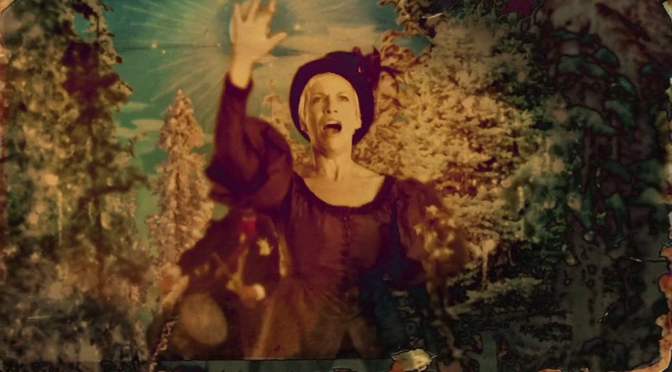
Because we’re well into the holiday season, this mean old atheist has started her annual couple weeks of listening to Christmas music. “Christmas Wrapping” by the Waitresses might be my all-time favorite Christmas song, but my favorite Christmas album is Annie Lennox’s A Christmas Cornucopia, which has solid renditions of a lot of fairly traditional carols that I adore. The best one, though, is “God Rest Ye Merry Gentleman,” and there’s a video for it in which Annie Lennox leads a pagan revel through a snowy wood. I will leave you with that this week:

Sure, things in the world are shitty right now, but nothing can take away that time Annie Lennox was a badass Christmas witch.

Weekend Links: December 4, 2016

It’s been a while since I’ve done one of these posts, but I’m slowly getting back up to speed after an extremely disappointing and upsetting couple of months. Like many creative types in the US (and elsewhere, too, I guess) recent events have taken their toll, primarily in the way of tanking my productivity. It’s only been in the last week or so that I’ve really been able to write anything less tiresome and more interesting than letters to my congressman. I won’t say that things are back to normal–I have a feeling that letters and calls to my congressperson are going to be a major part of my life going forward–but I am working on establishing some kind of new routine that lets me accomplish some SFF-related stuff and sleep at night.

To that end, this week I tried to make sure I was spending some time reading stuff that wasn’t just politics news, and I think I’ve got a pretty decent round-up of good links for you. Over the next couple of weeks, I’ll be working to get back to a more regular schedule of posting reviews, and I’ll have some year-end posts as well as some looking-forward-to-next-year posts. In the meantime, here’s some cool stuff to read/look at:

The Barnes and Noble Sci-Fi and Fantasy Blog has a pretty definitive list of the best SFF novels published in 2016.

I intended to read a lot more non-fiction this year, and I’ve failed miserably at it, but this Smithsonian Magazine list of the year’s best science books has definitely given me some ideas.

Awards eligibility and recommended reading posts are slowly trickling out now as well. Fran Wilde’s is good, with a more than expected amount of stuff on it that I haven’t read yet. This Uncanny Magazine awards eligibility post is great because it includes links to all the listed works online.

William Gibson’s Sprawl trilogy is getting a pretty rad redesign, which is awesome since my 20-year-old copy of Neuromancer could stand to be replaced.
At The Book Smugglers, “Is Fantasy Writing Gendered?” by Kate Elliot is a must-read.

I am firmly on the “Love It” side regarding the very love-it-or-hate-it comic ODY-C, so I also loved this interview with Matt Fraction and Christian Ward about the book.

There’s finally some early images of the Hulu adaptation of The Handmaid’s Tale by Margaret Atwood, and it looks amazing. I’m with Elizabeth Moss, though, in wishing that it wasn’t turning out to be so timely a project.

Planned Parenthood is my go-to non-profit for charitable donations, and they’ve been getting a lot of donations since the election (see above re: timeliness). I am delighted that some 72,000 people have donated specifically in Mike Pence’s name.

LitHub has a great list of 40 New Feminist Classics You Should Read.

Catherynne M. Valente did a Reddit AMA.

More importantly, Catherynne M. Valente published a new Fairyland story, which made me cry but also gave me hope: “The Beasts Who Fought For Fairyland Until the Very End and Further Still”.

Finally, Chimamanda Ngozi Adichie’s “Now Is the Time to Talk About What We Are Actually Talking About” lays out what I think we should all consider the bare minimum of our responsibility as citizens during these times:

Now is the time to resist the slightest extension in the boundaries of what is right and just. Now is the time to speak up and to wear as a badge of honor the opprobrium of bigots. Now is the time to confront the weak core at the heart of America’s addiction to optimism; it allows too little room for resilience, and too much for fragility. Hazy visions of “healing” and “not becoming the hate we hate” sound dangerously like appeasement. The responsibility to forge unity belongs not to the denigrated but to the denigrators. The premise for empathy has to be equal humanity; it is an injustice to demand that the maligned identify with those who question their humanity.

Book Review: Goldenhand by Garth Nix

Goldenhand is a welcome return to Garth Nix’s Old Kingdom universe, but it unfortunately feels, overall, a bit half-baked. It’s an enjoyable read if one doesn’t think too hard about it, but the truth is that Goldenhand is problematic in numerous ways that detract from the joy of revisiting such a well-loved fantasy world.
Goldenhand is a direct continuation of Lirael’s story following the events of Abhorsen and picking up about a year or so later. It also incorporates events from the novella The Creature in the Case, which continued the story of Nicholas Sayre after he returns to Ancelstierre at the end of Abhorsen. Lirael has been hard at work learning in her role as Abhorsen-in-waiting to her sister, Sabriel, and she’s given the chance to take on more responsibility when Sabriel and Touchstone go on their first vacation in twenty years. Meanwhile, after accidentally freeing and empowering a dangerous free magic creature, Nick is on his way back towards the Old Kingdom in pursuit of it. Meanwhile, Chlorr is still stirring up trouble in the north, and it turns out there’s a whole previously unmentioned group of people that are being used for Chlorr’s nefarious ends. There’s a lot going on, at least ostensibly. Perhaps the biggest problem with Goldenhand is that, despite the ambitious worldbuilding and great number of things happening, none of it particularly works.

It was interesting at first to be introduced to Ferin and her people, but with only Ferin as a point of view for that part of the world and no sense of what normal life is like for the tribes, there’s ultimately very little to learn about these new people and their culture. Ferin herself has a very specific and non-normative experience within that culture—she was raised to be basically a sacrifice, sequestered from the rest of the tribe and denied even the humanity of a proper name (“Ferin” is from a childish mispronunciation of “Offering”)—and she’s the only one of her people the reader meets directly. The rest are faceless villains and obstacles for our heroes to overcome, and there’s no real sense of who these people are and how they normally fit into the regular fabric of the Old Kingdom. This diminishes the reader’s investment in Ferin’s history and struggle, and it’s not helped along by Ferin’s extremely practical nature. She’s so pragmatic about everything that happens to her that it ends up feeling as if she isn’t affected very much by anything she goes through. This would be frustrating in a minor character, but Ferin is a point of view character for fully half of this book, and it’s extremely difficult to become really immersed in a perspective that is so poorly socialized and without enough context for understanding why and how she’s the way she is. Ferin is a weird character, and not in a good way. Rather, she takes up a lot of page space without ever being compelling enough to be a proper balance or complement to Lirael, who we already know from previous books.

Sadly, Lirael, too, is a lot less interesting this time around. Lirael and Abhorsen were heavily focused on Lirael’s journey to discovering her own identity and finding her place in the world, and there was a clear and well-executed character arc as she came of age. Goldenhand gives us a Lirael who is much more confident and self-assured to start with, which isn’t necessarily a bad thing, but this Lirael doesn’t have nearly so much to learn or so far to travel, for all that she goes fully from one end of the Kingdom to the other. Some attention is paid both to Lirael’s lost hand and her grief over her missing friend, the Disreputable Dog, but neither of these things are given the weight they ought to have. Indeed, Prince Sameth has already built a magical gold hand for Lirael by the start of the book, which effectively erases her disability. Most of Lirael’s thoughts about her hand are marveling at how functional the magical prosthetic is rather than lamenting the loss of the real hand. Similarly, Lirael does at times miss the Dog, but with everything else going on there’s not much time for truly exploring her feelings of sadness and loss. Instead, Lirael’s primary arc in this book is a romantic one, mostly centered around her growing feelings for Nick and her relationship with him. While Lirael’s final dealing with Chlorr/Clariel seems intended to be a climax for the story, it happens quickly and the novel is then ended rather abruptly, which prevents the event from having much emotional weight.

This lack of impact is, frankly, characteristic of Goldenhand. Erasing Lirael’s disability and glossing over her grieving process in favor of focusing on her burgeoning relationship with a man she barely knows (and who doesn’t get much development of his own, by the way) makes for a very slight novel. Both that romance and Lirael’s quest to stop Chlorr once and for all rely far too much on previous books in the series to generate what interest they do hold. If you haven’t read Lirael, Abhorsen, and Clariel (and preferably The Creature in the Case as well), you’re likely to find yourself more than a little at sea in Goldenhand. Goldenhand is not an entry point into the Old Kingdom for new readers; it’s a book for superfans who will consume anything they can get in this setting without being too picky about things making sense. This overall effect might have been counteracted if Ferin’s story was stronger, but Ferin’s goals and purpose are never quite clear; she is trying to do something to save her people I guess, but most of her chapters are taken up by an aimless chase that never manages to feel dangerous or high stakes enough to justify its existence. Instead of acting as a powerful new addition to the series, Ferin’s story functions mostly as a rather dull and uninspired distraction in what might otherwise have been a decent piece of fan service.

While Garth Nix does a lot of work here to expand the world of the Old Kingdom and provide more theoretically fertile ground for, presumably, future sequels, Goldenhand is plagued with enough craft problems and various missteps that it’s hard to get very excited to learn what comes next. Unless it involves queer Ellimere (I mean, come on—everyone else has been paired off heterosexually now) and lots of Mogget (there was not nearly enough Mogget in this book), I can’t say I’m very interested.

Book Review – Ghostland: An American History in Haunted Places by Colin Dickey

If you want to read ghost stories, read something besides this book. Certainly, Ghostland: An American History in Haunted Places contains ghost stories, but if you’re looking for titillating tales of terror for an autumn evening, you won’t find it here. Colin Dickey’s Ghostland isn’t about scaring its readers; rather, it’s a smartly eclectic work of history that looks to examine the whole ghost story phenomenon. Why do we tell ghost stories? Whose stories get told? What do these stories tell us about the places and people with which they’re associated? What do these stories say about the ways in which we, as a society, interact with death and with history? How do ghost stories help us connect with our past—and in what ways do they help us disconnect from aspects of the past that are unpleasant? If Dickey isn’t entirely successful in answering all these questions, he’s nonetheless crafted an engaging work of popular history that does a great job of introducing these ideas to the reader and encouraging further inquiry.
Ghostland is at its strongest early on, and Dickey’s exploration of the Winchester house in San Jose, California remains my favorite part of the book. Born and raised in Ohio, myself, I’d only heard the sensationalized story of the house and its unusual history, so it was wonderful to read such a thorough and well-researched counterpoint to the more mystical narrative. I appreciate the more feminist interpretation of Sarah Winchester’s life, although I must admit that I sometimes think Dickey’s conclusions about her motives are a bit of a stretch. Even if this is the case, however, the story and the way that it’s been embroidered and exploited over the years still serves as a perfect illustration of the points Dickey is trying to make about the way that female eccentricity is peculiarly pathologized. I tweeted early on while reading the book that the read would be worth it for this chapter alone, which is still true, but the whole book is packed full of these sorts of fresh looks at old stories.

Dickey’s thoughtful analysis touches on issues of gender but also includes issues of race and delves into some of the uglier episodes of U.S. history. Some of his chapters, such as those dealing with the slave trade and plantation culture of the South could easily be developed into whole books on their own, and I sincerely hope to see someone take these ideas and run with them. Ditto for Dickey’s look at some of the legends and ghost stories surrounding Native Americans. Throughout Ghostland, I often felt as if there was an enormous body of material and research that this book, ambitious as it is, was only capable of skimming the surface of. It would be great to see some of Dickey’s bigger ideas—especially about the ways in which ghost stories serve to erase and whitewash history—given more space to breathe. Here, the treatment of these concepts is necessarily brief (this isn’t that long a book) and sometimes shallow, and there are sometimes jarring shifts in tone and subject between chapters, particularly in the back half of the book.

Also evident in Ghostland is the author’s love of architecture and literature, and both of these things figure largely in Dickey’s historical analysis. Sadly, there are no photos in the book, which would have been a great addition to the stories it contains. Dickey dwells often on unusual architecture as being sort of inherently predisposed to being perceived as “haunted,” and it would have been nice to see some illustrative examples. Similarly, while the book is meticulously footnoted, it could have benefited from a bibliography or other section with suggestions for further reading or even just a list of literary works mentioned in the text. These lacks wouldn’t be felt so keenly in a more focused book, but in a history so wide-ranging, offering so many glimpses into little-known and lesser understood topics, some further guidance on where to look for more of the same would be much appreciated. That said, if you don’t mind digging through the notes at the back of the book, there are a wealth of resources, just not organized in the most useful possible way.

Ghostland is, on the whole, an excellent primer for the subjects that it covers. It’s full of interesting and entertaining information, and Dickey puts forward a lot of thought-provoking ideas that make this book a perfect reference for writers as well as readers. The questions that Dickey sets out to answer here are worthy ones, and there’s a lot to think about regarding the way we produce and consume ghost stories. With genre conversations often focused these days on issues of diversity and representation, Ghostland is a potentially very valuable conversation starter. I only hope that it is treated as the beginning of the conversation and not the end of it.

Buy the Book:

Amazon | Barnes & Noble | IndieBound

Further Reading:


Fox’s Rocky Horror remake is dull, sexless and even more problematic than the original

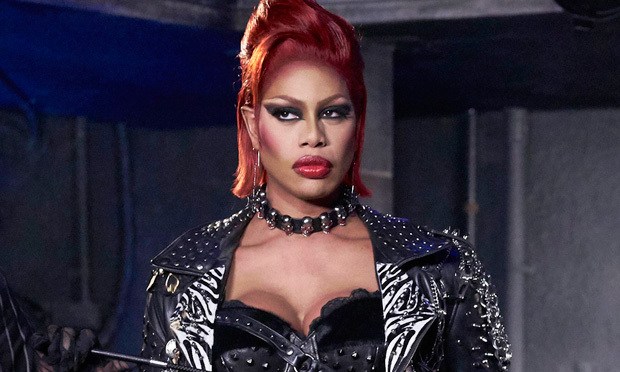
rocky-horror-press-fox-2016-billboard-1548Remakes of old movies are probably never necessary, but they can often be redeemed if they can breathe new life into old stories and present the audience with a fresh perspective on dated material. Sadly, Fox’s clunkily titled The Rocky Horror Picture Show: Let’s Do the Time Warp Again does neither of these things. Instead, it somehow manages to sanitize and straighten a classic piece of queer theater and highlight all of the problematic aspects of the original film at the same time.
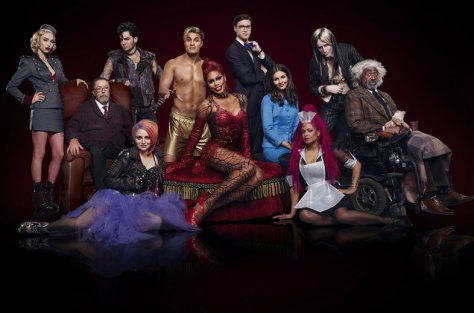
First things first, though. There are a few things to like about this new production. Laverne Cox (while in my opinion miscast—more on that later) sparkles in the role of Frank, and a couple of her songs are truly excellent. Annaleigh Ashford’s Columbia is pitch perfect, and she does the best job of anyone on the cast to make this role her own. It’s good to see a production that is so diverse in its casting in general, and this is especially apparent in the crowd scenes. Finally, the costumes are pretty great.

So, this new Rocky Horror isn’t a complete disaster. Still, it’s not good, either.

From pure craft standpoint, this reimagining of Rocky Horror is a bit of a mess. The framing device of the theater and the choice to include some of the audience participation that is common at the still-ongoing midnight showings of the original film sounded interesting when the show was in development and suggested a sincere attempt to introduce a new generation of young people to Rocky Horror. The execution of this concept was terrible, though, from beginning to end. Even decisions that in theory work really well to set this production apart from the 1975 movie—for example, the choice to cast the Usherette for the show’s opening number—fail to hit their mark.

Ivy Levan’s soulless rendition of “Science Fiction Double Feature” is illustrated with her empty-eyed vamping around an old-timey movie theater with no coherent sense of tone or meaning. Like, I literally don’t know what they’re going for here. Similarly, while Reeve Carney’s performance as Riff Raff is overall workmanlike, his introductory solo (in “There’s a Light (Over at the Frankenstein Place) is characterized by absurd overproduction and a truly bizarre set of incomprehensible facial expressions. It’s genuinely weird and not in a good way. This kind of emotional disconnect is (with a few exceptions) a consistent thread throughout the show, as if everyone learned the words of their songs but had no idea how to bring any of the characters to life. Lowlights include the worst version of “The Sword of Damocles” I’ve ever seen and a “Planet Schmanet Janet” that wildly misses its mark, tone-wise.

The whole show would likely have benefited from live performances, which might have felt more organic. Instead, everything kind of ranges from somewhat to ridiculously overproduced, which gives the whole thing a slightly sterile feel that is enhanced by the too-clean cast and pristine (if nice-to-look-at) costumes. There’s an affectation of high camp here, but it’s too self-conscious and purposeful to have the disheveled charm of the original. Probably the perfect example of what I mean comes when we get to the floor show. Frank has Columbia, Rocky, Brad and Janet decked out in gold costumes with gold makeup, but the makeup doesn’t run when they move to the water. The original Rocky Horror had a messiness, a sort of homemade quality, that made its weird world feel real and lived in, and this remake doesn’t have that.

Perhaps the greatest sin of this Rocky Horror, however, is the sheer sexlessness of it all. There’s very little chemistry between any of the characters. Brad and Janet seem not just innocent and unworldly, but practically childlike. The connection between Columbia and Eddie feels real enough, but it’s such a small, fast-moving section of the film—and with the dinner party scene missing its cannibalistic implications—that it isn’t actually very impactful. Laverne Cox is stunningly beautiful and oozes sex appeal, but all of Frank’s interactions with other characters have been toned down so much that it’s never actually clear if any sex happens at all. Instead, everything comes off as just slightly saucy play. This is also true of Janet’s big song, “Touch-a Touch-a Touch-a Touch Me,” throughout which she and Rocky gambol around a bed like a couple of thirteen-year-olds having a sleepover—I don’t think he even touches a boob. Meanwhile, Columbia and Magenta are very specifically non-sexual in their interactions. Even the climactic orgy in the pool is stripped of most of its sensuality. Lips barely even touch, and none of the ones that do belong to two women.

Even stripping most of the sex out of the show and making what remains almost aggressively heterosexual doesn’t allow the show to completely avoid the problematic messaging of the original. In fact, it almost highlights these things even more, and the casting of a trans woman as Frank actually deepens some of the more unfortunate implications of Frank’s predatory behavior. The toning down of Frank’s “seduction” of Brad and Janet here accentuates rather than mitigates that this is rape. While there’s less actual sexual content to the encounters, the coercion is exaggerated and then highlighted by the absence of any sense that Brad or Janet are overcome by either passion or pleasure. Instead, their decisions to give in to Frank’s advances feel both more calculated and less earned.

Rocky Horror has never been a paragon of sense-making cinema, but this production turns absurdity into straight up gibberish. It does nothing to address the problem of the damaging and dated depraved queer trope, and even adds a new dimension to it by inserting a trans woman into the role of Frank—which feels especially irresponsible in a time when public fears of trans women continue to incite violence and are motivating anti-trans legislation all over the place. Sure, the ultimate “message” of Rocky Horror is still about sexual freedom, but what was significantly transgressive forty years ago is positively tame by modern standards and made more so by the determined effort to sanitize and straighten the production so it could be aired in an 8:00pm Thursday timeslot.

Miscellaneous Thoughts:

  • It’s bittersweet to see Tim Curry as the Criminologist.
  • Christina Milian is a fine Magenta, but her wigs are godawful. That bright magenta is too on the nose, and the wigs are so monochromatic they look cheap.
  • I know I said I liked the costumes, but I hated Rocky’s gold boxers with a passion. They’re hideous and incredibly unsexy.
  • The conventioneers weren’t terrible, but they did all kind of blur together into a kind of indistinct countercultural blob of attractive bodies.
  • I wish Ben Vereen had gotten a little more screentime to stand out. His scenes felt rushed and a waste of his talent. Great legs, though.
  • Seriously, though, Laverne Cox’s version of “I’m Going Home” is incredible. Like, she’s so good that it almost redeems this whole shitshow.
  • Last thing: Richard O’Brien’s recent garbage statements about trans women have honestly kind of soured me on Rocky Horror altogether.

Lucifer: The best part of “Lady Parts” is said lady parts

lady-partsAfter a couple of weeks off writing due to some extremely inconvenient life stuff, I’m back now and catching up with Lucifer. As is often the case with this show, “Lady Parts” is a bit of a mixed bag. Following a good season opener that successfully rebooted the series and a couple of solid episodes that further established a new normal, this one could be generously described as set-up for things down the road but perhaps more accurately described as filler, with every character and plot spinning their wheels until the last few minutes of the hour.

The episode starts positively enough, with an interesting body discovery (though we never seen these guys again) and Lucifer back in therapy with Doctor Linda. I’ve been happy to see the show back off a little on his therapy sessions in general, but this is a good one. Lucifer’s philosophy of distraction and Linda’s deep sigh at the end of the scene are perfectly delivered. Unfortunately, this is one of the episode’s few highlights. Nothing else in the next forty-five minutes works quite so well as this exchange, mostly because Lucifer’s obsession with distraction quickly becomes farcical as he spends all his time this week pushing his new philosophy of deflection and conflict avoidance on his friends and family.

Chloe is not doing well following Dan’s request for a divorce last week, and she’s rather predictably throwing herself into her work and bottling up her feelings. The thing is, this isn’t all that interesting or dramatic. Chloe has always been a Serious Person, with a straight up hall monitor kind of personality, so her current funk doesn’t actually change her behavior. Poor Lauren German has been subjected to some of the worst writing of any actor on this show, and I feel like she does what she can with what she’s given, but Chloe’s best moments are always when she lets loose a little and that never quite happens here. A girls’ night out with Maze, Ella, and Linda has a ton of potential, but it’s ultimately a missed opportunity. It’s not without a couple of funny moments, but we don’t learn anything new about Chloe, she never really opens up, and in the end she’s unable to set her work aside and have fun.

It also doesn’t help that the whole girls’ night out thing is basically a set-up by Lucifer, who has wagered with Maze that she won’t get Chloe to relax. There’s an attempt to tie this to the case of the week, but it’s a tenuous connection at best and Chloe’s outrage at the betrayal of female friendship doesn’t ring quite true in the same episode in which she bemoaned her own lifelong lack of female friendship. That said, I am pleased by the development, late as it is, of a real friendship between Chloe and Maze, and I’m looking forward to seeing that odd couple sharing a living space. And for all that Chloe complains that she hasn’t had female friends, she does seem to genuinely like other women, which is nice. It’s refreshing to see a character whose lack of female friends is pretty explicitly about lack of time and opportunity rather than due to internalized misogyny or some kind of “not like other girls” syndrome. I just wish this Chloe-needs-friends plot was given more time to breath, and I hope (though I don’t expect) that it gets some consistent development going forward.

The biggest thing that isn’t working right now, however, is Lucifer’s mom. Last week, she was sentenced by Lucifer to a life as a human, she’s taken over the life of the woman, Charlotte, whose body she is inhabiting. This week, Maze drops by to visit, and as much as I love Tricia Helfer—and she’s game—there’s basically nothing about this that isn’t terrible, and I don’t know how the show can make it okay.

First, this is another woman’s life. Charlotte was, so far as we know, not the world’s best person, but still. That’s her house, her kids, her husband. For one thing, wouldn’t someone notice the change? For another, even if no one notices and the switch is pulled off with no one getting suspicious, it’s still deeply unethical. It’s particularly cruel to the aforementioned husband—who apparently is now being sexually manipulated—and children. That the show plays this essentially for laughs is kind of gross. It’s not funny, and I genuinely don’t see any way for this to be turned around into something positive.

Still, secrets on Lucifer have a way of coming out. With any luck, this one won’t last long. I only hope that when it breaks, the show takes the time to deal with the consequences in a reasonable fashion. I said to start with that this episode feels like it was mostly set-up. Here’s hoping that they’re setting up something good.

Miscellaneous Thoughts:

  • I’m frankly surprised that the “Dammit, Leroy” guy isn’t an internet celebrity after that performance.
  • Ella used to steal cars, which is moderately intriguing.
  • And Linda worked her way through college as a phone sex operator. I never liked Linda’s sexual relationship with Lucifer, and it had seemed as if the show was distancing itself from that characterization of her as a sort of sexpot, but I guess they aren’t really.
  • “Cosmos are yummy.” I mean, I disagree, but D.B. Woodside’s delivery of this line was amazing.
  • Maze and Chloe are going to be roommates!