All posts by SF Bluestocking

The Expanse: “The Seventh Man” is a perfect balance of personal and political

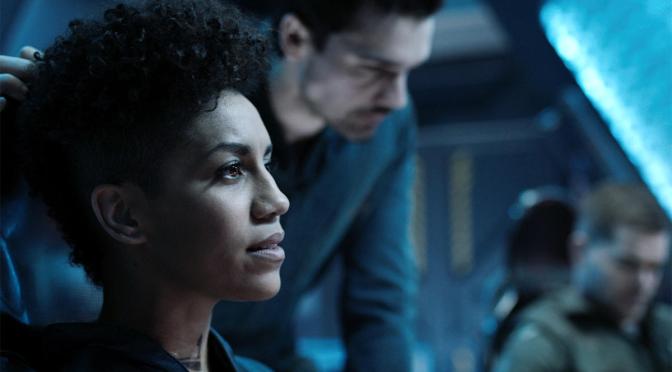
This week, The Expanse shifted gears again in “The Seventh Man.” After last week’s fast-paced mix of exposition and set-up, capped off with a decided feeling of consequence by the Ganymede incident, this episode takes the time to do a couple of hugely important things. On a Martian ship, Bobbie Draper is recovering from her injuries and trying to make sense of her jumbled memories, while on Tycho station there’s a struggle for control as Anderson Dawes and Fred Johnson compete with each other for the opportunity to determine the future of the Belt. It’s an episode that’s light on action but heavy on talking and politics and full of some of the show’s best writing to date.

Spoilers ahead!

There’s only one scene on Earth this week, but it’s a good one. When the news comes in about Ganymede, Avasarala and Errinwright are watching with the Secretary-General and they have to make a quick decision about what to do about it. Errinwright pushes for attacking a Martian target, but Chrisjen advises caution and calls for a peace conference on Earth, where she argues that Earth would have the advantage. The Secretary-General is convinced, so that’s happening, probably next week. It’s interesting to see how the balance of power has shifted in Chrisjen’s favor since Eros, but it’s also obvious that she’s still wary of Errinwright, with whom she’s increasingly at odds.

At Tycho Station, refugees from Ganymede are flowing in, and the Rocinante crew is helping to get people settled on the station. Meanwhile, Anderson Dawes has also arrived on the station, where he’s inviting refugees to Ceres as well as rallying Belters on Tycho. We soon find out why: Having wrangled Ceres, Dawes is on Tycho to make a decisive play to wrest control from Fred Johnson. We get to see Dawes publicly debate Johnson over what the OPA’s next steps should be, and it’s riveting stuff. The real ideological differences that have previously been implied or inferred are made explicit when the two men have to stand in front of a parliament-esque gathering of OPA faction leaders and make their cases. Later, as Dawes schmoozes his way around the station trying to ingratiate himself with Holden and Naomi, then Drummer, then Diogo, pumping them for information, we get a real sense both of how deep the divisions go and how different Dawes and Johnson’s tactics are.

The Tycho sequences are (except for a weird Amos segment) by far the strongest parts of “The Seventh Man,” and they’ve got several things going for them. The dialogue is smartly written. The speeches are entertaining to watch and effectively communicate complex arguments. The increasing tension between Holden and Naomi is well-conveyed as their relationship frays at the edges. Dawes’s connection with Drummer is clearly depicted, with enough on-screen information to intrigue the viewer but without telling us the whole story all at once. Dawes’s encounter with Diogo is pitch perfect and a great/chilling example of the ease with which young people can be manipulated by those they admire. The final short action sequence as Dawes abducts Cortazar is a much-needed break from talking scenes and gives Fred Johnson a clear goal going into the next few episodes. In short, it’s a balanced, cleverly plotted, and well-thought-out storyline that admirably holds up its half of the episode.

If there’s any major criticism I have of the Tycho story this week it’s that Holden’s “character development” doesn’t feel particularly earned. The foreshadowing of having Dawes compare Holden directly to Miller didn’t quite work because there’s not any actual evidence before this episode that Holden has evolved into anything at all, much less into a new Miller. To be fair, I suppose Holden has become more circumspect this season about shouting sensitive and inflammatory information to the whole solar system willy-nilly, but he’s still pretty much the same old frustratingly naïve and self-righteous Holden we’ve come to barely tolerate over a season and a half of the show. His late-night attempted attempt on Cortazar’s life was genuinely unexpected, and not in a good way. That said, his decision to shout over Belters to support Fred Johnson (and his dipshit defense of his actions to Naomi) was exactly what I would expect of him.

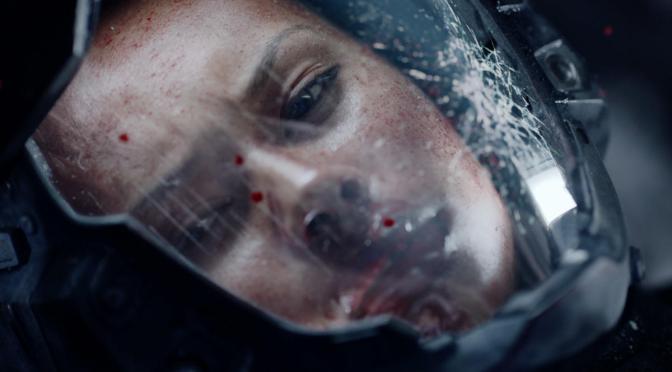
The part of the episode I was most excited to see was the Bobbie Draper stuff, which was both just what I predicted it would be and much better than I thought it would be, primarily due to Frankie Adams’ strong acting as she works through Bobbie’s trauma and confusion after the Ganymede incident. After being rescued from her damaged exo suit, Bobbie is taken to the Scirocco for treatment for her injuries and multiple rounds of questioning about what happened on Ganymede. It’s during this questioning that we get some of the blanks from last week filled in, which is pretty much how I suspected things were going to go. I thought we’d see more flashes of the seventh “man” that gives the episode its title, but the Ganymede monster is kept deliberately mysterious and Bobbie is told to not speak of it when she finds out at the end of the episode that she’ll be going to Earth to testify at the UN.

“The Seventh Man” (and The Expanse in general, if we’re honest) is, ultimately, a story about storytelling, but it’s also a story about the personal nature of politics. Powerful people vie to shape narratives to their own purposes, both selfishly and not. Avasarala has an almost preternatural ability to read situations and come up with creatively constructive sources of action to prevent all-out war. We see that she has counterparts among the Martians as well, people with cooler heads than the common soldiery who are working hard to keep the peace as well, even if that means making up a plausible story to cover up an implausible event. Fred Johnson and Anderson Dawes both have stories to tell this week, and both of them are true in their ways—humanity is stronger if they can live peacefully together, and the Belt and Outer Planets need to be self-governing and united against those who don’t have their best interests at heart.

Identity figures largely into all these storylines this week. Avasarala is still working to assert herself in her stronger position following the destruction of Eros; she sees herself as an iconoclastic champion of Earth, and perhaps her greatest pressures come from her own expectations of what she should be achieving. Bobbie Draper has lost her unit in a tragedy that she doesn’t yet understand, which has left her unmoored, and now she’s being sent to Earth, but not as a conqueror or even as a warrior; her navigation of this unfamiliar territory is going to be fascinating in weeks to come. Anderson Dawes sees himself as the true leader capable of uniting the OPA under his control, and his work for the Belt and Outer Planets is confirmed to be real and sincere. However, he also seems burdened with something like self-hatred—a sort of archetypal man-willing-to-do-bad-things-for-good-reasons who knows how to fight, but not how to achieve and maintain peace. Fred Johnson, on the other hand, dreams of real and lasting peace, but his history and status as an Earther makes him an eternal outsider in the Belt. They may respect and appreciate him, but they won’t follow him like they’ll follow Anderson Dawes.

All these various takes on identity are at work with Naomi and Holden. We saw last week that Naomi is identifying more and more strongly with her Belter roots, and this episode continues that trend. She is fully invested in the suffering of those she sees as her people, and she’s deeply admiring of and moved by Anderson Dawes. She’s definitely struggling with some feelings of guilt over deceiving Holden about the hidden protomolecule sample, but her feelings of resentment towards him for his lack of understanding of her are even stronger than guilt. In some ways, Holden’s motivations mirror Fred Johnson’s—he wants to do what he can to help people in the Belt, but he also wants peace in the solar system—but Holden has heroic aspirations as well and is (we learn) at least open to the idea of modelling himself more after his friend Miller. Holden’s arc here isn’t as well-defined as Naomi’s, and it’s certainly not as relatable or likeable, but it does fit within the general thematic neighborhood of what’s going on with everyone else.

The Expanse is always good, but this episode and last week’s “Paradigm Shift” have been truly superb. The show’s characteristically high production values, powerful writing, excellent casting choices and solid acting have worked together to create a deeply affecting new direction for things now that we’re past the relatively weak Leviathan Wakes source material. The deeper we delve into Caliban’s War territory, the better things are getting, and that’s an awesome achievement for a show that was already the best thing on television.

Miscellaneous Thoughts:

  • The blood snowflakes in the opening scene were beautifully gruesome and make for a great image, but that is not how blood works.
  • I didn’t really “get” the Amos stuff. This wasn’t quite a flashback, there wasn’t enough information given about Amos’s past to make sense of his actions, and things are left basically unresolved after he has the conversation with Cortazar about the “procedure.”
  • Jared Harris is perfectly cast as Anderson Dawes. Absolutely magnetic and probably my favorite character to watch aside from Shohreh Aghdashloo as Avasarala.
  • Not enough Alex this week, and I did not like how he talked to Naomi.
  • I feel like Naomi and Holden’s relationship is quickly headed for Greek tragedy territory, but they were still going strong at the end of Caliban’s War, so I’m very interested to see how that shapes up over the rest of this season.
Book Review: Seven Surrenders by Ada Palmer

Ada Palmer’s Too Like the Lightning was one of my favorite novels of 2016, and it was certainly among the year’s most unusual and ambitiously daring pieces of speculative fiction. Nevertheless, it felt a little unfinished, and anyone who loved it has no doubt been waiting with bated breath for the sequel that seemed necessary to complete what Too Like the Lightning started. Seven Surrenders is everything I thought/hoped it would be, with a vivid setting, intricate plot, high level philosophical and political ponderings and fascinating cast of characters, a truly worthy sequel to its brilliant predecessor and a powerfully compelling introduction to the conflict to come in the next book in the series.
The future that Palmer envisions is still utopian-seeming, though some of the shine was certainly worn off by the end of Too Like the Lightning. In Seven Surrenders, we get even more details of the organization of society, government and families in this imagined future, and many of the questions that Lightning left us with are answered. The relationships and interplay between the various Hives are more interesting the more one learns of them, and the ‘bash family unit is more fully explained in this volume as well. In short, everything makes more and more sense the more you read of this series. I love that Palmer doesn’t spend a ton of time on tedious exposition on these matters, which would amount to hand-holding, but a glossary, appendix or wiki could be highly useful.

That said, I read Lightning as an ebook but Surrenders in hardcover and I found it of great convenience to more easily be able to flip back and forward in the book to check information and reread sections to make sure I understood it. This is definitely a title that benefits from being read on dead trees instead of a screen, which I suppose is, incidentally, appropriate given the deliberately old-timey style of Mycroft Canner’s narration. Though I’ve largely transitioned to reading books digitally over the last few years, every now and then a title comes along that gives me a renewed appreciation for books as useful objects, enjoyable tactile experiences and beautiful artifacts. This is one of those books. If you can, get the hardcover. You won’t regret it, and it will look great on your shelf when you’re done.

Mycroft Canner continues to be one of the most challenging characters in the genre. After the revelations about his past crimes in Lightning, he begins Surrenders in something of confessional mood. Though many of the ugly details of Mycroft’s crimes have already been revealed, Surrenders gives us a much deeper understanding of why he did it. We also learn more about nearly all the book’s other characters as their murder conspiracy, which keeps the whole world at peace, is unraveled and falls apart. Mycroft’s relationships to the structures of power in this world are explained. Other characters’ secret identities and motives are revealed. There are plots on plots on plots that are uncovered over the course of four hundred pages that detail just a few days of events and a couple of legit miracles. It’s heady stuff. I suggest taking notes.

The big draw to this series, for me, is still the philosophy and the politics. I wouldn’t say that this is a particularly plausible future society, though that may simply be because I have a very difficult time imagining how we might evolve from here to there, but it’s a marvelous idea for how to organize a peaceful society. The political dynamics are complex and nuanced, and the Saneer-Weeksbooth conspiracy adds a great dystopian element to be explored. Palmer’s ideas about gender are somewhat less well-developed, although significant time is spent on gender in this volume. Mycroft’s use of gendered pronouns is inconsistent and the explanation given for Madame’s plot to reintroduce gender roles into society is less than convincing; frankly, I feel as if there is some huge complicated idea trying to be communicated that I’m just not quite getting. My hope is that this theme will carry on to the next books in the series, which promise to be about war.

Listen. There’s not a ton to write about this series without giving the whole story away, and it’s hard to discuss the ideas in it without it turning into a lengthy thinkpiece, and I can’t even guarantee that you’ll get the concept. But there’s nothing else like this series being published right now. Too Like the Lightning was a revelation, and Seven Surrenders shines even brighter than its predecessor. The stage is set for the next pair of books to explore what a war might looks like in a world that hasn’t warred in centuries, and you can’t possibly want to miss that. I know that this isn’t a series for everybody, but I still can’t help suggesting that everyone read it as soon as possible. It’s a work of rare and special genius.

Thank you to the publisher for sending me an early copy for review. 

State of the Blog and Weekend Links: March 5, 2017

Well, it’s been another slow week for me, mostly because I spent half of it back and forth to the auto shop having my car worked on, which took up a ton of time and energy. I think I’ve finally got the problem with the car sorted, however, and I’m hoping to have a few weeks before I have to take it back again (there’s still a couple other tiny issues that I’d like to get cleared up as well). In the meantime, I’m trying to just not stress out about it, with mixed success, because it is pretty stressful and I’m prone to anxiety even without good reason.

In other news, I’ve been slightly better this week at ignoring the noisy collapse of American democracy. I read several books (Agents of DreamlandFinal Girls, and Hunger Makes the Wolf), which leaves me with just four titles left on my planned reading list for the month of March. I’m kind of excited because I’m hoping that this will let me work in Borderline and Infomocracy this month before I want to get a head start on some April releases I have ARCs of. I also saw a couple of movies (Get Out and Operator, both excellent) that I have some thoughts on and might write proper reviews of if I have the time and inclination this week, but with weather turning positively springlike (I’ve never seen my town so green this early in the year) I may spend a lot of time outdoors enjoying it since I didn’t have the chance this past week because of the above-mentioned car troubles. We’ll see.

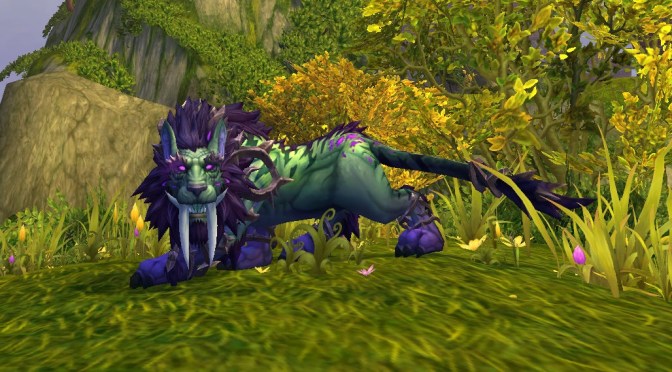
Also, I unlocked some new druid catform skins in WoW, and that was probably the highlight of my week.

newcat2
Why, yes, I HAVE been dreaming for months of lime-green tiger cat form, thank-you-very-much.

Links are a bit light this week. I feel like I read a ton, what with spending so much time stuck at home sans transportation, but not much that caught my interest. Probably the most exciting things of the week have all been news items rather than opinion or analysis pieces.

FIYAH posted the cover and table of contents of their second issue, Spilling Tea, out April 1, and it looks great.

Aliette de Bodard shared an updated bibliography of her Xuya universe.

The BBC is making a show based on the life of lesbian landowner Anne Lister and her search for a wife in the 1830s.

Neil Gaiman unveiled a trailer for a documentary about the genesis of American Gods.

Silvia Moreno-Garcia published a multi-author interview on the experiences of POC in SFF publishing.

I enjoyed this Fantasy Faction piece on winter in fantasy.

The Verge has a great list of March new releases in sci-fi and fantasy if you’re looking for something new to read this month.

nerds of a feather, flock together kicked off a new blog series on dystopian fiction that will be running for the next couple months.

At the Wertzone, Adam Whitehead introduced a new blog series on cities in fantasy that looks like it’s going to be fascinating.

The Expanse: “Paradigm Shift” is great start to a new chapter in the show’s story

I’m sure I’ve said it before, but season two of The Expanse is goddamned fantastic. After last week’s wrap-up of the last of the Leviathan Wakes storyline, I expected this week’s episode to be something of a bridge between two distinct parts of the season. “Paradigm Shift” is that, to some degree, but it feels even more like a whole new season premiere in structure and tone, with some humor (welcome, after a largely serious couple of weeks), some thematically relevant exposition, some set-up for future plots, great character work and a flashy (if slightly confusing) cliffhanger to leave us wanting more. In a season already full of great episodes, this one might be my favorite yet.

Spoilers below, natch.

There’s no pre-credits scene this week, and the first scene of the episode starts with a look at Mars from space that segues into a flashback to the Mars of 137 years ago, where we meet Solomon Epstein (guest star Sam Huntington), inventor of the Epstein drives that power the ships used in the solar system of The Expanse. Apparently, Epstein was simply trying to get a minor increase to fuel efficiency when he accidentally built the drive that was fast enough and fuel efficiency enough to change the course of human history in the solar system. The Epstein drive is the technology that allowed Mars to gain independence from Earth and enabled the colonization of the Belt and the Outer Planets, but this has also led to the complicated political and military situation between Earth, Mars, and the OPA that fuels the show. It’s an interesting bit of worldbuilding exposition that is spooled out in short pieces over the course of the episode, but it also serves as a thesis statement for the episode and, perhaps, for the rest of this season: the benefits of technological advancement never come without costs. If the protomolecule is, as Colonel Janus tells Avasarala in the U.N. situation room, “the greatest technological leap since the Epstein drive,” what will it mean for humanity?

Things on Earth are relatively quiet this week starting with the abovementioned situation room scene, which primarily works to establish that the Earth government doesn’t know what’s going on yet. They don’t know what happened on Eros, they’re no longer in contact with James Holden or Fred Johnson, and they’re missing some thirty nuclear missiles. They are going to mount a mission to Venus, however, to find out what they can about Eros. Because what could possibly go wrong? Avasarala is even going to send her ex-boyfriend, one Dr. Michael Iturbi (played by the very handsome Ted Whittall), to be her eyes and ears on Venus.

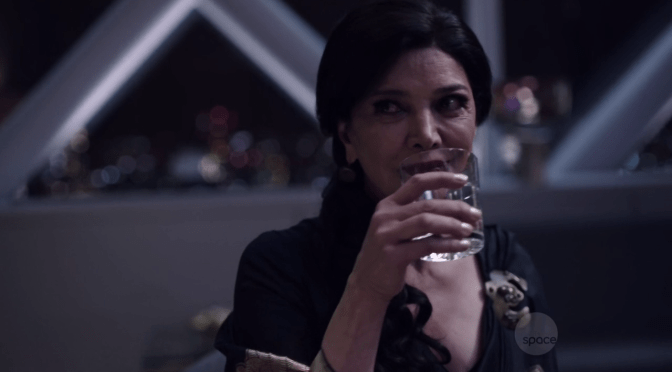
The standout Earth scene of the episode, however, doesn’t come until late in the episode when Chrisjen approaches Errinwright to talk about Jules-Pierre Mao. In short, Avasarala advises Errinwright to use whatever influence he has with the Mao family to get Jules-Pierre to turn himself in, and she gives a compelling speech about what the consequences will be if he doesn’t. Chrisjen Avasarala has been an iconic character since day one, but her rage-filled speech to Errinwright here is certainly her most iconic moment yet. Shohreh Aghdashloo is always glorious in this role, but she’s in rare form throughout the scene, full of arch looks and knowing smirks that shift to barely restrained fury as she makes clear to Errinwright both that she knows about him and Mao and that she has the power and will to destroy them both. Her small hair toss as she walks out the door at the end is a nice little visual punctuation for what just happened.

The Rocinante makes it back to Tycho Station, where they’re greeted as heroes, something that they aren’t all comfortable with. Amos and Alex head off into the station, while Holden and Naomi head straight to Fred Johnson to make their report, where they find out that Fred Johnson has the missing missiles from Earth. Holden is self-righteously pissed off about this, because of course he is, but not everyone on the Roci agrees with him. There’s a pretty obviously impending break between Holden and Fred Johnson, but we also see the seeds of a significant potential break between Holden and Naomi as well. While Holden might believe there shouldn’t be any “sides” he doesn’t seem to be at all aware of the ways in which his own indecision and lack of conviction are pushing Naomi to choose one on her own.

Identity is at the core of the dynamic between the members of the Roci crew. Holden imagines them as a family, and he might think that they’re above the factions and infighting in the solar system, but he is also still very much shaped by his birth and upbringing on Earth. Alex, even as a Martian expat, still retains some of the Martian nationalism that he was raised with, which we see when he suggests that they turn their hidden protomolecule specimen over to Martian scientists. Amos is practical and has a tendency to be a bit of a follower, and it seems that he’s at least partly transferred his loyalties to Holden, leaving Naomi as the only Belter on the Rocinante now that Miller’s gone. Her Belter identity is important to her, as evidenced by her easy connection and bonding with other Belter characters, and we can already see her chafing at being outvoted by the others on the Roci. She craves the company and camaraderie that comes from shared experience, especially when faced with a situation where she disagrees with Holden so profoundly, and it’s easy to see why she pursues a friendship with Samara and aligns herself with the OPA. What’s less easy to see is how this is going to work out; the current state of affairs is definitely not sustainable for either Holden and Naomi’s relationship or for the Roci crew as a whole. Something’s got to give.

The episode ends on Ganymede, where Bobbie Draper and her unit of Martian marines are stationed and complaining loudly of being stuck guarding farms. Things get interesting pretty quickly, though, when they’re attacked by unknown forces that destroy the Martian ship in the sky and leave Bobbie seemingly the only survivor on the ground. The problem is, it’s difficult to understand exactly what’s happening in the final few shots of the episode. The battle in the sky is visible to the marines down on the surface of Ganymede, and we know that the Martian ship is destroyed and Sutton is killed, but it’s not clear who’s firing on who in the air (though I think we’re meant to understand that it’s Mao’s stealth ships doing most of the shooting). Down on the ground, we see more of what Bobbie sees, so we can see that the U.N. soldiers that she thinks are charging her group are in fact being chased by a seventh figure behind them. It’s also clear enough at the end that the other three members of Bobbie’s team are dead, with their suits slashed open and helmets smashed. The final shot of the episode as well is clear enough, as Bobbie looks up to see a glowing protomolecule blue figure looming over her.

However, while it’s easy enough to understand what has happened if you think about it—or if you just rewatch it several times like I did—I think they could have shown a bit more of the actual action without giving it away entirely. Having read Caliban’s War, I expect that more of this stuff is going to be metered out through flashbacks in future episodes as Bobbie tries to get to the bottom of what happened, but I think that without that outside knowledge I might have been totally lost as to what I’d just watched. Not to mention even more frustrated than I already am at having to wait another full week for resolution to the cliffhanger ending.

Miscellaneous Thoughts:

  • I loved the Epstein scenes, but I didn’t love the choice to have him narrate it himself if he dies like that. That said, I don’t know how else the show could have communicated the information we get from Epstein’s narration, there’s no other character who would have been an appropriate narrator, and what we see on screen wouldn’t have made a lick of sense without narration. So. I guess they kind of had to do it like this.
  • That said, I expect the Epstein scenes are going to be divisive among show watchers. I really liked them and felt they were a smart way of giving us some history of the world while working up to an explicit statement of a thematic thesis. My partner, however, hated the Epstein stuff with a passion and found it unnecessary and jarring. I’m sure he isn’t the only one with that opinion, even if it is totally incorrect.
  • Avasarala’s costumes this week were stunning, as usual, but I loved that soft, flowy black gown she wore to talk with Errinwright best. It’s perfectly, artfully chosen to be restrained and unthreatening, very comfortable-looking and with relatively plain make-up and no jewels. It’s about as laid-back as we’ve ever seen Chrisjen looking, and then she pounces.
  • Holden’s message home was cute, but I think Naomi shouldn’t have to work so hard at managing Holden’s feelings. Yeah, he’s the captain of the ship, but why if he doesn’t want to be and there are at least a couple more people on the Roci who are almost certainly more capable?
  • The martyrdom of Miller and his elevation as a folk hero is predictable, as is Diogo’s almost religious fervor about spreading the news. I like this small detail, though, and it will be interesting to see how that movement develops over the next few weeks.
  • I ship Naomi and Samara so hard.
  • I wish that Bobbie’s exo suit was bigger and tougher looking, but I love the heads up display on it, which was used really smartly in this episode.

Book Review: Miranda and Caliban by Jacqueline Carey

So, I read Miranda and Caliban because I love Shakespeare and had never gotten around to reading any of Jacqueline Carey’s other work. I also read two other Tempest-based stories last year (Margaret Atwood’s Hag-Seed and Foz Meadows’ Coral Bones—both excellent) and thought it would be interesting to compare this one to the others. For what it’s worth, Miranda and Caliban is beautifully written, well-structured and readable, but the question I kept coming back to the longer I read it was “Is it necessary?” Sadly, I don’t think it is. I don’t regret having read it, but I also wouldn’t say that it deepened my understanding of The Tempest, Shakespeare or their themes, and what insight it gave me into the author’s understanding of these things didn’t impress.

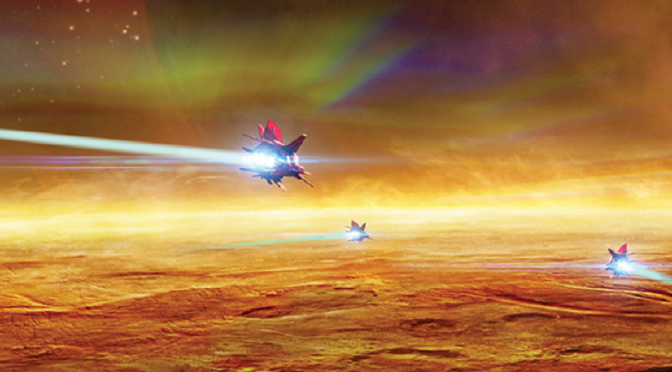
Miranda and Caliban tells the story of about ten of the twelve years that Prospero and Miranda spent on the island prior to the start of the play, beginning with six-year-old Miranda and story of the “taming” of the wild boy Caliban, who comes to be Prospero’s servant and Miranda’s friend. Over the years of the novel, the narrative is split between Miranda and Caliban’s points of view as they are both educated and come of age on the island, detailing their friendship and their respective relationships with both Prospero and Ariel. Rather than digging deeply for a fresh take on this material, however, Carey chooses to depict it as largely standard fare coming of age tragedy, and the tone of that tragedy infects the entire book with a bittersweetness that quickly turns cloying.

Though I went into the book knowing the ending, I was disappointed that there were so few surprises in store over the course of four hundred pages. There’s not a single event in Miranda and Caliban that couldn’t have easily been extrapolated from the play, and everything that happens is so absolutely banal that it’s barely enough to hold one’s attention. I kept expecting a twist or turn that would challenge my expectations or offer some new thought on the play, but Miranda and Caliban is literally exactly what it claims to be. I suppose that’s fine, but the tragic nature of the story also prevents it from being bland, relaxing comfort food, which sends me right back to the question of the necessity of this book.

Even the revelation of Miranda as an artist with a kind of magic of her own that complements her father’s doesn’t do much to elevate the novel. While Miranda is bright and clever and kind, she remains, ultimately, a passive character in a story that is happening around and to her. She’s never able to use her magic to help herself, her brief romance with Caliban is too inevitable-seeming to evoke much passionate feeling, and in the end she seems resigned to being a pawn of her father’s with no particular ambitions or goals of her own. Caliban, for his part, is much the same as depicted in the play, if perhaps somewhat more sympathetic with a fuller knowledge of his childhood. However, he too is at the mercy of Prospero and, later, of Ariel, with no opportunity to change his sad fate and no fresh shading added to color our understanding of his actions.

It’s possible that readers unfamiliar with The Tempest may feel differently, coming to this book with fewer expectations and preconceptions about the material, and longtime lovers of Carey’s work may just be happy for a new title by a favorite author, but as a first exposure to Carey’s work I can’t say there’s much here that makes me want to come back to it. Pretty prose and a flair for the occasional poetic description isn’t enough to redeem a dull and flawed premise, especially one that has so little of substance to say.

On the other hand, look at that incredible cover with art by Tran Nguyen and designed by Jamie Stafford-Hill. It’s gorgeous enough that even if you don’t love the book you might want it on your shelf.

This review is based on a copy of the title received for review via NetGalley.

State of the Blog and Weekend Links: February 26, 2017

The farther we get into 2017, the more I’m worried that I’m getting stuck in a new normal. When my productivity first tanked a few weeks ago, I thought that it would just be a temporary funk, but now it’s starting to feel like I’m slipping slowly into a full-blown depressive episode, which is worrisome (though not inevitable).

That said, there’s been some good news this week. I’ve got a couple of possibly upcoming projects that I’m excited and hopeful about, and the check engine light on my car turned out to be from a faulty part from the $1400 worth of repairs I had done a few weeks ago, so it was still under warranty. This coming week, I’ve got a couple of new ideas for how to restart my own mental systems–namely, quitting caffeine, taking yoga back up, and being sure to go to sleep at a reasonable hour–and hopefully head off the above-mentioned depressive episode. Also, I’m thinking of taking a short break from reading–a week or two, perhaps–until I get caught up on book reviews and other writing projects. I’ve been distracting myself a lot lately by just reading books, but it’s getting to the point that reading more is just adding to an intimidating backlog of stuff that I have opinions on.

So, that’s the goal for the upcoming week. Lots of writing. Some exercising. And, weather permitting, some time outdoors, though it’s supposed to rain most of the next few days.

Today, however, I’ve got links to share!

We’re getting into genre awards season, and several shortlists were announced this week:

At Tor.com, ten authors weighed in on the hard vs. soft sci-fi debate.

P. Djeli Clark and Troy L. Wiggins talked about the history and future of FIYAH.

Tor.com also announced the acquisition of a new novel–in verse!–by Jane Yolen. It’s about Baba Yaga, too, which makes it relevant to most of my interests.

Fantasy Literature’s Short Fiction Monday this week had links to some great free-to-read fiction by some of my favorite writers, including N.K. Jemisin, Elizabeth Bear, and Aliette de Bodard.

Ashok Banker has a new story in Lightspeed, “Six-Gun Vixen and the Dead Coon Trashgang” plus an Author Spotlight.

At Mary Robinette Kowal’s blog, Maurice Broaddus talks about his favorite bit of his new short fiction collection, Voices of Martyrs. I’m about a third of the way through the collection now, and it’s really excellent.

Paste Magazine has a good piece on how Dana Scully influenced a generation.

Kate Heartfield wrote about indigenous authors in science fiction in “Decolonizing the Future.”

V.E. Schwab’s A Darker Shade of Magic is going to be a movie, which reminds me that I really need to get around to reading the other two books in that trilogy.

This McSweeney’s piece on Five Beautiful Dead Bodies Every Aspiring Actress Dreams of Playing just about made me choke on my drink.

Finally, it’s been all over the news this week, but if you haven’t heard, NASA announced the discovery of SEVEN earthlike planets in the Trappist-1 system, about 40 light years away. There are some cool posters over at the Trappist-1 website.


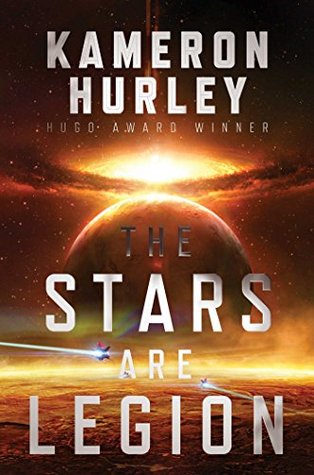
Book Review: The Stars Are Legion by Kameron Hurley

The Stars Are Legion is almost certainly the sunniest novel Kameron Hurley has ever written, which was a pleasant surprise. At the same time, it’s still very recognizably a Kameron Hurley novel, with its badass women, moral ambiguity, and copious grossness. It might be the most ambitious Hurley novel to date, at least thematically; it’s a smart, quick read; and it’s full of the inventive worldbuilding that Hurley is best known for. That it’s a standalone novel rather than the first in yet another new series that I’d have to follow for several years is just icing on the cake.
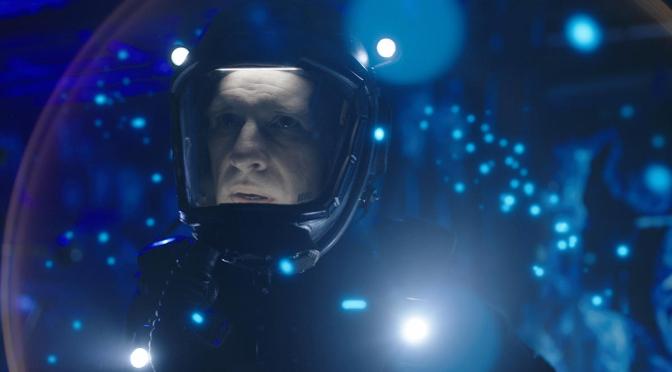
To start with, there are only women characters in this book. They live in a vast fleet of living world ships and reproduce through a kind of parthenogenesis that doesn’t always produce human babies. Unfortunately, the world ships are sick and dying, and the women who inhabit the ships are at war with each other. It’s against this backdrop that we’re introduced to Zan, who has no memories as well as a quest and an arduous journey ahead of her, and Jayd, who has a valuable womb and a complicated, high stakes plan that takes several hundred pages to unfold. The book has been called, somewhat jokingly, Lesbians in Space, and this has even been adopted as something of a marketing phrase for the title. However, though all the women in the book are lesbians, there’s not much romance to be had, the sexual relationships depicted are dysfunctional at best, and the overall tone of the novel is much darker than that blithe description, humorous as it is, would indicate. I was only mildly disappointed by this, but it does seem like a failure to manage reader expectations.

That said, Hurley’s choice to have only women characters is an excellent one for the story she’s telling. War is a common theme in Hurley’s work, and complex highly stratified societies are recurring as well. Here, the decision to have complex, highly stratified and brutal societies made up of only women makes it impossible to interpret them through the lens of patriarchy. The violence endured and meted out by the characters in The Stars Are Legion isn’t gendered, and we’re able to examine it as a function of corrupt hierarchical systems without the complication of sexist gender dynamics. Hurley creates a truly alien world that frees her characters from real-world constraints and expectations and frees herself as an author from having to communicate her ideas about war, pregnancy and birth, violence and abuse, and healing with any consideration of men’s opinions, points of view or desires. This is a novel that is probably as free of the male gaze as it’s possible for a book to be, and that’s refreshing.

As always, Hurley’s worldbuilding is excellent, and the enormous world ships she imagines are just marvelous. The first part of the book is full of almost over-the-top ugliness as we first meet Zan and Jayd and are introduced to the warring spacefaring families they are members of. The world ships themselves are living things, metal is rare, and everything seems to be at least slightly sticky and/or oozing. The women themselves are battle-scarred and often cruel, even our protagonists, and things get even weirder and more viscerally disgusting when Zan finds herself “recycled,” cast down into the bowels of the ship where she finds a great abattoir ruled by enormous woman-eating beasts. Hurley’s vivid description is at times slightly overwhelming in this section, and readers without a stomach for gore may find it deeply unpleasant. If you make it through the first part of the book, however, it pays off big time. Zan’s journey back to the top of the world is compelling stuff, and the slow reveal of Zan’s history and purpose as she journeys through alien lands to finally achieve what she and Jayd planned together is masterfully executed. The other women Zan meets along the way are fascinating characters as well, and the lands they move through are less bloody than the areas described in part one but just as slimily odd and even more wonderful.

If there’s any major criticism that can be levied against this book it’s that Zan is almost too interesting. Her story tends to dominate the book, and it’s so full of adventure and excitement that Jayd’s story of political maneuvering, manipulation, and patiently waiting and hoping for Zan to return has a hard time holding the reader’s interest. In the end, it’s Zan who must make pivotal decisions and take actions to create a different ending to a story that has played out in many variations many times before. It’s not that Jayd is uninteresting or even particularly passive. It’s just that Zan has an epic journey to take in search of her own identity, while Jayd’s struggle to survive by her wits and charm doesn’t have nearly as much sightseeing to it. While Zan and Jayd have a close to equal number of POV chapters, Jayd’s story never has as much room to breathe as Zan’s, and nothing Jayd does feels quite as consequential as what Zan does.

Still, The Stars Are Legion ticks off a lot of boxes on my list of things I want to read. I love difficult and unlikable female characters, and Jayd and Zan are a pair of glorious, passionate, murderous bitches like no others. I never get tired of Kameron Hurley’s weird fixation on bugs and organic tech and lavishly described gore. An all-women space opera with war and generation ships and parthenogenesis and a bit of a hero’s journey and a message, ultimately, of something like hope? Perfect.

The Expanse: “Home” is a one way trip to total emotional devastation

I know I complained a little last week that this week’s material wasn’t covered in that episode, but after watching “Home” I have to take most of that complaining back. This content deserved its own episode, and the execution of it—shifting between point of views, building tension, and ending with a pivotal shared moment—is truly marvelous. “Home” does a brilliant (and beautiful) job of examining the complexity of a single event, and it’s completely emotionally devastating. Well-constructed, perfectly paced, and thematically coherent and powerful, this is hands down the best episode of the show to date.

**Spoilers below!**

Every episode this season has made good use of its pre-credits scenes, but this one is my favorite. Last week’s episode ended with the Nauvoo missing Eros, and this one picks up right at that moment again, with a pre-credits montage of everyone basically trying to figure out what happens that sets the tone for most of the rest of the episode. On Eros, Miller is still busy holding down a button to keep a bomb from exploding. At the UN, Avasarala is being briefed on what is known about Eros so far, which isn’t much. And on the Rocinante, the crew is scrambling to figure out what happened and what to do next, as Eros is on a collision course straight for Earth. It’s a dramatic and effective introduction to the holding pattern that defines the episode. Earth, the Rocinante, and later Fred Johnson are made desperate and helpless by their inability to stop Eros as it becomes clear that the protomolecule won’t allow itself to be destroyed, so the episode is split between their increasingly futile actions and Miller, who goes on a journey that allows him to finally finish his quest for Julie Mao.

The UN Security Council is in disarray as they work to do something to prevent the impending apocalypse that would be caused by Eros—an asteroid three times the size of the one that killed the dinosaurs—striking the planet. The two-pronged solution is to evacuate as many people as possible while launching half of Earth’s nukes at the asteroid in the hope of destroying it before it reaches the planet. In short scenes, we see the initial chaos and disagreement slowly shift to grudging consensus, though not true unity of purpose. The divisions in Earth’s government run deep, and Errinwright will have a lot to answer for when his conspiracy with Jules-Pierre Mao eventually comes out.

In the end, however, we’re reminded that the Earth material really is Chrisjen’s story, and it’s her reactions and her emotional arc that we’re meant to follow here. Shohreh Aghdashloo has an incredible, room-filling presence, and in all the scenes in the UN situation room there’s always a sense that it’s Chrisjen who is in charge. It’s her solo scenes, however, that hold most of the power this week. Though it was her conversation with her husband, Arjun, that brought tears to my eyes (that time delay was absolutely gutting), it’s her quiet strength in choosing to stay on Earth—the classic heroism of any captain going down with their ship—that made me really cry. It’s a role and responsibility seldom given to women in fiction and perhaps never depicted with such craft. The production values and cinematography on this show have always been excellent, but the set for Avasarala’s office, her beautiful costume, the lighting, and the framing of the shot all work together to create an iconic moment for the character.

On the Rocinante, the crew starts the episode scrambling to figure out a way to rescue Miller before they’re commandeered to help target the Earth missiles that have been sent to destroy Eros. I love that the show has made Holden and Naomi into more nearly equal partners than they ever were in Leviathan Wakes, and it’s great to see the whole crew working so well together in this episode as they chase Eros sunwards. The building sense of drama works surprisingly well as the ship speeds up to keep pace with the asteroid and the crew is forced to turn to a drug cocktail that will allow them to withstand the high-G force. I do wish that more time had been dedicated to Holden working out his differences with Miller; that all has seemed somewhat glossed over in the last couple of episodes. That said, by making Naomi a better developed character and having her connect with Miller, it’s not entirely necessary for Holden and Miller to have some kind of big hug-it-out scene about things. It’s enough that Holden cares because he’s a decent guy when Naomi cares because of a genuine bond of friendship with the other Belter, and allowing these characters to share the emotional weight of dealing with this stuff is a big improvement over the way it was handled in the source material, where the whole first book was told from just Holden and Miller’s points of view.

While everyone else is trying without success to find a way to stop Eros from crashing into Earth, Miller must travel through the insides of Eros to find the heart of the protomolecule infection. The show smartly limits the other characters all to, essentially, single rooms from which to work while emphasizing Miller’s arduous physical journey, which has elements of dreamlike wonderland mixed with eldritch horror. The on-screen journey parallels what has become, for Miller, and almost spiritual journey, and the moment when he realizes that the center of the protomolecule infection is at the Blue Falcon where they found Julie in season one is only surpassed by his awestruck explanation to Holden and Naomi about what he’s seeing. The juxtaposition of Miller’s travels through Eros with the relative stillness of the rest of the cast is a perfect way of heightening the sense of epicness, and I must reiterate that I’m so glad this portion of the story was given a full hour so it has plenty of time to breathe and build up to the final scenes.

When Miller finally reaches Julie herself, she’s unconscious, covered in the protomolecule and dreaming of flying her racing ship back to Earth. He’s able to gently her, but she’s confused and disoriented, and it’s heartbreaking how all she wants is to go home. It’s melodramatic, but it’s a kind of melodrama that I love and when Miller tells her that she can’t go home anymore I about lost it completely. There’s a part of me that feels as if I ought to hate this story, and I didn’t love it in the book if I’m perfectly honest. However, Thomas Jane’s Miller is much, much better than Miller ever was in the books, and his desire to find and help Julie has always felt sweet rather than creepy. This meeting at the Blue Falcon is the final test of the show’s ability to really make this story work, and it does. Miller’s gentleness with Julie is beautiful and represents a real character development on his part, and even the way he kisses her and lays his head on her chest as they head off to eventually crash into Venus feels like a kindness that stems from feelings of true and selfless love. The moment felt truly earned by the time it had arrived, and I found that I mostly just felt glad that Julie wasn’t alone any longer.

The episode ends with a short montage of characters watching Eros make its way to Venus, and it’s a wonderfully low-key way to wind things down after the tension and stress of the preceding hour. Miller’s protégé Diogo is getting OPA tattoos, which hopefully bodes well for his continued presence on the show. Avasarala is lying on her rooftop watching the night sky, a lovely callback to a similar scene in season one but also a great image in its own right; she was willing to die with the planet she loves, and now she can relax knowing that it’s safe, at least momentarily. Fred Johnson watches the last leg of Eros’s journey on the news feed on Tycho while the Rocinante crew watches the same coverage on their ship. Finally, as Eros silently crashes on Venus, the Rocinante crew has a drink and toasts Miller’s empty chair. The quietness and stillness of all these moments, free of dialogue as they are, is exactly the right way to have ended an episode that was split between frantic activity and a fraught journey. There’s a sense of the momentousness of it, but also the sense that life keeps going on even after such a major crisis. As a way of wrapping up the material from the first book in the series, “Home” couldn’t have been much better.

Miscellaneous Thoughts:

  • Errinwright’s panicked, furious call to Jules-Pierre Mao is a great scene. Errinwright can be a bit of an opaque character at times, and this is probably the most emotion he’s shown about anything so far on the show.
  • Fred Johnson doesn’t get a ton of screen time this week, but he makes the most of what he gets, planting the seeds of a fragile accord with Earth, or at least with Chrisjen Avasarala. His “And so it goes” brought a tear to my eye, as all Vonnegut allusions, even much cheerier ones than this, are like to do.
  • I love Chrisjen’s conversation with Arjun, but it would have been even more heartbreaking if we’d seen even a little bit more of him in the preceding four episodes. One can easily believe the love between these two characters as portrayed by two skilled actors, but a little more showing of their relationship would not have been amiss.
  • We don’t see any Mars action, though we do hear about the Martian government. It makes me almost wish for some Mars POV analogous to Avasarala, but I must admit that it would only make the show bloated. Still, Mars is such a big part of things that it’s too bad we don’t get to see and root for them the way we do with Earth and the Belters.
  • A+ use of music this week. This show always does a great job in this department, but this episode was superb.

State of the Blog and Weekend Links: February 19, 2017

This turned out to be a slightly more productive week than the last one was, but it still wasn’t great. I continue to struggle with staying on task and avoiding news, which also means I continue to struggle with all the feelings of anger, worry and frustration that comes along with even minimal knowledge of current events. That said, the biggest thing that impeded productivity this week was just plain old adulting stuff. Our upstairs neighbors had bed bugs, so we had to have our place treated as well (again, ugh), which is stressful and highly disruptive, requiring extra laundry and moving stuff and this time an unfortunately unavoidable trip to an Ikea store. There’s basically no way that any week containing a trip to Ikea is going to be a good one, even in the best of times.

bmp_nighthold1Still, it wasn’t all bad. I got my Six Wakes review out along with my unpopular opinions about the most recent episode of The Expanse. I read Miranda and Caliban, which was probably not the best choice for my first reading of something by Jacqueline Carey. I got an early copy of Seven Surrenders in the mail the other day, so I’ve been working through that and it’s amazing. I’ve taken a bunch of photos of my cat, Spot’s, adorable romance with the large stuffed dog my daughter keeps on her bed. I druid healed some stuff in World of Warcraft for the first time in basically ever, and it was weird but fun. Then cleared all of Nighthold except for Gul’dan, which was pretty rad. My alts are all shamefully neglected, but it turns out that after all these years I’m still a druid person.

As always, I’m not making any promises about post frequency this week, but I’m optimistic. I’m halfway done already with a couple of book reviews, I’ll always write about The Expanse, and I’ve still got a couple of other projects knocking around on my to-do list. I also just ordered the 1970s Ballantine mass market editions of the Gormenghast trilogy, which I think is going to be my classic SFF reading/blogging project for the year, though I haven’t decided how I want to do it yet. Right now I’m just excited to be feeding my 1970s paperback addiction.

Kameron Hurley wrote a great post over at Boing Boing this week: “What Will Sink Our Generation Ships? The Death of Wonder”

If you’re into long reads, The Wertzone has conveniently listed the longest SFF novels of all time.

nerds of a feather, flock together collected a Taster’s Guide to January’s Speculative Short Fiction that’s very worth a look, especially if you don’t have time to read all the publications they suggest stories from.

Lady Business published their excellent list of Hugo Nomination Rrecommendations, which I know added a couple things to my TBR list. Also, SF Bluestocking is on their for Best Fanzine, which completely made my week. (Thanks, Renay!)

Jacqueline Carey wrote both a Big Idea and My Favorite Bit pieces about her new novel, Miranda and Caliban.

A. Merc Rustad is probably my favorite new-to-me writer from 2016, and they have a new story in Lightspeed, “Later, Let’s Tear Up the Inner Sanctum.” They also just revealed the cover for their first collection, So You Want to Be a Robot and Other Stories, coming in May from Lethe Press. This is the most exciting single-author collection of the year so far, hands down.

You can preorder the book now.

The Expanse: “Godspeed” doesn’t go as fast or as far as I hoped it would

After all last week’s great setup, I rather expected “Godspeed” to be a more action-packed episode and to move at a faster clip through the remainder of the story from Leviathan Wakes. Instead, this episode focuses a lot more on some compelling emotional beats and then stops just short of a major climax that I was really looking forward to seeing. So, in a way, “Godspeed” was something of a letdown. At the same time, however, the episode flows nicely for the most part; there’s some necessary character development, especially for Holden; and the CGI team really brought their A-game in bringing the space action to life. This wasn’t the episode I wanted or expected it to be, but it’s not bad, and the preview for next week’s episode looks promising enough that I’m glad that this last bit of Leviathan Wakes material is being given more room to breathe.

Book and show spoilers below.

“Godspeed” opens with Avasarala and Cotyar investigating the derelict stealth ship that Fred Johnson directed them towards last week. They’re having the wreckage explored, and the place is just dripping with evidence—an expensive warship with one of the stolen drives from the Bush shipyards, full of dead crew all of whom are found to have last worked at Protogen, which ties this all clearly to Jules-Pierre Mao and to the destruction of Phoebe. It’s not long before Avasarala has put together a significant portion of the plot between Mao and Errinwright, and she soon has both men in a room together to straighten things out. After this conversation, Mao is spooked, but Errinwright is still in denial about what Avasarala knows, which leads Mao to terminate their association. Still, plots are afoot, and Avasarala doesn’t have the full picture just yet, even if she is much cleverer than Errinwright gives her credit for being.

Sadly, though, most of this still feels like buildup to future events. I love Chrisjen Avasarala. I could watch just ten straight hours a year of her being the smartest person in every room, and the costumes, hair and makeup for this character are always exquisite. But none of what happened this week felt urgent, and none of it resolved anything. This season began Avasarala’s story with a dramatic attempt on her life, which was good. It gave us some real action on Earth and raised the personal stakes for the character, which led to her discovery of Errinwright’s plotting against her. That was good, entertaining stuff. Now, it feels as if the show is trying to send Avasarala down the rabbit hole to see how deep things go, but without much support. Mao and Errinwright might be worthy opponents for our Chrisjen, but they haven’t gotten much screen time before now, and watching the unraveling of their plans isn’t the best way to make them feel threatening. Cotyar is inscrutable, and he doesn’t seem in danger of getting a big shot of character development any time soon. Even Avasarala herself seems somewhat flat and one note so far this season, in spite of Shohreh Aghdashloo’s formidable acting chops.

Having read Caliban’s War, I expect that this is simply because there’s not a whole lot for her to do until Bobbie Draper shows up in a couple more episodes. It’s just unfortunate that in the meantime, the politicking on Earth feels less and less consequential with each scene we see. Much of what Avasarala is uncovering now is stuff that took her halfway through Caliban’s War to figure out (and then only with Bobbie’s help), which makes my concern now that by the time Bobbie Draper gets to Earth and Chrisjen meets her, they won’t have much to do together. This might make sense if somehow the show is hoping to squeeze the rest of Caliban’s War into the back half of this season, but that would make for either a lot of rushing things or a lot of cut book material. With the show being so true to the books up to this point, that seems unlikely, which could suggest invented material for the show, as with the pre-Ganymede scenes for Bobbie and her unit, but that’s been a mixed success at best. I guess we’ll find out in a couple of weeks once Bobbie gets to Ganymede and the Eros stuff is behind us.

There was, incidentally, no sign of the Martians this week, as aside from the brief scenes of Avasarala, Mao and Errinwright the rest of the episode followed through on Miller’s suggestion to Fred Johnson last week that they use the Nauvoo to ram Eros and the protomolecule into the sun. There was some great character work in these segments, especially from Chad L. Coleman as Fred Johnson and Steven Strait as Holden, two characters who had to deal with making major decisions in this episode. There’s also a great deal of fantastic CGI space action, with the launch of the Nauvoo a particular highlight and the boarding of Eros another. From a technical standpoint, the show absolutely nailed the things it needed to nail this week. When it comes to maintaining a cohesive narrative and thematic arc, “Godspeed” is somewhat less successful.

Things start out well enough on the Tycho with a pre-credits introductory scene in which Miller and Fred Johnson bring Holden and Naomi in on their plan for the Nauvoo and Eros. Holden, self-righteous as ever, is still sore about Miller killing Dresden, but he quickly sees the necessity of dealing with Eros as soon as possible and agrees to help with relatively little fuss. The scene is good, but the sudden end of Holden’s antipathy towards Miller after this final short display of it is too abrupt and feels unearned. It’s only Naomi who is willing to talk to Miller before they go back to Eros, but later in the episode when Miller is in danger, Holden seems to have forgotten their disagreement entirely. Any kind of short interaction between Holden and Miller to resolve their argument would have made a difference here, and we surely could have given up a few seconds of CGI spaceship porn to make room for it.

The standout scenes of the episode showed the commandeering and launch of the Nauvoo, but here the sheer CGI gorgeousness of it almost overshadowed the rest of what was happening. The scenes of the Mormons being evacuated from the Nauvoo, which also serves as their temple, are heart wrenching, but again this is material that feels somewhat rushed over. Jeff Clarke is perfectly cast as Elder McCann and imbues the Mormon leader with a humane earnestness that makes him a surprisingly likable minor character, and he deserved a little more consideration than he got. On the other hand, the final scene of Fred Johnson ordering the launch is perfectly executed, and Chad L. Coleman makes the most of his own limited on screen time to effectively convey Fred’s conflicted feelings about what they’re doing.

When Holden and company reach Eros, they find a small ship docked with the station full of doctors on a humanitarian mission to help the people trapped inside. Deciding how to deal with this might be the hardest thing Holden has had to do to date, and it’s certainly Holden at his most compelling so far. When the doctors on the Marasmus mistake the Rocinante for Martian ship, Holden plays along, hoping to scare them away from Eros without violence, but before the Marasmus can make their escape it’s discovered that they have already been inside the station and in contact with the protomolecule. The captain of the Marasmus intends to broadcast their Eros findings to the rest of the solar system, which could only add to the chaos and misinformation that has been fueling many of the events that have taken place since Holden’s own ill-advised broadcast about the destruction of the Canterbury. Holden has been through a lot since then, and circumstances have continually forced him to compromise his ideals and adapt to unfamiliar situations, which has made him far more circumspect about spreading information. In the end, Holden is forced to destroy the Marasmus, a symbolic killing of his own old self that should have interesting repercussions for the character down the road.

The pacing of the episode is strange throughout the hour, and the ending feels both sudden and anticlimactic. It’s not that it’s particularly telegraphed earlier on or anything, but the news that it’s Eros that is changing course and heading towards Earth just isn’t at all surprising when it happens. The voices coming from the station all this time have been a clear hint that something there might be sentient, and it prevents the ending of “Godspeed” from functioning as a proper cliffhanger, especially since we already know that Naomi can remotely disable the detonator that Miller has his finger on. It’s pretty obvious where this is going, and I just wish it would hurry up and get there so it can move on to whatever comes next.

Miscellaneous Thoughts:

  • “The Mormons are gonna be pissed.”
  • I loved the quick scene of Mao watching the news and finding out that his assets are frozen. François Chau has these amazing subtle facial expressions that make him perfect for this role and highly entertaining to watch. I’ll never not get a kick out of seeing wealthy business tycoon villains get the wind taken out of their sails.
  • Andrew Rotilio continues to be all charm as Diogo.
  • Not enough Alex and Amos, to be honest.
  • Even a weak episode of The Expanse has a lot of things going for it.