Category Archives: The Expanse

The Expanse: “Static” is a solid set-up for major events coming next week

After last week’s action-packed season premiere, “Static” is a fairly quiet interlude that splits its time between character development moments—as various people deal with fallout from last week’s events—and exposition and set up for another major event (or two) next week that should wrap up the end of Leviathan Wakes material and put us into Caliban’s War in episode five. The Expanse has always laid out its episodes in this sort of cyclical pattern, alternating between action and exposition, punctuating the flow of its overall story with periods of calm and excitement, but with mixed success. The show’s quieter episodes have had a tendency to feel like wheel-spinning, and there’s some of that here, but there’s also copious evidence that the show’s writers have taken some of the common criticisms of season one to heart and found a much better balance between exposition and events. To be sure, there are a few clunky moments in “Static,” but it was never boring, and there’s plenty going on the keep viewers excited for next week’s episode.

Spoilers below for the episode and books.

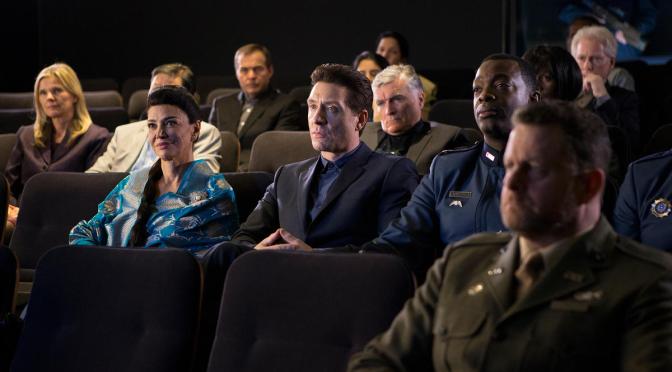
“Static” starts with an event leftover from last week, the destruction of Deimos by the Earth navy, which comes even before the opening credits. The opening shot of Earth’s missiles zooming towards Deimos quickly cuts to Bobbie Draper and her squad of Martian marines watching the news, which details the tiny moon’s complete obliteration and the deaths of all seventeen of its residents. We then get a short scene of Avasarala and Errinwright discussing the possible war with Mars, which turns to a voiceover on top of scenes of the Martian marines training. It’s a smart use of a couple of minutes that further sets up the rivalry between the Avasarala and Errinwright philosophies and highlights the seriousness of the situation. This whole opening sequence also resonates thematically with the rest of the episode (and, I expect, much of this season of the show), which deals heavily with ideas about the value of human life, whose lives matter, and the ease and difficulty with which different characters treat different lives as disposable. Sadly, Chrisjen doesn’t get much to do the rest of the episode, though her “What the fuck is that?” when she finally gets a message back from Fred Johnson near the end of the hour promises that she’ll have plenty to do in the next episode or two.

Similarly, Bobbie and the rest of the Martian marines are subjected to a somewhat boring and, frankly, redundant subplot this week. We get to see the way that the three native-born Martians single out and pick on the Earth born Private Travis, which was already touched upon in the first episode of the season. In the end, this relatively minor personnel issue is resolved and Bobbie and company are sent on to Ganymede, which book readers will recognize as the place where we first meet Bobbie in Caliban’s War. I suspect that all this time spent with Bobbie’s team is meant to help viewers connect with her and them before the Ganymede incident, but all these characters struggle with likability—probably because they spend so much time on petty bickering. It’s an interesting adaptational dilemma, though, if you think about it. On the one hand, I’m glad that the show didn’t work too hard to paint Bobbie and her team as overly soft and lovable. Bobbie’s not, in general, a super likable character, and the show is portraying her pretty much how she appeared in the book. On the other hand, they’re going to a lot of trouble to try and make the viewer care about this team of people and it’s, one, not working very well and, two, strongly telegraphing that this group of characters is marked for tragedy. The ominous way that Sutton pronounces “Ganymede” is a dead giveaway.

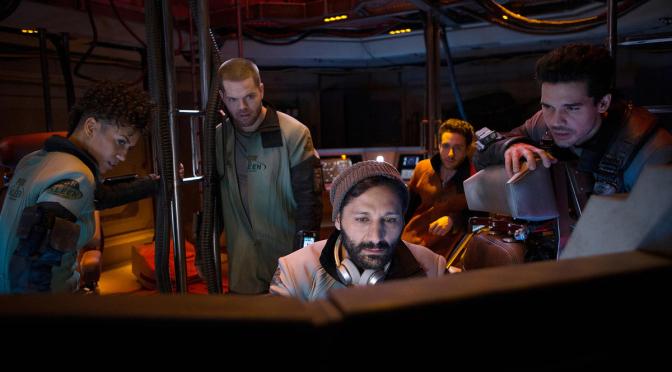
Most of “Static” takes place at Tycho Station, to which the Rocinante and Fred Johnson have returned with prisoners from Thoth. While the crippled ship is being repaired, its crew is fractured. After shooting Dresden last week, Miller is out, banished from the Rocinante by a furious, self-righteous Holden and from Tycho by Fred Johnson, who is himself struggling to figure out next steps in how to deal with Eros and the conflict between Earth and Mars that is sure to spill over into the Belt and Outer Planets. Holden and Naomi have a disagreement about Miller and Dresden, which sends Naomi off the Rocinante for some girl time with Fred Johnson’s assistant, Samara, and leads Holden to focus on interrogating their most important prisoner, a scientist named Paolo Cortazar. Amos starts the episode by having a commiserating drink with Miller but turns out to be instrumental in getting Cortazar to talk. Meanwhile, Alex is eaten up with guilt over the deaths of the twenty-five Belters on the second boarding pod at Thoth, and he spends the whole episode running and rerunning simulations of the fight in order to figure out a way that he could have saved them. All of this works together to produce a strange effect that is probably not quite exactly what the writers hoped for. The idea of breaking up the crew and then putting them back together at the end of the episode is a solid one, and it ought to be enough to fuel an episode, but the truth is that not all the conflicts here really work. There aren’t always clear consequences for characters’ actions, and the interpersonal stakes feel low when compared to the major events happening in the story.

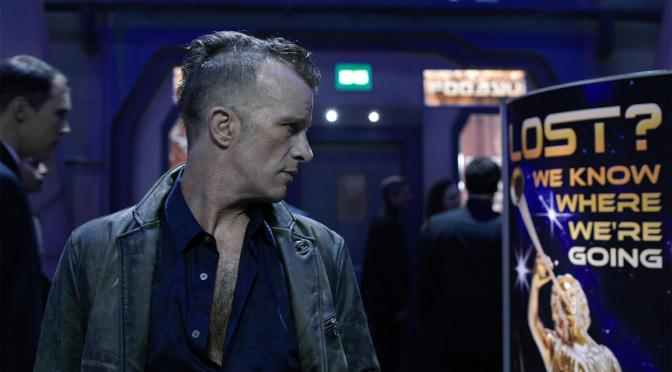
This is probably most glaring in Miller’s storyline this week. In his first appearance of the episode, Miller is assaulted and berated by Holden, who is outraged at Miller’s extrajudicial killing of the unarmed Dresden. Fred is more quietly angry at Miller, perhaps angry less at Miller’s action and more at Miller’s usurping of Fred’s authority in the situation, perhaps for some other complex reason. It’s not always easy to tell with Fred Johnson, who is still a somewhat mysterious character in the show. In any case, Fred orders Miller off Tycho ASAP and sends Miller off to, presumably, find a ship to take him off. However, this isn’t what Miller does at all. It turns out that almost no one is actually that upset with Miller. In fact, some of the Belters on Tycho seem almost to hero worship the ex-cop, and Miller loafs around the station for somewhere between a day or so and a couple of weeks. The timeline is confusing. He has a drink with Amos, then goes to the Mormon temple on Tycho and lets some poor nice Mormon waste time giving Miller the whole spiel about the generation ship, the Nauvoo, parked outside Tycho. Miller is also having visions of Julie Mao, who seems to be beckoning him back to Eros, so he decides Eros needs to be destroyed and goes back to Fred Johnson to suggest that they use the Nauvoo to do it, and Fred agrees with no real argument. It’s a weird storyline because it feels important and somewhat dramatic during the watching, but its internal logic doesn’t actually hold up to much scrutiny. It’s Fred’s easy agreement at the end that really killed my suspension of disbelief, but this plot overall relies a little too heavily on the ability of viewers to fill in blanks and imagine character motivations and rationalizations that aren’t adequately supported by what is shown on screen.

The disagreement between Holden and Naomi is an obvious one. Holden, self-righteous prig that he is, hates that Miller shot Dresden, who was unarmed and not obviously presenting any imminent threat to the people who were in the room with him on Thoth. Naomi, however, sees the wisdom of Miller’s decision, though she isn’t entirely approving of it being so unilaterally decided and carried out, and she urges Holden towards forgiveness and clemency or at least pragmatism. This argument sends the two apart for most of the remainder of the episode, with Holden working with Fred and Amos to get information out of the scientist, Cortazar, while Naomi drinks and plays and dances with her new friend Samara. Before the end of the episode, Holden and Naomi have one more conversation where they reconcile, and this puts them right with each other in time for whatever comes next for them. The thing is, this is the first test of their relationship, but it never feels truly consequential. When they aren’t in the same room, it’s as if the two characters don’t even exist to each other, and their reconciliation feels too easily accomplished at the end after such a significant philosophical disagreement.

Still, “Static” is a good episode that does a lot of necessary ground laying for next week’s major events. The Nauvoo exposition was nice and not too clunky, the use of the Eros noises as a soundtrack was mostly well-done, and while quieter than the first two episodes of the season, this one didn’t feel slower or less interesting. I’m happy to see that we’re on track to finish Leviathan Wakes by the end of episode four, though. I cannot wait to get deeper into Caliban’s War material. The back half of this season should be awesome for female characters, and that is definitely relevant to my interests.

Miscellaneous Thoughts:

  • I love Errinwright’s line at the end of the opening sequence, where he turns Avasarala’s own words against her: “It’s like you always said; Earth must come first.” This is a great way of pointing out Chrisjen’s own hypocrisy in using rhetoric that can be easily interpreted in ways she doesn’t intend but probably should have been able to foresee.
  • I noticed that “Nauvoo” doesn’t set off spellcheck, so I googled it and learned an interesting bit of Mormon history that I was previously unaware of, so that was neat.
  • It’s interesting how Amos is used this week to relate to both Miller and Cortazar. One man has a rough exterior but an excess of empathy, while the other has been altered to feel none, yet Amos connects with both of them. I’m not always sure that the writers are sure what they want Amos to be.
  • I would have loved to see Alex’s story given more time this week, as well as some more interaction with other characters. He felt very alone and adrift in his pain, but it seemed as if this mini-storyline was almost an afterthought.
  • I genuinely hated the short EDM montage with the music made from the Eros recording. I’m not big on montages in general, but this one in particular was egregiously bad. It communicated nothing that hadn’t already been conveyed in the previous scenes, and it was heavy handed way of making a thematic connection between disparate storylines.
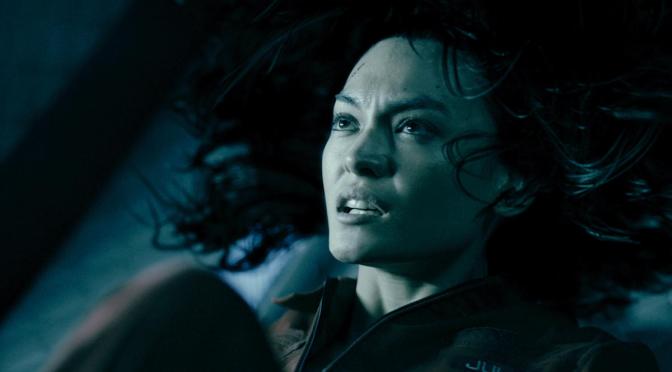
The Expanse: “Safe” and “Doors & Corners” are a thrillingly ambitious start to Season Two

Season two of The Expanse isn’t wasting time with handholding or revisiting last season’s material, so I hope everyone has been paying attention. “Safe” is a whirlwind of fresh exposition and new character introductions that moves through the aftermath of the Eros massacre at a blistering pace to set the stage for the Battle of Thoth Station that takes place in “Doors & Corners.” It’s a good thing these two episodes were aired together because they would each have been frustrating to write about separately, one being a huge helping of infodumping mixed with survivor’s guilt and the other being dominated by the lengthy battle sequence that overshadows its first half. As a pair, these episodes work well as an introduction to the themes and conflicts of the show’s second season. Apart, not so much.

Spoilers ahead for the episodes and the first two books of the series!

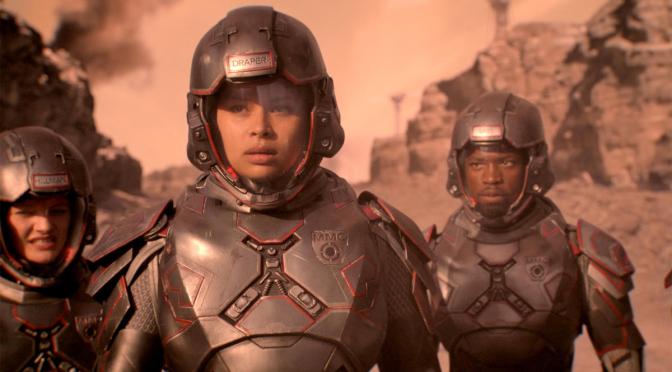
Having read Leviathan Wakes last year and Caliban’s War in preparation for this season, I wasn’t expecting to see Bobbie Draper (newcomer Frankie Adams) so soon, but “Safe” opens with her introduction. It’s a smart transition into the new season, immediately adding an additional layer of complexity to the story by starting with a new character, kicking off a dialogue-heavy episode with some action, and showing the audience Mars for the first time. Chronologically, this scene takes place before the start of Caliban’s War, and by the end of “Doors & Corners” we’re still pretty firmly in Leviathan Wakes territory, which makes me curious about how far into the second book we can reasonably expect the show to get this year. My guess is not nearly as far as I’d like, especially in Bobbie’s story, but I like this opening scene so much and Bobbie’s viewpoint is utilized so well in “Safe” that I can’t be upset about it.

It’s great to see Mars at last, and they do a good job here of communicating to the audience what the dream of Mars is—a terraformed paradise as we see in Bobbie’s snapshot of the future Mariner Valley—and what that means to young people like Bobbie. She and the rest of the Martian military get a good amount of screen time in these episodes as they work, possibly in vain, to avoid war with Earth. If the show is planning on following the course of the books, the groundwork being laid here is essential to getting viewers invested in these characters, their conflicts and their fates. So far, they’re nailing it, following up the initial action scene with some more domestic scenes of military camaraderie and using Bobbie’s interactions with Lieutenant Sutton (Hugh Dillon) to give us a ton of exposition about Mars and their goals in the solar system while also deftly painting Bobbie as a tough, passionately opinionated woman who often seems to only be barely held in check by her military training and discipline. When Bobbie ends “Safe” with the observation that war with Earth may be necessary and inevitable, she looks like she might be willing (and certainly seems capable) of waging that war all by herself.

On the Rocinante, “Safe” picks up with them having just left doomed Eros. Kicking off this first Roci segment with Holden’s nightmare that they may all be infected by protomolecule was a touch melodramatic—it’s very obviously a dream, and the ongoing fears Holden and the rest of the crew have after the trauma of their experiences on Eros are better communicated elsewhere—but in the broader context of two solid episodes that work in such excellent harmony, it’s practically forgettable and definitely forgivable. I suppose it serves as a reminder of what the protomolecule looks like so that we recognize it when Amos opens up a canister of it a couple minutes later, but I’m not sure it’s truly necessary, especially when the canister is confirmed by others to be the same stuff that they saw on Eros and they also have recorded scientific notes on the substance that explain more about it. Still, the fact that everything in “Safe” happens so quickly and in so many short scenes that it’s easy to lose this tiny dream sequence in the crush of information being thrown at the viewer almost makes it worse and more silly to have included it in the first place. In any case, the protomolecule canister is soon safely (hopefully) hidden near an asteroid, and the Rocinante is on its way back to Tycho and Fred Johnson with the other evidence found on Eros.

Much of the time spent with the Roci crew in “Safe” as well as parts of the first half of “Doors & Corners” is dedicated to the characters’ various reactions to trauma and survivor’s guilt. Alex (Cas Anvar) in particular struggles with his feelings of guilt and shame over not having rescued more of the Belter population of Eros, and it’s nice to see him getting more to do and the beginnings of a more distinct character arc this season. Meanwhile, Miller and Holden are still recovering from the massive dose of radiation they were subjected to on Eros. Miller is still angry at Amos for killing Miller’s friend Sematimba, while Holden is still unsure if he has what it takes to lead the crew. The resolution of the conflict between Miller and Amos works for the characters even if it is somewhat expected. It’s Alex, incidentally, whose basic decency sets the stage at the end of “Safe” for Miller and Amos to finally let bygones be bygones, and the cheese story is definitely in the running for my favorite scene from either of these episodes. It’s a great scene of domestic bliss on the Rocinante before they return to Tycho and get back into the shit.

Even more expected than the conflict and resolution between Miller and Amos, and somewhat spoiled by the season previews, is the start of the romance between Holden and Naomi, which I was surprised to not hate nearly as much here as I did when I read Leviathan Wakes. I mean, there’s still no way that Holden could ever possibly deserve Naomi Nagata, who is an actual perfect angel, and I still feel like things are very one-sided, with Naomi as the primary provider of emotional support. With Naomi also being responsible for Amos and whatever his deal is, it doesn’t seem quite fair. Still, Steven Strait and Dominique Tipper are both hot, and they have a nice chemistry that makes it fun to watch them squish their bodies together. It also helps that there’s nothing overwrought about the relationship and it doesn’t take up much screen time so it hasn’t completely outstayed its welcome yet.

The Rocinante material is dialogue heavy for all of “Safe” and this continues through the first half of “Doors & Corners” after they arrive at Tycho to report in with OPA leader Fred Johnson (Chad L. Coleman). There’s a lot of sly exposition in these first few minutes that helps to give us a much better understanding of the OPA, its factions, and how the events at Eros have changed things in the Belt. Fred Johnson gets nearly as much screen time in this one episode as he did all last season, and we see a new depth to his character now that he’s playing a larger role in the story. Coleman brings a decent gravitas to the role, and this week we get to see a lot of Fred Johnson’s complexity as he finds himself pushed back into a martial role that is far different than the politicking that he wants to be doing.

On Earth, we’re already starting to dig into some of Chrisjen Avasarala’s Caliban’s War content, and it’s interesting to see how this material is being adapted to try and keep it from getting too far ahead of the Rocinante plot, which still has probably two more episodes worth of Leviathan’s Wake material to cover. Avasarala’s story this season starts with an assassination attempt right after she’s given a public statement blaming Fred Johnson and the OPA for the Eros incident and the attack on the Donnager. She contacts an old friend of her son’s, Cotyar, to join her security team and work as a spy, though it’s still not clear by the end of “Doors & Corners” exactly what Cotyar is for. Avasarala herself splits her time between working to prevent all-out war between Earth, Mars and the Belt and trying to puzzle out Errinwright’s plot against her so she can keep working to prevent the war without getting herself murdered in the process. Shohreh Aghdashloo is always a commanding presence as Avasarala, and I generally find her to be the most fascinating character on the show. Unfortunately, much of her story in these first couple of episodes feels repetitive, as if it’s just spinning its wheels until the other plots catch up.

That said, even while spinning its wheels, the Avasarala plot manages to be compelling enough to mostly hold its own, especially in “Safe” though Avasarala also gets a great scene with Admiral Souther in “Doors & Corners.” There are several scenes of actual UN meetings which are entertaining if you appreciate that sort of peeking into the workings of government, and it appears that several other characters are going to play larger roles here as the season continues. Having read the first two books of the source material, I’m glad to see so much of it showing up here, and I’m hopeful that this means we’ll get significantly far into Caliban’s War later this season. My only concern is that by starting to dig into the conspiracy against Avasarala this early, it could be redundant to do it all over again later if the show decides to hew too closely to the source material. So far, however, the show has mostly made smart adaptational choices, seeming both cautious about huge changes and appropriately reverent of the books. I don’t think there’s much to really worry about on that score.

Overall, these two episodes are a pitch perfect start to the new season. There’s a certain amount of risk-taking going on with introducing some completely new characters and expanding the roles of some others requiring more skillful juggling to do everyone justice, and the show so far is pulling it off. Thematically, these episodes are solidly ambitious, but in a way that grows organically out of the previous season. The exploration of various forms of survivor’s guilt in “Safe” and the journey of the Roci crew towards something like healing (but that, ultimately, turns out to be political awakening) was particularly well done. Bobbie’s point of view offers an important new perspective on Mars that rounds out the viewer’s understanding of the major factions in the solar system, and by the end of “Doors & Corners” we have a much better idea of what the protomolecule is and some inklings of what that might mean to the warring factions. Visually, the show is a marvel, with gorgeous costumes and props, excellent sets and practical effects, and slick, polished CGI to enhance great photography.

The Expanse continues to be the most exciting thing on television, and I can’t wait to see what happens next.

Miscellaneous Thoughts:

  • I know that “I don’t use sex as a weapon, little ones; I use weapons as weapons” is sort of the Bobbie Draper pull quote of the night, but I actually don’t love it. I am still feeling pumped from Bobbie’s speech at Phoebe, though.
  • A line I do love: Naomi saying “I’m not scared. I’m angry.”
  • I liked the scene with Mao and Errinwright plotting together, but it felt somewhat derivative. The roses made Mao feel a little bit President Snow-ish, and the location they used looks very similar to one I’ve seen in a couple of other SyFy productions. I might be wrong about the specifics, but either way it all seemed a little too paint-by-numbers for me. I’d have liked to see something more visually distinctive and memorable.
  • I’ve never been wholly on board, in the books or on the show, with Miller’s creepy obsession with Julie Mao, but it seems like that has been wound down now. Here’s hoping.
  • On the one hand, Holden and Naomi banging in the airlock is hot as hell. On the other hand, if that airlock was open to space for them to come in, wouldn’t that hard ass wall be cold as shit?
  • The FedEx branding on the boarding pods was a nice touch.
  • Loved the ending of “Doors & Corners.” I love that scene in the book, and it was deployed here for maximum “Oh, shit!” effect. Good job, show.

The Expanse: “Critical Mass/Leviathan Wakes” deliver exactly the payoff we deserve

Well, that was a wild ride. Which I’m sure I’ve said more than once already this season, but I really, really mean it this time. The Expanse has been a captivating show from day one, but “Critical Mass/Leviathan Wakes” was an exhilarating experience. While I have at times felt that the show spent too much time on set-up and world building, it definitely paid off this week with several big reveals and a major ratcheting up of the stakes in preparation for the show’s second season—in 2017, a long wait which was probably the most devastating revelation of the day. Considering all that happened in the finale, that’s saying a lot.

“Critical Mass” opens with an extended flashback that tells Julie Mao’s story from Julie’s point of view. It’s a great way to elevate her from being essentially an object in a narrative that revolves around the stories of men—Holden and Miller in particular, but to a lesser extent Dawes and Johnson—to being a real character who we can empathize with and care about. By dedicating nearly a full half episode to showing us who Julie was, the show forces us to think of her as an active agent in her own right, driving her own narrative, which only intersects with Holden’s and Miller’s. What I most appreciated about the time we spend with Julie this week is how much of that is dedicated to showing us who she was as a person, not just what she did. At the same time, this material gives us a much better understanding of what Miller and Holden have gotten themselves into—even as it highlights that there is still a ton of stuff that they (and we) don’t know.

And can we all stop to appreciate that Julie Mao’s death isn’t sexualized? Her body isn’t posed in any kind of titillating fashion, and her illness is filmed in a way that invites the viewer to identify with her rather than simply observing her. It’s done in a way that is almost viscerally affecting, as we’re able to almost experience her increasing sickness, her rising desperation as her attempts to contact Anderson Dawes go unanswered, her panic as she realizes what is happening to her, and her final despair as she succumbs to whatever the blue space goo is. Still, she’s given a sort of sad dignity through all of it, and I was happy to see that her death is framed as tragic for her sake more than for Miller’s like it was in the book.

The second half of “Critical Mass” and all of “Leviathan Wakes” are dedicated to the present day, where things are getting very scary extremely quickly. Miller and the Rocinante crew manage to escape from the motel, only to find the whole station on lockdown due to a supposed emergency. As Eros residents are herded into radiation shelters, Miller, Holden, and the rest try to get their bearings. Eventually, they split up—Miller and Holden to find out what’s going on and Naomi leading the rest back to the Rocinante. What follows is a fast-moving series of tense, high stakes sequences as the two groups try to find their way off the doomed space station. It’s definitely the best work of this type that the show has delivered so far, and the danger they’re in, especially Holden and Miller, feels very real.

All of the events on Eros this week made me a little regretful that I read Leviathan Wakes before the show aired. The show is a pretty faithful adaptation of the book, and I think it would have been cool to see it with fresh eyes. Even knowing how things would turn out, I felt real worry for Holden and Miller, so I can only imagine how harrowing their scenes must have been for non-readers.

One thing that wasn’t in the books, though? Naomi’s journey back to the Rocinante, which I loved. It’s nice to see her get a chance to really be in a leadership position, even if she does decide before the end of the episode that she doesn’t really want that responsibility after all. I haven’t always been completely happy with the way the show dealt with the situation between Naomi and Holden as they jockeyed for primacy on the Roci, but I liked the way it ended here. Her struggle to lead felt real and human; her decision to defer to Holden felt honest; and the final tender moment they share together hints at a possible romance that feels genuine and earned. It’s a brief moment of sweetness in an overall extremely dark episode.

Meanwhile, back on Earth, Chrisjen is going to pay her respects to her old friend, Franklin DeGraaf. She finds his husband very angry with her, but he lets her in regardless. It’s impressive how much convincing feeling Shohreh Aghdashloo can produce in this role, and this is a standout episode for her character. She’s definitely grieving for her friend, but she’s also trying to piece together more pieces of a mystery—in this case, a proper conspiracy. When Fred Johnson makes an announcement regarding the destruction of the Donnager and broadcasts some of the same information that Chrisjen found in her dead friend’s desk, things start to become clearer. When she reconnects with Errinwright, Chrisjen immediately sees that he’s in on it, whatever it is, and she smiles and plays her part. Then she goes home and takes steps to keep her family safe from whatever storm is about to hit.

Avasarala’s story line this season has been perhaps the show’s most consistently weak link, but it finally starts to pay off in “Leviathan Wakes.” As an enormous Chrisjen fan, I can’t wait to see how this develops next season. Most of the season, her role seemed largely to function as a way to further understand the events in the Belt, but her uncovering of a conspiracy, combined with her introduction to Jules-Pierre Mao, finally gives her a proper story of her own. She’s still stuck on Earth, where most of the action isn’t, but now she’s in some real peril that she’ll have to face next year.

The Expanse is hands-down SyFy’s best production since Battlestar Galactica, and this finale only continues to prove the series’ strengths. It’s a perfect mix of personal stories and epic scale plots, and it ends with an iconic and ominous shot that promises that shit is going to get very real in season two.

Miscellaneous thoughts:

  • “Everyone’s a winner on Eros!” Indeed.
  • I feel like people would have been rioting in the streets if we’d had to wait a week between the end of “Critical Mass” and the beginning of “Leviathan Wakes.”
  • Those pencil-shaped data sticks are awesome.
  • “Half the system thinks you’re some kind of outlaw hero, but you’re really kind of clueless, aren’t you?”
  • I’m not entirely sure why Sematimba had to die. I suppose he’s just a loose end or perhaps this is going to lead to conflict between Miller and the Roci crew next season, but I didn’t love the way this went down. I’d have preferred it if he just disappeared in the chaos on Eros.
  • “You guys look like shit.”
  • One could almost feel bad for Kenzo. Only almost, though.


The Expanse: “Salvage” finally (and gloriously) unites the show’s two biggest plots

The Expanse up to this point has been highly entertaining, turning out consistently high quality, if not superb, episodes week after week. However, a common complaint and the show’s single biggest problem has been its tendency to get mired in exposition and distracted by filler material that prevents forward movement on the main plot lines. This has been largely due to the show’s trying to keep Miller’s and the Cant survivors’ storylines where they needed to be while still giving time to more tangentially related plots and characters. The end result, though, has been some unevenness from week to week and a couple of episodes that even felt slightly stagnant. At times, it felt as if the various plots the show has been juggling were never going to come together. This week, though, in “Salvage,” all of the patient waiting pays off in a big way.

On Earth, Chrisjen is informed by Errinwright that he’s activated a black ops team to investigate whatever Fred Johnson is up to on Tycho Station. She’s not thrilled, and she’s concerned about making a martyr of James Holden, but there’s nothing she can do to stop it. We also learn this week that Chrisjen’s old friend, Franklin DeGraaf, has killed himself. In a beautifully subtle moment, we get to see Chrisjen react to this sad news and then continue working through her grief. It’s a legitimately great character building moment, smack dab in the middle of a scene that shows that the U.N. on Earth has no idea what they’re dealing with in the Belt and might in fact be only compounding problems that they don’t understand. Avasarala’s scenes have felt somewhat disconnected all season from the events in the Belt, and it would be easy to write this scene off as unimportant or unnecessary, but there’s actually quite a lot going on here.

Miller’s flight to Eros is mostly uneventful, but there’s a great scene on the transport where he meets a Mormon man who is preparing to board the Nauvoo generation ship. It’s a nice, quiet interlude that deftly weaves together Miller’s character development with some exposition about the Mormons and their ship that seems like it will be important sometime down the road. When Miller arrives at Eros, he wastes no time in trying to locate Julie Mao, who has been traveling under the name Lionel Polanski, but his efforts only end up with him arrested and needing to be bailed out by his friend Sematimba, who wants to know what Miller has gotten himself involved with. Without being completely forthright, Miller convinces Sematimba to tell him the last place “Lionel Polanski” was known to be—a flophouse called the Blue Falcon.

The largest amount of time this week is spent with the crew of the Rocinante. When they reach the asteroid where the Anubis is supposed to be, they at first think they’ve been misdirected before they finally discover a stealth ship hidden in a crevasse on one side of the giant rock. Though the ship appears to be dead, Naomi points out that the intact hull suggests that there could still be air (and possibly survivors) inside. As everyone but Alex slowly explores the Anubis, they realize that the ship is not damaged at all, but has been deliberately turned off and vented—and a short range shuttle is missing. The most significant discoveries on the Anubis, however, are that it was at Phoebe Station and that there’s some kind of mysterious blue, glowing space goo that seems to be alive and gunking up the ship’s reactor. Fully freaked out, everyone hightails it back to the Rocinante so they can continue on towards Eros in search of the missing shuttle and Lionel Polanski, but not before destroying the stealth ship.

As a great lover of the mysterious space goo trope in science fiction, I have a deep appreciation for this segment, but I would have loved to see it portrayed more as it was in the books, with recognizable human parts embedded in the goo. In hindsight, however, I’m forced to admit that showing it that way on screen would have definitely spoiled the next big revelation of the episode. When the Rocinante arrives at Eros, Holden and company are able to relatively quickly make their way to the Blue Falcon, where Lionel Polanski is booked into room 22. Avasarala’s spy has set them up to be murdered, presumably on Errinwright’s instructions, but they are saved from that fate by the timely arrival of Miller.

The now-ex-cop recognizes Holden right away, but he’s more concerned with finding Julie as soon as possible. Unfortunately, when they all finally make it to Julie’s room, it’s clear right away that things are not right. All of the devices and lights in the room have been turned off, and it smells of “sweat, sick, and ozone” (a wonderfully evocative phrase that helps to convey the horror that the characters are experiencing). When they finally find Julie, she’s in the shower, covered all over with—you guessed it—space goo, which seems to have been fatal.

It’s a great way to end the episode, and perhaps the best possible lead-in to next week’s two-hour finale. “Salvage” manages to squeeze a lot of story into its running time, but it’s still an episode that is capable of pausing for interesting moments and continuing world building. It’s a wildly fast-paced episode that only builds momentum as it goes on, but it never feels rushed. Now it just remains to be seen how much story is going to be crammed into the finale, since this episode managed to somehow push all the way to the moment where I thought the show was going to be at the end of episode ten. I didn’t think it was going to be possible, but it now seems rather likely that this first season is going to make it to the end the source material in Leviathan Wakes, or very nearly so.

I can’t wait.

Miscellaneous thoughts:

  • The broad shot of the Nauvoo, with the trumpeting angel in gold, is incredible. Like, yes, of course that’s what a bunch of religious whackos are going to drive out into space. It’s gorgeous.
  • Fred Johnson is surprised by something in the data from the Donnager, but we don’t learn yet what it is.
  • “I kinda wanna blast it.” Good instincts, Amos.
  • The music at the Blue Falcon is amazing.
  • “Shit just follows you around, don’t it, kid?” Pretty much.

The Expanse: As its title suggests, “Windmills” is mostly just spinning its wheels

“Windmills” is probably the most thematically coherent hour of The Expanse to date, and we’re finally seeing all of the show’s disparate story lines begin to converge on one place: Eros. This is a frustrating episode in some ways, as very little actually happens, but I have high hopes that this is the final bit of stalling for the series before things get really interesting over the next couple of weeks.

The Rocinante is well into its journey this week, on the way to rendezvous with the mysterious Lionel Polanski, but they’ve also got Avasarala’s spy in tow and Martian inspectors trying to board the ship. Unfortunately, these attempts to liven up the Rocinante’s traveling time fall a little flat, acting more as filler to give the crew something to do for an episode while Miller and Avasarala’s plots catch up to where the Roci is. Still, there is some interesting character work in the Rocinante segments of the episode, and dealing with Kenzo Gabriel and the Martians does provide a good framework for both showing what makes the Roci crew tick and exploring how their recent experiences are affecting them.

These scenes also highlight a pretty significant (and kind of fascinating) change from the source material. By this point in Leviathan Wakes, Holden was pretty well-cemented as the captain of the ship, but his position is much more ambiguous and precarious on the show. This makes all of the Roci crew’s dynamics much more compelling, though I did feel this week that they weren’t particularly fun to watch. The conflict between Holden and Amos was nicely done, but Holden ultimately offloads that whole responsibility to Naomi, which is wildly unfair and, frankly, irresponsible. Naomi continues to prove, however, that she’s the smartest and most capable person in every room she’s in by basically saving the day by hacking the Roci’s systems and heroically managing not to punch Holden right in the face. The only character on the crew who still seems somewhat flat is Alex, although I kind of love how much he’s just having a great time flying this badass spaceship.

Meanwhile, Avasarala is back in a pretty big way this week, as she travels personally and alone alone to the farming collective in Montana where Holden was raised so she can speak with his birth mother, Alice. From a kind of objective standpoint, this may be the weakest part of this episode, but it’s one of my favorite sequences so far on the show. First, it’s some of the most perfectly beautiful scenery we’ve seen so far, and it appears to be a real place with only the wind turbines composited in during post-production. Second, Avasarala’s costume for this is glorious. Everything this woman wears is amazing, but this red number, and the way she strides confidently across the pristine Montana snow, is like something out of a fairy tale. Finally, the conversation between Avasarala and Alice Holden shows us yet another new side of Chrisjen. I can’t remember the last time I saw this kind of woman-to-woman real talk, and I found it riveting.

My only complaint about this whole sequence is that I still don’t quite understand James Holden’s origins and the political and economic climate that created this place and these people. There’s a lot that can be inferred about their collectivist lifestyle, the intimation that they are potentially armed and dangerous radicals, and the knowledge of how they groomed Holden to be a part of their political scheming, but there were a lot of missed opportunities here. One way that this could have been improved upon would be to have Chrisjen interview all (or even just several) of Holden’s parents separately, which would have offered us a bigger picture of how this all works and created more and better ways in which to work in some more exposition about the state of Earth and how Holden and his family fit into it. Instead, Avasarala only really speaks with Alice, and most of their talk consists of them bonding over their shared experiences of motherhood, which feels a little simplistic and almost defeats the purpose, in my opinion, of even introducing the idea of this sort of family arrangement. Why bother if it’s not going to be explored when the chance appears?

On Ceres, Miller is left reeling after losing his job with Star Helix, and he spends most of this episode revisiting the places on the station that have figured most prominently in his story so far. He confronts a smug Anderson Dawes in a bar, breaks into Julie Mao’s place, and then returns to his own apartment, where he gathers his few things of value, leaves his hat hanging on the hook, and goes to pawn everything so he can buy a ticket on the next ship to Eros.

Miscellaneous thoughts:

  • “Donkey balls” is not nearly as funny a phrase as the show’s writers seem to think it is.
  • Apparently Miller also sent out some disturbing goodbye messages to his few friends. This was actually moderately amusing to me.
  • I know Octavia is sad now, but someday she will appreciate dodging the bullet that is Miller.
  • As much as I hate Miller’s hat, his greasy hair might actually be worse to look at.
  • There were a lot of wonderful set details this week, but the house in Montana was stunning. I just wish we’d gotten to see a little more of it.

The Expanse: “Rock Bottom” sets us up for a wild ride to come

“Rock Bottom” is another solid episode that moves things along nicely, especially on Ceres, where Detective Miller is having the worst day.

First though, the episode opens with Chrisjen Avasarala, who I greatly missed last week and is in ruthlessly noble (or maybe nobly ruthless) rare form as she casually uses her position and inside knowledge to extort favors from a guy who doesn’t want to be involved with whatever she’s up to. I have said before that Shohreh Aghdashloo is creating Chrisjen Avasarala as a new science fiction icon, and every episode she’s in only further confirms that to be the case. This week, she doesn’t have a lot to do, but Avasarala’s ability to switch roles (here, between nurturing grandmother and cutthroat political player) is amazing to watch, if somewhat chilling.

My only criticism of Avasarala is really about the way she’s been written into this first season of the show. Since the character doesn’t appear in Leviathan Wakes, which material is primarily what has been adapted in the show so far, I’m concerned that not having much to do is going to be a perennial problem for Avasarala, especially if the show is pulling the current stuff she’s up to from the written material of later books. As much as I appreciate Avasarala, I would almost rather have waited until season two if it meant that I didn’t feel as if her storyline was so largely static and disconnected from the events in the Belt. That said, this week we did get to see her negotiate for use of a spy on Tycho, and we learned about her personal connection to Fred Johnson, which seems like a crucial bit of backstory and could turn out to be interesting later on. Still, I hate to see such a great character spending so much time basically spinning her wheels while there is much more interesting stuff going on elsewhere.

I kind of feel as if Holden and the rest of the Cant survivors’ journey ought to be the main event, but their arrival at Tycho and the sequence of events that end with them shipping back out on the Rocinante to go retrieve Fred Johnson’s mysterious contact, Lionel Polanski, are actually somewhat underwhelming. The show did manage to capture some of the tenseness in the first meeting between Johnson and Holden, but the more I see him, the more I’m not entirely happy with Steven Strait’s portrayal of Holden. Unless, of course, it’s the intention of the show that his face is supposed to be the most punchable one in every episode, in which case, mission accomplished. “Biggest dipshit in the universe,” indeed.

The negotiations that lead to Holden and the others all being able to leave Tycho together, which were pretty significantly detailed in Leviathan Wakes, feel a little glossed over and hand-wave-y here. I can understand the desire to avoid showing us a whole lot of people standing around arguing, and the generous reading of this adaptational choice is that the show’s writers don’t want to be holding the audience’s hand and that they trust us to figure things out for ourselves. This is certainly possible, but the explanation for how the crew all gets to leave together is almost a blink and you miss it moment, and I found myself filling in the details with recollections of how things went down in the novel. It’s not a huge problem, but it could definitely have been made a little more clear what happened.

The thing about the Rocinante crew’s time on Tycho that works, though, is the time that is spent this week showing us some more about who these characters are. Having them go out drinking and conversing in pairs (Holden and Naomi, Amos and Alex) is a nice reprieve from the constant stream of crises they’ve faced so far and continues some of the respite the characters got a taste of last week, but without ever feeling permanent. Instead, while the episode ends on a somewhat hopeful note for the crew, it also feels as if there is very clearly a storm on the horizon for them as the leave Tycho in their newly disguised ship.

Miller’s tribulations on Ceres steal the show this week, though this is mostly because Jared Harris is absolutely magnetic as Anderson Dawes. After being tased and kidnapped at the end of “Back to the Butcher,” Miller wakes up in a bad place and finds himself being interrogated/punished by Dawes, who it turns out is one of the show’s most compelling (albeit frightening) characters so far. More pertinently to Miller’s situation, Anderson Dawes is a true believer in his cause (Belter liberation), and he thinks that Miller is a traitor to their people. When Dawes realizes that Miller isn’t dangerous—that the detective is really just kind of sadly and creepily obsessed with Julie Mao—he decides to cut his losses and have Miller thrown out an airlock.

Fortunately, Octavia Muss shows up just in the nick of time to rescue Miller, and they retreat to Miller’s place, where Miller finally pieces together some of the last pieces of the puzzle of what’s going on with Julie Mao, the Scopuli, the OPA, and the destroyed ships. When he thinks he’s got it figured out, Miller finally gives in to Muss’s advice from last week. He takes it to his superior, Captain Shaddid, who promptly confiscates Miller’s evidence and fires him. Poor Miller just can’t get a break.

Miscellaneous thoughts:

  • I really like Octavia Muss, but the show doesn’t really seem to know quite what to do with her. This week was the most we’ve seen her get to do all season, but as soon as she’d outlived her usefulness, she’s shuffled off screen with unceremonious abruptness.
  • Naomi Nagata continues to be one of the show’s most interesting characters, but whatever her secret/mystery is has started to become somewhat infuriating. I’d love to get some piece of concrete information about her.
  • I’m a little baffled by this episode’s subplot with the space cops (unsurprisingly the same kind of brutal pigs as regular cops), the asteroid miners, and the suicide attack. While it’s tangentially connected to other things (nephew Diogo is one of the kids Miller busted in an earlier episode), it’s a fairly lengthy sequence that doesn’t have any direct impact on the rest of what’s going on, nor does it give us any new insight into other characters. If it’s just a bit of world building, it’s effective, but almost unnecessarily bleak and not that informative. Also, while Diogo is only listed on IMDb for two episodes, surely the show isn’t going to just leave things like this, with him just floating out in space by himself.

The Expanse: “Back to the Butcher” feels like a calm before a storm

“Back to the Butcher” feels like the show letting out a sort of sigh after four episodes of high tension, action-filled spectacle. Everyone gets to relax a little, including we viewers, and it’s interesting to see what the show’s characters do with their brief quiet time.

So far, while the show has avoided a truly episodic narrative, there’s still been a definite pattern and rhythm to the storytelling and how it shifts between Miller, the Cant survivors, and Avasarala. Last week was the first time since episode one that a new point of view was introduced. This week, Avasarala doesn’t appear at all, and there is a lengthy flashback sequence about Fred Johnson instead. It’s informative, but it stops short of telling the full story of this character and how he went from being Fred Johnson, The Butcher of Anderson Station, to Fred Johnson, high level OPA member. Having read Leviathan Wakes, I am familiar with the story, but I’m not sure if the Anderson Station stuff made much sense to anyone who hasn’t read at least the first book. It seems like there is enough information offered to let the viewer connect the dots, but I expect that next week we’ll hear more about it from Fred himself.

The reason we spend so much time on Fred Johnson, of course, is that he’s the first/only person to offer the now-fugitive Cant survivors some kind of lifeline. When the episode opens, they’re adrift in space, turning everything off so they can’t be found, and with a dead Martian (sadly, Lopez didn’t make it) on their purloined and highly recognizable ship. Catching up on newsfeeds now is also the first time the Cant survivors learn of how Holden’s announcement has gone over on the stations.

It’s an interesting situation for the crew, and while the debate over what to do next isn’t exactly compelling, I am just happy that there is a debate. In the book, this was all story that was told from Holden’s point of view, and it’s greatly improved by adapting it as an ensemble drama. I’m especially (still) enjoying Naomi’s increased importance on the show, and I love her friendship with Amos. This time on the ship—renamed the Rocinante when they finally decide to accept Fred Johnson’s offer of help—is a nice respite for everyone, and while there’s not a ton of actual time dedicated to it, there’s a lot of well-done touches that bring these characters to life a little more.

On Ceres, Miller is still digging deeper into his investigation of Julie Mao, to the point that he’s stopped drinking and is alienating his friends and coworkers. He’s approached this week by Anderson Dawes, who offers him a trade; Dawes will give Miller the guy who attacked Havelock if Miller will keep Dawes in the loop on the Julie Mao case. This all seems to be related in a subtle way to Miller’s crisis of identity and his torn loyalties, and it’s cleverly sharing screen time this week with what’s going on at Star Helix while Miller is busy elsewhere. I was legitimately surprised by Miller’s kidnapping at the end of the episode, though. That’s not at all where I thought things were going, and now I have to wait until next week to see a whole lot of shit hit the fan on the station.

Miscellaneous thoughts:

  • I want to know everything about Naomi.
  • Holden’s face when he finally gets his coffee might be the first time I’ve really found him likeable.
  • I like Octavia Muss a lot, but I wish she’d be given more to do than just act as a voice of reason and be ignored by Miller. It feels as if the show kind of wants to give her a bigger role, but they don’t want to actually do it, and so she’s turning out to be less a character and more of a device to be an impediment to Miller and give the appearance of the show having more female characters than it does. Here’s hoping that she gets more to do later on.
  • The Anderson Station story kind of destroyed me. It’s great world building and character background, too, but it’s good on its own and is a great example of how to properly utilize flashbacks.
  • Jared Harris steals every scene he’s in as Anderson Dawes. He’s a much more menacing-seeming character on the show than in Leviathan Wakes, but I like it.

The Expanse: In “CQB” shit gets REAL

While Avasarala gets a bit of a break this week and Miller’s investigation is moving along at a glacial pace, shit gets real for the Cant survivors in “CQB.” We’re also introduced to a new character, Fred Johnson, who is busy building a generation ship for Mormons but is also involved with the OPA. It’s an eventful episode, and the show is starting to move away from its (necessarily) heavy focus on world building in favor of more and better storytelling.

Once again, I have to compliment the decision to avoid any attempt to squeeze this story into an episodic narrative. In “CQB” the strengths of the “one long movie split into ten parts” approach start to become even more apparent, although it ends with another near-cliffhanger that might be frustrating—especially now that we’re stuck waiting a full week to find out what happens next. That said, I can’t wait to watch the whole series in one sitting eventually.

Perhaps the greatest positive of this storytelling style is that it allows for a flexible approach to including characters and switching between storylines. This week, we’re only given a couple of short scenes with Avasarala after the previous episode was dominated by her presence. By giving her a short break, the episode makes time for Fred Johnson, whose story as introduced in this episode both clarifies and complicates things. It’s good to see the show taking advantage of the freedom they have to slowly introduce characters and concepts without having to try and give every character equal time in each episode. It allows for the building of a lot of suspense, and as the mystery gets thicker each week I look forward to seeing more pieces of the puzzle revealed like this.

The big event of “CQB,” of course, is the close quarters battle referred to by the title, which takes place on the Donnager when it’s attacked and boarded by the same mysterious ships that destroyed the Canterbury. There were a couple of moments where this little saga started to get a little tiresome, most notably during the scenes where Holden is trying to rescue the rest of the Cant survivors, but there was some great stuff here, too.

I know this is a high-budget prestige show, but it’s still pretty impressive the things that the production team is able to accomplish. The battle scenes on the Donnager are a perfect example of smart decision making behind the scenes, and the show has managed to craft an important battle scene that has a good sense of scale and feels action-packed in spite of most of the scale and action being only implied. The exemplary instance of this is when Lopez, Holden and company are trying to escape across a bridge (an interesting callback to Star Wars, which seems to influence a good deal of the aesthetic of The Expanse) while being shot at from all sides. It’s nicely done, but it a way that seems calculated to not break the bank. I feel like the show is more interested in spending their budget on costumes and extras to build up the world rather than in blowing their wad on two minutes of combat in episode four.

Overall, “CQB” is a great achievement. It moves all of the stories along, thickening the plot and introducing new strands even as it lets the viewer untangle some of its web. On the emotional front, I do think the show is still struggling a little to make us really care deeply about its characters, but they definitely succeeded in pulling heartstrings with the destruction of the Donnager and the deaths of Shed and Captain Yao this week. At the same time, the revelation that Havelock is (at least for the moment) still alive couldn’t have come at a better time to cheer me up, and Avasarala’s contemplativeness was an excellent way to balance out some of the episode’s more stimulating parts.

Miscellaneous thoughts:

  • Avasarala might not get a lot of screen time this week, but the scene with her talking with her grandson on the rooftop is one of my favorite scenes on the show so far. I love how well they’re doing at letting her exist as a complex and sometimes contradictory character without being judged or punished by the narrative. Too often, women characters only get to be clever, ambitious and ruthless at great cost to themselves, but Avasarala has a pretty good life.
  • “Slingshotting” is such a wildly irresponsible and stupid idea, of course people are going to do it.
  • Octavia Muss’s face when Miller was digging around in that dude’s leg for the thing was exactly what I was feeling.
  • Speaking of Muss, I want more of her, please.
  • When the episode didn’t open with Havelock’s dead body I was pretty sure he was going to make it, but I was still happy when that fact was confirmed.
  • Shed’s death was exactly like it was in Leviathan Wakes, but I’m not sure the show really communicated how traumatic that was for everyone who witnessed it. I think this is because they just didn’t have red enough blood, so the gruesomeness of it kind of got lost in the dark palette of the Donnager scenes.

The Expanse: “Remember the Cant” is basically the Chrisjen Avasarala Show (which is great)

The Expanse chugs along this week with another hour that eschews the episodic format in favor of functioning more as a chapter of a greater whole than as any kind of self-contained story in its own right. For some, this may be a criticism of the series, but I rather like the way things flow along, even if I do hate having to wait a week between installments. (Yes, I know that the first four episodes have been online for over a week, but the faster I burn through them, the longer I have to wait for episode five, so I’ve been holding off.) In “Remember the Cant,” we see all of our story lines inch forward a little more, and it’s becoming easier and easier to see the connections between them, but it’s really Chrisjen’s that comes together this week after a lackluster start in the first two episodes of the show.

In the first couple episodes of the show, Chrisjen’s scenes on Earth felt very disconnected from the scenes on Ceres and with the Cant survivors, but this week we finally get to see her do something that feels important and shows how intimately tied her story is to what is going on farther afield in the solar system. Her interactions with—and manipulation of—her old friend the U.N. ambassador to Mars are compelling and really help to humanize a character who has so far spent most of her time onscreen overseeing the torture of a Belter. Here, we see that, while Chrisjen may indeed be a coldly calculating politician, she’s also on some level deeply principled and committed to doing what she thinks is the right thing to do in order to protect her planet. We also learn that she’s not unwilling to cause suffering to herself in service of what she sees as a greater good, as she sacrifices a lifelong friendship in order to try and head off an all-out war with Mars.

Unless something significantly changes over the coming weeks, I have little doubt that Chrisjen Avasarala is going to go down in history as one of sci-fi’s great, iconic women characters. She’s got a unique and distinctive look, and she’s played with an incredible mix of shrewdness and sensitivity by Shohreh Aghdashloo. So far, she’s the most complex and non-stereotypical character on the show, and in “Remember the Cant” her story just got a lot more compelling, helped along by a strong supporting performance from Kenneth Welsh as the Mars ambassador Franklin DeGraaf. The final exchange between Chrisjen and Frank is downright heart wrenching.

Meanwhile, on Ceres, Miller runs into a roadblock in his search for Julie Mao. Her trail ends at the Scopuli, which he discovers right around the time Holden’s video is going viral. This episode sees Miller struggling (sort of) to balance different aspects of his life and identity. His boss at Star Helix tells him to close the Mao case so he can focus on working with the rest of the Earth-contracted police force to nip the burgeoning rebellion on the station in the bud. However, Miller is increasingly distracted by Julie Mao, who he’s becoming somewhat obsessed with, and as a Ceres-born Belter himself his loyalties are somewhat murky when it comes to keeping the peace.

I’m surprised to find myself saying this, but I think the show is actually doing a better job than the first novel in the book series did of communicating Miller’s character and making him interesting to watch. I was happy with the way Miller’s meeting with Anderson Dawes played out, and I can’t wait to seeing what happens next week when Miller has to deal with Havelock’s possible murder.

The remaining crew of the Canterbury doesn’t fare so well this week as they are interrogated by the Martian navy in a somewhat confusing series of scenes on the Donnager. For a group of people who are supposedly innocent of any wrongdoing, the Martians are shady as hell, and the interrogator guy was legitimately unsettling. However, the information that was revealed about the Cant survivors was mostly just general background stuff about each of them, not all of which is particularly important—except for the fact that Shed faked his medical credentials to escape from a drug dealer who wanted to kill him, which is confirmed in a hilariously deadpan fashion by the good doctor himself. I’m also a little disappointed that the show seems to be reneging on last week’s suggestion that Naomi might be taking a more central role in the show than she did in the first book. By the end of “Remember the Cant,” we see Holden stepping up to take responsibility, of a sort, and referring to the other survivors as his people.

Episode four should be interesting. I’m looking forward to seeing everything hit the fan even more than it did this week.

Miscellaneous thoughts:

  • Hello, Brian George as Arjun Avasarala! IMDb says he was in “Dulcinea” as well, but I must have missed him.
  • The crowd scenes on Ceres are impressively done and really help to show the scale of the unrest there.
  • While I’ve read Leviathan Wakes, I can already see where the show is slowly moving away from the source material, even on Ceres and with Holden and company.


The Expanse: “The Big Empty” is full-on excellent

“The Big Empty” moves the story of The Expanse along, but only minutely. I’d hoped that this second episode would include more actual plot, but instead it’s a lot more world building and set-up for the rest of the season—sadly, without most of the sense of fun that “Dulcinea” had. Instead, the tone of “The Big Empty” is decidedly darker, and the mood is almost dour as we’re shown more of the show’s world.

Detective Miller spends most of his time this episode lurking around Julie Mao’s old apartment trying to piece together where she might have disappeared to since she’s clearly not on Ceres any longer. He does take a break to investigate some other things and casually police brutalize a couple of people, but there’s not a whole lot of movement in this storyline. That said, I think that so far the Miller stuff is my favorite part of the show—in spite of Miller’s ridiculous hat. I love the way the show is slowly exploring Ceres, and it’s very clear that the place is well thought out and meticulously crafted for television.

On Earth, Chrisjen Avasarala is still embroiled in some kind of political intrigue. This is the slowest feeling and least interesting of the show’s several plots, which is too bad since Avasarala is still very much the single most interesting character that we’ve been introduced to so far. However, I think that, long-term, this story line is going to pay off big time. Even after just two episodes we can start to see how these stories are all interconnected. I’m pretty sure Avasarala’s is just a slower burn than the others, likely because she’s a character who doesn’t even appear in the first volume of the book series. She may not have much to do until later this season if the show is trying to preserve a timeline from the novels, so I’m trying to be patient and not judge these parts of the show too harshly yet.

The part of the episode that I was most looking forward to as a book reader was seeing how the Canterbury survivors are getting on, and this was sadly the part of “The Big Empty” that I found myself most disappointed with. In Leviathan Wakes, basically the first thing Holden does is broadcast the accusation that Mars was behind the attack on the ice hauler, but this is actually one of the last things that happens in this second episode, which means that the fallout from that decision is being pushed off until episode three.

This leisurely pacing would be less frustrating if the rest of the Canterbury survivors’ time was put to better use this week. Instead, we’re treated to the better part of an hour of their floundering around in space dealing with the contrived drama of several unfortunately coinciding problems with their shuttle and space suits and radio. On the one hand, I admire the dedication the show has to really nailing down the idea that space is basically trying to murder people at all times. It’s a dangerous place, and the idea that human life is extremely fragile outside the nurturing atmosphere of Earth is an important one that is central to understanding the situation of those who live in space. On the other hand, even though the show demonstrated in “Dulcinea” that it’s not squeamish about killing off characters, the Cant survivors’ peril never felt, well, particularly perilous at all. It was, at every step of the way, obvious that they were going to get rescued or else there wouldn’t be much of a story to tell.

The bright side, though, is that “The Big Empty” ends right where it ought to, and now that a lot of world building stuff has been done two or three times in the first couple of episodes the show should be moving along at a faster clip with the actual story.

Miscellaneous thoughts:

  • Are they recentering the Cant crew’s story around Naomi? Amos said that he considered her the captain now, which would be awesome, but I don’t want to get too excited yet. I never did care much for Holden in the book, so Captain Naomi would be a positive change, but I’m holding off on celebrating until I get some confirmation.
  • I do not like that Holden’s dead girlfriend, Ade, was whitewashed on the show. In the book, she was a black Nigerian woman, and I thought maybe that she had been whitewashed to avoid just fridging her for some white dude’s character development, but the more I think about it, the more I don’t like it, especially if the memory of Ade is going to be showing up every week. If you really must sacrifice some poor woman on the altar of male character development like this, why can’t it be a black woman that haunts a dude’s dreams?
  • Loved the shot of the shuttle being picked up by the Donnager. Very Star Wars-esque.