These chapters are busy ones, but less with action than with characterization. Peacetime gives Mr. Strange in particular plenty of time to analyze his relationships with the other characters, especially Mr. Norrell.
The Painting
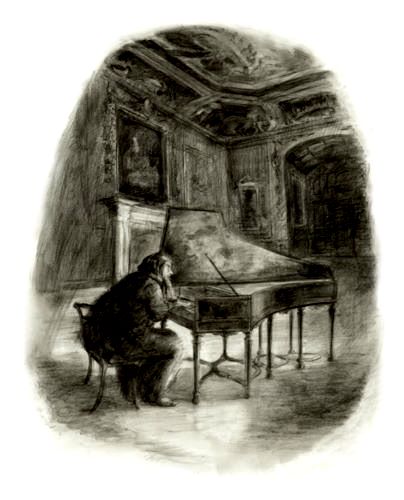
I’ve mostly avoided writing about the footnotes in this book, but Chapter 35 contains an important one regarding a painting that Mr. Strange and Mr. Norrell posed for in late 1814. I love the description of how the two men sat for the portrait, with Norrell fidgety, worried that the painter might somehow be stealing magical secrets, and Strange relaxed, indulgent and patient with Norrell’s neuroses. It’s an excellent sketch of their relationship up to this point, and it provides a starting point from which we begin, in these middle chapters of the novel, to see things degrade rather quickly between the two magicians.
Gentleman’s Magazine
While Drawlight and Lascelles attempt to sow discord between Strange and Norrell, chiefly by reminding Strange that he’s still never been allowed in Norrell’s library at Hurtfew Abbey, Norrell irritates Strange by nagging him about writing. In particular, Strange is supposed to write a piece for Gentleman’s Magazine, and Norrell expects him to only write what Norrell would agree with, and Strange chafes at this restriction, although he doesn’t relish the idea of confronting Norrell about it. Instead, he goes home, ostensibly to write, and complains to Arabella about it.
Drawlight’s Business
Arabella Strange has been listening to her husband’s complaints about Norrell for years, and she has her own very decided opinions on Norrell and Norrell’s friends. She wants, instead, to talk to her husband about a Miss Gray that she’s heard of who claims to be paying Jonathan Strange–to the tune of four hundred guineas–for magic lessons. Jonathan, however, dismisses the story and rather ignores his wife’s concern over the matter, even joking about it. It’s a moment of Jonathan Strange actually being kind of a dick, which I appreciate. Susanna Clarke does a good job, I think, of demonstrating that both of the magicians are kind of insufferable in very different ways. Conversely, she also balances this with including endearing and sympathetic qualities in her characters as well, which make them feel real and three-dimensional.
In any case, Strange doesn’t think of Miss Gray again until a few days later, when he’s at a club and is confronted with a pair of farmers who also claim to be receiving magical instruction from him even though they have never met. When finally introduced to Mr. Strange, the two gentleman farmers are quite understandably upset, but it soon comes out that they were paying a middleman who supplied them with instructional materials based on things Strange had said in conversation with Mr. Norrell–and overheard by the ever present Drawlight. To prove to the two defrauded gentleman that he is who he claims to be, Jonathan Strange steps into a mirror and disappears.
Strange surprises Drawlight and Mrs. Bullworth.
Mrs. Bullworth
When Jonathan Strange emerges from the mirror, it’s a different mirror entirely, in a very different place, some five miles from his own home in Soho. He surprises Drawlight at the home of one Mrs. Bullworth, yet another person who has been paying “Jonathan Strange” for magical services. Mrs. Bullworth has been giving Drawlight money to pay Mr. Strange for using black magic against her many enemies, not the least of which is Lascelles, who is the man who seduced and ruined Mrs. Bullworth, promising to marry her and then abandoning her when she was cast off by her husband.
Obviously, if you’ve read this far in the book you’ve known for some time what kind of men Drawlight and Lascelles are, but it’s kind of nice to see Drawlight, at least, get a bit of a comeuppance. By the end of Chapter 37, he’s banished from Norrell’s society (Norrell actually wants to reinstitute some draconian old laws so Drawlight could be hanged for his crimes) and ends up in a debtors prison. Lascelles manages to avoid a similar fate only because he has actually become truly interested in and invested in Norrell and magic–and because he cuts Drawlight out of his life immediately and completely to avoid any punishment by association with him.
The Strange’s Bargain
Regarding Jonathan Strange’s travelling through mirrors, he finds opposition to his further experimentation with this trick from both Mr. Norrell and Arabella. Although Strange is excited to explore this new power, he eventually promises Arabella that he won’t do it again until she says he may. She, in turn, promises that she will grant her permission as soon as she is convinced of the safety of mirror travelling. I adore their marriage, so much, and this is a lovely compromise.
Lord Portishead’s Book
The final matter of importance that occurs in these chapters is the publication, by Lord Portishead, of a book on modern English magic, to which both Norrell and Strange have contributed. However, when Jonathan Strange reads the published manuscript, he finds himself incredibly disappointed and feeling misrepresented by the final text in spite of his own contributions.
Borrowing a copy of the book from Norrell, Strange goes home and promptly writes the scathing review of it that makes up Chapter 38. It’s the first time that Strange has put himself so directly in opposition to Norrell’s peculiar agenda regarding English magic, and it’s not going to go over well. At all.
With the war now over, Strange and Norrell aren’t quite sure what to do with themselves. Strange’s experiences on the continent and his long absence have both made it somewhat difficult to just slip back into their old student-teacher relationship.
A Bad Place for Kings
Fortunately, the two magicians aren’t left to their own devices for long. King George is in the midst of a period of madness, and several of his children ask the magicians to see if there is anything they can do to help the king. While Norrell dismisses the idea, Jonathan Strange is at least willing to meet the man and see if any ideas come to him.
The first challenge Strange has to overcome is just getting to the king in the first place. King George is being kept basically locked up by the Willises, a pair of brothers who own a madhouse and who are apparently the only people consistently able and willing to actually deal with the king’s madnesses. However, when the king is in their custody, they control every aspect of his life and permit no visitors at all if they can help it.
“This is a bad place for kings!”
Using magic, Strange manages to arrange a meeting with the king, who is certainly mad but also oddly lucid about certain things. It’s clear the king is unhappy as well, which Strange learns more by overhearing the king speaking to an invisible guest (whom the reader should recognize as the gentleman with the thistledown hair) than by conversing with the king himself. Indeed, the king seems to hardly see Jonathan Strange at all, and has frustratingly little to say to him throughout the visit.
The Song of Strange’s Life
Strange takes the king outside to walk through the garden, much against the desires of the Willises, and things just keep getting weirder. The king begins to wander off into a strange wood, and Strange feels himself being lured that direction as well, hearing strange music. The king tells him that “he” is playing for Strange, and Strange hears that the song does indeed describe his life, although he doesn’t know who “he” is. Realizing that something is amiss, Strange suddenly has the idea to use an ancient sort of spell to resist the fairy magic he’s found himself entranced by, and he manages to cancel the enchantment and save himself and the king.
Fairies and Madmen
When Strange returns to Norrell, he asks straightaway about fairies, and Norrell is unhelpful and rather evasive on the subject. Apparently, the affinity of fairies for the insane has been written about at length, and this is what initially guides Strange’s line of questioning. However, Norrell seems eager to put an end to the topic by suggesting that fairies no longer live in England at all anyway, and certainly he and Strange would never be so reckless as to summon one even if they did.
To Crush Their Spirits
Finally, Chapter 34 is a short one, in which the gentleman with the thistledown hair takes Stephen Black on a trip to Africa so they can discuss what to do about the two magicians. These sort of conversations with the gentleman are some of my favorite parts of this book just because he’s so irrational and unbalanced. Still, there is a method to his madness, and he still intends to make Stephen Black the King of England. First on the agenda, though, is to destroy or otherwise thwart the two magicians who seem so dedicated to impeding the gentleman’s plans. “We must make them wish they had never taken up the practice of magic!” he announces at the end of the chapter.
I vaguely recall hearing something about this show sometime back in 2013, but I’m not usually into reality shows and I just totally forgot about it until it popped up on Netflix last week. Now, granted, my enjoyment of the show could have something to do with being stuck at home with a broken foot, but I kind of loved it.
The Quest is ten episodes of pure, slightly silly, feel good entertainment. It’s basically LARPing with occasional competitive games to eliminate contestants (called paladins) to find the One True Hero capable of rescuing the kingdom of Everealm.
The show is reasonably diverse, with the twelve contestants split evenly between men and women, including PoC, and seemingly representative of a fairly wide selection of geeks. I think what I liked best about the paladins, though, is that everyone was so nice. There are a couple of moments where people slip into regular reality show stuff, but overall everyone is just really earnest and positive. Because the show is largely a scripted adventure, even the competitive challenges are in essence cooperative.
The story is pretty predictable, and some of the acting leaves much to be desired, but The Quest is so fun and everyone is so likable that it manages to be such a good time that I didn’t even care. It looks unlikely that the show will get a second season, but if it does, I’ll be tuning in. Or at least waiting til it shows up on Netflix so I can watch the whole thing in one day again.
These two chapters, I think, feel as if there is a ton of stuff going on when, really, only a couple of things happen. There’s some really excellent exposition, though, and it’s great fun to read.
Nan Purvis
Once Jonathan Strange is gone from England, Norrell has time to focus on finding Vinculus’s book, although Childermass is doing most of the actual searching. A break comes when Vinculus’s first wife, Nan Purvis, tells Childermass the story of the time she and her husband met Vinculus’s father.
Apparently, Vinculus despised the man, whose name was Clegg, and Vinculus told Nan Purvis that Clegg was guilty of “the worst crime committed in England in the last hundred years.” When pressed on what exactly the crime was, Nan recalls that Vinculus said that Clegg had stolen a book.
The Book of Magic
After exhausting Nan’s knowledge, Childermass then went to Yorkshire in search of more concrete details about Clegg and the book he stole. Basically all of Yorkshire was once the Raven King’s country, and a family of farmers there, named Findhelm, came into possession of an ancient book some generations ago. The book in question is supposed to have been written by the Raven King himself, and if it could be found and authenticated, it would be the most significant magical discovery in centuries. Even Norrell, who despises the Raven King, is forced to admit the value such a book would hold.
Book Murder
In 1754, Robert Findhelm gave the book to Clegg to be delivered to a man in Derbyshire. However, on his way there Clegg went on a bender, one thing led to another, and he was dared to eat the book, which he did. Several days later, Clegg sobered up, realized what he had done, and simply moved to London where he could disappear. Four years later, he knocks up a waitress who turns out to be Vinculus’s mother.
Norrell insists that this story must be a lie, that Clegg must have stolen the book for his son, but Childermass sensibly points out that Vinculus wasn’t even a twinkle in his father’s eye at the time of the theft. It also turns out that, while Nan said that Clegg had stolen a book, when Clegg was hanged some years later the charge was book murder, Apparently, willfully destroying a book of magic is punishable under English law the same as if one had murdered a person, although Clegg was the last known person to actually be executed for such a crime.
Childermass was unable to find out anything else about the book, and no one can hazard a guess as to how Vinculus may have gotten it, but they all agree to that it’s unusual.
An Apology and an Explanation
Meanwhile, Stephen Black is visited by the gentleman with the thistle-down hair, who apologizes for not taking Stephen to live at Lost-hope forever and explains that it is because he is convinced that Stephen’s destined kingdom is England,so obviously, Stephen can’t just move to fairyland.
While this is all important stuff, my favorite part of this last bit of Chapter 30 is how wonderful an example it is of fairy reasoning. It’s been suggested already in the book that fairies are not entirely sane, and this definitely supports that view. Every time I reread this book, I fall in love with Susanna Clarke’s fairies a little more. They aren’t even particularly evil, just inhumanly inconsiderate and incapable of actually understanding human desires and needs.
Rather a Formidable Person
Jonathan Strange speaks to the dead.
Chapter 31 details the rest of Jonathan Strange’s time in military service. It’s a chapter that actually spans over two years of time, and it’s the first chapter I’ve reached in this reread that I didn’t really love. Mostly, I just find it overlong for the amount of important stuff that happens in it–which is basically two things.
Jonathan Strange does something that I think any reasonable person would consider to be black magic when he reanimates the corpses of seventeen Neapolitan soldiers. Worse than just animating them, he does it without knowing how to end the spell, so eventually the animated corpses have to be destroyed because they are so unpleasant.
The war ends, and Jonathan Strange returns to England. These scenes I actually did really like–Strange’s reunions with his wife and with Norrell–and they serve to establish how these relationships have changed over the last several years of book time.
Overall, though, the chapter just sort of dragged for me, until about the last page and a half of it. Even still, while reading all the stories about it gets tedious, the chapter does really hammer home the point that Strange is reckless with magic and often careless of the consequences of his actions.
So, this happened, and it’s wonderful. Amy Schumer has been on fire lately.
I don’t think I could ever have anticipated that I’d someday be warning for NSFW language on a video containing Bill Nye, but he definitely says the f-word.
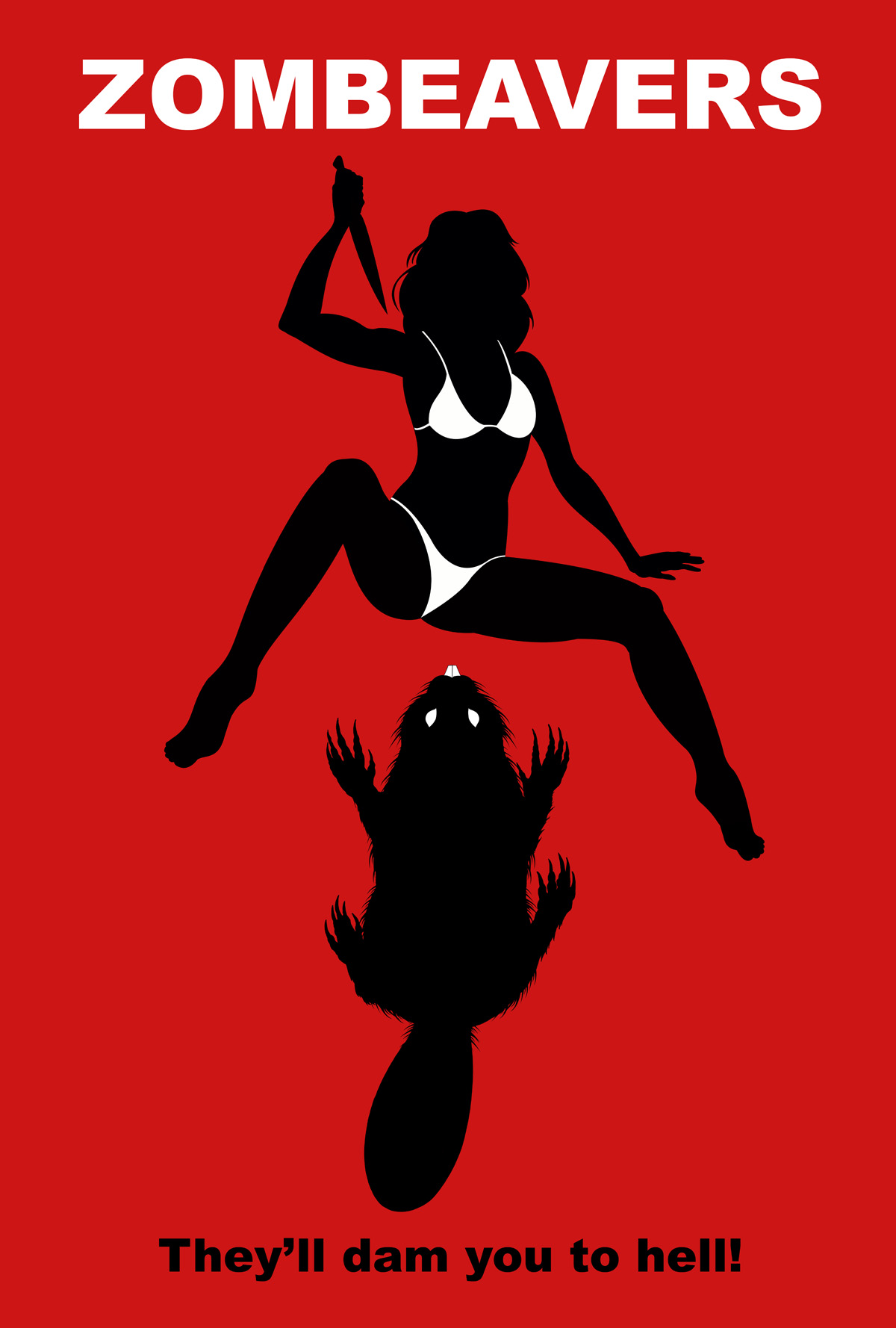
I knew, as soon as I saw the first trailer for this movie, that I was going to love Zombeavers, so I was super excited when it showed up on Netflix relatively quickly. There’s no way that this movie won’t be great, I thought, and I was not disappointed.
From the opening scene, Zombeavers is frequently laugh out loud funny. It’s got an appropriate level of cheaply produced gore. It’s got a charming cast of insufferable college kids who are all pretty much terrible assholes, but who are great fun to watch and make it obvious that they had a great time making this movie (a short blooper reel at the end confirms this).
The beaver jokes are present, as one must expect from this sort of flick. Even including visual gags, there are just enough for a drinking game but not enough to kill you with alcohol poisoning.
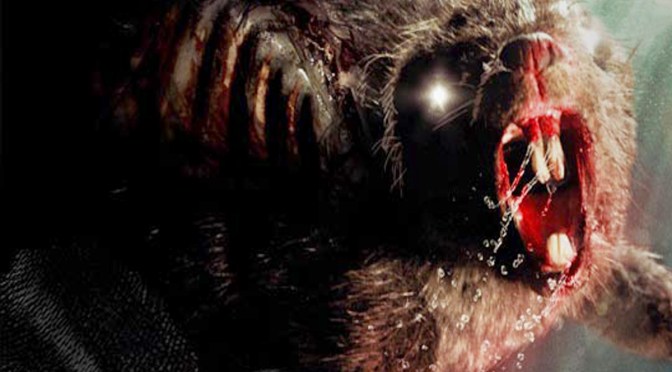
The real stars of the movie, though, are the beavers themselves, who are these delightful animatronic numbers who steal every scene they are in.
Basically, if you like zombie animal movies, you will love Zombeavers and should probably watch it immediately.
After checking in with Lady Pole, we’re back again to focusing on Strange and Norrell and the ways in which they can participate in the War. These chapters have some of the most impressive acts of magic in the books so far, as well as just generally being more action-oriented than the previous third of the book.
The End of 1810
By the end of 1810, basically everything is terrible.
A princess has died, the king has gone mad, the war is a quagmire, and no amount of spells cast by Strange and Norrell seems to make things better. Everything is a mess, and people are becoming decidedly disenchanted with magic.
Horse Sand
When a ship runs aground near Portsmouth, it’s an opportunity for magic to save the day again, and Jonathan Strange gets a moment to really shine. Most of his magic so far has been done in tandem with Norrell since arriving in London, but here Strange is alone and forced to rely on his own more creative sort of magic.
Taking inspiration from the name of the spit of land where the ship has run aground, Strange creates dozens of horses out of sand and sea water, with the idea that the horses should be hitched to the ship to pull it back into the water. Between the displaced sand and what little help the horses turn out to be, the ship is rescued, and it’s all very impressive. While it’s debatable just how useful the spell was, it does serve to get people excited about magic again, and the idea occurs to the ministers that, while they could never send Norrell abroad to help with the war, perhaps Strange would be just the man for the job.
Books
At first, Norrell is vehemently against the idea of his student being sent to the continent, and he’s even more upset when Jonathan Strange brings up the matter of the books he will need to take with him on his journey. Knowing that all the magic books in England are Norrell’s, Strange even manages to broach the topic of books in such a way that Norrell is obliged to agree to loan them.
It’s only when Norrell learns of a likely book sale that he becomes anxious to get Strange out of England. Norrell may miss the forty or so books that Strange intends to borrow for the trip, but Norrell is glad to remove Strange from having the opportunity to bid against him at auction. Even still, Norrell must bid against Arabella Strange, although it turns out that Norrell is able to outbid her every time.
Jonathan Strange reports for duty.
In the Lines
From pretty much the moment he lands in Portugal, Jonathan Strange finds himself a little out of his depth. When he finally makes the acquaintance of Lord Wellington, Strange is told outright that a magician is no use on the front and that the “help” he and Norrell have provided thus far has actually been no such thing. Dejected, Strange goes away, but he is still determined to contribute somehow or other.
Over several weeks, Strange submits proposal after proposal to Wellington, but all are refused. The chaplain is some help in encouraging Strange to find a way to make himself useful, but it’s only after he starts getting to know the soldiers that Strange starts having good ideas. Finally, he settles upon the idea of making roads for the troops to march down more easily. Wellington is thrilled with this idea, and the chapter ends with two happy images: Jonathan Strange riding down his magically-created road at Wellington’s right hand and enemy troops refusing to use perfectly ordinary roads for fear that they are magicked.
Well, that could have been worse. A couple of interesting things happened in this episode, they skipped Arya (which is a nice break from that snoozefest), and a couple of plots moved along nicely, but there was another incident of gratuitous (though not particularly graphic) sexual violence, some truly nonsensical stuff happening in Dorne, and Sansa actually manages to end this episode worse off than she begins it. A mixed bag is still better than last week’s shit sandwich, though.
Ser Alliser does not approve.
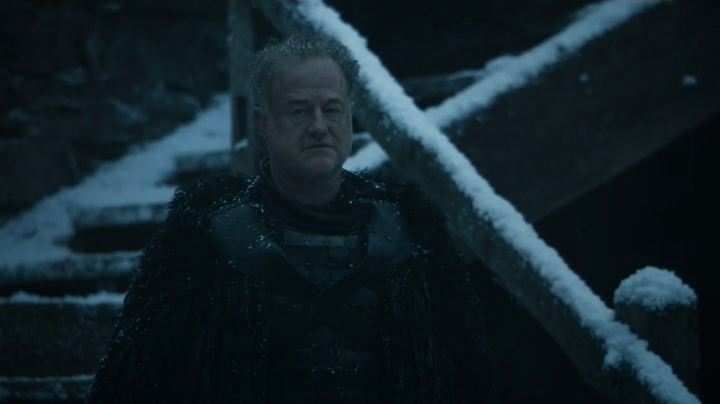
I expected “The Gift” to start right back at Winterfell, but it doesn’t. Instead, we begin at Castle Black where Jon Snow, a few loyal friends, and Tormund Giantsbane are departing for Hardhome. Alliser Thorne still thinks it’s a terrible idea, and Olly is angrily pouting at Jon the whole time as well.
Sam, at least, is sad to see Jon go, and he sends Jon off with a bag of dragon glass daggers and a hope that they won’t be necessary. Seeing these props in the light of what passes for day up at the Wall, I don’t think I like them. They’re supposed to be obsidian, which is a common material and well-known, but these look like they are made of smoky gray plastic–which I imagine they actually are. It’s a tiny thing, I suppose, but they don’t look real at all, which is distracting.
Meanwhile, Maester Aemon is not doing well. He’s not quite wandering in time, but he’s very weak, and he seems lost in reminisces of his youth. In a moment of clarity and presence, though, he warns Gilly to take her baby south “before it’s too late.”
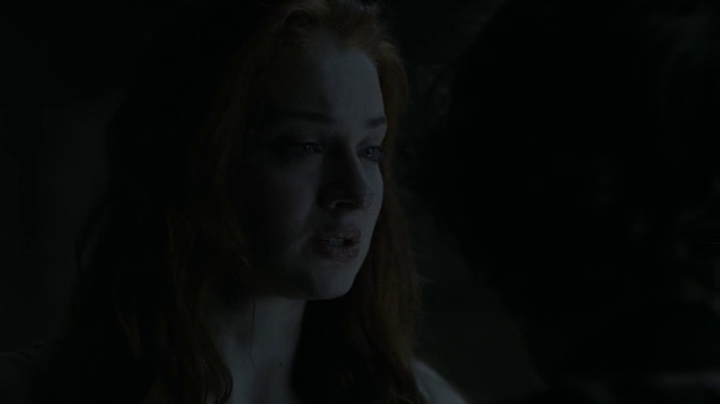
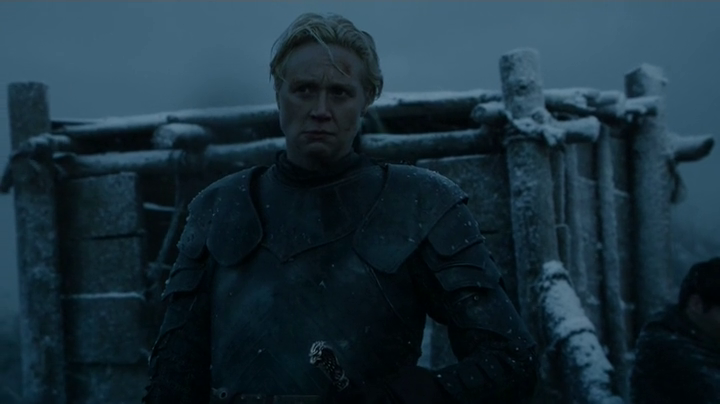
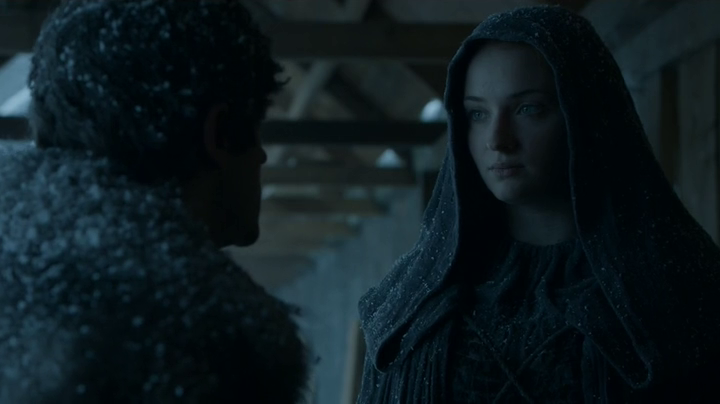
We do make it to Winterfell early in the episode, at least, but Sansa isn’t doing well. As Theon brings her some food, we see her curled up in bed sobbing. When she stands up, she’s pale, tear-streaked, and covered in bruises. However, she doesn’t seem broken, just desperate as she begs Theon to help her. This is the scene that was teased in the trailer for this episode, and I had some hope that it might mean the writers weren’t going to completely screw Sansa over. However, instead of helping Sansa, Theon goes straight to Ramsay and rats her out. Before we leave Winterfell, we see Brienne of Tarth still watching from outside the keep as the tower stays dark.
Brienne has nothing to do yet, but she looks ready.
While I’m more than a little frustrated with how this is going, there are some things I like about it. It’s nice to see Sansa being a little more forceful, and it’s nice to see them making some use of Sophie Turner’s imposing physique. She’s a strapping girl and can be physically intimidating when she wants to be, although she doesn’t quite match the stature of Gwendoline Christie. For the majority of the show, Sansa has been very passive, and her body language and actions have all backed up that perception of passivity, so I kind of like that we’ve gotten to see her do quite a lot more this season. That said, I’m not sure I trust the intentions of the writers, either, and I have a feeling that they are mistaking the appearance of physical power and strength for agency. When Sansa stops Theon from leaving her room and stands over him to make him listen to her, it feels like the writers and directors are trying to make us feel girl power where, really, there’s a desperate, abused woman with very few options.
Maester Aemon’s funeral pyre.
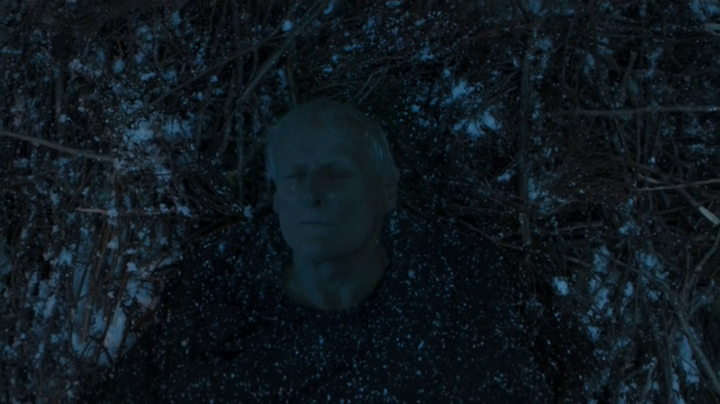
Back at Castle Black, Maester Aemon dies what is perhaps the first natural death in the history of the show. I’m not sure exactly what could have been done better here, but I just didn’t have that many feelings about it. The severe truncation of the various Castle Black plots versus what was in the books has, I think, led to a sort of general glossing over of basically everything that is important. I think I just haven’t seen Maester Aemon enough on the show, especially in the last couple of seasons, to really get too broken up over his death. Which is too bad, because Aemon’s death in the books is really, really sad. On the show the sadness is also cut short by Alliser Thorne’s apparent need to menace Sam literally during Aemon’s funeral.
Sansa always looks her best when she’s subtly mocking evil manchildren.
Later, at Winterfell, Ramsay has Sansa come out to walk around the castle with him while he explains all their defenses. You know, as supervillains do when they think the hero is really trapped. Because, obviously, spilling all your plans to your enemies always works out well. A+ job, Ramsay. As they walk, Sansa picks up some kind of sharp pointy thing off a worktable, and then she starts in on the same kind of passive aggressive commentary that she had some success manipulating Joffrey with, and which seems to get under Ramsay’s skin as well. Ramsay does manage to control his anger, although he lets slip that Jon Snow, Sansa’s half-brother, is now Lord Commander of the Night’s Watch–another big failure on Ramsay’s part to keep pertinent info away from the woman he apparently beats and rapes on a nightly basis. It also turns out that the real reason Ramsay wanted Sansa to walk with him is so he can show her the flayed corpse of the nice old lady Sansa met when she first returned to Winterfell.
I really have mixed feelings about the Sansa stuff in this episode. On the one hand, I’m not sure how I feel about the way they are portraying Ramsay’s sustained abuse, and I feel like the writers are really trying to get us to believe that this is all somehow part of Sansa’s plan, which completely disregards how few options the character has actually had so far. On the other hand, I think that Sansa and Ramsay’s interaction in this episode was really compelling, and I thought they did a really nice job of capturing Sansa’s own mixed feelings about her situation as well as showing that even though things are pretty dire for her right now, she’s still an intelligent and resourceful person. That said, I also feel like they’re showing Ramsay to be so stupid that he couldn’t organize a secret trip to the bathroom, much less run a castle during a war, so even if Sansa does somehow triumph here it’s not exactly some great achievement? It’s not that hard to outwit someone who is constantly feeding you all the information you need to outwit them and who is so lax in their supervision of you that you can easily arm yourself with sharp objects that are just laying around in plain sight.
Anyway. I didn’t hate the Winterfell scenes in “The Gift,” but I’m also not completely sold on the way things are going. Like some of the other story lines in the show, I feel like this one is suffering from being dumbed down so much that a not particularly clever dog could see its plot twists coming from a mile away. Still better than last week’s Winterfell scenes, though.
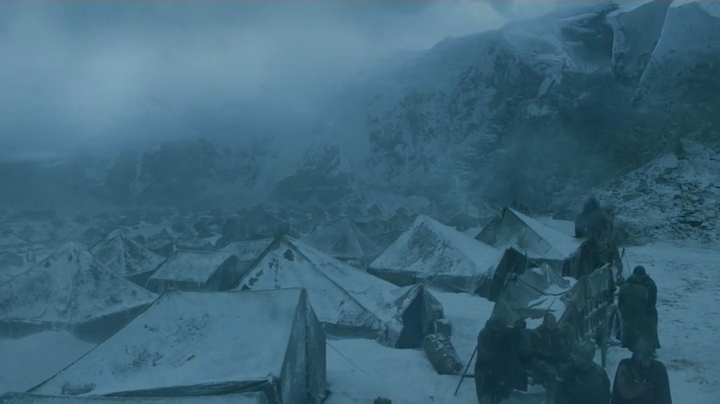
Winter is coming all over Team Stannis.
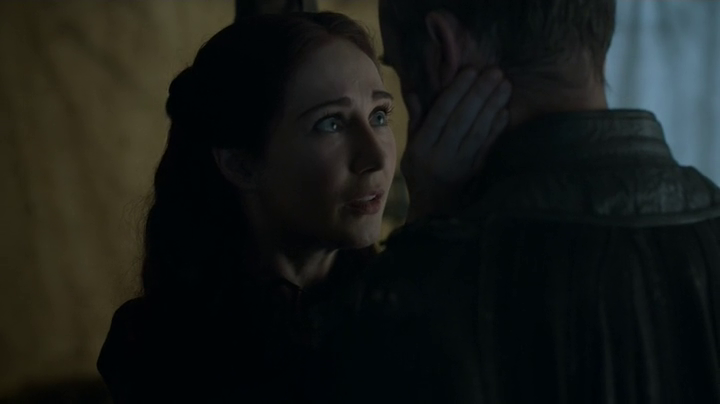
Somewhere between Winterfell and the Wall, Team Stannis is bogged down in snow already. They’re losing dozens of horses every day, there are sick men in the camp, and a group of five hundred mercenaries have deserted in the night. Davos advises that they should turn back to Castle Black and wait out the winter there, but Stannis is determined to press on to Winterfell. After Davos leaves, Stannis turns to Melisandre for reassurance, which she gives. However, she also has a recommendation: sacrifice Shireen in order to ensure their victory in the upcoming battle. This is Stannis’s hard limit, though, at least right now, and he actually sends Melisandre away because he’s that upset by her suggestion.
I honestly feel worried when even Melisandre looks desperately afraid.
I liked the scene a lot, but I’m really curious to see where Team Stannis is going. I think it’s actually unlikely that we will see the battle in the snow before next season, as I feel like there’s still a lot of ground to cover in the next three episodes of season five. I also think it’s unlikely that Stannis will actually give in and sacrifice his daughter, as that would make him so monstrous that I’m not sure anyone would want to watch him at all anymore. Stannis’s greatest strength on the show has always been that he’s a sensible man with a pretty strong and steady moral compass, and him sacrificing his daughter would be incredibly out of character. What does seem likely is that Jon Snow will be “killed” at the end of this season as he was at the end of A Dance With Dragons, and some popular fan theories require that Melisandre is there when that happens. My best guess at that the conflict over Shireen is going to break up Stannis and Melisandre and she will go back to the Wall by herself before the end of this season.
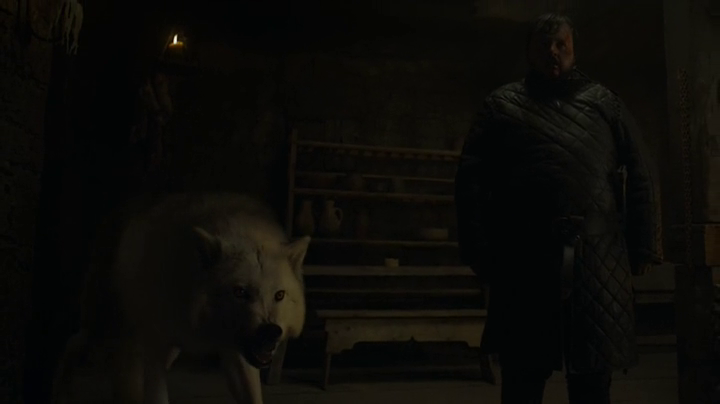
Back at Castle Black, again, we get a nice bit of absolutely gratuitous and nonsensical sexual violence, apparently as a reason for Gilly to pity fuck Sam. This is the part of last night’s episode that made me angry when I saw it and angrier the more I think about it. Basically, Gilly is moving some wet blobs of cloth around like she’s an extra in Monty Python and the Holy Grail when a couple of Night’s Watch guys come in and start harassing her, pretty obviously with the intention of raping her. She’s unarmed and alone with them, and when she resists they get physically violent with her. Then Sam comes in and tries to rescue her, but the other two men just beat the shit out of him. He manages to stand up and threaten them again, and then Jon Snow’s dire wolf, Ghost, pops in to scare the rapists away. Later, while Gilly is tending to Sam’s beaten up face, she straddles him and they do it. I pretty much hate everything about this whole bit, because:
We already know that Gilly is not exactly safe at Castle Black. She’s been sent away once (to Mole’s Town) and just in this episode Maester Aemon warned her to take the baby and go. There’s really no need to reiterate that again.
We know that Sam’s position is precarious and that he’s not really capable of physically protecting Gilly on his own. Even in this episode, we’ve seen Alliser Thorne threaten Sam, and we’ve also seen the other men of the Watch stare at Sam like they want to kill him (again, in this very episode). This was not new information that we needed to have shown to us.
While Sam’s refusal to back down from the fight could be considered to show some character growth on his part, this could have been shown in some other way than having Gilly almost raped. Again on this show a woman is subjected to sexual violence in service of a man’s story. Why not just have Sam harassed and attacked on his own and then go to Gilly for treatment afterwards?
If they really wanted these two characters to have sex, why not just have them driven together by their shared grief for Maester Aemon? This would have been more true to the spirit of how things went down in the books, and it could have been a genuinely sweet and romantic moment that was untainted by the specter of rape that the show’s writers seem to want to keep hanging over their female characters.
Plot convenience wolf! And it’s not even a good plot.
Finally, where did Ghost even come from? What is the point of Jon Snow having a wolf at all if the thing only shows up as plot convenience demands? I mean, a huge white wolf looks pretty cool, but the show seems to use Ghost in only the silliest possible ways.
Oh, and ALSO Sam is like “I don’t know what [those attempted rape guys] would have done.” Really? REALLY. This sort of danger has literally only been talked about ever since the first time Gilly arrived at Castle Black, but okay.
A scene that in the book was about mutual love, shared grief, and healing (especially for Gilly, for whom this is her first consensual sexual experience) becomes something very different on screen, and it’s very disappointing.
On the other side of the world, Jorah and Tyrion are being sold at a slave auction actually in sight of the walls of Meereen. Tyrion manages to get himself bought by the same man who buys Jorah, and they are led off to their new life.
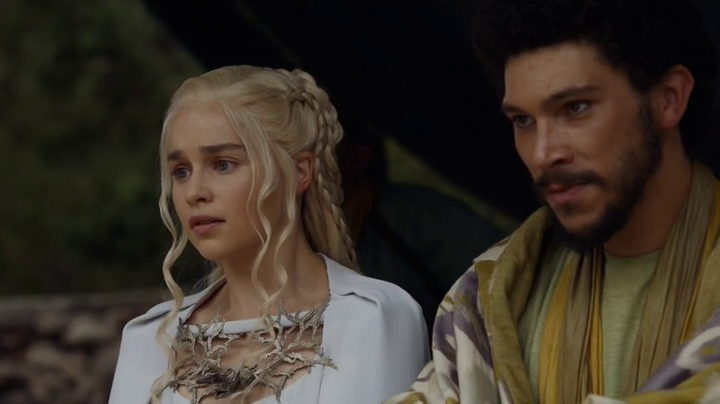
Daario is really harshing on Dany’s mellow.
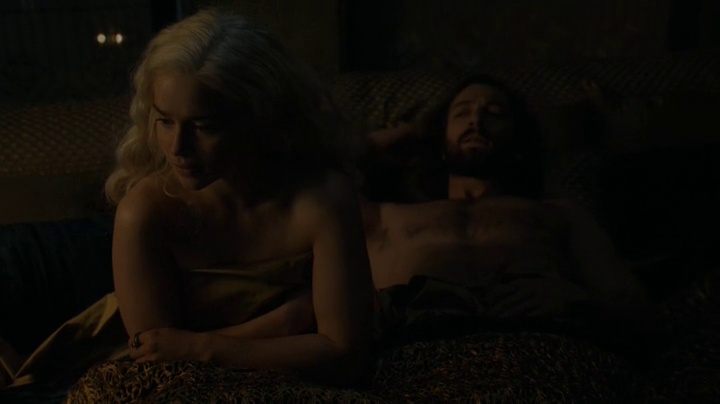
Within Meereen, Daenerys is busy enjoying herself with Daario, who is full of advice. First he suggests that the Sons of the Harpy have only stopped their attacks (apparently that has happened) because Dany is marrying their leader. Then he tells Daenerys that she should marry him instead of Hizdahr, and he seems a little hurt when she says that she has no choice. He insists that everyone has a choice, but she disagrees. His final bit of advice is to round up all of the masters and slaughter them, but she rejects this as well–she’s a queen, not a butcher. “All rulers are either butchers or meat,” Daario replies, and then we’re off to King’s Landing.
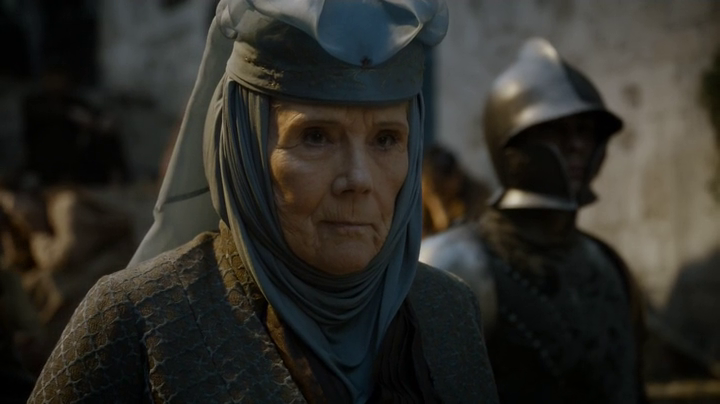
Olenna’s down, but not out.
Lady Olenna has come to speak with the High Sparrow about Loras and Margaery, and she’s prepared for everything but what she finds. Like Cersei, Olenna can’t quite seem to wrap her head around this man’s honestly and deeply-held beliefs. I’m glad to see the show add this context for Cersei’s actions, to be honest. It’s easy, I think, for people to just think Cersei is stupid or that she’s making amateur mistakes, but I think the truth is that, while Cersei is not always entirely rational, her biggest mistake so far has been one that even the legendary Queen of Thorns makes. Both women are laboring under the assumption that anyone can be bought. As Olenna leaves the Sept, frustrated, she’s stopped by someone carrying a message marked with a mockingbird seal.
Mother of the year.
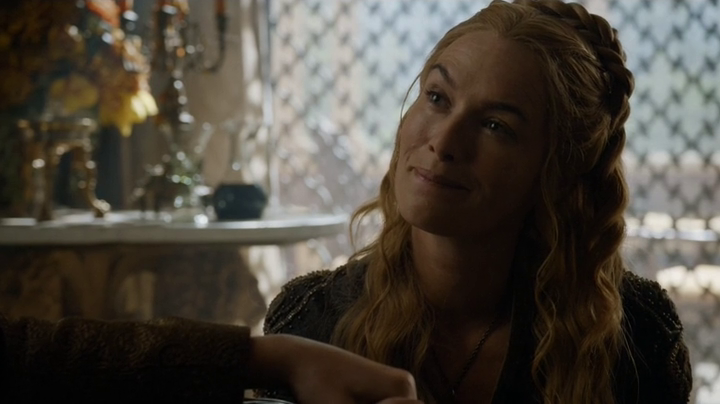
At the Red Keep, Tommen is furious that he can’t do more to help Margaery, and Cersei is there to comfort him. Some things, she says, are just entirely outside of their control, and probably this is all just fate. Tommen rages a little more, even threatens to go to war with the Faith, but Cersei talks him down and offers to go talk to the High Sparrow herself. Placated, Tommen finally relaxes, and Cersei gives a lovely speech about how much she loves him and how dedicated she is to doing whatever it takes to protect him and make him happy. I’m not always thrilled with the writing for Cersei, but I like this. This fierce love for her children is perhaps the only truly authentic emotion that Cersei has, and I never doubt Lena Headey’s performances of these scenes.
Ugh, you just. don’t. GET. it.
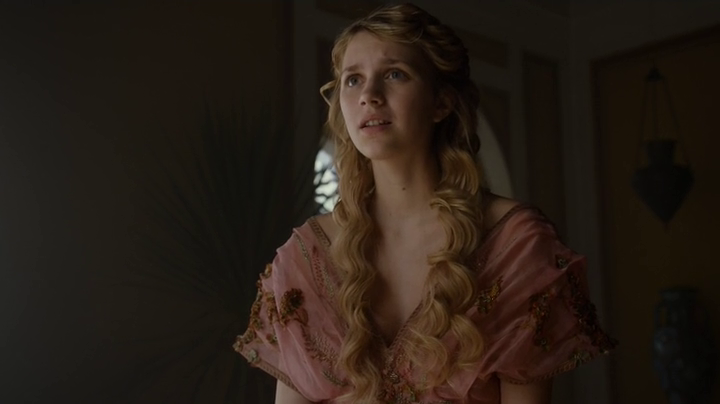
In Dorne, Jaime meets with Myrcella, who stomps her foot and declares her intention to marry Trystane and stay there forever. She’s been there for years, she reasons, so why the hurry to bring her back to King’s Landing now? I didn’t love Myrcella’s scenes with Trystane last week, but I kind of like the new actress here. Her tossing a “you don’t know me!” at Jaime and flouncing out is so wonderfully full of teenage temper and angst (and, honestly, perfectly sound reasoning on her part), it’s great.
Me, too, Nym.
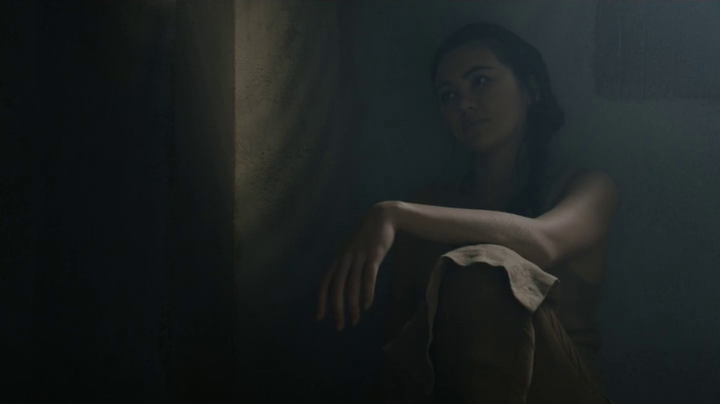
We finally get to hear the end of “The Dornishman’s Wife.” While Jaime is dealing with Myrcella, Bronn is sitting in a prison cell right across from the Sand Snakes. I guess because the show wanted to meet their boob quota or whatever, we get to see Tyene strip down in order to get Bronn to tell her she’s the most beautiful woman in the world, which gets her to give him the antidote to the poison that she cut him with last week. This all gets big eye rolls from Obara and Nym, and I concur. What an anti-climax. All that meaningful lingering on Bronn’s injury in last week’s terribly done fight scene, and Tyene just gives him the antidote because she kind of likes him? Ugh.
Back in King’s Landing, Littlefinger is moping about his destroyed brothel when Lady Olenna shows up for a talk. She’s furious, believing that Baelish sold Loras out to Cersei, which is apparently true. Olenna reminds Littlefinger that his fortunes and those of the Tyrells are deeply intertwined, what with them having killed a king together and all. Littlefinger replies that, though he did have to cooperate with Cersei, he has brought Olenna a gift as well–of the same kind that he gave Cersei.
Who says romance is dead?
Returning again to Tyrion and Jorah, the pair are now at a sort of gladiatorial school, still outside Meereen proper. There is going to be a fight staged, the winners of which will have the honor of fighting at the Pit of Daznak in Meereen, in front of Queen Daenerys herself. Unfortunately, Jorah and Tyrion are both being left out of this particular fight–until Daenerys shows up with Hizdahr on a date–because nothing is more romantic than blood sports. Jorah rushes out to fight, soon followed by the rest of the gladiators that are still down in their little dugout thing, but Tyrion is left chained to the stone benches. Jorah wins the melee, and without killing anyone since he knows Dany’s distaste for violence, but Daenerys isn’t happy to see him. Tyrion manages to get himself freed, and introduces himself to Daenerys as Jorah’s gift to her right as she’s about to send Jorah away again.
In all seriousness, I’m really happy that Dany was so unhappy to see Jorah. I’d be very disappointed if she was glad he was back.
In some ways, this is the worst sort of plot convenience theater, and the guard inexplicably chopping Tyrion’s chain was downright silly, but this actually worked for me. I think that, partly, I’m just bored with Tyrion and Jorah together, and I hated their stuff last week, so this seems good by comparison. And, partly, I’m just happy to see this story line moving along at this sort of clip. I loved ADWD, personally, but if the show really tried to capture all that stuff, it would run for like ten seasons at least. Between the Tyrion/Jorah show and boring Daario/Dany scenes, it would have been just excruciating if they’d put this meeting off any longer. While it’s not the last scene of the episode, it also works as a nice little cliffhanger and gives us something to look forward to next week.
Margaery in her cell.
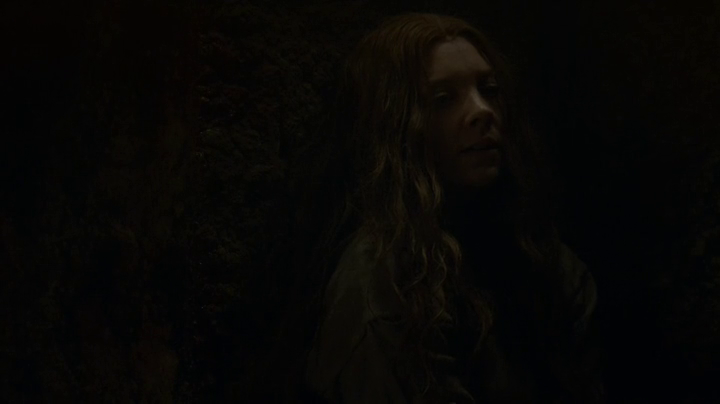
The show instead ends in King’s Landing, where Cersei arrives at the Sept to gloat at Margaery, who looks absolutely miserable in the dank cell she’s being kept in. As Cersei stands over her, smirking, Margaery gets the excellent and thematically important line:
“Lies come easily to you; everyone knows that. But innocence, decency, concern…you’re not very good at those, I’m afraid.”
Cersei is walking on air as she leaves Margaery.
I know we haven’t even reached the end of ADWD content for this storyline yet, but I kind of can’t wait to see what happens with these two queens next season. Certainly, neither of them will be killed (although poor Loras may not be so lucky), but with the end of ADWD bringing so many changes, there’s really no telling what these ladies will be up to after this mess clears. In the meantime, Natalie Dormer and Lena Headey really are consistently amazing in their roles, especially in their scenes together, of which this may be the most important to date.
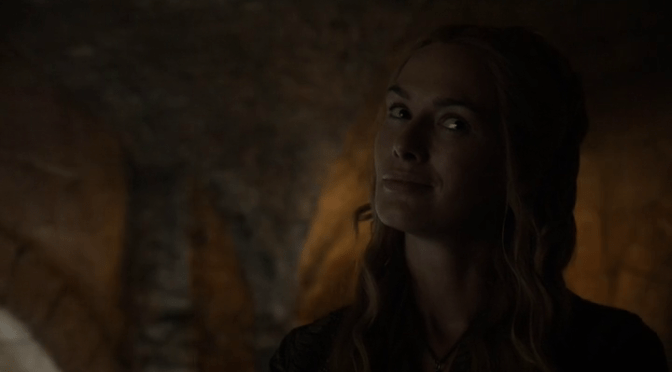
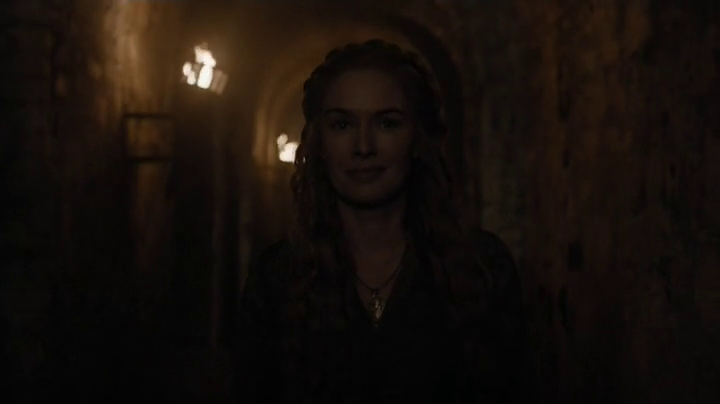
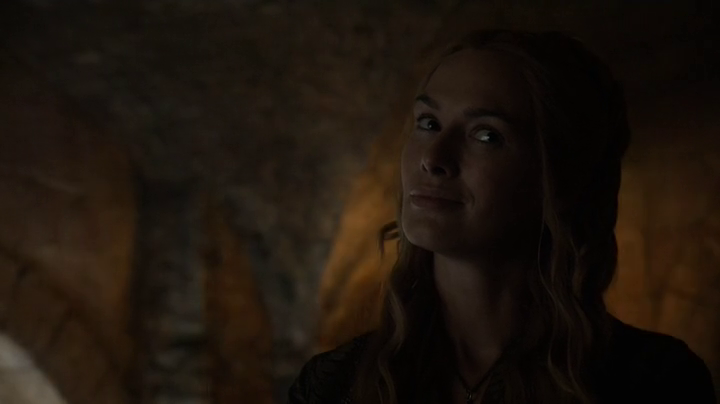
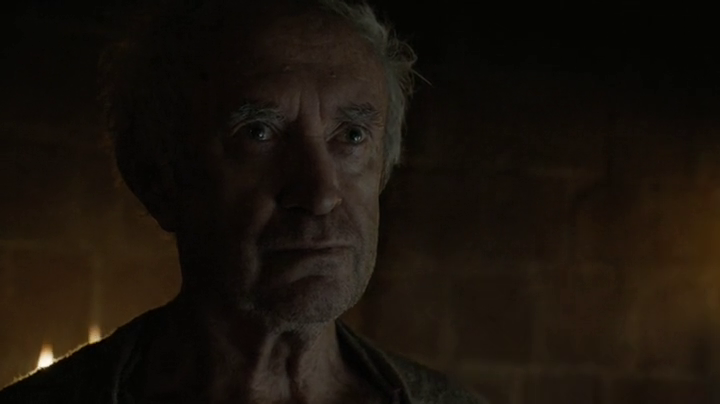
Cersei’s “Oh, Shit” smirk is only one glorious incarnation of her signature expression.The High Sparrow’s self-satisfied look is a lot more terrifyingly dead-eyed than Cersei’s usually are.
Cersei walks away from Margaery’s cell with an absolute spring in her step, she’s so pleased by how things are going, and she goes next to speak with the High Sparrow.
This scene is honestly magnificent, and I’m really not sure it could have been done any better. Probably my favorite thing about it, aside from Jonathan Pryce’s absolutely chilling performance, is getting to see such a wide range of Lena Headey’s smirks. We see Cersei go from self-satisfied, to bored, to mildly concerned, to completely terrified/angry, and her expression can reasonably be described as a smirk for about 95% of her time on screen. It’s a pretty great end to the episode, and I hope the show can maintain this pace over the next couple weeks.
Chapters 26 and 27 are largely concerned with updating us on the situation with Stephen Black and Lady Pole. Important introductions are made as well, between Jonathan Strange and Sir Walter Pole and–even more significantly–between Arabella Strange and Lady Pole.
The Music Never Varied
It is now nearly two years after Lady Pole and Stephen Black were first enchanted by the gentleman with the thistle-down hair. Both Stephen and Lady Pole continue to be whisked away every night for various entertainments–balls, dinners, processions, and so on–in fairy land, and we can see that this takes a great toll on their constitutions.
Throughout this time, the fairy gentleman has lavished all kinds of gifts and attentions on Stephen Black in particular, and in chapter 26, the fairy contrives to gift Stephen with a crown, scepter and orb, which are traditional accouterments of royalty. The gentleman is convinced that the kingdom that Stephen Black is destined to rule is in fact England. Stephen, for his part, wants none of this, but finds himself incapable of communicating his problem to anyone.
Mr. and Mrs. Strange
As the Stranges settle in to London, they find themselves quite popular and well-liked. Jonathan Strange is younger and much more agreeable than Norrell, and Arabella is pretty, intelligent and charming. However, the beginning of Chapter 27 finds Arabella slightly at odds with her husband, who seems to have grown a little distant and slightly inconsiderate of his wife. Although she’s sweet and good and patient, and largely indulgent of her husband’s new profession and friends, it’s clear that Arabella is not entirely comfortable with their situation.
In the winter of 1809-10, Jonathan and Arabella are invited to the home of Sir Walter Pole, where Pole wants Jonathan to discuss the use of magic in the war effort. While the men go to confer, Arabella determines to sit down and read, only to find she’s really not in the mood. Instead she begins to explore the Poles’ home.
What Lady Pole Said
Arabella soon comes to a lovely room filled with paintings of Venice. As she admires the artwork, she almost doesn’t notice Lady Pole, who is relaxing before the fireplace. The ladies introduce themselves, and Arabella comments that she has heard much of the great service Norrell has performed for Lady Pole.
“Mr. Norrell has been no friend to me,” said Lady Pole in a dry, matter-of fact tone. “I had far better be dead than than be as I am.”
Arabella is aghast, being used to thinking that Norrell’s saving of Lady Pole’s life was a miraculous service, although Arabella herself has no reason to love her husband’s tutor. As Lady Pole continues on, Arabella starts to be concerned, and Lady Pole insists that she has some secret to tell. Unfortunately, much like Stephen Black, Lady Pole is simply incapable of speaking about her enchantment, and all that comes from her mouth is mad-sounding stories.
Sir Walter comes to take his wife away, although Lady Pole greatly desires that Arabella should come back and visit.
“I see no one. Or rather, I see whole roomfuls of people, but not, a Christian among them.”
Arabella of course promises to visit. While left alone, Arabella hears a bell, which strikes her as odd, as Sir Walter told them earlier that the bells no longer ring in their part of town. As they leave, Mr. and Mrs. Strange both describe having odd experiences.
A few days later, Drawlight is trying to pump Arabella for information on Lady Pole, but this only confirms Arabella’s low opinion of the man.
The Ladies of Jonathan Strange & Mr. Norrell
I love these characters so much. Arabella is an absolute delight, but even Lady Pole is a well-drawn character with a personality of her own. Probably my favorite thing about this last chapter is the look that Lady Pole gives her husband, as observed by Arabella:
There was a sadness in it and pity too and, oddly enough, a little amusement. It was as if she were saying to herself, “Look at us! What a sad pair we make!”
I really appreciate that Lady Pole is not a mere object. She’s not simply a damsel in need of rescue or a mystery for a hero to solve. She’s a person, with opinions and ideas and a sense of humor.
By the same token, Arabella isn’t just Jonathan Strange’s good little wife. While she’s definitely patient with him and willing to put up with his eccentricities and the demands of his new career, she’s no pushover. She’s smart and funny and brave and kind, and she’s a fairly decent judge of human character.
It makes me very happy that in a book that is so concerned with the intertwining lives and stories of two men, the author still makes it a point to dedicate time and space in the story to developing female characters and writing their relationship.
 These chapters are busy ones, but less with action than with characterization. Peacetime gives Mr. Strange in particular plenty of time to analyze his relationships with the other characters, especially Mr. Norrell.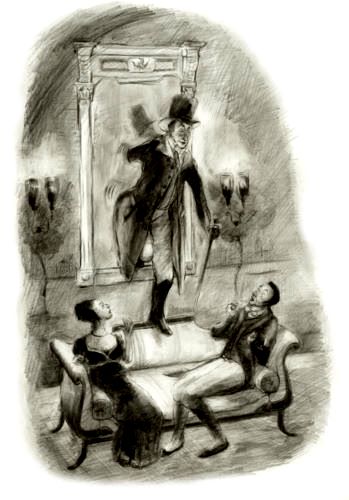





 SF Bluestocking