All posts by SF Bluestocking

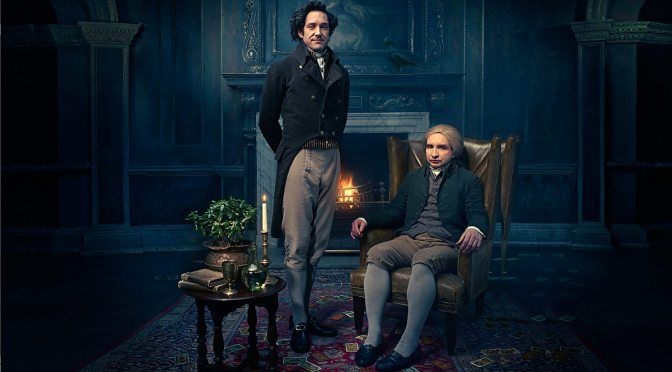
Jonathan Strange & Mr. Norrell Recap: “The Friends of English Magic”

“The Friends of English Magic” covers a good deal of the first third of its source material, but it still feels as if things are starting off pretty slow. This is reflective of the style of the book, which starts slowly as well and builds up into a dramatic juggernaut over time, and I’m not sure if anything could have been done differently and remained a faithful adaptation. Still, it might have been nice to have a little more excitement.

The episode opens with John Segundus and the question that he puts to the York Society of Magicians and later to Mr. Norrell:

Why is there no more magic done in England?
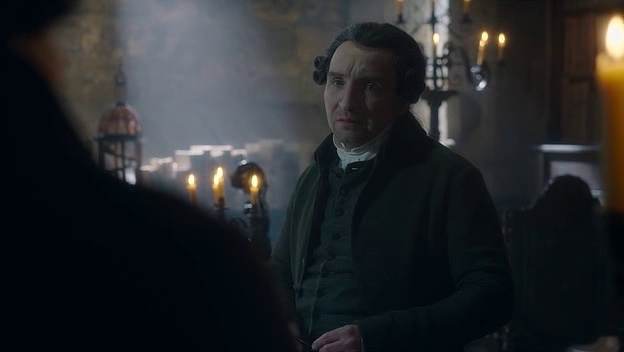
Quite a tolerable practical magician.

I’m happy to see this being translated to the screen so exactly, but I felt like the introduction of Mr. Norrell, in particular, was rushed, and the delivery of Norrell’s statement that he, himself, is a quite tolerable practical magician just didn’t quite work for me. Eddie Marsan looks the part, but his performance, at least in this crucially important scene, is unpleasantly affected-seeming.

Enzo Cilenti as Childermass is a little better. Although I imagined Childermass taller and darker, my main complaint about Cilenti’s portrayal is that he mumbles his lines to a degree that he’s nearly unintelligible. Edward Hogg as Segundus is a little too reminiscent of Sleepy Hollow-era Johnny Depp, but I find the sort of nervous energy he brings to the role endearing rather than otherwise.

I didn’t love the exterior shot of Hurtfew Abbey. It seemed run-down when I think they were going for gloomy, and I don’t really think either of those things are quite right for the magician’s house. Inside, I think they nailed the weirdness of Norrell’s labyrinth, but the library was a bit too medieval-looking. when I would have expected it to be a little more comfortable. The windows and light were nice, but just, in general, I find everything to be a little too grey and brown, which is too bad because I think grey and brown and dull is sort of the aesthetic the show is going for.

Norrell’s feat of magic at York Minster was similarly rushed feeling, almost frantic-seeming, and visually disappointing, again mostly because everything sort of congeals into a monochromatic grey dullness that sucks the life out of every scene.
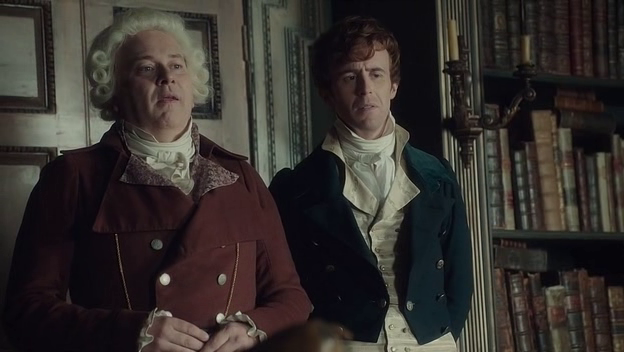
Drawlight and Lascelles

Even Norrell’s arrival in London only shifts tone from grey to beige; it’s less gloomy but not much more visually interesting. Even Drawlight (a poorly cast, too old, and obnoxiously lisping Vincent Franklin) is sadly muted in a muddy pepto-bismol pink. John Heffernan as Lascelles, on the other hand, is a perfectly bored and jaded almost-aristocrat, and is one of the few casting choices that I wholeheartedly approve of.
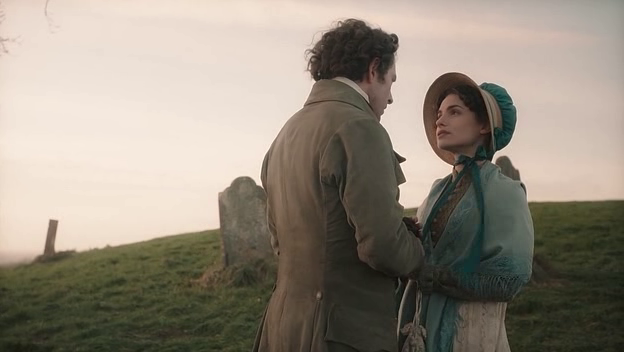
Jonathan and Arabella.

Since everything concerning Norrell is so shrouded in gloom, I would have expected Jonathan Strange’s scenes to be a little more bright and colorful, but that’s hardly the case. However, the casting of Jonathan Strange, Arabella, and Henry is on point. Charlotte Riley, in particular is everything I could have hoped for in Arabella, and her expressive face is put to good use in these early scenes. Bertie Carvel’s Jonathan Strange is perhaps a tad too ingenuous, especially since he’s a good deal older here than Strange is when he’s introduced in the book, but he’s likable and not too handsome for the role.

I was very happy to see Jonathan Strange’s father included, although I suppose the time could have been better spent on other material. There were several scenes that I though could have used just an extra thirty or sixty seconds, and the elder Strange just isn’t that important in the grand scheme of things. As a reader who loved all parts of the book, I’m glad this made the cut, but I can definitely think of more than one better use of that time.

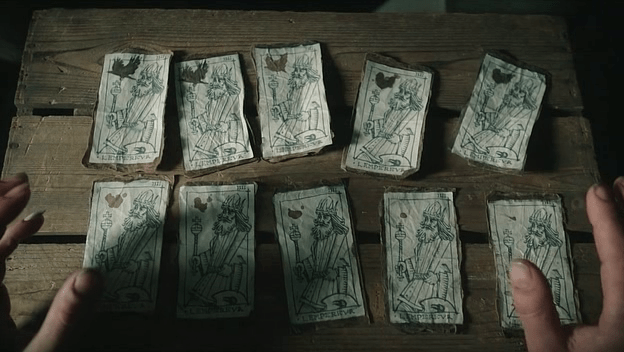
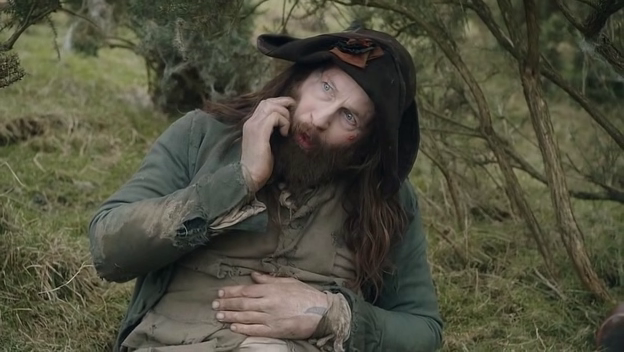
Possibly the greatest disappointment of this first episode is how quickly they fly through everything concerning Vinculus (Paul Kaye, perfectly cast). There’s no particular scene that has been cut from the source material, and all of the most important events happen in the show just as they did in the book, but every scene with Vinculus is one that could have run just a little longer to better effect. In particular, I would have liked to see the part with Childermass, Vinculus, and the cards of Marseilles taken a lot more slowly, and I think Vinculus’s prophecy to Norrell in the alley could have just been enunciated a little better. I’ve watched it twice now, and both times it came across garbled.
Vinculus.
Vinculus.

On the bright side, Vinculus’s meeting with Jonathan Strange was done nicely. Again, with the mumbling of lines, when I feel like important prophecies should be pronounced more clearly, but overall well-done. This is followed up with Jonathan’s revelation to Arabella and Henry that he plans to study magic, and this scene is one that probably couldn’t have been done better. It bothers me a little that the “enemy” is so clearly recognizable as Norrell, here, but I don’t know how it could have been done differently. When reading the book, this is one of those things that is obvious to the reader but not to the character, and by the time Strange and Norrell meet in the book it’s nearly forgotten because it’s been over a year of book-time. I just have a feeling that it’s going to have to be dealt with differently in the show to avoid making the Stranges seem stupid, and I’m not sure how I feel about that.

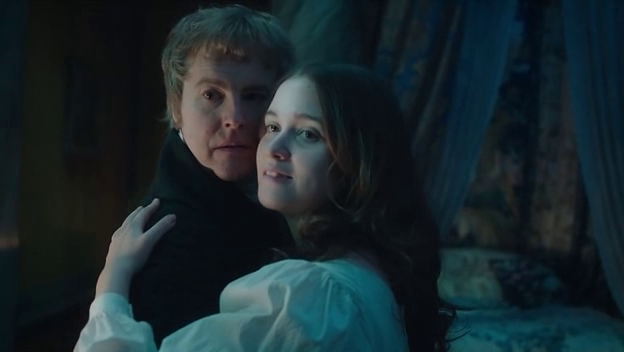
The episode ends right where it ought to: with Mr. Norrell’s resurrection of Miss Wintertowne (later, Lady Pole) and the introduction of the gentleman with the thistledown hair. I didn’t love this. In fact, I feel let down by it.
vlcsnap-2015-06-13-21h22m23s95
Sir Walter and his resurrected bride.

First, let me say that I actually love Alice Englert as Lady Pole. When I heard that the girl from Beautiful Creatures (which was a turd of a film based upon a book that I found unreadably bad) was playing one of my favorite characters, I was definitely apprehensive, but I think she’s going to be okay.

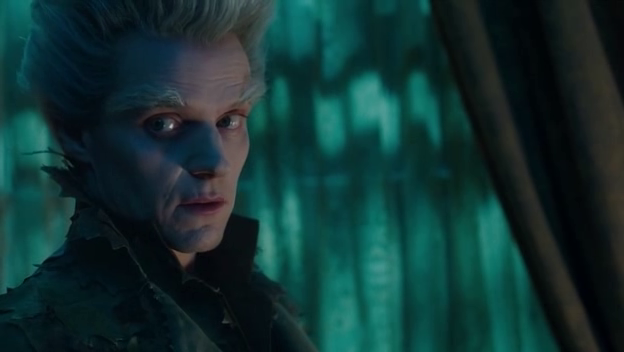
Second, I have to admit that I find myself liking Marc Warren’s Gentleman in spite of myself. I would have preferred a younger actor for the role, but I think he will work after all, once I adjust my expectations.
vlcsnap-2015-06-13-21h19m21s69
The fairy gentleman.

What I feel let down by, though, is the sheer level of gloom that seems to settle over everything. Like Drawlight’s puke pink suit, the Gentleman’s rather moldy-looking green ends up looking grimy rather than atmospheric, and the leafy cutouts around the edges of it are just a bit too heavy-handed a sign of him being a fairy. It’s certainly not magical, and I would have expected this scene, at least, to have something otherworldly about it. It’s not terrible, I suppose, but I find the sort of ever present pall over ever bit of the show to be a little depressing in a way that the book never was. While the show isn’t devoid of humor, I would like to see it being a little more fun. I think the worst thing that could happen would be for it to take itself too seriously.

Weekend Links: June 13, 2015

Mad Max: Fury Road modded ponies

Tor, Irene Gallo, and Sad Puppies (Because this shit just keeps happening.)

Chuck Wendig’s “I Stand by Irene Gallo” is pretty much the definitive post on the topic.

Kameron Hurley weighs in with “The Revolution of Self-Righteous Dickery Will Not By Moderated.”

Jim C. Hines collects shit the Puppies have said in “Puppies in Their Own Words.”

Martin Lewis reads the Puppy Slate nominees for Best Short Story so you don’t have to.

Eric Flint puts forward the eminently sane reminder that “No, Awards Aren’t ‘Fair.’ Never Have Been, Never Will Be. So What?”

Miscellany

The Mary Sue on Age Gap Films – As someone in an age gap relationship myself, I really appreciate this piece. The problem with cinematic age gaps isn’t so much that they exist, it’s that we aren’t supposed to think they are age gaps. We’re just supposed to think that women look the same for all the years between around age 23 and age 50.

Various...Mandatory Credit: Photo by Ian Dickson / Rex Features ( 750588ck )  X-Ray Spex - Poly Styrene  Various
Photo by Ian Dickson / Rex Features ( 750588ck )
X-Ray Spex – Poly Styrene
Various

Jason Heller at Clarkesworld – The Day-Glo Dystopia of Poly Styrene: Punk Prophet and Science Fiction Priestess

I feel like @BEYONCEFANFIC definitely falls under the SF umbrella, and it’s awesome.

The Mary Sue again, on why we should maybe “Stop Asking ‘Is This Feminist?'”

In a tangentially related vein, Tumblr user fierceawakening writes about the usefulness of the idea of being a “critical fan”

binti-book-coverCheck out the newly revealed covers for Tor.com’s upcoming novellas. I’m probably most excited about Nnedi Okorafor’s “Binti,” but there are only a couple of these that I’m not really looking forward to reading.


Reminder: Jonathan Strange & Mr. Norrell to air on BBC America starting tomorrow night

The great Jonathan Strange & Mr. Norrell reread is finished, and tomorrow the show starts airing in the US. I will be posting a recap and analysis of each episode the Monday after it airs.

You can get an early start on the series if you’d like, as the first episode is available to stream already at BBC America.

Rereading Jonathan Strange & Mr. Norrell: Chapters 68-69

Strange_BlackAfter the relative calm of the last three chapters, the penultimate chapter of the book contains another flurry of events described in short vignettes:

  • Jonathan Strange and Mr. Norrell discuss their shared experience of wanting John Uskglass’s attention and their shared desire to impress their mutual master. To that end, they begin looking for a spell that might do the trick.
  • The gentleman with the thistledown hair approaches Starecross, bent on revenging himself against Lady Pole.
  • Lady Pole is furiously writing letters to expose Norrell’s treatment of her when she sees the gentleman and Stephen Black approaching and runs out to meet them. John Segundus follows her.
  • Back at Hurtfew, Strange and Norrell locate the book they’ve been searching for and begin their spell, targeting the “nameless slave.”
  • Outside Starecross, Stephen Black suddenly finds all the magic of England at his disposal. Quickly working through some of his complicated feelings about England, Stephen Black uses the enormous burst of magic to kill the gentleman with thistledown hair. While the gentleman warns Stephen that he will never know his true name now, Stephen has come to terms with being the nameless slave.
  • At a house in Padua, Arabella Strange steps out of a mirror and into the arms of Flora Greysteel.
  • Stephen wakes up to Lady Pole calling him from far away. He ignores her, “[casting] off the name of [his] captivity,” and walks further into Faerie, where he finds himself at Lost-hope. There, he is welcomed by the inhabitants as their new king, fulfilling his part of Vinculus’s prophecy.
  • Once more at Hurtfew, Jonathan Strange and Mr. Norrell finally feel as if they’ve gotten the attention of John Uskglass, and they find it rather disturbing. Norrell locates Lady Pole (in Yorkshire) and Arabella (in Italy), but Strange doesn’t seem particularly interested in the news.

The final chapter of the book does two things.

To start with, it mirrors the first chapter of the book by focusing on a meeting of Yorkshire magicians. This one is every bit as raucous and argumentative as the first one, especially when they learn the reason for their having been called together. Childermass is there, and he’s come to tell them that their previous agreement with Norrell is null and void, that anyone can practice magic now however they like. When they complain of their lack of books, Childermass brings forth Vinculus, whose tattoos have been rewritten entirely.

Finally, the book ends in Padua, where Arabella Strange has been recuperating with the Greysteels. She and Flora have become fast friends, and they are getting ready to return to England when a spot of darkness appears, heralding the arrival of Jonathan Strange. Arabella goes to meet her husband, but this last reunion of the novel is bittersweet.

This, I think is my favorite part of the whole book, and I will love Arabella Strange forever for not going into the Darkness with her husband. It makes for an ending that is heartbreakingly sad, but also beautiful and just and completely perfect for the story. Because, ultimately, Jonathan Strange and Mr. Norrell deserve each other.

Rereading Jonathan Strange & Mr. Norrell: Chapters 65-67

Strange_RedThese chapters continue to examine pairs of characters: Stephen Black and the gentleman with thistledown hair; Jonathan Strange and Mr. Norrell; and Childermass and Vinculus. Then last line of Chapter 67 is also what I would call the proper climax of the book, the final revelation before the denouement in the last couple of short chapters.

These three chapters are each rather short, and after the sort of frantic pace of happenings in the last few chapters, these chapters are comparably calm.

Stephen Black’s Name

Chapter 65 is half taken up with the story of how the gentleman with the thistledown hair found out Stephen Black’s true name. It’s a fascinating story, although we don’t actually find out Stephen’s name.

Primarily, this chapter contains three events. The gentleman finds out that Jonathan Strange is back in England, and then he learns that Lady Pole has been released from her enchantment. Sandwiched between these two revelations, Stephen Black and the gentleman encounter Vinculus. In a fit of malicious caprice, the gentleman hangs Vinculus from a nearby tree before Stephen Black can even protest, and then they are off again. The gentleman intends to cast a spell on Lady Pole so that she won’t live long now that she’s free of him.

Jonathan Strange and Mr. Norrell together again.

“Let you and me do something extraordinary.”

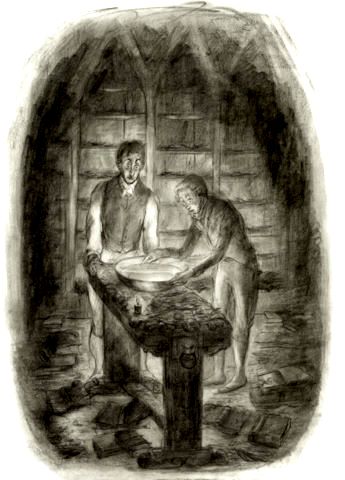
In Chapter 66, Norrell finally makes it to his library, where he finds a disheveled Jonathan Strange poring over the books. I love every single thing about this reunion. I love that it’s Jonathan Strange’s totally normal noise-making that emboldens Norrell to enter the room, and I love that the two men so quickly revert to something like their normal interactions. I love that Norrell is so easily seduced by Strange’s enticements–because no matter how repressed Norrell has been, he loves magic, and all he has wanted to do is magic, and the scary shit that Jonathan Strange is up to is exactly what Norrell has always wanted to do. I love that they find themselves stuck in Eternal Darkness together–because of course the are.

Aside from the reunion of the two magicians and all the feelings that generates, the only thing to really happen in this chapter is their attempt to summon John Uskglass. While he doesn’t show up in the room with them, Strange and Norrell are able to use a locating spell that places him in Yorkshire, and close.

John Uskglass’s Spell

Chapter 67 contains another reunion, this time between John Childermass and Vinculus, who is lately dead. Childermass comes upon Vinculus’s hanging corpse as he makes his way back towards Hurtfew Abbey, and this distracts Childermass from his stated mission to help Strange and Norrell. Instead of continuing his journey, Childermass stops to try and figure out a way to preserve the precious writing that covers Vinculus’s body.

As Childermass tries to figure out what to do, a mysterious man in black shows up. It’s obvious to the reader that this is the Raven King himself, but Childermass is unable to recognize him, probably because of magic. The Raven King resurrects Vinculus and disappears.

Vinculus awakes and Childermass thinks now that Vinculus was only unconscious. Vinculus tells Childermass some more about the prophecies that he’s told. Childermass expresses his loyalty to John Uskglass, but states that the restoration of English magic is the work of Strange and Norrell, not the Raven King. At this, Vinculus laughs outright:

“Their work!” Vinculus scoffed. “Theirs? Do you still not understand? They are the spell John Uskglass is doing. That is all they have ever been. And he is doing it now!”

Mad Max: Fury Road is the best two hour car chase you should be watching right now

Valkyrie
Megan Gale as the Valkyrie.

If you only see one movie this summer, make sure it’s Mad Max: Fury Road. I haven’t enjoyed a movie so much in years, and I can’t remember any time that I’ve come away from a film with so little to complain about.

Fury Road begins with a short introduction to Max, but he’s shortly captured and taken to  Immortan Joe’s citadel to be used as a blood bag. There’s a lot of worldbuilding going on here, and within he first ten minutes or so of the movie you get a pretty good idea of the post-apocalyptic world that George Miller envisions. Fans of his older Mad Max movies will recognize the aesthetic, which (refreshingly) avoids the gloom and doom that has become characteristic of the post-apocalyptic and dystopian genre (and, really, of sci-fi and fantasy in general) over the last few years. The darkness here is more akin to the surrealism of a Heironymus Bosch painting than the soul-crushing grimness of Game of Thrones or a Christopher Nolan film. While there’s not a lot of color (the palette sticks to shades of sand and black for high contrast) and there is a lot of dirt, Fury Road still manages to be full of light and warmth that endures even through night scenes.

Doof Warrior
The Doof Warrior

The plot is simple, and the movie is light on dialogue. I’m not being facetious or hyperbolic when I say it’s a two hour car chase. It is literally two hours of car chase, punctuated with stops for repairs. It’s an incredible spectacle, made even more amazing by the knowledge that Miller prefers to eschew CGI in favor of stunts and conventional effects. It’s also notable that, while there’s a lot of violence, there’s very little graphic violence. Indeed, much of the film’s violence is only implied. People die, but there are no long, lingering shots on dead bodies. People are injured, but there are no enormous blood splatters. Women have been kept as sex slaves for breeding and for milk, but there’s no explicit sexual violence on screen. Most of the violence is conveyed through explosions and flamethrowers and cars with spikes ramming into each other, and it’s all set to the aggressive rock music provided by the Doof Warrior (pictured above).

maxresdefault
The wives (clockwise from back left): The Dag (Abbey Lee), Cheedo the Fragile (Courtney Eaton), Capable (Riley Keogh), The Splendid Angharad (Rosie Huntington-Whitely), and Toast the Knowing (Zoe Kravitz)

Speaking of women, Fury Road is just full of them. Imperator Furiosa (Charlize Theron) is an excellent hero, with an appropriate amount of depth of character for the type of movie she’s in. Immortan Joe’s five runaway wives each have a personality of their own, and all of them are shown to be tough and resourceful along with Furiosa. The Vuvalini of Many Mothers, who Furiosa and company meet in the desert, are also amazing and are part of the coolest fight/chase sequence in the film. At the same time, George Miller doesn’t shove any of these women into the normal Strong Female Character box that is generally reserved for women in action flicks. Just the sheer number of women included creates plenty of room for them to be different from each other, and in addition to being badass fighters and all around tough broads, the women of Fury Road get to be frightened, sad, kind, nurturing, and gentle as well as brave and defiant. Even Furiosa, who it would have been very easy to turn into a caricature-like collection of girl power tropes, doesn’t have to be an automaton of “strength” all the time, and it’s very nice to see an action heroine who understands the value of community and the wisdom of being able to depend on others sometimes.

pacnv9d5s2ov5i0qt2pxWhat I love most about the women of Fury Road, however, is that none of them are grossly sexualized. The wives where diaphanous, skimpy white outfits, but there was never a shot that perved on their bodies–which is nice, since they are survivors of rape and reproductive coercion who are fleeing the man who abused them. There are no long, slow pans up from crotch to tits. There are no artfully posed bodies for maximized boner potential. There is no absurdly and inexplicably perfect hair and makeup in the post-apocalyptic desert car chase. Instead, everyone looks filthy and sweaty and slightly unhealthy, covered in dust and engine filth and definitely not packaged for male consumption.

All this said, there are a couple of issues with the film.

First, for me, the milking mothers were a bit of a sour note. I know that this is a post-apocalyptic world and all, but this seemed a little over-the-top, and it felt somewhat gratuitous and done for shock value. I think I would have felt differently if these women were given the same level of attention and agency as the wives, but we barely see them.

Second, for a post-apocalyptic Australia, everyone is awful white. It does seem to me that I saw some darker faces in the crowd scenes at Immortan Joe’s citadel, but I feel like I could have blinked and missed them. And I know that several of the women characters are women of color, but including a couple of women who are approximately the same color as the sand everyone is covered with maybe doesn’t count as diversity, especially when the main characters are all so, so white.

Mad-Max-Fury-Road-cars-700Still, Mad Max: Fury Road is an excellent film, with a strong (if fairly uncontroversial) eco-feminist message and a cast so full of women that the Bechdel Test need not even be mentioned as a metric to judge it by. It’s a big, beautiful action film with a great adventure and no romance. There are rad vehicles covered in spikes and enormous explosions and beautiful scenery and awesome fight scenes.

Mostly, it’s just great fun to watch, and when the movie ended I could have watched it again right away. I’m definitely looking forward to watching it over and over again at home when it comes to DVD/Blu-ray.

iZombie’s season finale left me hungry for more…

…and not in the best way.

I love this show, but it has some problems, and the first season finale had a lot of stuff to love as well as a couple of things that I hate. Spoilers ahead!

I think I expected the season finale to do a better job of wrapping things up with the Max Rager conspiracy plot, but instead I feel like that took a decidedly back seat to Liv’s feelings and Major’s zombie killing spree. The thing is, Liv’s feelings are important, and it’s nice to see Major get his moment to shine, but I was extremely upset by the continued absence of Liv’s roommate, Peyton–who just found out last week, in a pretty traumatic way, that Liv is a zombie.

“Blaine’s World” continues last week’s story, starting off with one dead teenaged band member (Teresa) showing up in the morgue and another missing. Liv eats Teresa’s brains, but I felt like this was barely noticeable throughout the episode. Liv has a couple of flashbacks, but this aspect of zombie-ism doesn’t play nearly as large a role in this episode as usual. Ravi jokes early on that Teresa isn’t different enough from Liv for him to notice a difference, and that turns out to be the case.

On the one hand, I think this could be a necessary thing–in this episode I think it’s important that we get to see an authentic Liv who isn’t unduly influenced by her food. On the other hand, the very necessity of this makes the “Teresa’s brains won’t even be noticeable” thing feel like plot convenience. Liv’s visions are usually extremely important to solving the case of the week, and the brief experience of others’ lives that her diet provides is an aspect of the show’s zombie mythology that has led to some of my favorite moments in the series so far. So it was a little disappointing to see that abandoned in this episode.

The mystery of the episode itself, well, wasn’t really. I felt like there weren’t really any big reveals here, and there wasn’t really any huge defeat of a bad guy, either. I’m not sure if I love this or hate this. I suppose it could be interpreted as reflective of the ambiguities of the real world, but if I wanted realism I probably wouldn’t be watching a show where the protagonist eats human brains. What I do like for sure is that, even without any major defeat of a villain, by the end of the episode everything is poised to change:

  • Meat Cute is gone (and Major’s destruction of the place is amazing)
  • Blaine seems to be getting better after Liv uses a dose of cure on him
  • Major may or may not be a zombie, but he’s definitely not real happy with Liv (I definitely love that they didn’t pair these two off, by the way. That would have been way too easy.)
  • Liv has possibly ruined any chance that Ravi could develop a cure for the zombies, and Ravi doesn’t know it yet
  • Liv’s brother is in the hospital, and she’s just refused to donate blood to him (we’ll have to wait til next season to find out if she sticks by that decision)
  • Lieutenant Suzuki is dead, which means some major changes in the police force probably
  • Clive is about to have Major arrested for murder, probably, which I think means Liv (or someone) is going to have some explaining to do
  • The Max Rager story finally hits the press and it looks like there are some structural changes going on there as well, which seems like a definitely mixed blessing

Honestly, though, I think that the season finale might have been better if it had been a little more focused. There’s a lot to unpack in this episode, and most of it is stuff that we’ll have to wait until next season to see how it’s really going to affect things. I felt like the episode was just a bit too much all over the place, and I actually found it a little confusing and overwhelming without actually being particularly exciting.

“Blaine’s World” covered an enormous amount of ground, but I don’t think it really did any of its various plot threads justice. More than that, I think that aside from Liv and Major and possibly Blaine, it didn’t do its characters justice. Peyton is still missing in action; Ravi doesn’t have much to do until he finds out about Liv’s use of the cure next season; I’m not sure I understand the purpose of Suzuki’s death; Clive seemed to barely appear in the episode at all; and Liv’s brother gets hurt, but I hardly care because, like Peyton and Liv’s mom, he only shows up when it’s convenient and I don’t feel like I know him yet or that he’s particularly important to Liv–sure, I know I’ve been told that Liv loves these people, but they seem to only exist to her when they are in the same room as she is.

All that said, I’m not truly unhappy with the episode; I just want another forty-five minutes of it to flesh everything out. I’d rather have a little more closure on some things–especially what is going on with Peyton–to make it easier to handle the wait until next season before finding out about some of the major (get it?!) things that happened in the finale.

Rereading Jonathan Strange & Mr. Norrell: Chapters 62-64

Strange_BlackEvery one of these chapters feels like it could be a climax, but none of them really quite manage it. Instead, they continue the enormous build up to the reuniting of Jonathan Strange and Mr. Norrell. Rereading these chapters, I found myself fascinated by a couple of things that I don’t remember really “getting” during previous readings.

First, there is some really gruesome stuff in this book–like, some really graphic and gory descriptions of violence that I guess maybe I just never caught or that never really stood out to me when I wasn’t paying so much attention.

Second, these late chapters are really where Susanna Clarke does an amazing job of working with the themes of dualities that she’s developed throughout the earlier parts of the book. Strange and Norrell’s reunion isn’t the only one happening late in the novel, and these chapters begin an almost frantic-seeming pairing off of characters and seeing how different relationships resolve before we get to the Strange/Norrell main event.

The Crossroads

Chapter 62 is entirely dedicated to a meeting between Henry Lascelles and Christopher Drawlight, and it’s amazing to see how these two characters have changed since we first met them.

Lascelles began the book as a skeptic and a cynic, but his acquaintance with Norrell has convinced him of the reality of magic as well as created in him a drive to be part of great things. Though Lascelles is not himself a magician, he rather fancies himself a sort of magician kingmaker, and he wants to make Norrell into a sort of Raven King for the modern age–primarily by zealously working to banish the mythology of John Uskglass from respectable society. Lascelles envisions magic as a gentleman’s profession, and John Uskglass and Jonathan Strange are not, in Lascelles’ view, gentlemen.

Drawlight, of course, is not so much profoundly changed by his experiences as he is almost driven mad. He’s a simple man, and his life since meeting Mr. Norrell has become anything but simple. At this point in the novel, Drawlight’s meeting with Jonathan Strange has frightened him nearly to death, and he returns to England basically to throw himself back on Lascelles mercy. Drawlight is at his wit’s end–which is no place to be for a man who has always lived by his wits.

When we met these men early in the book, they came as a pair. If they weren’t friends, exactly, they were probably as close as either of these fairly awful people could manage. It was only when Drawlight’s side business was discovered that there was a break between them. And it was only when Lascelles saw a new use for Drawlight that he bothered to “help” him out of debtor’s prison.

Now, Drawlight has returned to England carrying his three messages, and Lascelles meets him alone at a crossroads in the country. Lascelles extracts Jonathan Strange’s messages from Drawlight and then essentially executes the poor fellow. In one of the most poetically gruesome descriptions I’ve read of death in ages, Drawlight’s body is quickly eaten up by the earth, which seems to have taken on a bizarre new life. Lascelles, of course, doesn’t notice anything amiss because he’s too busy feeling like a badass after murdering his ex-friend.

Mr. Norrell at an inn on the way to Hurtfew Abbey.

The Road to Hurtfew Abbey

When Lascelles returns to Norrell after murdering Drawlight, he tells the magician that Drawlight never showed up for their meeting, but only left a letter. Of the three messages that Jonathan Strange gave Drawlight, the only one that is conveyed accurately is the message to Norrell that Strange is coming. Though Childermass is suspicious of Lascelles, his concerns must wait to be addressed as they are quickly on their way to Hurtfew Abbey, where it seems most likely that Jonathan Strange will appear.

On the road, Lascelles and Childermass continue their various ongoing disagreements, each trying to undermine the other in Norrell’s eyes. Also on the journey, it becomes even more apparent that magic is returning to England, and one of Lascelles and Childermass’s many arguments is concerning Childermass’s failure to fight a strange man he met while exploring a fairy road. Lascelles, still riding the bloodthirsty high he got from killing Drawlight, insists that Childermass should have dueled the fellow–who was ominously called the Champion of the Castle of the Plucked Eye and Heart–and that Childermass is a coward for retreating.

By the time the party arrives at Hurtfew Abbey, things are near a breaking point, and the final argument comes while they are waiting for Jonathan Strange to arrive. Childermass has been reading his tarot cards, and he divines that Lascelles has a message for him. Lascelles denies it, and Childermass calls the other man a thief. Lascelles responds to this by attacking Childermass, cutting the servant’s face, and forcing Norrell to choose between the two of them. Norrell, ever class conscious and seemingly incapable of making a right decision, sides with Lascelles, sending Childermass packing.

Fortunately, Childermass did manage to pick Lascelle’s pocket and retrieve the box with Lady Pole’s finger, and when he leaves Hurtfew, he rides off with purpose.

The Servants

As Childermass rides away from Hurtfew, he is the first person to notice that the darkness surrounding the house is not natural–Jonathan Strange has already arrived, although the inhabitants of the place don’t know it. It doesn’t take long before things start getting weird, though, and even as Childermass is riding away all the clocks in the house start to chime.

The servants and Lascelles help Norrell with some final preparations, and the whole group starts going towards the library only to find that Jonathan Strange has changed Norrell’s labyrinth. Norrell quickly becomes lost and confused, and before long he’s been separated from the rest of the group.

In Norrell’s absence, his remaining servants realise that there is nothing else for them to do here and prepare to leave. After protesting the servants’ departure and practically accusing them of thievery, Lascelles decides to leave Hurtfew as well. While the servants are planning to disperse to neighboring farms, Lascelles determines to travel down a fairy road, hoping to find the fight he believes Childermass was a coward for running from.

Lady Pole’s Enchantment

Childermass, in the meantime, has ridden for Starecross to see Lady Pole. When he arrives, he finds John Segundus in a sorry state. Segundus has always been sensitive to magic, and living in constant contact with Lady Pole’s enchantment has caused him to be, not ill exactly, but not well either.

When he’s taken to see Lady Pole, Childermass is even more negatively influenced by the magic that surrounds her, but he is able to learn what has happened. He is even able to discern a remedy, and Childermass and Segundus cast a spell to break Lady Pole’s enchantment once and for all. The relieved Lady Pole is passionately anxious to avenge herself on Norrell and to punish Strange, and she lets slip that Stephen Black and Arabella Strange are likewise enchanted. While she is still expressing her fury, Childermass takes his leave to return to Hurtfew, where he hopes to offer his assistance to the two magicians there in freeing Stephen and Arabella.

Plucked Eye and Heart

Finally, we return to Lascelles, who manages to find the Champion that Childermass refused to fight on the fairy road. Without even listening to what the man has to say, Lascelles initiates a duel which the Champion seems to lose on purpose. Lascelles is still reveling in his victory when another traveler approaches, and Lascelles turns to the new arrival and says, “I am the Champion of the Castle of the Plucked Eye and Heart…”

It’s a fitting ending for Lascelles, and I really appreciate the symmetry of events here and the way the author has ordered things so that as one character escapes enchantment, another replaces her.

Rereading Jonathan Strange & Mr. Norrell: Chapters 59-61

Strange_RedThings just get better and better. For the reader, that is. Maybe not so much for the characters in the book, for most of whom things are just getting scary.

These are the chapters where I would say Jonathan Strange & Mr. Norrell becomes an epic fantasy in a characteristic other than page count. While Norrell has done quite a bit of magic around England, most of it has happened off-page, and though Strange has done some impressive magic, especially in the war, it still feels inconsequential in comparison to the things going on now.

Rumors

In Venice, Dr. Greysteel receives a visitor: the newly-freed-from-debtor’s-prison Mr. Drawlight, who is as odious as ever. Drawlight has already been flittering about all over Venice in order to find out rumors, malicious and otherwise, about Jonathan Strange in addition to spreading some of his own (namely, the rumor that Jonathan Strange murdered his wife). Finally, Drawlight makes his way to see Dr. Greysteel, hoping to pump the man for information about Strange. To Drawlight’s disappointment, Dr. Greysteel is a sensible man and a loyal friend; even Greysteel’s servants are incorruptible.

Unfortunately, Drawlight doesn’t truly need Greysteel’s help to blacken Strange’s name all over town, and soon “Jonathan Strange murdered his wife” is added to the list of things that “everyone” knows. When Drawlight tries to bribe Greysteel’s servant, Frank, he finds himself pushed unceremoniously into a canal that uncannily whisks him into the dark part of town that surrounds Jonathan Strange.

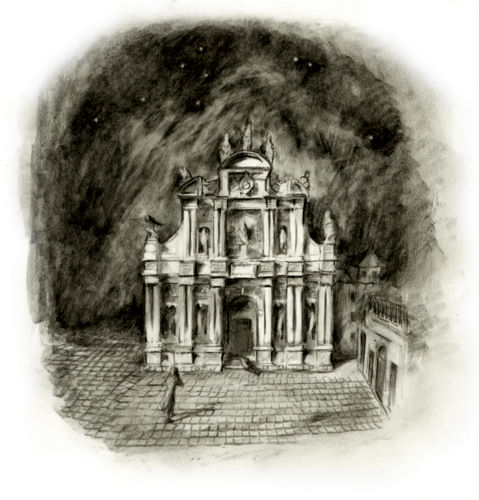
Drawlight discovers Jonathan Strange outside a church in Venice.

Three Messages

Drawlight is terrified by the darkness he finds himself in and is wandering around trying to find his way out when he finds Jonathan Strange. It takes a moment, but Strange recognizes Drawlight and tells him he has three messages Drawlight must deliver.

First Strange tells Drawlight about Lady Pole’s enchantment and that it’s Norrell’s doing. He gives Drawlight the box with Lady Pole’s finger in it and tells him to give the box to John Childermass and tell Childermass what Norrell has done. Next, Strange gives Drawlight a cryptic message for all the magicians in England:

“Tell them this… Tree speaks to stone; stone speaks to water. It is not so hard as we supposed. Tell them to read what is written in the sky. Tell them to ask the rain! All of John Uskglass’s old alliances are still in place. I am sending messengers to remind the stones and the sky and the rain of their ancient promises.”

When Strange is done, Drawlight reminds him that he never gave the third message. Strange seems very caught up in a moment of madness, but finally he spits out the last message:

“Tell Norrell I am coming!”

Back in England, Stephen Black is visited by the man with the thistledown hair, who is frightened and angry. He knows what Jonathan Strange is doing, and he doesn’t like it.

Aunt Greysteel
Aunt Greysteel

Flora Greysteel

I’m so happy that Flora kind of gets her own chapter here, and it’s a good one.

After being sent away from Venice, she and her aunt have taken lodging in Padua where Flora can rest and deal with her disappointment over her separation from Jonathan Strange. Before Flora can really move on, though, she has one last meeting with Strange, under bizarre circumstances.

We find out that the purpose of this meeting was so Flora could persuade Jonathan Strange to give up the madness, and he has even given her the bottle of tincture he made so she can dispose of it. Flora is sad about the loss of Strange, but she is determined to be a good friend to him and insists that she convinced him to leave off the madness because she believed it was what Arabella would want. When Flora pours the remainder of Strange’s madness tincture into the sea, I feel like she really is going to be okay.

The Magic of England

In England again, Norrell and Lascelles are very concerned about how things are going. While they have managed to largely discredit Jonathan Strange, this has also worked against their own interests, and Norrell is no longer receiving any commissions from the government and has become rather generally disliked and distrusted.

Perhaps the first sign of change is when Childermass informs Norrell that magic is being done in England. While there has been talk for years of magic, this is the first time that it seems to be legit claim, and Childermass seems alarmed. Lascelles is disdainful of the idea, though, and directs Norrell’s attention to a summons from the Ministers in the hope that it will be a new commission at last.

When Norrell and Lascelles meet with the Ministers, it turns out that it is a commission, but it’s not what either of them expected. Childermass was correct in his assertion that people were doing magic in England again, and the Ministers have numerous confirmed stories of their own. When Norrell denies any knowledge of or responsibility for any of this, it becomes obvious that Jonathan Strange has done something to bring back the magic.

Norrell’s new commission, therefore, is to prevent Jonathan Strange from returning to England. Norrell knows that there’s really no way he can prevent it–he can only prepare for it. Childermass suggests that Strange will go to Hurtfew Abbey–presumably for Norrell’s library–so that will be the place to meet him.

Also, Drawlight is back.