I loved The Three-Body Problem when I read it earlier this year, but I wasn’t really certain what to expect from The Dark Forest, especially with a different translator from the first book. While I didn’t find it to be–overall–as compelling as I found its predecessor, I think The Dark Forest might be the better of the two books if it wasn’t for a sometimes clunky translation.
The difference in translation is subtle but apparent from the beginning, and this is exacerbated by a shift in style from the first book. The Dark Forest is largely an exploration of a couple of interlocking metaphors, relying largely on poetic language and imagery to discuss some heavy ideas. There’s not a ton of plot going on–basically, people are scrambling to figure out what to do about the impending alien apocalypse–and its story unfolds far more slowly than so few events seem to warrant.
It turns out that a four hundred year wait for aliens to arrive for an epic showdown isn’t all the exciting when the aliens have destroyed your ability to make scientific and technological advancements that might allow you to win. It’s mostly just one long, soul-crushing existential crisis punctuated by various smaller actual crises.
The book opens with a lovely metaphorical prologue, which is immediately engaging, although I felt as if some of the poetry of the language must be lost in translation, but then it’s a slog for the first three quarters before transforming into a riveting page turner in the last act. For most of the book, I just felt a little confused and frustrated because so little actually happens–and much of what does happen doesn’t really matter–but in the last hundred and fifty or so pages, it all comes together and makes sense. The translation is still sometimes awkward, but the extended metaphors that Liu has been weaving finally cohere in a climax that is smart and well worth the struggle to get to.
The Dark Forest‘s translation may not be up to the same standard as The Three-Body Problem‘s, but it’s still well-worth reading. It’s a clever, beautiful, and at times darkly hilarious book that both neatly fits into sci-fi traditions and continues to broaden the horizons of the genre with a refreshingly different perspective on perennial science fiction questions.
I know we all loved the first season of Heroes back in 2006, but we also all remember that seasons two through four were pretty terrible. And I know, I know, writer’s strike or whatever, but you can’t reasonably attribute all of the show’s problems to that. Mostly, it was just three-quarters badly written.
But regardless of the reasons for the original show’s issues, Heroes Reborn is a reboot/sequel that literally no one was asking for. It’s pretty obviously a cynical attempt on the part of NBC to capitalize on what little goodwill people had retained for the original show. But I watched it anyway, because I’m a sucker.
Heroes Reborn is bad.
It’s an ill-conceived idea in the first place, burdened as it is with the history of the original show, but Heroes Reborn takes its badness to the next level in several ways.
Noah Bennet (Jack Coleman) is the only main character from the original show, and his story line in Reborn is boring. After some kind of obviously staged terrorist attack in Odessa, Texas, Noah has some of his own memories erased, and so far all he’s done is find this out. Neither he nor we, the audience, have any idea what is going on, but we also don’t have much reason to care, either. He’s kind of trying to find out what happened to his daughter or something, but even he doesn’t seem to care that much.
New teenaged hero Tommy (Robbie Kay) has a kind of cool power, but his story is weighed down with a bunch of mind-numbingly dull teen angst bullshit. We spend most of the first two episodes learning about Tommy’s high school bully and Tommy’s crush on the bully’s girlfriend.
Married couple Luke (Zachary Levi) and Joanne (Judith Shekoni) are on a revenge quest that is both evil and stupid. This is complicated by the increasingly obvious fact that these two characters absolutely loathe each other. I don’t understand how this couple ever made a child together, and I don’t know what they think they are going to accomplish by murdering every mutant they can find. I suppose it makes sense that Joanne might just be completely unhinged after her son’s death, but I don’t know why Levi sticks around since he isn’t totally on board with all the murder they’ve been doing. Which brings me to…
It’s hard to buy the idea that people with super powers are an oppressed minority being hunted and killed/imprisoned with impunity. I mean, sure most of the super powers are probably not world-changing, but enough are that you’d think it would be pretty easy for these folks to take care of themselves. Even if I accept the idea that the government or some kind of shadow organization might be able to mess with mutants, I think a couple of middle class suburbanites with some small arms would have a tough time against a room full of super heroes.
Everything in Japan is the worst. Both Miko (Kiki Sukezane) 0and Ren (Toru Uchikado) look like anime characters, which is just plain silly, but the major sin here is the whole thing with Miko’s father’s video game. This doesn’t even remotely make any kind of sense, even in a world with super heroes. It’s totally cut off from all the rest of the story so far, and after two episodes there’s still no hint as to how this part ties in to everything else we’re seeing. The very worst part, though? The piss poor computer graphics for the game world. It’s just sad.
There’s some other stuff going on with some people at a casino or something and a guy with a luchador mask, but these story lines are actually so boring that I don’t have anything to say about them. Also, there’s some girl being mysterious and ominous with the Northern Lights and a hole in the sky. That can’t be good.
Did you know that cherished childhood movie memory The Fox and the Hound is also a book? Because I did not. And I’m traumatized without even reading it myself.
Bustle has 11 Sci-Fi Books Every Woman Should Read. I was a little surprised that I’ve only read a handful of these. It’s nice to see a list that’s a bit less expected than usual.
I wasn’t making this show a priority because I just couldn’t get excited about the premise, but I finally watched it on Hulu this morning, and it was surprisingly enjoyable.
Here’s the thing, though. I’m still not sold on the premise of the show. In a world where there are increasing concerns about government surveillance and violations of privacy as well as serious problems with police overreach, corruption, and excessive force, Minority Report‘s nostalgia for pre-crime actually might be dangerously tone deaf. I mean, the entire point of Philip K. Dick’s book and the 2002 film was that the whole pre-crime thing was pretty irredeemably evil. The show, as was evident from its trailers, seems to be going with “but maybe it wasn’t?” (And I hope you are reading that in the Eli Cash voice I thought it in.) It’s a tough premise to sell, but after watching the pilot episode of the show I’m at least slightly encouraged that they might be handling things with a bit more nuance than I expected.
The good parts of the pilot are really, really good. The cold open, where we see ex-precog Dash (Stark Sands) running through future Washington, D.C. trying to stop a murder is excellently done and really hammers home the idea that, for Dash, his visions create a moral imperative that drives him back into the world to find a way to do some good with his gift. This might be hopelessly naive of him, in light of his own history as a formerly enslaved child, but the show seems prepared to address this issue. Both of the other precogs appear in the pilot and opinions on the moral imperative thing seem to be mixed. It also looks, based on the pilot’s epilogue, like the precogs’ ongoing fears of imprisonment and exploitation may fuel a longer story arc, which could get interesting and lead to an interested dilemma for Dash later on.
Meagan Good plays Lara Vega, the obligatory no-nonsense police officer, and I like her. She’s kind of a stock character, reminiscent of Sleepy Hollow‘s Abbie Mills, Castle‘s Kate Beckett, iZombie‘s Clive Babineaux and enough similar characters that there’s nothing about Vega that stands out. However, I love this particular collection of character tropes, and I rarely get tired of watching them in action. Aditionally, Meagan Good is likable and has an easy chemistry with both co-star Sands and Wilmer Valderrama, who plays her slightly slimy-seeming boss, Will Blake. This gives Vega’s interactions with other characters a natural feel that works in the show’s favor.
The only exception to this is in a couple of scenes between Vega and Dash where the show’s writers seem determined to hit the viewer right upside the head with exposition and shove some character motivation right in our faces. It’s too heavy handed in this first episode, and it ends up being jarring and distracting from the story. That said, television pilots often try to cram as much of this as possible in, so I can forgive it for now. The true test will come next week when we find out if this kind of ham-fisted hand-holding is just a pilot episode tic or if it’s going to be characteristic of the whole series.
The world-building is fairly pedestrian, with the usual near-future stuff in evidence, but the production values are slick and professional. The costumes are alright, and I actually kind of love Vega’s look, even if she does have a cleavage window. Minority Report continues the trend of more diverse casting in sci-fi television, which is nice to see as well. In general, while some of the show’s visual effects are a bit silly (the robots that look like someone chromed a bunch of golden snitches, for example) and there’s not much new or interesting in terms of the setting, the show’s future D.C. feels plausible enough that I can see myself spending a lot of time watching it if it can overcome some of the writing missteps of the pilot.
All in all, Minority Report turned out to be a pleasant surprise. I was expecting a disaster, and what I got instead was a well-cast show with some genuinely interesting ideas. The execution so far isn’t great, but it’s passable, and I think there’s a lot to work with here. I don’t know if it will ever be a great show, but it wouldn’t be hard for it to be a good one. In the meantime, it’s definitely enjoyable enough for me to come back to it to see if it improves.
Seriously. If you haven’t watched Scream Queens yet, don’t bother.
It’s the worst sort of unfunny, “ironically” racist, tacky crap that I’ve seen in ages, and I’m so disappointed by basically everything about it. I didn’t expect this to be a good show (I mean, Ryan Murphy is also responsible for perennial turdpiles Glee and American Horror Story), but I did expect it to be entertaining and fun (in the vein of Glee and AHS). Mostly, it’s just cringe-inducing.
The thing about horror comedy is that it has to be funny in order to work, and the biggest problem with Scream Queens is that it’s just not, so it doesn’t. While there are a couple of amusing scenes in the first two episodes–most notably security guard Denise (Niecy Nash) explaining how to notify her in case of an emergency and, surprisingly, Chanel #2’s (Ariana Grande) death–it’s mostly just a constant stream of hatefulness or stupidity (and hateful stupidity) from all of the characters except for good girl Grace (Skyler Samuels), who is just boring.
Sorority leader Chanel (Emma Roberts) is a caricature of a rich bitch sorority girl, but she’s just so over-the-top vile that it’s hard to stomach. A conversation between Chanel and Dean Munsch (Jamie Lee Curtis) suggests a sort of self-awareness about this, and Dean Munsch’s assertion that “out in the real world, people just don’t talk that way to other people. It’s not normal,” seems to be a wink to the audience to show that writer Ryan Murphy knows how awful his characters are. However, the Chanel/Munsch conversation doesn’t herald any character development for Chanel, and we later find out that Munsch is just as awful in her own way.
I was ready to turn the show off the first time I heard the phrase “white mammy,” but I didn’t. It turns out that it only gets more racist from there. Chanel’s blatant and incredibly hateful and mean-spirited racism seems intended to be amusing, but it’s not. It’s just a drag. Even worse is the stereotyping of Zayday (Keke Palmer), the show’s token black girl. The biggest disservice done to Zayday, though, is that she’s sidelined from the majority of the action, only appearing to show how nice and not-racist Grace is and popping up occasionally later on to exclaim colorful lines like “Y’all’s ratchet!” Zayday is, so far, less a character than a prop or a background decoration in a story that’s really about the white girls.
While I suppose good for Ryan Murphy for casting a deaf actress (Whitney Meyer) to play “Deaf Taylor Swift,” I feel like the progressiveness of that decision is undone by the choice to use the character’s deafness as the punchline of her jokey death.
The show also shortchanges Sam (Jeanna Han), a character who is still alive (for now) but just doesn’t make sense. The “Predatory Lez” moniker is as aggressively and offensively unfunny as any of the other nicknames on the show, and I just will never understand why the trope of the obviously hostile radical feminist lesbian sorority pledge even exists. I also don’t understand why Ryan Murphy would utilize that trope for comedy only to play it entirely straight. Apparently the joke here is that this character exists. Also, that feminism is hilarious.
Speaking of making fun of feminism, Jamie Lee Curtis deserves so much better than Dean Munsch. I feel like as second wave feminists get older, this type of character–the dreary, failed feminist with nothing to show for herself in middle age except a divorce and a job she despises–gets more popular. I hate it so much, and it just seems to reinforce that Ryan Murphy can’t stand women or feminism. Even the “best case scenario” feminism depicted on the show–Grace’s dream of a sorority as a real sisterhood where she can connect with her mother’s memory–is shown as silly, childish, and naive.
I have no desire at all to keep watching a show where the biggest “joke” seems to be about how stupid feminism is and how awful women are.
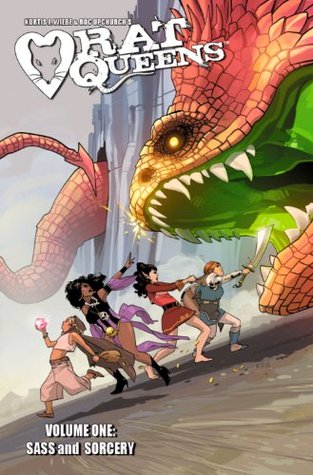
So, there’s really no good reason I put off reading this comic for so long. I think I was just turned off by the word “sass” in the title of this first collection. I don’t think there’s any word used to describe women that pisses me off more than “sass” (or any iteration thereof).
I’m glad I finally relented and picked it up, though, because Rat Queens is fucking excellent.
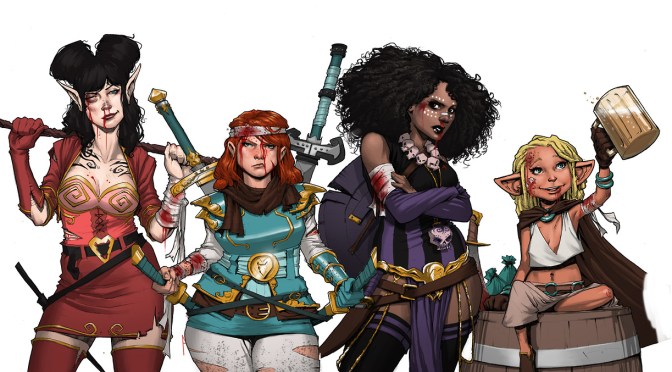
The Rat Queens–Hannah, Dee, Violet, and Betty–are one of several groups of adventurers working out of a town called Palisade. However, we learn early on that not everyone appreciates what the Rat Queens and their fellow mercenaries bring to the town. When someone tries to have all the adventurers killed, hijinks ensue as the Rat Queens try to save the day.
In many ways, this series is a pretty straight forward sword and sorcery adventure of the R-rated persuasion (it’s very full of coarse language, sex, drugs, and tons of extremely bloody violence). However, it’s not the usual sort of testosterone-fueled romp one might expect from this genre. Which is refreshing.
Even better, it’s nothing so simple as just gender-flipping things and writing about a bunch of women who “act like men.” Rat Queens plays with a lot of the genre-standard tropes in really clever and extremely funny ways, and it also develops each of its characters with loving attention to detail and a clear commitment to treating them all like full human beings.
This is especially apparent in the artwork, which is consistently nicely done. The main characters are a group of diverse women with plausible body types wearing adventure-appropriate costumes that reflect their roles and personalities. This in itself is enough to recommend the book to me, but when you toss in a good sprinkling of visual gags and some excellently-drawn action–without any obvious fan service–I consider the artwork a home run.
My only criticism is that I actually could have done with a little more exposition about each woman’s background, and I would love to know a little more about some of the secondary characters, too. Some of this, I’m sure, is just because I’m used to reading novels, which have fewer space limitations than comics have. Mostly, though, I just really love these characters and want to know everything about them.
I guess I’m just going to have to hope that the series runs for a long time.
Rat Queens is exactly the kind of feminist comic I want to read–mostly in that its feminism is all in the execution of the work, with no preachy, ham-handed messages getting in the way of a good story, and no ugly, sexist artwork to get in the way of my enjoying it. It’s an almost perfect comic that I can’t wait to read more of.
I’m a little surprised to say that I rather enjoyed “The Magician’s Apprentice.” It’s a very Moffat episode, which isn’t surprising since it was written by the show runner, but it manages to not be awful. That said, I feel like this should be a kind of good news/bad news sort of review.
The good news is that Missy is back, and she’s as delightful as ever. It’s really obvious that Michelle Gomez is having a ball with this role. The bad news is that Missy’s return doesn’t make a whole lot of sense, and her antics become grating after the first five minutes or so before she–in a fit of pique–does something evil enough that it’s no longer possible to classify her behavior as “antics” at all.
The good news is that Clara seems to be doing alright. She’s still teaching, and it’s nice to see that she didn’t have any inexplicable career change, and she’s apparently also working for UNIT, although it’s not clear exactly what her role there is, and it’s, frankly, not clear why UNIT appears in this episode at all. The bad news is that, with the introduction of Missy into the mix, Clara has basically nothing to do because Steven Moffat seems to be incapable of writing parts for two women in the same episode. Mostly, Clara spends the episode making disapproving faces about stuff that Missy does.
Another bit of good news about Clara, though, is that this entire episode passed by without a single instance of the Doctor commenting on her face, body, or age in a demeaning manner. The bad news is that Clara and the Doctor barely interacted at all, and none of it was memorable or interesting.
More good news? Clara might be canonically bisexual! Bad news? You could have blinked and missed her line about Jane Austen being a good kisser–which, by the way, would be a totally bizarre thing for a teacher to just say to a room full of twelve-year-olds who don’t know their teacher is a time traveler.
The thing is, this was a pretty okay episode. It’s not great, and it’s got a lot of the regular Moffat nonsense going on, but I enjoyed it more than I did any of last season’s episodes except maybe “Robot of Sherwood” (not because it was good but because I love Robin Hood). I think this episode might be more exciting for those who are more familiar with Classic Who than I am; I know my partner, who grew up watching the show, was much more excited than I was, although I at least remembered who Davros was.
The biggest problem I’m already sensing with Season 9–admittedly judging just from this episode and the titles and descriptions of the rest of the season–is that Moffat still seems obsessed with having the Doctor facing his “darkest hour” at least two or three times a year. At the end of “The Magician’s Apprentice” the Doctor is left without his screwdriver, his TARDIS, or his friends, but it just feels a bit ho-hum when we already know that this is just the first of several anticlimaxes to come.
The best news I’ve seen about this episode so far? Apparently, Steven Moffat’s tenure as show runner isn’t just wearing thin with mean old feminists like myself. Viewership for this episode was down by almost a third (from 6.8 to 4.6 million viewers) from the first episode of last season. People have been suggesting for years that Moffat is going to run Doctor Who into the ground, and these numbers don’t seem promising. Maybe this means that Moffat’s time with the show will be coming to an end sooner rather than later, and maybe that would clear the way for someone new to come in and make the show really good again. I’d love to have something better to say about it than “it wasn’t the worst.”
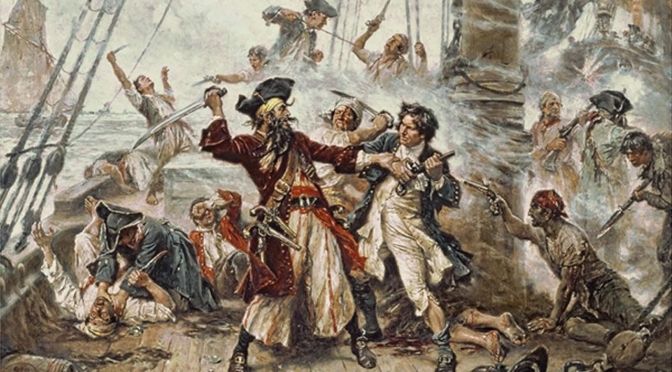
Today is Talk Like a Pirate Day, and Mental Floss has a great post up about the origins of several of the most common pirate stereotypes. Spoiler: They can all, one way or another, be attributed to Robert Louis Stevenson’s Treasure Island.
I love Halloween, and we’re about a month into Ugly Decorations I Nonetheless Desperately Want Season. Unfortunately, there’s not enough room on my balcony for these zombie flamingos. I might have room for this skeleton cat, though.
So, it took me most of a summer of watching light fare to recover from this last season of Game of Thrones, but I think I’m more or less ready for watching and writing about some new television this fall. I won’t be writing about everything I watch, obviously, and there are a couple of things I intend to write about that I don’t know if I’ll be able to stick with–that could end up like my watching and posting about Killjoys did this summer; I still haven’t watched the last two episodes of that show, I was so bored/frustrated with it.
Here’s the plan:
The Mindy Project – Tuesdays on Hulu starting 9/15. I honestly love this show, and I will watch it til the end of time, although I rarely write about it outside of a line or two on Tumblr. The first episode of season four is excellent, and the first three seasons are available to stream on Hulu as well so it’s not too late too catch up if you’re really dedicated.
Doctor Who – Saturdays on BBC America starting 9/19. Doctor Who is another show I just can’t quit. It’s also one that I intend to write about this year, although I haven’t had much positive to say about it during Steven Moffat’s tenure as showrunner. I’m not making any promises about this one, though. Right now, my goal is to have my Doctor Who post up on Monday mornings, but I’m not going to destroy myself over this show the way I do over Game of Thrones. If it gets too insufferable, I will likely switch to just watching it.
Minority Report – Mondays on Fox starting 9/21. Frankly, I’m already bored by this series, but I’ll probably check out the first episode or two just to confirm my suspicion that it makes no sense. I’m pretty sure the whole point of Minority Report was that the whole pre-crime thing is a terrible idea and this show seems to be presupposing that–maybe it isn’t? Okaaaay.
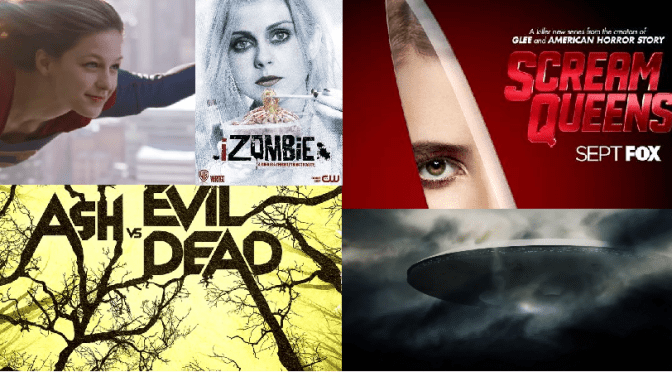
Scream Queens – Tuesdays on Fox starting 9/22. This show is relevant to basically all of my interests. And it has Jamie Lee Curtis. I’m currently planning to write about this one on Wednesdays.
Heroes Reborn – Thursdays on NBC starting 9/24. This show is basically not relevant to anything. No one wanted or asked for it. But it’s a thing that is happening. Since I loved the first season of Heroes as well as anybody, I will be watching this, but I’ll only be writing about it if it’s really good or really comically terrible.
Bob’s Burgers – Sundays on Fox starting 9/27. Love it. Watch it with my family. Will almost never post anything about it except gifs of Tina on Tumblr.
Brooklyn Nine-Nine – Sundays on Fox starting 9/27. Also love, but also won’t write about unless something major happens.
iZombie – Tuesdays on the CW starting 10/6. The first season of this show was a little uneven, and I wasn’t totally thrilled with the way it ended, but I plan to tune in again this year and write about it some more. Depending on how things pan out, I may end up choosing between this and Scream Queens to write about, though. Just, realistically, I’m not sure I have it in me to write about more than one show a day, especially as I’ve got a lot of reading that I want to do over the next few months as well.
Jane the Virgin – Mondays on the CW starting 10/12. I won’t write about this show (mostly because it’s basically perfect), but it’s another one that we watch as a family and I can’t wait.
Supergirl – Mondays on CBS starting 10/26. I kind of dislike most super hero stuff, but this show looks completely charming. I’m currently planning to write about it.
Ash vs. Evil Dead – Saturdays on Starz starting 10/31. This show is definitely what I am doing on Halloween. I’m not sure if I will write about it or not. It depends on how good this show is and how bad this season of Doctor Who is.
Into the Badlands – Sundays on AMC starting 11/15. This show is almost certainly awful, but I’m kind of interested in it anyway. No plans to write about it.
The Man in the High Castle – On Amazon Prime starting 11/20. I haven’t read the Philip K. Dick novel this series is based upon, but the trailer for the show looks promising. I’m hoping to read the book sometime over the next couple of months, and then I might watch the show.
Jessica Jones – On Netflix starting 11/20. Another Marvel show. I’m somewhat looking forward to this one, but I haven’t even finished Daredevil yet, so there’s no telling when I’ll get around to it. I do really like Krysten Ritter, though.
Childhood’s End – On SyFy starting 12/14. I read this book over the summer, and I totally understand why it’s one of the great sci-fi novels. I also totally have no faith in this adaptation of it. It looks legit awful, and I’m a little embarrassed for SyFy about it. I’ll definitely be watching it, though. And I expect that I’ll write some about it, too. I think it’s going to be just that enraging.
The Expanse – On SyFy starting 12/14. I’m somewhat more optimistic about this show, although I haven’t read the source material (and don’t really intend to unless the show is really good). I’ve no idea whether I’ll write about it or not. It depends on whether I have any feelings about it strong enough to be worth sharing.
I’m really disappointed that the new shows that seem intended to capitalize on the popularity of Game of Thrones-esque, gritty, dark medieval European settings (The Bastard Executioner and The Last Kingdom) both look boring as shit. I’m actually a pretty big fan of the gritty medieval stuff, but I have no desire to watch shows that look to be almost entirely devoid of women. Game of Thrones might hate its women, but at least they exist there.
In all honestly, the shows I’m most looking forward to this fall are all returning favorites. The new stuff that’s coming out isn’t that exciting, with a couple of exceptions, and a solid half of it looks actively bad. I figure I’ll try a few new things, though. Worst case scenario, everything is terrible and I end up reading more books instead.
So, I’ve gotten pretty good at picking books to read these days so that I have a minimal number of bad reading experiences, which is great, and it’s a skill I’m happy to have finally mastered as I approach my mid-30s. The downside of this skill, however, is that I often feel like about every other book that I read is a new favorite, or my favorite book of [genre], or at least my favorite book of the current year, or the last six months or last five years, or whatever. You get the idea. The point is, eventually that “favorite” distinction starts to lose all meaning, especially since I seldom reread anything anymore. But still, sometimes I really mean it.
This time, I really, really mean it.
The Library at Mount Char is certainly my favorite book that I’ve read this summer, perhaps my favorite this year so far. It’s not the best book I’ve read lately, but it’s definitely the most fun I’ve had reading in a good while. Absolutely enough fun to earn itself a place on the running list of “favorites” I keep in my head.
I knew straight away that I would love this book because I was moved to giggles in the first paragraph, which introduces us to a protagonist who only gets more weird and wonderful as you continue reading. I don’t know if The Library at Mount Char will last as one of my favorites, but its heroine, Carolyn, definitely makes my list of all-time favorite female characters.
We first meet Carolyn covered in blood and walking barefoot down a highway. She’s just killed a man, but she’s actually thinking about tacos. I fell in love with her immediately.
We soon learn that Carolyn is one of twelve “librarians” who started off as orphaned children adopted by a mysterious “Father” and taken to live in a library. Father isn’t a god, exactly, but he’s something of an all-powerful and ancient wizard kind of guy. Each of the twelve adopted siblings has been assigned a catalog–one portion of Father’s incredibly vast body of knowledge–that they alone are responsible for, and to study from another’s catalog brings a heavy punishment. Carolyn’s catalog is languages. Michael’s is animals. David’s is war. Jennifer’s is healing. Margaret’s is death. Other siblings’ roles are less obvious or well-defined, but it’s obvious that, all together, the breadth of their studies is pretty comprehensive. The story begins with Father’s disappearance and the librarians scrambling to figure out what has happened.
Although there are a couple of other important point of view characters–Erwin and Steve–Carolyn is undeniably the main character, and Carolyn is who I found most compelling and interesting to read about, even from other characters’ point of view. She’s a smart and resourceful woman, and she’s self-reliant in a way that I found refreshing. Her flaws are real and serious–never cute or quirky, although Scott Hawkins writes about all of his characters with a dry sort of humor that had me laughing aloud more than once. Due to her unusual upbringing, Carolyn’s not always great at being human. She can be narcissistic and is sometimes callously cruel, and she has to fuck up big time before she becomes who she needs to be by the end of the book.
This, I think, is what I like best about Carolyn. She’s allowed to be kind of awful in a way that female characters often aren’t, and there’s not a hint of apology for her in the text. She’s not always relatable or sympathetic, the mistakes she makes have terrible consequences, and she actually does some things that are kind of evil, but at no point was I not on Carolyn’s side. Every step of the way I was cheering for her to be successful in her ultimate goal (which is a pretty amazing goal that I’m not going to spoil).
Hawkins’ prose is perhaps just workmanlike, but he has a knack for capturing hyperviolence as well as humor and even some very tender moments in an almost naturalistic way. The world he’s created doesn’t feel real exactly, but it feels alive and lived in, with just a hint of high camp in in the details. The action scenes have a cinematic quality to them that makes me hope that someone gets the rights to film this story (although I think it would require a tv miniseries to do it properly). Overall, there’s an absurdist quality and a kitschiness to the novel that I found deeply enjoyable. And while the prose may not be especially beautiful, it’s highly readable and the story is structured in such a way that I didn’t want to put the book down at all (which is why I read it less than a day, in basically two long sessions).
The Library at Mount Char is definitely a book I will be evangelizing for this fall and winter, and I’m actually looking forward to reading it again myself, perhaps closer to Halloween when the nights are longer and colder and I can curl up under a blanket with this book and a warm drink. In the meantime, I’ll be suggesting to everyone I know that they read this book that way.
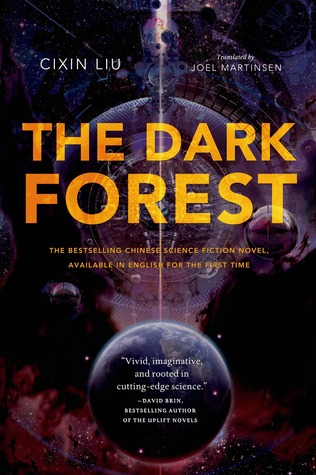 I loved The Three-Body Problem when I read it earlier this year, but I wasn’t really certain what to expect from The Dark Forest, especially with a different translator from the first book. While I didn’t find it to be–overall–as compelling as I found its predecessor, I think The Dark Forest might be the better of the two books if it wasn’t for a sometimes clunky translation.


 So, there’s really no good reason I put off reading this comic for so long. I think I was just turned off by the word “sass” in the title of this first collection. I don’t think there’s any word used to describe women that pisses me off more than “sass” (or any iteration thereof).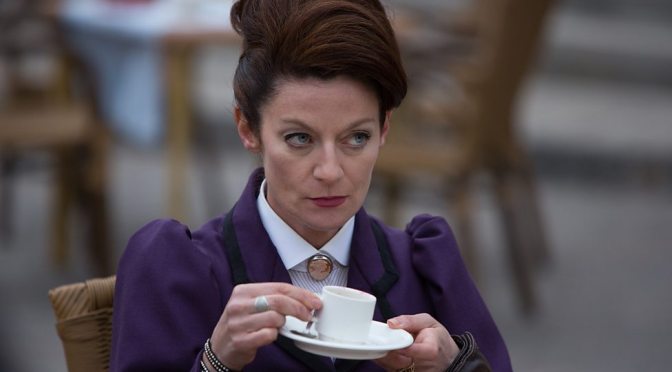
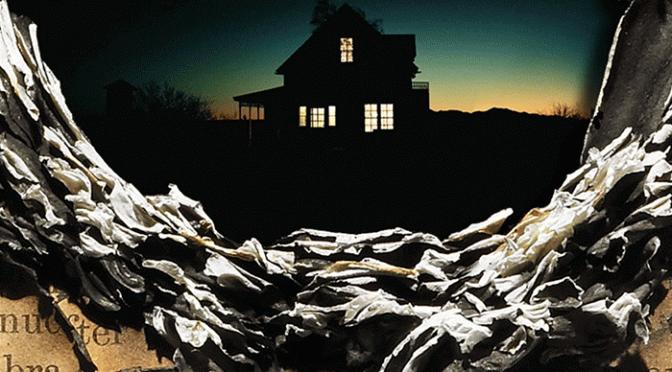
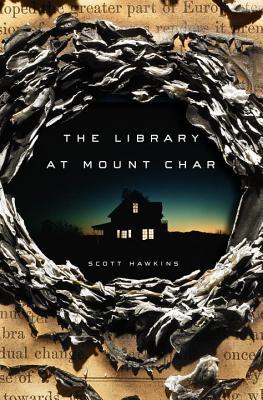 So, I’ve gotten pretty good at picking books to read these days so that I have a minimal number of bad reading experiences, which is great, and it’s a skill I’m happy to have finally mastered as I approach my mid-30s. The downside of this skill, however, is that I often feel like about every other book that I read is a new favorite, or my favorite book of [genre], or at least my favorite book of the current year, or the last six months or last five years, or whatever. You get the idea. The point is, eventually that “favorite” distinction starts to lose all meaning, especially since I seldom reread anything anymore. But still, sometimes I really mean it.
 SF Bluestocking