Hugo Reactions Roundup and Thoughts

Well, it’s been a full week now since the announcement of this year’s Hugo Awards finalists, and we’ve all had some time to process the fact that allegedly human trash fire Vox Day and his Rabid Puppies slate fucked the whole process up and ruined a lot of fun for a lot of people for the second year in a row. The Rabid Puppy slate placed 64 of its 81 candidates on the ballot, at least one in every single Hugo category, sweeping six categories entirely, and securing all but one slot in an additional four categories. In terms of how this measures up to last year’s fiasco, it’s a sort of good news, bad news situation.

The bad news, of course, is that this is still a thing that is happening, at all and that the Rabid slate was, if anything, more successful than last year’s in spite of nearly double the number of nominating voters participating in the process. The good news is that these results indicate several of things:

  1. As suggested by last year’s No Award votes, the vast majority of the influx of new voters are anti-Puppy.
  2. BUT, when it comes to nominations, those new voters are honest ones who continued the Hugo tradition of nominating things that they actually like and want to see win, and there is no evidence of competing slates or any other attempts to “fight fire with fire.”
  3. While the new voters’ lack of slate or bloc voting makes for a very fractured pool of potential nominees, allowing the Puppy slate a low bar for success, there’s no evidence that the Puppy bloc saw any significant increase in numbers.
  4. While the Puppy slate did succeed in getting a lot of nominations, the slate this year was not (quite) as irredeemably bad and transparently Vox Day/Castalia-serving as it was last year. In order to make some kind of statement about something or other, it includes quite a bit of work that looks to be worth at least attempting to consider.
  5. It appears that the Sad Puppies (yes, they’re still around, kind of) had no measurable effect on anything at all with their recommended reading lists. I think we can safely ignore them forever now and deal with the actual menace that is Vox Day.

Followup bad news to this good news, though, is that with such a mixed bag of nominees–everything from obviously trolling picks like Chuck Tingle’s “Space Raptor Butt Invasion” to the apparently unironic Rabid nominations for Best Related Work to several picks that almost certainly would have made the ballot regardless like Daniel Polansky’s The Builders, Neal Stephenson’s popular Seveneves, and Hollywood blockbuster The Martian–there’s not clear answer on how to respond to the slate. Sure, there are some obvious categories for a No Award and several nominees that are clearly out of place in other categories, but things are definitely not as cut and dried as they were last year, when it was very reasonable to deny the legitimacy of all slate picks. This is something that I will address more fully at a later date, however. I will likely blog my way through the voter packet when it arrives in a couple of weeks and talk some more then about how terribly wrong and mistaken I was in my own predictions for this year’s awards, which were based on my clearly very incorrect theory that the Rabid Puppies would have lost a significant amount of interest in the Hugos after last year.

I didn’t write a hot take of my own last week, though I did read plenty that were various degrees of useful, informative, and insightful. The best early-ish posts on the matter that I came across:

The Puppies themselves had typically asinine responses:

  • Vox Day posts about “Making the Hugos Great Again” in which he spends a couple of thousand words wallowing in schadenfreude and mocking John Scalzi because Vox really, really hates John Scalzi. It gets weird.
  • The Sad Puppies apparently have no official opinion, judging by the lack of updates on their site.
  • However, Kate Paulk has some mouth noises to make about how all the finalists “earned” their nominations, but also that as long as everyone follows the rules–the letter of, obv, not the spirit of, because respecting social contracts is for liberal wimps or something–people can pervert the process as much as they can get away with. A+ principles, Kate Paulk.
  • Brad Torgersen is predictably incoherent and rambling. Something, something CHORFs. Something something Brad Torgersen’s persecution complex. Something something Dragon Awards.
  • Larry Correia says we should have negotiated with him when we had the chance and so we are getting what we deserve. Okay, but I’m still not sure what Larry Correia ever wanted except to win a Campbell because he’s a sad little pissbaby who never learned to be a gracious loser or appreciate the honor of even being nominated for a major award. Also, I guess he wants everyone else to have the same low brow, trashy “literary” tastes as he has, but just saying that sounds unreasonable and stupid because you can’t just dictate to everyone else what they ought to like.
  • Puppy darling John C. Wright has a ton of bloviating opinions if you care to try and decipher his writing style, which I would describe as mid-19th century douchebag eats an SAT vocab study guide. He accuses GRRM of not even reading the nominees, which GRRM responded to the other day.

Several of the slated writers and publications have had responses as well:

In more big picture stuff:

I’m not sure how much I’ll be writing about the Hugos after this. I certainly intended to blog my way through the voter packet when that comes out, but at this point I’m going to just wait and see what that entails. Some of the Puppy picks I have already read. The Best Related Work shortlist, for example, I have read parts of and think it would be an absolute punishment (probably the Puppy intention) to read much more of. So, we’ll see. I may have thoughts on it, I may not.

While I didn’t want to clutter up this last week’s Weekend Links with Hugos stuff, probably further links of interest will show up there unless there’s another sudden, large influx of stuff that I want to share.

As far as my own reaction to another year of Puppy garbage–I was angry as hell last week, but after a few days to think about it I just feel sad and drained by the whole thing. It’s exhausting and disappointing and not much fun in spite of the occasional mock-able Puppy post on the topic. I’d much rather be talking about books I loved last year and discovering the work that other people loved enough to nominate than responding to the petty, childish antics of a bunch of people whose only goal seems to be to shit all over the things that other people love.
Book Review: A Whisper of Southern Lights by Tim Lebbon

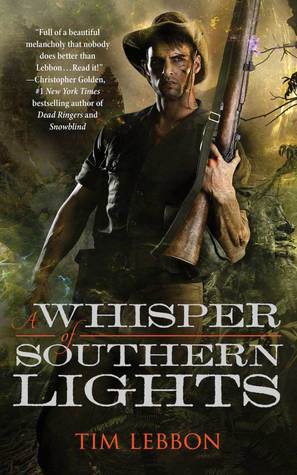
A Whisper of Southern Lights is the second novella I’ve read by Tim Lebbon, and it’s probably the last. I didn’t care much for Pieces of Hate a couple of months ago, or that book’s bonus novelette “Deadman’s Hand,” but I thought I would check this one out nonetheless. Generally Tor.com’s novellas are of good quality, and I thought that perhaps I just needed to give Lebbon’s Assassin Series a second try. Unfortunately, I liked this entry of the series even less than the previous installment.
The basic plot of this series is that this guy, Gabriel, is an ordinary man whose wife and children were murdered by a demon, Temple, after which Gabriel is made immortal and set to hunt Temple across time and continents. Over hundreds of years, the two immortal enemies meet and fight several times, but neither comes out ahead, and there doesn’t seem to be any actual purpose to their struggle. Indeed, when Gabriel and Temple do brush up against regular mortals, it tends to be fatal one way or another.

In A Whisper of Southern Lights, Gabriel is hunting for Temple in the chaos of the Second World War. He finds him in Singapore, where both of them are working to discover some knowledge possessed by a soldier who is being kept by the Japanese as a prisoner of war. However, for all that this sounds as if there would be some specificity to the tale, everything about this book is vague and generic. Even the racial slurs and the venom with which the soldier character thinks about the Japanese are entirely boring because it’s so obviously exactly the sort of thing I feel ought to be expected from this series as it moves into this setting. Gabriel continues to be a completely non-descript character, and Temple is still a caricature of evil. The man with the snake in his eye is as mysterious as ever, and the mythology of Gabriel, Temple, and their eternal struggle is still murky and ill-defined.

Worst of all, though, is that there’s very little reason to care about any of the characters at all. Even the soldier who is a temporary point of view character isn’t very likeable. He’s a random sort of fellow, not highly educated or a deep thinker, and without any particular virtue to make us root for his continued survival except that he is human, while Temple is not and even Gabriel is something else by now. It does seem unfair that some random guy would get caught up in their conflict, but with no real sense of what the conflict is even about and little enough to like about any of the characters, it’s hard to get invested in the events of the novella.

It seems as the Tim Lebbon wants to convey something deep and profound about the nature of war or of good and evil or humanity or something, but it’s hard to convey much of anything if you can’t string together a coherent story and make readers care about it. Your mileage may vary, but I’m getting off this ride before I waste any more of my time on waiting for it to come to some kind of point.

This review is based upon a copy received from the publisher through NetGalley.

A Whisper of Southern Lights will be released on May 10, 2016. 

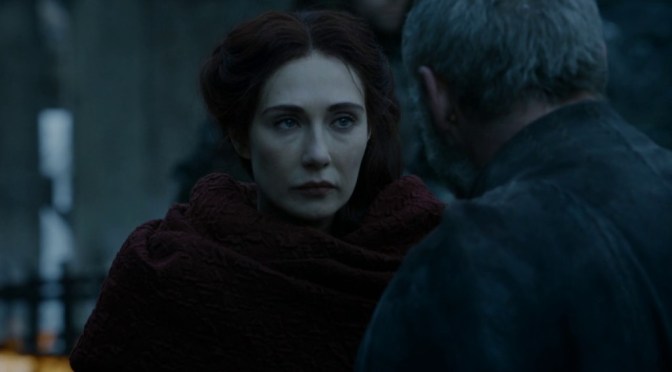
11 Nonsensical Things We’re Supposed to Believe About Davos and Melisandre

Spoilers abound, clearly. Though I didn’t include the Night’s Watch, Jon Snow, Wildlings, or other key parts of this storyline in the headline, they are all discussed herein.

This list appears as well in my full recap and review of last night’s episode, but it got so lengthy and it’s so ridiculous that I felt it deserved its own post. Although Jon Snow’s resurrection was so heavily telegraphed and obviously had to happen in order for the show’s story to continue, the way that it was accomplished last night was hands down the biggest mess of poor writing so far this season, in terms of inconsistent characterization and totally absurd leaps of logic.

  1. Davos has basically forgotten entirely about Stannis. I’d have to watch both of these first couple episodes a third time each to be totally certain, but I don’t think Davos has even said Stannis’s name this season, much less expressed any grief or sense of loss over the king he loved. I don’t even have to rewatch the episodes to be sure that Davos hasn’t mentioned Shireen Baratheon at all.
  2. Davos has become deeply embroiled in the affairs of the Night’s Watch, and in just a few days since Stannis’s death has become a strong partisan of Jon Snow in spite of the fact that they barely knew each other previous to this.
  3. Both the loyal-to-Jon members of the Night’s Watch and the Wildlings under Tormund defer to Davos’s judgment and are willing to stand with and fight for him unto death in order to I guess protect Jon’s legacy or something?
  4. Although almost everyone at Castle Black must have now had at least some first- or second-hand experience with a zombie by this point and at least one man of the Night’s Watch has come back as a wight within the very walls of the castle and it’s customary for both the Night’s Watch and the Wildlings to burn their dead as soon as possible after death, Jon Snow’s body has been kept, and not even under watch or guard.
  5. Even when Tormund finally says he’s going to go get things ready to burn the body, early in this episode, no one actually does it, which gives Davos plenty of time to go and convince Melisandre to try and resurrect Jon somehow.
  6. Davos knows that there is at least an outside chance that Melisandre can resurrect someone, even though at no point in the show has he been exposed to this information. Melisandre’s side trip in which she met Beric and Thoros, which is where she would have gotten the idea if it was truly something she didn’t already know was possible, was a journey she took alone, and we’ve never seen her speak about it to anyone, much less Davos, who has never had any love for the red priestess.
  7. Davos, though not a devout man, has for some reason decided to put his faith in Melisandre, even though he has long been a critic of what he considers dark and evil magic that she performs and skeptical of her religious claims. If anything, recent events seem like they would make him more distrustful of her, not less.
  8. We are also to believe that Davos holds no ill will towards Melisandre over the deaths of Stannis, Shireen, and thousands of men—a fate which Melisandre only escaped by fleeing on her own right as shit hit the fan. While it’s possible that Davos doesn’t know any of the particulars of how things went down, especially about Shireen’s death by burning, Davos’s previous mistrust and dislike for Melisandre would more naturally and believably lead him to feel resentment towards her for leading Stannis to his death and failing to protect Shireen.
  9. Davos, a man who is not devout and who is not highly educated (was actually illiterate until very recently) is capable of making impassioned theological arguments to a priestess and suggests magical solutions to problems that Melisandre was unable to think of on her own.
  10. Everyone is totally okay with a mysterious foreign priestess of a god they have likely never heard of prior to meeting Melisandre perform magic rituals over the dead body of their beloved Lord Commander in order to try and raise him from the dead. Even though most men of the Night’s Watch follow the Faith of the Seven, which would consider Melisandre’s magic heretical, and the Wildlings are almost exclusively believers in the Old Gods of the North and are distrustful of more organized religions. And foreigners. And women. Also, the only experience that the Watch and the Wildlings have had with risen dead so far has been with terrifying zombies that try to murder them all. But they are completely cool with Melisandre raising Jon Snow from the dead.
  11. Because Jon Snow is so popular and well-liked and effective as Lord Commander that the Night’s Watch, now inexplicably led by Davos, Edd, and Tormund, just don’t feel like they can do without him, even though Jon has not achieved anything of note during his time as Lord Commander and opinions on his decisions have been polarizing enough to motivate an assassination.

Is there anything I missed? I’m sure their must be. Let me know in the comments.

If you’ve somehow managed to make sense out of this, let me know that, too. I promise to be impressed.

Game of Thrones Recap/Review: Season 6, Episode 2 “Home”

Another week, another episode of Game of Thrones that proves both that the show really is capable of doing some things right and that the show’s writers have no clue what those things are or how to replicate their successes in any kind of consistent fashion. It’s the great moments—albeit few and far between—that keep me coming back to this show even though I know that, objectively, it’s the worst kind of trash programming, made even more offensively bad by the fact that they’re spending like $10 million and episode to make it happen. That said, most of “Home” isn’t extraordinarily bad or good; it’s simply boring, and nothing happens that isn’t expected, either because its demanded by the (ridiculous) narrative that the show’s writers have created, or because it’s so obviously exactly the sort of nonsense that we know the show for that one can’t possibly be truly surprised by it.

Spoilers, obviously, under the cut. Continue reading Game of Thrones Recap/Review: Season 6, Episode 2 “Home”

Weekend Links: April 30, 2016

So, this has been some kind of week, for sure. Obviously, the biggest news of the week, for bookish folks anyway, is probably the announcement of this year’s Hugo Awards finalists. Once again, the Rabid Puppies have fucked up the whole business, and once again basically everyone has an opinion on it. Personally, I’m still processing my thoughts on the matter, though you might have seen some inklings of my generalized frustration and anger over the last few days on Twitter. I won’t be cluttering up the regular weekend likes with Hugo stuff, though. I’ve been collecting various responses, and will probably be finishing a final post on it in a couple of days so I can have everyone’s hot takes in one place.

On the good news front this week, the shortlist for the 2016 Arthur C. Clarke Award was also announced. Of the six nominees, I’ve only read two–Nnedi Okorafor’s excellent The Book of Phoenix and Becky Chambers’ The Long Way to a Small, Angry Planet–but if those are indicative of the quality of the rest of the list, I’m sure it’s a great one. Also worth a read is current Arthur C. Clarke Award director Tom Hunter’s piece in the Guardian where he shares some of his vision for the future of the award and the genre.

Game of Thrones was back on the air on Sunday night, when I livetweeted my viewing experience (helped along by a bottle of wine), and my recap/review of the episode was posted on Monday. I’ll be doing the same thing every week throughout the season, and you should be able to count on my posts being up by mid-afternoon the day after each episode airs.

Elsewhere, Fandom Following tries to puzzle through what the everloving fuck just happened in Dorne and Feminist Fiction talks about what happens when a show that has built its reputation around being “shocking” isn’t any longer.

At the same time–and I hate myself a little for this–I kind of totally want Game of Thrones Risk.

I also really want (and don’t even have to feel bad about it) this gorgeous poster of Galen Dara Poster’s “Bubbles and Blast Off.” I only wish it was bigger.

It’s been a big week for adaptation news.

It’s not exactly adaptation news, since the cartoon adaptation of The Killing Joke has been in the works for a while, but Pornokitsch has a good breakdown of why that story kind of sucks.

Have you read Monstrous Little Voices yet? If not, you ought to, immediately. The Barnes & Noble Sci-Fi and Fantasy blog explains more.

If you’re into YA sci-fi and fantasy, Bookish has you covered with an excellent flowchart full of recommendations.

At Kirkus, John DeNardo writes about why science fiction matters.

There’s a neat post at Cosmos Magazine about putting the science in fiction.

SF Signal asks who well-read you are in the genre and makes a great case for joining Worlds Without End.

Ann Leckie writes about omniscient points of view.

Mythcreants offers five tips for emulating successful works.

LitHub has a short history of women detectives in fact and fiction.

Fantasy Faction suggests (and I agree) that diverse fantasy is better fantasy.


Book Review: Sister Light, Sister Dark by Jane Yolen

Somehow, I’ve never gotten around to reading much by Jane Yolen, so I was excited to see this title pop up on NetGalley prior to its rerelease (with new and striking cover art) as an ebook. Sadly, it was just okay. First published in 1988, Sister Light, Sister Dark has aged fairly well, all things considered, but like many feminist fantasy works of the ‘80s, it tends towards second-wave gender essentialism and a sort of pseudo-pagan sensibility. There’s nothing particularly offensive or terribly problematic about it, really, but it’s a subgenre that has just been done to death and has a definite sameness to similar work that will almost certainly make it feel dated and derivative to modern readers. It’s also a book that has some definite love-it-or-hate-it qualities.
The most obviously polarizing aspect of the book happens to also be pretty much its central conceit. It’s not just a straightforward story. Instead, it’s told in a mix of ways—with section headings like History, Myth, Legend, and Parable—so that it’s almost an epistolary novel. I loved this, myself, and thought that it worked well to provide multiple avenues for involving the main story’s themes as well as adding a meta dimension through which to explore bigger ideas about history, storytelling and mythmaking. There are times where parts of the story are repeated, however, and moments where the musings and speculations of the imagined historians are tiresome. If you enjoy the conceit and “get it” it’s nicely done, but if you prefer to just read the main narrative with no interruptions you might resent the breaks in the tale and the shifting perspectives on the story.

Though I in general like the multimedia-ish formatting of the story, I could have done without the Song parts. For some reason, lots of fantasy authors fancy themselves poets as well, and the truth is that they mostly ought to just stay in their lane. I know that poetry is a common feature of fantasy of this book’s age, but it’s just never very good and the poetry here is no different. It’s sophomoric at best and distracts from rather than adds to the story.

Perhaps one of the biggest draws for feminist readers may be that this is a novel that is full of female characters. It’s even touted in the marketing copy that it’s a world with no men, though this isn’t strictly true. There are plenty of men; it’s just the rather narrow world of the main protagonists that is made up of villages of matriarchal, mother-worshipping women. Unfortunately, Jane Yolen doesn’t actually have all that much to really say about gender. Her women-only towns have a more or less utopian maiden-mother-crone hierarchy that isn’t very compelling, and the patriarchal cities and armies that they encounter are, frankly, just too expected to be at all interesting.

Even the individual characters are just alright. Jenna is a pretty archetypal Chosen One, which means that her backstory is the most interesting thing about her. Though the book is largely about looking at what it means for a girl to grow up with the weight of her community’s expectations, fears and doubts on her, the examination of these themes through Jenna’s character is ultimately shallow. By the end of the book, Jenna seems to have conformed to or lived up to the prophecy that she’s supposed to be the fulfillment of, but the story as told in this book stops short of her actually doing anything very momentous.

Jenna’s relationships with others are as one-dimensional as she is. She has no mother, being thrice-orphaned, and her relationships with mother figures aren’t very important. Her friendship with Pynt is a significant part of the story, but both girls are immature and selfish to start with and the relationship is easily dumped towards the end of the story in favor of the suggestion of Jenna having a romance and a grand destiny in the future instead—not to mention that Pynt is essentially replaced when Jenna calls forth her dark sister, Skada. Her antagonistic relationship with the head priestess of her village has potential, but the priestess is more a caricature of petty small-mindedness than anything else.

Perhaps the most frustrating aspect of the book for me, however, is this whole dark sister concept. I want to love the idea, but it just didn’t work for me, mostly because it’s talked up through the whole book but when Jenna actually gets her sister nothing much happens. Instead, Skada is just sort of there, without anything of importance to do. I fully expected the dark sister thing to be a way of exploring the characters’ dual natures or of personifying the idea that people are often of two minds about things, but that’s not the case. It ends up just being a piece of window dressing that is never utilized to its full potential, which is a shame.

All the same, I think I would have loved this if I’d found it twenty years ago. Today, though, it just doesn’t hold up that well, even if the new cover art is gorgeous.

This review was based upon a free copy of the title received from the publisher through NetGalley.

Lucifer: “Take Me Back to Hell” Brings the Season Home

“Take Me Back to Hell” is strong finish to Lucifer’s first season, smartly written and well-acted, with a satisfying conclusion, just enough left unresolved to make us want more, and a last-minute introduction of next season’s probable major plot. It’s not great television, but it’s solidly good and highly enjoyable fluff of exactly the sort the previous twelve episodes prepared us for. In short, it’s exactly what it ought to be, a fitting end to this season and an excellent teaser for the show’s second season.

The episode opens where last week’s hour ended, with Lucifer surrounded by cops and under suspicion of murder. Not for long, though. Before Lucifer is arrested, and just in the nick of time to keep him from getting shot, Amenadiel swoops in—literally—to rescue his brother. It turns out that Amenadiel has had an attack of conscience over the whole Malcolm situation, and he wants Lucifer to help him put things right. Meanwhile, Chloe goes to Maze for help in finding Lucifer, so the first half of the episode is split between these two pairs before the second half of the episode draws everything together.

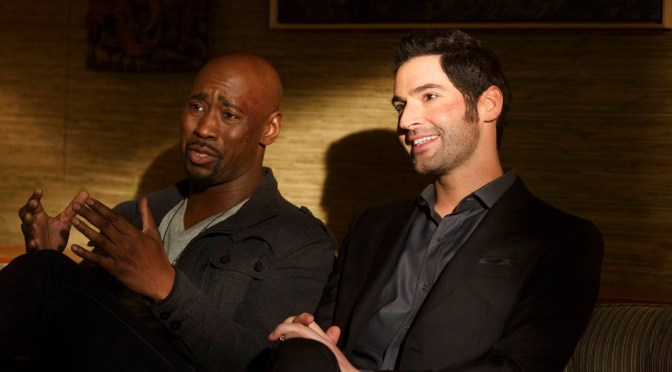
While the setup isn’t particularly intricate, there’s a good deal of story crammed in here, interspersed with smartly written and performed character work. Lucifer and Amenadiel are always wonderful together—Tom Ellis and D.B. Woodside have a great chemistry, are remarkably believable as brothers, and become great fun to watch when they’re friends—but Chloe and Maze are surprisingly good together as well. It’s nice to see the two most important women in Lucifer’s life getting to spend some quality time together, and Lauren German and Lesley-Ann Brandt work well together. Dan (Kevin Alejandro) fades a little into the background, though he does get a big moment as he tries to redeem himself, and Dr. Martin (Rachael Harris) is as sadly superfluous and ill-utilized as usual, but in general all the show’s parts are in perfect concert.

Malcolm (Kevin Rankin) is still delightfully villainous, but the episode almost goes overboard with including his implied sexual abuse of his wife, especially since late in the episode he holds Trixie hostage. The scene in which Chloe and Maze speak with Mrs. Graham is handled relatively sensitively, however. Mrs. Graham’s trauma is treated seriously, and while the word “rape” isn’t actually used, it’s obvious that the audience is meant to understand it as such, but the scene passes quickly and the topic is never revisited so it just doesn’t seem very important. Sure, it’s consistent with what we know about how Malcolm was changed by his time in Hell, and it serves in a way to further establish the mythology of the show (Maze has seen this affliction before), but I’m just not sure that it was warranted. Murder and kidnapping are plenty of evil for us to root for Malcolm’s demise without adding rape into the mix as well, but it could have been handled far worse than it was.

Though the episode starts with shaking things up and separating characters, in the end it’s about solidifying the bonds between all of them. Lucifer and Amenadiel discover a new closeness and come to perhaps a better understanding of their father’s plans—or at least a better understanding of the fact that they don’t understand His plans. Chloe and Dan are more complicated than ever, but the secrets Dan was keeping are all out in the open now. Maze is missing in action after healing Amenadiel, so I expect her fate to figure largely in the first part of season two. The central relationship of the show, of course, between Chloe and Lucifer, has matured into something quite deep, though, and it’s their reconciliation that carries most of the emotional heft this week. It’s not that I expect their friendship to be untroubled from now on, and I do expect for the will-they-won’t-they aspect to be heightened in season two, but a relationship that seemed shallow and laughable early in this season has become something that feels real, with emotional payoff that feels natural and earned.

The biggest question to be answered in season two, though, is who is Mum? I can’t wait.

Game of Thrones Recap/Review: Season 6, Episode 1 “The Red Woman”

For an episode titled “The Red Woman,” last night’s season six premier had remarkably little to do with Melisandre, and it didn’t introduce the other red priestess who has been teased in some of pre-season promotional materials. Still, the episode sort of starts with Melisandre, and it definitely ends with her, so I guess the title works alright.

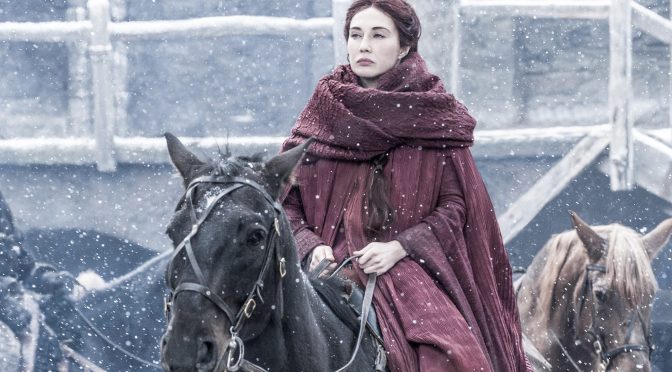
The hour opens with Davos discovering Jon Snow’s corpse, which Alliser Thorne and his men have just left laying out in the snow, in spite of the fact that they know that corpses at the Wall must be burned so they don’t rise up as wights. Davos and some of the men loyal to Jon take the body indoors and put it on a table while Ghost tries to escape from the room he’s shut up in. Dolorous Edd is sad and angry, but he leaves to get Ghost when Melisandre shows up. Melisandre says that she saw Jon Snow in the flames, fighting at Winterfell, but we all know how accurate shit she sees in the flames is.

Elsewhere, Alliser Thorne is humble bragging about how he killed Jon Snow out of patriotism or whatever and tries to rally the remaining men of the Night’s Watch against the Wildlings. He’s basically a dour Donald Trump. Meanwhile, Davos has a plan as well, which is good because Dolorous Edd is ready to just die gloriously trying to avenge Jon’s murder. Davos sends Edd to go talk to the Wildlings, because obviously a bloody, senseless battle is exactly what everyone needs to help them work through their grief. I’m guessing that we should expect a significant battle between the Wildlings and the Night’s Watch in the second half of episode two, or more likely in episode three. I’m calling it right now, though: Melisandre is going to resurrect Jon while the battle is raging, and he’s going to come out and his mere appearance will miraculously unite the Night’s Watch and Wildling factions. Also, either Jon Snow is going to chop off Thorne’s head to prove what a big man he is or he’s going to magnanimously allow Thorne to live and Thorne will become a creepily fervent supporter of Jon Snow.

Because this show definitely has its priorities in order, we’re taken next to Winterfell, where Ramsay Bolton is mourning his dead girlfriend by talking about how he first saw her when she was just eleven. It’s okay, though. The writers just buried the lead—Ramsay wasn’t much older, himself. Whew. And I thought this was going to be gross and creepy. Nah, it’s just supposed to be kind of sweet, I guess. Even sadistic torturing rapists have feelings that we’re supposed to be invested in. Just kidding! Ramsay tells the maester to feed Myranda to the dogs, because she’s good meat, after all.

No joke, I cackled maniacally when this happened, and it wasn’t just because I’d already downed half a bottle of wine. It was legitimately hilarious, and it gets even more hilarious when Ramsay gets a talking to from his dad. There is nothing funnier on this show than Roose Bolton dispassionately chiding his bastard son for irresponsibly losing his wife and pissing off the whole North, then threatening to pass Ramsay over in the succession in favor of a baby that isn’t even born yet. I love that D&D love Ramsay and his storyline so much and that they seem to see him as a sort of misunderstood but ultimately lovable antihero that they never stop trying to get us to root for. Because moral ambiguity, obviously. He really loved his evil girlfriend! And he’s got daddy issues! Sad trombone!

Theon and Sansa are running through the woods with Ramsay’s men in pursuit with dogs. They cross a freezing river in order to throw off the hounds, but not five minutes later the dogs find them anyway. Probably because, instead of traveling up or downstream to confuse their pursuers and buy themselves more time, Theon and Sansa just crossed straight over, leaving a very visible trail in the snow. Good news, though! Brienne and Podrick arrive just in the nick of time to save them. Because this is not at all unlikely, and goodness knows we need more scenes of Brienne straight up butchering guys (not really kidding, I actually kind of like seeing Brienne destroy like eight dudes at a time).

Here’s the thing, though. For all that D&D and directors and actors have talked up Sansa in the last couple of years and continuously promised that no, really, this season we’re going to get to see her come into her own, that’s not what happens here. Theon has to practically drag her into the water with the ominous warning that he’s seen what Ramsay’s dogs do to people, as if Sansa isn’t already very aware of her husband’s cruelty. Sansa at one point begs Theon not to try and sacrifice himself to save her because she says she won’t survive without him. Then, of course, Sansa is totally useless when Ramsay’s men do catch up with them, while Podrick is apparently a kind of badass now and even Theon gets to pick up a sword and kill someone.

The really unforgivable part of all this, though, is that when Sansa is finally safe(ish), after Brienne has dispatched Ramsay’s men and saved the day, Brienne again offers her service to Sansa, just like she once offered her services to Sansa’s mother. It’s the first time that Sansa has had a meaningful and more or less unconstrained choice to make in a while, and she looks to Theon for permission. It’s only when Theon nods his assent that Sansa accepts Brienne into her household (such as it is), and even then, Sansa—one of whose defining qualities (in the books, at least—I’m pretty sure that consistent characterization is a total mystery to D&D) is her knowledge of and adherence to social conventions no matter how terrible her circumstances—cannot remember the traditional response that she is supposed to make to Brienne’s oath. She has to have Podrick remind her of the words.

Listen, I’m sure that there are a thousand justifications for this. I’m certain that it will be explained away as Sansa being traumatized, that it’s a sign of just how much Ramsay’s abuse has affected her. It could be that they intended this moment to be illustrative of the similarities between Sansa and Podrick, who is admittedly a sort of kindred spirit to Sansa in this way. It could even be sowing the seeds for a romance between the two characters because the show is essentially just awful fanfiction at this point and no bad fanfic is complete without a crackship. Oh, god, this is really happening, isn’t it? I can’t help feeling as if by putting it into words I’m willing this garbage into existence, but now that I’ve had the idea, I’m about 80% certain that this is exactly where the show is going. Jesus wept.

In King’s Landing, Cersei is excited when she thinks Myrcella is home, and it is actually fucking heartbreaking to see her face fall when she realizes that her daughter is dead. It has nothing to do with the books, and it’s not particularly consistent with anything that has come before this on the show, but I actually don’t hate the following scene, where Cersei is grieving and Jaime is trying to comfort her. I did laugh like a maniac when Jaime says “Fuck everyone who isn’t us!” though. Because probably these two would have far fewer problems if they’d been doing that all along. In any case, there’s not much to mock here. The scene focuses on Cersei’s belief in prophecy, and it does kind of make it seem like we’re supposed to think she’s stupid for it, but it’s not the worst thing this show has done with these characters, and Lena Headey is great at making me care about her character even when what she’s doing makes no sense at all. This material is about three quarters plausible based on what we’ve seen of Cersei up to this point, so it seems great in comparison.

Elsewhere, Margaery would like to see her brother, but Septa Unella is a big old bitch. Sure, she might be a petty Catholic schoolboy’s misogynistic caricature of an overzealous nun, but really she’s just the bad cop to the High Sparrow’s good cop. I guess it’s good to get some kind of update on Margaery, but there’s not actually a lot of information in this scene, just a vague suggestion that Margaery might have stumbled upon the right thing to say in order to get herself out of jail. Alternatively, the High Sparrow may have simply realized that keeping the queen in a filthy dungeon for no real reason is probably not conducive to his continued good health. Who even knows, really?

With that, we’re whisked away to Dorne, where Ellaria and her daughters have staged a comically ridiculous coup. “Weak men will never rule Dorne again,” Ellaria says. Okay, but WHO WILL BE RULING DORNE NOW? This makes no sense whatsoever. Ellaria’s murder dress is stunning, though.

On the other side of the world in Meereen, Tyrion and Varys are walking through the apparently totally empty streets of the city. In case you’ve forgotten, Varys has no cock, which is a hilarious joke apparently. Tyrion is so funny. Things get even more hilarious when some poor brown lady thinks that Tyrion wants to buy her baby to eat and Varys has to explain that Tyrion just sucks at speaking Valyrian. Also, something something Tyrion walks like a rich guy, even though Varys is walking next to him in literally the exact same way. I hate this all so much. It makes no sense that Tyrion and Varys are now in charge of the city in the first place, and this is just deeply silly. Oh, “Our queen is not as popular in Meereen as she used to be”? Okay. When was that, exactly? There was violent resistance to her rule from day one. I guess at least the red priests are on Daenerys’s side, sort of? Oh shit, the entire harbor is on fire.

I had somewhat high hopes for comedy value of the Jorah and Daario bro journey, but it turns out to just be some rather maudlin reflections on how much they both love Daenerys. D- banter. The way they track Daenerys is kind of dumb, but okay. Jorah finds the ring Dany dropped in the middle of a huge field, where it was somehow not trampled into the ground or washed away by rain or just covered by grass, and now they know that she’s with the Dothraki.

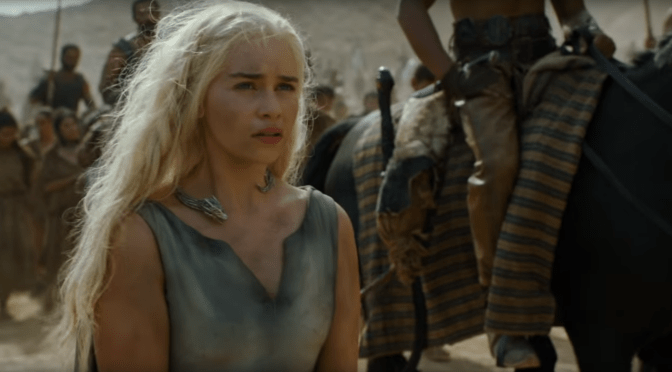
Speaking of the Dothraki, this show really loves to have wide shots where Daenerys is the only white person in a sea of brown faces, huh? Just to make sure we know how bad things are for Daenerys, we have to listen to a pair of Dothraki men say gross and demeaning things to her for several minutes while she’s marched to see the Khal whose property she now is. There’s plenty of racist overtones throughout Dany’s time with the Dothraki this week, but this first part kind of takes the racist cake, as the two cheerfully rape-y Dothraki men and their sexually violent and degrading comments are explicitly presented in contrast to Daario and Jorah’s true and pure love for their queen. This is all compounded, of course, when Dany is finally brought before the Khal and he too talks about raping her while a couple of Dothraki women just say superstitious garbage and advise him to kill her. It’s almost as if this show wants to make really sure that we know that the Dothraki are ignorant, vicious barbarians or something.

Fortunately for Daenerys, all she has to do is name drop her dead husband and instead of getting raped and enslaved she’s going to be treated with some basic dignity and carted off to Vaes Dothrak to live with the rest of the widows of Khals. I’m not sure why she’s so surprised and dismayed by this, though. I know the show has diverged pretty wildly from the books, but even in the show she’s supposed to have become very assimilated into Dothraki culture during her marriage, so she would know that this is what is supposed to have happened when Khal Drogo died. In the books, trying to avoid this fate is part of what drove her to travel away from the Dothraki in the first place; she wanted to be a queen, not stuck in what is essentially an old folks’ home. Here, though, it’s just one more thing for Jorah and Daario to rescue her from. I guess it beats them having to rescue her from sexual violence or slavery, but still. Ugh.

There’s a brief Arya scene, of course, where we learn that she is indeed blind, and begging in Braavos. The Waif shows up and beats the shit out of her for some reason, then goes away promising that she’ll see Arya tomorrow. Okay.

The episode ends back at Castle Black, where Alliser Thorne is trying to secure his hold on the Night’s Watch. Davos and the few Jon Snow loyalists are still barricaded in a room, and Thorne is trying to get them to surrender, promising that, no really, he’s definitely not going to murder them all if they just open the door come on guys pleeeease. I’m not really sure what Davos and company think they’re going to accomplish all holed up with Jon Snow’s corpse, and I don’t really understand why Davos thought this was a thing he needed to get this deeply involved in to begin with, but apparently everything depends on Dolorous Edd now. Then Davos is all “Well, we could use the Red Woman,” and the other guys are like, “For what?” but we don’t find out this week.

Instead, we get to see Melisandre, who is still pretty bummed about how things went down with Stannis, I guess. She starts stripping in front of a mold-covered piece of metal, because we haven’t seen any boobs yet this week, but PSYCH! She takes off her necklace and she’s been an old hag all along! Even though, back in season four (episode seven) we’ve already seen Melisandre completely naked in a bath without her necklace and she was still a total babe. I feel like this is meant to be shocking and symbolically resonant because she’s metaphorically aged by her experiences and is now feeling her age in a way that she hasn’t up to this point. Okay, sure, whatever, but it doesn’t even work.

It’s hinted at in the books that she’s much older than she looks, but the show has never hinted at this before and it explicitly contradicts what we’ve seen on screen years ago. D&D might think their audience is stupid—they have a long track record of both abandoning stories that they have done groundwork for (like Tyrion and Tysha, for example) and introducing “twists” like this seemingly out of nowhere. It’s incredibly insulting to the audience—we really can keep up; it’s not that complicated—and it’s in every case a disservice to the show’s characters. Which doesn’t even touch on the added insult of using an aged woman’s body as spectacle in a way that is calculated to make the viewer feel disgust and shock just at seeing it. Thanks, Game of Thrones.

Still, “The Red Woman” isn’t a terrible episode. Unlike most of the other first episodes of the show’s seasons, this one spends a minimal amount of time just recapping the events of the previous season. The hour does still mostly consist of setup for future events, but it nonetheless manages to feel as if there’s some forward movement on all its many fronts. Probably the most positive thing I can say about the episode, though, is that they made a smart decision to do this week’s storytelling in longer scenes than usual, without skipping around between settings. Often, Game of Thrones does well at crafting particular moments and events, but the show has struggled, increasingly, for years with actually forming those moments into coherent stories. With a couple of exceptions (Arya’s scene, most notably), every scene this week worked to move the story along, and there was even a sort of linear logic to the episode that made it fairly pleasant viewing. It wasn’t the regular scattered vignettes on a theme that we have become used to, and that’s a positive development. Now, if only we could get the stories and character development on this show to actually make some kind of sense, the show might be halfway good again.

Miscellaneous thoughts:

  • Every scene at Castle Black and Winterfell is unrelentingly dark and gloomy, still. It’s actually distracting, as it’s downright difficult to see what’s going on at times.
  • Roose confirms that Stannis is dead, but they don’t know who did the deed. “I’d reward the man,” Roose says. Hardy har har. See, it’s funny because we know that it was Brienne. Hilarious!
  • The Sand Snakes really are the worst. I think the best we can hope for is that this is the last we’re ever going to see of them.
  • Jorah’s greyscale is getting worse. Also, I am pretty sure he was definitely considering rubbing it all over Daario. “If” Daario grows old, indeed.
  • I did chuckle at “Seeing a beautiful woman naked for the first time is among the five best things in life” but I kind of hate myself for it.
  • I love the dude that’s like “Well, we’re fucked if we have to depend on Dolorous Edd.”

Book Review: Sleeping Giants by Sylvain Neuvel

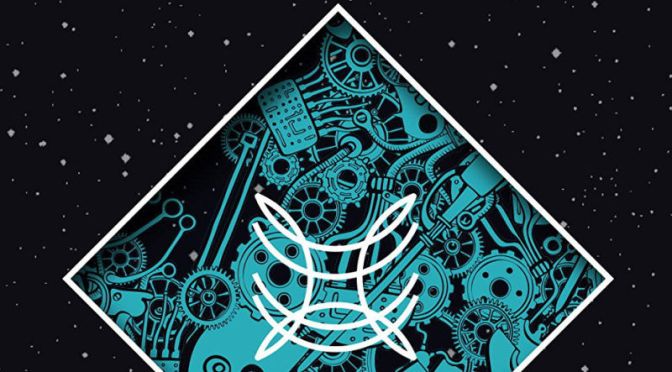
It’s easy to see why Sylvain Neuvel’s debut novel, Sleeping Giants, is one of the most talked about sci-fi novels of the year. It’s got a gorgeous cover, a great (in very inaccurate) mash-up description (World War Z meets The Martian? Not really.) to sell copies, and it’s compulsively readable from page one. It’s also a book that can be read as seriously or unseriously as you like; on its surface, Sleeping Giants is a blockbuster thriller that (judging from its recently being optioned for film) would be right at home at a movie theater in June, but there’s a good amount of depth to it as well if one cares to look. In short, it’s an excellently written middle brow novel that defies strict genre classification. Between its broad appeal and heavy advance promotion (it’s been on NetGalley since before Christmas, I believe), Sleeping Giants is well-positioned to be one of the most widely read sci-fi novels of 2016. Even better, it’s a novel that deserves to be widely read. Because it’s really, really good.
The story opens with a young girl falling into a hole in Deadwood, South Dakota. Inside the hole is a giant, glowing turquoise hand, which is quickly whisked away and the whole incident hushed up. Seventeen years later, the girl, now Dr. Rose Franklin, finds herself in charge of a team overseeing the search for the rest of the pieces and trying to figure out how to make the ancient alien machine work. In a way, this description—basically what is on the cover of the book—is misleading. Rose is not the main character as it implies, though she does have a vital part to play in the narrative. In some ways this is a little disappointing, as I was expecting a book about a badass lady scientist, but the lack of focus on Rose is more than made up for by the other main female character, pilot Kara Resnik, who is wonderful. That said, all the characters were pretty good, even linguist Victor Couture, who is a pretty obvious semi-self-insert on the part of the author but tends to steal every scene he’s in.

I have been a fan for many years of the epistolary novel, and I’m glad to see that it’s been coming back in recent years. Sleeping Giants is another one to add to the pile. Told primarily in the form of transcripts of interviews between various characters and an unnamed interviewer, Sleeping Giants is consistently entertaining and never once boring. Early in the novel, Neuvel does lapse into a more generic prose style that doesn’t feel as conversational as it ought to, given the format, but by about a quarter of the way in you can clearly see each character’s voice and personality emerging and by the end of the book they feel like old friends. It’s not perfectly executed, but the later finesse makes up for earlier stumbles, and the novel is overall nicely structured. Each character has a well-defined arc, and Neuvel does an excellent job of setting up the story, breaking things, and then pulling it all together for a satisfying ending to this first installment of his series.

Interestingly, the most compelling character turns out to be the unnamed interviewer. He doesn’t get a character arc in the same way that Kara and Vincent do, but the slow revelation of his character is fascinating. I wasn’t, at first, totally sold on him as a character—a shady figure outside the government who has, well, not a heart of gold, but some kind of conscience—but by the end of the book I was totally engaged in his story. And it is the interviewer’s story, at least as much as it’s the story of Kara or Vincent or Rose. Because the interviewer is the only constant character and the collected files that make up the book seem to be the part of the interviewer’s records, it’s the interviewer who is ultimately in control of the narrative that we’re exposed to as we read. This may not matter for a surface reading of the text, in which case it’s totally fair to just accept that the interviewer is what he seems to be, but I feel as if we could endlessly debate the veracity of the collected documents that make up the story, the motives of the interviewer, and the degree to which he is or ought not be considered a reliable narrator.

Sleeping Giants isn’t going to be one of the technically “best” novels of the year, in spite of all its hype. It’s good, and it’s highly enjoyable, but it’s not great literature. Still, it’s a solid debut for Sylvain Neuvel and a nice start to the Themis Files (a trilogy, I guess?). I don’t think this is going to be a book with much reread value, but I’m absolutely looking forward to the next installment of the series.

This review is based upon a copy of the book received through NetGalley.

Game of Thrones Season 6 Predictions!

I was ready to quit Game of Thrones by the end of season five, to be honest. It just… wears on me, you know, watching hour after hour of D&D completely missing every point that GRRM has ever tried to make with his ASOIAF, and last year was a new nadir for the show by pretty much any standard. The thing is, even that complete pile of garbage had some redeeming features, and the truth is that it’s still the longest running, highest production-value fantasy show on television. If you want grownup epic fantasy, Game of Thrones is basically the only game in town. So, here I am in 2016, back again and even somewhat excited to see what fresh hell D&D have created for us this year.

Obviously, I don’t have particularly high expectations for the show at this point—I’d always rather be pleasantly surprised than disappointed—and with the show moving (in some ways at least) past the books it’s a little hard to say exactly what we’re in for this season. That said, here are my predictions, in no particular order:

  1. The show is not going to be nearly as “past the books” as D&D might want us to think. There is still a lot of the source material that they haven’t touched, and we already know that at least some of that is going to make it to the screen in some form. I’m fairly certain that the whole “we’re past the books now” thing is primarily an attempt to head off criticism for piss poor adaptational choices. I’m also fairly certain that criticisms of the show’s adaptational choices will figure largely in my posts on each episode. I do think we’ll start to see more truly new material in the back third or so of the season, but I fully expect that the first half of the season will still be as much in book territory as season five was. Which is to say, not very, but sort of? We’ll see.
  2. Jon Snow is coming back one way or another. There’s just no way that he’s not. However, this won’t be resolved in tonight’s episode. It’s much more likely that we’ll find out how this is going to happen at the end of the second episode or perhaps even in the third, which would make sense since the episode three is titled “Oathbreaker.” I would be very surprised if Jon Snow breaking his Night’s Watch vows entirely wasn’t part of that.
  3. Myrcella is dead. Cersei is going to do something colossally stupid in reaction to it.
  4. Daenerys is going to be a damsel in distress for at least a couple of episodes. She will woodenly deliver some theoretically quotable, supposedly empowering, but really just silly speeches that liberal feminists will gif and spread all around Tumblr for the next several years.
  5. Yara Greyjoy will have some scenes this year, but they will make no sense. I’m pretty sure that it was Yara—based on a character who was aggressively heterosexual in the books—making out with a female prostitute in one of the trailers, so that’s a thing that I guess is happening. I’m sure that that’s not going to be leeringly gross and demeaning for all women involved in any way.
  6. Tyrion is going to be awesome at ruling Meereen while Daenerys is away, even though it makes no sense at all that he’s in charge in the first place. He is going to say a ton of maddeningly condescending shit to Missandei and Grey Worm while cutting them entirely out of decision-making. Tyrion stans are going to gif every absolutely asinine he says and spread it around Tumblr forever.
  7. Sam and Gilly will make it to his parents’ place, probably in the first couple of episodes. Whatever happens there will be soul-crushingly dull. Probably some pity sex.
  8. Speaking of soul-crushingly dull, we’re going to see a good amount of Bran this season.
  9. Ser Jorah is going to die. Probably he will sacrifice himself heroically to rescue Daenerys.
  10. Melisandre will try to seduce Davos. I could be totally wrong, but I just really have a feeling that this has to happen at some points. I wouldn’t be surprised if she needs Davos’s sperm to resurrect Jon Snow. That seems like exactly the sort of thing D&D would think up.
  11. Arya is going to have sex with someone. I don’t think she’ll be raped, but Maisie Williams was 18 during filming for this season, and D&D are nothing if not disgusting in the way they treat the young girls who have grown up on this show.
  12. The Faith Militant will still only care about gay dudes and prostitutes and not at all about systematic injustice and the suffering of the smallfolk.
  13. We’re going to find out who Jon Snow’s parents are.
  14. Ramsay is going to continue to be, along with Tyrion, D&D’s favorite character. He will survive the season and maybe even get some kind of redemption arc.
  15. There will be more than one wide shot of Daenerys as a speck of white in a sea of brown people.
  16. Everything else will continue to be poorly lit and difficult to make out.
  17. I will go through a lot of $5 bottles of wine in the next couple of months.

My plan as of now is to watch the show on HBO Now tonight, possibly livetweeting some reactions, and then I will have a full recap and review out tomorrow.