Let’s talk about Lego, or, Why I hate Nexo Knights

I do not understand how a company as large as Lego can continue, year after year, to fuck up this spectacularly and still have the enormous brand following that it does. I mean, okay, I understand, but it pisses me off, a lot.

A gender neutral Lego ad from the early 1980s.

When I was a kid, Lego was still primarily focused on selling building sets that encouraged imaginative play and creativity, and their themed sets were generic–City, Castle, Space, etc.–but as the company grew and time passed, Lego has increasingly shifted into the licensed merchandise market, with themed sets for enormous properties like Lord of the Rings, Star Wars, and Marvel and DC comics. Along with that change in focus, Lego’s original sets have also changed and become more specific, with settings even being discontinued and replaced with new iterations on the old themes. In some ways this has been kind of cool, and there have been some interesting developments over the years. However, there have also been disappointments.

Lego Friends’ hyperfeminine, stereotypical ideal of girlhood.

After years of facing criticism for their increasing marginalization of girls, in 2012 Lego introduced the Friends line of building sets, specifically (and sexistly) tailored to what they believe girls are interested in. It started with, basically, a Lego dollhouse kind of deal and expanded to include Disney Princesses, Pop Stars, and even Elves. While some of these Lego-for-girls themes have been fun, they largely play into and promote gendered stereotypes. More importantly, and to greater negative effect, by mostly merchandising these “for girls” products separately from the rest of the “regular” Lego sets in stores, the gender problem has been compounded rather than solved.

It was bad enough when the problem was just that parents and fans of the brand wanted the toys to be more inclusive, but now the company has decided on a kind of “separate but equal” approach–and like all “separate but equal” policies, it’s not equal. At all. All it has done is clarify that, though Lego may have begun as a toy for all children, the company’s evolving vision is of Lego as a toy for boys unless specifically marked otherwise. Lego Friends made it very explicit what Lego, as a company, thinks a girl’s place is.

Here’s the thing, though. I still kind of love Lego. I get excited about new theme sets when they come out, especially new original themes because it’s neat to see what they come up with. So when I first read, in passing, about Nexo Knights, I was intrigued. While Lego has definitely changed up its castle stuff over the years, it’s basically always been various flavors of medieval fantasy. Nexo Knights is much more sci-fi, with robots and mech-armor and war machines as well as castles and knights. Which sounds pretty cool.

Today I finally got a chance to sit down and look through the sets online to see if there were any that I might need to buy. It turns out that, nope, I don’t want any of these. With Nexo Knights, Lego once again shows how little they think of girls when designing their play sets: only about a quarter of the Nexo Knights characters are girls or women.

Nexo Knights mini figs.

Of the actual knights, only one is a woman, Macy, who is identified by her large red ponytail and the feminine figure printed onto the body piece of the figure. Of course, on her character page, the first image we see of Macy is her in a dress, looking unhappy, and her backstory is all about how she hates being a princess and wants to be a knight and impress her father, King Halbert. Because we definitely, in 2016, still need to have toys normalizing the idea that girls always have to struggle for recognition and acceptance, not to mention the idea that to be “strong” a girl must reject femininity.

Queen Halbert

Unlike many fictional princesses, though, Macy does have a mother, Queen Halbert, who couldn’t even get her own name–she has to share her husband’s. We’re told on her character page that Queen Halbert “is quite capable at defending herself (and her husband),” and she’s pictured with a huge, rather badass-looking hammer. However, Queen Halbert only appears in one of the twenty Nexo Knights sets currently for sale, and the story line of the set? Is that you have to rescue Queen Halbert from Infernox, a sort of robot-y lava monster. It’s bad enough that the supposedly capable and tough queen only appears as a damsel in distress, but the other minifig included in the set, who is supposed to do the rescuing, is a man. Having her rescued by her daughter, Macy, would have neatly subverted the trope, but clearly Lego intends to stick with traditional, sexist gender roles as much as possible while still pretending as if they are creating strong female characters.

Ava Prentiss

Ava Prentiss is the one female character in Nexo Knights that I don’t think I can complain much about. She’s a student at the Knight’s Academy, and is really into computers. I actually kind of love the idea of this character as a way to introduce kids to the common SF theme of magic vs. technology. I only wish that Ava’s story included a friendship with Macy or Queen Halbert. All three of the “heroic” female characters in Nexo Knights seem to exist totally independent of each other, and none of them are mentioned in the stories of any of the others in either the Lego website content or the marketing copy for the actual sets.

Flama

To balance out the three good female characters in Nexo Knights, there are likewise three evil ones. In a way, this is refreshing and a step in the right direction for the brand; I can’t recall another Lego line that had this many lady villains. On the other hand, they’re also a mess of gendered weirdness.

Whiparella and Flama aren’t too bad. Whiparella is a sort of fiery naga-looking thing, which is pretty rad, and Flama is straight-up awesome-looking, though I am a little confused about why fire monsters need to have visibly feminine figures. Whiparella even has actual drawn-on breasts. Are fiery naga things mammals? I wasn’t aware.

Lavaria

The character that has me spitting mad, however, is Lavaria. I liked that she gets her own set, but I definitely got some vague succubus vibes from the image included with the product listing. When you look closer, though, you’ll see that Lavaria–though she has a cool spear thing, a shield, and this mech-spidery vehicle–is wearing what amounts to a sort of chain mail bikini type outfit. I suppose this could be explained by the description of Lavaria as more of a rogue-like character, though I would argue that being a rogue still doesn’t eliminate the necessity of protecting one’s vital organs in battle.

However, the worst thing about Lavaria shows up on her character page on the Lego website. You see, Lavaria is basically the Harley Quinn of Nexo Knights–the thing she “truly wishes for” is “a kiss from her wicked master,” Jestro.  I’d love to say that this is as deep as the awfulness of this goes, but that’s not the case. It’s like an onion of sexist bullshit. The character pages give us quite a bit of information about the characters, and while Lavaria is described in some detail as a confident, villainous woman, Jestro is, well, something else. Namely, an inept, unintelligent buffoon, who is still inexplicably a love interest of sorts for Lavaria and the dominant half of the pair (he’s the main villain, she’s his sidekick).

Sadly, this new line of building sets could be seen as a sort of progress for Lego. Though only about a quarter of the total minifigs in the set, women and girls do make up fully a third of the named characters, and there is some amount of diversity in their personalities and backgrounds. This actually makes Lego’s failure in this set that much more frustrating. The movement towards something closer to gender parity shows that there is some recognition that the products have a problem, but the continued reliance on sexist tropes and antiquated (and insulting) gender roles shows that whoever is in charge at Lego still doesn’t truly understand or respect (or maybe just doesn’t really care about) the criticisms that have been levied against Lego products over the years.

Shadowhunters is an infinite pit of visual and storytelling atrocities

Here’s the thing about Shadowhunters: I didn’t expect it to be good. Cassandra Clare’s books were heavily derivative but highly readable fluff, and the movie based on City of Bones was awful, but entertaining. I rather thought that the material would be much better suited to the episodic format of a television show, as the source material is very obviously influenced by shows like Buffy the Vampire Slayer. Sadly, this show is just terrible, and not even hilariously so. It’s just really, really, horribly bad in basically every way. I even watched the second episode as well thinking that surely it must get better, but that’s just not the case.

The first thing I noticed was that Clary’s hair is godawful. Looking at photos of the actress (Katherine McNamara) online, she does appear to be (possibly) a sort of natural strawberry blonde, but until I looked it up I would have sworn that orange-y mess on her head was a wig. Now I have to admit that it’s actually just a mix of hideous dye-job and turning up the saturation in post-production. Either way, though, it’s distractingly unnatural without feeling like part of any cohesive sense of style. Instead, it’s just a bright orange blob in the middle of every scene, threatening to burn itself into the viewer’s retinas.

Clary’s hair is really just the tip of this show’s visual atrocity iceberg, though. While not literally everything in the show looks bad, it’s pretty overwhelmingly cheap, ugly, and unoriginal, from hair to makeup to costumes to visual effects. It’s a colossal missed opportunity, if nothing else, since one of the main reasons to watch these sorts of urban fantasy shows is to see sexy people wearing hot clothes while fighting cool-looking monsters. Unfortunately, there has to be something distinguishing about a show to set it apart from the rest, and the styling of Shadowhunters is lazy, low-budget, and boring.

A short and probably incomplete list of examples:

  • Magnus Bane’s makeup, which makes him look like a 14-year-old goth kid who doesn’t know how to put on makeup yet.
  • Isabelle’s white club costume, which is ill-fitting and wildly unflattering, especially with the clown-like makeup they put on her.
  • Jace’s whole look. Sure, he’s a type, but it’s just too on the nose.
  • The shadowhunters’ seraph blades, which function like lightsabers and look like amorphous pieces of pointy clear acrylic hot glued to the end of LED flashlights.
  • The runes on the shadowhunters’ bodies are somewhere between weird birthmarks and weird rashes, and when they glow they look positively sickening.
  • The outfit Isabelle lends to Clary.
  • The monster effects are very uneven. Some, like the tentacle-faced demons, are almost okay-looking, but mostly they look cheesy.
  • All of the warlocks’ magic effects look silly.
  • The Institute is full of generic sci-fi computer stuff, which is a both a huge departure from the source material and at odds with the rest of the show’s aesthetic.
  • That blinking club sign that switches between “PANDEMONIUM” and “DEMON” was mildly clever the first time, but not the twenty-first time I saw it in less than two hours.
  • Some of the worst fight choreography I’ve ever seen.

In addition to being visually offensive to the senses, the show is also a complete storytelling disaster. Granted, it’s been a while since I’ve read the books the show is based on, but the first two episodes seem to have raced through probably half of the first book. At the same time, however, if feels as if very little has happened, and most of the characters have had remarkably little to actual do with their time on screen. Instead, most of these first couple of episodes is devoted to worldbuilding, but not through showing the audience what’s going on. Rather, there’s just a metric shitload of clunky exposition delivered primarily through embarrassingly bad dialogue.

Perhaps worst of all, almost no one seems to be able to actually act worth a damn in this show. The dialogue is bad enough as written, but it’s not helped by soulless, wooden delivery. This could be the result of terrible characterization, though. The show so far relies heavily on hackneyed archetypes, and each character seems to have a single personality trait, none of them likeable. Clary speaks in a creepy little girl voice; Isabelle is portrayed as a sexpot; Magnus Bane is simply sullen; Alec is grumpy and xenophobic; Jace is vaguely and unconvincingly Byronic; Simon is a pathetic Nice Guy™; Luke is strong and silent-ish. Every single one is a worn out stereotype, and there’s nothing clever or interesting or subversive about any of them.

Listen, as I said in the beginning, I didn’t expect this show to be great, or even particularly good. I did expect it to be fun. Instead, it’s an epic catastrophe of everything that can go wrong with this sort of genre program: nonsensical mythology, bad visuals, awkward exposition, moving through material at such a blazing fast pace that there’s no emotional depth, dour performances, no discernable sense of humor. It’s so irredeemably, relentlessly horrible that I don’t even want to keep watching for laughs.

Book Review: Patchwerk by David Tallerman

I received a free advance copy of this title from the publisher via NetGalley.
I had no idea what to expect when I opened Patchwerk, aside from what the cover blurb says about it, so it was a complete and mostly pleasant surprise. I’d never heard of David Tallerman before, and this is the only thing I’ve ever read by him. Patchwerk is a type of sci-fi story that I don’t usually seek out—the “man invents something ill-advised and hijinks ensue” sort—so it was an interesting change of pace, although it was a great follow-up to Microsoft’s Future Visions anthology of “harder” sci-fi, which I just recently finished.

In some ways, Patchwerk is an interestingly experimental work, told in a series of alternate universe vignettes, each beginning where the previous one left off so that the reader learns what is going on at about the same rate as the characters do. At the same time, I figured it out before I think I was supposed to when I read it, so that the revelation when it came felt a little redundant and slightly condescending. It felt as if Tallerman thought he was being a good deal cleverer than he actually was when he came up with the concept for the book. Still, it wasn’t a particularly egregious example of this flaw, and the concept works well in other ways even if it fails somewhat as a tool for creating suspense.

What Patchwerk lacks in suspense—the stakes are said to be high (or at least implied to be), but things never do feel all that dire, and the ending was a little too pat—it makes up for in sheer action packed-ness. At no point was I ever bored reading this little book, and I finished it almost entirely in one sitting, on the edge of my seat the whole time. Though I complain that I figured some things out before the book confirmed them, I was so delighted with what was going on that it didn’t bother me at all while reading.

Perhaps my only significant complaint about this novella is a technical one. While I’d have to reread it to find specific examples, it seemed as if Tallerman shifted pretty freely between a close third person point of view focused on Dran and an omniscient narrator with some insights to Karen that Dran wouldn’t have been privy to on his own, and this was sometimes distracting. It might have benefited from another close read during the editing process to clarify some random-seeming point of view shifts that were a little distracting.

This definitely isn’t my favorite of Tor.com’s novellas, but it’s another solid entry into the catalog, and I’m glad to have read it. While it didn’t tickle my fancy as much as Of Sorrow and Such or Binti or Sorcerer of the Wildeeps, it was a nice journey outside my usual sub-genre choices, and it gave me something to think about for the afternoon that I read it.

iZombie: “Method Head” has a little of everything I love about this show

An uncharitable viewer may call “Method Head” overstuffed and disjointed, but I think I can say, without being entirely uncritical, that this episode managed to include basically all of my favorite things about iZombie. Sure, there’s a lot going on, and one of the major gut punches from the winter finale is resolved far too easily and quickly, but this episode seriously has everything. They even managed to squeeze scenes with Vaughn and scenes with Blaine into one episode, which almost never happens. Even better, in spite of all its moving parts, “Method Head” mostly works, although parts of the very meta case of the week fall a little flat.

The episode picks up the morning after Liv and Major’s breakup and Ravi’s discovery that their rat had reverted to being a zombie. All things considered, Liv and Major seem to be doing alright post-breakup, and they continue to be friendly throughout the episode, so it’s really Ravi who has the truly unfortunate news to share. Definitely the rat, New Hope, is back to being a zombie, almost certainly Major (and Blaine) will go back to being zombies, they’re right back at square one on the cure front, and they are out of tainted utopium. The only bright side here is that they know where they might be able to get more utopium—their search area is still a hundred acres, though. It’s a new raising of the stakes for the show and its characters and a renewal of the urgency that marked the series’ first season, which is nice, especially as the case of the week format has gotten a little stale.

I like the way this episode made use of title cards to move things forward in time, and it did a decent job of showing what everyone was up to over the remainder of the holiday season. It was a little sad watching Liv trying to get back into Clive’s good graces, but my complaint here is actually that the passage of time wasn’t enough. In the most generous reading of things, Clive was only mad at Liv for about two weeks, and by the end of this episode their status quo seems to have been restored.

This is especially disappointing after Liv’s very convincing devastation over it in the winter finale. This week she seems to have gotten over it relatively quickly, and we don’t see much of her sadness or stress or how she’s been emotionally affected by either her falling out with Clive or her breakup with Major. Certainly, I don’t expect Liv to sit home moping and eating pints of ice cream, but her arc this week was a very sharp turnaround after her apparent grief back in December.

The case of the week deals with the murder of an actor on the set of a show called Zombie High, which Liv apparently loves, and there are some fun moments, but I don’t think this idea was used to its maximum potential. There are some funny moments, but nothing that sticks in my mind even just a few hours after watching it. The one line I do remember—a teen actor suggests a show starring a zombie, and Clive replies, “That’s dumb”—is just too on the nose, but most of the rest of the Zombie High stuff is highly forgettable. The investigation does get Liv and Clive back together, but I would honestly have rather seen that drag out for a couple of episodes at least. It would have been interesting to explore who Liv is without that aspect of her life, and it would have given Clive some room to be developed as something more than just Liv’s way to play police officer.

The biggest surprise this week, for me anyway, was that it was Major’s story line that was the most interesting thing happening. Usually Major is the worst, but his scenes with Vaughn were excellent, even if I totally called it that the “whistleblower” thing was a loyalty test. It was predictable and obvious, but it worked, and I’m very interested to see how deep Major is willing to go down this rabbit hole.

Miscellaneous thoughts:

  • Dale and Clive have a very cute relationship, but I wish we got to see a little more of it.
  • “Hair color: white as snow.” I kind of wish the writers hadn’t wasted that Santa murder. They could easily have gotten a full episode of puns out of that.
  • Gilda/Rita and Vaughn are an incredible amount of fun to watch together. They hate each other so very, very much.
  • I was genuinely concerned for Dale when she went to talk to Blaine.
  • Looks like things could get real interesting for Major in the next week or two if Dale tracks the dog down to his place.
  • Peyton is missing in action. Again. Still.

The Shannara Chronicles: “Fury” goes backwards in order to move forward

The two-part opener for The Shannara Chronicles wasn’t a perfect piece of television, but it was marvelously entertaining and superbly beautiful to look at. “The Chosen” also did a creditable job of introducing all the show’s major characters and conflicts and setting up the major quest that will occupy the rest of this first season. The show’s third episode, “Fury,” is a step backwards in several ways, and it does become a little bogged down at times, but by the end it seems ready to move along to the real meat of the story.

After the fast-moving, plot-heavy “The Chosen,” the order of the day in “Fury” is to take a step back, metaphorically, and dedicate some time to character development. This is mostly a good thing, and Eretria especially improves upon further acquaintance, where we learn more about her motivations and what her life is like when she’s not out in the woods being a sexy, wise-cracking rogue. Amberle, who is a serious young woman, turns out to also be smart and funny once you get to know her a little more, and Poppy Drayton has noticeably relaxed into her role. Wil is in turns sweet and stupid and infuriating, but I think he’s overall likeable and not nearly as insufferable as other characters of this type.

Unfortunately, the episode also takes a step back more literally, by having our heroes travel all the way back to Arborlon before they can continue on their quest. More on that later, though. Before that can happen, there are some detours and another seemingly significant character is introduced.

While Allanon manages to save Wil and Amberle from the fury from the end of “The Chosen,” he’s injured in the process, and his incomplete instructions to them send Wil diving into the Silver River to get some kind of healing mud. It’s a good thing Allanon was just planning on healing himself with his druid powers, though, because by the time Wil gets out of the river, Eretria has shown up and has a dagger to Amberle’s neck. As they’re dragged through the woods to the Rover camp, Amberle takes Wil to task for falling for Eretria’s “half-baked Rover seduction” and the show’s love triangle is officially born.

Things continue to move along nicely once they reach the Rover camp and meet Eretria’s “father” Cephalo, who is almost inexplicably obsessed with the elfstones and is convinced that threatening Amberle’s life is the way to get Wil to share their secrets. Joke’s on Cephalo, though. Wil truly doesn’t know how to use the stones, Amberle is pretty resourceful, and Eretria isn’t totally on board with the plan. Before all that stuff can really come to a head, however, the Rovers find themselves under attack by the second fury, who has tracked Wil and Amberle to the camp. While people scatter in chaos, Wil desperately pulls out the elfstones and is able to use them to destroy the demon. Cephalo tries to take the stones, but Allanon shows up just in time to rescue Wil and Amberle, and put them back on the way to Arborlon where they’re supposed to be.

On the way back to the elven city, they come across a destroyed farm in the countryside. While searching for survivors, they find a boy chained up in a barn wearing a very creepy mask. He introduces himself as Bandon (which is a legitimately awful fantasy name; I hate it so much) and tells them that it was his parents who had locked him up, though he doesn’t share the reason why. It’s a very strange kind of random encounter that I don’t remember being in the book, and Bandon turns out to be a very strange character.

When they finally reach Arborlon, they receive a cool welcome, as abandoning your sacred post like Amberle did is pretty frowned upon. Here is where things go a little off the rails, though, and it feels like the show was just killing time for the last ten or so minutes of the episode. Literally none of this stony-faced posturing and lengthy deciding whether Amberle would be allowed near the Ellcrys was at all necessary. Just let her in the tree, dammit, and move along to figuring out who the spy in Arborlon is so we can move along to some real questing. Unfortunately, the unmasking of the spy is going to have to wait until episode four.

Miscellaneous thoughts:

  • I feel like a dirty old lady for saying it, but Austin Butler is surprisingly hot. I would have had the hugest crush on him twenty years ago. Also, Amberle totally checking him out was one of the funniest moments of the show so far. She might be a little too serious at times, but she’s not made of stone.
  • I would have liked to see a little more time spent on the emotional fallout of Pyria’s death, which seems like it should be a pretty big deal for both Allanon and Amberle. Sadly, I don’t think the show will ever have time to revisit this.
  • Cephalo threatening to kill Eretria is already tiresome because it’s such a toothless threat.
  • I didn’t love the elfstone props in the first episode, but they actually look pretty cool when Wil uses them.
  • The vibe between Amberle and her uncle Ander is very odd. I know the characters are supposed to be fairly close in age, but it definitely feels more like kissing cousins than almost-siblings, which is what I think is the intent.
  • I guess Bandon has visions of some kind, and that’s probably going to be important later on.
  • I hope this is the end of Wil threatening to bail on the quest.

The Expanse: “Rock Bottom” sets us up for a wild ride to come

“Rock Bottom” is another solid episode that moves things along nicely, especially on Ceres, where Detective Miller is having the worst day.

First though, the episode opens with Chrisjen Avasarala, who I greatly missed last week and is in ruthlessly noble (or maybe nobly ruthless) rare form as she casually uses her position and inside knowledge to extort favors from a guy who doesn’t want to be involved with whatever she’s up to. I have said before that Shohreh Aghdashloo is creating Chrisjen Avasarala as a new science fiction icon, and every episode she’s in only further confirms that to be the case. This week, she doesn’t have a lot to do, but Avasarala’s ability to switch roles (here, between nurturing grandmother and cutthroat political player) is amazing to watch, if somewhat chilling.

My only criticism of Avasarala is really about the way she’s been written into this first season of the show. Since the character doesn’t appear in Leviathan Wakes, which material is primarily what has been adapted in the show so far, I’m concerned that not having much to do is going to be a perennial problem for Avasarala, especially if the show is pulling the current stuff she’s up to from the written material of later books. As much as I appreciate Avasarala, I would almost rather have waited until season two if it meant that I didn’t feel as if her storyline was so largely static and disconnected from the events in the Belt. That said, this week we did get to see her negotiate for use of a spy on Tycho, and we learned about her personal connection to Fred Johnson, which seems like a crucial bit of backstory and could turn out to be interesting later on. Still, I hate to see such a great character spending so much time basically spinning her wheels while there is much more interesting stuff going on elsewhere.

I kind of feel as if Holden and the rest of the Cant survivors’ journey ought to be the main event, but their arrival at Tycho and the sequence of events that end with them shipping back out on the Rocinante to go retrieve Fred Johnson’s mysterious contact, Lionel Polanski, are actually somewhat underwhelming. The show did manage to capture some of the tenseness in the first meeting between Johnson and Holden, but the more I see him, the more I’m not entirely happy with Steven Strait’s portrayal of Holden. Unless, of course, it’s the intention of the show that his face is supposed to be the most punchable one in every episode, in which case, mission accomplished. “Biggest dipshit in the universe,” indeed.

The negotiations that lead to Holden and the others all being able to leave Tycho together, which were pretty significantly detailed in Leviathan Wakes, feel a little glossed over and hand-wave-y here. I can understand the desire to avoid showing us a whole lot of people standing around arguing, and the generous reading of this adaptational choice is that the show’s writers don’t want to be holding the audience’s hand and that they trust us to figure things out for ourselves. This is certainly possible, but the explanation for how the crew all gets to leave together is almost a blink and you miss it moment, and I found myself filling in the details with recollections of how things went down in the novel. It’s not a huge problem, but it could definitely have been made a little more clear what happened.

The thing about the Rocinante crew’s time on Tycho that works, though, is the time that is spent this week showing us some more about who these characters are. Having them go out drinking and conversing in pairs (Holden and Naomi, Amos and Alex) is a nice reprieve from the constant stream of crises they’ve faced so far and continues some of the respite the characters got a taste of last week, but without ever feeling permanent. Instead, while the episode ends on a somewhat hopeful note for the crew, it also feels as if there is very clearly a storm on the horizon for them as the leave Tycho in their newly disguised ship.

Miller’s tribulations on Ceres steal the show this week, though this is mostly because Jared Harris is absolutely magnetic as Anderson Dawes. After being tased and kidnapped at the end of “Back to the Butcher,” Miller wakes up in a bad place and finds himself being interrogated/punished by Dawes, who it turns out is one of the show’s most compelling (albeit frightening) characters so far. More pertinently to Miller’s situation, Anderson Dawes is a true believer in his cause (Belter liberation), and he thinks that Miller is a traitor to their people. When Dawes realizes that Miller isn’t dangerous—that the detective is really just kind of sadly and creepily obsessed with Julie Mao—he decides to cut his losses and have Miller thrown out an airlock.

Fortunately, Octavia Muss shows up just in the nick of time to rescue Miller, and they retreat to Miller’s place, where Miller finally pieces together some of the last pieces of the puzzle of what’s going on with Julie Mao, the Scopuli, the OPA, and the destroyed ships. When he thinks he’s got it figured out, Miller finally gives in to Muss’s advice from last week. He takes it to his superior, Captain Shaddid, who promptly confiscates Miller’s evidence and fires him. Poor Miller just can’t get a break.

Miscellaneous thoughts:

  • I really like Octavia Muss, but the show doesn’t really seem to know quite what to do with her. This week was the most we’ve seen her get to do all season, but as soon as she’d outlived her usefulness, she’s shuffled off screen with unceremonious abruptness.
  • Naomi Nagata continues to be one of the show’s most interesting characters, but whatever her secret/mystery is has started to become somewhat infuriating. I’d love to get some piece of concrete information about her.
  • I’m a little baffled by this episode’s subplot with the space cops (unsurprisingly the same kind of brutal pigs as regular cops), the asteroid miners, and the suicide attack. While it’s tangentially connected to other things (nephew Diogo is one of the kids Miller busted in an earlier episode), it’s a fairly lengthy sequence that doesn’t have any direct impact on the rest of what’s going on, nor does it give us any new insight into other characters. If it’s just a bit of world building, it’s effective, but almost unnecessarily bleak and not that informative. Also, while Diogo is only listed on IMDb for two episodes, surely the show isn’t going to just leave things like this, with him just floating out in space by himself.

Weekend Links: January 9, 2016

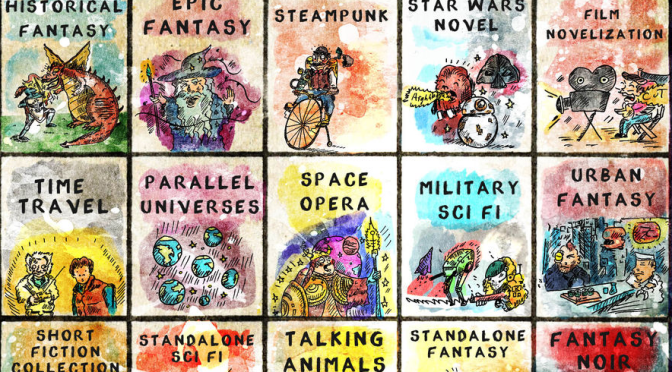
I haven’t done any yearly reading challenge things before because I usually like to just read whatever sounds good when I finish a book, but I think I might use this SFF bingo card from the B&N Sci-Fi and Fantasy Blog this year. There’s a nice variety on here, and I’m always looking for new things to read outside my comfort zone. Plus, it’s so pretty, I can’t wait to print it out so I can hang it up next to my work space.
Speaking of reading habits, it’s definitely become the fashion in the last couple of years for those of us of the feminist persuasion to declare, loudly and publicly, that we’re not reading any books by men, or by white men, or whatever. I’m guilty of this myself, a couple of years ago, and I don’t regret it–it’s actually a great way to shock oneself into reading more diversely–but Jia Tolentino at Jezebel makes a pretty compelling case for why we should all shut up about it already.  I don’t entirely agree, but I do approve of preemptively calling out the inevitable rash of self-congratulatory New Year’s think pieces on the topic.

Fandom Following is a voice of reason in the wilderness, with a good explanation of why we shouldn’t care about Game of Thrones season six passing up the books.

Hayao Miyazaki turned 75 this week.

Smart Bitches Trashy Books tells us all about Mary Wollstonecraft.

The Mary Sue tells us all about lesbian vampires.

George Lucas’s ex-wife apparently played a big role in make the first Star Wars trilogy as great as it was. I wish I could say I was surprised by this.

Also at the Mary Sue this week, “John Boyega and the Importance of the Unlikely Hero.”

As previously “unlikely” heroes become more likely and white dude heroes become less likely, racist and sexist white dudes have come out of the woodwork to cry about it. Laurie Penny has some advice for them.

The Root interviewed Nnedi Okorafor on putting Africans at the center of science fiction.

io9 lists 75 sci-fi and fantasy films to watch for in 2016.

At Fantasy Faction, publishers list their most-anticipated SFF novels of the year.

MCM Buzz gives us 6 new fantasy authors to watch in 2016.

Hodderscape has a sneak peek at A Closed and Common Orbit, Becky Chambers’ follow-up to The Long Way to a Small, Angry Planet, which is one of my most anticipated novels this year.

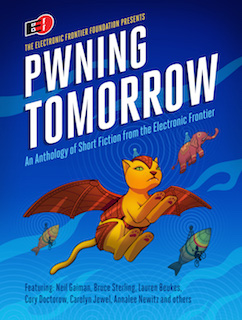
If you’re looking for some cheap/free fiction this week, the Electronic Freedom Foundation just published a speculative fiction anthology, Pwning Tomorrow. You can donate to the EFF and download the anthology here. The rather impressive table of contents includes Cory Doctorow, Charlie Jane Anders, Kameron Hurley, Neil Gaiman, and many more of today’s most popular authors. It’s like they saw Microsoft’s Future Visions and decided to top it. By a lot.
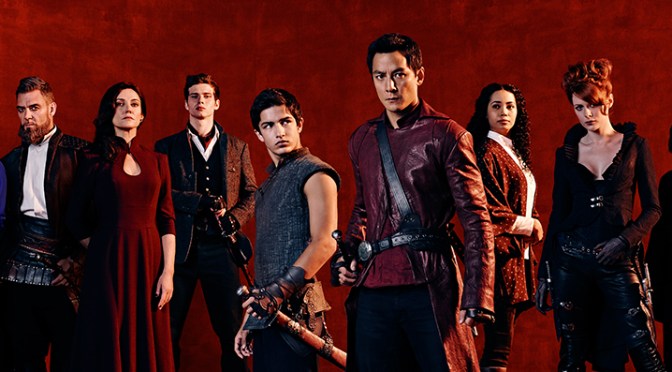
 

Why you should drop what you’re doing and watch Into the Badlands immediately

Listen. You should absolutely watch this show. I know it aired last year. I know it’s gotten largely middling reviews. I know it’s a slow starter. I know it ended on a bit of a cliffhanger in episode six. I know that AMC is dragging their feet on renewing it. But it’s really, really fucking good. Much better than its reviews give it credit for and much better than the overall tepid reception of the show would suggest. And there are actual reasons why this show should be on everyone’s watch list, reasons that have nothing to do with my own almost uncritical fangirling over it.

It’s a martial arts fighting show

Into the Badlands’ martial arts coordinator, Huan-Chiu Ku, has worked on numerous highly recognizable martial arts projects, including Crouching Tiger, Hidden Dragon and Kill Bill, and what he brings to the small screen is probably the best and most beautifully choreographed fights scenes to ever make their way to television. Every one of this show’s fights is at least good, and a high proportion of them are just breathtaking. If you at all enjoy choreographed martial arts, Into the Badlands is a must-see piece of the genre.

With an Asian lead

There’s a long, sad history of martial arts shows and films being made with white male leads in American cinema, but Into the Badlands has not one, but two Asian men in lead roles. Daniel Wu (Chinese-American) plays Sunny, and Aramis Knight (Indian/Pakistani/German) plays his apprentice, M.K. I’d be lying if I said that Daniel Wu’s gorgeous face wasn’t part of the reason I watched this show.

And a black woman as the main character’s love interest

Sunny is paired in the show with Veil (the luminous Madeleine Mantock), a doctor in the show’s post-apocalyptic town. If you’re old enough, as I am, to remember when Romeo Must Die cut out Jet Li kissing Aaliyah because audiences reacted with horrible racism to their interracial relationship, you’ll understand why Sunny and Veil’s relationship is important. What’s even better, though, is that Veil is so much more than just Sunny’s lover. As the show goes on, Veil proves to be a tough, resourceful, compelling character in her own right, which brings me to my next point.

And a whole host of badass women characters who mostly defy stereotyping

Veil might be my favorite character in Into the Badlands, but there’s also the Widow and her daughters, who are supposedly fighting to make a better world, including Tilda, who isn’t sure that her mother’s way is right. There’s Lydia, the formidable wife of the Baron Quinn, and there’s Quinn’s new (and ambitious) young wife, Jade. There’s Zypher, who has the same job as Sunny, but for another Baron. I would love to see at least a couple more women of color in the mix, but the diversity of personalities, roles, skills, and values these female characters display is also important and refreshing in a genre that often relegates women to a couple very passive or tokenized roles.

And surprisingly feminist sensibilities in general

I wouldn’t say that Into the Badlands is definitely a feminist show. Certainly, it doesn’t have any particular feminist message that it’s trying to get across. However, it’s a show that cares about being inclusive and diverse. It cares about examining power structures and oppression, and it cares about having a real conversation about it. It’s not a show that pretends to have all the answers; it’s a show that gives us a whole bunch of characters trying to figure things out, and it’s compelling as hell.

There’s really just nothing else like it on TV right now

The thing is, I’m not sure what we can reasonably compare Into the Badlands to. Sure, it’s firmly in the SFF genre, but its peculiar mix of post-apocalyptic and feudal influences (It’s loosely adapted from the Chinese classic Journey to the West) is pretty unique. It’s also bright and beautiful, filled with vivid and heavily saturated colors, excellent costumes, and amazing hair and makeup. It’s an original concept with a highly creative and recognizable style.

The story isn’t particularly groundbreaking, but it doesn’t need to be; it’s well done, nicely acted, and cleverly plotted over the six episodes of the first season. Admittedly, the first couple of episodes feel more full of potential than greatness, but I appreciate that the show doesn’t condescend to its audience. Events unfold in a natural progression, plot developments never feel forced or contrived, and there are several genuine surprises, especially in the back half of the season, that make the material feel fresh.

Watch it. ASAP. And then let AMC know that we want more of it.

Book Review: Future Visions – Original Science Fiction Inspired by Microsoft

Future Visions had me at Ann Leckie (also at “free” because who passes up free stories?), but it turns out that Microsoft’s first foray into sci-fi publishing is actually a solidly good collection of work. I honestly wasn’t at all certain that it would be, and, worse, I was more than a little concerned that it would end up being little more than an extended, fictionalized advertisement for Microsoft products. Instead, it’s a well-produced anthology of hard sci-fi that ranges from very recognizable speculation about the near-future to space opera.

First, though, there’s a forward and an introduction, both written by Microsoft Research executives and both of which sound a little too much like marketing copy, even though the only thing they’re “selling” is ideas. Still, Harry Shum and Rick Rashid do a decent job of kicking things off and giving the reader a little bit of insight into what the rest of the book contains. If nothing else, this pair of essays will be an interesting bit of context for future scholars who might examine Future Visions as an artifact of our times. This will be even better if this project turns out to be a recurring one. As someone with a scholarly interest in these things myself, I would love to look back someday at ten or twenty or fifty years’ worth of Future Visions and see how things have gone.

The opening piece of fiction is a delightful piece by Seanan McGuire, whose work I really ought to check out more of because I always enjoy her short fiction when I come across it. Her offering here, “Hello, Hello,” is an optimistic tale about the impact voice and body language translation technology could have on the lives of people with disabilities. It also suggests an interesting way in which this type of technology could expand our understanding of our world. The story is told with sensitivity and humor, and it’s sweet without being cloyingly so.

Greg Bear’s “The Machine Starts” is a rather darker story that examines some of the potential hazards of quantum computing. Something about how it could break the whole damn multiverse. It’s bad enough knowing that we’ve all got a couple of doppelgangers, just statistically, but now we’ve got to also worry that they could be actual alternate universe versions of us. Thanks, Microsoft.

“Skin in the Game” by Elizabeth Bear is the first story that I didn’t care much for, but it’s still not awful. I was surprised, though, as I’ve loved all the books I’ve read by this author. The Nancy Kress entry, “Machine Learning,” is another story that I found dull and a little uninspired, though your mileage may vary.

“Riding with the Duke” by Jack McDevitt is reminiscent of the work of Philip K. Dick and Kurt Vonnegut, so of course I loved it. It’s my favorite combination of optimism and cynicism—smart, funny, and deeply fucked up.

“A Cop’s Eye” is basically a comic book, and the story is just okay. I like the idea of police officers using technology to help people, but I feel like a lot more needs to change than some tech advances in order to make this story a real possibility. The art is simplistic and rather boring, and just getting to read it was a hassle as however it’s embedded into the file I was reading on my Nook HD would only crash the device’s reader when I tried to turn the page to it. I ended up reading it in the Nook app on my Surface, which worked fine, so maybe it’s just my device starting to show its age, but still. Very irritating.

Robert J. Sawyer’s “Looking for Gordo” is an excellent first contact story. It’s also another optimistic piece, although it does examine some of the arguments for and against trying to contact other life in the galaxy. If you like this story, I highly recommend checking out Liu Cixin’s Three-body series, which deals with some of the same ideas.

I tried so hard to stick it out and finish David Brin’s “The Tell,” but I just couldn’t. I won’t say it’s unreadably bad, but it definitely was, for me, impossible to do anything but skim it, skip to the end, and hope it made more sense. Unfortunately, it didn’t. The story deals with prediction-making, I guess, but really it felt much more like a long, dry, self-indulgent think piece. Again, I don’t know that I’d say it’s bad, but I certainly found that it wasn’t for me.

I wasn’t sure what to expect from Ann Leckie’s story, having only read her novels so far. I can’t tell if “Another Word for World” is set in the same universe as the Imperial Radch series, but it’s definitely in that neighborhood—definitely space opera, but also similar to the more sociological sci-fi of Ursula K. LeGuin or Karen Lord. It’s a story about colonialism, treaties, and the problems inherent in relying too much on translation devices. It’s also my favorite piece of Future Visions, and this book is definitely worth downloading (for FREE) just to read this story, though I do recommend giving the rest a try as well.