Doctor Who: “Hell Bent” is a hell of a finale after a rocky season

“Hell Bent” is a hell of an episode of a show that I have largely lost faith in over the last few years. My expectations for Doctor Who under the leadership of Steven Moffat have pretty much completely evaporated, and Moffat’s handling of the Doctor’s history, especially as it concerns Gallifrey, has consistently been one of the least interesting-to-me hallmarks of the Moffat era. The previews for this episode showed that Gallifrey was exactly where the Doctor was going in this finale, so my expectations of enjoying it were correspondingly low. I’m happy to have been pleasantly surprised.

Of course, I say “pleasantly surprised,” but the truth is that “Hell Bent” blew all my expectations out of the water. While it doesn’t redeem multiple seasons’ worth of bad writing, poor characterization, whiz-bang endings, and a general trend towards “style” over substance, this episode—especially in conjunction with the previous two—stands out as a stellar accomplishment, the type of truly excellent storytelling that Steven Moffat is, sadly, only all-too-occasionally capable of.

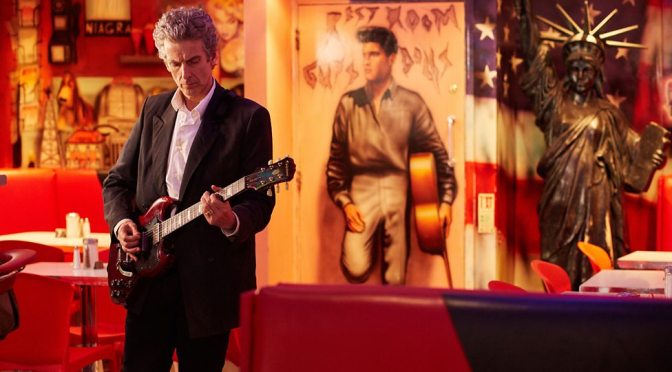
The framing device for the episode is the Doctor in a 1950s style diner in Nevada, telling the story of Clara to…Clara herself. This is the first surprise of the episode, which I had thought would be another no-companion episode that would deal with some kind of epic storyline on Gallifrey. It turns out that is not at all the case. The Gallifrey stuff, honestly, ends up being almost incidental rather than integral to real story, which is an exploration of the Doctor’s unhinged grief over Clara’s death and a way to provide an even better ending for Clara than the quite serviceable one we got in “Enter the Raven.”

That said, it takes until about halfway through the episode before we actually learn what the Doctor is on Gallifrey for. Spending nearly thirty minutes with the Doctor dicking around in a barn, prevaricating about what he knows about the Hybrid, and banishing all his political enemies is a shameless waste of time. Though I suppose this is Moffat’s attempt to establish Gallifrey’s place in the show’s current mythology, it’s a tiresome and senselessly circuitous route to take to the crux of the story: The Doctor is really on Gallifrey to gain access to an extraction chamber that will allow him to remove Clara from time at the moment of her death in order to save her life.

Once the Doctor has safely rescued Clara, we get more of the same speech that she gave before she walked out to meet the raven in the first place, which is a nice bit of emotional continuity while the Doctor steals another Tardis so he can take Clara to the end of the universe. He’s convinced that this journey will give time a chance to heal and set Clara’s heart beating again, which is a weird piece of mysticism, but it gets us to where Ashildr/Me is waiting for the Doctor with some perfectly delivered philosophical advice. This is also where things get really interesting, as the Doctor spills his plans to Me while Clara listens in from inside the Tardis.

In a sometimes incoherent discussion, we learn that it’s possible that the “Hybrid” that is supposed to be so dangerous might actually be the combination of the Doctor and Clara, something the Doctor acknowledges as a possibility. This, you see, is why the Doctor’s big plan is to resurrect Clara only to then remove all her memories of him and then leave her forever, something like what happened to Donna Noble, only even more infuriating because the Doctor’s decision here isn’t motivated by a desire to minimize harm. He’s just being high-handed and, frankly, selfish, which Me reminds him of.

Even better, when the Doctor and Me enter the Tardis, Clara is prepared. She’s used the Doctor’s sonic sunglasses to reverse the effect of the memory erasing device so it will work on the Doctor instead of on her, and she’s adamantly opposed to giving up her past. It’s a scene that finally brings home the idea that Clara really is perhaps too much like the Doctor for anyone’s good, and it’s also the first time since Martha Jones’ departure that a companion has left the Doctor so entirely on her own terms, and it’s really wonderful.

Jenna Coleman really shows her range in this episode as she refuses to have her own life and experiences subordinated to the Doctor’s will, and it doesn’t hurt that the Capaldi’s performance is absolutely superb both in his final scene on the newly stolen Tardis and in the scenes in Clara’s diner that bookend the main storyline. The best moment of the night, though, is a tie between the bittersweet instant when the Doctor insists that he will know Clara if he ever sees her again and Clara realizes that he’s really forgotten her and the moment very shortly after that when we get to see Clara fly off together with Me in the extra absconded-with Tardis.

If the first half of “Hell Bent” is an exercise in self-important grandstanding (it really, really is, on the part of Moffat and the Doctor both), the second half is a well-conceived, beautifully acted, and deeply resonant conclusion to Clara Oswald’s tenure as companion. “Face the Raven” was the best ending it was reasonable to expect for Clara, but “Hell Bent” is the ending that she deserved.

Miscellaneous thoughts:

  • I love Donald Sumpter, but I miss Timothy Dalton as Rassilon.
  • I’m don’t understand why Moffat seems to like Ohila so much, and I’m not sure why the Sisterhood of Karn is on Gallifrey this week.
  • The old-style Tardis that they steal is apparently the original design, and it looks kind of surprisingly great in color.
  • Clara and Me turned loose on the universe, taking the long way back to Gallifrey in a Tardis of their own, is basically my favorite thing that’s happened on Doctor Who in ages. However, this is the second time (The first time was when he gave us Lady Vastra and Jenny.) that Moffat has created a premise for a spin-off series that I want to see more than I want to see more Doctor Who. I desperately want to see Clara and Me’s adventures in time and space—as long as Steven Moffat isn’t anywhere near them.

Weekend Links: December 5, 2015

In spite of it not feeling like it (at least in Cincinnati, where we’re still having daily highs in the 50s and 60s), it is December, and if you need something to help you get into the holiday spirit, Book Riot has a wonderful literary Advent calendar.

Climate change has been on my mind this unseasonably warm week, so I’ve got a pair of climate change links to get us started on the more substantial side of things.

If Atwood’s Gizmodo piece isn’t enough for you, she’s also featured in the New York Times’ By the Book this week, and it’s just more proof that she’s one of the world’s most wonderful human beings.

I finally got around to watching Jessica Jones last weekend, though I haven’t written my piece on it yet. However, lots of other people are still churning out several pieces a day on it. These are my favorites this week:

In tangentially related news, Scientific American published a piece on some science that’s being done on how we’re affected by female superheroes. Discouragingly, it seems that the psychological benefits of seeing strong, capable female characters may be almost entirely offset by having them dressed in sexualizing and objectifying costumes.

I loved this piece at Smart Pop Books about love as a political act in The Hunger Games.

Black Girl Nerds has some great suggestions on what a new Star Trek ought to look like.

At Slate, there’s a great piece up on utopian and dystopian visions of Afrofuturism and whether or not we’re seeing more characters of color in science fiction.

At Book Riot, it’s posited that there are two types of girls: those who read Madeleine L’Engle and those who didn’t.

If you are one of the people who hasn’t read her and wants to start, there’s a ranking of Madeleine L’Engle’s YA canon at Flavorwire. Personally, I’d rank A Wrinkle in Time highest, but I never did get around to reading all of the listed books when I was a girl.

What I did read when I was a girl, though, was lots and lots of books about horses, so I was tickled to see Tor.com’s list of the greatest horses of fantasy this week. I was appalled, however, that not one horse from anything by Tamora Pierce made their list. An absolute travesty.

Electric Literature interviewed Catherynne M. Valente about her new novel, Radiance.

A.C. Wise interviewed A.M. Dellamonica about her latest, A Daughter of No Nation, which came out on Tuesday.

And the final installment of Queers Destroy came out this week as well. You can buy Queers Destroy Fantasy here, and I highly recommend that you do.


iZombie: “The Hurt Stalker” is a showcase for some of this show’s biggest problems

I feel like I’m decidedly in the minority with my ambivalence about “The Hurt Stalker” when all the other reviews of it I’ve seen have been glowing. It’s not a bad episode, and it tells us a lot more about Clive, who has been desperately in need of characterization for some time now, but a lot of the episode deals with Liv and Major drama, which is my least favorite thing about this season so far. Probably because Liv and Major drama is objectively boring, and this episode really highlighted to me just how unfair and hypocritical Major is being through all of this.

First, though, we get a big dose of Clive stuff right at the beginning of the episode, as he’s the initial suspect in the murder investigation of the week. It turns out the woman who was murdered was someone Clive dated a few months ago and who subsequently stalked him and menaced his new girlfriend. The evidence against Clive, of course—his gun was the murder weapon, and he had threatened the murdered woman just an hour before her death—is obviously too damning for him to actually be the killer, so the challenge for Liv and Ravi this week is to clear Clive’s name by finding the real murderer.

My biggest problem with the Clive stuff this week is that, while we do learn a lot more about him—He plays piano! He cooks! He love Game of Thrones!—all of this information is literally told to us in one conversation with Dale very early in the episode. There are a couple of scenes later in the episode where this information is revisited, but there’s nothing new introduced after of this initial reveal. As adorable as it is seeing Ravi poking gentle fun at Clive about Game of Thrones and watching Liv and Ravi together trying to get Clive to admit to cooking for them, it can’t reasonably be counted as characterization when Dale told us all about it in thirty seconds twenty minutes ago.

The other order of the day is more exploration of what Liv and Major’s relationship looks like now that she’s a zombie. There’s some great stuff going on here, and a couple of really powerful moments, but I can’t help feeling frustrated at how Major seems to have already checked out of the relationship. At the same time Major’s tendency to hold Liv to an entirely unfair standard continues to be infuriating. By the end of “The Hurt Stalker,” I was heartbroken for Liv, but for entirely different reasons than I think the show intends for us to be. Major is just the worst, and Liv does not deserve what he’s going to end up putting her through.

I missed Blaine and Peyton this week, but Vaughn du Clark was back, which was nice. I loved the scene between him and Gilda/Rita, although that was pretty much the only part of the episode where she showed to advantage. The rest of her time on screen was spent being subtly hostile towards Liv—who is totally oblivious, apparently, to the fact that her roommate hates her—and being creepily jealous over Major, who she also despises. I’d be the last person to argue that there’s no place for the occasional one-dimensional character in fiction, but Gilda/Rita is just terrible. She seems to be motivated pretty much only by hatred and spite, with no softer feelings at all, and she verges on being a misogynistic caricature at times.

As much as I love this show, it continues to be plagued by serious problems in the way it chooses to represent women. Liv is a great character, and I like Peyton, but Peyton is rarely around and even more rarely in scenes with Liv, in spite of their purported best friendship. Dale could be promising, but we only ever see her with (or about) Clive, and Gilda/Rita could be a wonderful antagonist if the show was willing to dedicate more time to developing her, but they don’t. For a show that is so well-known and well-loved for its excellent female protagonist, it’s a shame that it can’t figure out how to better utilize its supporting cast of women.

Miscellaneous thoughts:

  • Liv in jail felt like a situation with legitimately high stakes, but I feel like the woman she shared a cell with who was screaming about Ferguson felt like a horrendously racist caricature of a black criminal “playing the race card.” There are seldom women of color on this show, and that this one was set up in such a way that the show seems to be implying that she almost deserves to have her brain eaten is pretty horrifying.
  • As much as I can’t stand Major and Liv together, the engagement ring in the safe was really well-done.
  • Best use of “Karma Chameleon” ever.
  • It’s never a good idea to go snooping in your significant other’s devices, and that clearly doesn’t work out for Liv here, but I hate that this whole episode worked to essentially minimize and delegitimize Liv’s feelings and deflect her valid concerns about her relationship with Major—who is in fact being dishonest with Liv about multiple, important, probably deal-breaking things that she deserves to know about.

Supergirl: “Red Faced” is mostly an embarrassment

“Red Faced” is a big old mess of an episode that highlights literally every problem Supergirl has and showing almost none of its strengths. It could have been worse, but not by much, and it’s definitely dampened my excitement at the news that CBS has just expanded their order for the show by seven episodes.

I’ve complained from the beginning about Supergirl’s overly self-conscious feminism, but I’ve been hesitant so far to be too critical of it because, frankly, it’s mostly refreshing to see a show like this wear its feminist sensibilities on its sleeve, even if it is imperfectly executed. It’s always been heavy-handed with its Feminism 101 messaging, and the messages are often garbled, as with Cat Grant’s speech about the term “girl” in the pilot and all of “How Does She Do It?” which at least made up for its confusing ideas by being somewhat entertaining.

“Red Faced,” however, is an episode that seems to be desperately trying to make some kind of point but gets so bogged down under the weight of its own themes that it collapses under the pressure. It’s further hindered by several lackluster villains and a script that is almost entirely devoid of the show’s usual humor.

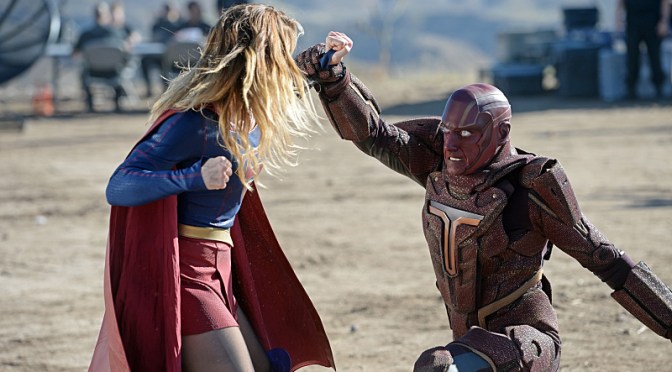
The episode starts off on the wrong foot to begin with, as Supergirl rescues a group of school children from being run down by a couple of road-raging douchebags. When one of the men takes a swing at her, she’s angry enough at their recklessness that she grabs the guy’s fist and twists it around, hurting him. Perhaps predictably, the media in National City blows this entirely out of proportion, and Kara finds herself in trouble with Hank Henshaw for not controlling her anger. It’s completely ludicrous, since Supergirl didn’t actually injure the dude, who did actually try to punch her (and had just almost killed like a dozen children). By the time Maxwell Lord (who has an opinion on everything) suggests putting a body cam on Supergirl, I was ready to punch this episode in the face, and that’s less than five minutes in.

At CatCo, we’re introduced to Cat Grant’s mother, who is a complete monster. I get the feeling that we’re supposed to find this old harridan funny, but she’s just unrelentingly terrible in every single possible way. The most unbelievable thing about this little diversion, though, is that this woman could get an invitation to a small, intimate dinner with Toni Morrison and Margaret Atwood. I can’t imagine either of them would tolerate this woman for more than thirty seconds. I suppose this gives us a little more context for Cat’s character, but the show’s writers think they’re being much cleverer than they actually are.

We see a lot more of Lucy Lane this week, and we also get to meet her father, an army general who supposedly wants Supergirl to help test out a new “anthropomorphic pseudo-entity” that’s being developed for military use. First of all, “anthropomorphic pseudo-entity” sounds absurd, and not in a funny way. Second of all, it’s quickly obvious that Red Tornado is actually being designed to fight Kryptonians. Finally, Red Tornado is the most boring monster-of-the-week yet; the stakes just never feel high enough to make it at all interesting.

All of this stuff is really just a way for the show to talk about anger—especially women’s anger, and the ways in which we are taught to suppress it and shamed for expressing it. Unfortunately, they begin with a straw man—Supergirl’s supposed outburst at the road rage guy in the beginning of the episode—progress through a series of non-escalating events that lead Kara to getting a tipsy after-school special-style lecture on the topic from Cat Grant, and then end the episode without really resolving anything.

The B-plot—James Olsen’s conflict with his girlfriend’s racist dad—supports and complements the Kara stuff, and this is even explicitly called out in a scene where Kara and James are going to punch things together to take out their frustrations. However, while I thought that it was smart to relate the similar oppression of women and black men, this is also never fully explored and also fails to have any satisfying resolution by the end of the episode.

Neither Kara nor James are fully able to express themselves, and the rewards they receive this week feel like consolation prizes. This is especially frustrating with James since, aside from his own reminder to Kara about the struggles black men face, the conflict he has with General Lane is never specifically related to racism. General Lane just doesn’t think James is good enough for Lucy. For reasons. Definitely not related to his vaguely racist and nationalist rhetoric elsewhere in the text. Right.

Frankly, it’s just a huge disappointment that the show would squander such potentially rich material. The ways in which women are discouraged from having and showing emotions could be mined for great drama, but “Red Faced” tries far too hard while being far too shallow at the same time. It’s the least fun I’ve had watching this show to date, piling dourness on top of an incoherent attempt at some kind of feminist statement.

Miscellaneous thoughts:

  • Please, please stop trying to make Alex Danvers and Maxwell Lord happen. Every time I see this guy on screen, I feel like I need to go take a shower.
  • Cat Grant is a much sloppier drunk than I would have expected. Although maybe she shouldn’t be drinking at all with the meds she’s on.
  • Speaking of women not being allowed to behave badly… the natural climax of all of Kara’s anger should have been her finally declaring her feelings to James and damn the consequences. They clearly have chemistry, and I would love to see Kara not be quite so perfectly good and honorable for once.
  • I do love that Supergirl doesn’t have to be pretty all the time. Yes, I know that she burrowed underground like a mole and came out totally unmussed this week (and the burrowing thing was cool), but we also got to see her being completely, inhumanly fearsome with her heat rays, and I loved it.
  • I’m calling it now: Jeremiah Danvers is definitely not dead.

Minority Report: “Everybody Runs” is as satisfying an ending as we could have hoped for

The last few weeks have really been an improvement for Minority Report, and “Everybody Runs” is an episode that is good enough that I find myself very sad that it is likely the last episode of the series. If this is the end, though, it’s a good one. While it doesn’t wrap up everything perfectly, it works well enough to not be terribly frustrating, which is better than can be said for most other shows cancelled by Fox.

“Everybody Runs” continues to deal with Memento Mori and the terrorist plot to murder the US Senate. We also see Blomfeld’s hunt for the precogs come to a climax—and a resolution. It’s a tightly plotted episode that makes excellent use of its time to squeeze a good amount of story in and create a satisfying ending while still leaving room for another season if the show manages to get one (although that seems increasingly unlikely).

The episode opens with a flashback to Wally being interviewed and hired to work with the precogs seventeen years ago. With time at such a premium in this final episode, this might be a little redundant, as it doesn’t really expand our understanding of Wally or his relationship with the precogs. However, it pays off at the end when Wally gets a chance to finally protect them the way he wasn’t able to during pre-crime. It’s a moment that ought to be even more powerful than it is, and there are several other similar moments in the episode, all with their emotional impact unfortunately muted by the series overall failure to fully develop its characters.

This, ultimately, is one of two things that account for this show’s downfall. Network shenanigans don’t help, and I would have liked to see Fox give this show a better chance at success than they did, but it’s always been a deeply flawed project. Though the last three episodes have definitely stepped up their game and finally seemed to more fully embrace the show’s high concept, it’s almost certainly too little too late to save the series, and the larger problem of the show has always been that it struggles to get the audience to really connect with its characters. In the end, this translates directly into those characters not being able to really sell us on major emotional moments, in spite of some fine acting on the part of, well, pretty much everybody this week.

I can’t believe I’m typing this, but one thing that might have helped this show would be some romance. Aside from Dash’s fling with that woman early in the season who turned out to be a murderer and Vega’s implied romantic history with Blake, the show basically avoided romance like it was the plague. I can definitely appreciate the desire to avoid focusing too much on romantic drama, but the utter lack of romantic entanglements actually makes the characters feel unrealistic. I’m sure someone has written the fanfic of it, but I would have loved to see Akeela have an ill-advised one-night stand with one of the twins (and, get real, probably it would be Arthur) or see Dash and Vega go on adorable dates together (I have a feeling that Vega is a secret romantic).

Still, I kind of loved this show, and I’m sad to see it go. The good news is that as endings go, this is a great one. If there’s never another episode, I can be happy that the show is going out with some dignity and on a high note.

Miscellaneous thoughts:

  • Wally and Agatha are obviously in love with each other, right?  What a sad, doomed, and slightly creepy romance to toss in at the last minute.
  • I never knew how much Andromeda meant to Arthur. I think the show always intended for Arthur to secretly be the soft-hearted precog sibling, and that would make his reaction to her death make more sense, but it’s one of the many things the writers either neglected or never got a chance to really develop.
  • I wish Dash wasn’t so boring. Agatha may say he’s the strong one, and he definitely is the one who is most committed to making use of his abilities, but he never did come alive as a real person.
  • Whoever designed Megan Good’s costumes throughout this whole series deserves an award. Or at least a pat on the back, because she always looked amazing.
  • Excellent use of Akeela and Blake this week. I still very much think that the show should have gotten Blake more involved with the precogs much earlier.
  • Vega standing over the milk bath as Agatha foresaw was perfectly executed, and Wally’s final decision to kill Blomfeld was legitimately surprising and interesting.