
Carey Mulligan, Helena Bonham Carter, Meryl Streep, and old-timey costumes means that this is basically a must-see movie for me.
Carey Mulligan, Helena Bonham Carter, Meryl Streep, and old-timey costumes means that this is basically a must-see movie for me.

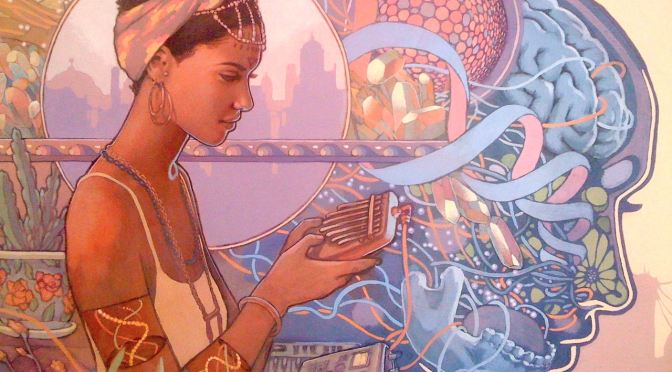
8 Afrofuturist Artists Who Are Out of This World – So much beautiful stuff, including the gorgeous Joshua Mays piece above.
Ursula K. LeGuin on How Amazon is Ruining Everything – I don’t entirely agree with her, as there are many obscure books and authors I would never have discovered if it wasn’t for Amazon’s recommendations and the ease of online ordering. While LeGuin makes good points about Amazon’s tendency to focus on promoting big titles, I’ve been using Amazon for almost fifteen years to get books that places like Borders and B&N never carried.
700 Free E-books at Open Culture – Lots of classic lit, but also a surprising amount of classic sci-fi.
Neil Gaiman and Kazuo Ishiguro talk about genre over at New Statesman – This is one of the most interesting interviews I’ve read in ages, although it did make me feel guilty that I still haven’t gotten around to reading The Buried Giant yet.
Adrian Tchaikovsky writes about inhuman characters over at A Dribble of Ink – His mention of Perdido Street Station makes me want to go reread it right away. I’ve been reading a lot of stuff the last couple of years that is less fantastical, but this article helped me remember how much I love bizarre people and things in my fantasy.
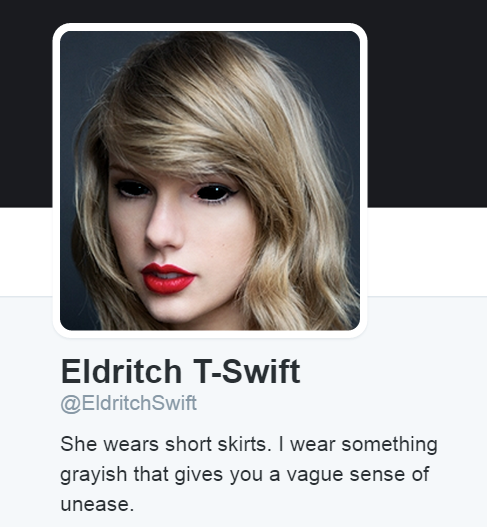
@EldritchSwift combines two of my favorite things:

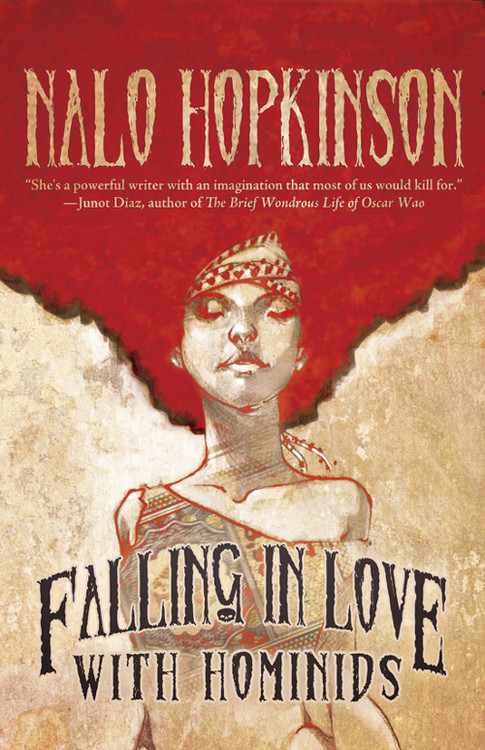 I read Nalo Hopkinson’s Sister Mine a couple of years ago after enjoying some of her short work in the anthologies After (ed. by Ellen Datlow and Terri Windling) and Unnatural Creatures (ed. by Neil Gaiman), but I’ve just never quite managed to get around to reading more of her novels. When I saw that she had a new collection of short fiction coming out this year, though, I was ecstatic.
Falling in Love With Hominids doesn’t disappoint. It opens with “The Easthound,” which was originally published in After and is the first story I ever read by Nalo Hopkinson, and even though I was anxious to move along to some stuff I hadn’t read it was nice to reread something I liked so well the first time I read it. Besides this first story, though, everything else in the collection was new to me.
As with any story collection, especially this type of story collection, where the stories are simply a selection of the author’s work in recent years rather than written on purpose with a theme in mind, not every story speaks to everyone, which is the case for me here. However, there are several standouts that I look forward to rereading in the future:
While I didn’t love the longer piece, “Ours is the Prettiest,” I do think it’s inspired me to check out the Bordertown books. I’m not always into that sort of modern faerie stuff, but I feel like I would have loved this story if I was more familiar with the shared world it was written in.
Overall, Falling in Love With Hominids is, I think, a great introduction to Nalo Hopkinson. There’s a nice variety of stories here both in subject matter and length, and I actually found some of the shorter stories to be the strongest pieces in the lot. Hopkinson’s introduction is nice, and I like the little paragraphs at the start of each piece. It’s a common thing in story collections, but I always feel like these bits of extra info give better context for the stories and let me get to know the author a little. Here, it helps that Nalo Hopkinson seems to be someone eminently worth knowing.
This review is based on an ARC received through NetGalley.
Falling in Love With Hominids will be published on August 11, 2015 and can be pre-ordered from Tachyon Publications.
George R.R. Martin spoke with EW the other day to answer some questions about Game of Thrones in the wake of several weeks of outrage and disappointment over the show’s constant depictions of violence against women.
Most recently, the show has been criticized for orchestrating the rape of Sansa Stark by Ramsay Bolton (in “Unbowed, Unbent, Unbroken”) and for the attempted rape of Gilly (in “The Gift”) by members of the Night’s Watch. Both of these scenes are departures from the source material. Although Sansa’s scene is based on events from Theon’s chapters in the books, it means that all of Sansa’s book storyline has been abandoned in favor of sacrificing show!Sansa on the altar of Theon’s development. The attempted rape of Gilly has no analogue in the books at all; in A Feast for Crows Sam and Gilly are finally driven together mostly by their shared grief of Maester Aemon’s death.
The thing is, both the books and the show have always been full of violence, and violence against women in particular. There’s seldom any female character in the books who isn’t raped or under near-constant threat of rape. Although it can be much more viscerally upsetting to see this kind of violence on screen as opposed to reading about it, the show is really not significantly more rape-filled than the books. However, while GRRM makes some mistakes in his handling of gendered violence in ASOIAF, the show manages to do a pretty disastrous job of portraying it responsibly and sensitively on television.
An argument that is constantly trotted out in defense of the show’s (and books’) heavy reliance on gendered violence is that, well, things were just like that back then. You know. Back then. When the Seven Kingdoms were at war and dragons were hatching for the first time in centuries and ice zombies were threatening from north of the Wall.
While GRRM’s EW statement isn’t quite as disingenuous as all that, it’s basically a more sophisticated, slightly better thought out version of it, and he even addresses this particular criticism:
“Now there are people who will say to that, ‘Well, he’s not writing history, he’s writing fantasy—he put in dragons, he should have made an egalitarian society.’ Just because you put in dragons doesn’t mean you can put in anything you want. If pigs could fly, then that’s your book. But that doesn’t mean you also want people walking on their hands instead of their feet. If you’re going to do [a fantasy element], it’s best to only do one of them, or a few. I wanted my books to be strongly grounded in history and to show what medieval society was like, and I was also reacting to a lot of fantasy fiction. Most stories depict what I call the ‘Disneyland Middle Ages’—there are princes and princesses and knights in shining armor, but they didn’t want to show what those societies meant and how they functioned.”
Well, and all this is mostly true. I love ASOIAF, and one of the things I love about it is how real the world is. However, it’s not the violence that makes it feel real.
On rape in particular, GRRM had this to say:
“And then there’s the whole issue of sexual violence, which I’ve been criticized for as well. I’m writing about war, which what almost all epic fantasy is about. But if you’re going to write about war, and you just want to include all the cool battles and heroes killing a lot of orcs and things like that and you don’t portray [sexual violence], then there’s something fundamentally dishonest about that. Rape, unfortunately, is still a part of war today. It’s not a strong testament to the human race, but I don’t think we should pretend it doesn’t exist.”
Again, true, as far as it goes. But that’s not actually very far. I feel like GRRM is defending himself and his work very well against a straw man here.
Most of the problems people have with Game of Thrones and ASOIAF are not out of some squeamish objection to seeing reality. Most people are not altogether opposed to the portrayal of rape in fiction. What people object to is the show’s history of turning consensual sex scenes in the books into rape on the show (Dany’s wedding night in season one, Cersei and Jaime in the Sept in season four). People object to the addition of nonsensical scenes of not just sexual violence, but disgustingly sexualized sexual violence (Ros’s murder in season three, Craster’s Keep in season four). People object to a beloved major character (Sansa) having her entire story cut from the show so she can be inserted into the place of a minor character (Jeyne Poole) whose suffering is used in the books to further the story of a man (Theon). People object to the use of sexual violence as an aphrodisiac (Sam and Gilly in season five). People especially object to the cavalier and tone deaf responses of the show’s writers, actors, and directors regarding these criticisms, and people object to the show continuing to make the same mistakes over and over and over again.
Right now, I object to GRRM’s failure to own his own authorial decisions. I object to his seeming reluctance to take responsibility for his own work and his apparent inability to even understand the complaints being levied against him. He ends his remarks at EW with this:
“I want to portray struggle. Drama comes out of conflict. If you portray a utopia, then you probably wrote a pretty boring book.”
As if there are only two options here: rape or boredom. Because, goodness knows, writing about rape responsibly, thoughtfully, and with sensitivity is just out of the question.
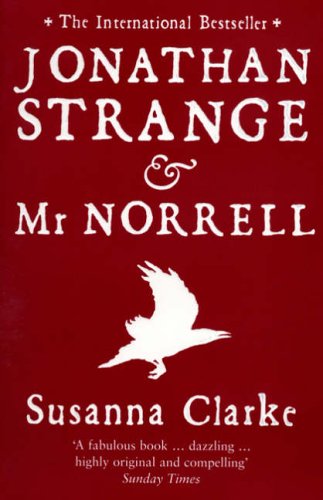 In Chapters 51-54, Jonathan Strange spends some time with the Greysteels, but mostly he spends his time obsessing over his quest to summon a fairy servant. He’s become fixated on the idea that fairies are attracted to madness, and so his primary goal at this point is to find a way to become mad himself.
Strange’s Letters
I love epistolary works, and I think a complex pastiche like Jonathan Strange & Mr. Norrell would be incomplete without some homage to that form. Fortunately, we don’t have to do without. Chapter 51 consists, in part, of several letters from Jonathan Strange to his friends in England in which Strange describes his travels. It’s an excellent way to reveal a bit more of Strange’s character, which is where the epistolary form really shines. Through these letters, we get some sense of Jonathan Strange’s feelings about the Greysteels, we see his remarkably philosophical response to Norrell’s response to The History and Practice of English Magic, and we learn how Norrell’s act of censorship leads to Strange’s reconciliation with Lord Byron.
All in all, these short letters make for an amusing read without the author overdoing it. Especially this late in the book, I think it would have been a mistake to do a lengthy epistolary section. This small bit feels just right to me, though.
Summoning
Right at the end of Chapter 51, Jonathan Strange has his first success in summoning a fairy, although he doesn’t know it. The gentleman with the thistledown hair shows up, Stephen Black in tow, only to remain stubbornly invisible to Strange. The gentleman, once so eager to “assist” Norrell, is positively abusive now towards Strange, and absolutely not inclined to work with any magician now.
The Cat Lady
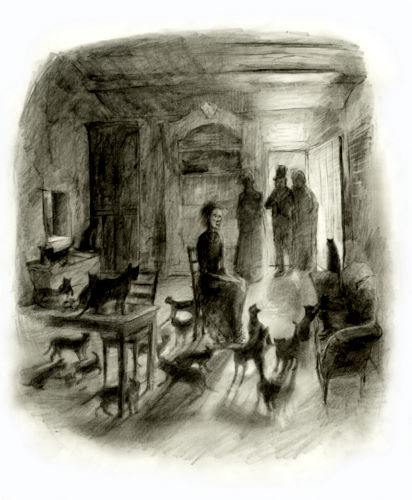
While Jonathan Strange is consumed with his work, the Greysteels pay a charitable visit to an old woman living in a Jewish neighborhood in Venice. Her name is Mrs. Delgado, and the Greysteels find her entirely alone, unresponsive, and surrounded by a great many cats. Mrs. Delgado seems to barely eat, having more in common with her cats than with any human visitors she may have.
The old woman is quite mad, as Flora Greysteel later communicates to Jonathan Strange. She wants to know if he could cure Mrs. Delgado by magic. Unfortunately, he cannot, but he soon comes up with a new plan on how he might finally ensnare a fairy.
Tincture of Madness
Strange goes to visit Mrs. Delgado, who remains nearly as unresponsive to him as she was to the Greysteels. He wants her to teach him to be mad, and he’s willing to give her something she wants in exchange. Shortly, Mrs. Delgado has been turned into a cat and Jonathan Strange has obtained a dead mouse, which he grinds up and makes into drops which he can take in order to induce insanity.
The Color of Heartache
While his tincture works quite well in giving Strange the experience of madness, it takes a few days before he achieves his end goal. Finally, though, Strange manages to not just summon a fairy, but see and speak to one. Unfortunately, what with the effects of the tincture, he’s not in particularly good shape to deal with the gentleman with the thistledown hair very well.
Strange’s second meeting with the fairy goes somewhat better. The gentleman, for his part, has determined that in order to get the magician to leave him alone he will just make Strange some gift of something that will sate his desire for fairy assistance. Rather than asking for anything material or monetary, however, Strange requests that the fairy bring him something that was gotten in the fairy’s last dealing with an English magician.
What Strange receives, that very evening, is a small box “the color of heartache” (a phrase that I love because it’s both incredibly non-descriptive and amazingly evocative at once) that contains a small, severed finger that the reader knows belongs to Lady Pole but which is baffling to Jonathan Strange:
“I thought that if I had a fairy to explain everything to me, then all the mysteries would become clear. But all that has happened is that I have acquired another mystery!”
 I would say that in these chapters the shit hits the fan, but I feel like at this point in the book there’s no way for me to divide up the chapters in a way were I don’t feel that way about every section I read. The last quarter of the book is just absolutely riveting as Susanna Clarke’s juggernaut of a plot continues to pick up speed and gain force.
Wildness and Madness
While still working on finishing his book, Jonathan Strange is looking for students, although his friends, Sir Walter and Lord Portishead, are a little skeptical when they learn that not all of the prospective students are wealthy gentlemen. Indeed, the most promising of Strange’s first three students is Tom Levy, who is Jewish and a dancing master, but is also the only one of the three to have actually done magic.
While Strange is definitely interested in educating other magicians, what he is mostly consumed with these days is summoning a fairy servant. However, his friends are worried about him. They are certain that Strange is much changed since Arabella’s death, that he is falling into bad habits, and they are positively appalled when Strange suggests that perhaps madness is the way to catch a fairy and proposes going wandering for a while in search.
Sir Walter and Lord Portishead are somewhat mollified when Strange admits that he doesn’t actually intend to go live as a vagrant, but they are still concerned about him. Meanwhile, Mr. Norrell is very upset about, well, everything Jonathan Strange does. Especially upsetting to Norrell is that Strange continues to be commissioned for government work and has even branched out so far as to do some work for the East India Company.
While Strange is definitely more open to teaching new magicians and sharing his knowledge than Norrell ever was, it soon becomes clear that he’s not necessarily any better suited to the task than Norrell was:
…whereas Strange had had Norrell’s evasiveness to contend with, [Strange’s students] were continually thwarted by Strange’s low spirits and restlessness.
By summer of 1816, Strange has determined to go abroad for some time, leaving his students entirely, although with the promise that their studies will continue when he returns.
Strange and Byron
In one of my favorite allusions to actual history in the novel, Strange’s travels through Europe follow basically the same path as did Lord Byron, Percy Shelley and Mary Shelley in 1816. Even, better, we get to read some of Jonathan Strange’s letters to his friends in England, in which he complains about what an asshole Byron is, which is a nice bit of comic relief at this point in the book. Because of course these two guys don’t get along well (although they do patch things up later).
The Greysteels
The Greysteels are introduced in Chapter 51. These are an English family that Jonathan Strange meets while traveling, and among their number is Miss Flora Greysteel, a charming young lady who takes a lively interest in Jonathan Strange.
Mr. Norrell’s Rebuttal
Jonathan Strange’s book, The History and Practice of English Magic, is published while he is abroad, and Norrell’s response to it is possibly the most important thing to happen in the whole novel so far.
The day of the book’s publication, copies of The History and Practice of English Magic sell like hotcakes. Then things get weird. People start coming back and buying second and third copies. Then people start complaining that their books are disappearing. The publisher, Murray, is very upset and confused and desperately trying to figure out what is going on when he comes upon John Childermass in a bookstore.
Mr. Norrell is “just buying some books” he informs the publisher, and communicates Norrell’s offer to compensate Murray for the whole printing. However, it’s also made clear that Norrell is prepared to keep magicking away people’s copies of the book if his demands are not met. Murray asks about his profits, to which Childermass responds that he’d have to ask Norrell about it.
In the meantime, Murray learns that even the copies of the book left in the warehouse have had their pages erased. He goes to Strange’s students, who have ideas for how they might combat Norrell’s magic, but this turns out to be in vain. The students just don’t have the skill to do anything.
In the end, Murray refuses Norrell’s money on principle, hoping instead to make Norrell pay in the future for a new edition of the book and the promotion of it. Childermass thinks this is unlikely, but he leaves Murray with the knowledge that the book is not entirely lost:
“I will tell you this,” he said. “The book is not destroyed however it may seem at present. I have dealt my cards and asked them if there are any copies left. It seems that two remain. Strange has one and Norrell the other.”
Norrell’s censorship of Strange’s book leaves him with fewer friends than ever before (Norrell’s allies are now just Lascelles and Childermass) and actually negatively impacts the reputation of magicians in general as people don’t take kindly to having their books stolen from them by magic. With Strange abroad, though, and distracted by Miss Greysteel and his struggle to summon a fairy servant, there is really no one in England capable of doing anything about Mr. Norrell whatsoever. Aside from a new batch of magical schools and shops popping up, of which Norrell deeply disapproves, and some muttering in Parliament about how something ought to be done, Norrell faces no real consequences for his actions.
It’s very clear as we enter the fourth quarter of Jonathan Strange & Mr. Norrell that the two magicians are truly each other’s only peers. No matter how many friends they accumulate and no matter how many interesting personages Susanna Clarke manages to populate her novel with, Jonathan Strange and Mr. Norrell are always the suns around which everything else revolves. Their relationship is the most important one, and the primary purpose of the book is to explore that.
In these chapters, the story continues to move along nicely. We also get our first glimpse of Jonathan Strange since Arabella’s death; he’s not doing well, but he’s not doing well in a very highly functional manner.
The Madhouse
Following her attempt on Mr. Norrell’s life, Lady Pole is being packed off to a madhouse, accompanied on her way by Stephen Black. The place is Starecross Hall, which John Segundus has turned into a country asylum following Norrell’s sabotage of his school of magic. Lady Pole is Segundus’s first patient, and she, surprisingly, seems to think Starecross may be a good place for her. I suppose it couldn’t be much worse than any other place would be for poor Lady Pole.
The Blue Man
Stephen Black begins is on his way back to London when his horse breaks its back and he’s forced to hitch a ride. There is already another hitchhiker in the cart with Stephen and it turns out to be Vinculus, who the cart driver described as “blue” as Stephen is black. This isn’t the case, Stephen learns. Vinculus tells him the prophecy of the nameless slave, who will become a king of a strange country, and Vinculus also reveals that he isn’t really blue at all–he’s covered with dense writing, like tattoos, all over his body.
The Wolf Hunt
Stephen is unsettled by his meeting with Vinculus and still not quite recovered when the gentleman with the thistledown hair comes for him a few days later. This time, they are off to watch a wolf hunt.
Stephen asks the fairy about the prophecy Vinculus delivered, and the fairy responds that it’s a prophecy about the Raven King, so it’s already been fulfilled. I think the fairy gentleman might really believe this, but it seems like a misinterpretation. However, it’s not really clear in the book at the point if the fairy knows about the rest of the prophecy, that which concerns the two magicians. From some things he said very early on in the novel, I would think so, but it’s not mentioned here.
The Famulus
In Chapter 48, we finally get to see how Jonathan Strange is doing these days. Surprisingly well, apparently, though not quite himself. Since Arabella’s death, Strange has really thrown himself into his work. His book is coming along nicely, and he’s even begun his own periodical, The Famulus, to compete with Norrell’s Friends of English Magic. He’s also gotten some somewhat famous engravers to do the illustrations for his book, and this has created some buzz around it.
Norrell, of course, is appalled by this development, convinced that Strange is out to destroy him and increasingly frantic to know what is in Jonathan Strange’s book. As always, when Norrell needs dirty work done–like spying–he sends Childermass to do it.
A Bargain
Childermass catches up with Jonathan Strange on a gloomy day in late winter, Childermass hiding as a shadow in a doorway across a street to watch as Strange goes about his business. Strange notices him almost immediately, but he isn’t displeased. Indeed, he’s been expecting Childermass for days, and he’s anxious for news of Norrell.
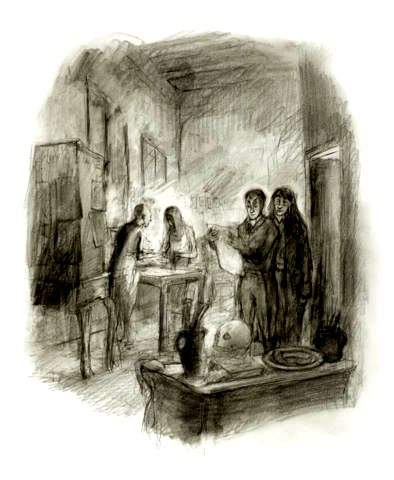
Strange takes Childermass with him to visit the French engravers who are doing illustrations for The History and Practice of English Magic, and Childermass is dutifully impressed, asking intelligent questions about the engravings and about Jonathan Strange’s magical travels. Strange is only too happy to oblige, answering Childermass’s inquiries and explaining the magic he’s used so that Childermass could duplicate it if he wishes. He even offers to take Childermass on as a pupil and assistant, at which Childermass laughs.
Throughout the book it’s been pretty clear that Childermass is something more than just a simple servant to Norrell. He’s a magician in his own right, for all the Norrell chooses not to acknowledge it, and he doesn’t always agree with his master. It becomes clear that Childermass isn’t a Norrellite partisan–he has plenty of his own ideas and opinions on magic–but he’s not about to sign up to be a Strangeite, either. Instead, he makes a promise to Jonathan Strange:
“If you fail and Mr. Norrell wins, I will indeed leave his service. I will take up your cause, oppose him with all my might and find arguments to vex him–and then there shall still be two magicians in England and two opinions upon magic. But, if he should fail and you will win, I will do the same for you.”
Strange is pleased with this answer, and Childermass is sent back to Norrell with Strange’s compliments. The chapter ends with Strange reiterating his own opposition to secret-keeping and his optimism about the publication of his book:
“I really cannot see that there is any thing Mr. Norrell can do to prevent it.”
I love these sort of chapter endings, personally. I know that it heavily telegraphs what will happen next in a way that goes well beyond simple foreshadowing, but I almost never get tired of anything like this that elicits the response from me of, “well, we’ll see about that.“
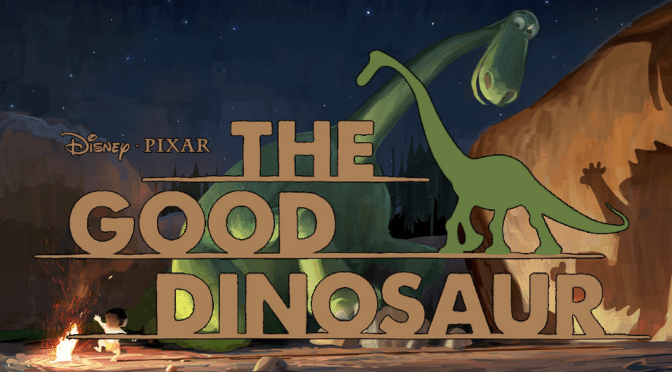
I haven’t heard anything about this movie since last year, when it was being postponed until November of this year so that the whole movie could be reworked. Between that, which is never a promising development in a movie’s life, and the fact that the animation style looks like it’s aimed at the preschool crowd, I can’t say I am particularly excited about this one.
The last two chapters of Volume II find Mr. and Mrs. Strange finally getting a chance to settle back into life at their home in Shropshire. Then something goes terribly wrong.
Ashfair
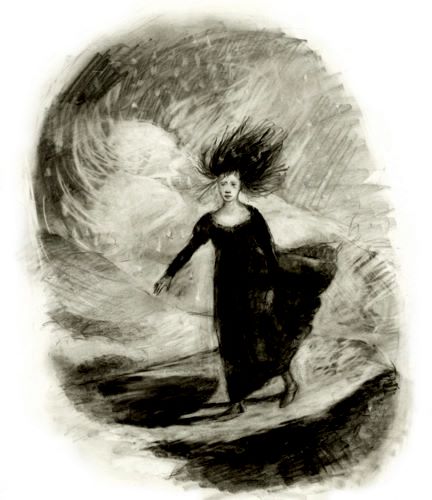
Jonathan Strange is interrupted from his work one day when his neighbor, Mr. Hyde, stops by to tell him that he saw Mrs. Strange wandering around outside in a black dress. It’s the dead of winter, though, and snowing, and Mrs. Strange has been safely inside the house all this time.
This is somewhat quickly forgotten when Arabella’s brother, Henry Woodhope, comes to visit. After several years in London, Arabella is saddened to learn that she no longer has much in common with Henry, who is a country clergyman. For his part, Henry finds much to criticize in the Stranges, who are not at all what he thinks a good country family should be like. Even the house is viewed by Henry with a critical eye.
The descriptions of Jonathan Strange’s house, Ashfair, are wonderful. While they are somewhat reminiscent of the descriptions of Norrell’s Hurtfew Abbey, this is only because the two places are similarly weird. However, they are also as different as their owners. By far my favorite line about the house, though, is that it’s “an old-fashioned house–the sort of house in fact, as Strange expressed it, which a lady in a novel might like to be persecuted in.” It’s a really lovely idea that works as a bit of characterization for Strange–so wry, so witty–and as a piece of rather funny meta-commentary in a book that is so clearly a pastiche of several genres of literature, including the Gothic novels that were so popular in the early 19th century.
One thing I will say about rereading this book in my thirties is that I appreciate this sort of thing much more now than I did in my early twenties. It’s definitely a style of book that is much better enjoyed the more one has read of other English literature. This is definitely a book that benefits from rereading, and I’m now very much looking forward to reading it again ten years from now.
Who was lost and what was found
Volume II ends with a heartbreak and a mystery that will define the last third of the novel.
One night, Jonathan Strange is awoken and sees Arabella, dressed, at the foot of the bed. Thinking that he’s only dreaming, he goes back to sleep and no one notices anything amiss until after breakfast, when Mr. Hyde arrives again to say that he saw Mrs. Strange only an hour before, wandering in the nearby hills. Jonathan Strange at first dismisses this again, but becomes alarmed when one of the household servants informs him that Arabella actually is not in the house, has actually been gone all morning.
Jonathan Strange immediately begins using magic to search for her, although Henry Woodhope doesn’t understand the purpose of this, thinking they should just go out and look themselves. This, in the end, is what they end up doing, as Jonathan Strange’s scrying is ineffectual–Arabella isn’t in England, Scotland, Wales, or France, which is confusing to Jonathan but not to the reader.
When Arabella is finally found, she’s wearing a black dress, covered in black mossy water, and saying weird stuff that sounds much more like the ramblings of a traumatized piece of wood than anything a real woman would say. Probably because this is not actually Arabella, but the piece of wood that Stephen Black and the fairy gentleman dug up several chapters ago.
On the third day after her “return” Arabella dies, and this is one part of the book that I wish I could read for the first time again. I know that a careful reader should know exactly what is going on here, as everything has been explained to the reader pretty thoroughly through our views of other characters. However, just the line, “On the third day she died,” is marvelous. It’s a shocking end of a chapter, and it’s a shocking end to the second volume of the book.
It’s an amazing cliffhanger, and a perfect use of it. Even though the reader should have a pretty good idea of what’s going on here, this ending still manages to shock, and I think it is very difficult to not keep reading after this just to see how the characters react.
Prologue to The History and Practice of English Magic
Possibly the best thing Susanna Clarke could have followed this cliffhanger with is the thing she actually follows the cliffhanger with. It’s not, however, the reactions of Jonathan Strange or Henry Woodhope to Arabella’s death. It’s not a scene confirming that Arabella is in fairy land. Nope. It’s the prologue to Jonathan Strange’s book.
In this prologue, we learn more of the history of the Raven King, John Uskglass, and how he came to England in the first place. We also learn a little more of fairies. Mostly, though, we learn about Jonathan Strange’s opinions on John Uskglass and fairies.
All Magicians Lie
When we return to the actual story in Chapter 46, it’s still not to see how Jonathan Strange is getting along. Instead, this chapter is centered around Childermass’s point of view.
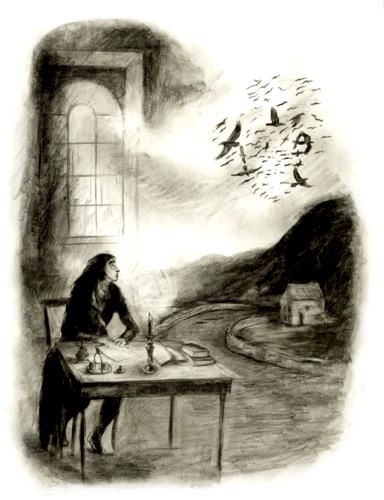
In Mr. Norrell’s library, Childermass is writing letters of business when he starts feeling very weird and slipping into a sort of dreamy trance where he sees strange and disturbing visions that the reader may recognize as connected to the book’s larger themes of the Raven King and fairies and the magic of England–and especially reminiscent of Vinculus’s prophecies.
Childermass quickly recognizes these visions as magical, and he tries to figure out whose magic it is. When he finds out that Norrell is not at home, Childermass becomes consumed with tracking down his master, and he reaches Norrell just in time to save him from being shot by Lady Pole, who is distraught over Mrs. Strange and holds Norrell responsible.
As Norrell, acting much put upon and aggrieved, discusses these events with Childermass, the chapter ends with Childermass recalling Vinculus’s words about Norrell:
All magicians lie and this one more than most.
Well, only one kind of horrible thing happened in this episode, and no one got raped (or even attempted raped), which is nice. Lots of story happens, but it didn’t feel nearly as rushed as last week’s episode, which chewed through probably a thousand pages of source material in an hour and didn’t do 95% of it justice. This week’s episode moves at a much more reasonable pace and is probably the strongest episode of the season so far (for what it’s worth, which isn’t much in this turd of a season).

In Meereen, Tyrion gets a proper interview with Daenerys, who isn’t entirely sure what to do with him. Jorah, on the other hand, she tells to shut up, so he just stands around looking sad. Tyrion tells Daenerys the story of her own life, as he’s observed it, and says he thought it was at least worth meeting her. Why is he worth meeting, though, she wants to know. He offers himself as an adviser, telling Daenerys that she can’t hope to make a better world all by herself.

The first piece of advice she wants is what Tyrion thinks she ought to do with Jorah. Tyrion gives a touching speech about Jorah’s devotion to Daenerys, but he can’t or won’t advise Daenerys to keep Jorah around. I’m not entirely sure if Tyrion is maneuvering here, to secure his own position with Daenerys, or if he sincerely believes his advice to her, and I’m also not sure if he is being kind or cruel to Jorah. However, I really did enjoy the scene. After the mess that has been the Tyrion and Jorah show the last couple of episodes, it’s nice to see it pay off.
This also gives Emilia Clarke some time to shine in her role as Daenerys. I’ve always felt her portrayal tended to be a bit wooden and soulless, but she was excellent here, and I thought she did a wonderful job of conveying her conflicted feelings of anger and pain and love and hatred about Jorah. Additionally, she’s so far managed not to say anything embarrassingly horrible to Tyrion, which gives me some hope that the writers are moving away from obnoxiously self-righteous and possibly insane Dany and towards a more sympathetic and sensible characterization of her.
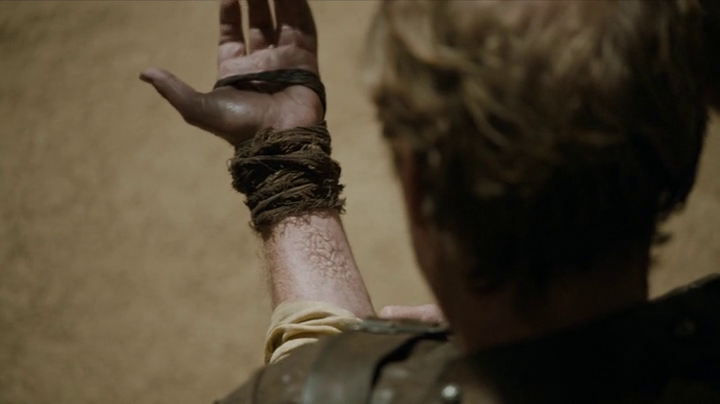
Ser Jorah is escorted from the city, though he doesn’t complain or struggle. He just looks back sadly, then checks to make sure his greyscale is still there (it is) and then goes on his way.
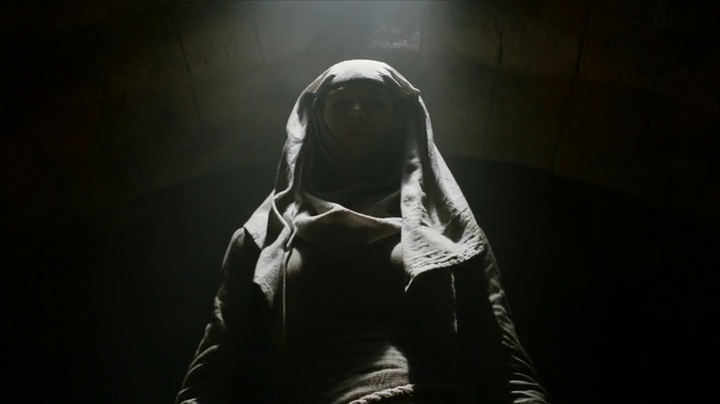
In King’s Landing, Cersei’s fortunes have taken a decided turn for the worse. She’s in a cell that is even darker and danker then Margaery’s, and her only visitor so far is a tall, grumpy-looking septa who alternates between telling Cersei to confess and beating Cersei for saying anything that’s not a confession. To be fair, the things Cersei has to say seem to be requests to see her son and threats against the septa’s life, so I can kind of see why the septa may not take very kindly to her.
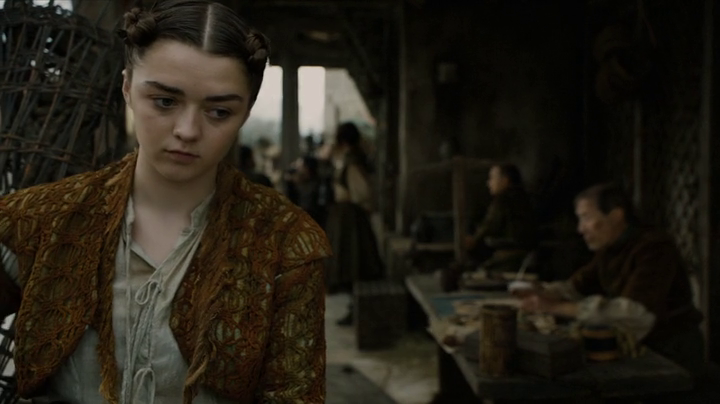
Meanwhile, in Braavos, Arya has become “Lanna,” a girl who sells oysters near the dock. Jaqen H’Ghar instructs her to start taking a different path than what she usually takes and to watch the docks and report back with her observations. In her rounds, she observes an insurance salesman–a “gambler” Jaqen explains–who has, apparently, refused to pay the family of a man who died. This man, “the thin man” as Jaqen calls him, is to be Arya’s first assignment as a servant of the Many-faced God. As Arya leaves, smiling, the waif approaches Jaqen to object–Arya isn’t ready, she says–but Jaqen just replies that, even so, “it’s all the same to the Many-faced God,” whatever that means.
This is the first time Arya’s storyline hasn’t bored me this season, and it’s especially nice to see some more of Braavos, even if it is just the harbor areas that we’ve already seen before. I love the new costume, and it’s nice to see Maisie William’s face when it’s not covered in dirt or obscured by gloom. I think we also get to see her smile more in this episode than we have since the first episode of season one, and it makes me happy to see one of the Starks having even a fleeting moment of happiness at this point.
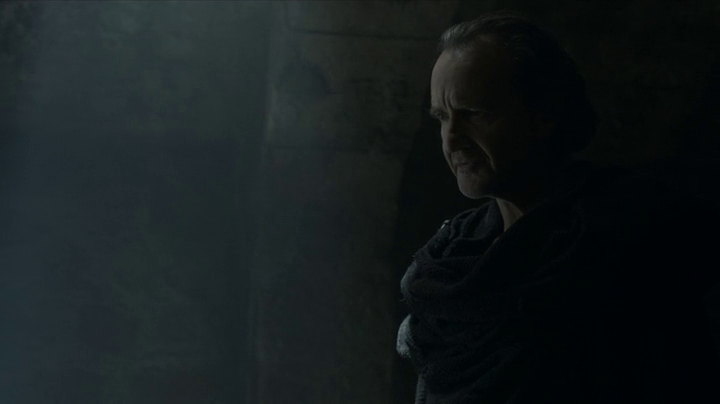
Back in King’s Landing, Qyburn comes to visit Cersei, and we finally get to hear the list of charges against her: fornication, treason, incest, and the murder of King Robert. “All lies,” Cersei says, and Qyburn doesn’t disagree–he may be Cersei’s only true ally in the world.
Otherwise, however, things couldn’t be much worse for Cersei. Qyburn’s concern is that the Faith’s standard of proof is very different than the Crown’s–his line, ”belief is so often the death of reason,” is no doubt going to turn Qyburn into a New Atheist icon, which is great. There’s seldom another group of people on whom irony is so often completely wasted. There has been no word of Jaime, Tommen has withdrawn to his chambers and isn’t eating, her uncle Kevan Lannister has taken over as Hand of the King, and no one else is coming to see Cersei before her trial.
Qyburn actually advises Cersei to confess, but she rejects this idea vehemently. There’s no way she will confess to the High Sparrow. When the septa–I’m going to say it’s Septa Unella from the books–returns, Qyburn takes his leave of Cersei. “The work continues” are his parting words, in case anyone has forgotten that he’s basically Frankenstein. I really, really love Qyburn on the show. He’s the most sinister kindly old grandpa sort of guy imaginable, and every one of his lines is delivered in a weirdly nice-sounding voice. There aren’t many things that I’d say the show has done perfectly, but I think the way they’ve cast and written Qyburn is one of them.
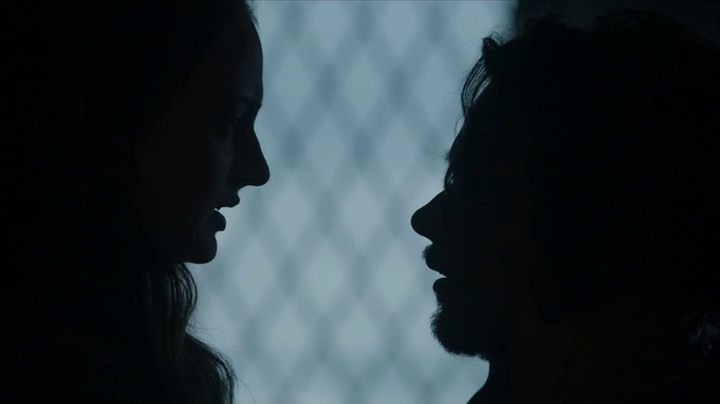
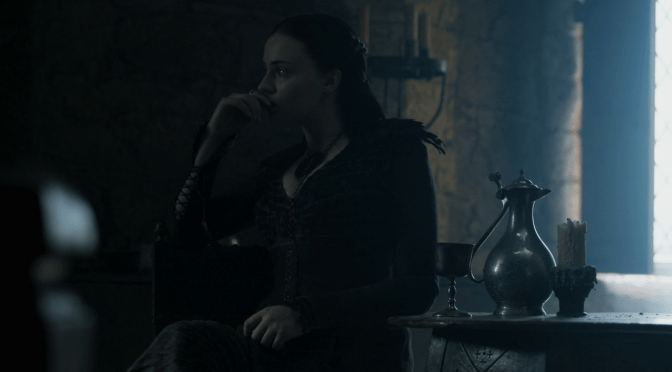
Up at Winterfell, Sansa is pretty murderously furious at Theon after last week’s betrayal. I hate that Sansa being impotently angry and menacing Theon is apparently what passes for female empowerment on this show now, but it’s nice to see her looking a bit more put together. In any case, she manages to berate Theon until he lets it slip that he never killed her little brothers, Bran and Rickon, although he flees the room before she can make him tell her anything else.
Elsewhere in the castle, the Boltons are discussing battle plans, which might explain why Sansa‘s looking somewhat better. Ramsay is too busy planning some colossally stupid act of military jackassery to rape and beat her. His father, Roose Bolton, is of the opinion that they’d best just sit tight in Winterfell, where they have provisions for six months and they can just watch from the walls while Stannis’s army dies in the snow. Ramsay wants to lead some kind of no doubt terribly conceived (and, knowing this show, terribly anticlimactic) attack that he says he only needs twenty men for.
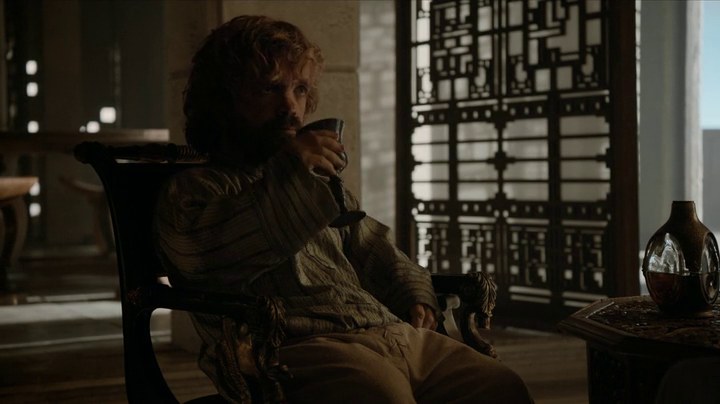
Back in Meereen, Tyrion and Daenerys are having a meal together, although it looks like it’s mostly wine. This long discussion is possibly the greatest highlight of the season so far, and again Emilia Clarke is at her best. Stiff and self-righteous and slightly mad-seeming works here Daenerys lets Tyrion in on her plan, such as it is. After Tyrion tells more of his story (although he demurs on the subject of why he killed his father), commiserates with Daenerys over being the terrible child of a terrible man, considers what is the “right kind of terrible,” and extolls the virtues of Varys, he points out that Daenerys would have a hell of a time taking Westeros with just the support of the common people–if she could even get that support. The Tyrells might be swayed to her cause, but they wouldn’t be enough. Daenerys replies with the “wheel” speech we heard in early trailers for the season. While I like it, and it sounds good, it’s not exactly a real plan if you think about it for more than a couple of seconds. That said, of all the many self-righteously tone-deaf motivational speeches that have come out of Daenerys’s mouth, this one is the best.
Outside the city, Jorah has decided to go back to the guy who bought him last week. Because, somehow, he has decided that the way to get back to Daenerys is by participating in the fighting pits that she reopened much against her will. Right. A+ thinking there, Jorah. I have a feeling it’ll be too much to hope that he ends up dragon food, though.
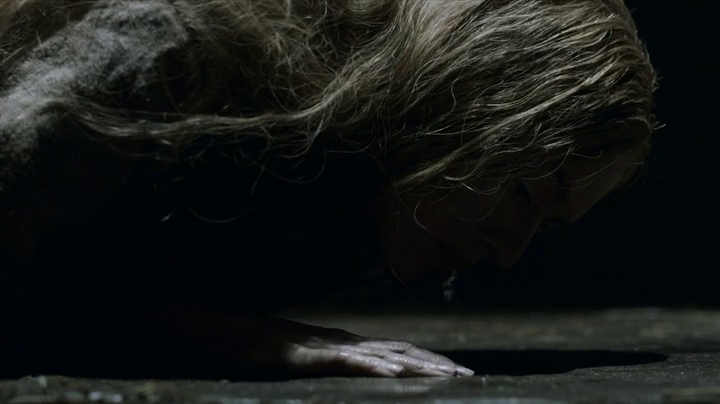
Once more in Cersei’s cell, Septa Unella has returned again with water and the command to confess. Cersei starts with bargaining but quickly turns to threats, which leads to the Septa dumping a ladle of water on the floor and walking out. Lips cracked and bleeding and seemingly starting to be a little delirious, our last image of Cersei this week is her lapping water off a filthy stone floor.
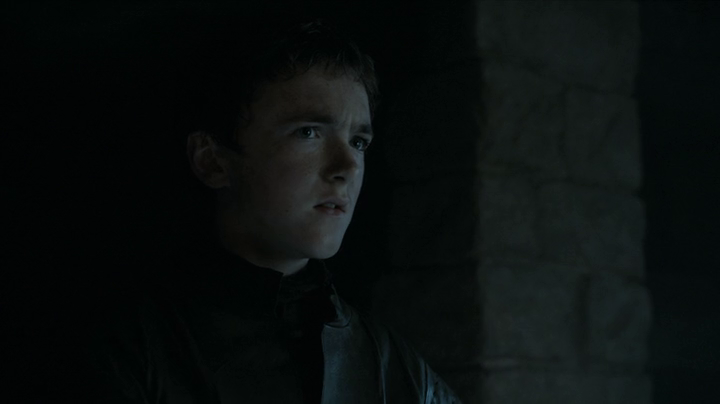
The front half of the episode ends at Castle Black. Gilly is tending to Sam’s wounds from the beating he received last week when Olly pops in to bring Sam some food and ask a question. The boy wants to know why Jon Snow would want to save the Wildlings, so we’re treated to another iteration of the “Wildlings are people, too” speech. There’s not a lot of new ground being covered here, although Sam might have just pre-absolved Olly of (attempted?) murdering Jon Snow later on if things go down on the show like the do at the end of A Dance With Dragons.
I’ve been saying that I might be done with the show after this season, but I’m starting to think that if anything can bring me back it’s the thought of seeing all the doubters and assholes at the Wall facing down ice zombies. Jon Snow is one of my least favorite characters in the books, but he’s one hundred percent right on the issue of the Wildlings and the zombies.
Speaking of Wildlings and zombies, the back half of the episode is all Hardhome. It’s a really enjoyable bit of horror action, but it’s nonsensical once you look past the spectacle of it.
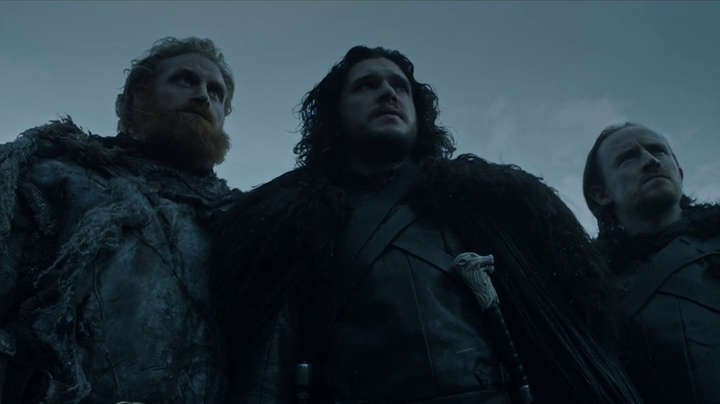
First up are some long shots of Jon Snow and company sailing into the small harbor that are a little too reminiscent of Washington crossing the Delaware for me to take entirely seriously. There’s really only so much of Jon Snow’s glorious hair blowing in the breeze that I can deal with, and this goes over my limit.
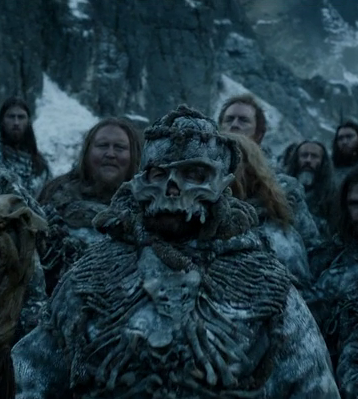
As Jon, Tormund, and company stride into Hardhome, they are surprisingly not killed on sight, but the first person they meet is Rattleshirt, who has some of the most badass armor in the series. Rattleshirt calls Tormund a traitor, tosses in a homophobic accusation about Tormund’s relationship with Jon Snow, and quickly gets his head beaten in by Tormund. This felt like a small anticlimax to me. Rattleshirt was a minor character in the books, but I’ve always felt like his presence loomed large. It’s kind of a bummer to see him go down so easily and quickly here.

It’s on to a sort or council of Wildling elders, though, for some talking. It’s here that we’re introduced to a new character, whose name I don’t think is mentioned in the episode, but she’s credited as Karsi. She’s the chieftain of one of the Wildling clans, and it’s nice to see the show finally recognize that Ygritte isn’t the only Wildling woman ever, even if it’s only for one episode. Karsi is a voice of reason in Jon Snow’s discussion with the Wildlings, and it’s largely to her that we owe the eventual decision for at least some of the Free Folk to move south of the Wall. Notably, a Thenn leader disagrees, and some others also seem to side with him.
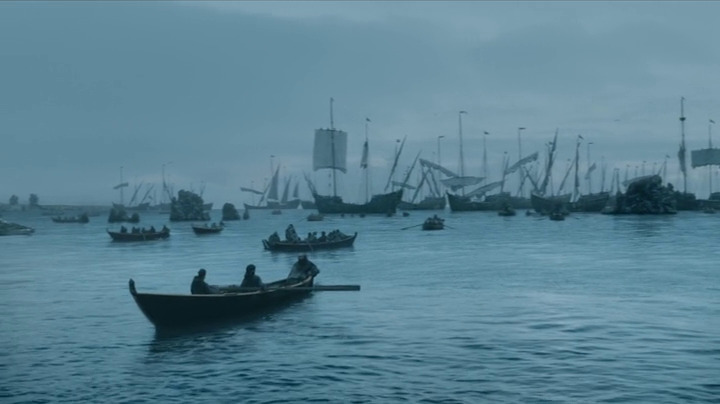
As Free Folk are being loaded onto boats to be ferried to larger ships offshore, Jon Snow frets that they are leaving too many behind. Tormund philosophically reminds him that, though it took Mance years to unite the Free Folk, they’ll soon change their mind when they realize they’re running out of food.
Meanwhile, Karsi is saying goodbye to her daughters, who she is putting on a boat to leave while she stays behind to help organize the exodus. I love this character, but I hate how heavy-handedly the show telegraphs what is going to happen to her in just a few minutes.
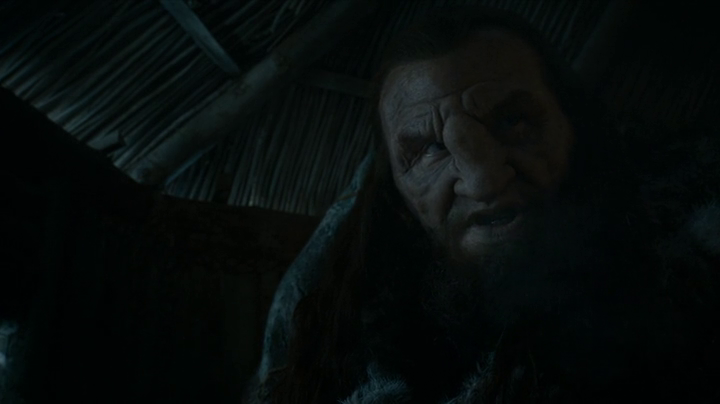
Back in the building where the elders were talking, Dolorous Edd is marveling at the giant, Wun Wun, and I’m so pleased they subtitled Wun Wun speaking in the old language. The moment is interrupted, though, when the dogs outside start barking.
The snow outside starts to thicken, there are some weird noises, and then people start screaming outside the walls of the village. The young Thenn leader who didn’t want to follow Jon Snow yells for the gates to be closed, which locks hundreds of people (at least) outside. For a little while, people are still yelling and beating at the gates, but there’s more snow and more swirling noises and then just dead (get it?!) silence. When the Thenn peeks through the gate, all he can see is some vague shadows moving in the snow, and then a skeletal hand shoots through the wood and almost gets him in the face.
Because everyone outside is now zombies. And they still want in.
Next up is twenty minutes of chaos with most people desperately trying to get to the boats, some people running to fight, and just zombies and white walkers everywhere. It’s honestly incredible to watch, and it’s one of the best-filmed fantasy fight scenes I’ve ever seen.
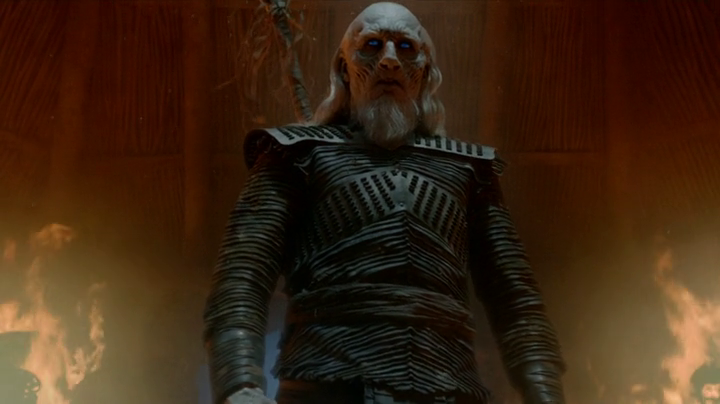
What I liked about it:
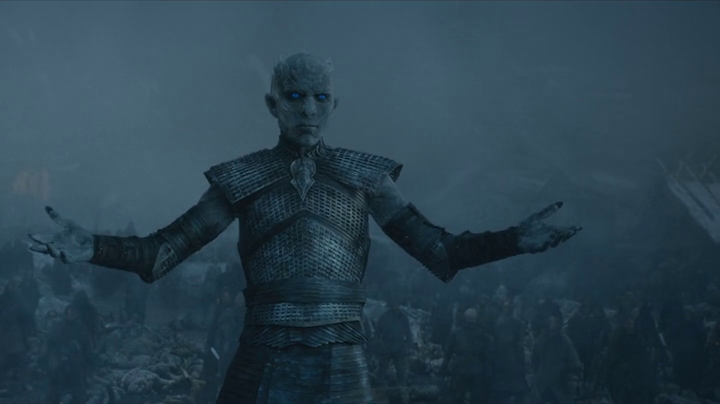
I have a few problems with it, though:
The Worst Thing
Why did they have to kill Karsi? And why did they have to kill her the way they did?
First off, in the books the Free Folk are fairly egalitarian. While not entirely free of sexism, they definitely treat women a lot better than in most places in the rest of the world. However, the show has failed over and over again to communicate this to viewers, and to this point the only wildling women we’ve seen have been Ygritte and Craster’s wives (including Gilly). Finally, the show includes a wildling woman as a leader of her people, and she gets less than half an hour of screen time before dying.
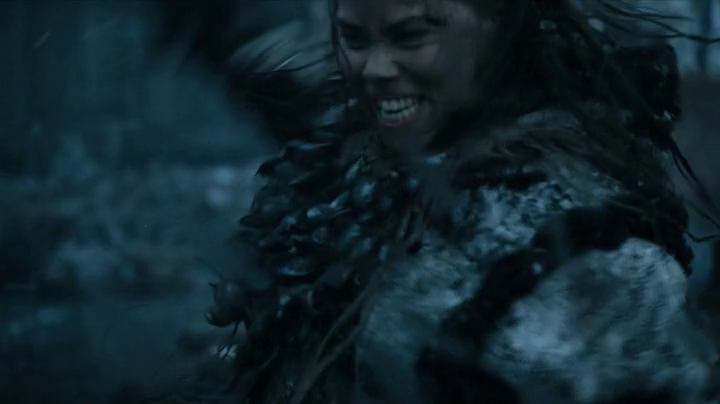
And Karsi is really wonderful. She’s funny and smart and a warrior, but she’s also a mother of two daughters and a responsible leader who is instrumental in making Jon Snow’s plan work to the degree that it does at all. All of this adds up to the makings of a really great character, but then she gets killed off.
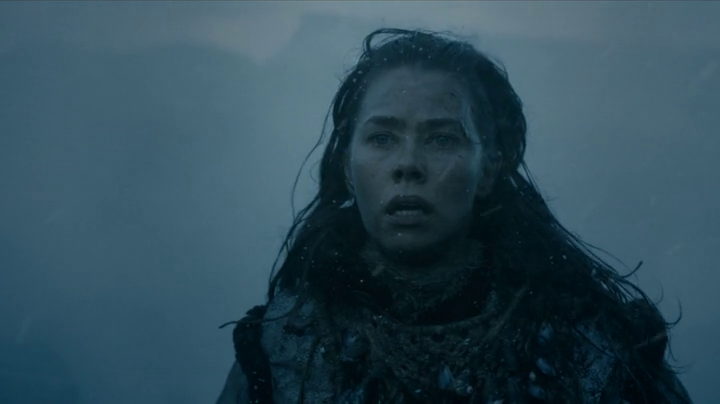
And the way Karsi is killed is bullshit. People are fighting zombies everywhere. She herself is chopping them down left and right. Until she sees a bunch of little kid zombies. And she’s not even scared, exactly. Rather, she just looks heartbroken, and then she just stands there while the little kid zombies run over and kill her.
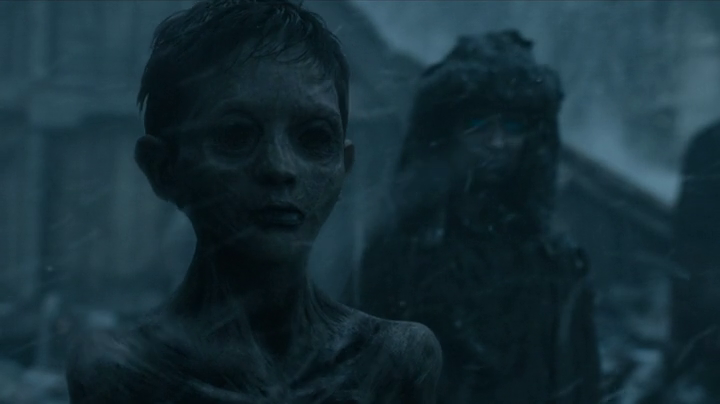
The thing is, I feel like this could just be a totally human reaction to seeing a bunch of children turned into evil zombies. I get it. It’s traumatizing. But they make so much of Karsi being a mother herself, they really play up her goodbye to her daughters, and then this is the thing that makes her lose her will to live so she can get back to her own children? And of course there are no men being similarly disarmed by the child zombies. Just Karsi. Because of course a woman would die like this.
Who wants to bet on whether we ever see her daughters again or if the show writers consider them just as disposable as their mothers?

 SF Bluestocking