Mockingjay, Part 2 is a satisfying finish to a solidly good-but-not-great film series

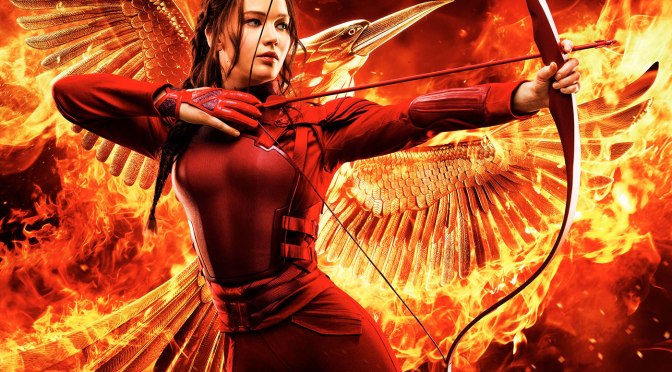
It’s an unpopular opinion, to be sure, but I’ve always loved Mockingjay the best of Suzanne Collins’ trilogy. Indeed, it’s a book that is different enough from the first two installments that it could easily have been a standalone novel with just some minor tweaks—and would perhaps have been stronger for it; certainly Catching Fire suffers more than a little from middle book syndrome, but also from too-much-like-the-first-book syndrome, and The Hunger Games could probably all have been condensed into a hundred pages or so. Alas, we live in an epoch of YA book trilogies and an age of turning book trilogies into blockbuster movie tetralogies, so Mockingjay Part 2 is necessarily imperfect. Still, it’s a good movie and a great finish to the series. It almost does the book justice.

The film begins with Katniss testing out her voice for the first time since being strangled by Peeta at the end of Mockingjay Part 1, and this is an excellent, if just a bit too on the nose, opening for a story about a young woman finding her voice. Things quickly get on track, though, and Mockingjay Part 2 is off at a relentless pace towards the ending; it doesn’t feel like almost two and a half hours when it’s over.

Mockingjay Part 2 really shines in its action scenes, which are well-thought-out and deployed at nicely spaced intervals in the film. Of these, by far the best is the long sequence in the sewers beneath the Capitol as Katniss and company try to make their way to President Snow’s mansion so that Katniss can assassinate him. It’s an absolutely harrowing journey, and it manages to be chaotic and tense as well as carried out with obvious purpose. The unleashing of the mutts and the struggle to escape from them was a wonderful incorporation of straight-up horror elements to great effect. It all unfolds perhaps a little too methodically, but as a stylistic choice this works, and it’s reflective of the general visual and tonal melodrama of both of the Mockingjay films.

Speaking of the visual style of this film, it’s very clearly a war movie. Things are grey and dark and gritty and grim, and the violence is—while it’s kept pretty strictly PG-13—enough to be both visually striking and emotionally affecting. The several major character deaths in the film were all handled in ways that implied the awfulness of their ends while never looking right at it, and this is accomplished without feeling coy or disingenuous. It’s a well-considered situation where less really is sometimes more, and in an era of increasingly graphic trauma and death being acceptable to show in film, Mockingjay does a masterful job of showing how much power mere implication can still exert.

Some of the dialogue is a little stilted, and franchise fatigue seems to be lurking just around the slightly frayed corners of some of the main actors’ performances. In particular, Katniss seems bone-weary in this installment in a way that feels like more than just Jennifer Lawrence’s good acting, but it’s not obvious enough to ruin the movie.

What stood out to me more than that was the sad underuse of so many of the secondary and tertiary characters. Katniss’s mother and sister barely appear, which lessens what should be nothing short of complete emotional devastation in the third act. Finnick and Annie’s wedding is similarly rushed and causes similar third act emotional problems. Jena Malone turns in a potentially powerful performance as Johanna Mason, only to have it feel, in the final presentation, as if large portions of it were left on the cutting room floor. The same can be said for Elizabeth Banks as Effie Trinket and Woody Harrelson as Haymitch, both of whom don’t get nearly enough screen time. Philip Seymour Hoffman’s Plutarch, of course, is at times notably missing from places where he might have played a significant part, which made me sad all over again over the actor’s untimely death.

Some of the very small roles were practically nonexistent. During production, much was made of Gwendoline Christie appearing in Mockingjay, but she only had a role in one relatively small scene early in the movie. Stanley Tucci only showed up momentarily in a couple of Capitol broadcasts, and I don’t think the surviving tributes Beetee and Enobaria even got lines.

The biggest complaints I’ve seen about the film so far, though, have been regarding the execution of the Katniss-Gale-Peeta love triangle throughout the film and the ending of it in general, and I must say I don’t share these criticisms.

While the love triangle did take on increased significance in this final film, I think it was appropriately done and sensitively handled so as not to infringe too much on the other ideas and themes that Mockingjay examines. I could have done without the slightly creepy conversation between Gale and Peeta where they were negotiating a sort of truce while they thought Katniss was sleeping; I’m never a fan of men talking about a woman as if she’s their property, and there’s definitely a kind of proprietary tone here as Gale and Peeta agree that they’ll wait for Katniss to choose between them, as if she doesn’t have any other choices. Katniss’s feelings, on the other hand, were shown beautifully, and it’s easy to follow and relate to Katniss’s emotional arc.

I’ve seen some moaning about the lack of an epic ending, but I can’t help but simply dismiss that as a silly and wrongheaded grievance put forward by people who appear to have missed the point of The Hunger Games series entirely. It turns out that it’s fundamentally anti-fascist, actually, and it’s at its heart a tragedy of Shakespearean proportion. The ambiguity of its ending is essential and, frankly, beautiful, and while it’s well-done in the film I felt that it could have been, if anything, more bittersweet.

All that said, I thought I’d cry more in this movie, but the only thing that really brought the tears was that damn cat.

Miscellaneous thoughts:

  • I remain disappointed in the look of the mutts. The use of the faces and features (and perhaps the actual dead bodies) of people Katniss knows was an incredible bit of psychological horror in the books, and it’s too bad that none of the movies managed to capture that.
  • Tigris was very close to how I imagined her when I read the book. A+ casting, costuming, and make-up.
  • I hated the casting of Sam Claflin as Finnick, but he really pulled it off this film.
  • I love Effie so much, and of all the underused characters in this movie, she was the one whose absence I felt most keenly.
  • I love the visual language of the scene of Snow’s execution. It reminds me a lot of the early scenes in Rome in Julie Taymor’s 1999 Titus (which is a great film—go watch it), and there are a lot of interesting parallels between Katniss’s and Titus Andronicus’s respective positions as potential kingmakers. I feel like there’s no way this is accidental, and someone should definitely write a scholarly piece on this.
Weekend Links: November 21. 2015

Let’s start the weekend with a piece of great, though not exclusively SFF-related advice from Terrible Minds: Google before you share stuff.

We’re moving into the season of “Year’s Best” lists, and while I haven’t gotten mine quite together yet (trying to read a few more things in the next couple of weeks) they’re starting to trickle out, reminding me of how much I still want to read in the next month or so.

  • The Barnes & Noble Sci-fi and Fantasy Blog has got 25 of the Best SFF Books of 2015, which I’ve only read a dozen of.
  • The SFWA just released their Nebula reading list, of which I haven’t counted how many I’ve read, but it’s a small enough percentage to make me feel like I’ve missed out on almost everything this year.

So, it turns out that an actual white nationalist organization is creating their own H.P. Lovecraft award.

If that’s not enough to make you feel happier about the replacement of Lovecraft as the face of the World Fantasy Awards, there’s a sensible reminder at the Atlantic that this turn of events won’t destroy Lovecraft’s legacy. I suspect, though, that literal white nationalists using Lovecraft’s likeness for their own ends will do much more to damage the man’s image than anything else.

In interesting news, it looks like Kurt Vonnegut’s Cat’s Cradle may be getting a television adaptation.

Inverse breaks down some of the interesting recent changes at SyFy with a look at what’s coming up from the network over the next few months.

Microsoft has released their (FREE) Future Visions story collection, with work from Elizabeth Bear, Greg Bear, David Brin, Nancy Kress, Ann Leckie, Jack McDevitt, Seanan McGuire, and Robert J. Sawyer.

At Futurity, an exploration of why sci-fi is so obsessed with Mars.

At Slate, there’s a great piece on pulp science fiction’s legacy to women in science.

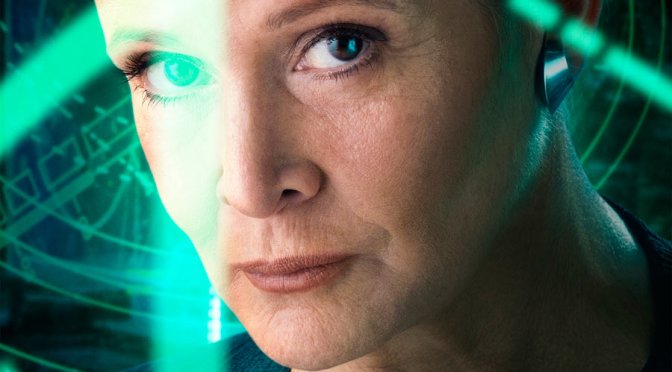
And at C-Net, a look at why Carrie Fisher looks so right in the new Star Wars movie.


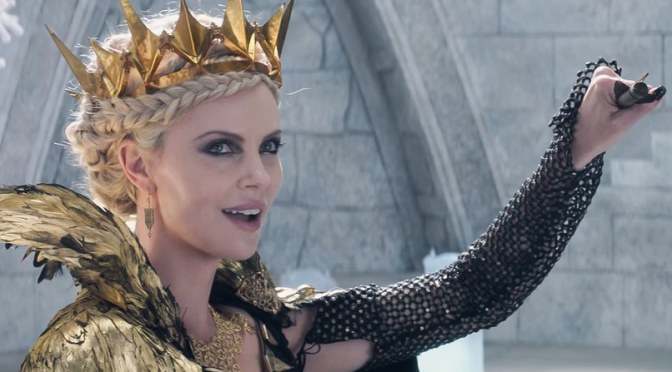
The Huntsman: Winter’s War just made it onto my must-see list

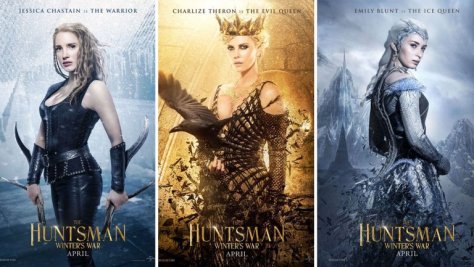
So, first I saw these amazing character posters:

TheHuntsmanWintersWarPosters

And while I still don’t understand how this movie has managed to get all three of these women on board, I was kind of excited.

I actually rather liked Snow White and the Huntsman to begin with, and I was disappointed when Kristen Stewart got booted from the sequel. The huntsman was the most boring part of that movie, and I honestly don’t care to see a movie about him at all. However, it looks like this one isn’t going to be. Or, it is, but it’s also going to be about a big magical war with two evil queens in it this time. Plus Jessica Chastain.

At least that’s what I got out of the trailer when I finally watched it today. I’m not sure it makes a lick of sense, but there’s basically no universe in which I don’t go see this movie just to see Charlize Theron and Emily Blunt vamping around in gorgeous costumes. If the film is at all coherent, that’ll just be a bonus.

Book Review: Domnall and the Borrowed Child by Sylvia Spruck Wrigley

Domnall and the Borrowed Child is the definitely weakest of Tor.com’s novellas published to date. It’s not bad, but it’s a little too short and doesn’t have any standout qualities to elevate it above the ordinary.
The story has the kernel of an interesting idea, but it’s not very well-developed, and even just hours after finishing the book I find myself struggling to remember details of it. I like the concept of a faerie people in decline and struggling to survive on the margins of modern society, and this is alluded to throughout the story, but the story is too small and too personal to be really effective at communicating anything substantial about these hinted-at themes. I could see it being a nice fit for a larger collection of work exploring these ideas in greater depth, but it falls a little flat as a standalone tale.

None of the characters are particularly distinguished, and the elderly Domnall’s sexual interest in his young protégé is just plain creepy. Domnall had the potential to be an interesting character, but I just never felt like he truly came alive. The characters that I found truly fascinating were Micol and the human girl the fairies entranced, but neither of these characters gets a point of view in the novella and the human girl doesn’t even get a name. Sadly, what this means is that there are more interesting stories here than Domnall’s, and that knowledge colors the whole experience of reading Domnall and the Borrowed Child.

It’s bad enough reading a dull story; it’s far worse to read a dull story with potentially wonderful stories trapped inside it.

iZombie: “Abra Cadaver” breathes life into a pretty standard dead magician murder mystery

It seems that it’s a requirement that every police procedural show must eventually do an episode involving stage magicians, and iZombie’s time to continue this tradition has come. In “Abra Cadaver,” Liv eats the brain of a death-obsessed magician with a penchant for explaining his colleagues’ best tricks on YouTube.

It’s nice to see an episode where the murder mystery of the week is more than just incidental to more important goings on, although this mystery turns out to be not as clever as the writers think it is. The best parts of this episode are all the parts that aren’t the investigation of Sid Wicked’s murder, and we finally get to see the show begin to address the enormous elephant that’s been in the room since the beginning—how Liv’s being under the influence of the brains she eats affects her relationships.

Post-, well, not –coital, but post-probably-hand-stuff, I guess, Major talks a good game about how he’s cool with all incarnations of Liv, but it turns out that he’s much more bothered than he wants Liv to believe. By the end of the episode, Liv has gotten very weird from morbid magician brains, and Major has gotten very weirded out by it. I might be annoyed that Major’s brief flirtation with the most boring drug problem ever is so quickly forgotten, but this shift in direction for Major and Liv spawns one of my favorite interactions on the show so far when Major asks Ravi and Peyton about Liv’s personality changes.

My love for this scene might have something to do with the fact that it immediately follows Peyton shutting down Ravi’s awkward and totally unwelcome and inappropriate attempt to ask her for relationship advice. Left to his own devices, Ravi ends up dumping his girlfriend, Steph, later in the episode, which is actually the lowlight of the episode. Steph, weirdly and annoyingly, has decided to throw a Guy Fawkes Day celebration for Ravi—a couple of weeks late—and it’s every bit as cringeworthy as you could expect. It’s a really lazy way of dealing with a character who’s outlived her usefulness to the narrative the show is building.

Steph was introduced as Ravi’s new, relatively cool-seeming girlfriend a couple of weeks ago, and now she’s suddenly, well, this? I don’t buy it. And I didn’t like it. I ship Ravi and Peyton as much as the next person (which is to say a lot), but I hate to see this kind of character assassination in service to that. It could just as well have been handled by Ravi saying at some point that it just didn’t work out with Steph. There was no need to humiliate her on screen like this, and it didn’t make Ravi look good either.

By far my favorite parts of the episode, though, are the scenes of Liv and Blaine hanging out together trying to figure out who is killing zombies. By the end of their time together, I want nothing more than for them to get married already and make some beautiful zombie babies. In all honestly, though? Liv and Blaine have about ten times the chemistry that Liv and Major do, and we know that Blaine isn’t totally thrilled about being de-zombified. Liv and Blaine giving into their obviously sexual tension would be a great way for him to get re-zombified.

“Abra Cadaver” is a solid episode overall, and it hit most of the right notes, but it could have made better use of its premise. Personally, I could have used more magic puns, but it’s still a solid example of iZombie at its near-best and a nice entry into the annals of the dead magician murder mystery genre.

Miscellaneous thoughts:

  • How did Liv not even seem to notice that the dog in Dale’s file looked an awful lot like Major’s new canine friend?
  • Please stop trying to make Blaine and Peyton happen.
  • Who is the mysterious woman who drops off something at Babineaux’s place?
  • Speaking of Babineaux, I really like him and Dale together.

Book Review: The Builders by Daniel Polansky

The Builders is a wild ride from start to finish, and it’s my favorite so far of Tor.com’s new series of novellas. It’s a wonderful use of the form, and Daniel Polansky has managed to make a great many parts move like clockwork in a fast-paced, riveting revenge story with a deeply satisfying ending.
The best thing, on a technical level, about The Builders is Polansky’s clever use of its short length and the cinematic effect he produces by chopping the story up into short chapters, most only one or two pages long. There’s very little telling here, just showing, and each chapter is like a scene in a movie, painting a compelling picture that moves the story forward. It makes the book compulsively readable, and I could hardly bear to put it down.

There’s not much about The Builders that is particularly original or groundbreaking, but that is more than made up for by the sheer skill Polansky exhibits by arranging a collection of old tropes and a commonplace plot into a masterfully woven tapestry of a story. It goes to prove that, while there is very little new under the sun in the realm of storytelling, there’s definitely something to be said for doing something that’s been done before—but doing it very, very well.

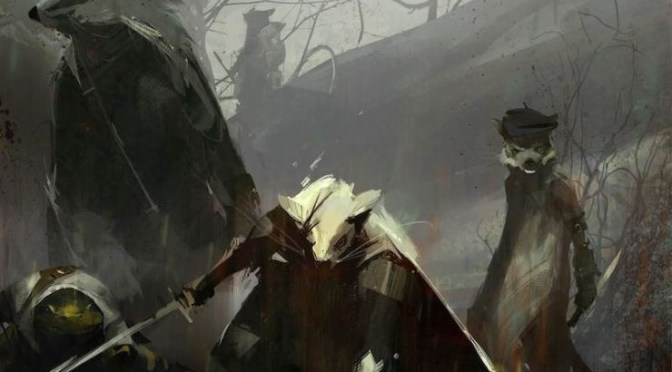
Of course, this isn’t to say that everything about The Builders is expected. Indeed, I’ve never seen this kind of getting the old gang back together for one last revenge quest job story done in quite this way before. You know, with animals. It’s, perhaps surprisingly, pretty great.

Cute little forest animals have never been so grimdark, which also makes this the funniest thing I have read this year. ­­­I highly recommend it.

Minority Report: “American Dream” offers a glimpse of a different, better show

After a week without an episode, Minority Report is back with one that reminds me of a lot of the things that initially attracted me to the show in the first place. “American Dream” isn’t great, but it is good, and it’s definitely the most I’ve enjoyed this show in a while.

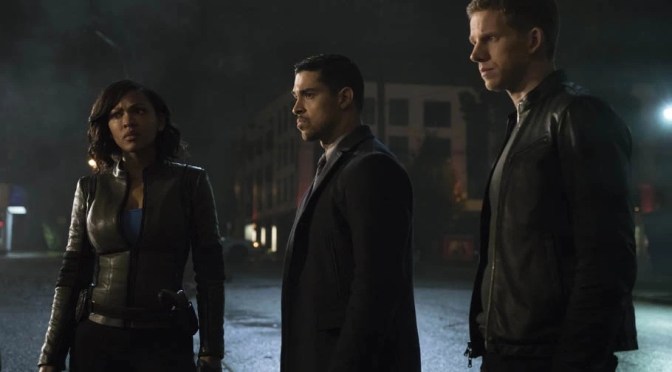
This episode does something that I think is one of the best things it could have done at this point: it lets Vega’s boss, Blake, in on the precog secret. Blake has been completely underutilized up to this point, which is a shame, but “American Dream” does its best to make up for lost time, with Blake joining Vega and Dash to investigate an impending murder in the poor, immigrant neighborhood where Blake himself grew up.

We learn that in 2025 the US government granted citizenship to some ten million undocumented immigrants, but that the “compromise” (in the true, Republican sense of the word) negotiated in exchange for that amnesty was the repeal of the 14th Amendment. Blake was one of the unfortunate children born in the US after that repeal, as was this week’s pre-murder suspect. The episode spends most of its time exploring what that status means to the people who are affected by it, focusing heavily on Blake’s experiences as a child of immigrants and a member of a marginalized community. This is definitely the best job the show has done to date with integrating world building with character development, though it does turn a little after school special in the end.

My biggest complaint about this episode is that it doesn’t manage to dig deep enough into any of its big ideas. It also sidelines its female star in favor of exploring a secondary character who they’ve actually made more interesting than either of the leads. Blake’s background is interesting enough that he could have carried a whole series himself, and indeed Wilmer Valderrama does most of the heavy lifting in this episode. Poor Vega exists at a similar-in-some-ways intersection of identities and experiences, but somehow the show just never has managed to really explore those and she’s relegated to background decoration in this episode.

The worst part about all of this is that it indicates, to me, large structural flaws in the whole premise of the show. Vega has suffered all along from poor writing and inconsistent (and unlikable) characterization, and Dash is just bland. These leads have always struggled to distinguish themselves in comparison to more interesting secondary characters, and this episode offers a glimpse of what the show might have been like if they’d centered the narrative around someone else altogether. Blake’s well-drawn background, his naked ambition, and his interesting connection to pre-crime make him far more qualified to be a lead protagonist than Vega has proven to be.

I’ve felt from the very beginning that Minority Report was a show that has a lot of potential, and I’ve spent the last several episodes bemoaning the ways in which the show has failed to live up to its early promise. It’s nice to see the show exploring some of its more interesting ideas, even if it is almost certainly too little too late. It feels obvious to me after this episode that the show’s writers just have never known what to do with Vega and should probably have chosen a character they could have written well from the start.

Miscellaneous thoughts:

  • The more I think about all this, the more it makes me angry for Megan Good, who I think has done the best she can with the material she’s been handed.
  • Wilmer Valderrama is ridiculously handsome and charismatic.
  • I about lost it when that guy got a drone in the face. That was the funniest thing that has ever happened on this show, if for no other reason than it was a pretty random thing to have happen.
  • I also about lost it when that guy tore a page out of a first edition of The Origin of Species. I know it’s a prop, but still.

Supergirl: “Livewire” gives us a cool new villain and examines troubled mother-daughter relationships

So, this episode actually aired out of order, with CBS deciding to hold off on showing an episode that dealt with events they thought might be uncomfortably similar to events in the real world this past week. It looks like last week’s episode really did wrap up the who comparing Supergirl to Superman thing, which is encouraging, but this week’s focus on every character except Supergirl left our heroine a little sidelined in her own show.

I was a little concerned that the show’s tendency to race through story might cause “Livewire” to feel extremely out of place, but the only thing that really felt off was the revelation that James and Lucy are apparently very much back together now. This had already been telegraphed by Lucy showing up in National City to begin with, so it’s not surprising that she’s continuing to be a roadblock to any romance between James and Kara. Sadly, this is such a boring and totally expected development that my eyes about rolled out of my head when I saw it, and this isn’t helped by the fact that Lucy is little more than a pretty face so far. I can only hope that when we finally get to see the episode that “Livewire” replaced it gives Lucy more of a personality so we can understand what James sees in her.

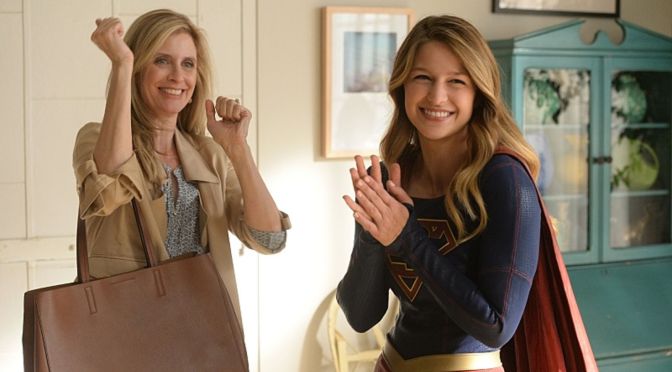
Ultimately, though, this early interlude serves just to get James out of town for Thanksgiving, minimizing Kara’s boy troubles and making room for Eliza Danvers to come into town to spend the holiday with her daughters and for Kara to have a ton of bonding time with Cat Grant, who basically steals the whole episode. What few scenes Cat doesn’t steal are stolen by villain of the week Livewire (Brit Morgan), who is great to watch in spite of a pretty nonsensical origin story.

Livewire starts the episode as a contentious radio shock-jock, Leslie Willis, who has been mentored by Cat Grant but who oversteps when she decides to denigrate Supergirl on the air in an opening sequence that is one of the more naturalistic pieces of writing that we’ve seen on the show so far. Leslie’s dislike of Supergirl feels real and her insulting tirade against our superheroine is also sharply funny. I can see why Cat hired Leslie in the first place. Unfortunately for Leslie, Cat has very specific plans for Supergirl’s “brand,” and she won’t stand for being undermined by Leslie’s grudge.

When Leslie refuses to let Cat dictate her content, Cat simply busts Leslie down to covering traffic until her contract with CatCo runs out. It’s on her first day in the traffic ‘copter that Leslie gets struck by lightning-via-Supergirl, falls into a coma, and then wakes up with superpowers and an even bigger ax to grind against Supergirl and Cat Grant both. Mostly, though, this plotline functions as an exploration of Cat Grant’s character through examining her relationships with Livewire and Supergirl, and it works perfectly to make Cat much more well-rounded and relatable character. As a fan of Cat since episode one, I am thrilled to see her given so much new depth this week.

Meanwhile, Kara’s foster mother, Eliza Danvers has come to National City for Thanksgiving. Kara is excited to share the newest developments in her life with the woman who raised her through her teen years, but big sister Alex is certain that Eliza is not happy about the situation. Alex is right, of course, and Eliza can’t even make it through dinner before lighting into Alex for failing to sufficiently protect Kara. These sequences also give us our first flashbacks to Kara’s life when she first came to Earth, which is a nice change, but the Alex/Eliza stuff is really just completely overshadowed by the much more interesting interactions between Kara, Cat, and Leslie.

It doesn’t help that things between Alex and Eliza are mostly resolved by the end of the episode. I expect for a super hero show to have unbelievable things going on, but I expect that to be confined to the actual super hero portions of the show. The idea that ten years of mother-daughter strife can be fixed with a couple minutes of hugging it out on Thanksgiving just doesn’t feel true, which is too bad. It’s very important in a show like this that the more “out there” comic book elements are balanced by a naturalistic approach to its human drama. Rushing through these issues minimizes their emotional impact and makes them too unrealistic to counterbalance the absurdity of aliens and cyborgs and magical lightning powers. This has been a problem in the show since the pilot, and it’s worrisome that this is starting to feel like one of Supergirl’s defining characteristics. I’d hate to see it become the show’s downfall.

Miscellaneous thoughts:

  • Is the radio shock-jock character even a recognizable archetype in the modern age? While Leslie Willis isn’t alone in recent television history, I would seriously question whether or not a lot of young people would recognize the inside of a radio station anymore.
  • Winn’s dad is in prison, apparently. Since I’ve never read any of the comic books that this series is based on, I have no idea who any of these characters are, but I guess Winn’s dad probably is (or is going to be) some kind of supervillain. Frankly, I’ve felt for a while now that Winn himself gives off some faint future-supervillain vibes, so this isn’t terribly surprising.
  • Who on earth made the decision to use a cover of “Take Me to Church” for a mother-daughter bonding scene? This show is usually pretty obvious with its use of modern pop music, but this was bonkers. I haven’t seen a musical decision this baffling and bizarre since that time on Glee when Idina Menzel and Lea Michelle did a mother-daughter duet of “Poker Face.”
  • They really are moving right along with the “Hank Henshaw is a villain” storyline.
  • I still feel at times that including the DEO headquarters as a setting makes the whole show feel a little disjointed. Even when an episode is, like “Livewire” is, objectively not overstuffed with story, having those extra setting shifts can make it feel busier than it is.
  • Livewire herself felt a bit half-baked in this episode, but she’s definitely the most interesting villain-of-the-week we’ve seen so far. With her only being captured, not killed, I’m very hopeful that we’ll see her again in the future.
  • Speaking of villains, where is Astra? Even if they’re saving another showdown between her and Supergirl for a finale episode, it seems like we ought to get an update on her occasionally.
  • “You’ve always been my super girl” was the one like out of all the Eliza/Alex stuff that really worked for me. There might have been a tear or two.

Doctor Who: “Sleep No More” is a disaster in every possible way

“Sleep No More” definitely numbers among Doctor Who’s worst episodes. Although it may not be the absolute worst in history, I can’t think of one that I’ve disliked more. That said, it’s not an episode to inspire a great deal of, well, anything. My singular thought as the episode ended was just “What the fuck did I just watch?”

The episode begins by skipping the opening credits in favor of jumping straight into a confusing and frustrating forty-five minutes of found footage nonsense. The story—a pretty standard base under siege plot—is introduced by creepy scientist Rasmussen, who is too-obviously some kind of villain, and we’re then introduced one by one to the unfortunately forgettable members of a doomed rescue party.

The only character this week who got anything like a development arc was Chopra, but even he was sadly one note. The show cast its first transgender actor, Bethany Black, as genetically engineered “grunt” 474, but her talents are largely wasted in the role, and the secondary plot where 474’s self-sacrifice helps Chopra to see the grunt’s humanity is underdone, unconvincing, and ultimately irrelevant as both characters involved die within moments of each other. Deep-Ando is separated from the rest of the group early on and dies alone as well. Rescue party leader Nagata was barely present and contributed little, but she did at least get to escape with the Doctor and Clara in the Tardis at the end.

Speaking of Clara, she fades into the background here almost as much as any of the secondary cast members this week. With Jenna Coleman’s definitely impending departure from the show and Clara’s possibly impending death (hey, it is rumored) coming as soon as next week, it’s incredibly saddening to see her once again marginalized in the story with almost nothing to do. It’s no comfort, either, that the Doctor is just as ineffectual this week. It only makes me wonder what the point of this episode is at all.

I have seen some posts praising the found footage format and the horror elements of the episode, but I didn’t find it compelling or frightening in the least. The shaky camera work was occasionally nauseating, but never managed to convey the sense of panic that I think was intended. The monster of the week was more silly than anything else, and if the sleep dust monsters weren’t absurd enough to look at, with their rather disgusting-looking heads like huge gaping (and vaguely scatological) orifices, the Doctor’s various theories and explanations made the monsters just plain ridiculous.

It’s not a great sign when even the Doctor ends the episode with an exasperated exclamation that none of it makes sense, and that’s exactly what happened here. The whole way through the episode, I kept waiting for it all to finally congeal into something resembling a coherent story, but it just never happened.

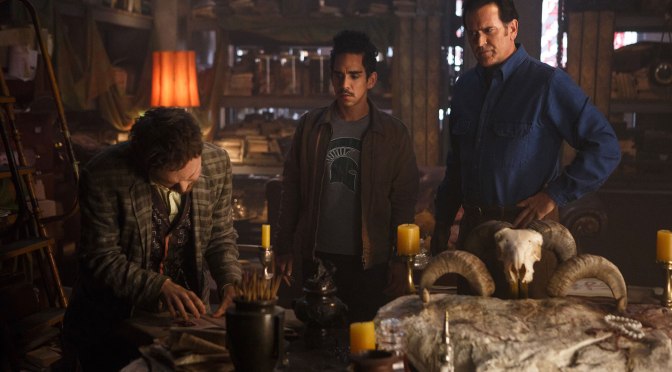
Ash vs. Evil Dead: “Books from Beyond” is some yappening and not a lot of happening

I had very high hopes for “Books from Beyond,” so I was a little disappointed when this episode felt like a bit of a step back after the first two really excellent half hours of the show. It’s not a terrible half hour of television, but it’s not particularly scary, not as funny as the last couple episodes, and it doesn’t do as much as it ought to move the story along.

After a week without Lucy Lawless, it was nice to see her back in the opening minutes of this episode, although I think her scene might leave us with rather more questions than answers about her character. I had kind of expected her to play a bigger part in the action this week, as the preview for the episode seemed to imply she would, but she only has perhaps five minutes of screen time. It’s not quite a deal breaker, but it is irritating to feel misled by promotional material in this way.

What’s more unfortunate this week is that Lawless’s Ruby isn’t the only female character to find herself somewhat sidelined once Ash and company arrive at the bookstore. While Ash and Pablo deal with ancient book expert and obvious weirdo Lionel (Kelson Henderson), Kelly is left to keep an eye on a handcuffed Amanda Fisher, who’s got no idea what’s going on but is convinced that Ash is responsible for it. Kelly has almost nothing to do this week, and Amanda doesn’t have anything useful to do. Both women end up only hindering Ash’s efforts to find a way to stop the evil he’s unleashed, but the largest portion of their time is spent doing nothing at all. This would be annoying enough if all the interesting stuff was happening where the women aren’t, but that’s sadly not the case here.

You wouldn’t expect a demon-summoning to be boring, but this one somehow manages it. There are some funny moments, but there are even more missed opportunities. Aside from this episode’s failure to include Kelly and Amanda in most of the action, the summoned demon and the ensuing fight just doesn’t end up being particularly well-done on any level. The demon itself is dull-looking, the show has toned down it’s characteristic gore, and the huge number of creepy specimen jars that are shown over and over again throughout the episode are never used to their full possible effect. Considering how much the camera lingered on all those jars of pickled fetus-looking things, I kept expecting them to at some point end up out of the jars and attacking Ash’s face. Not having that happen is a major missed opportunity.

Overall, “Books from Beyond” is simply a much slower-paced episode than the last two. It wasn’t bad, but it didn’t deliver on the promise of the episode preview. On the one hand, I’m not certain it’s reasonable to expect that the show could have kept up the level of energy and humor that characterized the first couple of episodes. On the other hand, I’m not sure the show works if it doesn’t somehow manage that. When you add in the fact that the show seems to have lost interest in its female characters, at least temporarily, “Books from Beyond” is layer upon layer of letdown.

Miscellaneous thoughts on the episode:

  • I did love Lionel’s costume, although I think his jacket really needed to have elbow patches.
  • They are seriously having Pablo get “friend-zoned”? I hate that trope so much. It’s the worst sort of low key misogynist bullshit.
  • I hate to harp on the fetus jars thing, but that really was an enormous disappointment. I know they already did Ash fighting a comically small opponent in episode one, but this would have been a whole bunch of exceptionally gross-looking comically small opponents, which is clearly an entirely different thing.
  •  Best line of the night: “Well, you two learned a very valuable lesson today: Cops don’t help.”
  • That said, I’m starting to get the feeling that the show either has a total disdain for Amanda Fisher or just doesn’t have any idea what to do with her. She’s clearly a tough, capable person, but this week in particularly she functioned as nothing but an obstacle to our heroes while also ending the episode worse off than she started it. I thought the show was moving towards having her join up with Ash and company, but that seems to not be the case. I suppose this may mean that Amanda is going to end up working together with Ruby (who is downright sinister at this point), but I’m not exactly holding my breath on that, either, after this week’s mishandling of her character. It is still early in the series, but Amanda deserves better than what she’s been given so far.

Sci-fi and Fantasy books, tv, films, and feminism