State of the Blog and Weekend Links: April 16, 2017

Happy Passover and happy Easter for those who are celebrating this week! I’m almost too bloated on deviled eggs and mini-cheesecakes and ham to write tonight, but I’m working through it.

It’s been an uneventful and moderately productive week for me, both in writing and otherwise. This coming week, my goal is to finish several book reviews, as I’ve finished a few things lately that I really enjoyed. After about a week-long reading slump (mostly due to getting stuck on a title I didn’t like but that had a concept too good for me to quit it right away), I just started an ARC of Wicked Wonders by Ellen Klages (out May 2 from Tachyon Publications). I’ve only read the first story, but I’m already really excited about the rest. I’ll probably be reading that in tandem with the new John Joseph Adams edited anthology, Cosmic Powers, which has my favorite table of contents of the year so far and is out this Tuesday, April 18, from Saga Press.

The finalists for this year’s Eugie Award have been announced.

The new and improved World Fantasy Award.

The World Fantasy Awards Administration unveiled the new award statuette that will be replacing the bust of old, gross racist H.P. Lovecraft. It’s gorgeous, and finally addressing the Lovecraft problem built up a lot of good will. Which was then swiftly squandered when everyone learned that they’re keeping Lovecraft on as a pin for all award nominees. Apparently there’s a bunch of pins left over from previous years and they want to use them til they’re gone, which is thrifty, but still ill-advised considering how much people don’t want to look at some nasty old racist’s ugly face anymore. Still, that new stature really is lovely.

Word is that Piers Anthony’s Xanth novels are being adapted for film and television, and I’m full of mixed feelings about it. I read and loved the shit out of those books when I was in middle school, but I realize as an adult that Xanth is best enjoyed when you’re just old enough to appreciate puns but still young enough that Piers Anthony’s creepily unfortunate gender politics is all going to go right over your head.

It turns out that I’m still not okay about Carrie Fisher. This tribute video made me cry. A lot.

I felt slightly better on reading the announcement of a new Star Wars anthology. Coming October 3, From a Certain Point of View will consist of 40 new stories told from the perspectives of background characters from A New Hope. While there’s no table of contents yet, there’s already an impressive list of authors donating work to the collection, from which all proceeds will go to benefit First Book, a non-profit that provides books and other learning materials to educators and organizations helping children in need.

Fantasy Book Cafe’s Women in SFF Month continued this week:

Dianna Gunn’s novella, Keeper of the Dawn, is out on April 18 from Book Smugglers Publishing, and this week she talked about her inspirations and influences for the book.

Aliette de Bodard wrote a guest post over at Skiffy and Fanty about writing vibrant, unexpected characters.

Margaret Atwood was profiled in The New Yorker.

Nerds of a Feather, Flock Together is still pumping out their Dystopian Visions series, which I am still loving. It’s a great mix of posts on stuff I know well and things I’m less familiar with. This week, they covered:

At Strange Horizons, Erin Horakova wrote an amazing essay on what she calls “Kirk Drift”–the disconnect between the popular imagination of James T. Kirk and the actual, textual reality of the character.

Aidan Moher kicked off a new blog series at Tor.com, The Art of SFF, with a post about Richard Anderson.

My favorite free-online short fiction of the week was Kate Lechler’s “The Hulder’s Husband Says Don’t” over at Fireside.

I loved Ana Lily Amanpour’s first feature-length film, A Girl Walks Home Alone at Night (on Netflix if you haven’t seen it!), so I’m pretty stoked about her new movie, The Bad Batch, which is being described as “a horror-romance (with cannibals).”

I’m fairly certain that Atomic Blonde is going to be a problematic mess, but I am really excited for it. There’s a new trailer, and it looks AMAZING:


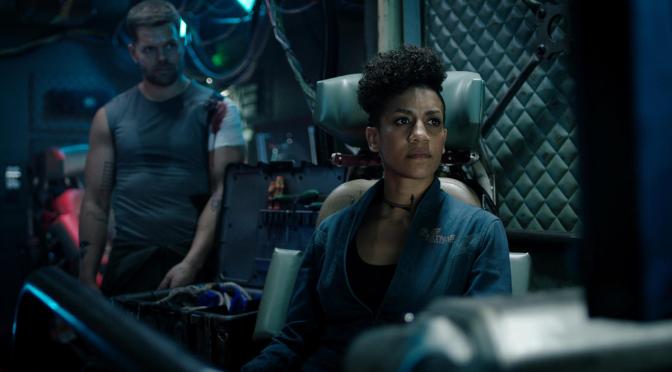
The Expanse: “The Monster and the Rocket” is a brilliantly multilayered penultimate episode of the season

Every time I’ve seen the best The Expanse has to offer this show manages to reach a new height of exciting and thought-provoking entertainment, and “The Monster and the Rocket” is its newest leveling-up episode. It’s a tightly plotted and paced episode that hits every story beat and emotional note exactly right; it’s got layers of meaning and metaphor that make it ripe for critical analysis; and it ends each of its storylines in such a way as to build up maximum anticipation for next week’s season finale.

**Spoilers below.**

The episode opens with Sadavir Errinwright shaving and replaying Avasarala’s recent advice to him in his head. I started humming “Needle in the Hay” about the time he nicked himself and stared pensively into the mirror, but then it cuts to him walking his teenage son, Jefferson, to school. We learn that the elder Errinwright has been having nightmares, and his son is as sweetly concerned as any teenager ever is when their parent is acting strange. Sadavir tries to impart what sounds like some final advice to the boy, which freaks him out enough that Sadavir tries to calm him down with a particularly unconvincing “Everything is gonna be okay.” If there’s any part of this episode that I didn’t love, it’s this opening sequence, partly because the shaving scene feels a little on the nose and partly because, while I appreciate the attempt to humanize Sadavir Errinwright and make sure the audience knows that he’s got a whole life that he’s pissed away on his scheming with Mao, I have a hard time caring too much about this teen son at this point unless he’s going to be more than a throwaway character.

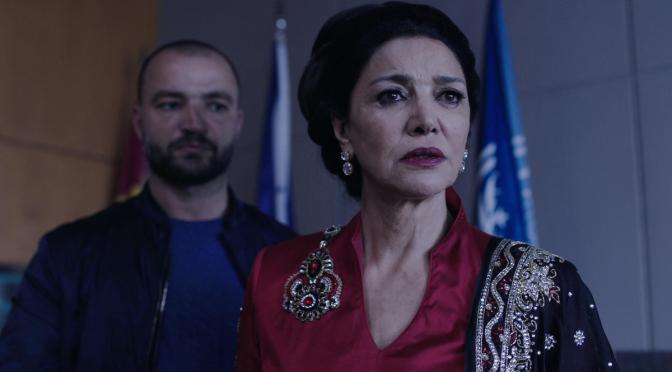
Before the Eros hearings begin, Errinwright meets with Avasarala, who feels bad for him but is still unwilling to sacrifice her own career and credibility to save him from the consequences of his own actions. Chrisjen tries to reassure Errinwright about the outcome of the hearing, but he’s not encouraged and in fact seems very agitated as he forces Chrisjen to hold onto a medal that he hopes she’ll give to his son if things go poorly. She also tells him about her upcoming meeting with Jules-Pierre Mao, and Errinwright insists to her that Mars would use the protomolecule weapon to destroy Earth. Avasarala doesn’t believe that, but Errinwright insists that she must convince Mao of it as well. She doesn’t get to do that, however, because Errinwright’s plan to get himself out of any consequences for his horrible actions is about to be set in motion.

If it wasn’t obvious enough after the opening scene and the short conversation with Avasarala before the hearing that we’re mean to think Errinwright is on the road to suicide, there’s a scene for that. He writes what appears to be a suicide note to his ex-wife, Jodie, and then plays with a small green vial that looks like poison. In hindsight, it’s almost a little too heavy-handed a red herring (not quite, though—I was momentarily fooled), and the next time we see Errinwright he’s coming back into his office after visiting the opera with the Martian defense minister, Pyotr Korshunov. Errinwright pours from a 107-year-old bottle of scotch and starts a sort of “let’s be real” talk about the protomolecule. Soon enough, however, Korshunov collapses, having a heart attack from the poison Errinwright has slipped into the scotch. The poison is one that specifically targets only Martians and was banned under international law, but Errinwright points out that “if you give a monkey a stick, eventually he’ll beat another monkey to death with it.”

Errinwright isn’t willing to let Mars have sole access to the protomolecule—even though Korshunov says they would use it to accelerate their terraforming project—and he’s willing to kill to make his point. At the same time, we learn, Errinwright has the MCRN ship Karakum destroyed before it can pick up the protomolecule on Ganymede. The last step of Errinwright’s plan, it turns out, is to call up Avasarala and Mao, now in orbit on Mao’s ship, and let them know how things are going to be. Mao is instructed to kill Avasara and come back to Earth so he and Errinwright can continue their partnership. As soon as the message ends, guns are drawn and Mao is out the door, leaving Avasarala, Bobbie, and Cotyar in the ship’s lounge with one tiny gun against several of Mao’s security force. And that’s where this story ends for the week! They’ve changed things just enough from the book that I’m not quite sure how it’s going to go down in the season finale, but however it does, Avasarala is going to be furious, and I suspect it’s going to be amazing.

It’s somewhat weird, this late in the show, to shift the primary point of view of a storyline like this, and I wasn’t sold on the change from Avasarala and Bobbie’s POVs to having this part of the story told more from Errinwright’s perspective, but it works well on several levels. Having read some of the books, even knowing that the show has deviated somewhat from how these events occurred in Caliban’s War, it’s interesting to get a POV that we didn’t get in the novel. The POV change is also a great way of revealing the rather vast difference between the way that Chrisjen perceives and understands Errinwright and the way that he really is, which is much more underhandedly ambitious than she has given him credit for before now. Both Avasarala and Mao are caught flatfooted by Errinwright’s actions this week, and so, to a certain extent, is the audience, who has been primed all season long to think the same way Chrisjen does about Errinwright and to see him as a pawn of Mao’s rather than a competent and cutthroat schemer in his own right. Smart writing combined with capable performances on the part of all involved have paid off wonderfully in the form of a genuine surprise and a cliffhanger ending that feels truly consequential.

On Ganymede, the Roci crew is still split up. Holden, Prax and Alex are hunting for the Caliban hybrid in the wreckage of the domes while Naomi and Amos go to see what they can do to help Melissa get the Weeping Somnambulist airworthy so they can help evacuate the collapsing station.

When they arrive at where the Weeping Somnambulist is docked, Naomi and Alex find near chaos and no welcome, as Melissa is still angry about them getting her husband murdered. However, Naomi insists on helping to repair the ship, and Melissa eventually lets her since it needs doing. While repairs are going on, conditions on the station continue to deteriorate, more people keep showing up outside, and things start to get increasingly chaotic as people start to get frightened. Things get worse when Melissa tells Naomi that they only have enough air on board to take fifty-two people out of the well over a hundred who are waiting outside. Melissa closes the door to the ship when people start to get violent, and she and Amos don’t think it’s safe to open in again. Naomi, however, can’t bring herself to leave everyone, and she insists on going out to talk to the crowd, organizing them into groups and taking children first, then young women and men until they can’t take any more. It’s a truly heart-wrenching scene and a superbly executed redemptive moment for Naomi, who desperately wanted to help at least some of Ganymede’s people.

Meanwhile, the hunt for the hybrid isn’t going super well, as it’s hiding and darting about so that Holden can’t see where to shoot it, which has him very much on edge. Holden’s state of mind isn’t helped by Prax being against killing the creature altogether—since they don’t actually know what it is and it might be someone’s young child and the victim of an evil science experiment—and Alex being concerned about damaging the ship and/or getting caught by the MCRN and shot. In fact, Holden seems to have finally gone full Ahab on us, and he’s being absolutely monstrous to the other two men about everything. It’s only when the Karakum is destroyed and it becomes obvious that ships leaving the station—like the Somnambulist—are in need of assistance that Alex puts his foot down and refuses to keep hunting the hybrid. He takes the Rocinante to help, intercepting a torpedo launched at the relief ship, and by threatening (bluffing?) to take out the rest of the Martian fleet they’re able to stop the MCRN from firing any more.

The episode ends with the Rocinante escorting the Weeping Somnambulist to safety, but they don’t know yet that the Roci has a stowaway. The hybrid has torn into the side of the ship, so that’s gonna be a fun discovery next week. Personally, I almost didn’t notice it this week, watching the episode for the first time on a computer monitor; even on a 21” wide screen, it’s small, and the episode was exciting enough that, if you don’t know to look for it, you might be too busy breathing a big sigh of relief for the Somnambulist to catch it. That said, on a 50”-ish television screen, the hybrid tearing into the side of the Roci is pretty clearly visible, so anyone watching the show more traditionally should have no problem seeing it.

Miscellaneous Thoughts:

  • Errinwright’s advice to his son—“listen to your heart”—is reminiscent of Polonius’s advice to Laertes in Hamlet, and the stage metaphor is continued explicitly in Errinwright’s conversation with Pyotr Korshunov later on. I’m not really equipped to analyze that much more deeply, but I’m certain the Shakespearean allusion is intentional and I will read the shit out of anything that someone else wants to write about it.
  • Speaking of “Korshunov,” I choose to believe that’s not a reference to Air Force One.
  • Bobbie and Cotyar bickering is my new favorite thing. I’m definitely going to be looking for fanfic while I wait for season three of the show to come out.
  • Avasarala is a terrible traveler.
  • Chrisjen’s short speech about “Earth’s real gravity” is excellent.
  • “You even arrested my cousin! He’s a monk.”
  • “You people are shit magnets.” #ACCURATE
  • “Please, put those down and step away from the panel right now.” Delivered with exactly the right air of exasperated outrage at seeing something done wrong.
  • “You’re not finished yet.” Not finished crying, that is.
  • “Give me an open channel.”
    “Oh, man…”

iZombie: “Zombie Knows Best” would be better if it wasn’t a showcase for Whiteness

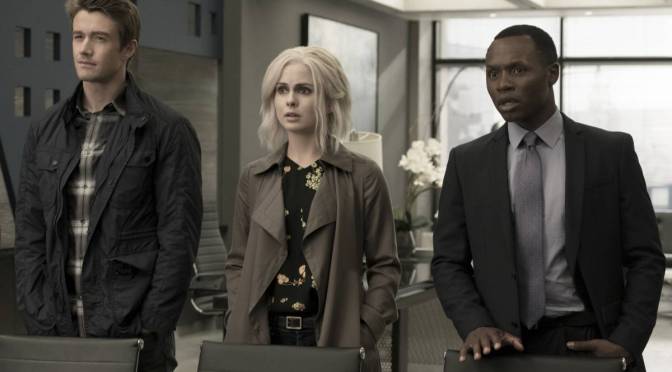
iZombie is a show that has always struggled with issues of race (and even, at times, gender), and “Zombie Knows Best” functions as a showpiece of several of the show’s general race/gender problems. I suspect it’s a writers’ room (more like Whiteness room) problem, to be honest. Still, it manages (though not impressively) to be a solid episode with some enjoyable moments. Clive gets some much needed, albeit extremely belated, backstory; we learn some more about what’s going on at Fillmore Graves; there’s a decent-but-not-stand-out case of the week; and for all that there are significant flaws in the execution of it, Liv and Major on father-daughter brains still delivers some humor if you don’t think too hard about any of it. I’d like to see the show do better, but this episode could have been worse.

**Spoilers below.**

The episode opens with Clive being questioned by Detective Cavanaugh, which seems to have taken place the night before the events that make up this week’s case. Cavanaugh wants to know more about Clive’s relationship with Wally. Clive at first tries to downplay the relationship, but he’s forced to spill when Cavanaugh pulls out a photo of Clive with Wally and his mother, Anna (Caitlin Stryker), in which they all look very cozy. Clive’s answer to Cavanaugh and his memories of Wally and Anna are metered out over the course of the episode, and we learn that Anna’s husband was abusive, which landed him in prison. While the husband was in prison, Clive grew close to Anna and Wally, almost becoming romantically involved with Anna before he went undercover and Anna and Wally moved in with Anna’s brother, Caleb, and somehow got turned into zombies, at which point Anna sent Clive a letter telling him they didn’t want to keep in touch.

This is the most we’ve learned about Clive since the show started, and it’s by far the most real Clive has ever felt. It’s just unfortunate that Anna and Wally had to be fridged in order for Clive to develop as a character, especially when we see how wonderful Anna is and especially especially considering how few women of color have been featured on this show in any kind of positive capacity. And listen. I get it. I understand that this is all about Clive’s regrets and doubts and what-might-have-beens. It’s meant to give a previously enigmatic character some more depth and shape, and there’s nothing like a tragedy to make that happen. However, this is the same show that screwed around for months having Clive date that Dale woman last year only to have nothing ever come of it. They could easily have introduced Wally and then Anna as a love interest for Clive, given them basically the same backstory with the abusive husband and zombification and lost contact, and written a story about Clive reconnecting with Anna and coming to terms with her being a zombie as he comes to terms with the whole zombie thing in general. Instead, we get a pretty much textbook fridging leading to what is moving towards revenge quest territory.

Anna deserves better, and the audience deserves better than this kind of lazy, cliché nonsense, no matter how cleverly the story is told in intricately woven together flashbacks.

The case of the week concerns a father and daughter, Stan and Cindy Chen, who are killed in an obviously suspicious hit-and-run. When Cindy’s friend Winslow sent Cindy a photo of Winslow in bed with her step-dad, Cindy showed it to her father, who insisted that they had to tell the authorities, which turns out to be a motive for murder when Winslow’s mom finds out. There are a couple of interesting twists and turns here, and even a nicely done red herring moment—when we see Major’s flashback to Cindy showing her dad the image on her phone and exclaiming “gross,” the context suggests (briefly) that it could be something zombie-related—but the truth is that this whole case just seems like an excuse to have Liv and Major eat these brains for humor reasons.

Literally as soon as we meet Winslow’s mom it’s obvious that she’s the murderer and the case is solved without much more trouble. Much more time is spent on Major and Liv being entertainingly effected by Cindy and Stan’s brains, which is definitely funny, and it helps to lighten things up since Clive’s story line this week is so dark and sad, but it’s a bit of a cheap laugh. Robert Buckley hamming it up stereotypical teenage girl style loses its charm quickly, and dad Liv isn’t much better. The problem with both of these is that they rely on only stereotypes for their characterization this week, and they’re positively archaic stereotypes at that. Teen girl Major could have been based on the teen daughter in any movie from about 1975 to the present, and Liv’s dad brain seems straight out of the 1950s. Neither of them give us any insight whatsoever into who Cindy and Stan were as individuals, though we know that they were killed on the way to an ice skating practice at 4 am and that they surely had complex internal lives that weren’t boring clichés. That Cindy and Stan were Asian American is entirely ignored in favor of playing with the lower-hanging fruit of “jokes” that are more “relatable.” I suppose it’s for the best that they didn’t go for mocking Asian stereotypes, but I don’t think what they did do, just ignoring the individuality of the characters altogether, is much better.

The worst effect of this is that it makes it difficult to become emotionally invested in the murder victims. Instead, the audience is encouraged to identify more with rich white girl Winslow. Even though Winslow isn’t painted as a particularly sympathetic victim, she still gets significantly more screen time than Cindy and Stan Chen together. We never even learn if Cindy has a mother or if Stan has a wife, and we certainly never meet her if she exists. However, we meet Winslow’s mother and step-dad, we see their business, we learn their history and see something of their family dynamic. It’s a lot of information about them and a lot of attention paid to Winslow’s victimization—we even get to see her skeevy step-dad’s booking on screen—but we don’t meet a single other soul who’s even met Cindy or Stan. I doubt this is maliciously intended, and it’s common for the show to focus on suspects and the main cast rather than on its murder victims, who are often simple plot devices, but still. They usually do better than this at giving us an idea of who their murder victims are and why we should care about them, at least for forty or so minutes.

Miscellaneous Thoughts:

  • Clive’s flashback mustache is surprisingly hot.
  • Liv’s “King of the Grill” apron might be my favorite thing about the episode.
  • Ravi’s angst over Peyton is already boring, and it, frankly, makes him seem like kind of an asshole.
  • Speaking of Peyton, she’s absent this week, as is Blaine. They’re missed, but I don’t know when they could have been squeezed into the hour.
  • The Fillmore Graves zombies eat a mash of different brains that keeps them from having the personality shifts and flashbacks that Liv and Major experience.
  • While much of dad Liv fell a little flat for me, “In this house we eat brains and solve murders!” made me laugh.
  • I’m not sure about the creepy IT guy. His role here seems like a new character introduction, but he’s weird and unfunny and bland enough that I can’t even remember his name. He’d definitely be an unnecessary addition to an already large cast.

Into the Badlands: Sunny’s absence lets the show shine some light on other characters in “Palm of the Iron Fox”

After last week’s relatively slow episode and its extremely frustrating ending, “Palm of the Iron Fox” provides quite a lot of payoff, though it’s not without its own frustrations. I’m glad that we finally get to see the Barons’ conclave, but there’s a major plot event that feels somewhat abrupt, especially this early in the season. Veil finally gets a plot that’s just hers, which might be my favorite thing about the episode, but I missed Sunny and Bajie this week, even if their absence works well to give the other plots, especially Veil’s, more space to breathe. As always, the fight scenes are well done, and the showpiece of the episode—the fight at the Barons’ conclave—is worth the wait.

**Spoilers below.**

Rather than just a pre-credits scene, this week there’s a rather long pre-credits sequence at Quinn’s underground compound, where Quinn’s making the final preparations to make his move against the other Barons. Veil, on the other hand, is clearly angling to get him to leave her alone in the compound with baby Henry because she wants to escape. Unfortunately, though Quinn doesn’t seem wise to Veil’s desire to leave, he is also too canny to leave her alone. He informs her that he’ll be leaving Edgar with her to be sure she’s “safe” and then goes to give a gloriously unhinged speech to his men. I know many reviewers like to criticize Marton Csokas’ accent as Quinn because it’s bizarre, but I genuinely love the over-the-top campy flair that Csokas brings to the role and it’s turned up to eleven here in an atmosphere that’s nothing short of cult-like.

Veil’s first escape attempt, once Quinn and the rest of the men leave, is to climb out through the roof of the ventilation room where she takes Henry for his daily dose of sunshine. Unfortunately, climbing up a rope while wearing an infant is harder than she seems to have anticipated and Edgar gets suspicious and comes to check on her before she’s out, putting an end to that plan. Later, Veil decides to drug Edgar and just go out the front door of the compound, but this too proves difficult. The gate to the outdoors is locked, and before Veil can break the lock Edgar wakes up and attacks her. He’s angry at being drugged and furious at what he sees as Veil’s betrayal of Quinn and the men, and he nearly strangles her to death before she’s able to fight him off and eventually kill him. Unluckily, a key that Veil managed to get away from Edgar has broken off in the gate’s lock, and when we see her last she seems to be still trapped underground, but now also traumatized, injured, and with Edgar’s dead body to explain if Quinn and company get back before she figures out another way to get away.

After spending the last couple episodes quietly making it clear that Veil wasn’t staying with Quinn of her own volition, it was nice to see Veil finally make her move to leave, but neither of her plans were fully thought out or explained very well. This ends up leading to some mixed messaging. On the one hand, Veil is explicitly portrayed as patient and methodical, willing to endure indignity and frustration to keep her child and herself safe. We’re also shown that she’s smart and resourceful and able to think quickly to avert disaster. On the other hand, she’s apparently not smart, resourceful or quick-thinking enough to make a success of either of her plans in this episode, and neither of those plans are particularly indicative of patience or of methodical planning. That said, Veil’s story this week ended on a little bit of a cliffhanger, with her collapsed and sobbing after fighting Edgar, so it’s still entirely likely that she’ll come up with some smart, resourceful, quickly-thought-up plan between now and the time Quinn gets home. Things are just uncertain enough that whatever happens next could shift the narrative and clarify the messaging we’re supposed to be getting about this character.

I’m also unsure how I feel about Veil killing Edgar. While, no doubt, even the gentlest person can probably kill in a fight for their life, Veil is the second woman this season (after Lydia) who has killed in self-defense after being characterized clearly as not a killer. Veil, for most of the show so far—and especially this season—has been a Penelope to Sunny’s Odysseus, not a damsel in distress waiting to be rescued (fortunately), but still a largely passive character whose agency in the story has been compellingly subtle up until now. In a show that has the ethics of murder as a major thematic concern, it has felt significant that Veil was so clearly not a killer. Even her refusal to treat Quinn’s tumor and her decision to keep his condition secret from him aren’t particularly murderous actions; it’s likely that Veil is simply without the means to cure the cancer, and it’s obvious how she benefits from using her status as his doctor to manipulate Quinn and ensure at least something akin to safety for herself and her child. At the same time, it also makes sense that Veil would want to escape; her situation with Quinn is tenuous at best. He might discover her ruse, he might go completely insane, he may die and leave her alone with a group of trained killers, at least some of whom still retain some hero worship of Sunny that may put her in a weird situation during any kind of power struggle.

Still, Veil killing Edgar feels out of character and unnecessarily tragic. Edgar seemed kind—though that is shown to be highly conditional—and seems to be one of Veil’s few friends and potential allies in this place. It’s possible that this is what is meant to be the real tragedy here—that a man who seemed so caring could so quickly turn on Veil and try to kill her, but if that was the case it’s muddled by the fact that he only turns on Veil after she poisons him (and does it knowing that he could be killed if Quinn returned to find Veil missing). While this, too, may all become less confused once we find out what Veil does next, it all just amounts to a failure of the fantasy morality of the show. It’s a show in which violence and killing are common—and commonly depicted with artful blood splatter as scores of nameless extras are slaughtered in battles between named antiheroes of various stripes—and life is decidedly cheap. Veil’s killing of Edgar is different, more personal and more ethically acceptable by real world standards, but it’s nonetheless hard to feel the full impact of it when ten minutes later we’re watching a gleefully wet bloodbath.

Finally, Veil’s purity, primarily expressed as nonviolence (even in resistance), and her penchant for healing rather than harming have been so essential to her character and to her dynamic with Sunny that her killing of Edgar feels like a despoiling event, complete with the lingering shot of baby Henry with Edgar’s blood splashed across his little face. There’s a sense here that, whatever happens next, Veil has been tainted by her experiences, and that it touches her baby as well. Considering the degree to which Veil’s resolute purity has always stood in contrast to Sunny’s corruption, it’s surely significant that Veil would find herself damaged just as Sunny has gotten well and truly started on his redemption arc (highlighted last week in his refusal to kill Nathaniel Moon).

The other major plotline of the episode concerns the Barons’ conclave that Ryder called for two weeks ago. This all opens with a scene of the Widow getting dressed for the actual event, which seems a little redundant since she just got to the estate, but okay. Waldo advises her to be fearless in a pep talk that is only just this side of insufferable mansplaining. I’m starting to wonder just how the Widow ever managed to become a Baron in the first place if she is as incompetent at politicking as Waldo treats her like she is. The only new Baron we’re introduced to at any length this week is Baron Chau, the only other woman Baron and a strict traditionalist, probably because she’s the Baron who is the source of all the cogs owned by the others. Chau offers her support to the Widow in exchange for a promise not to shelter any more runaway cogs, which the Widow at first balks at before being convinced by Waldo (natch) to take Chau’s offer. Still, it’s not enough, and when it comes time all five of the other Barons, Chau included, vote to strip the Widow of her title and banish her from the Badlands all together.

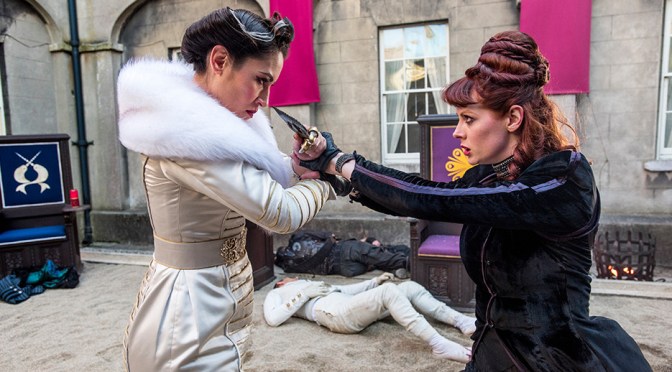
Just as an all-out battle royal is about to start, Quinn and his men show up to crash the party. This sends Ryder fleeing through a window with Quinn in pursuit, but it leaves the rest of the Barons free to fight amongst themselves in a cleverly conceived and gorgeously executed battle scene in which each Baron must rely on small weapons they were able to hide on their person and whatever they can improvise from what’s close at hand. The standout here is Waldo’s weaponized wheelchair, but Chau and the Widow trying to stab each other with their stiletto heels is pretty cool as well. Sadly, this fight is over almost too quickly when Tilda shows up to help her mother and Waldo even the odds a little. The other Barons flee while these three stand over a courtyard full of dead and dying clippers. Something tells me that the Widow isn’t going to abandon her lands without a fight, vote or no.

The second major emotional climax of the episode is Quinn’s final confrontation with Ryder. First, however, Quinn comes face to face with Jade, who begs Quinn for Ryder’s life. It’s an interesting moment for Jade, who has at times seemed cold and patronizing towards Ryder and is certainly a master manipulator of her husband, but who here seems truly desperate to save him from Quinn. It smartly complicates Jade’s character to have her love for Ryder be genuine, and not a moment too soon as she seems poised by the end of this episode to become a much bigger player over the rest of the season. Quinn is almost respectful towards Jade and ends up ignoring her to chase after Ryder, who has entered an enormous hedge maze.

The race through the maze ends in front of a statue of Laocoön that Quinn mistakes for Kronos, an intriguing classical allusion that I spent far more time than I’d like to admit today trying to figure out the symbolism of. It’s obvious that Quinn sees himself as Kronos, but it’s less clear what connection we’re supposed to draw between the story of Quinn and Ryder and the story of Laocoön and his sons. Even less clear than that is where either of these guys learned classics with no formal education. In any case, Quinn wants Ryder to kill him, while Ryder still just wants his dad to love him. It’s a tragedy waiting to happen, and it does. In the end, Quinn is the one who ends up killing Ryder (or at least it looks like Ryder is dead) and immediately regretting it before running away. The final shot of the episode is Jade weeping over Ryder’s body as Quinn retreats. It’s a surprising and abrupt ending for a character who had seemed to be just at the beginning of his story.

Miscellaneous Thoughts:

  • What’s the deal with the white streaks in so many people’s hair this week?
  • M.K. probably killed his mother himself, apparently, which would explain why he dissociated from it so much that he can’t remember what happened and it’s fractured his personality.
  • I missed Chipo Chung this week.
  • Are Tilda and Odessa getting flirty?
  • How, exactly, did Quinn get Gabriel into Ryder’s household as an inside man? When was this decision made? Quinn’s whole plan here is woefully underdeveloped.
  • I worry that we’re getting into “Strong Female Characters must be Buffy-style ass-kickers” territory with all the show’s women. Lydia having to kill in self-defense made a certain sense; Lydia was always fierce in a way that suggested that she had the potential for that, and that fierceness was at least part of why she left her father’s cult to begin with. Veil has always had other strengths, though. And with Ryder’s probable death at the end of this episode, it seems as if Jade may be being set up to become another Widow-type character. Part of what I’ve always loved about this show was that it had a decent variety of women with different types of strength. It would be a shame for that to change.

State of the Blog and Weekend Links: April 9, 2017

So, the big news of this week, for me, is that SF Bluestocking is a Hugo Finalist for Best Fanzine, and I cannot even begin to express the depth of my gratitude for everyone who thought well enough of this blog to nominate it for the honor. I’m honestly still just blown away that this is a thing that has happened in the world, and I’m beyond thrilled to be in such fine company in the Best Fanzine category. Thank you, truly and with many superlatives, to those who nominated me, and welcome to new readers, which I know there are a few of this week. I’m glad you’re here.

Even better news: last year’s rules tweaks seem to have led most of the various Rabid and Sad Puppies to change their tactics and/or just lose interest in griefing the awards altogether. There’s still a smidgen of puppy influence, but it’s little enough that I feel pretty confident saying that this year’s finalist list is, overall, the strongest and most diverse one in the years that I’ve been following the awards.

If you want to get a head start on reading for the awards, File 770 has already collected links to where you can read this year’s finalists online for free.

io9 talked with Stix Hiscock, the pseudonymous author of this year’s Rabid Puppy troll pick, the Best Novelette finalist “Alien Stripper Boned From Behind By the T-Rex,” and she seems nice.

For the first time since 1971, a music album has been nominated for Best Dramatic Presentation, Short Form. It’s an experimental hip hop album by clipping., Splendor & Misery, and it’s brilliant. Pitchfork has the scoop on why this nomination is important.

This year’s finalist list for the Nommo Awards, given by the African Speculative Fiction Society to celebrate work by African authors, was also released this week.

Tor.com shared their lists of all (or at least a lot) of the releases to look for in April:

Fantasy Cafe’s annual Women in SF&F Month began:

You can read the schedule for week two here.

Predictably, the Ghost in the Shell movie starring Scarlett Johansson is flopping, big time and largely because of the white-washing of the lead role. The best thing I’ve read about it yet is this round table discussion about it with Keiko Agena, Tracy Kato-Kiriyama, Atsuko Okatsuka and Ai Yoshihara at The Hollywood Reporter.

Troy L. Wiggins wrote about why black characters in fantasy need backstories.

A. Merc Rustad’s So You Want to Be a Robot and Other Stories is at the top of my must-read list for this spring, so I was pleased to see them interviewed at Quick Sip Reviews.

It’s been a cool five years since Kristin Cashore’s last novel, but there’s finally a title, cover and excerpt for her next one, Jane, Unlimited.

George Takei is writing a graphic novel to be published sometime next year.

Sarah Gailey and Max Gladstone chatted about Gladstone’s now Hugo-nominated Craft Sequence. Also, you can now get the first five books in a digital omnibus edition for just $12.

Ruthanna Emrys (Winter Tide) wrote about the optimism of H.P. Lovecraft.

P. Djeli Clark’s review of Andre M. Carrington’s Speculative Blackness: The Future of Race in Science Fiction is a reminder that I literally have a copy of the book three feet away from me and I haven’t started it yet but definitely ought to, ASAP.

Mari Ness continued her fairy tale blog series at Tor.com with a post about one of my favorite fairy tales, The Goose Girl.

The first title in the Book Smugglers’ new Novella Initiative has a title, cover and release date: Keeper of the Dawn by Dianna Gunn will be out on April 18th.

Black Girl Nerds posted on why Doctor Who‘s black gay character matters.

Nerds of a Feather, Flock Together’s Dystopian Visions series is still going strong:

Aliette de Bodard’s newest novel, House of Binding Thorns, was out on Tuesday, and she’s been making the rounds promoting it:

The second half of Uncanny #15 is now available online, and you should definitely drop everything you’re doing and go read Sarah Pinsker’s wonderful short novella “And Then There Were (N-One).” It’s the first novella ever published in Uncanny, it starts with a convention for Sarahs from thousands of alternate universes, and it’s my early favorite for best novella of 2017. Truly superb and a very fun read.

Finally, Fireside Fiction has added a new $20 tier to their Patreon. $5/month will go to support the Southern Poverty Law Center and the American Civil Liberties Union, and you also get a rad Antifascist Fiction Club pin.

The Expanse: In “Here There Be Dragons” lines are drawn and sides are chosen

“Here There Be Dragons” is, in general, another solid episode of The Expanse, though it’s central metaphor—relating the search for the protomolecule to historical exploration, where exploration is supposed to represent human advancement—falls a little flat and nearly obfuscates the much more impactful way in which the episode is about breaking points and choosing sides. The overall effect is sadly somewhat muddled, but there are enough smartly written, powerfully realized scenes that get their point enough that most of the episode’s flaws are forgivable in context.

It’s also starting to be very apparent that the show is diverging from the books in some significant ways. I’d planned on reading one book ahead of each season, but I’m increasingly feeling as if—if I want to continue reviewing the series as an adaptation of the source material—I’m going to have to go ahead and read the rest of what’s already been published, sooner rather than later. In the meantime, and for the foreseeable future since I don’t expect to read another four books and several novellas before the end of this season, expect less book-related commentary here. Instead, I’ll for the most part just be analyzing and commenting on what they put on screen unless there’s some very important book versus show connection to be made.

**Spoilers ahead.**

The episode starts with a flashback to Ganymede Station, before the mirrors fell, in which we see Dr. Strickland with Mei and a woman doctor or scientist walking through the station, apparently to the secret tunnels and rooms under the station. There are several of these flashbacks throughout the episode, and they don’t do much besides confirm that Mei was alive before the mirrors came down and that Dr. Strickland is an absolute monster. There’s not enough new information in these scenes about either Strickland or what he’s doing on Ganymede to really justify their existence, and as adorable as Mei and her backpack are every one of these scenes was a speedbump that distracted from actual current events in the show without being particularly entertaining. These kinds of running flashbacks have been used to great effect in the past to reinforce a thematic thread of an episode—the Epstein story was almost perfectly utilized in this way—but even Strickland’s late-in-the-hour speech to Mei about imagining themselves as explorers, a sinister echo of something Iturbi says earlier in the episode, isn’t impactful or memorable enough to feel necessary to the broader plot or message of the show or even just to this episode. This material could all have been left on the cutting room floor and the episode would have been better for it.

On Ganymede in the present, Holden, Naomi, Amos and Pax are working their way down into the depths of the station to search for Strickland and Mei. While still on their way down, Amos points out to Holden that Holden didn’t even try and stop him from killing Roma. Holden replies that he “[doesn’t] mind bashing some asshole’s head in” if it’s for a greater good, in this case finding and eliminating the protomolecule, which has clearly become Holden’s white whale at this point. Holden’s increasing tendency towards violence and amorality when it comes to achieving his, frankly, ill-defined objective continues to drive a wedge between him and Naomi. By the end of the episode, after Holden cruelly (and stupidly, from a strategic standpoint, to be honest) allows the final (barely) surviving Project Caliban scientist they’ve found to bleed to death before she can give them any useful information, Naomi has reached her breaking point.

While Holden, Pax and Alex are going to continue hunting for the Caliban creature and the protomolecule, Naomi is staying on Ganymede, where she intends to help Melissa on the Weeping Somnambulist evacuate people from the station. They can’t stop the protomolecule, she says, but she can do some good here and now for the people who need help on Ganymede. It’s probably the best thing Naomi has done for herself or anyone else all season. Holden is unhealthily obsessed with the protomolecule, and he’s dragged the rest of them along with him for more than long enough. That Holden feels the need to send Amos with Naomi as a protector is exactly the kind of sexist garbage I would expect from him, and Holden’s final kiss to Naomi is ugly and possessive enough—though I suspect it was intended to be bittersweet—that I’d be fine if she was rid of him for good. Losing Naomi may be the wake-up call Holden needs to get his act together, but he’s got a long way to go to deserve her.

On Earth, Bobbie gets a lecture from Captain Martens about duty before being informed that she’s out of the marines when they get back to Mars. When they go to leave, however, their dropship isn’t allowed to land and pick them up—something about an attempted OPA attack, straight from the desk of Undersecretary Avasarala. While they’re waiting for their next chance to leave, Bobbie goes to Martens’ quarters, where she gives him one last chance to come clean with her about what happened on Ganymede before she beats the information out of him. When she gets the story—“We were a goddamn sales demo!”—Bobbie flees (or, rather, walks quickly) through the Martian embassy before having to run the rest of the way to the Earth border, where she requests political asylum.

Everything about this sequence of scenes is done well, from Bobbie’s subtle expressions as she’s told that she’s no longer a soldier—which has been the core of her identity before now—to the restrained brutality of her attack on Martens—she wants information, not to kill him—to the tense drama of her flight from the embassy. Everything is crisply filmed and artistically composed, and I love the contrast between the artificial lighting inside the Martian embassy and the bright natural sunlight outdoors. Bobbie’s decision to go after Martens for information and her even more important choice to take what she’s learned to the U.N. represent hard-earned character development, and the beating she gives Martens is a great catharsis for both Bobbie and the viewer, especially in light of the confirmation that Mars is looking to buy Project Caliban. That we also get a nicely done scene with Bobbie, Cotyar and Chrisjen is just icing on the cake of this storyline this week.

Chrisjen herself is still dealing this week with fallout from Eros and doing her own work to find out as much as she can about the protomolecule and what’s going on in the solar system. Iturbi is still sending her regular updates from the Arboghast at Venus, where he and Janus have almost buried the hatchet and managed to get some science done. In another standout scene, Errinwright comes to Avasarala with an idea to get at Jules-Pierre Mao through his daughter, Clarissa, though Chrisjen cuts him off to break the news that he’s about to face some consequences for his role in what happened with Eros. Errinwright seems to think that he’s taking the fall just because Mao isn’t available, and he even has the balls to ask Avasarala to speak in his favor—which she, of course, won’t do—before kind of sighing and resigning himself to the fact that he’s on his own. Still, Errinwright seems at least slightly certain that he’ll get through this mess, at least to judge by his slightly ominous parting “somehow” to Chrisjen. Shohreh Aghdashloo and Shawn Doyle have a great onscreen chemistry together, and they do a wonderful job of selling the scene and making the audience really believe that these characters have a long, somewhat tumultuous, history as colleagues and political adversaries while still having a friendship (for lack of a better word) that goes quite deep.

As if a great Avasarala/Errinwright scene wasn’t enough, we’re also treated to a brilliant Avasarala and Cotyar scene late in the episode when Chrisjen receives a message from Jules-Pierre Mao himself, inviting her to parlay with him at a place of his choosing, off Earth, with a limited escort of her own. Cotyar insists that it’s a trap but then makes Avasarala’s own arguments to her, and it’s nice to see how much he’s come to care for her. His protective concern and her need for him to validate her opinions establishes an almost familial closeness between the two of them, and it’s sweet.

Miscellaneous Thoughts:

  • While I didn’t like the flashbacks in general, I appreciated the contrast in the job done by the set dressers to transform the hallway between pre- and post-incident looks.
  • I want a Misko and Marisko backpack.
  • So, Naomi had a kid. Nice to have that confirmed, but it’s been so strongly hinted at this season that the revelation wasn’t surprising.
  • Alex scenes on the Rocinante are delightful. There’s one moment during their slingshotting path to Ganymede where they come around the turn of a moon and Alex sees Jupiter and several other moons ahead of them, and it’s beautiful. I suspect that sort of thing would never get old, no matter how common space travel gets.
  • While Alex’s slingshot maneuver has already been criticized for its science fail—which showrunner Naren Shankar has already addressed—that wasn’t the most absurd thing to happen in the episode. That honor belongs to the coffin pod thing that they find in what Holden calls an incinerator but that seems to work much more like a near-magical vaporizer. It looks ridiculous when they zap it, the sound it makes is silly, and calling it an incinerator is just plain inaccurate. There’s not even any ash or melted plastic or metal left over. Just *fwoop!* out of existence.
  • Bobbie to Cotyar: “What the fuck are you looking at?” She’s a people person.
  • The protomolecule sure has set up house on Venus.

iZombie: “Heaven Just Got a Little Bit Smoother” establishes a new and problematic normal

**This is a pretty spoilery review from start to finish.**

iZombie’s season two finale cleared the board, killing off or otherwise getting rid of the show’s major villains while ending the season with a zombie- and energy-drink-fueled conflagration that threatened to alert the whole world to Seattle’s undead problem. The first episode of season three, “Heaven Just Got a Little Bit Smoother,” is all about establishing a new baseline for the show and for all its characters, starting with everyone getting their stories straight about what happened at the Max Rager party, as the episode picks up 2.8 minutes after the last one ended. It’s a tense beginning, with Clive, Liv and Major coordinating their stories with new character Vivian Stoll (Andrea Savage) while on the other side of town Peyton, Ravi and Blaine are dealing with the aftermath of the shootout with Mr. Boss’s men after they’d kidnapped Peyton.

After this initial excitement, however, things slow down for a minute so we can get a slightly info-dumpy Liv voiceover that catches us up on the current state of the team—Liv, Ravi, Major, Peyton, and Clive—who are gathered together at Liv’s place to figure out what to do next. Liv suggests that they adopt a new “no secrets” policy between the five of them, and in the interest of that agreement tells them about her first meeting with Vivian and Vivian’s idea of making Seattle the capital of a zombie homeland. Interestingly, instead of jumping to conclusions and immediately labelling Vivian as a villain, Liv, Major and Clive take the time to set up a meeting with Vivian the next day to find out more about what she and her company (Fillmore Graves!) have planned.

Meanwhile, Blaine has headed back to his funeral home, where he’s confronted by Don E., who is convinced that Blaine is faking his amnesia. It’s an interesting and entertaining way for Blaine’s past to come back and haunt him, but even more interesting is to see a glimmer of the old Blaine when he realizes that the business is his and that Don E. and Chief were taking advantage of him when he first lost his memories. He lets Don E. quit, but before Don E. leaves, he finds Blaine’s frozen dad. It’s no surprise later in the episode to find Don E. unfreezing the old man so they can plot revenge against their mutual enemy, but it is a positive development, at least for watchers of the show. I’m encouraged that the show seems to have found a balance between Blaine having amnesia and Blaine still being Blaine, deep down.

The meeting with Vivian is delightfully unexpected. I rather thought she was going to replace Vaughn Du Clark as the show’s manically wicked corporate bad guy, and Andrea Savage would be great in that type of role, but that doesn’t seem to be the direction the show is going at all. Instead, Vivian’s preparations for “D-day” (“D” for discovery, when humans learn about the zombies in their midst) are actually mostly sensible. I mean, if she’s really concerned about humans taking military action against zombies, I’m not sure that moving every zombie man, woman and child to a tiny island is the best strategy, even if she does have her own zombie militia, but it’s not the worst idea, either. Sure, it sounds like a made-to-order target for drone strikes, but it could also work to prove that zombies are peaceable, normal people capable of existing in regular society if given the chance. If nothing else, Vivian thoroughly shows here that she’s not planning a pre-emptive strike or anything of the sort, and this gives Liv, Major and Clive quite a bit to think about regarding whether humanity is ready to know about zombies at all.

Unfortunately, after this promising start to the episode, the rest of it turns into a little bit of an overstuffed mess that all the smart, snappy dialogue in the world can’t completely make work. Here’s a list of things that happen in the final two thirds of “Heaven Just Got a Little Bit Smoother”:

  • Ravi isn’t dealing well with the news that Peyton and Blaine slept together, and he’s being a dick about it. Peyton hasn’t been entirely fair to Ravi, what with totally bailing on him without a word and all, but Ravi needs to grow the fuck up. I almost audibly cheered when Liv told him to stop it.
  • Peyton goes to see Blaine to thank him for saving her life, and he asks her straight up if they’re a couple. Whatever conversation that leads to happens off-screen, however, which makes it not really clear to anyone, viewer included, exactly where these two stand.
  • Major is looking for a job, but everyone still thinks he’s probably the Chaos Killer, which sucks. He eventually takes a job at Fillmore Graves. Because of course he does.
  • Ravi and Clive have a genuinely excellently done expository scene where they talk a lot about Ravi’s seventeen remaining doses of zombie cure and Liv and Major’s options re: getting cured and losing their memories versus just sticking this zombie thing out for a while longer. We’re also reminded that Major must make a choice sooner rather than later before the first non-working cure he took horribly kills him.
  • The security guard from the Max Rager party goes on a right-wing conspiracy theory radio show and spills about the zombies he saw tearing through the event. Liv and Clive try to stop him, but this only makes matters worse by adding fuel to the government cover-up fire.
  • Liv keeps staying on soldier brains to try and keep from feeling her feelings about having to shoot Drake, but it obviously stops working. Clive gets her extremely drunk, off-screen, which is sweet, but now it feels like the show is trying to avoid letting anyone have any feelings about this.
  • Peyton is being harassed and/or threatened on Twitter, and it frightens her. She tries to call Ravi, who petulantly refuses to answer the call, so instead she turns to Blaine for comfort. Nice going, Ravi.

What I want to talk about is the end of the episode. Early on, when Vivian is showing Liv, Major and Clive around Fillmore Graves and explaining what they do there, they meet a little boy, Wally, who knows Clive. It turns out that Wally and his parents are zombies, but they also used to be Clive’s neighbors, and Clive is happy to see Wally again so they agree to make plans to get together later. At one point in the hour, we hear a caller on the radio talking about how he thinks his neighbors are zombies, and the episode ends with Wally and his parents being murdered, each one shot in the head, presumably for being zombies. I suppose this can be interpreted, generously, as a way for the show to make the zombies’ potential plight real and to give Clive a very personal reason to care about what happens to the zombies in case his friendship with Liv isn’t enough.

Okay, sure. But there is a lot of weird coding going on here. While Malcolm Goodwin and Rahul Kohli have been regular cast members since day one, the show has otherwise struggled at times with diversity and hasn’t spent much time dwelling on race at all. However. There are some definite parallels emerging between the zombie experience and the experiences of immigrants and people of color in the US, and it’s uncomfortable, to say the least. All but one of the show’s notable zombies (good and bad) before now have been white, and it’s bad optics—at the very least—for the first black zombie family on the show, including a young child, the be murdered before we’ve even been properly introduced to them. At worst, it’s lazily racist shorthand to reiterate—in case the violent anti-zombie rhetoric that sounds very like ordinary right-wing vitriol wasn’t enough—that the show’s white zombies are, in the universe of the show, an oppressed minority. That the instigator of the anti-zombie frenzy that led to Wally and his family’s murders is also black doesn’t seem coincidental. It’s weird messaging all around, and I’m not sure that I’m willing to give it the generous interpretation when the show has failed on race in several other ways.

Finally, and still speaking of race, let’s talk about why this show, now in its third season and having received criticism for it for years, still can’t seem to cast a woman of color in any significant role. In addition to Vivian Stoll, the show also introduced us to Ravi’s ex-boss, Katty Kupps (*groan*), who is (surprise, surprise) also white. Listen. I love this show, and I love Liv and Peyton, and I liked Gilda or Rita or whatever her name was last season, but the most memorable woman of color that’s ever been on the show is memorable primarily for being a horrendously offensive racist stereotype of black women. No woman of color has ever had a multi-episode arc, and Liv has never been shown to be friendly with any woman of color. We couldn’t even get a woman of color as a love interest for Clive, who when he was dating dated a white woman, or Ravi, who is very hung up on Peyton.

This is bullshit. Women of color deserve better, and white women don’t deserve to always have even fictional worlds revolving around them a hundred percent of the time. Maybe I’ll be pleasantly surprised later this season, but I’m not going to hold my breath.

Miscellaneous Thoughts:

  • Considering this show’s predilection for slightly on the nose joke-y names, I googled “Stoll” and was not disappointed: Vivian Stoll could be roughly translated to “life support.”
  • So… do zombie kids grow up? Or are they trapped as children forever? This is important.
  • “We’re trying to keep a secret here.”
  • “I don’t like thinking about that!”
  • David Anders should sing in every episode.
  • Aly Michalka has finally gotten promoted to series regular, which means we should be seeing a lot more of Peyton from here on out.

Into the Badlands: “Red Sun, Silver Moon” is fascinating and frustrating

After a great season opener and a solid episode last week, “Red Sun, Silver Moon” is something of a letdown. It’s not a bad episode, and there are a couple of excellent scenes, but the whole thing feels decidedly slow-paced. This is mostly due to a major event teased in episode two not happening this week at all. “Red Sun, Silver Moon” is a lot of exposition and set-up with a deeply frustrating ending. The exposition is interesting, but it’s not particularly exciting for a full hour when you’re waiting on something else to happen.

**Spoilers ahead.**

Sunny and Bajie are still crossing the Outlying Territories, where apparently “everything is barren and windswept,” when they arrive at a bridge where their way is being blocked by a new character. Before we get a proper introduction, a group of bounty hunters show up—down ask where they came from—to try and capture or kill Sunny for the price that’s been put on his head. It’s nice to get a good fight scene in before the opening credits, but this is the most interesting thing that happens to Sunny this week. The new character, Nathaniel Moon (Westworld’s Sherman Augustus), is cool—an ex-Clipper with even more kill tattoos than Sunny (999 to Sunny’s 404)—but his purpose in the story is fairly predictable, and he never feels like a credible threat. That’s he’s left alive and missing a hand as Sunny and Bajie move on (with Bajie taking Nathaniel’s sword), likely means that this isn’t the last we’ve seen of Nathaniel. I only hope that means better use will be made of him in the future.

Nathaniel Moon serves a couple of purposes in the episode and in Sunny’s overarching hero’s journey, a questing storyline that’s sometimes (like this week) a little too conventional for its own good. First, Nathaniel a barrier in Sunny’s path back to Veil, both literally and metaphorically. Like Odysseus, Sunny is finding himself side-tracked this season by other characters and events that demand his attention, and this week that’s Nathaniel Moon, who Sunny must physically best in order to move on to the next step of his journey. Secondarily, Nathaniel represents a version of Sunny himself, but a failed version with a fridged wife and son to function as a cautionary tale for Sunny, and in this sense Nathaniel exists to instill doubt in the hero. Nathaniel, grieving and broken and cynical as he is, is Sunny’s worst fear of what he could become if he doesn’t get back to Veil. The problem with this is that it is such an archetypal externalization of internal conflict that it’s not surprising or even particularly compelling. We even saw a similar, but more visually interesting, storyline play out with M.K. just last week, so it’s repetitive as well.

Speaking of M.K., this episode finds him still dissatisfied with his lack of progress at the Temple. The Master won’t let him back in the mirror room, advising him to stop fighting himself, which suggests that, whereas last week M.K. needed to conquer his darker side (and this week, Sunny needed to physically overcome a symbol of his own darkness and doubt), the Master’s ultimate goal for M.K. isn’t for the young man to beat his darker self into submission. Rather, M.K.’s goal should be a more holistic solution to his problems; he must reintegrate the fractured part of his personality in order to find wholeness and discover the answers to his questions about his past. M.K. doesn’t have the patience for this yet, though. Instead, kept awake by his anxious desire to be finished with the Temple, M.K. snoops around until he observes something frightening: the nomad boy, Tate, being tortured, which we find out from Ava is how the monks cleanse failed initiates of the gift. Instead of taking that information, heading back to bed and rededicating himself to his studies, M.K. asks Ava to leave the Temple with him.

At Quinn’s secret villain lair, which is still one of the coolest secret villain lairs I’ve seen in ages, Quinn is reading “Rumplestiltskin” to baby Henry when Veil tells him that it’s time for his x-ray. Perhaps unsurprisingly to the viewer, given his bizarre behavior, Quinn’s brain tumor is frighteningly large. We learn, however, that Veil has told him that the tumor is cured, although she’s still treating him with some kind of unusually blue potion that apparently just keeps his headaches under control. It’s an intriguing new shade of nuance added to the power dynamic between these two characters, and adds some nice depth to Veil, who can sometimes feel a little one-note. While last week it seemed as if she was primarily Quinn’s prisoner, here we see that if he’s guarding her very closely it’s because he’s actually extremely dependent upon her, both physically and—it seems—emotionally, though the show seems to have abandoned the idea from season one of Quinn having a sort of sexual obsession with Veil. Instead, we’re now getting something much weirder and more compelling. It’s going to be interesting to see which happens first—Quinn finding the real x-rays that Veil is just keeping in an unlocked drawer or Veil making her escape as its heavily implied she’s planning.

We first heard of Ryder calling for a conclave of barons last week, and I rather expected it to happen in this episode, but it doesn’t and it’s hugely anticlimactic. Instead of the conclave, we get a pre-conclave planning session with the Widow, Tilda and Waldo, which is at least a well-conceived and nicely acted scene, even if it is a huge disappointment to not see more forward movement in this storyline. The short story here is that the Widow isn’t taking her official Regent, Tilda, with her to the conclave; she’s taking Waldo, who has advantages of experience and knowledge that Tilda doesn’t. Tilda isn’t thrilled about this, but she’s mollified when her mother leaves her in charge, though the Widow’s “if I die, destroy the oil fields” feels worrisomely like foreshadowing, and I will burn some shit down if anything happens to her. The episode ends with the Widow and Waldo arriving at Ryder’s new mansion for the conclave, and things look bad. The place is absolutely crawling with clippers, the Widow and Waldo are unarmed, and Ryder and Jade look like murder is on their minds. Unfortunately, that’s it for this week, and now I have murder on my mind because that’s no way to end an episode.

Miscellaneous Thoughts:

  • I’m still slightly unclear on some things about the setting for this show. Like, I’m sure there are some rules for the worldbuilding, but I’m not at all certain what they are. That said, the monks’ secret science rooms are fascinating.
  • Sunny finally got a shave and a change of clothes, and holy shit Daniel Wu is a beautiful man.
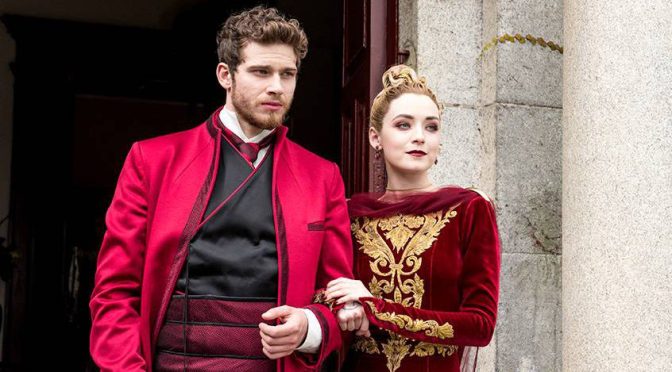
  • I love Jade’s red eyeliner and dark red lip, but that dress is a little too matronly for a femme fatale look. Still, I’m digging the clash between her true red look and Ryder’s almost magenta suit. I have no idea how people in this kind of bonkers post-apocalypse are getting such great clothes, but the show’s costume designers do a great job of using costume to tell a story.

State of the Blog and Weekend Links: April 2, 2017

I almost skipped this post this week because I’m worn out. My partner spent all week home sick, my kid was on spring break (and nothing is more tiresome than a “bored” teenager), the foot I broke almost two years ago has been swelling up and painful again (Thanks, changing seasons!), there’s a new WoW patch with new stuff to do, and I wrote quite a lot trying to wrap up some things from the last few months. I’m also trying to do some spring cleaning type things around the apartment, and I’m still trying to figure out how to make myself stick to some kind of reasonable food and exercise regimen for healthier living since I’m not getting any younger. And, honestly, I think I might be getting sick with whatever my partner had, which isn’t great since I’ve got tons of stuff I want to do this coming week.

I did accomplish some things this week, however. I hung up the hummingbird feeder I finally bought (though I haven’t seen any birds yet) and shopped around for some flowers for the balcony (though I haven’t found any I liked well enough to look at all spring and summer yet). I didn’t read much, but I wrote a decent amount, publishing a book review, two television episode reviews, a wrap-up post of my last three months’ reading and my Spring Reading List.

This coming week, in addition to Into the Badlands and The Expanse, I’ll also be reviewing the third season of iZombie, which comes back on Tuesday. You can catch up on my last two seasons of reviews here if you’re so inclined. There’s also a spiffy new trailer for the new season:

It’s the beginning of a new month, and that means Patreon rewards. If you aren’t supporting Kameron Hurley, you should be. $1 a month gets you a new short story. Catherynne M. Valente just joined Patreon as well, and she’s wonderful. $5 gets you recipes and essays and as much access as you could want to Valente’s general delightfulness since she’s a frequent updater. Finally, think about supporting Fireside Fiction on Patreon. For just $2, you can get an ebook version of all the fiction they publish each month, plus the satisfaction of keeping them around and publishing great stories.

There’s a new issue of Fiyah Literary Magazine available. This quarter’s theme is “Sipping Tea” and just look at that gorgeous cover art. It’s also got seven new stories for your reading pleasure as well as an excerpt from the YA fantasy novel, Coal by Constance Burris.

There’s a new Aimee Mann albumMental Illness, and I can’t stop listening to it.

Aliette de Bodard’s sequel to her 2015 novel, The House of Shattered Wings, is out this Tuesday. This week, she promoted The House of Binding Thorns and talked about her myriad influences at the B&N Sci-Fi and Fantasy Blog.

The Book Smuggler’s shared a Becky Chambers essay, “The Case for Optimism” from their third Quarterly Almanac.

Jezebel took the time to remind us that Beauty and the Beast is just one in a long line of stories about women hooking up with animals. The more you know.

New Doctor Who Companion Bill (Pearl Mackie) is gay. She’ll be the first full-time openly gay Companion in the show’s history. The new series starts on April 15, and I have to admit it looks good after a couple of lackluster years:

Nnedi Okorafor is interviewed in Issue 82 of Lightspeed.

The new Ann Leckie novel has a title, Provenance, realease date, October 3, and now a cover, as revealed at Book Riot on Monday. Though it’s obviously designed to be visually compatible with the Imperial Radch covers, I think this one is an altogether sharper look with the high contrast between the dark moon, the bright red of the ship, and the blue of the vaguely Star Trek-ish font of the title. I am excite.

The Guns Above by Robyn Bennis is one of the more interesting-looking debut novels coming out this spring, and her Q&A about the book at the Tor/Forge Blog is encouraging.

Fantasy Cafe posted the schedule for week one of their 6th (!) Annual Women in SF&F Month.

At nerds of a feather, flock together, their Dystopian Visions series continued with Parable of the Sower by Octavia E. Butler, 12 Monkeys, and “Get Out/Speak Out: Dystopia, Violence, and Writing as Action.”

Also at nerds of a feather, 6 Books with Matt Wallace, whose Sin du Jour series of novellas should be on everyone’s reading list.

I’m currently reading Lilith Saintcrow’s short story-turned-novella, She-Wolf and Cub, published by Fireside Books on March 28. Saintcrow talked about the genesis and writing process of the book over at terribleminds. So far, I’m loving the book, but also look at this gorgeous cover art by Galen Dara:

The SF Bluestocking Spring Reading List

I try to keep my reading lists realistic, but the next couple of months have a frustratingly uneven distribution of books I’d like to read. For one thing, I’m usually only getting through two books or magazines a week, and there are several weeks coming up that have four to six new releases that I’m looking forward to. While having access to advance copies lets me get a head start on things, the truth is that there’s just (always, natch) far more great fiction being produced and published than I’m physically capable of reading and writing about. So this is really more of a wishlist of all the fiction coming out in April, May and June that I would read if I could.

Tor.com Publishing

I generally make an effort to read all of Tor.com’s novellas because they’re inexpensive and the variety encourages me to read things I might not normally give a chance to. I’ve also really fallen in love with the novella length; it’s long enough to feel like a book, but short enough to make for quick reading. Here’s what they’ve got coming out over the next three months.

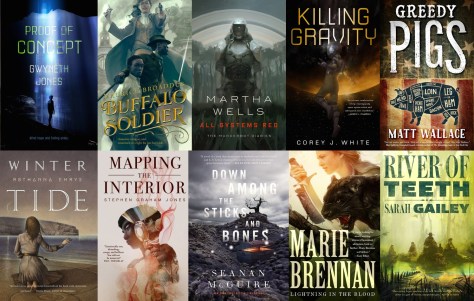
  • Winter Tide by Ruthanna Emrys (4/4)
    This is actually a short novel, and I’m sadly thinking of skipping it in spite of having been sitting on an eARC of it for months. While it’s been well-reviewed, it’s yet another Lovecraftian book, and, frankly, I’m just Lovecraft-ed out right now.
  • Proof of Concept by Gwyneth Jones (4/11)
  • Buffalo Soldier by Maurice Broaddus (4/25)
    I’m still slowly making my way through Broaddus’s recent short story collection, Voices of Martyrs, but I’m really looking forward to this title.
  • All Systems Red by Martha Wells (5/2)
  • Killing Gravity by Corey J. White (5/9)
  • Greedy Pigs by Matt Wallace (5/16)
    On the one hand, I’m thrilled about a new Sin du Jour book. On the other hand, I’m already sad that there’s only two more coming after this one.
  • River of Teeth by Sarah Gailey (5/23)
    This book had me at “bloodthirsty feral hippos” and “mercenary cowboys.”
  • Lightning in the Blood by Marie Brennan (5/30)
    A sequel to last year’s Cold-Forged Flame.
  • Down Among the Sticks and Bones by Seanan McGuire (6/13)
    A prequel companion to last year’s Every Heart a Doorway.
  • Mapping the Interior by Stephen Graham Jones (6/20)

Magazines

  • FIYAH Literary Magazine, Issue Two, Sipping Tea (4/1)
    I loved the first issue of FIYAH, and I have every expectation that their second issue will be excellent as well.
  • Uncanny Magazine #16 (May/June 2017)
  • Lightspeed Magazine #82, #83, #84
    My free three month subscription runs out in May, and I still haven’t gotten around to reading the March issue, just for time-constraint reasons. It’s a great magazine, and I’m hoping to get around to it, but there’s just so much else out there that I want to read.
  • Fireside Fiction
    I highly recommend supporting Fireside on Patreon so you, too, can get a convenient digital format of what they publish each month.

Comics and Graphic Novels

I had a couple of things on my winter reading list that would have been nice to read but that I never got around to. However, these are must-reads.

  • Ladycastle #2 (3/29)
  • Saga, Volume 7 (4/4)
  • Bitch Planet, Volume 2: President Bitch (5/31)
    The publication date on this has moved several times, so I may just end up grabbing the single issues.
  • Monstress, Volume 2: The Blood (6/6)

Books

  • She-Wolf and Cub by Lilith Saintcrow (3/28)
    My current read.
  • The House of Binding Thorns by Aliette de Bodard (4/4)
  • Red Sister by Mark Lawrence (4/4)
    I feel like Mark Lawrence’s work before now has been exactly the sort of thing I like to avoid, but this new series has a girl protagonist who has been compared to Arya Stark. That still puts it in the category of things I like to avoid, but Lawrence is a popular author and YOLO, so I’m thinking of trying this one out just in case I’m not going to hate it.
  • Spindle Fire by Lexa Hillyer (4/11)
  • So You Want to Be a Robot and Other Stories by A. Merc Rustad (May)
    I just discovered Rustad’s work last year, and they’ve quickly become one of my favorite short fiction writers, so I’m super excited for this release. You can pre-order it from Lethe Press now.
  • Final Girls by Seanan McGuire
  • A Tyranny of Queens by Foz Meadows (5/2)
  • A Court of Wings and Ruin by Sarah J. Maas (5/2)
  • Wicked Wonders by Ellen Klages (5/2)
    Klages’ Tor.com novella, Passing Strange, was wonderful, so I’m looking forward to checking out more of her short fiction.
  • The Radium Girls by Kate Moore (5/2)
    I don’t read nearly as much non-fiction as I ought or as I’d like, but I’m pretty excited about this book.
  • The Guns Above by Robyn Bennis (5/9)
  • Behind the Mask: A Superhero Anthology edited by Tricia Reeks and Kyle Richardson (5/16)
  • The Refrigerator Monologues by Catherynne M. Valente (6/6)
    I would read a phone book if Catherynne M. Valente wrote it.
  • Raven Strategem by Yoon Ha Lee (6/13)
    Sequel to last year’s excellent Ninefox Gambit.
  • The Changeling by Victor LaValle (6/13)
  • The Space Between the Stars by Anne Corlett (6/13)
  • The Prey of Gods by Nicky Drayden (6/13)
    One of my most anticipated debuts of the year.
  • The Strange Case of the Alchemist’s Daughter by Theodora Goss (6/20)
  • The Waking Land by Callie Bates (6/27)
  • Amatka by Karin Tidbeck (6/27)

Sci-fi and Fantasy books, tv, films, and feminism