Category Archives: Television

The X-Files: “Founder’s Mutation” focuses on what has always been good about the show

My favorite thing about this reboot so far is how unceremoniously the show has dumped Mulder and Scully right back into the same kinds of stuff they’ve always done. It was announced at the end of “My Struggle” that the X-Files were being reopened, and this episode finds our agents back in the field investigating the suicide of a scientist who killed himself under strange circumstances. “Founder’s Mutation” is a genuinely twisty episode, though, and things quickly turn out to be much bigger than the bizarre suicide that it begins with.

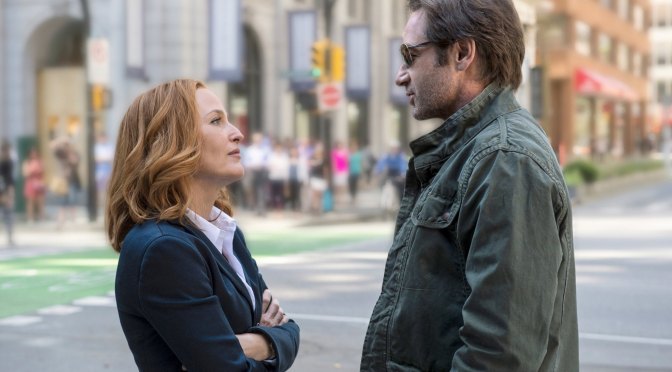
Scully and Mulder barely even seem like the same characters they were in the new season’s first episode. Mulder in particular is transformed into an official silver Fox, benefiting from a good shave and a suit, but Scully too seems invigorated by her return to the Bureau. Gillian Anderson is always a perfect angel, but she turns in a much livelier performance in this episode, full of arch looks and wry comments. She’s complemented by a David Duchovny who seems much more comfortable in his Mulder skin than in the previous episode, and the show’s decision to essentially just hand wave the whole process of how and why the X-Files were reopened works to everyone’s advantage. The X-Files’ premise has been dodgy from the very beginning; there’s no sense in trying to adequately explain anything now.

“Founder’s Mutation” is in many ways a classic monster of the week episode, which is an area where the show has always shined. It stands alone well, and the mixed resolution—part satisfying punishment for the bad guy and part ambiguous conclusion for everyone else—is classic X-Files. Even the themes and motifs of the episode are well within the continuity of the original series. Children with weird medical conditions and seemingly supernatural abilities, unusual pregnancies, the exploitation of the young and innocent (especially young mothers), sinister doctors performing mad science, and the relationships between estranged family are all things that should be familiar to longtime fans of the show. In that sense, there’s very little new here, and the mystery unfolds in an interesting but largely predictable fashion.

Where this episode departs from the more traditional monster of the week format is in tying it, pretty explicitly, to the overarching plot of season ten’s six-episode arc. This is particularly notable regarding Mulder and Scully’s emotional journey, and “Founder’s Mutation” even included a couple of rather extended daydream sequences as Scully and Mulder each imagined what their lives might have been like if they had kept their son, William. It’s only moderately interesting, and not terribly entertaining, to get to see each of their hopes and fears for their son played out this way, but I suppose it beats some kind of long, awkward conversation about it. Presenting it like this also shows that Mulder and Scully’s thoughts on the matter only partially overlap and highlights how they’ve chosen to mostly process their grief and guilt separately from each other. In this way, it provides deeper context and a broader understanding of the current state of their relationship. Basically, without the X-Files to tie them together, they each retreated into more solitary pursuits as a way of managing their disappointments. I’m not totally in love with these dream sequences, but I have to admit that they are effective.

Overall, this is a strong entry to the show’s canon. If “My Struggle” proved that The X-Files has retained its unique identity, “Founder’s Mutation” goes on to prove that The X-Files is still good. I wouldn’t say this is the show at its best, but it’s certainly an improvement over the uneven first episode of season ten. I’m glad to see the show trying some new things, and so far it’s being largely successful at doing so, smartly and without trying to reinvent the wheel.

Miscellaneous thoughts:

  • Hello, Aaron Douglas from Battlestar Galactica!
  • Mulder’s encounter with Gupta was just…weird.
  • The open head on the autopsy table was a nice bit of blink and you’d miss it gore.
  • Good to see that Mulder and Scully still can’t find the light switch in anywhere, ever. Some things should never change.
  • The birds looked cool, but felt unnecessary.
  • “I blacked out after Goldman’s eyes popped out of their sockets. Believe me, you can’t unsee that.” Hands down the best line of the episode.
Lucifer: Are charm and good looks enough to make this watchable? (Meh. Maybe?)

I’m honestly a little surprised that this show even got made, much less on Fox, and I have to admit that I’m very concerned about that network’s commitment to the project, which has apparently faced some opposition from concerned religious people with no sense of humor. Lucifer’s original start date was pushed back several months, and promotion for it has been nearly non-existent, which I heavily suspect does not bode well for the continued existence of the series. While this doesn’t quite fit Fox’s usual pattern of self-sabotaging their own shows, it’s not encouraging. All I’m saying is let’s not get too attached to it.

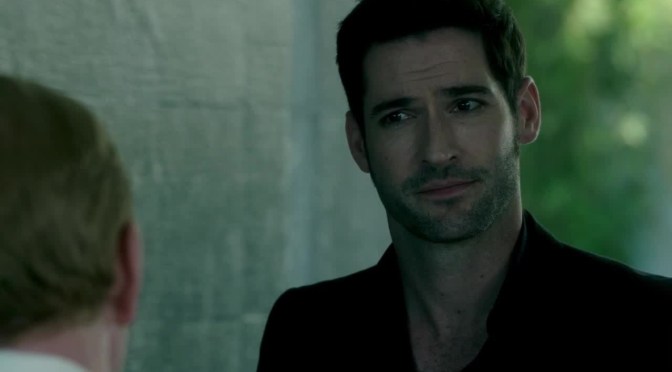
That said, the pilot was a mostly fun piece of television. Not good, mind you, but fun and with no deficit of charm, mostly because of the devil himself, played by Tom Ellis, who is really, really, ridiculously good-looking and seems to be playing this role with exactly the level of seriousness it deserves—not much. Unfortunately, the star’s charisma and absurd handsomeness are not going to be enough to carry this highly flawed series long term without the rest of the show stepping up its game.

What I’m mostly concerned with here, however, is the sexism on display in this first episode. It’s primarily targeted toward lady cop Chloe Dancer (Lauren German) and mostly played for laughs.

Chloe is a detective, following in the footsteps of her father, who was also an officer. She’s also divorced and a mother of one of the most adorable children I’ve seen on television in ages. However, a huge running joke throughout this episode is that lots of people (well, men, anyway) recognize her but can’t quite place her. Because—get this—she was an actress as a teenager, and she did a nude scene in a movie that is compared to Fast Times at Ridgemont High (a reference that almost no one under the age of thirty will even get). That’s it. That’s the whole joke. That a bunch of dudes recognize her because they’ve seen her boobs.

It’s suggested early on that maybe she’s a woman that Lucifer has had sex with and doesn’t remember, and then it’s implied that maybe she was a porn actress. It’s as if we’re supposed to feel relieved to find out that she isn’t actually a slut or a sex worker—she only committed a youthful indiscretion that has, you know, continued to affect her life as people shame and mock her for it, apparently just straight to her face. It’s also made clear that her actress past has made it difficult for her to progress in her chosen career and contributed to her marginalization on the police force. Obviously, this is hilarious. Ha. Ha. Ha.

Also, all women secretly want to bang Lucifer. And there’s a gold-digging woman marrying the episode’s murderer guy for his money. And every single woman in the show so far looks like a model (I know it’s L.A. but still). Perhaps the crowning moment of grossness in the episode, however, is when Lucifer, an adult man, tells a seven-year-old that her name—Trixie, short (adorably so) for Beatrice—is “a hooker’s name.” I get that he’s the actual devil, but yuck. Again, we’re supposed to laugh at how very, very funny and edgy this is. Ha.

Listen, Lucifer isn’t the worst, and I have actually read that the Chloe nude acting history stuff got scrapped between the pilot and being ordered to series, so I will be giving it another chance or two over the next few weeks. However, it’s not great. The concept could be interesting, but it seems a little too close to other odd couple police procedural shows. Lucifer is way too powerful for crime fighting to be anything like a challenge for him, so I don’t see how that’s going to be very interesting. The pilot has some laughs, when it’s not just mocking the female lead for showing her tits one time or making fun of a child’s cute nickname, and it’s got an interesting premise and a slightly silly and manic energy that I found endearing, but it remains to be seen if this will develop into a show worth coming back to watch every week. With several other genre shows airing on the same night, competition seems stiff, but we’ll see.

Supergirl: “Strange Visitor from Another Planet” is a smartly written hour of character development

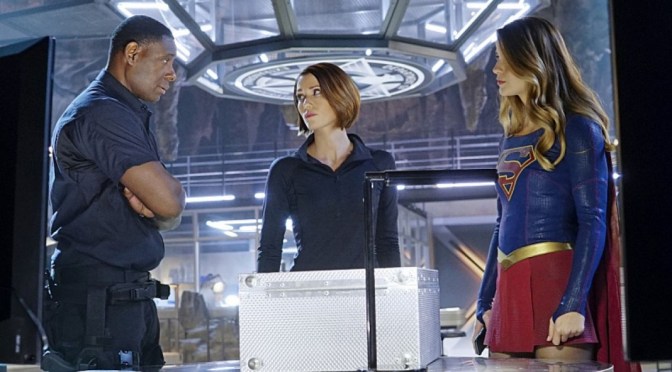
“Strange Visitor from Another Planet” is one of Supergirl’s most thematically consistent and successfully resonant episodes to date, although it’s a somewhat sharp change of pace from last week’s fairly silly episode. It’s nice, though, to see the show’s disparate parts work more or less in harmony for once. Often, the themes explored in the DEO scenes are just at odds with the tone of Kara’s scenes at CatCo, but this week that two-faced quality works to the show’s advantage as the episode focuses less on Kara and more on developing Hank Henshaw and Cat Grant. While the two major storylines are wildly different from each other, they manage to complement each other nicely instead of fighting with each other for audience investment and attention.

The episode opens with the arrival of Cat Grant’s estranged son, Adam. We learn that Cat often drafts letters to him that she never sends, and Kara—incorrigibly Pollyannaish meddler that she is—finished and mailed one. This story is actually surprisingly well done, and Kara’s lack of boundaries doesn’t go uncommented upon, even if she is forgiven in the end. She’s even rewarded with a date with Adam, which is actually the thing that I found least believable about the whole situation. Kara is consistently oblivious to male attention, is still (in this episode, even) hung up on James Olsen, and is still dealing with the fallout of the stuff that happened with Winn last week. The last thing Kara needs is another guy vying for her attention and affection, especially when it’s obviously a terrible idea—even by Supergirl standards—to go out with your domineering boss’s estranged son. Honestly, I’d much prefer to see Kara have a better sense of herself before being pushed into any romantic entanglements, much less this one.

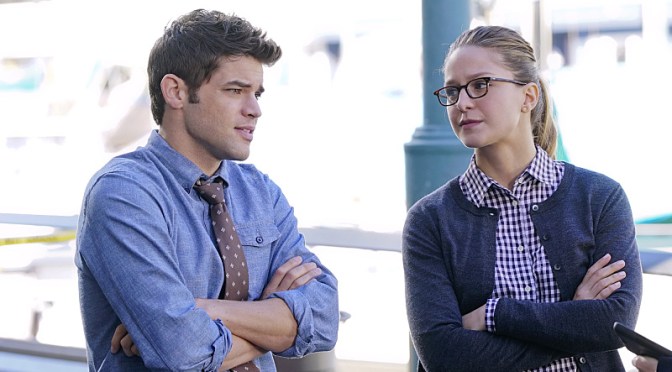
On the bright side, we get quite a lot of Cat Grant time this week, both with Kara and with Adam, and even a scene with all three together that is surprisingly well-done. While I was appalled to start with that Kara would even write to Adam in the first place, it ultimately leads to a new closeness between Kara and Cat, and it provides new opportunities for Kara to show off some of her less super-powered skills. You’d think that the adorkable shtick might wear thin, but Melissa Benoist plays Kara as so sweet and good and kind that I never get tired of watching her.

The other major plot of the episode deals with the kidnap of a cartoonishly (think Trump-like) anti-alien Senator, Miranda Crane, by one of the White Martians who, we learn, are responsible for the extermination of Hank’s entire race on Mars. It’s good to see Hank getting some greater depth and more interesting material. The conflict with the White Martian is very personal, and there are some nicely integrated flashbacks in this episode that show us more of Hank’s history back on Mars so that we really understand how big of a deal this is. I’m not sure about the heavy-handed Holocaust allusions in the Mars stuff, which I thought were strange, but having never read the comics I don’t know if that’s a source material issue or not. I guess I just think that they could have conveyed Hank’s trauma without so clearly linking it to real tragedies like that, especially when the event is treated as shallowly as it is this episode.

Fortunately, Hank’s feelings are not treated shallowly, and he’s given a lot of screen time this week. It’s interesting to see how quickly this show burns through story, though. I’m enjoying to new timbre of Hank’s relationship with the Danvers sisters—particularly with Alex who gets some good material this week—but the dynamic has evolved almost ridiculously quickly. It works well in this episode, though, and the final bonding moment between these three was well-earned.

Both of this weeks’ stories deal with family issues and how to move on after mistakes and loss, but the real strength of the episode is that it continues to highlight Kara’s deep and radical commitment to love, forgiveness, mercy, and hope for the future. I love a kickass heroine, and Supergirl can certainly fight when she needs to, but I have even more love for a heroine who wants to heal the world around her rather than just beating it into submission. Supergirl may seem overly optimistic at times, and our post-post-modern world tends to mock that sort of thing, but in spite of its many flaws this show continues to be refreshingly fun, hopeful, and above all a necessary light in a largely cynical entertainment landscape.

Miscellaneous thoughts:

  • I’m so confused, still, about who this show’s intended audience is. When I watched it this morning on CBS’s website, I was subjected to multiple Viagra commercials.
  • “It’s worth it. Family always is.” Awww. Kara thinks of Cat as family.
  • I hate the frequency with which fictional bigots are cast as black people. Like, right, I get that it’s a metaphor for real-world oppression or whatever, but it seems like that shit is always put into the mouths of black people these days. Just an observation.
  • Senator Crane wants to build a dome around the Earth to keep the aliens out.
  • We never do find out much about Adam. Why did he drop out of college? Also, on a related note, what happened to Cat’s other kid?
  • Melissa Benoist and real-life husband Blake Jenner have a nice chemistry on screen. I don’t love the idea of Kara being pushed into a relationship, but this pair is awfully cute.

The X-Files: “My Struggle” effortlessly recaptures everything that matters about this show

So, it turns out after all these years that The X-Files is still what it always has been.

I was a little worried, frankly, about what this revisitation of the show was going to be, and I wasn’t reassured by the two full minutes of exposition before the opening credits. I suppose it worked to refresh our memories and introduce the show to those who aren’t familiar with it, but it ran a little long and was slightly over-serious. I don’t like the way that the opening exposition and the [unfortunately vaguely Hitler-esque—seriously, how did no one catch this?] episode title frame it all as primarily Mulder’s story, but then, the show always did set Scully up as an observer or accessory to Mulder. It feels almost accidental that Scully became the icon that she is, and I’m not surprised to see her still being treated the way she was twenty-odd years ago. In any case, it barely matters because then the theme song was on, and my response—to immediately turn off some critical thinking parts of my brain—was practically Pavlovian.

This turns out to be a good thing, as there’s quite a lot about this episode that doesn’t really hold up under much scrutiny. The X-Files’ mythology has always been convoluted and at times bizarre, but this newest iteration of it is something else. I’ve always rather felt as if the whole concept of the show was somewhat undermined by the fact that speculating about government conspiracies stopped being fun in light of the scary dystopian realities of the post-9/11 world, and this new show tries to address that with mixed success. Mostly, it tries to address it by combing through conspiracy theory subreddits and chain emails from your gun-nut Trump-voting uncle for material and then combining it all into a sort of grand unified theory of government malfeasance. It’s a weird tactic, but it works about as well as any of the show’s mythology from the pre-9/11 days. Take that as you will.

Joel McHale is entertaining in his turn as Tad O’Malley, and he captures some of what real-life conservative blowhard Bill O’Reilly has in spades—surprisingly good-natured charm. This is a guy that I’d be happy to go out for drinks with, though I was still slightly appalled that Scully would. As a sort of instigator for getting Mulder and Scully back together and, ultimately, having the X-Files reopened, O’Malley is as good as any other idea the show could have come up with. When you have such a deeply implausible premise for a show, nearly anything goes, and this is both one of The X-File’s perennial problems and its saving grace. It’s a little weird to be somewhat rooting for a conservative nutjob, but I kind of like that the show would go that direction. There are few enough ways for a 23-year-old show to do something unexpected; O’Malley is a fun character; and McHale has enough charisma to make him likeable.

The central mystery of the episode, to the degree that it has one, centers around a young woman, Sveta, who claims to have been abducted many times by aliens (or men masquerading as aliens), who performed experiments on her, including forcibly impregnating her and stealing her fetuses. It’s pretty standard X-Files stuff, as is the way Sveta is somewhat aimlessly shuffled around in the episode’s narrative, appearing only when needed and then disposed of unceremoniously. It’s a paper-thin plot, and it’s a little sad to see Annet Mahendru’s talents wasted in such a throwaway role, but I think it’s important to recognize that “My Struggle” isn’t about telling a self-contained story of its own. It’s really only secondarily about reestablishing the show’s mythology. Rather, it’s about getting the old team back together, and everything in this episode is striving towards the moment at the end when Skinner officially reopens the X-Files.

The other thing this episode is about is reintroducing us to Mulder and Scully. To that end, we get a pretty good picture of both how the years have changed these characters and how much is still the same. Mulder has visibly aged, growing grey and a little soft, and David Duchovny still plays him with a certain level of ironic detachment, but he’s still our Fox. He’s as credulous as ever, but he does seem more self-aware, especially when it comes to his relationship with Scully. Gillian Anderson as Dana Scully, of course, is a perfect paragon of beauty and grace and long-suffering. Scully has gotten a little harder with age, but she’s still game for uncovering, well, whatever they’re going to be uncovering. Most importantly, Mulder and Scully still have the chemistry that made them so compelling to watch in the old series, now tempered with the weight of nearly twenty-five years of friendship and love and shared experiences. This is the thing that made the show great and led us to forgive it so many sins over the course so many years, and it’s pretty thrilling, honestly, to see it recaptured in a fashion that seems so effortless and natural.

Here’s the thing about The X-Files: I love this show. With a deep and abiding passion born of having fallen in love with Scully and Mulder at a formative age. This reboot would have to be really, really terrible for me to hate it. The good news is that it’s not really terrible. “My Struggle” isn’t a great episode, but it’s recognizably The X-Files, from its writing to its production values to its lead characters, who feel like they have been right where we left them nearly fifteen years ago, just waiting for us to come back and see them. While “My Struggle” is a bit of a mess, it’s a very familiar and beloved mess that I, for one, am happy to revisit after all this time.


The Expanse: As its title suggests, “Windmills” is mostly just spinning its wheels

“Windmills” is probably the most thematically coherent hour of The Expanse to date, and we’re finally seeing all of the show’s disparate story lines begin to converge on one place: Eros. This is a frustrating episode in some ways, as very little actually happens, but I have high hopes that this is the final bit of stalling for the series before things get really interesting over the next couple of weeks.

The Rocinante is well into its journey this week, on the way to rendezvous with the mysterious Lionel Polanski, but they’ve also got Avasarala’s spy in tow and Martian inspectors trying to board the ship. Unfortunately, these attempts to liven up the Rocinante’s traveling time fall a little flat, acting more as filler to give the crew something to do for an episode while Miller and Avasarala’s plots catch up to where the Roci is. Still, there is some interesting character work in the Rocinante segments of the episode, and dealing with Kenzo Gabriel and the Martians does provide a good framework for both showing what makes the Roci crew tick and exploring how their recent experiences are affecting them.

These scenes also highlight a pretty significant (and kind of fascinating) change from the source material. By this point in Leviathan Wakes, Holden was pretty well-cemented as the captain of the ship, but his position is much more ambiguous and precarious on the show. This makes all of the Roci crew’s dynamics much more compelling, though I did feel this week that they weren’t particularly fun to watch. The conflict between Holden and Amos was nicely done, but Holden ultimately offloads that whole responsibility to Naomi, which is wildly unfair and, frankly, irresponsible. Naomi continues to prove, however, that she’s the smartest and most capable person in every room she’s in by basically saving the day by hacking the Roci’s systems and heroically managing not to punch Holden right in the face. The only character on the crew who still seems somewhat flat is Alex, although I kind of love how much he’s just having a great time flying this badass spaceship.

Meanwhile, Avasarala is back in a pretty big way this week, as she travels personally and alone alone to the farming collective in Montana where Holden was raised so she can speak with his birth mother, Alice. From a kind of objective standpoint, this may be the weakest part of this episode, but it’s one of my favorite sequences so far on the show. First, it’s some of the most perfectly beautiful scenery we’ve seen so far, and it appears to be a real place with only the wind turbines composited in during post-production. Second, Avasarala’s costume for this is glorious. Everything this woman wears is amazing, but this red number, and the way she strides confidently across the pristine Montana snow, is like something out of a fairy tale. Finally, the conversation between Avasarala and Alice Holden shows us yet another new side of Chrisjen. I can’t remember the last time I saw this kind of woman-to-woman real talk, and I found it riveting.

My only complaint about this whole sequence is that I still don’t quite understand James Holden’s origins and the political and economic climate that created this place and these people. There’s a lot that can be inferred about their collectivist lifestyle, the intimation that they are potentially armed and dangerous radicals, and the knowledge of how they groomed Holden to be a part of their political scheming, but there were a lot of missed opportunities here. One way that this could have been improved upon would be to have Chrisjen interview all (or even just several) of Holden’s parents separately, which would have offered us a bigger picture of how this all works and created more and better ways in which to work in some more exposition about the state of Earth and how Holden and his family fit into it. Instead, Avasarala only really speaks with Alice, and most of their talk consists of them bonding over their shared experiences of motherhood, which feels a little simplistic and almost defeats the purpose, in my opinion, of even introducing the idea of this sort of family arrangement. Why bother if it’s not going to be explored when the chance appears?

On Ceres, Miller is left reeling after losing his job with Star Helix, and he spends most of this episode revisiting the places on the station that have figured most prominently in his story so far. He confronts a smug Anderson Dawes in a bar, breaks into Julie Mao’s place, and then returns to his own apartment, where he gathers his few things of value, leaves his hat hanging on the hook, and goes to pawn everything so he can buy a ticket on the next ship to Eros.

Miscellaneous thoughts:

  • “Donkey balls” is not nearly as funny a phrase as the show’s writers seem to think it is.
  • Apparently Miller also sent out some disturbing goodbye messages to his few friends. This was actually moderately amusing to me.
  • I know Octavia is sad now, but someday she will appreciate dodging the bullet that is Miller.
  • As much as I hate Miller’s hat, his greasy hair might actually be worse to look at.
  • There were a lot of wonderful set details this week, but the house in Montana was stunning. I just wish we’d gotten to see a little more of it.

The Shannara Chronicles: “Changeling” changes almost nothing for anyone

“Changeling” is a tough episode to review. On the one hand, it’s a kind of objectively dull hour, with little forward movement, a lot of time spent standing around spouting expository dialogue, and not much actually happening. On the other hand, it’s an episode that is heavily focused on character, and this benefits nearly everyone on the show. It’s also nice to see a good deal more of Arborlon, which now feels much more like a real, living place. So while the episode is certainly flawed, I kind of loved it, and the end of “Changeling,” finally and for real, has our heroes actually setting out on their journey.

Episode four picks up right where the third one left off, with Amberle entering the Ellcrys tree. Once inside, she’s rather predictably subject to a vision and a test wherein she has to overcome her fears and master her emotions in order to prove that she’s capable (at least theoretically) of completing the quest the tree is going to give her. It’s pretty straightforward, standard issue chosen one stuff, but it’s nicely filmed and Poppy Drayton is convincing in her role as Amberle. She’s got an expressive face and isn’t afraid to use it, and this episode is definitely a showcase for her abilities as Amberle has to confront her fears, deal with a trauma, and come to terms with a tragedy before embarking on a journey that is going to change her life even more than it has been already.

The downside of this, though, is that Amberle doesn’t really get a lot to do once she emerges from the Ellcrys besides look very serious and sad and disapproving. This isn’t helped by the fact that she’s also being hunted by a changeling demon that wants to murder her, which keeps Amberle moving around quite a bit through the episode, but always within the palace at Arborlon and mostly with at least a couple of guards in tow. I was happy to see her get a nice quiet moment with her friend Catania. They have a nice chemistry, and it’s obvious that the two young women share a great deal of love and affection. It’s a good counterpoint to Amberle’s contentious relationship with Eretria, though I’m happy to say that the conflict between these two is more substantial than fighting over a boy (even if I suppose that Wil is part of it).

Probably my favorite Amberle scene this week, though, was when her grandfather, Eventine, gifts her with her father’s sword, along with a speech about how like her father she is. This is also a great scene for Eventine, who was kind of a jerk in his other scenes this week. For a guy who no longer plans to abdicate his throne, he sure does a lot of delegating of responsibility. Also, poor Arion! Arion is the worst, but I felt legitimately bad for him when Eventine told him that he’s not ready to be king. Maybe if Eventine had been a better dad, his heir wouldn’t be such a dick.

While Amberle is busy having a very serious coming of age moment as she accepts her sacred responsibility or whatever, Wil is busy banging Eretria and getting his elfstones stolen again. He is seriously so easy, which is cute in a way, but I can definitely understand why Amberle might be very worried about having to maybe kill him, what with his being self-destructively stupid and all.

In any case, Eretria gets caught and is being framed for murder and accused of trying to kill Amberle, but this all ends up with them figuring out that the demon is a shapeshifter. There is some kind of half-baked plot to trick the demon by using Eretria as a decoy, but it doesn’t work. However, Allanon manages to kill the changeling anyway, and by the end of the episode Amberle, Wil, and Eretria are setting out from Arborlon.

I’m curious to see how this works out, mostly because I wonder how long the show is going to make us wait for the inevitable showdown with Cephalo and the Rovers. I’m also not sure what the show is going to do with Bandon and his visions, which seem almost superfluous with Allanon around reading minds and looking stuff up in his magic book that conveniently has all the answers. Also, what is going to happen with Catania? I hope she’s going with them as well; otherwise, it will feel like sort of a waste for her to exist at all.

Mostly, though, I’m just very excited to see the real quest finally getting underway. Hopefully next week will see a lot more forward movement on the main plot—because it’s really the only one. As refreshing as it is to watch a show that is relatively free of subplots, this style of storytelling only really works if there is consistent linear development. Keeping all of the action (if you want to call it that) contained in one small setting (Arborlon) feels claustrophobic and is, ultimately, frustrating, especially when this bit with figuring out the changeling could have been handled in about ten minutes.

Still, I really like that this show seems to be so aware of what it is. It doesn’t put on airs, and it doesn’t try to pretend as if this isn’t a story we’ve seen a thousand times before, but it does seem fairly committed to doing a proper job of it. Though the writing doesn’t often rise above workmanlike and the story is pedestrian at best, The Shannara Chronicles is exactly the sort of gorgeously designed comfort-programming I want to watch these days. “Changeling” and its weird feeling of stasis is somewhat of a hiccup, but if the next six episodes are good, it will be easy to forgive the sins of this one.

Miscellaneous thoughts:

  • The seed prop is cool, but it looks a little too much like metal.
  • Spinning the camera around in a circle doesn’t hide the fact that you’re just filming a group of people standing around spouting exposition.
  • “Accomplishments? What would they be?” BURRRRN.
  • “I’ll never call you short tips again.”
  • “She attacked me in my room.” Oh, Wil. I was a little disappointed when Amberle didn’t point out his red ears.
  • I loved the interior shots of Arborlon. They’re not as nice to look at as the scenery porn in the show’s outside world, but it’s pretty impressive what they’ve done with relatively small sets.

Supergirl: “Childish Things” is all about Winn Schott’s daddy issues

I think we all knew, as soon as it was revealed that Winn’s dad was in prison, that his daddy issues were going to rear their ugly head at some point. “Childish Things” is that point. Surprisingly, though, especially considering how painfully boring Winn has been in the series so far, this episode mostly works really well.

My biggest complaint about Winn Schott, from day one, has been that he was a pretty straightforward Nice Guy™ who spent all his time creepily hanging around Kara and resenting her for not wanting to bang him, and “Childish Things” addresses all that stuff head-on. It’s a surprising and refreshing change of pace for a show that has so far been content to leave Winn be, utilizing a constellation of unpleasant tropes pretty much totally uncritically regarding his relationship with Kara. When Winn’s deranged father escapes from prison, though, things come to a head and Winn and Kara are forced to deal with whatever lies between them. Kind of.

The best decision the writers made this week was having Kara react negatively to Winn trying to kiss her while they were sharing a moment of bonding over their respective murderous relatives. I fully expected, and frankly was almost rooting for, them to share an actual confused-feelings-full kiss, but that wasn’t what happened. Instead, Kara pulled away, as one does when someone misreads signals and goes for a kiss when it’s very unwanted. Watching, I was genuinely surprised. Unfortunately, this isn’t fully dealt with by the end of the episode. Though Winn finally lays all his cards on the table and confesses his love to Kara, she’s not equally candid in response, and the future of their friendship is still unresolved when the credits roll.

Winslow Schott, the Toyman, is equal parts ridiculous and deeply disturbing, and letting the audience meet him definitely helps to give his son, Winn, a lot more depth. The problem is that he’s never really a particularly worthy opponent for Supergirl. Although we can see how much interacting with his father affects the younger Schott, and those interactions (and the subsequent talks with Kara about them) are pretty compelling, there’s never much sense of danger from the Toyman himself. Instead, it’s Winn’s behavior that’s most concerning, and his concern that “bottling up his emotions” will turn him evil is something very close to a veiled threat. I suppose, if Winn does turn out to be the same sort of psycho as his father, he can at least rest easy knowing that he’ll be handily defeated by Supergirl in the space of a day or so.

The secondary plots are also only partially successful.

Lucy Lane appears to be officially moving to town now, and she’s getting a job at CatCo. I love James Olsen as much as the next girl, but he was profoundly dull this week. His failure to communicate about his feelings is frustrating, and I suppose works as a contrast to Winn’s newfound openness, but I still don’t understand why he was being so weird with Lucy. I loved Lucy and Cat together, but the conflict between Lucy and James ended up being not a conflict at all and simply cemented them together as one very boring couple.

Meanwhile, Alex and Hank were investigating Maxwell Lord, who is still the absolute worst. Kara’s attempts to encourage Hank to “come out” as a super-powered alien were positively cringe-inducing. I hate the whole idea of using super powers as a metaphor for other oppressions, and this instance of it is especially frustrating. While I liked Hank’s stuff this week, and I can see that he has some very real misgivings about using his powers, which was interesting, the reality is that there are basically zero drawbacks to his being a Martian. I mean, sure, people could be mean to him, but he still has godlike superpowers.

In the end, though, “Childish Things” is more good than not. The character work for Winn and Hank was largely excellent, and it was definitely necessary. And the episode ends with Kara and Alex spending time together—more of this, please (and more of Lucy and Cat).

Miscellaneous thoughts:

  • “She’s so nice!” is the best thing Lucy could possibly have said when emerging from a meeting with Cat Grant.
  • “I want to work for a cool, powerful, kickass woman instead of a bunch of old white men.” You and me both, Lucy.
  • I always loved Emma Caulfield on Buffy, so it was cool to see her show up as an FBI agent.
  • Speaking of childish things, if the snail eggs were delicious, why did Alex spit them out as soon as she found out what they were.
  • “Max Lord is nothing more than a reformed nerd with a God complex.” ACCURATE.

Shadowhunters is an infinite pit of visual and storytelling atrocities

Here’s the thing about Shadowhunters: I didn’t expect it to be good. Cassandra Clare’s books were heavily derivative but highly readable fluff, and the movie based on City of Bones was awful, but entertaining. I rather thought that the material would be much better suited to the episodic format of a television show, as the source material is very obviously influenced by shows like Buffy the Vampire Slayer. Sadly, this show is just terrible, and not even hilariously so. It’s just really, really, horribly bad in basically every way. I even watched the second episode as well thinking that surely it must get better, but that’s just not the case.

The first thing I noticed was that Clary’s hair is godawful. Looking at photos of the actress (Katherine McNamara) online, she does appear to be (possibly) a sort of natural strawberry blonde, but until I looked it up I would have sworn that orange-y mess on her head was a wig. Now I have to admit that it’s actually just a mix of hideous dye-job and turning up the saturation in post-production. Either way, though, it’s distractingly unnatural without feeling like part of any cohesive sense of style. Instead, it’s just a bright orange blob in the middle of every scene, threatening to burn itself into the viewer’s retinas.

Clary’s hair is really just the tip of this show’s visual atrocity iceberg, though. While not literally everything in the show looks bad, it’s pretty overwhelmingly cheap, ugly, and unoriginal, from hair to makeup to costumes to visual effects. It’s a colossal missed opportunity, if nothing else, since one of the main reasons to watch these sorts of urban fantasy shows is to see sexy people wearing hot clothes while fighting cool-looking monsters. Unfortunately, there has to be something distinguishing about a show to set it apart from the rest, and the styling of Shadowhunters is lazy, low-budget, and boring.

A short and probably incomplete list of examples:

  • Magnus Bane’s makeup, which makes him look like a 14-year-old goth kid who doesn’t know how to put on makeup yet.
  • Isabelle’s white club costume, which is ill-fitting and wildly unflattering, especially with the clown-like makeup they put on her.
  • Jace’s whole look. Sure, he’s a type, but it’s just too on the nose.
  • The shadowhunters’ seraph blades, which function like lightsabers and look like amorphous pieces of pointy clear acrylic hot glued to the end of LED flashlights.
  • The runes on the shadowhunters’ bodies are somewhere between weird birthmarks and weird rashes, and when they glow they look positively sickening.
  • The outfit Isabelle lends to Clary.
  • The monster effects are very uneven. Some, like the tentacle-faced demons, are almost okay-looking, but mostly they look cheesy.
  • All of the warlocks’ magic effects look silly.
  • The Institute is full of generic sci-fi computer stuff, which is a both a huge departure from the source material and at odds with the rest of the show’s aesthetic.
  • That blinking club sign that switches between “PANDEMONIUM” and “DEMON” was mildly clever the first time, but not the twenty-first time I saw it in less than two hours.
  • Some of the worst fight choreography I’ve ever seen.

In addition to being visually offensive to the senses, the show is also a complete storytelling disaster. Granted, it’s been a while since I’ve read the books the show is based on, but the first two episodes seem to have raced through probably half of the first book. At the same time, however, if feels as if very little has happened, and most of the characters have had remarkably little to actual do with their time on screen. Instead, most of these first couple of episodes is devoted to worldbuilding, but not through showing the audience what’s going on. Rather, there’s just a metric shitload of clunky exposition delivered primarily through embarrassingly bad dialogue.

Perhaps worst of all, almost no one seems to be able to actually act worth a damn in this show. The dialogue is bad enough as written, but it’s not helped by soulless, wooden delivery. This could be the result of terrible characterization, though. The show so far relies heavily on hackneyed archetypes, and each character seems to have a single personality trait, none of them likeable. Clary speaks in a creepy little girl voice; Isabelle is portrayed as a sexpot; Magnus Bane is simply sullen; Alec is grumpy and xenophobic; Jace is vaguely and unconvincingly Byronic; Simon is a pathetic Nice Guy™; Luke is strong and silent-ish. Every single one is a worn out stereotype, and there’s nothing clever or interesting or subversive about any of them.

Listen, as I said in the beginning, I didn’t expect this show to be great, or even particularly good. I did expect it to be fun. Instead, it’s an epic catastrophe of everything that can go wrong with this sort of genre program: nonsensical mythology, bad visuals, awkward exposition, moving through material at such a blazing fast pace that there’s no emotional depth, dour performances, no discernable sense of humor. It’s so irredeemably, relentlessly horrible that I don’t even want to keep watching for laughs.

iZombie: “Method Head” has a little of everything I love about this show

An uncharitable viewer may call “Method Head” overstuffed and disjointed, but I think I can say, without being entirely uncritical, that this episode managed to include basically all of my favorite things about iZombie. Sure, there’s a lot going on, and one of the major gut punches from the winter finale is resolved far too easily and quickly, but this episode seriously has everything. They even managed to squeeze scenes with Vaughn and scenes with Blaine into one episode, which almost never happens. Even better, in spite of all its moving parts, “Method Head” mostly works, although parts of the very meta case of the week fall a little flat.

The episode picks up the morning after Liv and Major’s breakup and Ravi’s discovery that their rat had reverted to being a zombie. All things considered, Liv and Major seem to be doing alright post-breakup, and they continue to be friendly throughout the episode, so it’s really Ravi who has the truly unfortunate news to share. Definitely the rat, New Hope, is back to being a zombie, almost certainly Major (and Blaine) will go back to being zombies, they’re right back at square one on the cure front, and they are out of tainted utopium. The only bright side here is that they know where they might be able to get more utopium—their search area is still a hundred acres, though. It’s a new raising of the stakes for the show and its characters and a renewal of the urgency that marked the series’ first season, which is nice, especially as the case of the week format has gotten a little stale.

I like the way this episode made use of title cards to move things forward in time, and it did a decent job of showing what everyone was up to over the remainder of the holiday season. It was a little sad watching Liv trying to get back into Clive’s good graces, but my complaint here is actually that the passage of time wasn’t enough. In the most generous reading of things, Clive was only mad at Liv for about two weeks, and by the end of this episode their status quo seems to have been restored.

This is especially disappointing after Liv’s very convincing devastation over it in the winter finale. This week she seems to have gotten over it relatively quickly, and we don’t see much of her sadness or stress or how she’s been emotionally affected by either her falling out with Clive or her breakup with Major. Certainly, I don’t expect Liv to sit home moping and eating pints of ice cream, but her arc this week was a very sharp turnaround after her apparent grief back in December.

The case of the week deals with the murder of an actor on the set of a show called Zombie High, which Liv apparently loves, and there are some fun moments, but I don’t think this idea was used to its maximum potential. There are some funny moments, but nothing that sticks in my mind even just a few hours after watching it. The one line I do remember—a teen actor suggests a show starring a zombie, and Clive replies, “That’s dumb”—is just too on the nose, but most of the rest of the Zombie High stuff is highly forgettable. The investigation does get Liv and Clive back together, but I would honestly have rather seen that drag out for a couple of episodes at least. It would have been interesting to explore who Liv is without that aspect of her life, and it would have given Clive some room to be developed as something more than just Liv’s way to play police officer.

The biggest surprise this week, for me anyway, was that it was Major’s story line that was the most interesting thing happening. Usually Major is the worst, but his scenes with Vaughn were excellent, even if I totally called it that the “whistleblower” thing was a loyalty test. It was predictable and obvious, but it worked, and I’m very interested to see how deep Major is willing to go down this rabbit hole.

Miscellaneous thoughts:

  • Dale and Clive have a very cute relationship, but I wish we got to see a little more of it.
  • “Hair color: white as snow.” I kind of wish the writers hadn’t wasted that Santa murder. They could easily have gotten a full episode of puns out of that.
  • Gilda/Rita and Vaughn are an incredible amount of fun to watch together. They hate each other so very, very much.
  • I was genuinely concerned for Dale when she went to talk to Blaine.
  • Looks like things could get real interesting for Major in the next week or two if Dale tracks the dog down to his place.
  • Peyton is missing in action. Again. Still.

The Shannara Chronicles: “Fury” goes backwards in order to move forward

The two-part opener for The Shannara Chronicles wasn’t a perfect piece of television, but it was marvelously entertaining and superbly beautiful to look at. “The Chosen” also did a creditable job of introducing all the show’s major characters and conflicts and setting up the major quest that will occupy the rest of this first season. The show’s third episode, “Fury,” is a step backwards in several ways, and it does become a little bogged down at times, but by the end it seems ready to move along to the real meat of the story.

After the fast-moving, plot-heavy “The Chosen,” the order of the day in “Fury” is to take a step back, metaphorically, and dedicate some time to character development. This is mostly a good thing, and Eretria especially improves upon further acquaintance, where we learn more about her motivations and what her life is like when she’s not out in the woods being a sexy, wise-cracking rogue. Amberle, who is a serious young woman, turns out to also be smart and funny once you get to know her a little more, and Poppy Drayton has noticeably relaxed into her role. Wil is in turns sweet and stupid and infuriating, but I think he’s overall likeable and not nearly as insufferable as other characters of this type.

Unfortunately, the episode also takes a step back more literally, by having our heroes travel all the way back to Arborlon before they can continue on their quest. More on that later, though. Before that can happen, there are some detours and another seemingly significant character is introduced.

While Allanon manages to save Wil and Amberle from the fury from the end of “The Chosen,” he’s injured in the process, and his incomplete instructions to them send Wil diving into the Silver River to get some kind of healing mud. It’s a good thing Allanon was just planning on healing himself with his druid powers, though, because by the time Wil gets out of the river, Eretria has shown up and has a dagger to Amberle’s neck. As they’re dragged through the woods to the Rover camp, Amberle takes Wil to task for falling for Eretria’s “half-baked Rover seduction” and the show’s love triangle is officially born.

Things continue to move along nicely once they reach the Rover camp and meet Eretria’s “father” Cephalo, who is almost inexplicably obsessed with the elfstones and is convinced that threatening Amberle’s life is the way to get Wil to share their secrets. Joke’s on Cephalo, though. Wil truly doesn’t know how to use the stones, Amberle is pretty resourceful, and Eretria isn’t totally on board with the plan. Before all that stuff can really come to a head, however, the Rovers find themselves under attack by the second fury, who has tracked Wil and Amberle to the camp. While people scatter in chaos, Wil desperately pulls out the elfstones and is able to use them to destroy the demon. Cephalo tries to take the stones, but Allanon shows up just in time to rescue Wil and Amberle, and put them back on the way to Arborlon where they’re supposed to be.

On the way back to the elven city, they come across a destroyed farm in the countryside. While searching for survivors, they find a boy chained up in a barn wearing a very creepy mask. He introduces himself as Bandon (which is a legitimately awful fantasy name; I hate it so much) and tells them that it was his parents who had locked him up, though he doesn’t share the reason why. It’s a very strange kind of random encounter that I don’t remember being in the book, and Bandon turns out to be a very strange character.

When they finally reach Arborlon, they receive a cool welcome, as abandoning your sacred post like Amberle did is pretty frowned upon. Here is where things go a little off the rails, though, and it feels like the show was just killing time for the last ten or so minutes of the episode. Literally none of this stony-faced posturing and lengthy deciding whether Amberle would be allowed near the Ellcrys was at all necessary. Just let her in the tree, dammit, and move along to figuring out who the spy in Arborlon is so we can move along to some real questing. Unfortunately, the unmasking of the spy is going to have to wait until episode four.

Miscellaneous thoughts:

  • I feel like a dirty old lady for saying it, but Austin Butler is surprisingly hot. I would have had the hugest crush on him twenty years ago. Also, Amberle totally checking him out was one of the funniest moments of the show so far. She might be a little too serious at times, but she’s not made of stone.
  • I would have liked to see a little more time spent on the emotional fallout of Pyria’s death, which seems like it should be a pretty big deal for both Allanon and Amberle. Sadly, I don’t think the show will ever have time to revisit this.
  • Cephalo threatening to kill Eretria is already tiresome because it’s such a toothless threat.
  • I didn’t love the elfstone props in the first episode, but they actually look pretty cool when Wil uses them.
  • The vibe between Amberle and her uncle Ander is very odd. I know the characters are supposed to be fairly close in age, but it definitely feels more like kissing cousins than almost-siblings, which is what I think is the intent.
  • I guess Bandon has visions of some kind, and that’s probably going to be important later on.
  • I hope this is the end of Wil threatening to bail on the quest.